Studies in Soft Computing with
an application to Complex
Manufacturing Systems
Adrian Rubio Solis
Department of Automatic Control and Systems Engineering
University of Sheffield
This dissertation is submitted for the degree of
Doctor of Philosophy
Because family represents the very first source of strength for anybody. To the memory of Ines Carbajal Rodriguez.
First of all, I would like to express my sincere gratitude to my supervisor Dr. George Panoutsos for his patient guidance, constructive advices and extraordinary support during this thesis process.
Secondly, I also wish to express my sincere thanks to The National Com-mittee of Science and Technology, CONACYT and the Bureau for the pub-lic Education, SEP in Mexico for their financial support, since without their help the realisation of this research work would have been impossible.
Thirdly, I would also like to thank my parents Alonzo and Teresa, my brothers Joel, Antonio and my sister Elizabeth and my lovely girlfriend There-sia for their unflagging encouragement and concern which were the source of my strength.
Throughout the time of my PhD studies I have had cause to be grate-ful for the support, understanding and above all the advice of many people at the department of Automatic Control and System Engineering for their friendship and kind help.
In systems modelling and control theory, the benefits of applying neural net-works have been extensively studied. Particularly in manufacturing pro-cesses, such as the prediction of mechanical properties of heat treated steels. However, modern industrial processes usually involve large amounts of data and a range of non-linear effects and interactions that might hinder their model interpretation. For example, in steel manufacturing the understand-ing of complex mechanisms that lead to the mechanical properties which are generated by the heat treatment process is vital. This knowledge is not available via numerical models, therefore an experienced metallurgist esti-mates the model parameters to obtain the required properties. This human knowledge and perception sometimes can be imprecise leading to a kind of cognitive uncertainty such as vagueness and ambiguity when making de-cisions. In system classification, this may be translated into a system defi-ciency - for example, small input changes in system attributes may result in a sudden and inappropriate change for class assignation.
In order to address this issue, practitioners and researches have devel-oped systems that are functional equivalent to fuzzy systems and neural net-works. Such systems provide a morphology that mimics the human ability of reasoning via the qualitative aspects of fuzzy information rather by its quantitative analysis. Furthermore, these models are able to learn from data sets and to describe the associated interactions and non-linearities in the data. However, in a like-manner to neural networks, a neural fuzzy system may suffer from a lost of interpretability and transparency when making de-cisions. This is mainly due to the application of adaptive approaches for its parameter identification.
Since the RBF-NN can be treated as a fuzzy inference engine, this the-sis presents several methodologies that quantify different types of uncer-tainty and its influence on the model interpretability and transparency of the RBF-NN during its parameter identification. Particularly, three kind of
un-certainty sources in relation to the RBF-NN are studied, namely: entropy, fuzziness and ambiguity.
First, a methodology based on Granular Computing (GrC), neutrosophic sets and the RBF-NN is presented. The objective of this methodology is to quantify the hesitation produced during the granular compression at the low level of interpretability of the RBF-NN via the use of neutrosophic sets. This study also aims to enhance the disitnguishability and hence the trans-parency of the initial fuzzy partition. The effectiveness of the proposed method-ology is tested against a real case study for the prediction of the properties of heat-treated steels.
Secondly, a new Interval Type-2 Radial Basis Function Neural Network (RBF-NN) is introduced as a new modelling framework. The IT2-RBF-NN takes advantage of the functional equivalence between FLSs of type-1 and the RBF-NN so as to construct an Interval Type-2 Fuzzy Logic System (IT2-FLS) that is able to deal with linguistic uncertainty and per-ceptions in the RBF-NN rule base. This gave raise to different combinations when optimising the IT2-RBF-NN parameters.
Finally, a twofold study for uncertainty assessment at the high-level of interpretability of the RBF-NN is provided. On the one hand, the first study proposes a new methodology to quantify the a) fuzziness and the b) am-biguity at each RU, and during the formation of the rule base via the use of neutrosophic sets theory. The aim of this methodology is to calculate the associated fuzziness of each rule and then the ambiguity related to each nor-malised consequence of the fuzzy rules that result from the overlapping and to the choice with one-to-many decisions respectively. On the other hand, a second study proposes a new methodology to quantify the entropy and the fuzziness that come out from the redundancy phenomenon during the pa-rameter identification.
To conclude this work, the experimental results obtained through the application of the proposed methodologies for modelling two well-known benchmark data sets and for the prediction of mechanical properties of heat-treated steels conducted to publication of three articles in two peer-reviewed journals and one international conference.
Contents ix
List of Figures xiii
List of Tables xix
1 INTRODUCTION 1
1.1 PROBLEM STATEMENT . . . 8
1.2 RESEARCH AIMS . . . 11
1.3 CONTRIBUTIONS . . . 12
1.4 OUTLINE OF THE THESIS . . . 15
2 A BACKGROUND TO SOFT COMPUTING TECHNIQUES 19 2.1 INTRODUCTION . . . 19
2.2 FUZZY SETS . . . 20
2.2.1 FUZZY LOGIC SYSTEMS . . . 24
2.2.2 FUZZY MODUS PONENS . . . 27
2.3 TYPE-2 FUZZY SETS AND SYSTEMS . . . 33
2.4 NEUTROSOPHIC LOGIC . . . 40
2.5 GRANULAR COMPUTING . . . 45
2.6 UNCERTAINTY BASED-INFORMATION . . . 48
2.7 FUZZY UNCERTAINTY BASED-INFORMATION . . . . 52
2.8 NEURAL NETWORKS . . . 55
2.8.1 RBF NEURAL NETWORKS . . . 59
2.9 SUMMARY . . . 65
3 SOFT COMPUTING FOR COMPLEX MANUFACTURING PRO-CESSES 67 3.1 INTRODUCTION . . . 67
3.3 AN OVERVIEW OF STEEL PROPERTIES AND STEEL
MAKING PROCESSES . . . 76
3.3.1 THE CRYSTAL STRUCTURE OF STEEL . . . . 79
3.3.2 HEAT TREATMENT PROCESS . . . 80
3.4 MECHANICAL TESTING . . . 81
3.4.1 TENSILE TESTING . . . 82
3.4.2 HARDENING TESTING . . . 83
3.5 IMPACT ENERGY IN HEAT TREATED STEELS . . . 84
3.5.1 NEURAL-FUZZY MODELLING ON IMPACT EN-ERGY TEST . . . 87
3.6 DATA-DRIVEN MODELLING OF IMPACT ENERGY TEST APPLIED ON HEAT TREATED STEELS . . . 88
3.6.1 FUZZY RULE OPTIMISATION . . . 101
3.6.2 PRELIMINARY MODELLING RESULTS . . . 103
3.7 SUMMARY . . . 107
4 LOW-LEVEL INTERPRETABILITY IN THE RBF-NN USING GRAN-ULAR COMPUTING AND NEUTROSOPHIC SETS. 109 4.1 INTRODUCTION . . . 109
4.2 INTERPRETABILITY IN THE RBF-NN STRUCTURE . 113 4.3 GRANULATION OF DATA . . . 119
4.3.1 MODELLING RESULTS BY USING GRANULA-TION . . . 128
4.4 MODELLING OF CHARPY IMPACT TEST BY USING NEUTROSOPHIC SETS . . . 134
4.4.1 MODELLING RESULTS BY ESTIMATING THE UNCERTAINTY IN THE LINGUISTIC SCENARIO AND GRANULATION INFORMATION ’COVER-AGE’ . . . 144
4.5 SUMMARY . . . 148
5 IT2-RBF-NN: INTERVAL TYPE-2 RADIAL BASIS FUNCTION
5.1 INTRODUCTION . . . 149
5.2 T1-RBF-NN STRUCTURE AND FUZZY LOGIC SYS-TEMS OF TYPE-1 . . . 152
5.3 IT2-RBF-NN STRUCTURE . . . 154
5.4 PARAMETER IDENTIFICATION OF THE IT2-RBF-NN 161
5.4.1 LEARNING METHODOLOGY . . . 164
5.5 center . . . 167
5.5.1 EXAMPLE 1: IRIS PLANT CLASSIFICATION . . 168
5.5.2 EXAMPLE 2: ECOLI DATA SET CLASSIFICA-TION . . . 173
5.5.3 EXAMPLE 3: MECHANICAL PROPERTY PRE-DICTION OF HEAT TREATED STEEL . . . 174
5.5.4 SIMULATION RESULTS BY USING UNCER-TAIN MEAN, IT2-RBF-FNN-M . . . 176
5.5.5 SIMULATION RESULTS BY USING UNCER-TAIN STANDARD DEVIATION, IT2-RBF-FNN-(SD) . . . 178
5.5.6 SIMULATION RESULTS BY USING UNCER-TAIN HEIGHT, IT2-RBF-FNN-(H) . . . 180
5.5.7 SIMULATION RESULTS BY USING UNCER-TAIN HEIGHT AND UNCERUNCER-TAIN STANDARD DEVIATION, IT2-RBF-FNN-(H-SD) . . . 182
5.5.8 SIMULATION RESULTS BY USING UNCER-TAIN HEIGHT AND UNCERUNCER-TAIN MEAN, IT2-RBF-FNN-(H-M) . . . 184
5.5.9 COMPARISON ANALYSIS FOR IMPACT EN-ERGY MODELLING RESULTS . . . 186
5.6 SUMMARY . . . 187
6 STUDIES FOR UNCERTAINTY ASSESSMENT IN THE
RBF-NN AND THE IT2-RBF-RBF-NN. 189
6.2 UNCERTAINTY ASSESSMENT IN THE RBF NEURAL NETWORK USING NEUTROSOPHIC SETS . . . 194
6.2.1 FUZZINESS . . . 196
6.2.2 AMBIGUITY . . . 199
6.2.3 PARAMETER IDENTIFICATION METHODOL-OGY . . . 200
6.3 EXPERIMENTS AND ANALYSIS . . . 202
6.3.1 EXAMPLE 1: IRIS PLANT CLASSIFICATION . . 203
6.3.2 EXAMPLE 2: IMPACT ENERGY TEST . . . 205
6.4 SIMILARITY-BASED UNCERTAINTY MEASURES IN THE RBF-NN AND THE IT2-RBF-NN . . . 210
6.5 SIMILARITY-BASED UNCERTAINTY MEASURES IN THE RBF-NN and IT2-RBF-NN. . . 214
6.5.1 SIMILARITY FOR THE RBF-NN AND THE IT2-RBF-NN . . . 215
6.5.2 UNCERTAINTY MEASURES ASSESSMENT . . 218
6.6 EXPERIMENTAL SIMULATIONS . . . 220
6.6.1 EXPERIMENTAL RESULTS FOR EVALUATING THE SIMILARITY IN THE RBF-NN RULE BASE 221
6.6.2 UNCERTAINTY BEHAVIOUR . . . 224
6.7 SUMMARY . . . 227
7 CONCLUSIONS AND FUTURE WORK 229
7.1 CONCLUSIONS . . . 230
7.2 FUTURE WORK . . . 233
References 235
Appendix A FUZZY LOGIC SYSTEMS OF TYPE-1 AND TYPE-2257
A.1 FUNCTIONAL EQUIVALENCE BETWEEN THE RBF-NN AND FUZZY LOGIC SYSTEMS OF TYPE-1 . . . 257
A.2 TYPE-2 FUZZY SETS . . . 260
2.1 Shapes for Membership Functions (MFs). . . 22
2.2 Fuzzy Logic System (FLS) [Mendel,1995].. . . 24
2.3 System’s interpretation for generalised modus ponens. . . 29
2.4 General topology of a fuzzy model. . . 30
2.5 Improvements of interpretability and accuracy [Casillas,2003]. . . 32
2.6 T2 Fuzzy Membership [Mendel and John,2002] . . . 33
2.7 Vertical slice and embedded type-2 fuzzy sets theorem represen-tations [Mendel and John,2002]. . . 35
2.8 T2 Fuzzy Logic System taxonomy . . . 37
2.9 Neutrosophic Fuzzy Logic System Structure, [Wang et al.,2005] . 43 2.10 f-granularity . . . 47
2.11 Granulation . . . 48
2.12 Uncertainty measures . . . 49
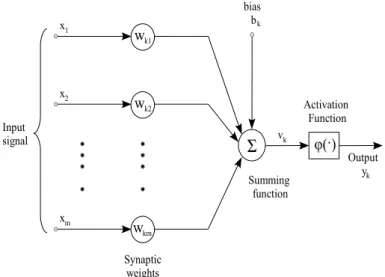
2.13 Artificial Neural Network model. . . 56
2.14 Affine transformation as a consequence ofvk=bkatuk= 0. . . . 56
2.15 Activation functions: (a) Threshold function, (b) Piecewise linear function and (c) Sigmoid function. . . 57
2.16 Radial Basis Function Neural Network architecture-RBF-NN. . . 61
3.1 Steel making process. . . 78
3.2 (a)BCC, (b) FCC and (c) FCC crystal structure of austenite. . . . 79
3.3 Tensile strength Curve. . . 83
3.4 Charpy impact test. . . 86
3.5 (a) Cantilever arrangement and (b) beam arrangement of the Izod and Charpy specimen. . . 86
3.6 Data density example . . . 91
3.7 RBF-NN structure. . . 92
3.8 Data-driven model based on RBF Neural Networks and Fuzzy Clustering. . . 93
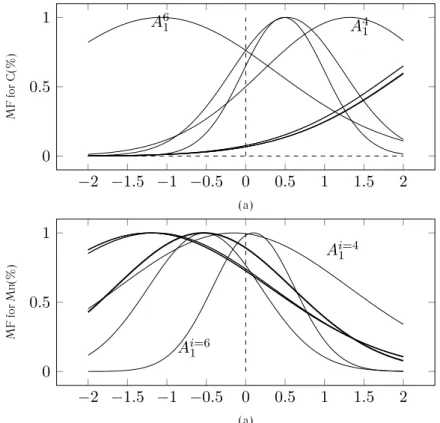
3.9 Final distribution in the Universe of discourse of the C(%) and
Mn(%) after Fuzzy C-Means (FCM).. . . 97
3.10 Fuzzy rule-base example . . . 99
3.11 Response surface for six out of 16 parameters of the Charpy test. . 100
3.12 Data fit, Charpy Impact Test Prediction by using Fuzzy C-Means as the clustering approach for the construction of the initial fuzzy rule base. . . 104
3.13 Response surface of the RBF NN after the training process. . . 105
3.14 Response surface of the RBF NN after the checking process. . . . 106
3.15 Response surface of the RBF NN after the testing process. . . 107
4.1 Interpretability levels for Fuzzy Logic Systems. . . 114
4.2 Interpretability levels at the RBF-NN taxonomy . . . 116
4.3 Resulting information granule′C′ by merging granulesAandB [Pedrycz and Bargiela,2002]. . . 122
4.4 Data granulation process.. . . 123
4.5 Terms associated to Eq.4.9. . . 125
4.6 Compuation of the resulting granule ’C’. . . 126
4.7 Union of two granules ’A’ and ’B’. . . 127
4.8 (a) Raw data, (b) 60 information granules, (c) 20 information gran-ules . . . 128
4.9 Data-driven model based on RBF Neural Networks and Fuzzy Clustering. . . 129
4.10 Compatibility behaviour throughout the training stage. . . 131
4.11 Data fit-impact energy by using granulation . . . 133
4.12 Data fit-impact energy by using the FCM algorithm . . . 133
4.13 Granulation evolution for 80 data input points extracted from the Charpy Impact test data set. . . 135
4.14 Dimenisonal granulation evolution and final density function ex-traction . . . 136
4.15 Data fit-impact energy by using the FCM algorithm . . . 136
4.16 Consistency of fuzzy rules after granulation . . . 137
4.18 Overlapping membership representation using intervals. . . 141
4.19 Uncertainty/fuzziness evaluation . . . 142
4.20 Data-driven model based on RBF-NNs and Gr-NS. . . 143
4.21 Data fit-Impact energy by using Gr-NS. . . 144
4.22 Final shape of the MFs after granulation. . . 146
4.23 Final shape of the MFs after granulation and neutrosophic sets. . . 147
4.24 Neutrosophic index behaviour throughout granulation. . . 147
5.1 RBF Neural Network Structure . . . 153
5.2 Structure of the proposed IT2-RBF-NN . . . 155
5.3 Interval type-2 Membership Functions for the receptive units in the IT2-RBF-NN . . . 158
5.4 Two-dimensional interval RBF MF . . . 160
5.5 Overview of the GrC-based IT2-RBF-NN framework . . . 162
5.6 Interval fuzzy rule example (Iris Classification with IT2-RBF-FNN-(M)) . . . 169
5.7 (a) Initial and final distribution of the (b) T1-RBF-NN, (c) IT2-RBF-FNN-(SD) and (d) IT2-RBF-FNN-(M) for the simulation 1.. . . 170
5.8 Training RMSE and Testing performance for the simulation 1 with 3 rules and uncertain standard deviation . . . 171
5.9 Performance of the IT2-RBF-FNN using data granulation with 5 rules for the simulation number 1. . . 173
5.10 Interval fuzzy rule example (Impact Energy modelling-IT2-RBF-FNN). 175 5.11 (a) Initial and (b) final distribution of MFs with ’uncertain mean’ - for simplicity showing 5 out of 9 IT2 fuzzy MFs . . . 177
5.12 Data fit-Impact Energy by using uncertain mean. . . 178
5.13 (a) Initial and (b) final distribution of MFs with ’uncertain standard deviation’ - for simplicity showing 5 out of 9 IT2 fuzzy MFs . . . 179
5.14 Data fit-Impact Energy by using uncertain standard deviation.179 5.15 (a) Initial and (b) final distribution of MFs with ’uncertain height’ - for simplicity showing 5 out of 9 IT2 fuzzy MFs . . . 181
5.16 Data fit-Impact Energy by using uncertain heighthi. . . 181
5.17 (a) Initial and (b) final distribution of MFs with uncertainhiand uncer-tainσi- for simplicity showing 5 out of 9 IT2 fuzzy MFs . . . 182
5.18 Data fit-Impact Energy by using uncertain heighthiand un-certain meanσi. . . 183
5.19 (a) Initial and (b) final distribution of MFs with ’uncertain heighthiand uncertain meanmi k’ - for simplicity showing 5 out of 9 IT2 fuzzy MFs . . 185
5.20 Data fit-Impact Energy by using uncertain height (hi) and uncertain mean (mik). . . 186
6.1 RBF-NN structure based on NS . . . 195
6.2 Fuzziness (f ei k) . . . 197
6.3 Overlapping Area between the fuzzy setsAjandAi . . . 199
6.4 Ambiguity (Iikp). . . 200
6.5 Neutrosophic parameter identification process . . . 202
6.6 (a) Final distribution using the tuple< T,0,0>, (b) Final distri-bution using the tuple< T, F, Ik >, (c) local uncertaintyEjk per-formance and (d) the overall uncertaintyIkproduced by the over-lapping among the RUs throughout the training process. . . 205
6.7 Performance of (a) Training, (b) Checking and (c) Testing using the tuple< T, F, Ik >. . . 206
6.8 (a) Final distribution using the tuple< T,0,0>, (b) Final distri-bution using the tuple< Ti, Fi, Iikp > . . . 208
6.9 (a) Ambiguity behaviour of the N-RBF unit number 7 at dimen-sion C(%) . . . 208
6.10 Performance of (a) Training, (b) Checking and (c) Testing using the tuple< T, F, IA >and (d) the behaviour of the overall ambi-guityIA . . . 209
6.11 Representation of the elements considered to estimate the simi-larity between two interval type-2 MFs based on their shape their distance. . . 213
6.12 Representation of the elements considered to estimate the simi-larity between two interval type-2 MFs based on their shape their
distance. . . 215
6.13 Uncertainty behaviour for the RBF-NN. . . 224
6.14 Uncertainty behaviour for the IT2-RBF-NN. . . 224
6.15 align=center . . . 225
6.16 align=center . . . 226
A.1 RBF Neural Network Structure. . . 258
A.2 Fuzzy Inference Engine used by an FLS . . . 260
A.3 Interval Type-2 Membership Function for discrete universe of dis-course . . . 261
2.1 A catalog of uncertainty measures [Pal et al.,1993]. . . 51
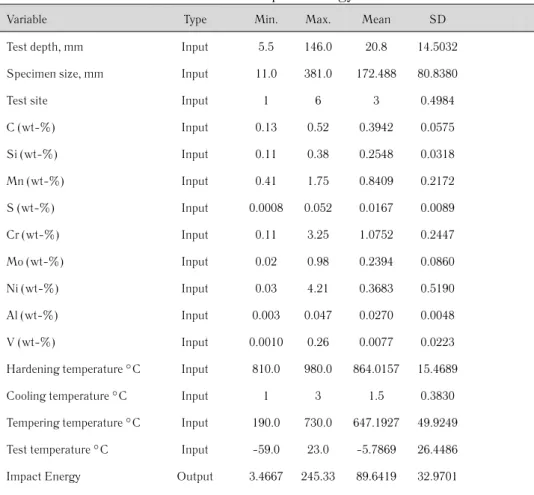
3.1 Statistics of Impact Energy Test dataset . . . 90
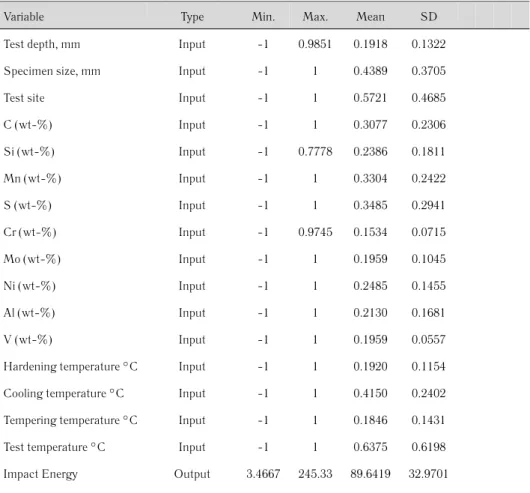
3.2 Statistics of the normalised Impact Energy Test dataset . . . 95
3.3 RMSE of the neural fuzzy framework . . . 103
4.1 RMSE using Granulation and FCM . . . 132
4.2 RMSE performance by using FCM, GrC and Gr-NS. . . 145
5.1 Performance of the T1-RBF-NN and IT2-RBF-FNN models for the Iris Database prediction in example 1 . . . 172
5.2 Performance of the T1-RBF-NN and IT2-RBF-NN models for the Cel-lular localisation sites prediction in example 2 . . . 172
5.3 Modelling performance . . . 187
6.1 Iris Database statistics, attributes and average classification ac-curacy . . . 204
6.2 Performance of the optimised RBF-NN for modelling the Charpy test. . . 209
6.3 Similarity matrix representation during the training process for the RBF-NN. . . 221
6.4 Similarity matrix representation during the checking process for the RBF-NN. . . 221
6.5 Similarity matrix representation during the testing process for the RBF-NN. . . 222
6.6 Similarity matrix representation during the training process for the IT2-RBF-NN. . . 223
6.7 Similarity matrix representation during the checking process for the IT2-RBF-NN. . . 223
Roman Symbols ˆ
ai Ambiguity produced by theithfuzzy rule
ˆ
S Similarity matrix
∥ · ∥ Euclidean norm
˜
A Embedded Type-2 Fuzzy Set
−a Lower boundary of the non-standard seta
A Embedded type-1 Fuzzy Set
b+ Upper boundary of the non-standard setb
C(m) Confusion
CA Centroid of a Type-1 Fuzzy Set CA˜ Centroid of a Type-2 Fuzzy Set
compat(·,·) Compatibility between any two Fuzzy sets
E(m) Dissonance
eH Entropy
Eip Overall Fuzziness of the Receptive Unitith ERM S RM SError
F Falsity
f(·) Activation function
f ei
k dimensionalkthFuzziness ofithfuzzy set Gi Fuzzy consequence
G1,2 Global uncertainty of a system
h1i Upper height of theithfuzzy rule
h2
i Lower height of theithfuzzy rule
I Indeterminacy
ii∪j Indeterminacy produced by the fusion of the
gran-ulesiandj
Jx Primary membership
LA,B Multidimensional length of a resulting granule from
mik kthmean of theifuzzy rule
N Clusters’s matrix
N Total number of input-output data pairs
Ni(·) Neutrosophic index for measuring the disorder
through-out the granulation process
T Truth
T(m) Total uncertainty
ux Secondary variable-u∈jx V(m) Innate contradiction
wi Output fuzzy weight
wi
l ithLeft output weight wi
r ithright output weight
xp Input vector
xnor Normalised input vector
yp Model output
Greek Symbols
α Learning rate
γ Momentum
µi Membership Function of type-1 of the setA µA˜(x, u) Secondary membership
µi mean vector of theithfuzzy rule Pp Performance index
µOv Overlapping coefficient σ2
Acronyms
ANN Artifitial Neural Network
RBF-NN Radial Basis Function Neural Network.
BBA Basic Belief Assignments.
IT2-RBF-NN Interval Type-2 Radial Basis Function Neural Network.
FCM Fuzzy C-Means.
GrC Granular Computing.
IT2-FS Interval Type-2 Fuzzy Set.
MF Membership Function.
FS Fuzzy Set.
FLS Fuzzy Logic System.
MISO Multiple-Input-Single-Output.
MIMO Multiple-Input-Multiple-Output.
T2-FS Type-2 Fuzzy Set.
IFL Intuitionistic Fuzzy Logic.
T1-FS Type-1 Fuzzy Set.
FOU Footprint Of Uncertainty.
NL Neutrosophic Logic.
MCP McCulloch-Pitts Model
MLP Multilayer Perceptron
1
INTRODUCTION
U
NCERTAINTY is frequently found in real situations and it usuallyrepresents a deficiency in the information [Klir and Wierman,1999]. That means, uncertainty is part of the world and in systems is inevitable as it appears in almost every measurement; either as a consequence of the theoretical framework used for quantifying it or due to the combination of measurement errors and resolution limits of the measuring instruments [Klir and Wierman,1999,Liu,2004]. For this reason, the correct processing and quantification of information becomes vital when its understanding involves the knowledge of uncertain events.
For more than two hundred years, the study and understanding of uncer-tainty has been a pivotal issue in order to make decisions and create models that imitate the human reasoning when dealing with real complex systems. Furthermore, there has been a controversy about which is the best mathe-matical framework that is capable of capturing and then faithfully charac-terising situations under uncertainty. It is generally believed that the very first studies associated to uncertainty began in the seventeenth century with Fermat and Pascal who laid the fundamental groundwork of probability the-ory by deriving the exact probabilities for problem gambling. Subsequently, in 1931 a significant contribution from Von Mises who proposed the concept of sample space initialised the field of applied mathematics by unifying the fields of probability and measure theory. Next, this idea was overtaken by Kolmogorov’s axiomatisation which laid the foundations of modern proba-bility theory. In addition to this, different points of view for capturing the uncertainty were proposed in the twentieth century. On the one hand, L. Zadeh [Zadeh,1965,1968] proposed the concept of fuzzy set denoted by a class of objects where each element in the set is characterised by a degree of
membership in the closed interval[0,1]. This type of theory was proposed to deal with uncertainty that comes out from approximate reasoning. On the other hand, Dempster, 1967 and Shafer, 1976 [Shafer,1976] introduced the theory of evidence which allows to make decisions based on the available evidence collected from different sources. As an extension to fuzzy set the-ory, L. Zadeh introduced in 1978 the possibility theory [Negoita et al.,1978] which is devoted to handling of incomplete information [Dubois and Prade, 1988] and it is considered within fuzzy set theory an alternative to probabil-ity. In 2002, Liu developed a new branch of mathematics devoted to unify the concept of uncertainty under a generic framework used in order to study the behaviour of random, fuzzy and rough events [Liu,2004]. The question of which is the best theoretical framework to quantify and describe uncer-tainty within these theories is highly difficult to answer. Because it is clear that several types of uncertainties exist and hence it is also clear that un-certainty is multidimensional. That means that usually the quantification of uncertainty is problem-dependent and if this quantification is just conceived in terms of only one theory, its multidimensional nature is obscured [Klir and Wierman,1999]. As it is pointed out by the theorem ofG¨odel, mathematics is not immune to uncertainty.
In systems engineering especially in systems modelling and making de-cision, the understanding about the nature of uncertainty has drawn a lot of attention from some practitioners and researches in the last three decades. This is mainly due to the increasing interest for understanding the influence that each model component and the associated parameters have for con-tributing with an uncertain and indeterminate system behaviour in the out-put model. Usually, uncertainty can be catalogued into Aleatory uncertainty and epistemic uncertainty. The former is originated by the system variability which reflects the inherent randomness of the nature. This type of uncer-tainty never disappears by collecting more information and sometimes can be also referred as random uncertainty, stochastic uncertainty, real-world uncertainty or natural variability. The latter arises as a lack of knowledge of the physical of world and a lack of measuring and modelling the physical world [Li et al.,2013]. Therefore, uncertainty in system engineering can be
attributed to different sources, i.e.
• Parameter uncertainty. This type of deficiency comes from the model parameters which sometimes are estimated in advanced representing an input to the the mathematical model. For example when simulating the dynamic of a car during a crash, an important parameter is the initial car speed.
• Parametric variability. This type of uncertainty is produced by the vari-ability of input variables of model. An example is when monitoring and estimating the final flow acceleration of a liquid in a pipeline; this pre-diction can be inaccurate since the stochastic behaviour of the liquid contained the pipeline and the environmental conditions add some un-certainty.
• Structural uncertainty. This source frequently comes out when we are uncertain about the functional form of the model, and hence it pro-duces a deficiency in order to reflect properly reality producing an un-certainty about a adequate data processing.
• Algorithmic uncertainty. This is a numerical uncertainty that results from numerical errors and numerical approximations by the imple-mentation of a computer model.
In this context, two major quantification problems are usually found in literature, i.e. 1) forward uncertainty propagation and 2) inverse uncertainty propagation. The former aims to quantify the uncertainty propagated from uncertain inputs in the system outputs. For example the evaluation of low-order moments of the outputs such as mean and the standard deviation, the evaluation of the output reliability based on the system performance, and the assessment of the probability distribution of the output model. The latter quantification basically aims to evaluate the discrepancy (called bias cor-rection) between the results obtain from a mathematical model and experi-mental results.
As can be seen, the understanding of uncertainty in system engineering can be accredited to several factors. For this reason transparency and in-terpretability play an important role for a good system knowledge. In other words, the more interpretable the information of a system under study, the better its understanding. Particularly in system modelling, extracting in-formation and converting it to ’easy to interpret’ knowledge is a crucial but not a trivial task, especially in the case of modelling very complex systems and non-linear processes [Zhou and Gan,2006, 2008]. Conventional ap-proaches that are usually based on differential equations to system mod-elling offer a poor performance when modmod-elling complex and uncertain sys-tems.
In order to gain insights of the system being modelled (to a certain de-gree), fuzzy modelling has shown to be an effective and a popular tool since it can formulate the system behaviour by qualitatively expressing the sys-tem knowledge with linguistic rules in a transparent and interpretable way rather by a quantitative analysis [Kandola,2001]. That means, a fuzzy model is fully transparent if it is possible to identify, understand and analyse the influence of each system parameter in the model output. Particularly, trans-parency is a measure used to validate how reliable and accurate are the lin-guistic rules and hence the associated fuzzy sets necessary to make a fuzzy system an interpretable model. In this regard, in literature efforts for creat-ing fuzzy systems with a good balance between interpretability and accuracy have been proposed. As pointed out in [Casillas,2003], one of the main ob-jectives in fuzzy modelling is to construct models that have a good balance between accuracy and interpretability. However, this is a contradictory pur-pose as not always this balance can be achieved. Basically, the reasons of having fuzzy models with a high degree of accuracy and low degree of inter-pretability or viceversa depends mainly on what requirements are pursued.
In the specialized literature, some researchers have created and studied systematic rule-based systems that are functionally equivalent to fuzzy logic systems and neural networks citarrr. Particularly, the Radial Basis Function Neural Network (RBF-NN) has shown to be a prominent architecture to modelling complex systems in system identification and control. The
mer-its of the RBF-NN is that inhermer-its some significant properties from fuzzy systems such as the ability to model systems via the use of linguistic rules which can be generated based on some prior human expert knowledge or heuristics. However, opposite to fuzzy systems, the RBF-NNs suffer from some loss of interpretability and hence transparency as a consequence of the learning process which is usually carried out through the use of gradient descent-based approaches. The analysis of this deficiency in transparency and hence in interpretability might aid to improve the RBF-NN performance and then reduce its black-box properties.
Relevance contributions by using the RBF-NN as a fuzzy system can be found in literature [Chen and Linkens,2001b,Cho and Wang, 1996,Jang and Sun,1993,Nelles,2001]. Specifically, in manufacturing processes the reputation of RBF-NNs for system identification have been extensively ex-ploited [Raviram et al.,2009,Wu et al.,2010]. For instance, in the aerospace industry neural fuzzy systems have been applied to acquire a relationship be-tween the mechanical properties of a titanium alloy and the processing pa-rameters involved for its heat treatment [Yu et al.,2010]. These type of pro-cesses represent in the manufacturing industry a highly difficult challenge since expert knowledge is often of very high importance to fulfil the produc-tion requirements dictated by the customers. Therefore, models constructed from data such as the RBF-NN falls into the interpretability scrutiny of experts in order to confirm the system’s validity [Panoutsos and Mahfouf, 2010a]. Furthermore, the black-box properties of the RBF-NN hinders its interpretability due to a lack of transparency. For this reason, some authors have developed methodologies whose main objective is to achieve a good level of interpretability without losing accuracy . In literature, the existing research work in improving the interpretability in neural fuzzy systems have been focused on creating systematic data-driven structures that usually in-cludes the initial model self-generation, input selection process, partition validation, parameter optimisation and rule-base simplification . Compared to neural networks and fuzzy systems, a neural fuzzy model (for example the RBF-NN) posses the ability to approximate any real nonlinear function by explicit knowledge representation in the form of if-then rules, the ability
to mimic cognitive reasoning in human understandable terms, the facility for processing linguistic information from humans and then combine it with numerical data. Even so, neural fuzzy systems inherit the shortcoming of being black-box models and therefore the criticism of not providing any in-formation of how they work [Benítez et al.,1997].
Although in literature a large number of publications in relation to trans-parency and interpretability in fuzzy systems can be found, an small number of articles address the problem of transparency and hence the associated uncertainty created by this lack of interpretability in neural structures, par-ticularly in RBF networks. A significant amount of methodologies dealing with approximate and uncertain reasoning can be listed in soft computing theory. This means that neural fuzzy properties can be studied not only from the existing theory in neural networks and fuzzy systems, but also from the new developments in computational intelligence ranging from evolutionary computing, fuzzy uncertainty, possibility theory, intuitionistic sets theory, interval type-2 fuzzy sets, computing with perceptions, etc. For instance, in [Pal and Bezdek, 1994] a review of the existing uncertainty measures is provided. In that article, all the merits and drawbacks for applications are discussed. Basically the type of uncertainty treated in fuzzy sets theory deals with situations where the set boundaries are not sharply defined. Moreover, in [Pal and Bezdek,1994] probabilistic uncertainty is sometimes related to fuzziness in the sense of the belongingness of elements or events to crisp sets giving a higher dimensional meaning to probability theory in fuzzy sets theory.
Among the latest and general proposals to deal with uncertainty in fuzzy logic is intuitionistic sets logic [Atanassov,1986]. This theory was proposed by Atanassov as a new branch of fuzzy logic that represent the uncertainty of rules and facts through the association of falsity and truth to two differ-ent values. In other words, this type of analysis can be translated into a problem for quantifying the uncertainty propagation through the inference engine which is employed in fuzzy logic systems to make decisions.
Another good example, is neutrosophy which is a generalisation of fuzzy logic that deals with the"origin and scope of neutralities as well as their
interactions with other spectra" [Wang et al., 2005]. This new logic is based on the infinitesimal calculus in order to use tuples that associate the truth, indeterminacy/uncertainty and falsity to an event. Different success-ful applications of neutrosophy can be found in literature. Particularly these applications proposed the analysis and quantification of uncertainty in neu-ral networks by the exploration and exploitation of soft computing tech-niques. For instance, in [Kraipeerapun et al.,2007] P. Kraipeerapun intro-duced a new framework based on ensemble neural networks and interval neutrosophic sets for binary classification. The purpose of that study was to quantify the associated error and vagueness (uncertainty) during the pro-cess of classification. In [Kharal,2014] the author introduced a new neutro-sophic multicriteria decision making method (MCDM) in which the mathe-matical foundations of neutrosophy sets theory was successfully applied for classification purposes.
Quite recently, some researches have explored the advantages of neural fuzzy systems of type-2 with the view of quantifying the linguistic uncer-tainty that is not handled by the fuzzy sets of type-1. A good example was provided in [Castro et al., 2011], where a novel integration of an interval type-2 fuzzy inference system based the Takagi-Sugeno-Kang reasoning and an adaptive network was introduced. In that work, the authors created a hybrid methodology capable of dealing with uncertainty that resulted from the imprecision during the parameter identification.
In system modelling, the understanding and then the quantification of uncertainty can be carried out by the use of existing methodologies in soft computing. Particularly the uncertainty that result from improper data, bad modelling as a consequence of wrong interpretations or human mistakes, imprecision originated by language granularity, vagueness and inconsis-tency which result by redundant linguistic rules producing conflict and hence contradictions.
1.1 PROBLEM STATEMENT
In soft computing several theories have been proposed in order to deal with various types of incomplete and uncertain information. Particularly, fuzzy logic and probability theory might be seen as the main mathematical frame-works dealing with uncertainty [Li et al.,2013]. Moreover, the unification of two or more different methodologies to quantify uncertainty has become a popular tool in soft computing literature. For instance, in [Kocadağlı and Aşıkgil,2014] a new evolutionary Monte Carlo algorithm was introduced in order to train a Bayesian neural network for the time series forecasting of weekly sales of a finance magazine.
In [Denoeux,2000] a new classifier based on a multilayer neural network and on the Dempster-Shafer theory of evidence was introduced. On the one hand, the authors proposed an specific architecture based on an input layer, two hidden layers and one output layer to evaluating the patterns as evi-dence and then presenting them as Basic Belief Assignments (BBA) which are pooled using the Dempster’s rule combination. On the other hand, the methodology performance was compared to different statistical and neural network techniques.
The authors in [Kraipeerapun et al.,2006] proposed a systematic proce-dure based on two different frameworks to quantify the uncertainty in min-eral prospectivity. The main purpose of that study is to construct a method-ology based on three neural networks in order to estimate the associated truth, uncertainty and falsity when predicting the degrees of favourability for gold deposits. Furthermore, researches in the area of statistics have paid a lot of attention in constructing simple and more transparent systems from the perspective of complexity reduction. Particularly, in achieving a trade-off between complexity reduction and how well the system prediction is during the training process. Methodologies such as support vector ma-chines [Smola and Schölkopf,2004,Suykens and Vandewalle,1999, Vap-nik,2000], orthogonal least squares [Chen et al.,1991] and input selection [Zhang et al.,2004] have shown to be an excellent tool for complexity reduc-tion while preserving transparency and interpretability in system modelling.
More importantly, such methodologies have proved to enhance fuzzy inter-pretability when applied in fuzzy modelling.
More examples can be found in literature, especially in the sense of im-proving trade-off between accuracy and interpretability of fuzzy rule-based systems by using adaptive learning methodologies from neural networks theory and single and multi-objective evolutionary approaches [Ishibuchi and Nojima,2007,Ishibuchi and Yamamoto,2004,Pulkkinen and Koivisto, 2008]. On the one hand, in the 1990s efforts were focused on improving the accuracy more precisely in system modelling and control theory. Particu-larly, an emphasis on accuracy maximisation [Wang,1992] was placed by the application of evolutionary techniques whose cost was a lack in trans-parency and hence the complexity of such systems increased importantly [Cordón et al.,2001]. On the other hand, in the last decade; various method-ologies for designing interpretable fuzzy models which are constructed from data were conducted. First, it was suggested to consider the structure of a fuzzy model as a twofold taxonomy in order to discriminate the role of each component associated to the fuzzy model interpretability.
In this context in [Zhou and Gan,2008], a deep insight of the different components involved in achieving an interpretable fuzzy model were classi-fied into two different levels: a) low-level interpretability and b) high-level interpretability. The former refers to the optimization of the membership functions in terms of semantic criteria related to a fuzzy set level and the latter involves the interpretability associated to coverage, completeness and consistency of the rules in terms of the criteria on fuzzy rule level leading the complexity reduction to a moderate number of rules and their associated consistency.
In spite of the large number of research works that have been proposed for evaluating the interpretability in fuzzy systems, this issue is still an open field in neural fuzzy systems theory. Moreover, a reduced number of attempts can be found in relation to the importance of evaluating the uncertainty and its association with fuzzy interpretability in neural fuzzy systems. This limi-tation can be translated into an appealing field to be explored because having an interpretable model allows us to incorporate to it prior or expert
knowl-edge.
Particularly, in RBF-NN modelling there is a lost of transparency and hence of interpretability that results from the application of adaptive algo-rithms used for the associated parameter identification. In this sense, this deficiency may produce a grade of uncertainty that might be expressed into several mathematical frameworks. Such an uncertainty can affect the inter-pretability of the RBF-NN and therefore its transparency and performance. Since an RBF-NN can be seen as a type of fuzzy system, this research work addresses the issue of uncertainty quantification and its relationship with system interpretability during the parameter identification of the RBF-NN. Especially, the functional equivalence between the RBF-NN and fuzzy systems allows us to explore and exploit a significant number of existing soft computing tools for uncertainty quantification and the evaluation of system interpretability. For this reason, a group of different soft computing tools will be studied and then used for the uncertainty evaluation, including Neutro-sophic sets theory, GrC, IT2-FSs and uncertainty theory. Due to the nature of the system considered in this research work, the following types of cogni-tive uncertainty are suggested to be studied:
•Linguistic uncertainty
•Fuzziness
•Entropy
•Ambiguity
• Uncertainty produced as a consequence of the redundancy among the fuzzy sets.
Finally, such uncertainty studies are tried against a real case study and well known benchmark data sets for manufacturing processes with partic-ular application in the prediction of mechanical properties of heat-treated steels.
1.2 RESEARCH AIMS
The aim of this research work is to quantify the uncertainty produced during the parameter identification of the RBF-NN for modelling purposes - and to study the relationship between this uncertainty and the interpretability of the RBF-NN. This research work also suggests to take advantage of the functional equivalence between the RBF-NN and fuzzy systems of type-1 for exploiting and exploring alternative tools from soft computing in order to quantify the network uncertainty and extract information from the associ-ated interpretability.
Basically this study consists of the identification and analysis of differ-ent sources of uncertainty in the RBF-NN at two differdiffer-ent levels of pretability, i.e. a) at low-level of interpretability and b)at high-level of inter-pretability. Therefore, the major aims of this research work can be listed as follows:
• The first study aims to identify and quantify the uncertainty due to a ravenous behaviour that results from a granular inclusion throughout the granulation process which is employed for the initial parameter identification of the RBF-NN. Hence, an index is suggested to handle and minimise this type of uncertainty having an impact in the creation of a more parsimonious fuzzy rule base.
• Secondly, an interval type-2 RBF neural network (IT2-RBF-NN) and the corresponding parameter identification process are suggested in order to deal with the linguistic uncertainty that is associated to the interpretation of words and linguistic propositions contained in the fuzzy rule base. The intention of this study is to execute a group of simulations for evaluating the performance of the proposed IT2-RBF-NN with two different types of clustering approaches, i.e. a) Fuzzy C-Mean (FCM) and b) Granulation on the one hand. On the other hand, the objective of this architecture is to explore the benefits of comput-ing with words by dealcomput-ing with the uncertainty that results from the semantic framework.
• Finally this research work aims to provide a twofold study that con-sists in the interpretation of two types of fuzzy uncertainty measures based on the fuzzy entropy and the ambiguity produced during the parameter identification of the RBF-NN and the proposed IT2-RBF-NN architecture. The first study evaluates the information contained at each receptive unit and hence suggests the use of neutrosophic sets theory to develop a methodology capable of enhance the RBF-NN in-terpretability. The last study, suggests a similarity measure that quan-tifies two types of fuzzy uncertainty in relation to the redundancy be-tween the fuzzy rules; i.e. a) Fuzziness and b) ambiguity.
1.3 CONTRIBUTIONS
The main contribution of this research work is to provide a number of differ-ent methodologies for uncertainty quantification based on the interpretabil-ity of the RBF-NN during its associated parameter identification. Such methodologies allow us to create a more transparent neural fuzzy model based on the RBF-NN. Under these circumstances, it is possible to evalu-ate the distinguishability and then the interpretability of the RBF-NN. Such methodologies also allow us to investigate the RBF-NN performance based on fuzzy uncertainty theory and its association to a good trade-off between accuracy and interpretability during the parameter identification of the net-work. Basically, a number of uncertainty studies will be presented according to two main levels of interpretability i.e. a) high-level of interpretability and b) low-level of interpretability. Therefore, the main contribution of this re-search work can be listed as follows:
• In chapter 3, a systematic neural fuzzy modelling based on the Fuzzy C-Means (FCM )and neural networks is used in manufacturing pro-cesses with an special application for impact energy prediction on heat-treated steels using a data set collected at six different labs.
• In Chapter 4 a twofold contribution is provided; firstly, it is proposed the application of a systematic modelling framework based on the RBF-NN and Granular Computing (GrC) for modelling a real case study in
manufacturing processes. The modelling framework was initially de-veloped in [Panoutsos and Mahfouf,2010a] and then was successfully applied in this research work to exploit the advantages of granulation enhancing the transparency of the initial rule base at the low-level of interpretability of the RBF-NN [Zhou and Gan, 2008]. Secondly, a new clustering approach based on granulation and neutrosophic sets was introduced. This study investigates the significance of each input by evaluating the distinguishability of the fuzzy rules during the initial clustering stage. Moreover, a new compatibility criteria is developed in order to measure the uncertainty produced by a ravenous behaviour that results from the overlapping between the fuzzy rules. Finally, ex-perimental results were run in order to compared the performance of the granulation with and without the application of neutrosophic sets.
• In chapter 5, an Interval Type-2 Radial Basis Function Neural Net-work (IT2-RBF-NN) is proposed. Such a frameNet-work is functionally equivalent to Interval Type-2 Fuzzy Systems and the RBF-NN. The major contribution of this network is twofold - first the IT2-RBF-NN not only provides a new methodology for dealing with linguistic un-certainty and then with perceptions, but also in a like-manner to its type-1 counterpart, the IT2-RBF-NN interpretability can be treated at two different levels of linguistic information. Secondly, this chapter also provides the corresponding parameter identification of the new IT2-RBF-NN which is different to that used for training its type-1 counterpart.
A further experimentation was carried out in order to verify the model performance of the IT2-RBF-NN and then compared to its counter-part the RBF-NN or as it is called here the RBF-NN. Therefore, some results for modelling some popular benchmark data sets and the real case study employed in chapter 4 are provided respectively. With con-clusive evidence, the simulation results showed the RBF-NN might be a prominent tool to cope with linguistic uncertainties and then per-ceptions.
• Finally in Chapter 6, two studies about fuzzy uncertainty quantifica-tion during the parameter identificaquantifica-tion of the RBF-NN and the pro-posed IT2-RBF-NN are provided. Firstly, the propro-posed methodology exploits and explores the functional equivalence between the RBF-NN and a number fuzzy logic systems of type-1 [Hunt et al.,1996]. Thus, two new uncertainty measures based on neutrosophic sets and used to evaluate the fuzziness and ambiguity in the rule base of the RBF-NN are introduced. Such measures allows the RBF-NN to evaluate on the one hand the distinguishability in the rule base, and on the other hand the ambiguity that comes out from selecting one choice among different options in the RBF-NN rule base. The second part of this chapter contributes with an study about the relationship between the similarity of fuzzy sets and the uncertainty associated to the fuzzy rules redundancy in both the RBF-NN and the proposed IT2-RBF-NN. That means, in the time this study estimates the sim-ilarity between the shape and distance of the fuzzy sets involved in the rule base, a similarity matrix is being constructed in order to evaluate the uncertainty associated to the redundancy of each of those fuzzy sets.
The work in this thesis has contributed in part or full to the following publications and revisions:
• Rubio Solis, A. and Panoutsos, G. "Interval Type-2 Radial Basis Func-tion Neural Network: A modelling framework". IEEE TransacFunc-tions on Fuzzy Systems, 11(99), 2014.
• AR Solis, G. Panoutsos, "Granular computing neural-fuzzy mod-elling: A neutrosophic approach", Applied Soft Computing, Elsevier, 13(9), 4010-4021, 2013.
• Rubio Solis, Adrian, Panoutsos, G., "Fuzzy Uncertainty Assessment in RBF Neural Networks using Neutrosophic Sets for Multiclass Clas-sification", 2014 IEEE International Conference on Fuzzy Systsems, Beijing China, 2014.
Journal Papers in Preparation:
(To be submitted to Materials Science and Technology and Soft Computing respectively.)
• Performance of the Interval Type-2 Radial Basis Function Neural Net-work in Materials Science.
• Interpretability aspects when computing with words: An Especial Ap-plication for the Prediction of Mechanical Properties of Heat-treated Steels
Other activities
• Invited reviewer on the topic: Rough sets Theory for the International Journal of Machine Learning and Cybernetics.
• Invited reviewer on the topic: Granular computing and Rough sets Theory for the International Journal of Machine Learning and Cyber-netics, Springer.
1.4 OUTLINE OF THE THESIS
The structure of this thesis is organised in 7 chapters and one appendix. In this chapter the basic notions necessary to understand the contributions of this research work are described. The next 6 chapters describe the current contributions and the conclusion of this thesis. Therefore, the document is organised as follows:
Chapter 2, covers the main soft computing techniques that may be use-ful to deal with uncertainty in systems modelling. These include a general review of Fuzzy Sets (FS) theory, including theory related to Fuzzy Systems (FSs), Granular Computing and the modus ponens or inference mechanism which is crucial to understand how a Fuzzy system handles the information. Secondly, an uncertainty-based information theory for crisp and fuzzy sets is reviewed as it may play an important role in the development of this re-search. Finally, this chapter briefly reviews the theory of artificial neural net-works, particularly that information related to RBF neural networks making reference to its functional equivalence to fuzzy systems.
Chapter 3 includes on the one hand a detailed description of heat treat-ment process from a metallurgical point of view and manufacturing pro-cesses. Details on the mechanical, physical and chemical properties of fer-rous and non-ferfer-rous materials were included. Consequently, an overview of steel making and of mechanical testing for materials is reported. On the other hand, a data-driven modelling framework based on the RBF-NN the-ory and Fuzzy C-Means (FCM) was applied for the prediction of mechanical properties of heat-treated steels in manufacturing processes. The realisa-tion of a systematic model based on neural fuzzy systems aims to mimic the human reasoning ability to express complex system with simple linguistic rules. Finally, experimental results were accounted graphically and numeri-cally.
Chapter 4 is concerned with enabling the RBF-NN for extracting in-formation in a more distinguishable form by the use of granular comput-ing (GrC) and the quantification of uncertainty through the application of neutrosophic sets. An initial experimentation was carried out to investigate the RBF-NN performance with the aid of granulation [Panoutsos and Mah-fouf,2010a]. The aim of this experimentation was to predict transparently the initial rule base of the RBF-NN and for the prediction of the mechan-ical properties of heat-treated steels. The associated parameter identifica-tion process of the RBF-NN model was firstly estimated by the granulaidentifica-tion (GrC) of input raw data and consequently optimised by the application of a gradient-descent based approach. The main role of the granulation process was to generate the initial fuzzy rule base of the RBF-NN according to the compability of the input data. A new compatibility criteria that quantifies the uncertainty during the granulation process and that is a consequence of an excessive overlapping between the fuzzy sets during the formation of the rule base was proposed. Particularly, this new compatibility measure was used as a granular constraint for evaluating the interpretability throughout the granulation process.
In Chapter 5 concentrates in the development of a systematic data-driven modelling based on the RBF-NN and Interval Type-2 Fuzzy Sets for sys-tems modelling purposes; such a methodology was named: Interval Type-2
Radial Basis Function Neural Network (IT2-RBF-NN). The aim of the pro-posed network structure is for dealing with the linguistic uncertainty that is not quantified by its type-1 counterpart the RBF-NN. More importantly, this new structure was developed to inherit not only the properties of the RBF-NN and fuzzy systems of type-2, but also to be susceptible to the rameter estimation employed in the RBF-NN. Therefore, the associated pa-rameter identification process that is able to deal with interval fuzzy sets is also developed. Experimental results by using the proposed IT2-RBF-NN are conducted through the modelling of two well-known benchmark data sets and the real case study for mechanical prediction of heat-treated steels proposed in this thesis.
Chapter 6 considers on the one hand a fuzzy uncertainty assessment methodology by using RBF neural networks and neutrosophic sets for multi-class multi-classification. The idea of this methodology is to create a more trans-parent and interpretable training process that can explore and exploit the information contained at each receptive unit (RU) of the RBF-NN. On the one hand, a neutrosophic measure for quantifying the fuzziness among the fuzzy sets (RUs) is proposed. On the other hand, an assessment of ambigu-ity associated to the nonspecificambigu-ity and representing a cognitive uncertainty based on neutrosophic sets is conducted. On the other hand, is provided an uncertainty assessment of ambiguity and entropy based on the similarity among fuzzy rules in the rule base either a) the RBF-NN, or b) the proposed IT2-RBF-NN architecture. And a comparison analysis of the uncertainty assessment suggested for impact energy prediction is provided. The simi-larity measure suggested in this chapter is based on the distance and shape of the receptive units functions.
Finally, chapter 7 includes a detailed conclusion of this research project and the future directions will also be discussed.
2
A BACKGROUND TO SOFT COMPUTING
TECHNIQUES
T
HE main objective of this chapter is to provide an insight about theexisting techniques found in soft computing. A particular emphasis will be put on Fuzzy Logic, Fuzzy modelling and Neural Networks. As far as Fuzzy Logic is concerned, a review of the different types of uncertainty is included. This is mainly due to the type of topic considered in this research work.
2.1 INTRODUCTION
The term soft computing was coined by Zadeh, the inventor of fuzzy set theory, to be an extension to fuzzy logic. Basically, soft computing is a partnership of several problem-solving paradigms such as fuzzy logic (FL), Probabilistic Reasoning (PR), Neural Networks (NNs) and Evolutionary Computation (EC) [Bonissone,1997]. Moreover, this collection of different methodologies exploits the advantages of human tolerance for imprecision and uncertainty to achieve tractability, robustness, and low solution cost.
In this partnership, fuzzy logic is mainly concerned with imprecision and approximate reasoning; neural networks with learning and curve-fitting; and probabilistic reasoning with uncertainty and belief propagation [Seising,2010]. In this regard, uncertainty plays an important role behind fuzzy logic and neural networks in dealing with information obtained from sources which are non-linear behaviour, time-varying behaviour and the interaction with uncertain/indeterminate environments.
2.2 FUZZY SETS
The concept of fuzzy sets was introduced and formalised by [Zadeh,1965] as an extension of conventional set theory. The aim of fuzzy sets lies in mod-elling the impreciseness of human reasoning by representing uncertainty for the variables that are used by assignment of a set of values to the variable.
A crisp set usually represents a dichotomisation of individuals to be mem-bers or not into two groups in a given universe of discourse (which it is known as the domain of a function). However, many classification concepts suffer from the lack of this property, for example the group of tall people, sunny days or cheap cars. From a mathematical standpoint, the definition of a classical set of objects X is called the universe where its generic el-ements are denoted by x. Therefore a crisp set can be represented by the notation X = {x1, x2, . . . xn} and defined by a property that is satisfied
by its members: X = {x|P(x)} where P(x) is a proposition of the form "x has the property P". The membership in a classical subset A of X is usually viewed as the characteristic functionµAfromxto{0,1}Such that
µA(x) = 1, iffx∈A 0, iffx /∈A (2.1)
where{0,1}is the valuation set and the characteristic functionµA→ {0,1}.
A fuzzy set can be defined mathematically by assigning to eachx over the universe of discourse a value representing its grade of membership in the fuzzy set. For example, a fuzzy set might represent the set of cloudy days with the maximum and minimum value of 1 and 0 to those days that are sunny and completely cloudy respectively. This means that values of 20%
can be designated to those days that are partially cloudy. If the valuation set is allowed to be a real interval[0,1],Ais called a fuzzy set, andµA(x)is
the grade of membership ofx inA. The closer the value ofµA(x)to 1, the
morexbelongs toA, and whereAis a subset ofXthat clearly has no sharp boundaries. From this notation,Ais completely characterised by the set of
pairs
A={(x, µA(x)), x∈A} (2.2)
Zadeh proposed a convenient notation, where a fuzzy set of X is defined as
A=
n
X
i=1
µA(xi)/xi (2.3)
IfXis not finite it is said to be:
A=
Z
x
µA(x)/x (2.4)
In fuzzy set theory, containment, union, intersection and complement are defined in terms of their MFs. Therefore, such definitions lead to the follow-ing expressions [Mendel,1995].
Containment
A⊆B ⇐⇒µA(x)≤µB(x),∀x∈X (2.5)
Union
µA∪B(x) = max[µA(x), µB(x))],∀x∈X (2.6)
Intersection
µA∩B(x) = min[µA(x), µB(x))],∀x∈X (2.7)
Complement
µB(x) = 1−µB(x),∀x∈X (2.8)
However, the "max" and "min" are not the only operators which can describe union and intersection of fuzzy sets. Zadeh proposed two operators for union and intersection [Zadeh,1965], namely: union based on the maximum and algebraic sum represented byµA∪B(x) = µ(A)(x) + µB(x)−µA(x)µB(x)
and intersection which is based on minimum and algebraic product and ex-pressed byµA∩B = µAµB. Basically, the authors [Höhle,1978] and [Alsina
et al.,1983] were the pioneers that introduced the t-norm and the t-conorm into fuzzy set theory be the operations for the intersection and union of fuzzy
sets. Since that, many other researches have proposed various types of t-operators. Particularly, in [Gupta and Qi,1991] a review of the most promi-nent examples about t-norms is provided. Further contributions of t-norms and t-conorms which have axiomatic basis [Mendel,1995] have been pro-posed and represented by the symbols⋆and⊕respectively. Examples of t-conorms (also known as s-norm) arebounded sum:x⊕y=min(1, x+y),
drastic sumx⊕y = xify = 0,yifx = 0,1ifx, y > 0. And examples for the t-norm arebounded product: x ⋆ y = max[0, x+y−1]anddrastic product:x ⋆ y=xify= 1,yifx= 1, and0ifx, y <1. −2 0 2 0 0.5 1 σ c (a) Gaussian MF 0 6 12 0 0.5 1 c c - a c + a Slope =−b 2a (b) Bell MF 0 1 2 0 0.5 1 a b c (c) Triangular MF −0.5 0 0.5 0 0.5 1 t a m (d) Singleton MF
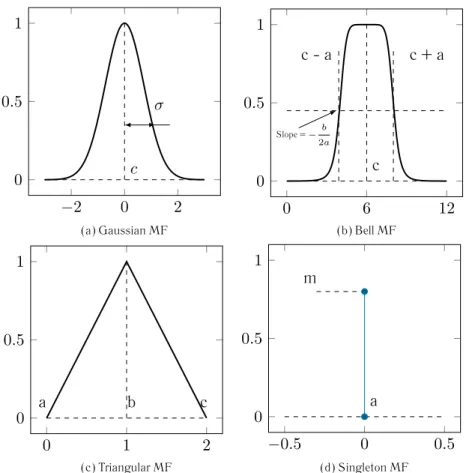
Fig. 2.1Shapes for Membership Functions (MFs)
By using the extension principle it is possible to define some other ba-sic operations from set theory into fuzzy set theory. A fuzzy set is
com-pletely characterised by its membership function (MF). For this reason is more convenient to express the MF through a mathematical formula. In Fig. 2.1 the most popular MFs are depicted whose expressions are given below. Triangular MF F∆(x;a, b, c) = 0, x≤a x−a b−a, a≤x≤b c−x c−b, b≤x≤c 0, x≥c (2.9) Trapezoidal MF FT(x;a, b, c, d) = 0, x≤a x−a b−a, a≤x≤b 1, b≤x≤c d−x d−c, c≤x≤d 0, x≥d (2.10) Gaussian MF f(x;c, σ) =exp − x−c σ 2! (2.11) Generalised Bell MF f(x;a, b, c) = 1 1 +|x−c a |2b (2.12) f(x;a) =m (2.13)
2.2.1
FUZZY LOGIC SYSTEMS
A Fuzzy Logic System (FLS) is a nonlinear mapping of a crisp input vector (feature)Xp into an scalar outputyp where thepthoutput vector case can
be decomposed into a collection of multi-input/single-output systems. As it is pointed out in [Mendel,1995], an FLS is able to simultaneously process numerical data and linguistic knowledge. Furthermore, it has been proved Mendel[1995], Wang [1992] any FLS can be considered as a lin-ear combination of fuzzy basis functions and hence as a nonlinlin-ear universal aproximator. As it is described in [Mendel,1995], an FLS contains four el-ements, namely: a) fuzzifier, b) an inference engine, c) a fuzzy rule base and a defuzzifier; in Fig.2.2the general structure of an FLS is illustrated.
Fuzzifier Rules Inference Defuzzifier Crisp Outputs Crisp Inputs Input sets u ϵU i
Fuzzy Output sets
v ϵ V
y = f(x) ϵ V
x ϵ X
FLS
Fig. 2.2Fuzzy Logic System (FLS) [Mendel,1995].
• Thefuzzifierplays a twofold role in an FLS; on the one hand the fuzzi-fier maps crisp numbers into fuzzy sets, and on the other hand the fuzzifier is needed to activate the fuzzy rules expressed through the use of linguistic variables associated to fuzzy sets. Basically, the most popular mathematical expressions used for converting the crisp input numbers into the corresponding fuzzy sets defined in the linguistic rule base are the equations (2.9)-(2.12).
• Rules (fuzzy rule base). A fuzzy rule base is a collection of prede-fined linguistic IF-THEN rules set up either by expert knowledge or by experts in the area. Since fuzzy rules are the vehicle of knowledge
representation, the flexibility of the rule base structure is determined by the form of the rules. Particularly in fuzzy modelling, the rules of a multiple-antecedent and multiple-consequent FLS can be expressed as follows [Mendel,1995]. The basic form of a rule is
Ri : IF x1is F1iand x2is F2iand . . . xnis FniT HEN v is G
i (2.14)
where i = 1, . . . , M,k = 1, . . . , n inputs, Fki and Gi are fuzzy sets in Ui ⊂ R and V ⊂ R respectively ( R denotes the real line), ⃗x =
(x1, x2, . . . , xn)∈X1×X2. . .×Xnandv ∈V. According toMendel
[1995], different adaptations of the fuzzy rule based can be obtained if the rules are:
1. Incomplete IF rules. A rule base may contain a set of rules whose antecedents are only a subset of theninputs, e.g.
IF x1 is F1iand x2is F2iand . . . xmis Fmi T HEN v is G i
Such rules are incomplete IF rules, and apply regardless the
xm+1. . . xnantecedents. However, these rules can be treated as
complete IF rules if the antecedents xm+1. . . xn are considered
as elements of a fuzzy set called INCOMPLETE (IN for short), where by definitionµIN(xk) = 1,∀x∈R, i.e.
IF x1 is F1iand x2is F2iand . . . xmis F
i
mT HEN v is G i
If and only if:
IF x1is F1iand x2 is F2iand . . . xmis Fmi and xm+1is IN
. . . and xnis IN T HEN v is Gi
oper-ators such as "and" and "or" in the following way:
IF x1 is F1iand x2is F2iand . . . xmis Fmi or xm+1is Fmi+1
. . . and xnis Fni T HEN v is G i
Hence, such a rule can be expressed as the following two rules:
R1 :IF x1is F1iand x2is F2i and . . . xmis Fmi T HEN v is G i
and
R2 :IF xm+1 is Fmi+1and . . . and xnis Fni T HEN v is G i
Where both rules can be seen as two incomplete if rules (see [Mendel,1995]).
3. Comparative rules. Some rules are comparative, e.g. "The largest the u", "the smaller the v". However, according to [Mendel, 1995] this type of rules must be first formulated as IF-THEN rules, for example: "IF u is L" THEN "v is S", where L is a fuzzy set representing Large and S small.
4. Unless rules. This type of fuzzy rules employ the connective "unless" and can be put into the format of 2.2.1if the De Mor-gan’s Law is used. For example, the rule
v is Gi unlessx1is F1iand x2 is F2iand . . . xnis Fni
which can be first expressed as
IF (x1is not F1ior x2 is not F2ior . . . xnis not Fni) T HEN v is Gi,wherenot Fkiis a fuzzy set 5. Quantifier rules. The last case includes a quantifier "some" or
"all". The former quantifier is mostly applied by the operator union to the number of antecedents which include "some" and
the intersection to the elements that employ the latter quantifier. By using De Morgan’s Law, A∩B = ¯A∪B¯, therefore the rule can be expressed as
IF x1is F1iand x2 is F2iand . . . xnis Fni
• Theinference engineof an FLS is used for mapping fuzzy sets into fuzzy sets, that means that the inference engine handles the way the rules are combined. There is a vast number of inference engines, how-ever just an small number of them are used. The aim of an inference engine is to mimic the way the human beings make decision based on a linguistic representation.
• The defuzzifiermaps output sets into crisp numbers. This conver-sion is context dependent which means that for example whether the problem is about control theory, the output is an action.
2.2.2
FUZZY MODUS PONENS
The modus ponens in crisp sets is a well known deduction rule in logic (as described in 2.2.2). Basically, from the fact x is A and the rule IFx is A
THENy is B, a new factB can be deduced. However, if there is not cer-tainty thatx is A, hence it is difficult to m
![Fig. 2.6 T2 Fuzzy Membership [Mendel and John, 2002]](https://thumb-us.123doks.com/thumbv2/123dok_us/534952.2563108/57.892.184.645.572.876/fig-t-fuzzy-membership-mendel-and-john.webp)
![Fig. 2.7 Vertical slice and embedded type-2 fuzzy sets theorem representations [Mendel and John, 2002].](https://thumb-us.123doks.com/thumbv2/123dok_us/534952.2563108/59.892.169.700.383.873/vertical-slice-embedded-fuzzy-theorem-representations-mendel-john.webp)
![Fig. 2.9 Neutrosophic Fuzzy Logic System Structure, [Wang et al., 2005]](https://thumb-us.123doks.com/thumbv2/123dok_us/534952.2563108/67.892.160.696.594.875/fig-neutrosophic-fuzzy-logic-system-structure-wang-et.webp)