Information system for quality management
Alexander Petkov PETKOV, PhD., University of Rousse “Angel Kanchev”, Bulgaria
Certifying of Bulgarian firms is essential condition for opening the country towards European and world market. It allows producers offer their own products at international market, guar-antee quality and insurance of delivery for their partners. Through certified quality manage-ment system (QMS) firms become competitors to foreign investors and traders, which also of-fer quality products at Bulgarian market. The trend of equalizing Bulgarian law to European also put higher requirements to deliverers of materials for public orders and auctions. Certi-fying of QMS requires preparing and implementing of management information system, which is dealing with big quantity of documents, data and information and meeting requirements of EN ISO 9001-2000. At the same time it should not enlarge the work of administrative and management staff. In the paper an analysis is made for the needs of QMS, defined by the standard. A structure of information system is designed for quality management in a produc-tion firm. Rules for management of firm’s informaproduc-tion are defined, which guarantee keeping the requirements of QMS and least burden users of the system. Characteristics of main mod-ules for management of information flow and the interactions between them are also defined. Methods for building a dynamic firm’s data base are offered, which include data renovation and result’s analysis.
Keywords: quality management, ISO9000, quality management system.
ertifying of firms in Bulgaria is a condition, which turns gradually from wishful into imperative with the opening the country towards the European and world market and with foreign producers entering the country. On one hand, a pro-duction firm should present its partners guarantee for quality and security of deliv-eries in competition with other producers who offer certificates for quality, in order to go at the world market. On the other hand on Bulgarian market foreign traders and investors appear, who also offer, re-spectively search for products with guaran-teed quality. On third point of view the tendency of harmonizing Bulgarian legisla-tion with the European one during the processes of our integration with Europe set higher requirements to the deliverers of materials for social commissions and auc-tions.
Thus gradually the necessity of introduc-tion of certified quality management sys-tem (QMS) becomes stronger. The re-quirements for the introduction of such system are defined by strategic goals set by
the firm’s management, by markets and clients towards which it is directed, by the legislation of countries in which the pro-duction of the firm is realized. The real possibilities, which stand in front of the Bulga rian firms at the moment, are related with introduction of systems in accordance with the standards of the country, the European and American ones or other standards, which has corresponding pres-tige and important for firm’s contractors. As relatively prestigious and good standard for many of our firms is the European standard of managing the quality ISO
9001-20001 and guidance for improving
the results ISO 9004:2000. As a next step to improving the work and increasing the ability to compete (in some cases it is compulsory) introduction of systems for management of health, safety at the work place and preservation of environment BS 8800:1996, ISO 14000:2000 appear. The integrated system for quality, safety and
1EN – ISO 9001:2001 accepted for Bulgarian
stan-dard 2001.
environment is realized during their intro-duction in a firm.
In the base of the new international
stan-dards for managing the quality2 is the
processing-oriented model of designee, in-troduction and improvement the efficiency and effectiveness of a QMS. The most important goal is to higher the client’s sat-isfaction through fulfillment his require-ments. This approach ensures a better management of the numerous related-to-each-other activities, which are scrutinized as a process of transformation the ingoing data as outgoing. The application of a sys-tem of processes in an organization, to-gether with realization of the interaction between these processes and also their management is defined as processing-oriented model.
The advantage of the processing-oriented model is in the uninterrupted management, which offers this model through unifying the separate processes in one system of processes and their combination and inter-action. This means the applying of the sys-tem approach over the firm’s organization and management with its development through giving an account of the firm’s dynamic character and putting the empha-sis on the clients’ leading role in the work and the management.
The introduction of such systems in a firm and their certifying gives quality guarantee of the firm’s production and increases the ability to compete also on the market. The introduction and the functioning of such systems, however, is related to consider-able increase in the volume of work of the production, administrative and in the high-est extent of the management staff. This increase is expressed mostly in growth of the firm’s document volume: documentary of all important processes, following the movement and alteration of recourses and registration of their condition in all stages- from the entrance to the exit of the system and after realization of the products (sup-port and repair services). Introduction of
2
ISO 9002:2000 and ISO-9004:2000
such system makes worse the firm’s flexi-bility, obstructs taking fast, consistent with the present situation decisions and is hard to introduce in smaller firms, where the skills, practice and documentary are not enough, where informal approach in com-municating is mainly used. In order not to allow excessive increase of the staff and the corresponding expense increase during the introduction of the new system, an ap-propriate information system should be developed and introduced, which will con-centrate all efforts, will centralize the in-formation in database, will mitigate the work over the creation of the documents, their use and the management of the document exchange, will integrate the quality management and the firm’s ma n-ager information system.
A. Functions of the integrated informa-tion system.
Building of integrated information system in the firm embraces all basic functions and tasks of the manager information sys-tem [5], subordinated and supplemented with the requirements set by the standard and the procedures in the firm’s system for management of the quality [6]. It can unite the following major functions:
• Centralizing of information in database.
Thus a fast access to the information from all management stages is reached, the search for data is eased and the time for reaching the needed information is short-ened.
• Efficient management of the
informa-tion flows. It is executed by the system and the programs and rules for work in it. It in-cludes preservation and archiving of the data. Thus security and rehabilitation in case of problems are guaranteed. The sys-tem for management of the quality and the standards define the rules of creation, pres-ervation and processing the information in the base as they guarantee access and ra-pidity.
• Analyzing the information: tools for
analysis, automatic functions for analysis. The system includes implemented
func-tions and programs for analyzing the data for helping the management. Frequently repeating analyses and processing of the data can be implemented in modules for automatic processing – making up refer-ences from data in the base or the files cre-ated in different sections. When analysis of the information not with a traditional method is needed, the system should have instruments and tools for analysis and ex-perts that can do them. Because of the dy-namics of the environment and the possi-bilities of the modern program products, these are the experts who can create the modules for automatic processing and analysis. Thus constant development of the system and improvement of its introduc-tion benefit is ensured.
• Management of the access to the
infor-mation through program means of the products used in the system, administrating the access to users and passwords.
• Combination of different types of data,
files. Transfer between different formats data. It is imposed by the variety of the used program products and the format of the electronic data. Where is necessary to use data which is laid with one type appli-cation software in another, the specific possibilities for converting are to be used, programs and modules for automatic trans-fer from one format to another are to be designed.
• Facilitations during searching and
ac-cess the information – well-built structure and firm rules for working with centralized preservation of data, creating names of the files and fast and easy reaching the needed information is ensured. When the firm’s computer network is used and a large number of assistants have access, it is im-portant common rules to be kept, which save time for searching.
• Guarantee of the possibility for control
of procedures over the management of quality. During introduction of the system for quality management it is important to conform with it the creation of all docu-ments and modules for processing the in-formation. Every document related with
the quality management should be deve l-oped with all attributes (date, supervisor, designer, manager and so on) that are in the templates generated by the information system. This ensures enough information for control, feedback to the managers and will guarantee the completion of quality management procedures with minimum waste of time.
B. Firm data, documentation and in-formation flows
The accountancy information is compara-tively well organized in firms. It is impor-tant for the needs of the management to automate the creation and estimation of di-vers firm information related with different aspects of its functioning. On fig.1 group-ing of firm’s information for aluminum doors and windows production is presented according to its type. More important ele-ments in the firm’s information flow are:
• Trade information – offers and
con-tracts – information and documents, that are purposed for the firm’s clients which include technical data (description of the product), financial data (prices and cond i-tions for delivery), certificates and docu-ments showing the quality of the product, guarantee cards, references etc. On one hand this type of information should be developed explicitly and in details (prices of products and services should be defined and real), on other hand – different prod-ucts and different conditions for delivery should be made. This requires much time, different specialists and different informa-tion (mostly for prices).
Production information – Technical infor-mation – concerning technical devices in the firm including construction documenta-tion, technical requirements for the ma-chines and the used equipment. Techno l-ogy information – the technologies for production, which can be relatively con-stant during serial production, and produc-tion in large numbers, but during single and small series production (which is often met in small and average enterprises SME) constant development of new technologies
and constructive documentation for each new product is required. Planning of the production is made on the basis of docu-ments for the accepted offers and the con-cluded contracts. The planned documents are developed in different management stages, but the most detailed and concrete
are in the operative stage – in different production lines. The problems of firms exist because of the constant changes of plans and projects because subjective and objective reasons – changes in client’s re-quirement, in prices of row material, in terms of delivery etc.
Corporative information system external informatio n internal informatio n marketing informatio n standards and references supliers clients compet itors raw materials human recources trade
information informatiofinancial n production information wareho use equipm ent reports for particip ation wages offers contrac ts book -keepin g technol ogy informa tion technic al informa tion plans informa tion reports informa tion
Fig. 1. Decomposition of information, used by Firms
Information System windows and doors
• Standards – making internal norms
(system for management of quality, in-structions for security and support of equipment, etc.) and outer norm docu-ments (from national organizations, go v-ernment, parliament, ministries, etc.). With the introduction of the system for qua lity management internal system of rules, pro-cedures and norms for keeping the quality in the firm is being created and introduced.
• Records of quality – documents that
register the quality of raw materials, not finished and finished products, discrepan-cies (defects), etc. Their contents and structure cover the processes in the firm and put boundaries, in which should be put all documents concerning the quality ma n-agement of the products and the processes of the firm.
It is seen that the information used in the firm is diverse. Different departments use it and it is hard to build a strict scheme de-scribing the whole process of registration, cultivation, preservation, analysis and transferring the information in the firm. The introduction of the system for quality management through written procedures, instructions and references puts at e certain extent in order the firm’s documentation and its cultivation. Unfortunately apart from their execution, which increases the employee’s administrative work, the order in the information recourse is not complete because the aims and the tasks, which are solved, are limited to management and guarantee of the quality. In order to in-crease the productivity according to quality system’s requirements, it is important to be
integrated in the existed FIS and FIS to be changed and developed according to QMS. On fig.2 a connection is presented, which follows to be built up during the introduc-tion of a system for quality management in a firm, in order to guarantee effective func-tioning and ma naging of production firm. The system for quality management re-quires strict development over the rules
mentioned in procedures of all
docu-ments, precise registration and taking full responsibility for keeping the rules in the
whole production process. The problems in the small and average firms during the itroduction of the system for quality ma n-agement are defined as considerable in-crease of the work related with creation, cultivation and preservation of large amount documents, lack of experience of the staff, informal management and com-munication approach, insufficient number of employees for all activities, complicated and slow system for documentation, con-firmation, verification and control.
management
Corporative Information System
Quality Management System
Fig. 2. Connections between CIS, QMS and management
Conditions for introducing the system for quality management :
• QMS requirements for documentation
of processes in the firm. Putting a norm basis and generating tracking of processes.
• Interaction between QMS and FIS –
during the process of introduction of QMS – developing application software – elec-tronic database.
• The benefit of FIS during the
introduc-tion of QMS. QMS requires processing of large amount of information, its analysis and its committing to the needs of the management, which can be realized with minimum expenses of time and recourses through introducing the processes of qua l-ity management in the firm’s information system.
FIS can be looked upon as complicated system, in which many subsystems can function together and each of them process information with different character and content [5]. In view of clearer presentation of the relations and interactions between the subsystems, described previously, it is appropriate the management information system to be looked upon as a structure de-fined, on the basis of a certain measure, as
part of a more common firm information system.
C. Structure of an integrated informa-tion system
Elements – constructing on the principal of FIS
• Database – different information from
different sources, for different needs, ca-ters for different interests
• Universal software – word processing,
spreadsheets etc.
• Specialized software – modules
book-keeping, store, offers, constructing, analy-sis,
• Requirements for their defining
• Renovation, modernizing and
im-provement of the system
• Teaching and presenting the
possibili-ties of the staff
• Staff – teaching
• Dynamics – constant development
• Modules – software is designed by
in-dependent modules and possess synergetic effect when modules works together
• Available organization structure to be
covered and when needed to be actualized
• To embrace all processes in the activity
• To embrace all documents, procedures and requirements of the QMS – docume
n-tation to have information about people who create, confirm and control it.
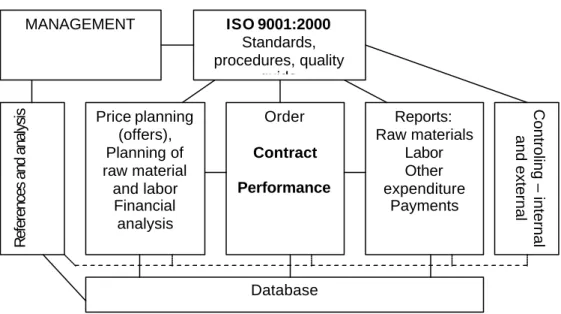
ISO 9001:2000 Standards, procedures, quality guide Price planning (offers), Planning of raw material and labor Financial analysis Reports: Raw materials Labor Other expenditure Payments Order Contract Performance Database
References and analysis
MANAGEMENT
Controling
–
internal
and external
Fig. 3. Structure of the quality management information system.
On fig.3 a scheme of the structure of a firm information system is presented. It is built up during the introduction of a quality management system and taken into consid-eration with the practice.
Problems, which occur during its creation, are:
• Presence of various information –
dif-ferent form, usage of various software (for word processing, spreadsheets, database, construction and designing and as follows files with different types, concerning one and the same object (client)
• Constant change of the conditions,
re-quiring creation of many variants of offers, plans and etc. – requires keeping certain rules during the formation of the variants and supporting the information about the variant of the day.
• Admission to documents and
informa-tion of different specialists in the firm – during usage of electronic documents as files it is necessary to create and practi-cally introduced rules for the formation of the files’ names and the place for their preservation in a firm’s database with common admission, which allows the needed document and respectively infor-mation to be found.
D. Construction
Choice, appointment and training of staff – support on high level of competence as to the usage of the firm’s information system and keeping the rules for creation of the documentation. Simultaneously, together with the introduction of QMS, the deve l-opment of the firm’s information system and defining the rules of work are realized. This should take place through adapting and improving of the present information system. After the introducing of the quality management system, during the exploita-tion, the permanent evaluation of the sys-tem and its modules, concerning its effi-ciency, promptness and accuracy, takes place. When problems occur and the pos-sibilities for improving are specified, we should continue towards change and im-provement of the corresponding element of the system.
Choice of technology, techniques, and software – it takes place in the beginning through evaluation of the present cond i-tion, technique and technology and the needs defined by the accepted procedures, rules and manual for quality management. The employed staff for the system’s sup-port looks for novelties in the sphere of in-formational systems and technologies and through objective eva luations of the
possi-bilities and the benefits of their introducing it develops and offers well- grounded plan for improving through introduction of new technique, new program products or deve l-opment of new modules to the system. The usage of new module principle for building of the system allows more flexible management and easier renovation. This principle allows also the creation of open system towards improvement, which al-lows, in certain moments, two types of modules and program products to be used in parallel – existing and new one, and thus testing, adapting and improvement of the new module in practice, before being in-troduced and without interrupting the work or breaking the process of production. Appropriate, from the point of view of the automatic processing and analysis of the information is the usage of program prod-ucts type Database. They support and offer many instruments for creating client-oriented modules, means of management (including management of the admission) and analysis of the information. The re-quirement of the structuring and homoge-neity of the information, as well as the lim-its, which are set during designing of data-base, do not allow it to be widely used in all spheres of the firm’s activity. Even in the smallest change in the structure or the type of the data, professional intervention of programmers and alteration in the data-base management system DBMS or in the structure of the modules for introducing the data are needed. That is why develop-ing a new information system in a given firm should be realized at stages at succes-sive introducing and improving of separate elements – modules. It is appropriate to use at the beginning universal program prod-ucts like Word, Excel as more flexible and convenient for the creating of documents and processing of information. After ap-proving of an appropriate, stable structure of the documents and information of the given sphere of the firm, it is preceded to-wards the creation of a module on the bases of the database.
During the construction of an integrated in-formation system some basic rules and re-quirements of the quality management sys-tem should be kept.
• Creating a clear structure
• Description of concrete responsibilities
and tasks: of each link; of each leader; of each position
• Creation of concrete Templates with the
necessary filling information from each employee of the firm, deadlines, responsi-bilities.
• Management of the transfer of
informa-tion, responsibilities for its creainforma-tion, ex-amination, processing, deadlines.
• Description of the points fo r control of
information – interstitial rendering an ac-count of the results of its processing.
• Evaluation of the expenses for
introduc-ing and the efficiency of the information system.
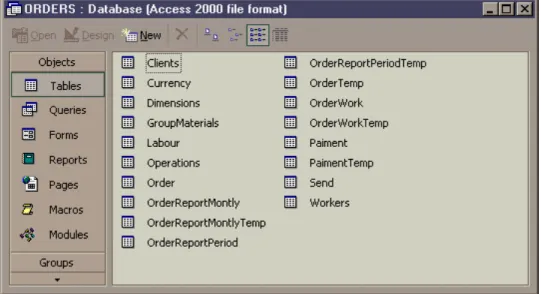
Important moment in the constructing of the system is the integration in different modules of the system tools for analysis and assessment – criteria, for which infor-mation is collected and brought in the firm and on this basis analyses are generated. In the firm’s system there are analyses of the critical reserves of materia ls, optimizing the orders for delivery, loading and using the staff, retable of every order and prod-uct. The introduced in the previously me n-tioned firm modules are conventionally called OFFERS – about formation of the price and planning the expenses of materi-als and labor for every concrete order for production by the clients; ORDERS – about following the information concern-ing the accepted offers for production; WAREHOUSE – follows the information for SEND materials for orders, clients, suppliers; LABOR – about rendering an account of the complete work over orders and workers; REFERENCE – sums up and analyzes the information for the needs of the management of the data for offers, or-ders, materials and labor expenses. Part of the structure of the firm’s database built up in environment of Microsoft Access and
introduced in the firm is presented on fig.4 and fig.5.
Fig. 4. Database – Module AREHOUSE
Fig. 5. Database – Module ORDERS
The integration of the activities of offering and planning in one module, created on the basis of spreadsheets Excel it allows very fast and with minimum labor to receive various primary information, helping the planning of all stages and directions, fi-nancial grounding of the deal – analysis of profitability and taking a decision for the concrete project, for offering discounts in the price, relieves during the execution and simultaneously guarantee for quality with the full connections between work and in-formation. At the moment of creating the offer, a plan for the needed materials, a plan for the labor and financial plan with
costs and profit of the concrete order are created automatically for the client with precise price of the project.
During introduction of the firm’s informa-tion system and the quality management system in the firm it is necessary to formu-late rules for work, which defines the us-age of the computer system, creating in-formation as files or as a part of the data-base, the rights for access and alteration of the data, the management of the
informa-tion flo ws. Here are presented Rules for
collecting, preservation and processing of firm’s information:
1. Centralized database and files with in-formation
2. Management of the access to the
infor-mation
3. Keeping main principles for creating
filenames and data. The usage of filenames in native language with details from the file’s contents allows easier search through arranging by the most commonly used pa-rameter of through the function Search of Windows.
4. Routine processing of the data through
automatic modules and principles and methods of the firm.
5. Preservation of variants of files – every
change is saved in new name (V1, V2…)
6. Supporting basic attributes of every file
– data, author, content – allows control of information and searching through means of computer technique.
7. Creation and management of firm’s
di-rector structure.
8. Regular archiving of data.
9. Training of personnel – including
re-quirements of QMS
10. Control in usage – outer and inner
con-trol and examination, including following for keeping the rules.
11. Constant control of work – integrated
instruments for control – strategic data for its using, passwords and usernames for ac-cess.
12. Continuous development and
improve-ment of the system.
Problems, defects and dangers
• Requires time and resources for its
building, hiring new specialists,
• Training and changing in work,
strug-gle against traditions
• Additional work for people, especially
in the beginning of QMS designe.
E. Conclusions
A production firm is analyzed in direction of the need of information system for qua l-ity management. The main problems are formulated and the possibilities to solve them during integration of the quality management system with information sys-tem in a firm for production of aluminum windows and doors.
A structure and principles are created dur-ing the creation of dynamic integrated in-formation system for management of the firm and the quality according to the stan-dards EN ISO 9001:2000
Effective rules are formulated for develop-ing and exploitation of a firm’s informa-tion system, which guarantees the intro-duction of a quality management system, support of up-to-date, full, reliable data-base for the functioning and managing of the small and medium firms in the sphere of ordering (single) production.
Reference
1. Ruth M. Hamon B., Modelling
Dinam-ics Economic Systems, Springer Verlag. New York 1997
2. Oakshott L., Business Modelling and
Simulation, Pitman Publishing 1997
3. Kalldraff J. Wilson J. Business
optimi-zation using mathematical programming, MacMillan Press 1997
4. Russell Zapalac, Karen Kuemmler, Tim
Malagon. Establishing management infor-mation systems for multiproject programs Journal of management engineering, Jan,febr. 1994,.
5. Mc Kewon, Patrick G., Management
information systems. Managing with com-puters,The Dryden Press 1993