SOCIAL TIES, SHARED VALUES, AND TURNOVER AT THE TOP OF UNDERPERFORMING FIRMS
A Dissertation by
JOSEPH SPENCER HARRISON
Submitted to the Office of Graduate and Professional Studies of Texas A&M University
in partial fulfillment of the requirements for the degree of DOCTOR OF PHILOSOPHY
Chair of Committee, Steven Boivie Committee Members, Nathan Y. Sharp
Laszlo Tihanyi Michael Withers Head of Department, Wendy Boswell
May 2017
Major Subject: Management
ABSTRACT
This dissertation explores how social ties and shared political values among top management teams (TMTs) and directors influence who leaves the firm when it is underperforming. It does so in two distinct studies, using data on executive and director turnover and performance of S&P 1500 firms between 2000 and 2014.
The first study examines how individual executives’ ties to the TMT, including the CEO independently, affect their likelihood of exit in underperforming firms. I argue that greater links to the CEO and the rest of the team—via education, employment, and political ties—will decrease executives’ likelihood of exit in underperforming firms by increasing their level of integration with other team members. I also suggest that greater pay disparity between a given executive and the CEO or the rest of the team will reduce this effect by decreasing executives’ identification with their role and perceptions that they are valued members of the team. Results generally provide support for these arguments and particularly indicate the importance of employment ties and ties to the CEO in reducing executive turnover.
The second study builds on these concepts to explore how these same ties affect power contestation within the triad of the CEO, the TMT, and the board in
underperforming firms. I argue that assigning blame is a social process, such that blame for poor performance will fall on whichever member of the triad is most dissimilar, increasing their likelihood of exit. I also suggest that the level of structural power of the
dissimilar group will reduce this effect by preventing forced turnover. Finally, I argue that when dissimilar members take the blame for poor performance, this will result in a downward spiral scenario in which forced exit prevents turnaround and leads to poorer subsequent performance. Results provide some support for these arguments and indicate that ties to the board may be especially important in predicting whether the CEO or other members of the TMT exit. They also provide evidence that forced turnover of the CEO, but not of the TMT or board, is detrimental to subsequent performance.
ACKNOWLEDGEMENTS
I would like to thank my committee chair, Dr. Boivie, and my committee members, Dr. Sharp, Dr. Tihanyi, and Dr. Withers, for their guidance and support throughout the course of this research.
I also acknowledge helpful comments and suggestions from faculty and students in the Department of Management during the Dissertation Proposal and practice job talks as well as from participants of the Dissertation Consortium of the Organizational and Management Theory Division at the 2016 Annual Meeting of the Academy of Management.
Finally, thanks to my parents for their love and encouragement and inspiring me to pursue a Ph.D. and to my wonderful wife for her patience, love, and support
throughout a rigorous doctoral program. .
CONTRIBUTORS AND FUNDING SOURCES
This work was supervised by a dissertation committee consisting of Professor Steven Boivie and Professors Laszlo Tihanyi and Michael Withers of the Department of Management and Professor Nathan Sharp of the Department of Accounting. All work for the dissertation was completed independently by the student.
There are no outside funding contributions to acknowledge related to the research and compilation of this document.
TABLE OF CONTENTS
Page
ABSTRACT ...ii
ACKNOWLEDGEMENTS ... iv
CONTRIBUTORS AND FUNDING SOURCES ... v
TABLE OF CONTENTS ... vi
LIST OF TABLES ... viii
1. INTRODUCTION ... 1
1.1. General Approach of the Dissertation ... 4
1.2. Contributions of the Dissertation ... 6
2. STUDY 1 ... 8
2.1. Background ... 10
2.2. Theory and Hypotheses ... 13
2.2.1. Education Tie Strength ... 14
2.2.2. Employment Tie Strength ... 18
2.2.3. Shared Political Orientations ... 20
2.2.4. Moderating Role of Pay Disparity ... 21
2.3. Methods ... 24
2.3.1. Sample and Data Collection ... 24
2.3.2. Dependent Variable ... 25
2.3.3. Independent and Moderator Variables ... 26
2.3.4. Control Variables ... 30 2.3.5. Analysis Strategy ... 32 2.4. Results ... 33 2.5. Discussion ... 37 2.5.1. Contributions ... 38 2.5.2. Future Research ... 40 3. STUDY 2 ... 43 3.1. Background ... 45
3.2.1. Elite Education Tie Strength ... 49
3.2.2. Employment Tie Strength ... 52
3.2.3. Shared Political Orientations ... 54
3.2.4. Moderating Role of Formal Power ... 56
3.2.5. Tie-driven Turnover and Subsequent Performance ... 58
3.3. Methods ... 60
3.3.1. Sample and Data Collection ... 60
3.3.2. Dependent Variables ... 61
3.3.3. Independent and Moderator Variables ... 63
3.3.4. Control Variables ... 68 3.3.5. Analysis Strategy ... 70 3.4. Results ... 72 3.4.1. Turnover Models ... 72 3.4.2. Performance Models ... 78 3.5. Discussion ... 79 3.5.1. Contributions ... 80 3.5.2. Future Research ... 82
4. SUMMARY AND CONCLUSIONS ... 85
REFERENCES ... 87
LIST OF TABLES
Page Table 1.1. Descriptive Statistics and Correlations (Study 1) ... 106 Table 1.2. Results of Random Effects Logistic Regression Predicting Executive
Turnover ... 108 Table 2.1. Descriptive Statistics and Correlations (Study 2) ... 111 Table 2.2. Results of Random Effects Logistic Regression Predicting CEO
Exit ... 115 Table 2.3. Results of Random Effects Logistic Regression Predicting TMT
Exit ... 118 Table 2.4. Results of Random Effects Logistic Regression Predicting Board
Exit ... 121 Table 2.5. Results of Random Effects Regression Predicting Firm Performance
Following Forced CEO Exit ... 124 Table 2.6. Results of Random Effects Regression Predicting Firm Performance
Following Forced TMT Exit ... 126 Table 2.7. Results of Random Effects Regression Predicting Firm Performance
1. INTRODUCTION
Despite the considerable body of research exploring turnover at the top of
organizations (Giambatista, Rowe, & Riaz, 2005; Kesner & Sebora, 1994), one question that remains unsettled is how relational dynamics among top organizational members affect who leaves the firm. Research seeking to answer this question has typically drawn from the upper echelons perspective and related theory on organizational demography (Hambrick & Mason, 1984; Pfeffer, 1983) to explore how the demographic or
experiential composition of the top management team (TMT), which are presumed to influence interpersonal attraction and social cohesion among team members, affect turnover. Studies have used a variety of demographic and experiential measures to test this relationship, including tenure, age, industry or functional experience, and education level, but have yielded mixed results. Whereas some have found that diversity along some of these dimensions increases turnover (e.g., Ucbasaran, Lockett, Wright, & Westhead, 2003; Wagner, Pfeffer, & O'Reilly, 1984), many have found null effects for these measures (e.g., Jackson et al., 1991; Ucbasaran et al., 2003; Wiersema & Bantel, 1993) and some have even found effects in the opposite direction (e.g., Boeker & Wiltbank, 2005).
A careful reading of this literature reveals at least three possible explanations for these equivocal findings. First, it may be that the dimensions of TMT composition examined in the past are not closely related to the relational dynamics they presumably measure. While the practice of using executives’ observable characteristics as proxies for unobservable constructs may be just as necessary now as it was when first proposed
in Hambrick and Mason’s (1984) seminal work on the upper echelons perspective, there are likely observable characteristics other than demographics or broad experience that better align with TMT relational dynamics. In particular, research on team processes at lower levels of the organization has distinguished between surface-level diversity, which relates to demographic characteristics, and deep-level diversity, which relates to
attitudes, shared experiences, beliefs, and values (Harrison, Price, & Bell, 1998; Jackson, May, & Whitney, 1995; Milliken & Martins, 1996), and suggests that deep-level
differences are stronger predictors of team cohesion than surface-level differences. Building on this idea, upper echelons research would likely benefit by identifying and studying characteristics of executives that are more closely linked to deep-level comparisons than broad demographics and experience.
Second, the mixed findings in extant research may indicate that the effects of relational factors depend on the context. Importantly, however, scholars have mostly not considered how the strategic context influences the relationship between TMT
composition and turnover. This is a significant oversight, especially given fairly consistent findings in research studying the strategic antecedents of turnover (see Finkelstein, Hambrick, & Cannella, 2009). Specifically, research from a strategic perspective has shown that executive turnover increases during times of poor
performance or crisis (e.g., Arthaud-Day, Certo, Dalton, & Dalton, 2006; Wagner et al., 1984; Walsh, 1988; Walsh & Ellwood, 1991) or when the firm is operating in unstable or complex environments (Wiersema & Bantel, 1993). It has also shown that turnover of top executives (and particularly the CEO) is influenced by agency conditions such as
board independence and executive career horizons (Krause & Semadeni, 2014; Laux, 2008). At the same time, because this work has conceptualized turnover at the level of the system rather than the individual level (Wagner et al., 1984), it has tended to study whether turnover occurs in a firm without considering which individuals leave the firm. In this regard, integrating strategic and relational perspectives may not only help to clarify mixed findings associated with the effects of TMT composition (Carpenter, 2002), but may also inform the strategic perspective by clarifying who is most likely to exit when turnover occurs.
Third, research from a relational perspective has not included directors in analyses of turnover at the top of organizations. Yet, research from a strategic
perspective suggests that the same factors that influence executive turnover may also affect director exit (Arthaud-Day et al., 2006; Semadeni, Cannella, Fraser, & Lee, 2008; Srinivasan, 2005). Moreover, based on Finkelstein and colleague’s (Finkelstein & Hambrick, 1996; Finkelstein et al., 2009) concept of the “supra TMT”, which essentially considers boards an extension of the executive team, failing to consider how directors play into the relational dynamics at the top of the organization may lead to theory and findings that are underspecified. Overall, these issues lead me to question: what relational characteristics most influence turnover within an organization’s dominant coalition? When are the effects of these characteristics on turnover most evident? And how do they simultaneously affect turnover of the CEO, other top executives, and outside directors?
1.1. GENERAL APPROACH OF THE DISSERTATION
This dissertation seeks to answer these questions by developing novel theory on the effect of internal composition on top organizational member turnover in two distinct studies. The theory integrates the notion of deep-level diversity with various concepts from the domains of social psychology and sociology, including concepts from the identification literature and research on social network ties, to explore how social ties and shared values influence turnover at the top of firms. I specifically examine the effects of educational and employment ties and shared political values on turnover of top organizational members.
As a starting point for both studies, I argue that the effects of these relational factors will be most evident in underperforming firms. This argument follows the social identification literature (Ashforth & Mael, 1989; Tajfel & Turner, 1985; Turner, 1975, 1984), which suggests that similarities and differences between individuals become most salient under conditions of tension or conflict (Ashforth & Johnson, 2001). Within an organization, underperformance represents a high-pressure context that is likely to increase conflict between members at the top of the organization as they seek to assign blame for the firm’s strategic failings and encounter pressure from shareholders to improve the situation. Under these conditions, similarities and differences between top decision makers will become more salient. As such, I argue that the relationships between social ties as well as shared values and turnover will be more pronounced in underperforming firms relative to superior performing firms.
Building from that point, the first study seeks to understand how the social ties and values shared between individual executives and the CEO or the rest of the team affect their likelihood of exit when the firm is performing poorly. The general argument is that, while overall turnover levels may rise when the firm is performing poorly, a stronger relationship between any given executive and the CEO or the rest of the team via social ties and shared values will reduce that executive’s likelihood of departure. This is because these links, which I suggest are more representative of deep-level similarities than factors examined in the past, will enhance the executive’s sense of integration and identification with the CEO and the rest of the team and strengthen his or her desire to remain with the firm and improve its performance. The study also considers how different types of identification may interact to determine exit outcomes for
executives in underperforming firms. Specifically, it examines how pay disparity influences the effect on exit of social ties and shared values, which are indicative of social identification and integration, by altering executives’ perception of themselves as valued members of the team and their identification with their role.
The second study expands on the concepts of the first to examine how these same social ties and shared values influence power contests at the top of underperforming firms by affecting the relative strength of the relationships between the triad of the CEO, the TMT, and the board. I argue that the assignment of blame for poor performance is a social process such that the more tightly connected are any two members of the triad, the greater the likelihood that members of the dissimilar group will be directly or indirectly pushed out of the firm. I also explore how structural power moderates these relationships
by affecting the ability of any two groups to force members of the third out of the firm. In this way, I consider how relational and structural power may interact to determine who leaves the firm when it is performing poorly. In addition, I argue that forced exit is likely to lead to a downward spiral scenario as ineffective managers and/or directors are retained and those members with perhaps the best likelihood of encouraging turnaround leave the firm.
1.2. CONTRIBUTIONS OF THE DISSERTATION
By exploring how social ties and shared values influence turnover and power contests at the top of firms, this dissertation makes a number of contributions to
management research. The first study extends work on executive turnover by developing novel theory and measures of factors that are more closely associated with deep-level diversity and that help to clarify the effects of team composition on turnover outcomes for individual executives. At the same time, it controls for the measures used in past work in order to demonstrate the importance of these indicators of deep-level similarities above and beyond the broader demographic and experiential measures. It also
distinguishes between individuals’ relationship with other team members versus their relationship with the CEO, in particular, and how these separately affect the likelihood of exit. Finally, by exploring how the performance context of the firm influences how these relational factors affect turnover, it provides a greater understanding of the
interaction between strategic and relational antecedents of executive turnover and when relational factors may be most salient.
The second study further extends research on executive and director turnover by exploring how these same relational factors affect power contests between the CEO, TMT, and board in underperforming firms. Despite consistent findings related to the direct relationship between poor performance and turnover for each of these individual groups (e.g., Arthaud-Day et al., 2006; Cowen & Marcel, 2011; Fama, 1980; Puffer & Weintrop, 1991; Srinivasan, 2005; Wowak, Hambrick, & Henderson, 2011), research has seldom explored simultaneous turnover for these members. By exploring how the social links among all members of the firm’s dominant coalition influence power contestation, this study develops knowledge regarding which organizational member is most likely to exit when a firm is underperforming.
The dissertation also expands research on turnover by extending the focus from CEOs to other organizational members. Although scholars have done much to build our understanding of CEO turnover and succession, we still know relatively little about the antecedents of turnover for other top executives and members of the board. Additionally, while the strategic antecedents of turnover are generally well established, research has yielded mixed findings related to the effects of compositional or relational factors. Overall, by examining the dynamic relationships between the CEO, TMT, and board in a given firm, this dissertation adds insights to the processes leading to exit of a broader range of organizational members at the top of the firm.
2. STUDY 1
Executive turnover has strong implications for the future direction and
performance of firms (Huson, Parrino, & Starks, 2001; Kesner & Dalton, 1994; Miller, 1993). As a result, scholars have devoted considerable attention to exploring its
antecedents. Extant research has particularly emphasized the role of firm performance and the environment in predicting executive turnover, generally finding evidence that these factors are relevant antecedents (see Finkelstein et al., 2009). However,
recognizing that organizations are fundamentally relational (Wagner et al., 1984), some have also sought to explicate the relational drivers of exit. In general, this work has suggested that the composition of the top management team (TMT), as reflected by demographic or experience diversity, affects TMT turnover by influencing the relational dynamics elsewhere shown to predict turnover outcomes, such as social cohesion, integration, and relational conflict (Michel & Hambrick, 1992; Simsek, Veiga, Lubatkin, & Dino, 2005; Wagner et al., 1984). Yet, results across studies have been mixed.
Although some have found that diversity along these dimensions increases turnover (e.g., Wagner et al., 1984), others have found null effects (e.g., Jackson et al., 1991; Wiersema & Bantel, 1993) and some have even found effects in the opposite direction (e.g., Boeker & Wiltbank, 2005).
This work helps to illustrate that much is still unknown regarding the effect of relational factors on executive turnover. In particular, given weak relationships between turnover and demographic and experience diversity, we are left to question whether there may be other elements of TMT composition that are more relevant to internal dynamics
and subsequent turnover outcomes. Further, while scholars have explored strategic and relational antecedents separately, little work has attempted to integrate these disparate research streams to answer the question of how these factors may interact to predict executive turnover. Given evidence that the effects of relational factors largely depend on the context (Carpenter, 2002), it is likely that exploring this question may clear up some of the mixed findings in extant work. Relatedly, this may also extend past research on the strategic antecedents of turnover, which has generally focused on overall TMT turnover, to address whether relational factors help to predict which specific individuals leave when the firm is underperforming.
This study builds on these opportunities and seeks to extend work on executive turnover by developing and testing theory related to the effect of social ties and shared values on executive turnover in underperforming firms. Drawing primarily on theory and research from the social network and identification literatures, I explore how education ties, employment ties, and shared political values between individual executives and the rest of the TMT, including the CEO specifically, influence their likelihood of exit when things go poorly. I argue that, while underperformance may increase overall rates of turnover, executives with stronger links to the CEO or the rest of the TMT will perceive a greater sense of integration and commitment to the team and will be less likely to exit than less connected individuals. I also explore how pay disparity moderates these relationships by affecting executives’ identification with their role and the CEO as well as their perception that they are valued members of the team. Prior to developing these
arguments, however, I first provide a brief summary of the research on executive turnover as a motivation for exploring the relationships I examine.
2.1. BACKGROUND
As previously indicated, extant research examining the antecedents of executive turnover has been dominated by studies exploring strategic factors such as firm
performance, agency conditions, and/or the environment (see Finkelstein et al., 2009). This research has consistently demonstrated that turnover of top executives increases when a firm is performing poorly (e.g., Wagner et al., 1984; Walsh, 1988; Walsh & Ellwood, 1991) or when it is operating in unstable or complex environments (Wiersema & Bantel, 1993). Similarly, this work has found that turnover rises above “normal levels” within target firms following acquisitions and these effects are intensified for firms with a history of poor performance (Walsh, 1988; Walsh & Ellwood, 1991). Research has also provided evidence that turnover of top executives, and particularly the CEO, depends on factors associated with corporate governance and agency conditions within the firm, such as the degree of board independence or executive career horizons (Krause & Semadeni, 2014; Laux, 2008). Overall this work suggests that executive turnover often represents an adaptation or turnaround strategy intended to help
struggling firms realign with their competitive environment and that it is dependent on the governance of the firm.
To a more limited extent, scholars have also explored how composition of the TMT, as an indicator of team relational dynamics, affect executive turnover. This work has generally posited that diversity increases turnover rates within the TMT and the
likelihood of individual turnover because it decreases integration and leads to internal conflict (Jackson et al., 1991; Wagner et al., 1984; Wiersema & Bird, 1993). To test this proposition, scholars have examined broad characteristics associated with executive demography or experience, such as age, tenure, industry or functional experience, and education level. Yet, results across studies have been mixed. For instance, in a sample of Fortune 500 firms, Wagner et al. (1984) found positive relationships between both demographic heterogeneity team-level turnover rates as well as individual demographic dissimilarity and the likelihood of individual-level exit. By contrast, Boeker and
Wiltbank (2005) found that greater functional diversity decreased exit in entrepreneurial firms. However, the majority of work in this area has found little or no effect of
demographic and experiential dimensions on turnover of top executives (e.g., Jackson et al., 1991; Wiersema & Bantel, 1993).
A review of this work suggests a few possible reasons why scholars have struggled to come to any sort of consensus understanding of the relationship between team composition and executive turnover. One possible explanation is that past work may have been limited by scholars’ use of broad demographic and experiential characteristics to proxy for deeper, social processes. In this regard, the distinction between surface-level diversity and deep-level diversity from the organizational behavior literature (Harrison et al., 1998) may be helpful in developing a clearer understanding of the factors that contribute to social dynamics within executive teams. This research suggests that surface-level diversity related to demographic characteristics, which have largely been the focus of past work, is a much weaker determinant of social
dynamics than deep-level diversity, which reflect individuals’ shared experiences, beliefs, and values (Harrison et al., 1998; Jackson et al., 1995; Milliken & Martins, 1996). Thus, while the use of proxies may be necessary to examine these relationships at the highest levels of the firm (Hambrick & Mason, 1984), research could greatly benefit from the examination of factors that more closely resemble deep-level diversity.
A second possible explanation for the equivocal findings in extant work is that this work has mostly not explored how the relationship between social factors and turnover may differ based on the context in which the TMT is operating. This is
surprising, given consistent evidence regarding the strength of the relationship between strategic factors, and especially performance, and turnover (e.g., Wagner et al., 1984; Walsh, 1988; Walsh & Ellwood, 1991). Indeed, the strategic context may be critical in determining how diversity affects social dynamics (Carpenter, 2002) and, in turn, turnover outcomes.
This idea is reflected in the social identification literature (Ashforth & Mael, 1989; Tajfel & Turner, 1985; Turner, 1975, 1984), which offers theory to describe the way individuals view themselves and others within the social environment. From this perspective, much of what people do in a social context is motivated by a desire to fulfill intrinsic needs such as maintaining or enhancing a sense of self-esteem, belonging, distinctiveness, efficacy, meaning, and/or stability (Lange, Boivie, & Westphal, 2015; Vignoles, Regalia, Manzi, Golledge, & Scabini, 2006). These motives lead to
“psychological grouping” in which individuals classify themselves and others into social categories or groups based on salient characteristics of category “members” (Tajfel &
Turner, 1985; Turner, 1985). Importantly, however, the characteristics used for these grouping processes become most salient under conditions of tension or conflict (Ashforth & Johnson, 2001). In this regard, similarities and differences among top managers may be most salient when the firm is underperforming, since
underperformance represents a context in which conflicts are likely to arise. In the following section, I build on these ideas to explore how factors that are more closely linked to deep-level diversity affects who leaves the firm in the context of
underperformance.
2.2. THEORY AND HYPOTHESES
At the top of the organization, underperformance is one situation that may increase tension or conflict between TMT members, as both internal and external
constituents seek to assign blame for the firm’s strategic failings (e.g., Barton & Mercer, 2005; Boeker, 1992; Clapham & Schwenk, 1991) and pressure boards and executives to make changes to improve the situation (e.g., Bethel & Liebeskind, 1993; Davis & Thompson, 1994). At the same time, underperformance (or performance under that of competitors) is common enough that it is unlikely to cause mass exit, as would be the case under circumstances of extreme poor performance or firm crises such as financial reporting failures or bankruptcy (e.g., Arthaud-Day et al., 2006; Gomulya & Boeker, 2014; Semadeni et al., 2008). Further, because forced exit is most likely to occur only in severely underperforming firms (Conyon & Florou, 2002), executives likely have at least some level of discretion in deciding whether to leave the firm. Thus, while poor
1988; Walsh & Ellwood, 1991), who specifically leaves the firm may depend on the relationships among executives, as determined by their level of connectedness or similarity.
At the same time, not all similarities and differences are likely to affect team dynamics and subsequent turnover equally. Rather, characteristics related to deep-level similarities, or shared experiences, beliefs, and values, are likely to have a more
prominent effect on relational dynamics than demographic or other surface level
similarities (Harrison et al., 1998; Jackson et al., 1995; Milliken & Martins, 1996). Here, I develop theory related to three factors that may be more indicative of deep-level similarities for TMT members—education ties, employment ties, and shared political values. For each, I describe its relevance to executives, how it relates to deep-level similarities, and how it subsequently influences a given executive’s likelihood of leaving the firm when it is underperforming. Importantly, I also suggest that these characteristics will have an independently meaningful beyond (and controlling for) the effect of
demographic characteristics.
2.2.1. Education Tie Strength
One relevant aspect of executives’ social context that may affect their likelihood of turnover in underperforming firms is the strength of their ties to other executives through shared university affiliations (i.e., a common alma mater). Indeed, for members of the corporate elite, educational credentials are not just a signal of human capital in terms of intelligence or skill (e.g., Colombo, Delmastro, & Grilli, 2004; Pennings, Lee, & Van Witteloostuijn, 1998), but may also affect their social capital by affecting their
relative social standing or membership in social groups (e.g., Belliveau, O'Reilly, & Wade, 1996; D'Aveni, 1990; Erkens & Bonner, 2013). From a social identity perspective, this is because education ties represent a salient characteristic used for psychological grouping, which also increases identification between individuals who share them (Mael, 1988; Mael & Ashforth, 1992). That is, because individuals often take pride in their alma mater, they are likely to identify with and show favoritism towards other alumni. This tendency is likely irrespective of the time that has passed since attending the school or the number of other schools attended (e.g., Mael & Ashforth, 1992). Based on a social networks perspective, this may be because education ties are among the most stable forms of social networks (Nguyen, 2012) and affect individuals’ social worlds and interpersonal relationships by creating “divides in [their] personal environments” (McPherson, Smith-Lovin, & Cook, 2001: 415).
In addition, sharing similar backgrounds and personal experiences through common university affiliations may be associated with similarities in attitudes, beliefs, and value systems as well as a common language (Wiersema & Bird, 1993). For instance, alumni of the same school would be familiar with the customs, traditions, or other idiosyncratic elements of their alma mater, encouraging greater identification and cohesion between these individuals (George & Bettenhausen, 1990; Mael & Ashforth, 1992). Further, although individuals consider a number of factors when selecting a university (Maringe, 2006), particular universities are likely to attract similar, like-minded individuals who are drawn to the school based on the culture, environment, and stated values of the school. In this way, education ties may be reflective of deep-level
similarities because of both a selection effect (i.e., individuals selecting into universities based on deep-level characteristics) and a treatment effect (i.e., socialization and
experiences at the institution allow individuals to develop deep-level similarities). In either case, these ties would lead to enhanced cohesion and cooperation among executives who share them.
Moreover, these dynamics should be more pronounced for individuals who attended the same university during the same period. In part, this is because concurrently attending the same university would increase the perception of joint experience, which is associated with a common language (Johannisson, 1987) and can enhance social
identification. Further, concurrent attendance also increases the likelihood that
individuals would have directly interacted while at the university (e.g., been in the same courses, gone to the same social gatherings, etc.). Having attended the university at the same time would therefore increases the likelihood that the working relationship came from a previous friendship tie, which would increase trust, mutual respect, and shared identity between executives (e.g., Chua, Ingram, & Morris, 2008; McGrath &
Krackhardt, 2003; Rydgren, Sofi, & Hällsten, 2013).
In turn, during times of underperformance, executives with greater education ties to others on the team will be less likely to leave the firm because they will experience greater cohesion and lower levels of conflict with the rest of the team (e.g., Friedkin, 2004; George & Bettenhausen, 1990). Indeed, extant research on the corporate elite has found that greater identification between executives increases collaboration and
perceptions of and involvement in the organization and cooperation with other group members (e.g., Dutton, Dukerich, & Harquail, 1994). Additionally, since education ties heighten identification between individuals, executives with greater ties to the rest of the team through shared university affiliations may be more committed to the team and more willing or likely to remain with the firm to help improve its situation (Withers, Corley, & Hillman, 2012).
Further, education ties between an executive and the CEO may have particularly strong effects relative to, and independent of, the ties between the executive and the rest of the team. This is because the CEO is typically the most powerful and influential member of the managerial team (Smith, Houghton, Hood, & Ryman, 2006). In part, this dominance will encourage classical identification (Kelman, 1961) in which executives strive to appease or emulate the CEO and subsequently have greater commitment to that individual (Ashforth & Mael, 1989). As such, individuals with strong ties to the CEO will be more likely to remain in the firm and to support the CEO when things go poorly. Additionally, because the CEO may have some direct control over who is blamed and ultimately dismissed for poor performance (Boeker, 1992), links to the CEO may be particularly important in determining whether an executive leaves the firm when it is underperforming. That is, executives may be in a better position to avoid blame or may be protected by the CEO, thus retaining their position.
Of course, ties to the CEO may only protect an executive when the CEO him- or herself is not dismissed for poor performance. In this regard, while past work has
also suggested that CEO dismissal is most likely to occur in severely underperforming firms and that CEOs are often able to avoid dismissal in circumstances other than extreme poor performance or crisis (Boeker, 1992; Conyon & Florou, 2002; Fisman, Khurana, Rhodes-Kropf, & Yim, 2014). I therefore argue that, in most cases, CEOs will remain even in underperforming firms such that stronger ties to the CEO will decrease the likelihood of individual executive turnover. Overall, I posit:
Hypothesis 1.1: Stronger education ties between an executive and (a) the CEO or (b) the rest of the TMT (excluding the CEO) will decrease the likelihood that the executive will leave the firm when it is underperforming.
2.2.2. Employment Tie Strength
Another factor that may influence executives’ likelihood of leaving the firm during times of underperformance is the strength of their ties to the rest of the team via common employment histories. Similar to education ties, employment histories not only reflect executives’ human capital or expertise (e.g., Harris & Helfat, 1997; Pennings et al., 1998), but may also reflect individuals’ social capital and may form the basis for their personal networks (Belliveau et al., 1996). Also similar to education ties, common company affiliations enhance social identification and increase cohesion among those who share them (Hogg & Turner, 1985; Turner, 1984). As stated by Beckman (2006: 743), “team members with common prior company affiliations have a shared language, culture, and narratives”. Employment ties are therefore likely to reflect deep-level similarities that will enhance integration and cohesion among executives (Wiersema & Bird, 1993) as well as their sense of mutual respect and shared identity (Chua et al., 2008; McGrath & Krackhardt, 2003; Rydgren et al., 2013).
Consistent with the arguments in the previous section, the effects of employment ties should also be stronger for those with shared time at a prior employer as compared to those who worked for the company at different times. Again, this is because
executives with shared time at a prior employer are likely to have known each other and worked together directly, which would improve the nature and extent of communication, integration, and cohesion between them (e.g., Eisenhardt & Schoonhoven, 1990;
Wiersema & Bird, 1993). Such ties may also reflect that the current working relationship materialized because of a previous friendship tie, which again, is associated with mutual respect, trust, and shared identity (e.g., Chua et al., 2008; McGrath & Krackhardt, 2003; Rydgren et al., 2013). In addition, executives with contemporaneous employment at a prior company would have experienced the same dynamics (e.g., culture, leadership, etc.) or strategic events (e.g., mergers, divestitures, etc.), increasing their level of identification with each other. Moreover, such shared experiences need not engender pride in the prior employer or be positive to encourage identification. Rather, because “identification is seen as personally experiencing the successes and failures of the [psychological] group” (Ashforth & Mael, 1989: 21, emphasis in original; see also Foote, 1951; Tolman, 1943), even shared negative experiences or failures at a previous employer would enhance identification and cohesion among individuals.
Overall, executives with stronger employment ties to the rest of the team will identify more and be more committed to the team. When difficulties arise in the firm, then, these individuals will be more likely to remain with the firm than less-connected executives (Withers et al., 2012). In addition, following the same logic presented in the
previous section, these effects are likely to be especially and independently predictive for ties to the CEO relative to the rest of the team. Thus, I posit:
Hypothesis 1.2: Stronger employment ties between an executive and (a) the CEO or (b) the rest of the TMT (excluding the CEO) will decrease the likelihood that the executive will leave the firm when it is underperforming.
2.2.3. Shared Political Orientations
In addition to social ties, the degree of overlap in executives’ political orientations is another factor that is likely to influence turnover at the top of
underperforming firms. In general, political orientations are a major indicator of one’s belief systems and core values (see Goren, 2005) and, therefore, represent another deep-level characteristic that would affect the relationships among group members. Moreover, given evidence that executive political ideologies are often reflected in firm strategy and decisions (e.g., Chin, Hambrick, & Treviño, 2013; Christensen, Dhaliwal, Boivie, & Graffin, 2015), these orientations are likely to come into the workplace and become a relevant aspect of executive team dynamics.
Similar to the other characteristics examined, political affiliations are also a relevant factor contributing to psychological group formation and social identification (Deaux, Reid, Mizrahi, & Ethier, 1995). They are thus likely to affect the degree of cohesion and conflict among executives. For instance, research on political identity suggests that affiliates of major political parties tend to psychologically discriminate in favor of their own party and against the opposing party (e.g., Duck, Terry, & Hogg, 1998; Fowler & Kam, 2007; Huddy, 2001). This is true even when individuals perceive some differences between their personal political positions and those of the political
party (e.g., Duck, Hogg, & Terry, 1995). As such, political affiliations are likely to lead to increased intragroup cohesion, while simultaneously increasing inter-group conflict (see Huddy, 2001; Monroe, Hankin, & Vechten, 2000).
The tendency for executives’ political orientations to affect team dynamics may be even more likely during periods of underperformance, since tensions will already be high and similarities and differences in executives’ values will become more evident (Harrison et al., 1998). Under these circumstances, executives who lean towards the dominant political orientation of the team are likely to experience greater identification and have a greater sense of integration with the team than those who do not. In turn, these executives would be more committed to the team and more likely to remain with the firm. At the same time, based on the same arguments regarding the relative
importance of ties to the CEO, executives who share political orientations with the CEO may also be less likely to leave irrespective of whether those orientations reflect the dominant position of the rest of the team. Altogether, then, I posit:
Hypothesis 1.3: Shared political orientations between an executive and (a) the CEO or (b) the rest of the TMT (excluding the CEO) will decrease the likelihood that the executive will leave the firm when it is underperforming.
2.2.4. Moderating Role of Pay Disparity
To this point, I have argued that stronger social ties and shared values may
decrease exit for individual executives in underperforming firms by increasing their level of integration and social identification with other members of the team. However, other contextual factors may also be pertinent in determining whether these ties will reduce an executive’s likelihood of exit. In particular, research suggests that multiple forms of
identification (i.e., social identification, relational identification, role identification, organizational identification) often interact to determine actors’ behavior (e.g., Sluss & Ashforth, 2007, 2008). In the context of turnover from underperforming firms, Withers et al. (2012) specifically suggested that individuals’ identification with their role may compete with their collective identity (i.e., social identity) to determine whether or not they leave the firm. Although the authors make this argument for corporate directors, because executives and directors are both members of the corporate elite, I suggest that this logic should apply equally well to executives. In particular, I argue that an
executive’s identification with the group and their identification with their role as one of the firm’s executives may interact to determine their likelihood of exit.
In general, role identification reflects the meaning obtained by an individual by virtue of maintaining a particular role position (Hogg, Terry, & White, 1995; Stryker, 1980). However, one’s identification with a specific position may vary based on the context and whether it fulfills their expectations of the meaning they associate with their role. For executives, one factor that may have a particularly important effect on their identification with their position is pay disparity between them and other members of the team. Within the management literature, pay disparity denotes relative compensation either between executives and the CEO, referred to as “CEO pay gap” (e.g., Gnyawali, Offstein, & Lau, 2008; Ridge, Hill, & Aime, 2017), or between a given executive and the rest of the team (e.g., Fredrickson, Davis-Blake, & Sanders, 2010; Ridge et al., 2017; Siegel & Hambrick, 2005). In this way, compensation often becomes the basis for social
comparisons and may influence how executives view their position and the meaning they derive from being an executive of the firm.
Executives whose pay is substantially lower than either the CEO or other members of the team are likely to experience lower levels of satisfaction and
identification with their position (Wall & Nolan, 1986, 1987). In part, this is because relative pay often reflects power dynamics within the team. Since executives tend to be highly ambitious and desire autonomy in their positions (e.g., Harrell & Alpert, 1979; Olujide & Badmus, 1998), any factor that reduces their perceptions of power will decrease their sense of fulfillment and identification with their role (Lorsch & MacIver, 1989). Similarly, higher pay disparity may weaken executives’ perceptions that they are valued members of the team and thus limit the sense of integration that would come from links to other TMT members. When the firm is underperforming, then, even executives with links to the rest of the TMT may be less committed to the firm and less likely to remain to help improve the situation. I therefore posit:
Hypothesis 1.4: Greater pay disparity between an executive and (a) the CEO or (b) the rest of the TMT will weaken the negative relationship between education ties with the CEO or the rest of the team, respectively, and the likelihood that the executive will leave the firm when it is underperforming.
Hypothesis 1.5: Greater pay disparity between an executive and (a) the CEO or (b) the rest of the TMT will weaken the negative relationship between
employment ties with the CEO or the rest of the team, respectively, and the likelihood that the executive will leave the firm when it is underperforming. Hypothesis 1.6: Greater pay disparity between an executive and (a) the CEO or (b) the rest of the TMT will weaken the negative relationship between shared political orientations with the CEO or the rest of the team, respectively, and the likelihood that the executive will leave the firm when it is underperforming.
2.3. METHODS
2.3.1. Sample and Data Collection
The sample for this study includes 13,581 executives of 1,475 firms that were included on Standard & Poor’s (S&P) 1500 at any point between 2000 and 2014. The base sample was drawn from Compustat Executive Compensation (Execucomp) database, which contains names, titles, annual compensation data, and demographic information for the highest paid executives of S&P 1500 firms since 1992. Executive education and employment information were taken from BoardEx database, which contains, among other things, education levels attained, degrees completed, and
comprehensive employment histories for executives and directors of more than 800,000 major public and private organizations around the globe. To gauge political orientations, I used individual political contributions taken from the Center for Responsive Politics (CRP; opensecrets.org). CRP is a non-partisan research institute that provides
summarized political data including all campaign contributions over $200 made by individuals to U.S. political candidates since 1989, originally taken from the Federal Election Commission (FEC) website. Additional firm and industry data were collected from Compustat.
Except for the political data, all data used for the study were drawn from databases included on the list of public use datasets approved by Texas A&M
University’s Institutional Review Board (IRB). Additionally, political data taken from CRP included only publically available data that are identifiable without expectation of privacy.
2.3.2. Dependent Variable
The dependent variable for the first study is individual executive turnover, measured using a dichotomous variable coded 1 if the focal executive left the firm within a year of the year the independent and control variables were measured and 0 otherwise. I assessed turnover within a year in order to grant adequate time for the theorized relational dynamics to manifest following underperformance, without introducing error from changes in the composition of the TMT between the onset of underperformance and the time the executive left the firm.
For robustness, I also ran models using turnover within two and within three years of the focal year. Results related to my hypothesized relationships were consistent to those reported below for the two-year window but were not consistent for the three-year window. These findings seem to validate the concern that an excessive lag between the onset of poor performance and observed exit may introduce error, likely because of changes in the composition of the TMT. Specifically, the composition of the TMT will change over time and who is in the firm immediately preceding a given exit period is much more likely to affect turnover during that period than who was in the firm three years prior.
In addition, because Execucomp only lists the highest paid executives within a firm in a given year, it is possible that some observed “exits” are the result of the executives dropping out of the highest paid group rather than leaving the firm. To mitigate this issue, I performed a check for each executive to determine whether he or she reappeared as an executive of the given firm in the three years following the first
observed exit. In cases where the executive reappeared within three years, I recoded the first exit event as 0. Thus, the final turnover variable only takes the value 1 if the focal executive left the firm and did not reappear in the firm within three years of the initial exit.
2.3.3. Independent and Moderator Variables
The major independent variables for this study are education tie strength,
employment tie strength, and shared political orientations. Each variable was constructed using a multi-phase approach and assessed for individual executives relative to the CEO as well as individual executives relative to the rest of the TMT (excluding the CEO).
I assessed education tie strength as the sum or sum of standard scores of two indicators of education ties: (a) common alma mater and (b) contemporaneous attendance at a common alma mater. To calculate this variable, I used data on prior university affiliations and degrees for each individual executive, including the name of the university and the year the degree was granted. I then matched university affiliations for each executive against the CEO and every other member of the TMT for every firm-year in the sample. To assess whether a given pair of executives had a common alma mater, I created a dummy variable coded 1 if they both received a degree from the same school, regardless of the level of the degree (i.e., bachelor’s, master’s, etc.). For
executive pairs with a common alma mater, I then determined whether the executives had shared time at the university by comparing the years their degrees were granted and generating a dummy variable coded 1 if the executives received their degrees within the same two- or four-year window, based on the type of degree (i.e., bachelor’s degrees
were assumed to be four-year programs, most masters degrees were assumed to be two-year programs, etc.). For comparisons against the CEO, I then calculated education tie strength (CEO) as the sum of these two dummy variables. As such, this variable not only reflects the existence of a tie between an executive and the CEO, but also indicates the relative strength of that tie.1
I followed a similar procedure for comparisons against the TMT, except that before taking the standard scores, I created proportional measures by generating
variables reflecting the number of members of the TMT with whom the focal executive had a common alma mater or contemporaneous attendance at a common alma mater, respectively, divided by the number of other non-CEO executives on the team. Thus, education tie strength (TMT) reflects the sum of standard scores of the proportion of the TMT that had a common alma mater with the focal executive and the proportion of the TMT that attended a common alma mater at the same time as the focal executive.2
I similarly assessed employment tie strength as the sum of standard scores of two indicators of employment ties: (a) common prior employer and (b) contemporaneous employment at a common prior employer. For this variable, I first gathered data on all
1 As a robustness check, I also ran models separately including these indicators of education ties to the CEO as well as the indicators for ties to other members of the TMT. These models also included separate indicators for the employment ties to both the CEO and the rest of the TMT, described below. In these models, only the indicator for shared alma mater with the CEO remained statistically significant. This suggest that shard alma mater with the CEO may be a particularly important link, but also seems to support the notion that, beyond just the existence of a link, the strength of the link is relevant in determining executive exit.
2 I also ran models using the simple count of executives with shared alma mater or contemporaneous attendance at an alma mater (i.e., rather than the proportion of executives with such a tie). These models also included simple counts for the employment ties described below. I found no change in the reported effects using these measures. I opted to use the proportional measure because it controls for the size of the TMT, allowing for clearer comparisons across firms.
prior company affiliations for each executive, including the name of the company as well as the executive’s start and end dates. I then matched these affiliations following the same procedure used for education ties. As such, employment tie strength (CEO) is the sum of standard scores of dummy variables indicating whether the focal executive and the CEO had worked for the same prior employer and whether they were employed by that company at the same time. Likewise, employment tie strength (TMT) reflects the sum of standard scores of the proportion of the TMT that worked for the same prior employer as the focal executive and the proportion of the TMT that worked at a prior employer at the same time as the focal executive.
Following previous work (e.g., Chin et al., 2013; Christensen et al., 2015; Gupta & Wowak, 2017) I evaluated shared political orientations by comparing executives’ political orientations with the CEO and other TMT members based on their individual political contributions to Republican versus Democratic candidates. Specifically, I measured each executive’s political orientation as the amount of money he or she provided to republican candidates minus the amount provided to democratic candidates, divided by the total money provided to both democratic and republican candidates. This variable fell on a range from -1 to 1, where -1 indicates that all contributions were made to democratic candidates and 1 indicates that all contributions were made to republican candidates. Executives with no contributions to either party were assumed to be
moderate and given a value of 0. Using this measure, I next created a categorical
variable indicating whether the executive had political leanings towards the Democratic Party (i.e., political orientation less than 0), was a moderate (i.e., political orientation
equal to 0), or had political leanings towards the Republican Party (i.e., political
orientation greater than 0). I then used this variable as the basis for comparisons against the CEO. Specifically, I measured shared political orientations (CEO) as a dichotomous variable taking the value 1 if the focal executive and the CEO had the same political orientation.
To measure shared political orientations between executives and the rest of the TMT, I compared each executive’s political orientations to the average of the rest of the team. That is, for each firm-year, I first created a variable containing the average
political orientation of other TMT members (outside of the focal executive and the CEO). Next, I used this variable to create an indicator of the political orientations of the rest of the TMT, similar to the individual-level variable described above. I then
measured shared political orientations (TMT) as a dichotomous variable taking the value 1 if the focal executive’s orientation was the same as the dominant orientation of the TMT.3
The moderators for this study include measures of relative compensation
between executives and the CEO as well as the rest of the TMT. Relative compensation was evaluated using measures of the pay gap (e.g., Gnyawali et al., 2008; Henderson & Fredrickson, 2001). Specifically, pay gap (CEO) is operationalized as the annual compensation of the CEO, including salary, bonus, and stock option grants, minus the
3 As a robustness check, I also created and tested a measure reflecting the proportion of the TMT with the same political orientations as the focal executive similar to the education and employment tie variables. Results using this measure were unchanged. I chose to retain the dichotomous variable because, unlike the tie variables, I am not concerned here with tie strength, but with the predominately held beliefs and values of the rest of the team as a whole and whether the focal executive is likely to share those values.
annual compensation of the focal executive. Similarly, pay gap (TMT) is measured as the executive’s annual compensation subtracted from the average compensation of the rest of the executive team (excluding the CEO). Thus, positive values indicate pay below the CEO or the average TMT member, respectively, and negative values indicate pay above the referent.
2.3.4. Control Variables
I also control for a number of variables with potential effects on turnover
outcomes for executives. At the individual level, I control for executive gender and age. Given the relative difficulty women have breaking into the corporate elite (Oakley, 2000), female executives may place more value on any given position and be generally less likely to leave. The age of the executive is likely positively associated with turnover, as older executives may leave due to retirement. In addition, to eliminate possible
confounding effects of executive exit due to death, I dropped all executives from the sample who fell out of the sample due to death.
At the team level, I control for various measures of demographic and experience diversity that have been widely examined in past work on executive turnover (Jackson et al., 1991; Wagner et al., 1984; Wiersema & Bird, 1993). I assessed demographic
diversity along three dimensions: age, gender, and ethnicity. Gender and ethnic diversity were measured using Blau’s (1977) heterogeneity index (1 − ∑ 𝑝𝑖2), where pi equals the
proportion of TMT members in each ith category. Age diversity was assessed using the coefficient of variation on age, calculated for each firm-year as the standard deviation of the age of all TMT members divided by the average age of all TMT members. I assessed
experience diversity along four separate dimensions: education level, firm tenure, tenure in the focal firm’s industry, and industry experience diversity (i.e., the number of
industries in which each executive had experience). Similar to the demographic variables, I used Blau’s (1977) index to calculate education level diversity. All other experience diversity measures were calculated using the coefficient of variation.
I also control for a number of firm-level variables, including CEO and TMT exit, firm size, and two indicators of firm crises shown to significantly influence turnover of executives. I measured CEO exit as a dichotomous variable and TMT exit as the
proportion of executives (other than the focal executive or the CEO) who left the firm in the same one-year period for which I measured the dependent variable. Firm size was measured as the natural log of firms’ number of employees in a given year (Henderson & Fredrickson, 2001). To account for firm crisis, I created two dummy variables respectively indicating whether there were material financial restatements in the firm in a given year and whether there were any lawsuits brought against the company in a given year (Arthaud-Day et al., 2006; Boivie, Graffin, & Pollock, 2012; Gomulya & Boeker, 2014). I also control for firm performance by splitting the sample on one-year lagged, industry-adjusted return on assets (ROA). I provide more description of this measure in the analysis section, below.
Finally, I control for various industry dynamics which have been shown to affect turnover of executives (Finkelstein et al., 2009; Wiersema & Bantel, 1993). I control for the level of competition in the industry using the size-weighted industry concentration ratio (Wiersema & Bantel, 1993). I also control for industry dynamism and munificence
following the method outlined by Connelly, Haynes, Tihanyi, Gamache, and Devers (2013).4
2.3.5. Analysis Strategy
In order to test my hypotheses regarding the effects of social ties and shared political values on executive turnover in underperforming firms, I used random effects logistic regression and split the sample on performance, measured as one-year lagged, industry-adjusted ROA. I used ROA to assess performance because that is the most commonly used measure of firm performance in the management literature and is a good indicator of the size-weighted profitability of the firm. Comparing firm ROA to the industry average allows me to control for industry effects on profitability. That is, a firm’s profitability is at least partially a function of the industry, since different industry characteristics affect the cost structure and margins that are obtainable by industry participants. What may be low profitability in one industry may be closer to average or even high profitability in another. Thus using industry-adjusted ROA allows me to provide an objective assessment of firms’ high versus low performance relative to similar firms.5
4 In separate analyses, I also tested models including industry fixed effects. Results were unchanged in these models; however, there was significant multicollinearity between industry dummy variables, so I excluded them from the reported results.
5 As robustness checks, I also tested models where I operationalized performance as the two-year average of industry-adjusted ROA and where I included continuous interactions with the performance measures and the independent and moderator variables rather than splitting the sample. Results of models in which I split the sample on the two-year average of industry-adjusted ROA were generally consistent with those reported below. In the models using continuous interactions with the performance variables, most of the hypothesized variables did not have statistically significant effects. However, these results are also consistent with the reported results, since I observe significant effects in both low- and high-performing firms. That is, as I describe in the Discussion section, the effects of social ties and shared values on
Although the Hausman test was significant (χ2=1073.86, p<0.001), I opted to use random effects rather than fixed effects models to avoid creating sampling bias. That is, fixed effects models require variance in the dependent variable, but not every panel in the data experienced an executive departure. Thus, applying fixed effects would have removed all panels without a departure prior to performing the analysis, leading to possible sampling bias by restricting the analysis to only executive-firm pairs that experienced a departure. Random effects are also desirable in this case because they provide more efficient estimates of variables with little within-subject variability over time (Allison, 2009), which is the case for the independent variables included in this study. In all analyses, I also used robust standard errors, clustered on firm, to account for common firms across panels.6
2.4. RESULTS
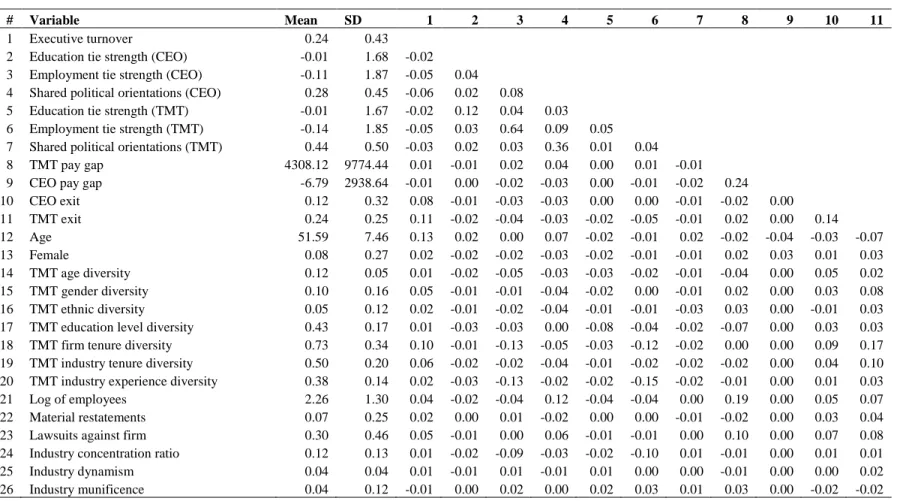
Table 1.1 provides summary statistics and correlations for all variables for the full sample of firms used in the study. Individual executive exit occurs in 24 percent of executive-firm-years. In addition, the average age of an executive across the sampling frame is about 52 and only about 8 percent of executives are female. In order to examine patterns of turnover more closely, I also ran correlations for the subsamples of under- and superior-performing firms, collapsing values to the firm-year level.7 For the
6 Still, for robustness, I did run fixed effects models and I also tested models using discrete event history analysis, in which I estimated effects using a basic logit model with time dummies included. While there was some variance in the significance level of the independent variables, results across these models generally demonstrated a consistent pattern. Specifically, employment ties and ties to the CEO were consistently statistically significant for both low- and high-performing firms regardless of the estimation method used, whereas there was much less consistency in the significance of education ties and ties to the rest of the TMT.
subsample of underperforming firms, CEO turnover occurs in about 5 percent of firm years and the average proportion of non-CEO executives leaving the firm each firm-year is 14 percent. For the subsample of superior-performing firms, CEO turnover occurs about 3 percent of the time and the average level of non-CEO executive turnover is 11 percent. These values confirm past research that suggests poor performance leads to higher rates of CEO and TMT turnover. At the same time, they seem to support the idea that, more often than not, CEOs remain in the firm even when it is underperforming.
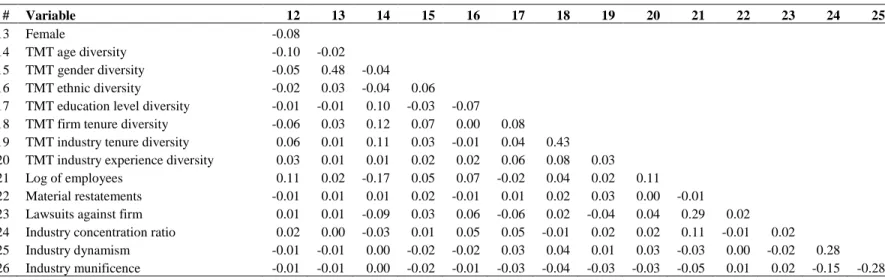
For the most part, correlations appear to be reasonable and do not indicate
multicollinearity. There are, however, a few variables with relatively higher correlations. These include the correlations between employment tie strength with the CEO and with the rest of the TMT (0.64) and executive gender and TMT gender diversity is (0.48). The high correlation between the gender variables is not surprising, given the small number of female executives in the sample. That is, a female executive is likely to be the only woman (or one of only a very few women) on the TMT; thus, their presence would greatly affect the gender diversity of the overall team. However, the correlation between the employment tie variables is intriguing. This correlation may be indicative of the small-world effect of employment ties and the tendency of executives to work within the same network of individuals when moving between firms (Davis, Yoo, & Baker, 2003; Mills, 1956; Nguyen, 2012). In a way, this also provides some initial support for the relative strength of employment ties in affecting the composition of the TMT.
In spite of these few relatively high correlations, collinearity diagnostics appear to be well within reasonable limits. Specifically, after running ordinary least squares
models and calculating variance inflation factors (VIFs), the mean VIF was 1.15 and no VIF exceeded 1.70. Overall, it appears that multicollinearity is likely not an issue.
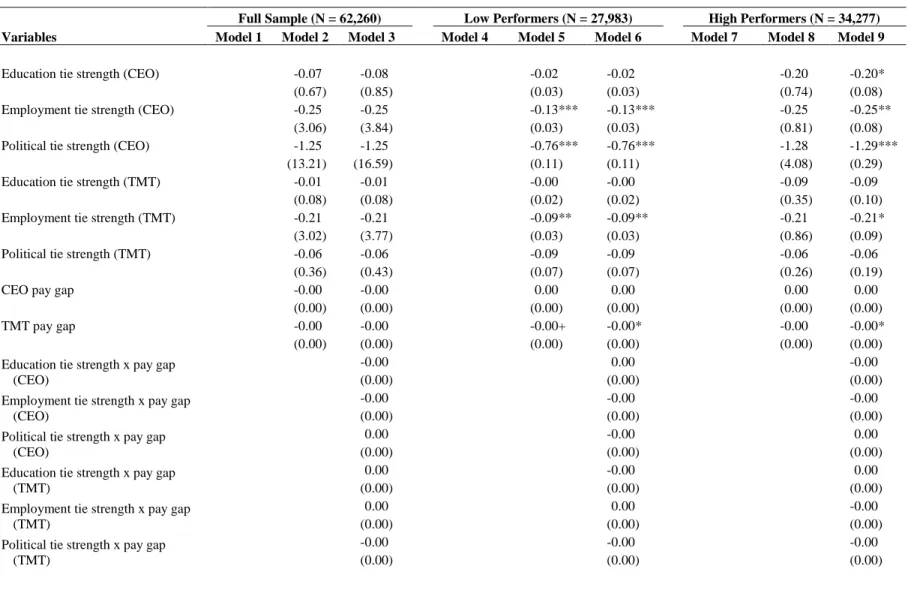
Table 1.2 provides results of the random effects logistic regression analyses. Models 1 through 3 provide results for the full sample, Models 4 through 6 present results for the subsample of low performing firms, and Models 7 through 9 are for the subsample of high performing firms. The first model in each series includes only the control variables, the second adds the independent and moderator variables, and the third is the fully specified model with all independent and control variables as well as the interaction terms. To mitigate potential multicollinearity in the models including interactions, I centered all continuous predictors and moderators prior to generating interaction terms. In reporting results, I refer primarily to Model 6, the fully specified model for firms with ROA below the industry average. In addition, in order to gauge effect sizes for statistically significant continuous effects, I calculated the marginal effects moving from one standard deviation below to one standard deviation above the average of the independent variable.
Hypotheses 1.1a and 1.1b respectively predicted that the strength of the
education ties between an executive and the CEO and between the executive and the rest of the TMT would decrease the likelihood that the executive would leave the firm when it was underperforming. However, in Model 6 neither the coefficient for education tie strength with the CEO nor for education tie strength with the TMT was statistically significant. In addition, the coefficient for education tie strength with the CEO in Model 9, the full model for high performing firms was negative and statistically significant
(-0.20, p<0.05). While this coefficient is in the expected direction, the fact that it is
statistically significant in the sample of high performers but not low performers also runs contrary to expectations. Overall, the first set of hypotheses was not supported.
Hypotheses 1.2a and 1.2b respectively predicted that the strength of the
employment ties between an executive and the CEO and between an executive and the rest of the team would decrease the likelihood of individual exit in underperforming firms. The coefficient for employment tie strength with the CEO in Model 6 is negative and statistically significant (-0.13, p<0.001). Computing the marginal effects shows that, in the subsample of underperforming firms, increasing employment tie strength with the CEO from one standard deviation below to one standard deviation above the mean decreases the likelihood of exit by 52 percent. Similarly, the coefficient for employment tie strength with the rest of the TMT was negative and statistically significant (-0.09, p<0.01). Here, increasing employment tie strength with rest of the TMT from one standard deviation below to one standard deviation above the mean decreases the likelihood the executive would exit by 36 percent. At the same time, the coefficients of these variables are also statistically significant and appear to have a greater effect in the high performing firms in Model 9. Specifically, in high performing firms, increasing employment tie strength with the CEO from one standard deviation below to one
standard deviation above the mean decreases the likelihood of exit by 97 percent. Also in this sample, increasing employment tie strength with rest of the TMT from one standard deviation below to one standard deviation above the mean decreases the likelihood the
executive would exit by 78 percent. Thus, results support Hypotheses 1.2a and 1.2b but also provide evidence that these effects are not unique to underperforming firms.
Hypotheses 1.3a and 1.3b respectively predicted that shared political orientations between an executive and the CEO or the TMT would reduce individual executive exit in underperforming firms. The coefficient for shared political orientations with the TMT was not significant in either subsample. Thus Hypothesis 1.3b was not supported.
<