Distributionally Robust and Structure Exploiting Algorithms for
Power System Optimization Problems
A dissertation submitted to
The University of Liverpool
in partial fulfillment of the requirements
for the degree of
Doctor of Philosophy
By
Chao Duan
Supervisor: Dr. Lin Jiang
Electrical Engineering & Electronics
October 2018
Acknowledgements
Acknowledgements
I cannot overstate my gratitude to my supervisor Dr. Lin Jiang who makes my liverpool life so enjoy-able and rewarding. His invaluenjoy-able guidance, encouragement, and advice have helped me go through the most difficult times during my Ph.D. study. The unsurpassed academic environment he provided broadens my research ideas and makes my Liverpool experience indispensable and unforgettable.
Also, my deep gratitude goes to Prof. Wanliang Fang, who is not only my supervisor but also life mentor. In the past six years, his insightful teaching, patient guidance, and helpful advice have helped me tremendously throughout my journey toward Ph.D. The high academic taste and rigorous scholarship of him have shaped my views on research and will continue to influence my academic career. He not only academically inspires but also philosophically enlightens me, which impacts my views on the society, value, life, and happiness.
I would like to thank Dr. Jun Liu for his constant accessibility, friendship and helpful suggestions for various problems I encountered during my study. The discussions with him have always been enjoyable and beneficial to me. My sincere thanks also go to Dr. Chuanke Zhang. The interaction with him has helped me enter a new research field of stability and control of time-delay systems. I would like to extend my gratitude to Dr. Chongtao Li. The stimulating discussions with him have broadened my research ideas and he kindly provided the codes of the benchmarking approach in Chapter 9 of this thesis. My deep thanks also go to Prof. Zhaohong Bie, Prof. Jianxue Wang, Prof. Dengfu Zhao and Prof. Zhengchun Du for their courses of power system analysis that open up to me the wonderful field of power systems to which I decide to devote the rest of my life.
I am grateful to my friends and colleagues at Xi’an and Liverpool: Zhixiang Wang, Zhanhong Wei, Danhua Mei, Yongqian Yang, Xi Nie, Xiaojuan Zhou, Yang Liu, Kai Shi, Qi Zhu, YueFang Du, Yingjie Wang, Li Yao and many others for making life more excited and colorful.
I am deeply in debt to my parents and family for their unconditional love, support, and encouragement throughout all these years. My father and mother’s belief in me has supported me through difficult times of my life. My deepest gratitude goes to my wife for her love, support, understanding, and tolerance for my staying away from home. I warmly dedicate this thesis to her.
I would like to thank the International PGR Programme of the University of Liverpool, the National Key Research and Development Program of China (2016YFB0901903), and China Scholarship Council for financial support.
ABSTRACT
Title: Distributionally Robust and Structure Exploiting Algorithms for Power System Optimization Problems
Applicant: Chao Duan
ABSTRACT
The modern power systems are undergoing profound changes as the large-scale integration of renewable energy and increasingly close interconnection of regional power grids. The intermittent renewable sources are bringing significant uncertainties to system operation so that all the analysis and optimization tools for the power system steady-state operation must be able to consider and manage the uncertainties. The large-scale interconnection of power systems increases the difficulty in maintaining the synchronization of all generators and further raises the challenging problem of systematically design multiple local and wide-area controllers. In both steady-state and dynamical problems, the large-scale interconnection is increasing the problem scale and challenging the scalability of analysis, optimization and design algorithms. This thesis addresses the problems of power system operation optimization under uncertainties and control parameter optimization considering time delays. The contributions are as follows.
This thesis proposes data-driven distributionally robust models and algorithms for unit commitment, energy-reserve-storage co-dispatch and optimal power flow problems based on novel ambiguity sets. The problem formulations minimize the expected operation costs corresponding to the worst-case distribution in the proposed ambiguity set while explicitly considers spinning reserve, wind curtailment, and load shedding. Distributionally robust chance constraints are employed to guarantee reserve adequacy and system steady-state security. The construction of ambiguity set is data-driven avoiding presumptions on the probability distributions of the uncertainties. The specific structures of the problem formulation are fully exploited to develop a scalable and efficient solution method.
To improve the efficiency of the algorithms to solve the operation and control optimization prob-lems, this thesis investigates computational techniques to exploit special problem structures, including spar-sity, chordal sparspar-sity, group symmetry and parallelizability. By doing so, this thesis proposes a sparsity-constrained OPF framework to solve the FACTS devices allocation problems, introduces a sparsity-exploiting moment-SOS approach to interval power flow (IPF) and multi-period optimal power flow (MOPF) prob-lems, and develops a structure-exploiting delay-dependent stability analysis (DDSA) method for load fre-quency control (LFC).
The power system stabilizers (PSS) and FACTS controllers can be employed improve system damp-ing. However, when time delays are considered, it becomes more difficult to analyzing the stability and designing the controllers. This thesis further develops time-domain methods for analysis and synthesis of damping control systems involving time delays. We propose a model reduction procedure together with a condition to ensure theϵ-exponential stability of the full-order system only using the reduced close-loop system model, which provides a theoretical guarantee for using model reduction approaches. Then we for-mulate the damping control design as a nonlinear SDP minimizing a carefully definedH2 performance
CONTENTS
CONTENTS
Acknowledgements ... iii
1 Introduction ... 1
1.1 Background ... 1
1.2 Research Status-quo and Challenges... 3
1.2.1 Power Flow Analysis under Uncertainties ... 4
1.2.2 Power System Optimization under Uncertainties... 5
1.2.3 Time-delay Power System Stability Analysis and Control Design ... 7
1.2.4 Remaining Challenges ... 8
1.3 Contribution and Thesis Outline ... 10
2 Data-driven Affinely Adjustable Distributionally Robust Unit Commitment ... 14
2.1 Introduction... 14
2.2 Ambiguity Set for Univariate Distribution ... 17
2.3 Affinely Adjustable Distributionally Robust Unit Commitment ... 20
2.3.1 Feasible Set ... 20
2.3.2 Objective Function... 23
2.3.3 Evaluation of Worst-case Costs ... 24
2.3.4 Application Modes... 29
2.3.5 Elimination of Redundant Line Capacity Constraints ... 29
2.4 Case Studies ... 31
2.4.1 Distributional Robustness and Data-exploiting Feature ... 31
2.4.2 Computational Efficiency and Scalability ... 32
2.4.3 Assessing the Conservatism of Affine Policy ... 34
2.4.4 Comparing Different Methods to Deal with Uncertainties ... 38
2.5 Conclusion and Discussion ... 40
3 Data-driven Distributionally Robust Energy-Reserve-Storage Dispatch ... 42
3.1 Introduction... 42
3.2 Distributionally Robust Optimization ... 45
3.2.1 Basic Concepts... 45
CONTENTS
3.3 Problem Formulation... 46
3.4 Solution Approach ... 50
3.4.1 Reformulation of Distributionally Robust Chance Constraints ... 50
3.4.2 Evaluation of Worst-case Expectation ... 51
3.4.3 Deterministic MILP Formulation ... 52
3.4.4 Eliminating Inactive Line Capacity Constraints ... 52
3.4.5 Convex Relaxation... 54
3.5 Numerical Results ... 55
3.6 Conclusion ... 61
4 Distributionally Robust Chance-Constrained AC-OPF with Wasserstein Metric ... 63
4.1 Introduction... 63
4.2 Problem Formulation... 65
4.2.1 Power Flow and Its Control under Unceratainties... 65
4.2.2 Linear Power FLow Response Model under Uncertainties ... 67
4.2.3 Problem Formulation of Distributionally Robust Chance-constrained Ap-proximate AC-OPF ... 69
4.3 Ambiguity Set Using Wasserstein Metric ... 71
4.3.1 Wasserstein Metric and Ambiguity Set... 71
4.3.2 Selection of Wasserstein Radiusϵ(N)... 71
4.4 Solution Approach ... 73
4.4.1 Evaluation of Worst-case Costs ... 73
4.4.2 Reformulation of Distributionally Robust Chance Constraints ... 74
4.5 Numerical Results ... 78
4.5.1 Implementation and Benchmarking ... 79
4.5.2 IEEE 14-Bus System ... 80
4.5.3 IEEE 118-Bus System ... 81
4.6 Conclusion ... 86
5 Steady-state Optimal Allocation of FACTS Devices via Sparse Optimization ... 88
5.1 Introduction... 88
5.2 Formulation and Algorithm for General Sparse Optimization ... 91
5.2.1 Sparse Optimization Problems ... 91
5.2.2 ADMM-IPM-STO Algorithm for Sparse Optimization... 92
CONTENTS
5.3 General FACTS Devices Allocation Problems... 98
5.3.1 Branch and FACTS Devices Modeling... 98
5.3.2 Sparsity-constrained OPF Model ... 100
5.4 Case Studies ... 102
5.4.1 Parameter Settings ... 102
5.4.2 Multiple-type FACTS Devices Allocation ... 103
5.4.3 Single-Type FACTS Devices Allocation... 104
5.5 Result Discussion ... 107
5.5.1 Comparisons with Other Methods ... 107
5.5.2 Convergence and Non-convexity ... 109
5.6 Conclusion ... 109
6 Moment-SOS Approach to Interval Power Flow ... 111
6.1 Introduction... 111
6.2 IPF Problem Formulation ... 113
6.3 Moment Relaxations of IPF Problems... 114
6.4 Exploiting Sparsity in Moment Relaxations ... 116
6.5 Case Studies ... 118
6.5.1 Exact Global Solutions on Small Cases ... 118
6.5.2 High Accuracy Solution on Larger Cases ... 119
6.5.3 IEEE 300-bus System with Wind Power... 122
6.5.4 Performance Analysis... 124
6.6 Conclusions... 127
7 Multi-Period OPF with Energy Storages and Renewable Sources: A Parallel Moment-SOS Approach ... 130
7.1 Introduction... 130
7.2 Multi-Period OPF Problem Formulation ... 131
7.3 Parallel Moment Approach to Multi-Period OPF Problem ... 133
7.3.1 ADMM Decomposition ... 133
7.3.2 Parallel Moment Relaxation of (v,x)-Subproblem... 134
7.3.3 Exploiting Sparsity in (v,x)-Subproblem... 135
7.3.4 Solution of z-Subproblem... 136
7.4 Case Study ... 137
CONTENTS
8 Structure-exploiting Delay-dependent Stability Analysis of Power System Load
Fre-quency Control... 140
8.1 Introduction... 140
8.2 Time-delay Load Frequency Control and Delay-dependent Stability Analysis ... 142
8.2.1 Load Frequency Control Loops ... 142
8.2.2 Delay-dependent Stability Criterion ... 144
8.3 Chordal-structured Matrix Decomposition ... 145
8.3.1 Theoretical Background ... 145
8.3.2 Useful Lemmas ... 147
8.4 Structure-exploiting Delay-dependent Stability Analysis of Load Frequency Con-trol ... 151
8.4.1 Exploiting Chordal Sparsity ... 151
8.4.2 Exploiting Symmetry ... 152
8.4.3 Implementation Issues ... 155
8.5 Numerical Results ... 156
8.5.1 Computational Efficiency... 157
8.5.2 Evaluation of Additional Conservatism ... 159
8.6 Discussion ... 163
8.7 Conclusion ... 164
9 Path-following Method to Design Power System Damping Controllers Considering Time Delays ... 165
9.1 Introduction... 165
9.2 System Model... 166
9.3 Stability and Dynamical Performance Analysis ... 169
9.3.1 Stability and Performance of the Reduced-order System... 169
9.3.2 Considering the Impact of Error System in Stability Analysis... 172
9.4 Control Design... 176
9.4.1 Optimization Problem Formulation ... 176
9.4.2 Path-following Method ... 177
9.5 Case Studies ... 180
9.5.1 Analysis... 180
9.5.2 Design... 182
CONTENTS
10 Conclusions and Prospects ... 189
10.1Conclusions... 189
10.2Prospects ... 190
AppendixA Adaptive Barrier Filter Line-search IPM for Optimal Power Flow with FACTS Devices ... 192
A.1 Introduction... 192
A.2 General OPF Formulation With FACTS Devices ... 193
A.2.1 Branch Model ... 193
A.2.2 OPF Formulation... 194
A.3 Adaptive Barrier Filter Line-search IPM ... 195
A.3.1 Outline of the Interior Point Method... 195
A.3.2 Adaptive Barrier Parameter Update Strategy ... 197
A.3.3 Filter Line-search Method ... 199
A.3.4 Feasibility Restore Phase... 200
A.4 Case Studies ... 201
A.4.1 Case studies on IEEE Standard Test Systems ... 201
A.4.2 Case studies on Real-world Systems... 204
A.4.3 Case Study under Difficult Operation Condition ... 205
A.4.4 Relationship between System Scale and Performance ... 206
A.5 Conclusion ... 207
References ... 208
1 Introduction
1 Introduction
1.1 Background
Electric power systems are the most clean and effective way to transmit and distribute en-ergy. All other forms of energy, including fossil fuel, hydro, wind, solar, and nuclear etc., can be conveniently converted into electric energy and fulfill various needs of the end-users. At the consumer side, the utilization of electric energy is much more efficient than directly using other forms of energy, e.g. the energy efficiency of a diesel vehicle is only 60% of that of an elec-trical vehicle. More importantly, the end-user usage of electricity is completely emission free. Therefore, the electric power systems have been and will continue to be the backbone infras-tructure for human society. Currently, the modern power system is undergoing far-reaching changes from different aspects among which we will focus on the large-scale integration of renewable energy and large-scale interconnection of power systems.
In the past two and a half century, the fossil fuels, mainly the coal, oil and gas, have supported the development of the industrial civilization. After the large-scale exploitation and utilization since the Industrial Revolution, there will inevitably be an exhaustion of fossil fu-els due to their non-renewable nature. The overexploitation of fossil fufu-els has also brought environmental problems, including air pollution and climate change, which threatens the sus-tainability of human society. In stark contrast to the unsussus-tainability and environmentally un-friendly of fossil fuels, the hydro, wind and solar energy are clean, renewable and extremely abundant around the global. According to the estimation of World Energy Council, the total amount of renewable energy that could be exploited and utilized is1.5×108 GW·h per year
which amounts to 38 times of all the explored fossil energy. Such a large amount of energy is far beyond the current usage of human society. Therefore, shifting from fossil fuels to re-newable energy is an irresistible trend and constitutes the energy revolution we are currently undergoing. From 2006 to 2016, the wind power global capacity increased from 74 GW to 487 GW, and the solar PV global capacity increased from 6 to 303 GW [1]. In 2016, the world in-stalled more renewable power capacity than the capacity added from fossil fuels. By the end of 2016, renewables comprised an estimated 30% of the world’s power generating capacity. All the renewables are integrated into the electric power systems, transmitted through the power networks and then distributed to consumers.
Large-scale integration of renewable energy brings challenges to the operation of power systems due to the uncertain and intermittent nature of renewable generation. In the conven-tional power systems, the generation side is completely controllable and the uncertainties only arise from the demand side. But when the renewables penetrate the system at a non-negligible level, both the generation and demand sides of the power system are subject to uncertainties.
1 Introduction
Compared to the load demand, the renewable generation is more variable and unpredictable. For instance, the standard deviation of hourly aggregated wind generation is 17.9% of the installed capacity in Nordic and Baltic countries in 2014, and the probability of an hourly gen-eration below 8% of the capacity is around 0.05 [2]. Considering the fact that the geographical dispersion of the renewable generation in Nordic and Baltic countries has reduced the uncer-tainties, the situation could be more severe in countries like China where large-scale centralized wind and PV power plants are constructed. As a result, all the computational tools for power system operation, including power flow analysis, unit commitment, economic dispatch and op-timal power flow etc. need to take the variability and uncertainties into consideration and also incorporate new technologies and strategies like energy storages and demand-side response.
The electric energy still cannot be stored in a very large scale. The generation, trans-mission and distribution must be completed simultaneously. The electric energy supply and demand are always in real-time balance. In addition, the energy supply centers are geograph-ically far away from the demand centers in many parts of the world. For example, in China, the eastern coastal regions produces 61.7% of the country’s GDP, consumes 57.1% of the total electricity, but only 10.5% of the coal and 7.3% of the hydro resources locate in these areas [3]. In addition, 6 of the 8 largest wind power bases with each capacity larger than 10 GW locate in the less developed western and northern parts of the country. A similar situation appears in other countries. Brazil has very rich hydro resources especially in the Amazon river system located in the less populated North, while the load and economic centers are in the south and southeast of the country. Moreover, the Arctic circle contains 20% of the total wind power resources of the world but it is very sparsely populated. In all the cases listed above, the large-scale interconnection of power systems is almost the only choice toward better utilization of the natural energy resources. From the viewpoint of power engineering, the large-scale inter-connection of power systems has the following advantages. First, the interinter-connection of power grids provides the physical basis for the optimal dispatch of the electricity generated from dif-ferent primary energy resources dispersed in a large geographical area, which improves the economic efficiency of the gross energy utilization. Second, The aggregation of load demand and renewable generation in different areas could alleviate the variability and uncertainties of the net demand thereby reducing the spinning reserve required for safe operation of the system. Third, large-scale interconnection can also reduce the required contingency reserve, improve system reliability and increase system inertia. Due to the above reasons, interconnected power systems have been constructed in China, Europe, North American, Brazil and some other parts of the world. In recent years, the State Grid Company of China is even promoting the idea of global energy internet and the Global Energy Interconnection [4] Development and Coopera-tion OrganizaCoopera-tion was established in Beijing in 2016.
1 Introduction
system analysis, optimization and control. The most immediate result of interconnection is the increase of problem scales. Numerical algorithms for power system operation and planning therefore must have enough ability to scale up to real-world large-scale problems. This aspect is especially true when large-scale interconnection interacts with large-scale introduction of uncertainties. Many algorithms for stochastic optimization of power systems suffer from the statistical curse of dimensionality and/or computational curse of dimensionality. On the other hand, the interconnected power systems also face typical stability problems. The AC power system is an electromechanical system whose safe operation relies on the synchronization of connected generators. The synchronized state is always disturbed by the continuous load/gen-eration changes and sporadic faults. When the system becomes more and more interconnected, the oscillation mode between generators in one area against those in another area could be eas-ily excited, which results in low-frequency oscillation across the system if the damping control systems are not carefully designed and implemented. To improve the observability and situa-tion awareness of large-scale interconnected power systems, wide area measurement systems (WAMS) have been quicked developed and applied to real-world applications. WAMS pro-vides the infrastructure for realizing the idea of wide-area damping control which can suppress the inter-area oscillations much more effectively than the conventional power system stabiliz-ers using local feedback signals.
The trends of large-scale integration of renewable energy and large-scale interconnection of power systems are the most relevant undergoing changes to this thesis. Other trends of the modern power system may include the increasingly high penetration of power electronics, the ever-growing integration of electric power systems with other energy systems, and the restructuring of the business and operation models, etc. All these profound changes will have significant technological, economic, environmental as well as social impacts on human society. These undergoing changes also open up for new research opportunities.
1.2 Research Status-quo and Challenges
To facilitate the large-scale integration of renewable energy and large-scale interconnec-tion of power grids, the following quesinterconnec-tions need systematical answers. 1) How do we deal with the uncertainties in power flow analysis and operational optimization? 2) How can we develop efficient algorithms to solve large-scale problems in power system optimization, sta-bility analysis and control design? 3) How can we consider the imperfection of communica-tion networks in stability analysis and design of damping control systems involving wide-area measurements? 4) How can we design the local and wide-area controllers in an automatic and coordinated manner to improve system damping? In the rest of this section, we provide a review of the-state-of-art in answering some of the questions listed above.
1 Introduction
1.2.1 Power Flow Analysis under Uncertainties
Power flow analysis methods in the presence of uncertainty can be classified into two groups according to how uncertainty is represented. The first group is the probabilistic power flow (PPF) in which loads and generations are expressed as random variables with associated distribution functions. PPF aims at deriving the probability distribution of power flow solu-tions. Monte Carlo simulation based techniques [5, 6], analytical methods [7–9] and point estimate methods [10, 11] are extensively investigated to deal with this problem. By assuming the uncertain nodal power injections to obey pre-defined probability distribution, PPF aims at obtaining the probability distribution of power flow responses, including bus voltages and line flows. Vast literature has been devoted to developing solution method to PPF problem [5–14]. Monte Carlo simulation (MCS) [5, 6] obtains PPF solution by repeatedly running determin-istic power flow. It is usually regarded as the benchmark method yet criticized for its huge computational burden. To improve computational efficiency, analytical methods including conventional convolution [7, 12, 13] and cumulants method [8, 9, 14] have been proposed to obtain approximate solution of PPF. These methods usually linearize the AC power flow equa-tions at the point of expected power injecequa-tions to express the power flow response as the linear combination of power injections. Based on the linear formulation, conventional convolution directly obtain the probability distribution through convolution process, whereas cumulants method first obtains the cumulants of the power flow responses then estimate probability dis-tribution using series expansions. Point estimation [10, 11] is another approximate method. It estimates the moments of the power flow responses by running deterministic power flow at selected points. The probability distribution can also be constructed using series expansions based obtained moment information. Recently, stochastic response surface method [15] has also been applied to PPF problem. It models the power flow responses as polynomial chaos expansion with standard random variables and determines the unknown coefficients by running several deterministic power flows.
The second group of methods, interval power flow (IPF) [16–20], model uncertainty of loads and generations as intervals without distribution structures, which seems a more practi-cal approach because system operators need to consider the worst-case scenario to guarantee the security of the power networks. Interval arithmetic (IA) is introduced in [16] to modify conventional Newton iterations to obtain the outer approximation of the solution set, but the results are highly conservative and the convergence is unfounded. A local search procedure is proposed in [17] to find accurate boundary solutions but the convergence is not proved and only local optimality is guaranteed. To overcome the limitation of the IA method, affine arith-metic (AA) is used in [18] by expressing power system state variables as an affine function of uncertainties, and linear programming (LP) is employed to obtain tight bounds of uncertainty
1 Introduction
parameters. However, this method is still approximate in nature. In [19], from a range arith-metic perspective, a nonlinear programming (NLP) model with complementarity constraints is proposed to find the upper and lower bounds of power flow solutions. Although the for-mulation is non-convex and difficult to solve, this work provides a theoretical foundation for optimization-based method to solve IPF. In the most recent work [20], IPF is formulated as a quadratically constrained quadratic programming (QCQP) problem. Convex envelops are employed to relax the non-convex QCQP to a convex LP. Starting from estimated solution intervals, the optimality-based bounds tightening (OBBT) method is introduced to obtain the tight outer approximation of the feasible region. Though this method can obtain less conser-vative interval solutions than previous methods, the results in any case are still supersets of the exact intervals.
1.2.2 Power System Optimization under Uncertainties
We are not intended to review all aspects of power system optimization under uncer-tainties. Our purpose here is to exposit the key ideas and methods to deal with uncertain-ties in power system optimization problems. Focuses are given to four approaches, namely scenario-based stochastic program (SBSP), chance-constrained program (CCP), robust opti-mization (RO), and distributionally robust optiopti-mization (DRO).
SBSP approach assumes operational uncertainties, i.e. load forecasting inaccuracies and uncertain renewable generation, follow pre-defined probability distributions which can be ob-tained from historical data. The objective is to minimize the expected value of generation costs. Two-stage problem formulations share the form
min y∈Ξ { G(y) + min x∈ΩP(y)EP{F(x,ξ)} } (1-1)
whereydenotes the first-stage commitment decision variables of generation units,xdenotes the second-stage dispatch variables andξis a random vector representing uncertainties. Since continuous distributions are usually numerically intractable, they are replaced by discrete sce-narios. So the objective becomes minimizing the weighted-average generation cost over par-allel scenarios for two-stage problems [21, 22] or a scenario tree for multi-stage problems [23–25]. Thus the solution quality of SBSP relies on the representativeness of selected scenar-ios. Monte Carlo simulation based method is usually employed to generate scenarios [22, 25]. A huge number of scenarios are often required to comprehensively represent the underly-ing stochastic nature [26], which results in prohibitively high computational burden [26, 27]. Therefore, SBSP is often equipped with scenario reduction methods to control computational complexity [25, 26]. However, due to the approximate nature of SBSP, the dilemma between quality and complexity of scenarios always exists. Consequently, the robustness of the schedul-ing strategy obtained cannot be rigorously guaranteed.
1 Introduction
CCP approach is motivated by the fact that SBSP usually requires all technical operational constraints being satisfied under any scenarios, which may include extremely rare events and increase cost unnecessarily [27]. In CCP, under pre-defined probability distribution of the uncertainties, some constraints are required to be met with a specified high probability, which is written in the general form
P{L(ξ)≤0} ≥1−ε (1-2)
whereL(·)is a function determined by other decision variables representing certain technical constraint. In [28], chance constraints are applied to load satisfaction. Under normal distribu-tion, such chance constraints are transformed to deterministic linear equalities with some con-servatism. In [22], chance constrained are employed to ensure the utilization of wind power, and such problem is solved by a Monte Carlo simulation based sample average approximation (SAA) method. Since the transformation in [28] is restrictive and conservative and SAA used in [22] is approximate in nature, there exist no elegant methods to equivalently convert the chance constraints to deterministic constraints to facilitate optimization computation.
In stark contrast to SBSP and CCP, RO does not require any probability distribution infor-mation of the uncertainties. Instead, randomness is represented by a deterministic uncertainty set which includes worst-case scenarios. The objective is minimizing the worst-case cost re-garding all possible realizations of the uncertainty set. The following two-stage formulation attracts most attention [29–33]:
min y∈Ξ { G(y) +max ξ∈D xmin∈Ω(y)F(x,ξ) } (1-3)
whereDdenotes the uncertainty set. The numerical tractability and solution quality of above formulation both rely on the design of uncertainty setDwhich are usually defined by a set of linear inequalities. To solve the second stage max-min. problem in (1-3), the innermost min. problem needs to be dualized so that the max-min. problem is transformed into a non-convex bilinear max. problem which is NP-hard in general. This bilinear problem can be either solved by outer approximation method [30] (only local optimality is guaranteed) or rewritten into a mixed integer linear program (MILP) using big-M method [29, 32] (under some assumption on D, see [32]) and solved by generic MILP solvers. Although RO provides security against worst-case scenario, it may also yield over-conservative solutions resulting from the sheer ignorance of underlying probabilistic information.
Some works attempt to melt the bright sides of above approaches and make remedies to their disadvantages. In [22], chance constraints are integrated into the two-stage SBSP frame-work to improve wind power utilization. Reference [34] proposes a UC (unit commitment) formulation that combines SBSP and RO to achieve lower expected cost while ensuring sys-tem robustness. In [33], risk consideration on specific scenarios is incorporated into two-stage
1 Introduction
RO.
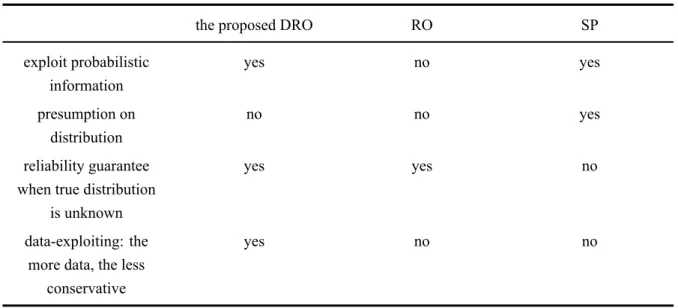
Note that the SP assumes the underlying probability distribution of uncertainties to be precisely known, whereas RO ignores the probabilistic information. In practice, the probabil-ity distribution truly exists but must be estimated from historical data and is, therefore, itself uncertain. To better modeling and tackling uncertainties, in several very recent studies, distri-butionally robust optimization (DRO) has been introduced to power system optimization prob-lems including unit commitment [35, 36], energy reverse dispatch [37, 38], reverse scheduling [39, 40] and DC optimal power flow [41, 42]. DRO assumes that the true probability distribu-tion of uncertain parameters lies in an ambiguity set (of probability distribudistribu-tions) and immu-nizes the operation strategies against all distributions in the ambiguity set. Different ways to construct the ambiguity set leads to different DRO approaches with the different degree of con-servatism and computational efficiency. Paper [35] adopted a scenario-based approach where the random variable representing wind generation is assumed to have finite support. Statisti-cal inference technique is employed to construct ambiguity sets for the discrete distributions. This method is data-driven and more data leads to the less conservative solution. Other pa-pers assume that the random variables have continuous distributions. In [36], the support of a one-dimensional random variable is partitioned into several segments, and the ambiguity set imposes an upper bound for the expectation in each segment. As the number of segments in-creases, the probability distribution can be characterized by more details. The ambiguity sets employed in [37–40, 42] are the sets of all probability distributions with given mean and co-variance. Paper [38] further assumes unimodality to reduce conservatism, and reference [42] further considers the uncertainties of mean and covariance. Different from all others, paper [41, 43] assumes the distribution type is known as a priori while the mean and covariance are subject to uncertainties.
1.2.3 Time-delay Power System Stability Analysis and Control Design
Two groups of methods have been applied to analyze the stability and performance of time-delay load frequency control (LFC) and wide-area damping control(WADC). The first group is the frequency-domain method based on eigenanalysis [44–47]. To obtain the eigenvalues, the time-delay system is often approximated by an augmented delay-free linear system through discretization of the continuous state function of the time-delay system. Usu-ally, the dimension of the delay-free system is much higher than the time-delay system and proportional to the number of discretization points employed. As the number of discretization pointsN increases, the eigenvalues of the delay-free system converge to those of the time-delay system at the rate ofO(N−N). Hence, practically speaking, frequency-domain methods can obtain the exact eigenvalues along with other accurate performance metrics, e.g. delays margins, damping ratios and damping factors, for systems with constant delays. The
classi-1 Introduction
cal frequency-domain phase compensation approaches [48–50] have been the most practically applicable methods to design PSSs and FACTS controllers to suppress oscillations. However, their extensions to time-delay power systems are scarcely reported.
The second group of methods is the time-domain delay-dependent stability analysis [51– 55] which leverage linear matrix inequalities (LMI) as the computational tools. In time-domain methods, the stability of the time-delay systems is certified by the existence of certain Lyapunov -Krasovskii functionals (LKF). To find such LKFs, a candidate LKF with undetermined weight-ing matrices is first constructed, and some integral inequalities are employed to bound the time derivative of the LKF. Then the positive definiteness of the LKF and the negative definiteness of its derivative are then expressed as LMIs. The time-domain methods are always conser-vative, but the conservatism can be reduced by using more general LKF and tighter integral inequalities. In addition, they can deal with both constant and time-varying delays and facil-itate the robust design of the controllers. For example, LMI based delay-dependent stability criteria are employed to calculate the delay margins of WADCs installed at generator excitation systems [51] and FACTS devices [56]. Similar methods are also applied to LFC with constant and time-varying delays [57]. A more accurate and computationally cheaper LMI-based sta-bility criterion is applied to multi-area LFC in [58]. Although time-domain methods possess some conservatism when calculating the delay margins, they can be conveniently applied to systems with single or multiple, constant or time-varying delays. Moreover, the development of the modern interior point method (IPM) provides off-the-shelf tools to solve LMIs.
The ultimate goal of stability analysis is to inform the controller design to mitigate the adverse effects of time delays. From this aspect, time-domain LMI based methods have ad-vantages over frequency domain methods due to the fact that LMI based criteria can be conve-niently employed to derive the delay-independent and delay-dependent bounded real lemmas (BRL) [59] which then can be used to design H∞ robust controllers. For instance, delay-independent BRLs are used in [60] and [61] to design state-feedback and PI robust controllers for LFC, respectively. In [62], PID-type robust controllers are designed for LFC systems based on a delay-dependent BRL. In addition, delay-dependent BRLs are also employed in [53] to de-sign state-feedback WADC. Above-mentioned controllers for LFC and WADC are all dede-signed to minimize theH∞index while guaranteeing stability for any delays less than the preset upper bounds (the upper bounds are∞for delay-independent methods).
1.2.4 Remaining Challenges
Based on the overview of previous works, we have identified the following remaining challenges:
1. Although there have been several attempts to apply the idea of DRO to power system operation under uncertainties, the performance and efficiency of existing methods are
1 Introduction
still not satisfactory. For instance, the DRO approach discussed in [38, 63, 64] has the following drawbacks. First, the ambiguity set characterized only by the first two moments is in fact very large thus the method is still very conservative. Second, mo-ments also need to be estimated from historical data therefore are uncertain as well. Third, the problems are finally cast into a sequence of semi-definite programs which are very computationally intensive. The core issue here is the structure of the ambigu-ity sets employed in the DRO. How to construct an ambiguambigu-ity set which is theoretically tractable, statistically reliable and numerically scalable is still a challenging problem. 2. The OPF and IPF problems are inherently non-convex optimization problems due to
the non-linearity of power flow equations. The conventional interior point method can only produce a locally optimal solution. How to solve those non-convex problems to global optimality with acceptable computational resources is still challenging. Recent attempts [65–67] to convexify the OPF problem bring new insights into this field. The questions of how to construct ever-tighter convex relaxations with mild increase of computational burden and how to deal with the infeasibility and scalability issues of convex relaxations await systematical answers before the convex relaxation techniques can be applied to real-world problems.
3. The major obstacle of the LMI-based time-domain methods for time-delay power sys-tem stability analysis is the computational burden of solving large-scale LMIs due to the very limited ability of the state-of-the-art solvers to tackle large-scale problems. To resolve this problem, we have two pathways. The first one is to reformulate the prob-lems into easier ones by exploiting the structural features of the power system control loops. The second one is to employ the model reduction methods, but the stability analysis result on the reduced-order model does not necessarily imply the same result for the original full-order system. How to ensure the stability of the full-order system by just using the reduced-order model is also a challenging problem.
4. The problem of coordinate design of multiple local and wide-area damping controllers also expect systematical solutions. Although it is quite easy for time-domain LMI-based methods to formulate the design problems due to its affinity to modern H∞
and H2 control theory. However, it is not always easy to actually solve those
prob-lems. Only when the full state feedback control is adopted, the problem can be equiv-alently formulated as convex semi-definite programs (SDP) thus solvable by off-the-shelf solvers [53]. For other control architectures, the problem is bilinear [68] or more general nonlinear SDPs which are non-convex and NP-hard.
1 Introduction
1.3 Contribution and Thesis Outline
The research contents of this thesis can be summarized as in Fig. 1-1. The physical object studied in this paper is the power systems with the uncertain, interconnected and time-delay features. The basic theoretical tool is optimization theory and method with emphasis on the distributionally robust optimization. Meanwhile, focuses are given to exploiting special problem structures, e.g. sparsity and symmetry, to improve efficiency in the problem-solving processes. Specific power system applications considered include operation schedule, interval power flow, device allocation and control analysis & synthesis.
Figure 1-1 Summary of the Contents of this thesis
The contribution and organization of the rest of the thesis are as follows.
Chapter 2 proposes a data-driven affinely adjustable distributionally robust method for unit commitment considering uncertain load and renewable generation forecasting errors. The proposed formulation minimizes expected total operation costs, including the costs of gen-eration, reserve, wind curtailment and load shedding, while guarantees the system security. Without any presumption about the probability distribution of the uncertainties, the proposed method constructs an ambiguity set of distributions using historical data and immunizes the operation strategies against the worst-case distribution in the ambiguity set. The more histori-cal data is available, the smaller the ambiguity set is and the less conservative the solution is. The formulation is finally cast into a mixed integer linear programming whose scale remains unchanged as the number of historical data increases. Numerical results and Monte Carlo sim-ulations on the 118- and 1888-bus systems demonstrate the favorable features of the proposed method.
1 Introduction
method to facilitate the integration of variable and uncertain renewable energy. The uncer-tainties of renewable generation forecasting errors are characterized through an ambiguity set which is a set of probability distributions consistent with observed historical data. The proposed model minimizes the expected operation costs corresponding to the worst-case distribution in the ambiguity set. Distributionally robust chance constraints are employed to guarantee re-serve and transmission adequacy. More data also leads to smaller the ambiguity set and less conservative decision strategy. The formulation is finally cast into a mixed integer linear pro-gramming whose scale remains unchanged as the number of historical data increases. Inactive constraint identification and convex relaxation techniques are introduced to reduce the com-putational burden. Numerical results and Monte Carlo simulations on IEEE 118-bus systems demonstrate the effectiveness and efficiency of the proposed method.
Chapter 4 discusses a distributionally robust chance constrained approximate AC-OPF. The power flow model employed in the proposed OPF formulation combines an exact AC power flow model at the nominal operation point and an approximate linear power flow model to reflect the system response under uncertainties. The ambiguity set employed in the distribu-tionally robust formulation is the Wasserstein ball centered at the empirical distribution. The proposed OPF model minimizes the expectation of the quadratic cost function w.r.t. the worst-case probability distribution and guarantees the chance constraints satisfied for any distribution in the ambiguity set. The whole method is data-driven in the sense that the ambiguity set is constructed from historical data without any presumption on the type of the probability distri-bution, and more data leads to smaller ambiguity set and less conservative strategy. Moreover, special problem structures of the proposed problem formulation are exploited to develop an efficient and scalable solution approach. Case studies are carried out on IEEE 14 and 118 bus systems to show the accuracy and necessity of the approximate AC model and the attractive features of the distributionally robust optimization approach compared with other methods to deal with uncertainties.
Chapter 5 formulates FACTS device allocation problem as a general sparsity-constrained OPF problem and employs Lq(0 < q ≤ 1) norms to enforce sparsity on FACTS devices
setting values to achieve solutions with desirable device numbers and sites. An algorithm based on alternating direction method of multipliers is proposed to solve the sparsity-constrained OPF problem. The algorithm exploits the separability structure and decomposes the original problem into an NLP subproblem, anLqregularization subproblem, and a simple dual variable
update step. The NLP subproblem is solved by the interior point method. TheLqregularization
subproblem has a closed-form solution expressed by shrinkage-thresholding operators. The convergence of the proposed method is theoretically analyzed and discussed. The proposed method is successfully tested on the allocation of SVC, TCSC and TCPS on IEEE 30-, 118- and 300-bus systems. Case studies are presented and discussed for both single-type and
multiple-1 Introduction
type FACTS devices allocation problems, which demonstrates the effectiveness and efficiency of the proposed formulation and algorithm.
Chapter 6 describes a novel optimization-based method to obtain high-accuracy or even exact global solutions to IPF problems. At first, the IPF problems are formulated as polynomial optimization problems probably with rational objective functions. Then Lasserre’s hierarchy, or moment-SOS (sum of squares) approach, is introduced to relax the non-convex problems to convex semidefinite programming (SDP) problems. Correlative sparsity in the polynomial optimization problems is exploited to improve numerical tractability and efficiency. Finally, case studies on IEEE 6-bus, 9-bus and 14-bus systems demonstrate the second-order moment relaxation is capable of obtaining exact global interval solutions on small-scale systems, and numerical results on IEEE 57-bus, 118-bus and 300-bus systems show the proposed method can significantly improve the interval solutions compared with recent Linear Programming (LP) relaxation method on larger systems.
Chapter 7 discusses a convex relaxation based decomposition algorithm to solve the full AC multi-period OPF with energy storages and renewable sources. Based on alternating di-rection method of multipliers (ADMM), the original time-correlated non-convex optimization problem is decomposed into two subproblems. The first subproblem is non-convex and sep-arable among different time slots. Moment relaxation can be constructed and solved for each time slot in parallel. The second subproblem is a convex quadratic program (QP) and separable among different buses, which can be solved in parallel by standard interior point (IPM) solver. Case studies on a benchmark systems demonstrate the effectiveness of the proposed algorithm. Chapter 8 investigates the computational aspect of delay-dependent stability analysis of LFC. The basic idea is to improve the numerical tractability of DDSA (delay-dependent stabil-ity analysis) by exploiting the chordal sparsstabil-ity and symmetry of the graph related to LFC loops. The graph-theoretic analysis yields the structure restrictions of weighting matrices needed for the LMIs to inherit the chordal sparsity of the control loops. By enforcing those structure restrictions on weighting matrices, the positive semi-definite constraints in the LMIs can be decomposed into smaller ones, and the number of decision variables can be greatly reduced. Symmetry in LFC control loops is also exploited to reduce the number of decision variables. Numerical studies show the proposed structure-exploiting techniques significantly improves the numerical tractability of DDSA at the cost of the introduction of acceptable minor conser-vatism.
Chapter 9 addresses two important issues of the time-domain LMI-based approaches to analyze and design damping control for time-delay power systems. The first issue concerns with the deficiency of the reduced-order system model often used in the time-domain method to reliably reflect the stability of the original full-order system. Leveraging tools from dissi-pativity theory, we propose a model reduction procedure together with a condition to ensure
1 Introduction
theϵ-exponential stability of the full-order system only using the reduced close-loop system model, which provides a theoretical guarantee for using model reduction approaches. The sec-ond issue is the numerical intractability of the nonlinear SDP problems when attempting to coordinately design controllers. Instead of seeking global optimum of the problem, we pro-pose a path-following method to systematically search for a local solution. The algorithm iter-atively improves the damping factor andH2 performance of the system by tuning the control
parameters in an automatic and coordinated manner. Case studies on three benchmark systems demonstrate the design power the proposed method.
Appendix A details the interior point method we use in Chapter 5 of the thesis to solve the NLP sub-problem. Three measures, namely the adaptive barrier update strategy, the fil-ter line-search method and the feasibility restore phase, are simultaneously introduced in the conventional primal-dual interior point method (IPM) framework to enhance the robustness of existing Optimal Power Flow (OPF) algorithms when applied to systems with consider-able number of FACTS devices. Firstly, an adaptive barrier parameter strategy is employed to update the barrier parameter after the current μ-barrier problem solved to a certain accu-racy. Secondly, a filter line-search procedure is introduced to generate the next iterate. Third, the algorithm initiates a feasibility restore phase as a remedy in case of getting stuck at a non-optimal point. Comparative case studies with previous algorithms on both standard test systems and large-scale real-world systems demonstrate the novel algorithm outperforms conventional IPMs in robustness and efficiency.
2 Data-driven Affinely Adjustable Distributionally Robust Unit Commitment
2 Data-driven Affinely Adjustable Distributionally Robust Unit
Commitment
2.1 Introduction
Unit Commitment (UC) aims at reducing costs and improving reliability by optimal schedul-ing and dispatchschedul-ing generation units. Integration of intermittent renewable energy and market-driven operation have brought uncertainties to both generation and demand sides. It is, there-fore, necessary to incorporate uncertainties into UC. Vast literatures are devoted to the stochas-tic optimization for UC [27]. Among all the methods proposed so far, the stochasstochas-tic program-ming (SP) and the robust optimization (RO) attract the most attention.
SP approach assumes operational uncertainties follow pre-defined probability distribu-tions which can be learned from historical data. The objective is to minimize the expectation of generation costs. Since continuous distributions are usually numerically intractable, they are replaced by discrete scenarios. Hence the objective becomes minimizing the weighted-average generation costs over parallel scenarios for two-stage problems [21, 22, 69] or a scenario tree for multi-stage problems [23–25]. The solution quality of SP relies on the representativeness of selected scenarios. Monte Carlo simulation based method is usually employed to generate scenarios [22, 25]. A huge number of scenarios are often required to comprehensively repre-sent the underlying stochastic nature [26], which results in prohibitively high computational burden [26, 27]. Therefore, SP is often equipped with scenario reduction methods to control computational complexity [25, 26]. However, the dilemma between quality and complexity of scenarios always exists.
In contrast to SP, RO does not require any probabilistic information of the uncertainties. Instead, randomness is represented by a deterministic uncertainty set containing worst-case scenarios. The objective is minimizing the worst-case costs regarding all possible realizations of the uncertainty set. The two-stage adaptive optimization framework has been the subject of many contributions [29, 30, 32]. One difficulty appears in this framework is that the robust counterpart of the second-stage problem is bilinear and non-convex. This bilinear problem can be either solved by the outer approximation method [30] (only local optimality is guaranteed) or rewritten into a mixed integer linear program (MILP) using the big-M method [29, 32] (under some assumptions on the uncertainty set [32]) and solved by generic MILP solvers. Although RO provides security against the worst-case scenario, it may also yield over-conservative so-lutions resulting from the sheer ignorance of underlying probabilistic information. Paper [34] proposes a UC formulation combining SP and RO to melt the bright sides of both approaches. Note that the SP assumes the underlying probability distribution of uncertainties to be
2 Data-driven Affinely Adjustable Distributionally Robust Unit Commitment
precisely known, whereas RO ignores the probabilistic information. In practice, the probabil-ity distribution truly exists but must be estimated from historical data and is, therefore, itself uncertain. To better modeling and tackling uncertainties, in several very recent studies, distri-butionally robust optimization (DRO) has been introduced to power system optimization prob-lems including unit commitment [35, 36], energy reverse dispatch [37, 38], reverse scheduling [39, 40] and DC optimal power flow [41, 42]. DRO assumes that the true probability distribu-tion of uncertain parameters lies in an ambiguity set (of probability distribudistribu-tions) and immu-nizes the operation strategies against all distributions in the ambiguity set. Different ways to construct the ambiguity set leads to different DRO approaches with the different degree of con-servatism and computational efficiency. Paper [35] adopted a scenario-based approach where the random variable representing wind generation is assumed to have finite support. Statisti-cal inference technique is employed to construct ambiguity sets for the discrete distributions. This method is data-driven and more data leads to the less conservative solution. Other pa-pers assume that the random variables have continuous distributions. In [36], the support of a one-dimensional random variable is partitioned into several segments, and the ambiguity set imposes an upper bound for the expectation in each segment. As the number of segments in-creases, the probability distribution can be characterized with more details. The ambiguity sets employed in [37–40, 42] are the sets of all probability distributions with given mean and co-variance. Paper [38] further assumes unimodality to reduce conservatism, and reference [42] further considers the uncertainties of mean and covariance. Different from all others, paper [41, 43] assumes the distribution type is known as a priori while the mean and covariance are subject to uncertainties. To clear the jungle of ambiguity sets, we raise four criteria to judge the quality of ambiguity sets.
1. Tractability: DRO problems are reformulated as deterministic optimization problems to
be solved by numerical methods. The numerical tractability of the corresponding deter-ministic problems decides the solvability and practicability of the DRO approach. There-fore, the designed ambiguity set must allow a tractable and efficient reformulation of the DRO problems. For example, the DRO problems in [35, 36] are reformulated as (mixed integer) linear programmings (LP) whereas those in [37–40, 42] are reformulated as semidefinite programmings (SDP). LP is much more tractable than SDP.
2. Statistical Foundation: Is there a sound statistical foundation for determining the
parame-ters of the ambiguity set? For instance, the ambiguity set in [35] is based on the statistical inference which guarantees that the ambiguity set contains the true distribution with given confidence level. In contrast, no theory is provided in [36] to guide the parameter selec-tion.
3. Scalability: How does the computational burden change when encoding more detailed
2 Data-driven Affinely Adjustable Distributionally Robust Unit Commitment
variables and constraints of the deterministic reformulations grow linearly with the num-ber of bins in [35] and the numnum-ber of segments in [36].
4. Data-exploiting Ability: Can the ambiguity set become smaller when more historical data
is available? Intuitively, the more data we have, the more accurate we can deduce about the underlying true distribution, which leads to smaller ambiguity set. DRO with smaller ambiguity set results in the less conservative solution. Such data-exploiting ability is evident in the ambiguity set in [35].
This chapter discusses a data-driven affinely adjustable distributionally robust unit com-mitment (AA-DRUC). The contribution is twofold. Firstly, we propose a novel ambiguity set based on a non-parametric confidence band of the cumulative distribution function (CDF) of the random variable. Secondly, assuming the generation units respond affinely to the total fore-casting error of renewable generation, we present a UC problem formulation that minimizes the expected operation costs corresponding to the worst-case distribution in the proposed am-biguity set while explicitly considers spinning reserve, wind curtailment, and load shedding. Distributionally robust chance constraints are employed to guarantee reserve and transmission adequacy. The proposed method possesses the following features:
1. The problem is finally formulated as a mixed integer linear programming (MILP) for which off-the-shelf solvers are available. (tractability)
2. All parameters in the ambiguity set are automatically obtained through non-parametric inference. (statistical foundation)
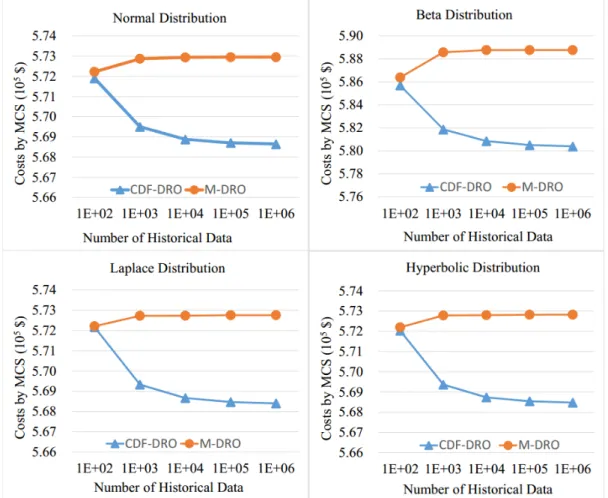
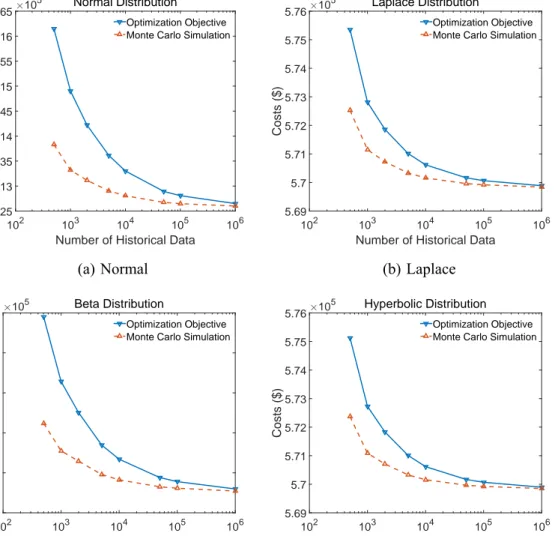
3. The method is data-driven in the sense that no prior knowledge about the probability distribution of the uncertainties is needed and the historical data is directly incorporated in the solution process. The more historical data is available, the less conservative the solution is. (data-exploiting ability)
4. The scale of the MILP remains unchanged as the amount of historical data and the number of uncertain renewable sources increase. (scalability)
The rest of this chapter is organized as follows. Section 2.2 introduces the ambiguity set constructed from confidence band of CDF. Section 2.3 presents the problem formulation and solution approach of the AA-DRUC. Case studies are reported in section 2.4. Finally, we draw the conclusion and make discussion in section 2.5.
Nomenclature
B,L,T Set of all buses, lines and time periods. Gb Set of all generators at busb.
sb,upi /sb,dni Start-up/shut-down costs of unitiat busb.
Fib(·) Cost function of unitiat busb.
2 Data-driven Affinely Adjustable Distributionally Robust Unit Commitment
fib,up/fib,dn Upward/downward reserve procurement price of unitiat busb.
Cls/Cwc Penalty price of load shedding / wind curtailment.
Mib,up/Mib,dn Minimum up/down time of unitiat busb.
Rb,upi /Rb,dni Ramp up/down rate limit of unitiat busb.
Rb,upi /Rb,dni Start-up ramp-up / shut-down ramp-down rate limit of unitiat busb.
Lb
i/Uib Output power lower/upper bound of unitiat busb.
Cl Capacity of transmission linel.
πb
l Load shift factor from busbto linel.
wbit Binary decision variable: “1” if unitiat busbis on in timet; “0” otherwise.
ubit Binary decision variable: “1” if unitiat busbis started up in timet; “0” other-wise.
vb
it Binary decision variable: “1” if unit i at bus b is shut down in time t; “0”
otherwise.
xb
it AGC setting point of unitiat busbin timet.
ab
it AGC participation factor of unitiat busbin timet.
ritb,up Upward reserve of unitiat busbin timet.
rb,dnit Downward reserve of unitiat busbin timet.
˜
pb
it Uncertain actual power output of unitiat busbin timet. ˜
ltb Uncertain composite load at busbin timet.
ˆ
lbt Forecasted composite load at busbin timet.
P A probability measure/distribution.
EP Expectation respect to probability measureP.
P0(Ξ) Set of all probability measures with supportΞ.
IS(·) Indicator function of setΞ, i.e. IΞ(x) = 1whenx∈Ξand 0 otherwise. (x)+ max{x,0}.
2.2 Ambiguity Set for Univariate Distribution
Consider a one-dimensional random variableξwhose probability distribution is unknown whereas sample set S is available. The ambiguity set P is a set of probability distributions consistent with observed sample set S. P should have the following desired properties: 1) P contains the underlying true probability distribution; 2) to reduce conservatism, P can be made as small as possible by incorporating more observed data; 3) the structure ofP allows the reformulation of distributionally robust optimization problems into tractable deterministic problems. In this section, we provide one approach to construct the ambiguity set P with above properties based on confidence bands for cumulative distribution function (CDF) from non-parametric statistics.
2 Data-driven Affinely Adjustable Distributionally Robust Unit Commitment
forF(x)is a pair of sample-dependent functions P(x)andP(x)for whichP(x) ≤ F(x) ≤
P(x), ∀x∈Rwith probability1−αover the choice of sample setS. Deriving finite sample confidence bands of CDF is a basic problem in non-parametric statistics [70]. The most widely used method is based on Kolmogorov-Smirnov (KS) statistic [70], but the bands obtained by KS test are well-known to be unfavorably wide in the tails of the distribution. Recently, the Dirichlet method provides even sensitivity in different parts of the distribution and the closed-form approximation closed-formula given in [71] make this method commendably easy to use. We summarize the method from [71] in the following Lemma.
Lemma 2.1 ([71]): LetS ={ξˆ(1),ξˆ(2),· · · ,ξˆ(n)}be the ascendingly ordered
sam-ple set of random variable ξ generated independently according to true distribution P∗ with continuous CDFF(x). Bα
k,n denotes theα-quantile of theβ(k, n+ 1−k) distribution. For
givennandα, definepk=Bk,nα/˜ 2andpk =Bk,n1−α/˜ 2where
˜ α=exp ( −c1(α)−c2(α) √ ln[ln(n)]−c3(α)[ln(n)]c4(α) ) (2-1) withc1(α) =−2.75−1.04ln(α),c2(α) = 4.76−1.20α,c3(α) = 1.15−2.39α, andc4(α) =
−3.96 + 1.72α0.171. Addξˆ(0) =−∞andξˆ(n+1) =∞to the ascending sequence of the sample
setS, and definep0 = 0andpn+1 = 1. Then
P(x) = max{pk: ˆξ(k) ≤x} (2-2)
P(x) =min{pk : ˆξ(k) ≤x} (2-3)
are the1−αconfidence bands forF(x). □
The underlying principle for Lemma 2.1 is that the spacingsF( ˆξ(1)), F( ˆξ(2))−F( ˆξ(1)),· · ·,
F( ˆξ(n))−F( ˆξ(n−1))are random variable havingn-variate Dirichlet distributionD(1,· · · ,1; 1)
if S is independently sampled from an identical continuous distribution. Equivalently, the random variables F( ˆξ(1)), F( ˆξ(2)), · · ·, F( ˆξ(n)) follow the ordered n-variate Dirichlet dis-tribution D∗(1,· · · ,1; 1). Then marginal distributions are F( ˆξ(k)) ∼ β(k, n + 1− k), for
k= 1,· · ·, n. Finally, the ordered Dirichlet distributionD∗(1,· · · ,1; 1)determines the point-wise1−α˜(α, n)coverage ofF( ˆξ(k))that yields the overall1−αcoverage of the CDF. Goldman
and Kaplan gives the close-form approximation formula (2-1) for the mappingα˜(α, n)through extensive simulations [71].
Therefore, given sample setSand significance level1−α, the confidence bands of CDF can be readily computed using Lemma 2.1. α is generally set to be equal to or smaller than 0.1 in engineering practice, and it is set to be 0.05 in this chapter. Note thatP(x) andP(x)
have the following properties: 1) they are stair-step functions that take values p
k and pk at
ˆ
ξ(k), respectively; 2) the empirical CDFFˆ(x) = 1
n
∑n
2 Data-driven Affinely Adjustable Distributionally Robust Unit Commitment x -1 -0.8 -0.6 -0.4 -0.2 0 0.2 0.4 0.6 0.8 1 Probability 0 0.1 0.2 0.3 0.4 0.5 0.6 0.7 0.8 0.9 1 sample size = 200 True CDF
Confidence Lower Bound
Condidence upper Bound
(a) 200 Samples x -1 -0.8 -0.6 -0.4 -0.2 0 0.2 0.4 0.6 0.8 1 Probability 0 0.1 0.2 0.3 0.4 0.5 0.6 0.7 0.8 0.9 1 sample size = 2000 True CDF
Confidence Lower Bound
Condidence upper Bound
(b) 2000 Samples x -1 -0.8 -0.6 -0.4 -0.2 0 0.2 0.4 0.6 0.8 1 Probability 0 0.1 0.2 0.3 0.4 0.5 0.6 0.7 0.8 0.9 1 sample size = 20000 True CDF
Confidence Lower Bound
Condidence upper Bound
(c) 20000 Samples
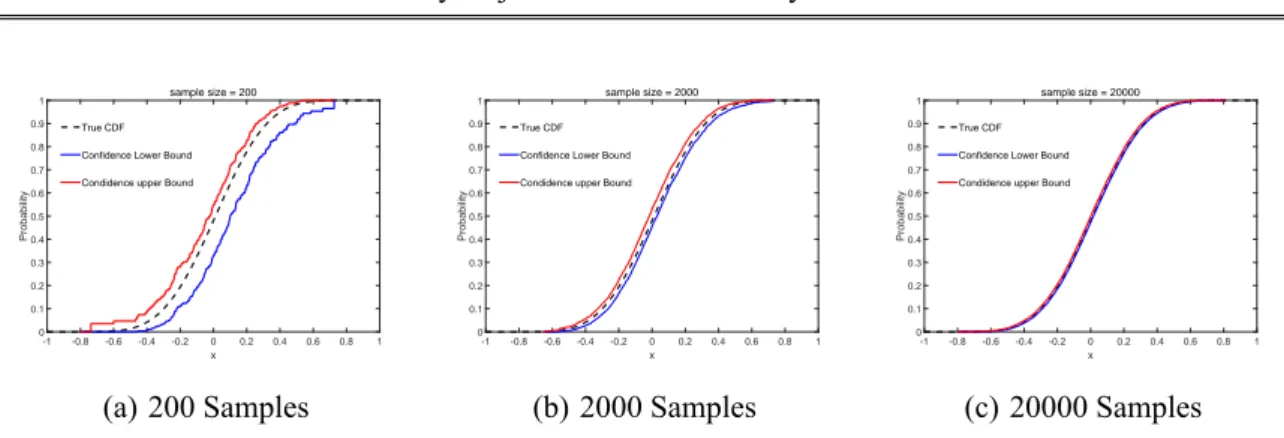
Figure 2-1 Confidence bands of CDF constructed from 200, 2000 and 20000 samples of the random variable.
by P(x) and P(x), i.e. P(x) ≤ Fˆ(x) ≤ P(x); 3) as the size of the sample set n → ∞, sup|P(x)−P(x)| → 0. In other words,P(x) andP(x) represent the reliable information that can be extracted from finite samples and the information becomes more and more accurate as the size of the sample set grows. Fig. 2-1 illustrates the evolution of the obtained CDF confidence bands as the size of the sample set increases.
Note that confidence bands for CDF do not contain the support information of the random variable. We further introduce Devroye-Wise method [72] to estimate the support[ξ, ξ]. Define
δ= max
1≤i≤n| ˆ
ξ(i+1)−ξˆ(i)|. It is suggested in [73] to choose[ξ, ξ] = [ ˆξ(1)−δ/2,ξˆ(n)+δ/2]which
is proved to converge to the true support in probability.
Based on the confidence bands for CDF and the estimated support, the ambiguity setP employed in this chapter takes the form
P ={P∈ P0([ξ, ξ])P{ξ ≤ξˆ(k)} ∈[pk, pk], k = 1,· · · , n }
(2-4)
where P0([ξ, ξ]) denotes the set of all probability measures whose supports are the interval [ξ, ξ]. The proposed structure of ambiguityP is designed to encode the information from con-fidence bands for CDF and does not assume any prior knowledge about the distribution type. Due to the convergence property of the confidence bands shown in Fig. 2-1, the ambiguity set P is made smaller and smaller by incorporating more and more historical data. Moreover, the structure defined in (2-4) allows very efficient reformulation of distrituionally robust optimiza-tion problems, which will be analyzed in secoptimiza-tion 2.3. Compared with uncertainty set used in RO, ambiguity set is a set of probability distributions (measures) while uncertainty set is a set of possible realizations of the random variable. Analogous to RO which considers the worst-cast realization in the uncertainty set, the proposed DRO considers the worst-case distribution in the ambiguity set.
2 Data-driven Affinely Adjustable Distributionally Robust Unit Commitment
2.3 Affinely Adjustable Distributionally Robust Unit Commitment
2.3.1 Feasible Set
The constraints for the binary commitment variables are as follows: ∀i∈ Gb, b ∈ B, t∈ T
−wib(t−1)+wbit−wikb ≤0, ∀k ∈[t+ 1,min{t+Mib,up−1, T}] (2-5) wib(t−1)−witb +wikb ≤1, ∀k ∈[t+ 1,min{t+Mib,dn−1, T}] (2-6) −wib(t−1)+wbit−ubit≤0 (2-7) wib(t−1)−witb −vitb ≤0 (2-8) witb, ubit, vbit∈ {0,1} (2-9) where constraints (2-5) and (2-6) represent the minimum up-time and minimum down-time restrictions, and constraints (2-7) and (2-8) indicate the relationship between on/off status and start up/down operations.
As for the continuous dispatch problem, we adopt the affinely adjustable approach [43, 74–77], i.e. the actual power outputs of generators respond affinely to the total forecasting error of composite loads:
˜
pbit=xbit+abit∑
b∈B
(˜lbt−ˆlbt) (2-10) wherexbitis the generator setting point andabitis the generator participation factor in response to the total difference between uncertain composite load˜ltband its forecast valueˆltb. This affine policy has its own limitations. First, the affine policy is only a conservative approximation to the optimal recourse action. Second, only system-level probabilistic information is exploited. However, it possesses some indispensable advantages as follows. 1) Tractability: the robust counterparts of affinely adjustable approach is usually tractable convex problems whereas those of fully adjustable approach are non-convex problems. 2) Scalability: due to such aggregated treatment with uncertainties, we only need to consider a one-dimensional rather than high-dimensional random variable in each time period. Therefore, the computation burden does not increase with the number of uncertain sources; moreover, thanks to the designed ambiguity set and the related reformulation technique discussed later, the computation burden remains unchanged when using more historical data. 3) Practicabili