INTRODUCTION
The promise of increased efficiencies stemming from electronic data capture and electronic data management (referred to here collectively as EDC) has existed for years. However, adoption of EDC as a standard clinical trial tool has been slower than expected, primarily because of the mixed track record for EDC implementations. According to the most recent benchmarking document from The EDC Forum, 70% of EDC initiatives fail to achieve expected benefits.1 The full potential of EDC has yet
to be realized by the majority of clinical develop-ment organizations.
Any clinical development function that has considered implementing—or is in the process of implementing—EDC no doubt understands that it takes more than new technology to reap its benefits. While EDC can help streamline the clinical trial process, to maximize the benefits of a paper-less system, one also must institute and manage change across the organization as a whole. Put sim-ply, fulfilling the promise of EDC requires managers to effectively implement a range of operational changes.
The authors of this paper have assisted in numer-ous successful global EDC implementations that achieved company objectives and expected benefits. Through that experience, the authors have identified a number of critical success fac-tors, “must-haves” and “must-avoids,” and general guidelines that managers should follow if they are to realize EDC’s full potential. To share those key success factors, as well as common mistakes to avoid, this paper is organized into four parts:
1. Critical Success Factors in Global EDC Implementation
2. Five Steps to Successful EDC Vendor Selection 3. Process and Role Changes Required to
Successfully Implement EDC
4. Effective Testing, Training, and Rollout of EDC Solutions
While this paper is not intended to be a compre-hensive guide to EDC selection and implementa-tion, it is intended to provide a framework that will help managers plan their efforts, organize their thinking, and guide their actions.
PART 1: CRITICAL SUCCESS
FACTORS IN GLOBAL EDC
IMPLEMENTATION
CRITICAL SUCCESS FACTOR ONE: STRONG
LEADERSHIP AND AN UNDERSTANDING OF
EDC’S CHALLENGES
Making EDC the new standard in an organization re-quires unambiguous executive support and strong project leadership. All areas within and aspects of clinical development are affected by the change. Through experience, the authors have learned that successful EDC projects must involve the following key roles:
n Executive sponsor—usually the vice president of Clinical Development
n Project sponsor—usually the senior director of Clinical Operations
n Steering committee members, including the most senior
➢ n Biostatistician ➢ n Data Manager
➢ n Monitor (Clinical Research Associate (CRA)) ➢ n Study Manager
➢ n Clinical Information Technology (IT) Specialist ➢ n Medical Director
➢ n Senior Project Manager, who serves as the day-to-day project leader
Common Mistake: Treating EDC as a Data Manage-ment or a Clinical Operations issue
Clearly, Clinical Monitoring, Data Management, and Study Management are affected by EDC. However, the Biostatistics and Medical Director functions, both of which often serve important support roles in clinical trials, are also integral to the success of EDC. As such, clinical development leadership must gather and incorporate these groups’ input to the EDC processes.
Common Mistake: Allowing the internal IT function to drive the implementation process
EDC implementation is not simply a computer sys-tem implementation. In fact, EDC technology is only the tool that enables the critical changes that lead to benefits. However, since IT has traditionally man-aged new systems implementations and since IT
Realizing the Promise of Electronic Data Capture
is typically structured to manage internal projects, many EDC efforts are given over to IT to lead. While IT is an absolutely critical component of a project, if the project is perceived as being driven by IT, end users’ acceptance of the system may be hampered. Unless Study Managers, Data Managers and Monitors, and other key functions are involved in the implementation, few benefits or expectations will be realized.
Common Mistake: Ignoring knowledge gained from past EDC experiences and external vendors Prior to launching a major EDC initiative, realistic assessments of the challenges ahead must be conducted. Most clinical development organiza-tions interested in making EDC the standard have some experience with it—either through utilizing in-house systems, working with CROs that employ a system, or outsourcing the EDC portion of a study to an EDC vendor. The key for clinical development organizations is to capture the learnings from these experiences to enhance future, full-scale implemen-tations.
Common Mistake: Choosing the wrong technical approach
A number of potential system opportunities exist. Tools are available to build EDC systems internally. However, many organizations rely on external tech-nology vendors for EDC implementation. While the vendor arena remains fragmented, several leaders have emerged:
n Phase Forward n Oracle
n eResearch Technology n Phoenix Data Systems n Medidata Solutions n DATATRAK n eTrials n Ninaza
Given the range of options, the project leadership team must have a clear EDC strategy to ensure the correct technical approach is selected.
CRITICAL SUCCESS FACTOR TWO: SET
AGGRESSIVE TARGETS
One of the primary responsibilities of project spon-sors and the steering committee is to establish explicit targets for the EDC project, relative to both timelines and benefits. Aggressive benefits targets encourage the implementation team to move from simply installing the system to questioning how clinical development processes and procedures can be improved overall. While a fine line exists between aggressive and unreasonable goals, com-panies with cautious targets often fail to realize the full potential of their change efforts.
Common Mistake: Allowing too much time for implementation
EDC implementations, like all major projects, must have momentum. In most cases, the most successful initiatives are those with aggressive targets. Although EDC programs are highly complex and involve a large number of moving parts, fast-tracking implementation provides better results. Establishing a strong sense of urgency, as well as a bold timeline, makes dedicating resources and completing tasks more efficient.
Common Mistake: Setting “reasonable” benefit expectations and targets
Many companies develop their project benefits targets in a group environment, such as a steering committee meeting. Doing so often results in “low-est common denominator” targets that are selected because they are the least objectionable to a range of stakeholders. While these targets support easy consensus, they fail to drive change.
Instead, aggressive benefits should be developed by the executive sponsor and shared with steer-ing committee members for their comments and support. The executive sponsor should actively defend the benefits targets to ensure the pressure to produce results remains high. Examples of typi-cal benefits include: five-fold reduction in number of manual queries, two week last subject/last visit(LSLV) to database lock (DBL) and reduction of data management outsourcing by 20%.
CRITICAL SUCCESS FACTOR THREE: MAKE
PROCESS REDESIGN THE CENTER OF THE
CHANGE
To benefit from EDC systems, everyone involved in clinical operations must modify the way they work. From the CRA’s approach to site visits to the data manager’s approach to database lock, every aspect of clinical operations must change to leverage the technology. These process changes must be defined in advance of the system rollout. Defining the new processes should be the basis of the entire EDC effort.
Common Mistake: Adapting technology to existing processes
Work processes are often refined over a number of years. In most cases, they have been revised over time to support the existing paper-centric environ-ment. Attempting to modify EDC software—regard-less of whether it is packaged or custom built—to support existing work processes will lock in all the inefficiencies in the current environment. In con-trast, adapting work processes to the new software enables companies to fully leverage the technology. By redesigning work processes to optimize benefits of the technology, less time will be invested in sys-tem programming, and future support needed for the system will be reduced. While a few key system components may require special programming, the barriers to supporting these changes should be minimal.
Common Mistake: Limiting process change to system support only
While adapting to the new technology is critical, an EDC implementation offers the unique opportunity for a wholesale review of current operating pro-cesses. In addition to those changes driven purely by the EDC system, other non-system-driven issues also should be examined. As such, EDC sponsors and the steering committee need to clearly support the entire range of process changes that can add value to clinical operations.
CRITICAL SUCCESS FACTOR FOUR: USE A
PROVEN PROCESS CHANGE METHODOLOGY
Effective process change requires the right balance of risks and rewards. While it may be efficient to tackle all process changes in a single meeting, doing so rarely reduces the risk of failure. Typically a tested and proven process change methodology offers the best opportunity for ensuring that both efficiencies and risks are well managed. Campbell Alliance’s RAPID EDC Methodology, for example, typi-cally calls for the process to be broken into 5 to 10 sub-processes for purpose of redesign.
Common Mistake: Redesigning with the wrong people
The complexity of day-to-day activities must be considered when redesigning processes. Success-ful redesign projects involve experienced line-level personnel that support a specific function. While it is tempting for senior managers of a given function to drive the process, they are often so far removed from current operating conditions that they overlook key details in the redesign.
Rather than involving themselves in process change, senior managers should serve as sounding boards to teams of line-level personnel that are empowered to affect change. A sound methodology should support this relationship.
Common Mistake: Treating phase 1 studies and phase 2-4 studies the same
While the work processes in phase 1 studies share many of the same steps and procedures as phase 2, 3, or 4 studies, the needs of phase I studies are sufficiently unique to require special attention. However, when processes are redesigned across all phases, they are typically driven by the needs of phase 2-4 studies. If phase 1 processes are not considered separately, the opportunity to gain phase 1 staff acceptance and ultimately achieve project benefits for phase 1 studies is reduced. While some organizations have gone so far as to implement separate EDC systems for phase 1 and phases 2-4, typically, a single system with specially tailored phase 1 work processes can suffice.
CRITICAL SUCCESS FACTOR FIVE: MANAGE
ORGANIZATIONAL CHANGE
EDC implementation invariably alters the alignments and responsibilities of various roles in clinical devel-opment. For example, EDC can significantly alter or eliminate some roles in CRF development, and EDC often drives change in the roles of and relationship between Data Monitoring and Data Management. As a result, organizational change must be managed as actively as process change. And ideally, organiza-tional changes should be rolled out simultaneously with the new EDC system and new work processes.
Common Mistake: Separating process change from organizational change
Given that process change is best supported by line-level personnel and organizational change is usually driven by senior management, it is tempting to treat them as two separate, parallel processes. However, this approach requires the two visions be reconciled before implementation is finalized. This reconcili-ation typically occurs near the end of the project after both visions have been fleshed out. The result is a mad scramble to make changes where the two visions diverge.
Usually, organizations are most successful when they allow the redesigned processes to be the pri-mary driver of organizational change. By doing so, organizational change can be conducted to support and align with the process change.
CRITICAL SUCCESS FACTOR SIX: TEST BOTH
SYSTEMS AND PROCESSES TOGETHER
Any new computer system must be tested before it is rolled out. This is a standard IT approach to sys-tem implementation. Yet, as mentioned previously, the benefits of EDC are achieved through work pro-cess changes. Despite this fact, few organizations jointly test the new processes and the EDC system. The authors’ experience has shown that an end-to-end process test utilizing the production version of the EDC system can help avoid problems and ensure that work processes are followed.
Most EDC initiatives fail when fundamental changes to business processes are ignored.
Manage Study Performance
Figure 1.1: Key Process Changes Required for EDC
Data Management must start cleaning data at the beginning of the study.
1
Data checks must be built onthe front end.
2
Site monitors must alter theirapproach to and frequency of site visits, changing key proce-dures and metrics.
3
Current approach to studycloseout must be restruc-tured to ensure more rapid turnaround.
4
Study DataRequire-ments Defined
1
Study Monitoring3
Query Execution3
Data Quality Assured3
Study Closeout4
Study Initiation2
eCRF Development2
Common Mistake: Relying solely on IT to conduct testing
Traditional systems testing is often a technical effort driven by IT. Given the importance of joint processes and systems testing, Campbell has found that IT needs to partner closely with clinical opera-tions stakeholders to conduct testing. Campbell also has found that testing can serve as a “train-the-trainer” opportunity, providing clinical operations stakeholders with a broad understanding of both the system and processes before conducting training.
CRITICAL SUCCESS FACTOR SEVEN:
DEDICATE THE RESOURCES NEEDED FOR
TRAINING
All the hard work involved in an EDC implementation is lost unless personnel are adequately trained on both the new system and work processes. Train-ing should be designed around and provided to unique roles, especially if the responsibilities have changed. Such training is best provided by those line-level personnel who designed and/or tested the new processes and thus can discuss the logic behind new processes and the system.
In addition to dedicated trainers, EDC sponsors and the steering committee need to assume that all resources in clinical development will need between one and two days of training—approximately one day for systems training and half to three-quarters of a day for process training.
Common Mistake: Providing inadequate time for process training
Surprisingly, there is often a strong resistance to providing adequate time for process training. Although in most cases the changes made to work processes can be extensive, in many instances leadership assumes—at their risk— that one to two hours for process training will be sufficient. Failing to provide adequate time for formal process training burdens personnel with having to teach themselves using whatever form of documenta-tion is available. Self-instrucdocumenta-tion on new processes rarely produces adequate results. Organizations should expect process training that supports EDC implementation to take between half and three-quarters of a day, depending on the level of change each role will experience.
A BRIEF CASE STUDY
Now that the critical success factors and common mistakes associated with EDC implementation have been described, it is helpful to review an example of a successful one. The following case study provides a solid overview of how to successfully manage change within an organization when making EDC the standard.
Background
A “top 5” pharmaceutical company faced a number of major strategic issues. Its growing pipeline was placing great pressure on the Clinical Development function. Economic realities dictated against hiring more staff to handle the increased workload, so function leaders needed to change the way the organization operated—to do more with less. One critical decision was to improve the efficiency of clinical trials and improve the speed of the capture and management of subject data by implementing a paperless system.
The authors’ firm, Campbell Alliance, was engaged to help the client redesign all global trial-related processes—from eCRF development to study close-out—for phases 1-4.
Past EDC Experiments
The company had previously experimented with a range of EDC systems, including one developed in-house. This proprietary, laptop-based system had been developed and deployed at a legacy organization. The solution proved popular with both investigators and study monitors. However, the system was cumbersome to manage and difficult to reconfigure as a solution for all global studies, as it required the organization to provide each partici-pating site with a laptop configured specifically for each individual study. In addition, the company had utilized packaged EDC software solutions for several studies, but had never moved beyond the “experimentation” stage to realize the true benefits of the system.
System Selection
The company conducted a robust analysis of its experiences to develop a list of key requirements needed from the EDC system. Next, personnel per-formed two separate system selection processes—
one for phase 1 and another for phase 1-4 studies. Both processes included reviews of the internally developed and the packaged EDC systems. Person-nel conducting the separate reviews identified the same optimal solution—and selected the same packaged EDC system.
Process Redesign: The Center of Change
One key take-away from the company’s past experience with EDC was that it represents much more than the implementation of new technology. Management understood that changing the way the organization conducted clinical trials was central to realizing the benefit goals it had set. Simply implementing EDC on top of paper processes would result in failure.
The company identified two areas of focus that were critical to the success of their EDC effort:
n PROCESS REDESIGN: The authors worked with senior management to establish an effective project structure that included resources from all critical functions, representation from different global regions, and subject-matter experts in key process areas. The project involved separate process redesign teams for phase 1 and phases 2-4. Teams were structured to focus on specific aspects of the clinical trial process, such as eCRF creation and data monitoring.
n PROGRAM LEADERSHIP AND COMMUNICATION: The authors worked directly with the client’s senior management to provide guidance for this large undertaking, confirm process changes were clearly understood and accepted by leadership, and ensure processes drove system design rather than the other way around. Working ses-sions were conducted with the project steering committee at critical junctures to communicate process and organizational change recommenda-tions, receive input from the steering committee, and promote consensus on appropriate changes among steering committee and project team members.
Overview of the Approach
The authors used a well-developed methodology for redesigning business processes and changing organizational infrastructures. In addition, the client brought its own proven methodology to the effort.
A critical step in beginning the process redesign effort was to effectively combine these two meth-odologies to develop a single approach to process redesign and organizational restructuring that would meet the client’s targets and expectations in the aggressive time frame established.
A high-level overview of the approach taken to re-design business processes, manage organizational change, test processes and system together, and train key employees is provided below.
Process Redesign
The cornerstone of the process redesign efforts were two sets of three-day process redesign workshops for each critical function area. In the first workshop, process redesign teams were tasked with defining high-level enhanced business pro-cesses and identifying process changes required to implement the enhanced processes. Team members were assigned as “champions” of the process change effort and charged with removing barriers to successful implementation throughout the organization.
During the three weeks between meetings, team members resolved open issues identified during the first workshop, communicated the required process changes to their colleagues, and generated feed-back on the teams’ recommendations. Additional information gained from these activities served as critical input to the second workshop.
During the second workshop, process redesign teams refined and added details to the initial to-be processes. The teams then identified tools and
documentation needed to support execution of the redesigned processes. Work plans were devel-oped, and owners were assigned to developing the supporting tools and documentation. The authors worked closely with client team members to support communication and build individual work plans. Next, they consolidated individual team member work plans into work plans that would govern the development effort.
Organizational Change
Once processes were redesigned, the redesign teams identified roles responsible for executing each step in the new processes. The authors then facilitated a three-day workshop with the project steering committee to discuss the new processes and associated roles, receive steering commit-tee input, and determine the potential impact the process and role changes would have on the Clinical Development organizational structure.
Process and System Testing
Process and system testing is critical for future success. Given the significant alterations to the work to be conducted and the global scale of those changes, testing the redesigned processes and EDC system prior to conducting “live” clinical trials was crucial. As such, once process and role changes were agreed upon and supporting tools and docu-mentation were developed, more than 75 detailed scripts were developed based on every potential scenario an employee would encounter while executing a clinical trial. These scripts included all redesigned process steps, as well as exercises to test whether the system, as designed, would
support the execution of the new processes. The team also conducted a simulated study in which a cross-functional team of employees executed all processes using the system. This exercise identi-fied opportunities for improving the processes and supporting tools, documentation, and the system prior to going live.
Organization-Wide Training
The significant changes stemming from EDC imple-mentation also required in-depth training for study team members. In addition to the system training, the team developed detailed training modules spe-cific to critical roles—eCRF developer, study monitor, data manager, and study manager—for clinical development staff. These training modules provided a detailed walk-through of all process steps in which each role was involved. Trainers, who had been members of the process redesign teams, delivered role-specific training to their colleagues who would conduct clinical trials using the new EDC system.
IN CONCLUSION
For an EDC implementation project to achieve organizational goals, the critical success factors detailed above must be integrated into the program. While no magic bullet exists, clinical development organizations will have a much greater opportunity to achieve benefit targets and surpass expectations if they follow the guidelines and avoid the common mistakes mentioned above.
Project Process Overview
Time
Figure 1.2: Overview of EDC Implementation Approach
Develop EDC Goals and Metrics Redesign Processes to Maximize Value Implement Changes and Train Staff n Work with senior management to develop
goals
n Identify and document expected benefits n Develop a plan for measuring performance
against goals and anticipated benefits
n Develop work processes to support the execu-tion of clinical trials using EDC
n Understand and document changes to critical activities such as study monitoring, data management, and study management n Test the execution of work processes using
the EDC system prior to going live
n Translate role changes into potential organiza-tional changes
n Support the communication of organizational changes
n Develop and deliver training to support the execu-tion of new work processes using EDC
PART 2: FIVE STEPS TO
SUCCESS-FUL EDC VENDOR SELECTION
OVERVIEW
Decreasing go-to-market time for individual prod-ucts, as well as the overall product pipeline, is a primary concern of pharmaceutical companies. An effective EDC strategy is essential to achieving this goal. Moving from paper-based to electronic clinical trials creates several quantifiable benefits, including n Faster study close-out: reduces time from last
study/last visit (LSLV) to database lock by up to 70%¹
n Reduced workload and corresponding cost: reduces data entry, query management, and site monitoring workload, thus eliminating an esti-mated $250,000 to $350,000 in costs per study To fully achieve these benefits, a company should leverage EDC technology to complete the following key activities:
n Capture of clinical trial data electronically at the investigator site
n Real-time query generation and resolution n Integration of data with back-end systems, such
as a clinical trial management system (CTMS) and statistical analysis software
n Remote monitoring of study and site perfor-mance by Study Managers and Site Monitors The success of these activities is largely determined by the selection of the most appropriate EDC vendor. This white paper will provide readers with tools and insights to
n Better understand the EDC technology vendor landscape
n Apply a disciplined, pragmatic process to EDC vendor selection efforts
n Evaluate EDC vendor capabilities using a “real-world” approach
DECIDING WHETHER TO RENT OR BUY
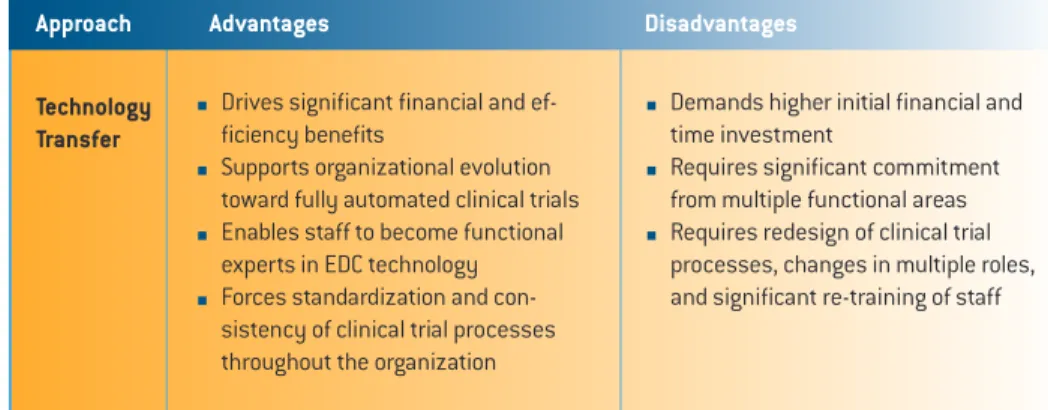
Prior to selecting an EDC vendor, pharmaceutical companies must decide whether to “rent” the capa-bility through an application service provider (ASP) model or “buy” the capability through a technology transfer arrangement with their vendor of choice.
The ASP and technology transfer models are de-scribed in Table 2.1 above.
The authors believe that ASP vs. technology transfer is not an “either/or” decision. Rather, the choice corresponds to different points in an organization’s progression towards full commitment to conducting EDC trials.
The ASP model is appropriate for companies “experi-menting” with EDC. The model enables customers to realize some benefits of EDC trials on a study-by-study basis, without having to make a commitment to a single vendor. While this allows companies to gain experience with EDC technology, many of the benefits of EDC are never realized through the ASP model. Table 2.2 below explores advantages and disadvantages of the ASP model.
In contrast, the technology transfer model is more appropriate for companies making a commitment to conducting the majority of their clinical trial electronically. In order to realize the full benefits of EDC, a company must:
n Redesign clinical trial processes and organiza-tional structures
n Customize the software to support redesigned processes
n Implement and test software and processes in tandem
n Train resources on new EDC-focused job func-tions
n Conduct pilot EDC studies, learn from those ex-periences, and revise processes, organizational structure, and software accordingly
n Manage the change until EDC is the standard method for capturing, analyzing, and managing clinical trial data
n Vendor owns and hosts the software on its servers.
n Customer pays a monthly subscription fee for use of the software. n Vendor provides professional services to handle study setup and
elec-tronic case report form (eCRF) design.
Model Description
Table 2.1
n Customer purchases the software, which may be hosted on its or the vendor’s servers.
n Customer tailors the software as appropriate to meet its specific opera-tional needs.
n Customer resources conduct all study set up, eCRF design, and study conduct activities.
ASP
Technology Transfer
n Allows companies to try multiple packages
n Limits organizational commitment— process and organizational design are not expected
n Costs less than technology transfer on a single-study basis
n Allows studies to be “up and running” in a matter of weeks
Approach Advantages
Table 2.2
ASP
Disadvantages
n Offers few quantifiable benefits n Fails to capture key learnings at the
operational level, as key processes are executed by the vendor n Costs more than technology transfer
on a relative basis
n Limits staff learning curve by testing different vendor packages
n Increases confusion amongst staff and investigators through lack of com-mitment to a single solution
Table 2.3 above explores advantages and disadvan-tages of the technology transfer model.
In order to make the “rent vs. buy” decision, companies must determine where they stand in the progression from paper-driven to electronic trials. Is the company still learning and developing a comfort level with EDC technology? Or is it ready to standardize on one platform?
Wherever the organization is in its progression between initial evaluation and total commitment to EDC, it is necessary to make the rent vs. buy deci-sion prior to beginning vendor selection.
THE EDC VENDOR SELECTION PROCESS
Key steps to successfully identifying potential solution providers, evaluating their capabilities and business models, and ultimately selecting the right partner to meet the company’s needs include the following:
Step One: Categorize Solution Providers One of the most confusing aspects of choosing an EDC solution provider is navigating the fragmented vendor landscape. Companies can simplify their selection process by segmenting EDC providers into the following categories:
Table 2.5
“eClinical Suite” Providers:
n Vendors in this category provide a range of eClinical solutions including EDC and CTMS, as well as peripheral solutions like patient diaries and interactive voice response systems (IVRS).
n Vendors in this category include etrials, Phase Forward, and Oracle.
EDC Specialists:
n These vendors exclusively provide EDC solutions.
n It is critical that the specialist’s solution can be easily integrated with other clini-cal systems.
n Vendors in this category include Medidata, eResearch Technologies, and Datatrak International.
Late-Stage Specialists:
n These specialists offer solutions that meet the specific needs of late-stage, or post-marketing studies such as Phase IV, investigator initiated studies (IIS), and patient registries.
n Vendors in this category include Ninaza and Outcomes Research.
Step Two: Involve the Right Players Companies too often view selection of an EDC vendor as an exercise driven by the IT and Data Man-agement groups. While IT and Data ManMan-agement are clearly stakeholders in the process, they are by no means the only critical parties.
Given the wide implications of using EDC technology, it is recommended that a cross-functional team of executives be formed to consider the optimal solu-tion. This team must include representation from all clinical trial phases being considered. An ideal selection committee construction may look like this:
Figure 2.6: Sample EDC Implementation
Team
n Drives significant financial and ef-ficiency benefits
n Supports organizational evolution toward fully automated clinical trials n Enables staff to become functional
experts in EDC technology n Forces standardization and
con-sistency of clinical trial processes throughout the organization
Approach Advantages
Table 2.3
Technology Transfer
Disadvantages
n Demands higher initial financial and time investment
n Requires significant commitment from multiple functional areas n Requires redesign of clinical trial
processes, changes in multiple roles, and significant re-training of staff
Figure 2.4: Overview of EDC Vendor Selection Process
Categorize Solution Providers
1
Involve the RightPlayers
2
Learn From YourExperiences
3
Narrow the PlayingField Further
4
Evaluate Candidate Solutions in a Real-World Setting5
IT-Application Development Advisor Clinical Operations Co-lead Data Management Co-lead IT-Infrustructure Management Advisor Therapuetic Area Representatives Advisor Pre-Clinical Representative Advisor Medical Affairs Representative Post-marketing AdvisorStep Three: Learn From Your Experiences Most pharmaceutical companies have conducted at least one clinical trial using some form of EDC and can build upon this institutional knowledge. Past experiences with specific EDC providers is critical information to gather, as there is no research more valuable than past experience. Key questions that will help a company gain insight based on its experi-ences include:
n What vendors has the organization worked with in the past?
n How many studies did each vendor support for the organization?
n In what phase was each of those studies? n Which vendors have worked in what therapeutic
areas?
n What elements of each vendor’s product suite did the organization utilize?
n Was the study managed by the organization or through a CRO?
n What were the positive experiences with each vendor?
n What were the negative experiences with each vendor?
In the case that an organization has no specific institutional knowledge, informal networking among peer companies at industry events and organization meetings can serve as a rich source of information. Industry analysts and consultants can also provide valuable insight. However, it is critical in soliciting peer advice to consider the source and any incen-tives they may have to recommend a particular solution provider.
Step Four: Narrow the Playing Field Further After categorizing vendors and gaining insight from institutional experiences and peers, a company should develop a “short list” of two to four EDC solu-tion providers. This short list should be comprised of providers with the potential to meet an organiza-tion’s specific needs.
The needs that drive the development of require-ments for an EDC system vendor include intended use of the EDC system and specific features of the organization’s clinical trial processes.
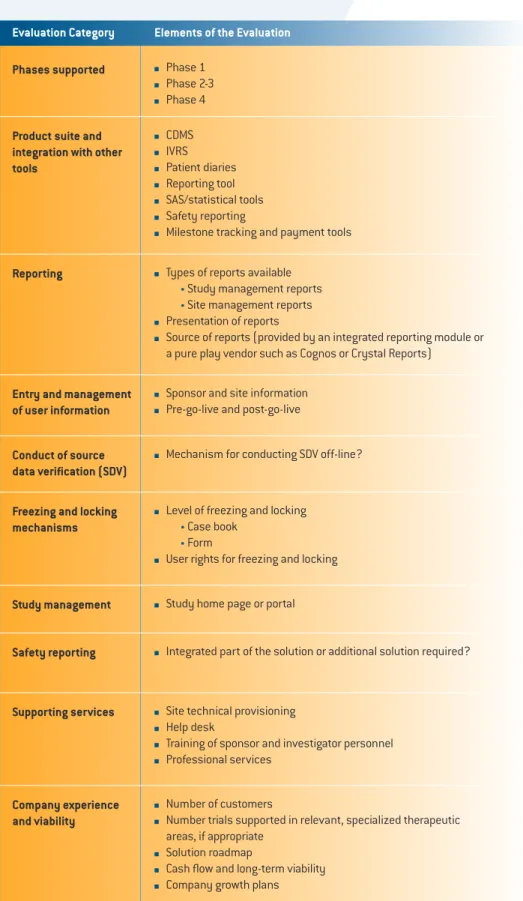
Using the following vendor evaluation checklist, an organization considering their EDC options can catalogue the critical elements of each vendor’s solutions, ranging from technical modules to profes-sional services support.
n Phase 1 n Phase 2-3 n Phase 4
Evaluation Category Elements of the Evaluation
Table 2.7: Vendor Evaluation Checklist
n CDMS n IVRS n Patient diaries n Reporting tool n SAS/statistical tools n Safety reporting
n Milestone tracking and payment tools Phases supported
Product suite and integration with other tools
n Types of reports available n Study management reports
n Site management reports n Presentation of reports
n Source of reports (provided by an integrated reporting module or a pure play vendor such as Cognos or Crystal Reports)
Reporting
n Sponsor and site information n Pre-go-live and post-go-live Entry and management
of user information
n Mechanism for conducting SDV off-line? Conduct of source
data verification (SDV)
n Level of freezing and locking n Case book
n Form
n User rights for freezing and locking Freezing and locking
mechanisms
n Study home page or portal Study management
n Integrated part of the solution or additional solution required? Safety reporting
n Site technical provisioning n Help desk
n Training of sponsor and investigator personnel n Professional services
Supporting services
n Number of customers
n Number trials supported in relevant, specialized therapeutic areas, if appropriate
n Solution roadmap
n Cash flow and long-term viability n Company growth plans Company experience
Step Five: Evaluate Candidate Solutions in a Real-World Setting
Once the playing field has been narrowed to two-to-four candidates, a company can begin to evaluate the solutions against their most specific require-ments.
In order to truly understand whether an EDC solution will meet the needs of an organization, it must test the system in its own clinical trial process. Usually, a scenario-based testing exercise is appropriate, in which candidate EDC solution providers execute critical clinical trials processes based on scripts and data provided by the organization.
While developing scripts and sharing relevant data with EDC vendors creates extra work for an organi-zation, the exercise provides the most realistic op-portunity—short of actual trial conduct—to observe the candidate solutions in action. Following are a set of recommended scenarios to test:
n eCRF development, including the creation of edit checks and testing
n Site technical evaluation and provisioning n Site technical training
n Importation of study user names and profiles— both sponsor and site—into the system
n Creation and viewing of site-specific performance reports
n Electronic source data verification n Freezing of data and locking of forms n Study close-out activities
As scenario-based exercises are conducted, each vendor should be evaluated not only on its solution capabilities but as a potential partner in future EDC endeavors. The following criteria can be used: n How well did the solution meet specific
require-ments?
n What level of customization will be required?
n How much technical training will be required to comfortably conduct clinical trials using the system?
n How responsive was the vendor to requests, and how comfortable were interactions with the vendor’s management and staff?
n How open was the vendor to providing critical experience and financial information?
IN CONCLUSION
The fragmented vendor landscape, lack of a “one-size-fits-all” solution, and complex requirements of the clinical trial process can make the task of iden-tifying, evaluating, and selecting an EDC partner appear daunting.
Engaging EDC providers in an ASP model is one way to reduce complexity, but this option fails to gener-ate the promised benefits of EDC. To fully receive these benefits, an organization should select a provider offering a technology transfer approach to EDC.
Organizations ready to commit to EDC as their standard method for collecting, analyzing, and managing clinical trial data should follow five key steps in selecting an EDC partner:
1. Categorize Solution Providers 2. Involve the Right Players 3. Learn From Your Experiences 4. Narrow the Playing Field Further
5. Evaluate Candidate Solutions in a Real-World Set-ting
The organization that is willing to invest the time, energy, and focus into methodically executing the five critical steps of EDC vendor selection increases its chances of developing a successful partnership and, ultimately, realizing the promised benefits of EDC.
In order to truly understand
whether an EDC solution will
meet the needs of an
organiza-tion, it must test the system in
its own clinical trial process.
PART 3: PROCESS AND ROLE
CHANGES REQUIRED TO
SUCCESS-FULLY IMPLEMENT EDC
OVERVIEW
To say that conducting a clinical trial is a complex undertaking would be a serious understatement. Conducting clinical research means managing everything from creating case report forms, through monitoring sites, to locking databases. It can involve numerous sites and thousands of subjects in multiple countries around the world—and that is when things go smoothly. In reality, clinical research also involves resolving countless queries, recruiting often hard-to-find subjects, and cleaning mountains of data, all while enduring intense regula-tory scrutiny.
In other words, conducting a clinical trial is hard work. Yet over the years, pharmaceutical firms, biotechnology companies, and research organiza-tions have found a way to make it happen. So is it any surprise that these same clinical development organizations are not eager to give up on a system they believe already works in order to implement electronic data capture (EDC)—technology that requires change to this already complex system? It is this very resistance to change that contributes to the fact that almost 70% of EDC implementa-tions fail to meet expectaimplementa-tions¹. Organizaimplementa-tions try to implement the technology without adapting the clinical development processes that support it. They are then disappointed when they do not
recognize all the promised payoffs of EDC. The benefits of EDC, such as simplified site monitor-ing, elimination of double data entry, and faster da-tabase lock, are only realized by organizations that are willing to tackle the organization and process changes necessary to support the technology. In this section (Part 3), we will discuss what changes are necessary for implementation and how best to go about making them.
SUMMARY OF EDC-DRIVEN PROCESS
CHANGES
EDC is more than just new technology; it’s a new way of thinking about clinical trials. Implementing EDC while maintaining the processes that supported a paper-based system is like trying to play a CD on a turntable. The technology is only effective when it is supported by the right base of business processes. One fundamental premise regarding the success of EDC is that the benefit potential will not be reached unless clinical trial processes are redesigned and key roles are updated so that they integrate ef-ficiently with the EDC solution.
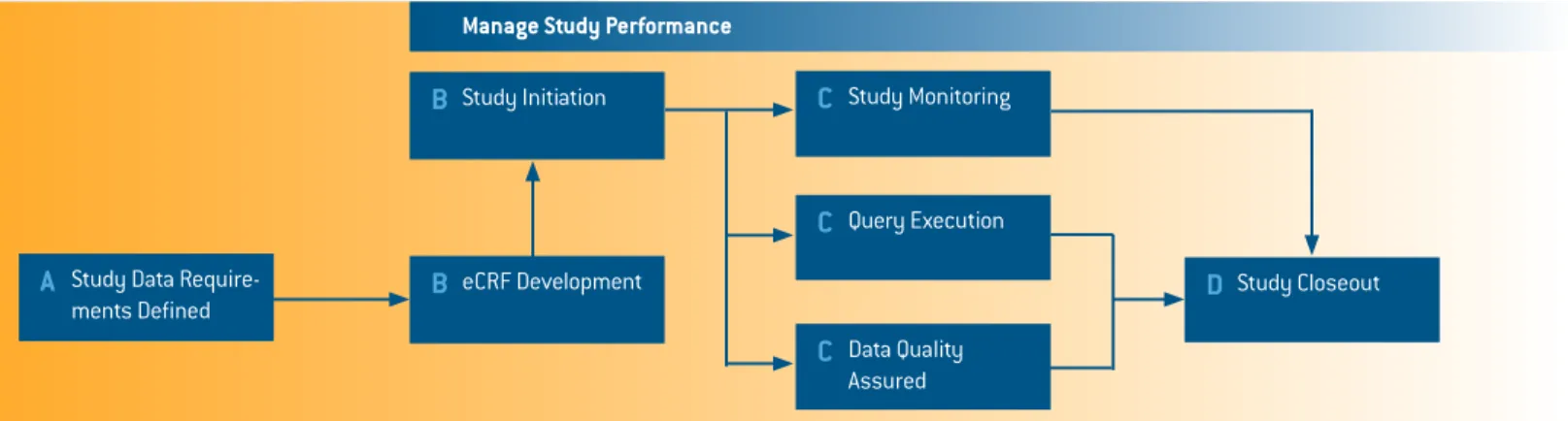
These process changes must occur at several key points along the clinical trial process, as illustrated in the diagram below.
The critical process changes start with defining the study data requirements (Fig. 3.1, A). In a tradition-al, paper-based clinical environment, defining these requirements is an iterative process that is done in concert with case report form (CRF) development. As the CRF evolves, so do the data requirements.
This back and forth process is extremely time-con-suming, as it leads to delays due to revisions, false deadlines, and general confusion.
When implemented, EDC solutions make it very difficult to edit the data requirements that underlie the electronic case report form (eCRF). Effective clinical development organizations will view this condition as an opportunity to create a well-defined set of study data requirements on the front end. When critical issues like desired data endpoints and structure of site visits are addressed as “final” on the first go around, then time-consuming revisions and misleading deadlines can easily be avoided. When data requirements are thoroughly developed on the front-end, the creation of eCRFs becomes much easier (Fig, 3.1, B), and EDC can begin deliver-ing tangible efficiency gains. An eCRF must be built in a serial fashion, and having a strong set of data requirements facilitates a smooth building process. It is only when clinical organizations maintain the paper-based tradition of jumping back and forth be-tween edits to the study requirements and edits to the eCRF that implementing EDC becomes a burden instead of a benefit.
Process change is also critical in study monitoring (Fig. 3.1, C). EDC makes it possible for Site Monitors to gather information on a continuous basis without having to make as many site visits. This shift in capabilities requires the underlying responsibilities and procedures to be altered if benefits are to be realized.
The attributes of a successful Site Monitor shift significantly once EDC is implemented. The most obvious need is for an increased degree of technical
Manage Study Performance
Figure 3.1: Points of Critical Process Change for EDC
Study Data Require-ments Defined
A
Study MonitoringC
Query ExecutionC
Data Quality AssuredC
Study CloseoutD
Study InitiationB
eCRF DevelopmentB
know-how. EDC allows those with the necessary technical skills to successfully monitor the sites without the frequent site visits required under a paper-based system. In turn, site monitors must have the communication skills to build and foster relationships remotely, as their degree of live inter-action with investigators significantly decreases. In addition to the shifting nature of investigator rela-tionships, remote monitoring also means that data is constantly being collected. In order to keep up with this more rapid stream of information and the simultaneous flow of data from multiple locations, a successful Site Monitor must possess strong project management skills.
More effective project management is the driving force that enables the more rapid study closeout (Fig. 3.1, D) promised by EDC. Paper-based clinical organizations often experience the greatest delays at study closeout. Traditionally, this was when the data first began to be cleaned. Creating and replying to all the queries at one time created a significant bottleneck in the closeout process. Implementation of EDC solves this problem because an effective Site Manager can resolve data issues as they occur. When query resolution is successfully managed throughout the monitoring process, then study closeout becomes more streamlined and free of traditional paper-based study roadblocks.
ROLE CHANGES IN CLINICAL DEVELOPMENT
As clinical processes change, so must the underly-ing roles. The EDC transition primarily affects clinical roles in three areas: data management, site monitoring, and study management. These role changes do not just affect the core clinical staff; they affect everyone with a hand in the clinical process.
Using EDC, data management begins earlier in the study cycle. Because eCRFs must be built in a serial fashion, there is a stronger incentive to correctly define the data requirements the first time. To accomplish this goal, input is gathered from a wider range of participants, including the site staff that will be collecting the data in the field.
EDC also affects data management during the site monitoring process. Site Monitors, Investigators, and site staff should all expect a shift in workload from a post-study peak to a steady flow through the life of the study. While the number of live site visits
may decrease with EDC, the amount of interac-tion between site monitors and site staff greatly increase to support the continuous flow of data and related queries.
In fact, the site staff’s role is greater throughout the entire clinical process. Once the eCRF is completed and the study begins, the remote access capa-bilities enabled by EDC mean that the role of the primary site contact must be realigned to support the constant stream of data. The ability to directly query a site throughout the study means that the primary site contact’s role is much more active and involved.
This ability to constantly query sites and collect data also creates a shift in study management responsibilities. To leverage this improved data ac-cess, study managers must change their approach to reporting study progress to incorporate the new information that is constantly available. Increased access to data also allows study managers to make decisions in a more real-time manner. To do this effectively, they must develop new approaches to identifying and resolving study-wide and site-spe-cific issues on an ongoing basis.
KEYS TO SUCCESSFUL CLINICAL TRIAL
PROCESS CHANGE
Key One: Set measurable goals and break the process up into manageable pieces
It is easy for an organization to commit to using EDC as its standard for executing clinical trials. It is much more difficult to understand how to make that commitment a reality. Realistically, organizations planning to convert their clinical operations to EDC must create smaller, more-actionable, incremental goals for implementation. This is done by breaking the process up into manageable pieces.
In clinical development, even the smallest task has multiple stakeholders who must be involved in the integration of EDC. After all, the clinical trial process is a highly complex undertaking, compris-ing multiple sub-processes that are dependent upon the successful execution of the others. So it is best to break the process into logical sub-processes for the purpose of redesign, then “re-assemble” the end-to-end clinical trial process at the conclusion of the exercise. Following is a logical breakdown of clinical trial sub-processes:
Processes involved from developing study-specifications through publishing the eCRF
Table 3.2
All tasks required to prepare study teams and sites for study conduct eCRF Development
Study Initiation
Activities required to effectively monitor sites using EDC, from first subject/ first visit, through source data verification, to last subject/last visit Site Monitoring
Processes focused on addressing and closing all types of queries generated during the execution of a study
Query Management
Management of data during the course of a study and all activities required to prepare the study database for closure
Ongoing Data Manage-ment and Database Closure
Steps required to archive site and study data, remove site access to the EDC system, and decommission technical infrastructure
Study Closeout
Information and reports made available by EDC and required to more effec-tively manage an EDC study
Study Performance and Reporting
Breaking the clinical development process down into these smaller pieces is the most effective way to manage the change of such a complex process. Key Two: Treat process redesign as a global, Clini-cal Development-wide effort
While creating manageable pieces is effective, treating the redesign process as a solely technical function is not. One of the greatest temptations of organizations implementing EDC is to take the path of least resistance and treat EDC as a Data Manage-ment effort. While Clinical Data ManageManage-ment has a large stake in the outcome of an EDC implementa-tion, it is clearly not the only group affected. It is only through including all affected groups within a clinical organization that EDC is success-fully implemented. The redesign effort needs to include input from each of the following groups, and these groups must also endorse the final outcome of their combined efforts.
n Clinical Data Management n Monitoring
n Biostatistics n Clinical study teams n Safety
n Development Information Technology n Regulatory and Compliance
Beyond including these functional groups, compa-nies with a global presence must also account for regional differences in how trials are conducted. This includes recognizing regional nuances in the process and organizational structure within their own organization.
Key Three: Redesign as a group
In order to effectively include all of the process stakeholders while simultaneously addressing the complexities of each clinical sub-process, organiza-tions should tackle redesign as a group.
Unlike other redesign efforts, clinical develop-ment is not a process that is effectively addressed through a study and report model. While conducting fact-finding interviews about the current process and reporting back with a suggested new process may be effective for simple redesign efforts, those who attempt to apply the typical study and report model to clinical development are generally unsuc-cessful.
Given the criticality and complexity of the clinical trial process and the multiple departments affected by its redesign, the authors believe that the only way to effectively redesign the process is as a group. A group structure allows for the needed interaction among the stakeholders for each clinical development sub-process.
Each sub-process should be redesigned by a cross-functional team focused specifically on the detailed activities involved in a particular process. The team should include representatives from the functional areas most likely to be affected by or have influ-ence on the changes generated by the team. For example, the study monitoring process redesign team should include more than just Monitoring staff. Clinical Data Management and Clinical Team staff should also be involved, because the activities and processes of all three functions are interdependent. In the same manner, global organizations must look beyond functional interdependencies to include the perspectives of the monitoring staff in different regions so that the redesigned study monitoring process also accounts for varying global practices. Such inclusive redesign teams are able to focus on creating ideas and developing solutions creatively and quickly.
In the authors’ experience, it has been useful to hold two process redesign workshops during the redesign phase, spaced two to three weeks apart. Following is an overview of each workshop, as well as the activities conducted during the period between workshops.
At the end of the workshop process, the members of the process redesign teams will be the true EDC experts within their organization. Their understand-ing of the processes is necessary to support suc-cessful execution of studies, and they will serve as mentors to their colleagues during the organization’s transition to EDC. Workshop participants are well-positioned for this role, as they are the ones who developed the solutions.
Key Four: Create a culture of ownership Of course, the process redesign groups can only develop effective solutions if they are empowered to do so. An organization must commit not only to implementing EDC, but also to implementing the necessary process changes. Senior-level support must be given to each process redesign group so that they can make the changes necessary to truly affect their particular sub-process.
This ability to affect change is particularly important because transition to EDC creates many opportuni-ties to improve processes that have nothing to do with EDC. In a system as complicated as clinical de-velopment, it is rare that sweeping changes can be made. The opportunity to make changes throughout the clinical development process is not one that organizations should take for granted. After all, the complexity of clinical trials and the necessary degree of regulatory scrutiny has cre-ated a culture within many clinical development organizations where overbearing checks, reviews,
Teams initially focus on understanding the scope of their sub-process and their benefit goals. Upon reaching agreement, teams develop a high-level, first-draft process flow and capture the key change ideas incorporated in the redesigned process. This includes identifying any issues and barriers stand-ing in the way of makstand-ing the change ideas a reality.
Table 3.2
Process Redesign Workshop One
Team members meet with appropriate colleagues throughout the organiza-tion to discuss key change ideas and understand how best to resolve issues and remove barriers. Teams meet regularly to discuss progress, resolve issues, and discuss topics that will ultimately inform the finalization of new processes in redesign workshop two.
Inter-Workshop Period
Teams reconvene to apply findings from their activities since the first workshop, finalize the redesigned processes, and identify the roles that will execute each activity in the redesigned processes.
Process Redesign Workshop Two
signatures, and documentation are the norm. While process redesign teams are examining the clinical development process from the perspective of EDC, they must also know that they are free to challenge these cultural norms and break the “rules” put in place over time. This allows for the removal of process steps that do not ultimately add value to the end result.
The resulting culture of ownership is what drives successful EDC implementation and the organiza-tion’s ability to reap the benefits of this technology. Key Five: Create generalists out of specialists Beyond process ownership, the group workshop format also realigns individuals’ perspective so that they see the clinical development process as an interrelated whole. This is important because over time, clinical development organizations have evolved into groups of highly specialized roles that focus only on specific elements of the clinical trial process.
Organizations benefit from this specialization in that individuals become very efficient and effective in their designated roles. At the same time, specializa-tion can cause individuals to lose visibility into how their work affects the work of others.
As the organization begins the end-to-end process redesign effort, individuals within the organization must be acutely aware of how changes to one part of the process can greatly affect—positively or negatively—the success of other seemingly uncon-nected steps in the process.
Creating this awareness is as simple as putting representatives from different specialized areas in a room to discuss the process together. In this environment, individual participants are forced to think as members of the broader organization. As a result, the revised processes the group designs to support EDC implementation will support the broader organizational needs.
Key Six: Link closely with technical implementa-tion
In addition to experts from each functional area, workshop groups should also include technical experts. While clinical trial process redesign and implementation of the EDC system travel along separate parallel paths, they are inextricably linked in the sense that each work stream must inform the activities of the other.
This connection is supported through technical representation on the process redesign teams. These resources can be from the organization’s internal IT group or from the EDC software provider. The key is that they are experts in the functionality of the software and can provide input regarding the software’s ability to effectively support the rede-signed processes the team is creating. It is also helpful to create issue-focused working groups to tackle technical issues related to process redesign. These groups can be focused on many different issues. The most common of these issues include the following:
• Long-term integration of systems to create a fully integrated eClinical infrastructure
• Incorporation of external data, such as IVRS, labs, and patient diaries
• Handling of severe adverse events (SAEs) • Core configuration of the EDC system
Key Seven: Test processes, system, and support-ing tools together
All efforts in implementing EDC technology and re-designing clinical trial processes are in preparation to support the organization in conducting clinical tri-als in the most efficient manner possible. The first study teams to execute redesigned processes using EDC will be operating in an environment of change and uncertainty, and must be effectively supported. It is during the execution of these initial studies that the stakes are highest—positive experiences will generate support for the initiative, while negative
experiences could stall the organization’s efforts and lead to inadequate adoption and lowered return on investment.
It is recommended that, prior to supporting initial study teams, organizations test redesigned pro-cesses and supporting tools, along with the EDC system, in as real-world an environment as pos-sible. This exercise, known as a Conference Room Pilot, simulates the conduct of a clinical trial from end to end using scenarios that document all activi-ties in the trial. Role players execute redesigned processes, enter data into the EDC system, and use supporting tools for guidance, while observers document any and all changes required.
The Conference Room Pilot serves as a highly valuable final step in the process redesign exercise, enabling organizations to find potential issues with processes and supporting tools prior to their use in the “real world.” Addressing these issues prior to rollout eliminates their impact on initial study teams, ultimately making for a smoother rollout and increasing adoption of EDC and redesigned processes.
CONCLUSION
Obviously, the process of redesigning a clinical organization’s operations to effectively work with EDC is not an easy one. But considering the alterna-tives—inefficient paper-based trials or poorly-ex-ecuted EDC trial—the decision to undertake the redesign effort is a simple one.
PART 4: EFFECTIVE TESTING,
TRAINING, AND ROLLOUT OF EDC
SOLUTIONS
OVERVIEW
Many organizations that invest in EDC systems and related process changes still fail to achieve their expected benefits. Why? In many cases, EDC imple-mentations fail at the very end—the testing, training and rollout of the EDC solution.
Testing, training, and rollout come at the end of a long and challenging implementation process. Often the staff members who are the primary drivers of the EDC project have been working on the effort for over a year, sometimes two years. By the time the EDC project has reached the final stages, key team members may begin to be pulled away to other, high-priority initiatives or simply lose interest in the EDC initiative. So, when their energy, knowledge, and drive are needed most, many of them are no longer available to see it through to a successful conclusion.
Also, because these tasks occur at the end of the implementation cycle, budget overruns earlier in the project are often extracted from the budget origi-nally earmarked for testing, training, and rollout. These unfortunate circumstances are analogous to moving a ball to within feet of the goal line and then failing to score.
Typically, organizations that gain the greatest ben-efits from EDC are those that keep the project mo-mentum strong and preserve the budget necessary to support these final implementation steps. There are, of course, many other factors to consider as well. This document provides a five-step approach to streamline the process of EDC testing, training, and rollout including
1. Testing and revision 2. Approach to training
3. Training the clinical organization 4. Rollout to the clinical organization 5. Making continuous improvements
TESTING, TRAINING, AND ROLLOUT PROCESS
FOR EDC SOLUTIONS
Step One: Testing and Revision
For the purposes of this chapter, we focus on the testing of new processes and the final acceptance of the EDC system by the users, usually called “user acceptance testing.” This testing deals with proving that the system and processes are fit for their intended use and are conducted in addition to any technical testing, which ensures that the hardware and software are functioning according to specification.
Conference Room Pilot Testing
As discussed earlier in this book, the key to suc-cessful implementation of an EDC system is the de-velopment of revised work processes that take full advantage of the software by changing fundamental assumptions about what, how, and when work is performed.
If an effective process design methodology is employed, the newly designed processes have a greater likelihood of success. However, the develop-ment of these processes is never perfect. Testing is needed to detect flaws before staff and sites are trained on the new work processes. This need is further heightened when the development of the new processes is broken into segments and given to multiple teams. In these cases, the various seg-ments need to be tested as a whole to find points of potential redundancy or overlap.
The best approach to testing the processes and their interaction with the software, is through a “conference room pilot.” The goal of a conference room pilot is to conduct a rapid but complete run-through of all the processes defined by the EDC project using the actual software and realistic test data. The most effective conference room pilot tests are conducted with representatives of the actual roles that are expected to complete the process.
Preparation
The first set of decisions that must be made relates to the amount of effort and risk that are acceptable. Testing is all about risk mitigation. The primary reason for testing is to reduce the risk that that a problem with that process is discovered after training, when corrections are time consuming and costly to implement.
It is not feasible from a timeline and resource stand-point to test every possible scenario that could occur after the system goes live. Therefore, the leaders responsible for testing need to understand how much risk they are willing to assume. The authors’ experience has shown that valuable testing can be condensed into as little as one week, focusing on the key processes and work steps, or expanded to up to four weeks, covering most major and minor processes, as well as exception processes.
To determine risk tolerance in this instance, a practi-cal exercise is the best approach. Often the amount of risk willing to be assumed is expressed in terms of the amount of time and resources the organiza-tion is willing to invest in testing. Where the organi-zation falls on that continuum (i.e., taking from one week to four weeks for testing) is a statement about its risk tolerance
To prepare for the conference room pilot test, a set of test scripts need to be developed. Test scripts
Figure 4.1: Steps in the Testing, Training, and Rollout Process
Testing and Revision
1
Selecting Training Approach2
Training the Clinical Organization3
Rolling Out to the Clinical Organization4
Making Continuous Improvements5
define the testing scenario to be executed by the attendees. These scripts include background on the specific situation, lay out the work steps necessary to complete the scenario, and include any data needed to be entered into the system. Test scripts are developed to match the overall scope of testing, and they reflect the risk tolerance discussed earlier. Testing will only be as effective as the test script, since the attendees will only cover what is included in the script.
After establishing risk tolerance and developing test scripts, managing the logistics is the third most critical variable to the success of conference room pilot tests. Attendees must be identified and time on their calendars must be made available—no small task for such an intensive period of time. The most successful conference room pilot tests in-clude cross-functional attendees, even for sections that are primarily driven by a single function. By be-ing present durbe-ing sessions where other functions hold primary responsibility, these cross-functional attendees can identify issues that might affect their functional area later. Such representatives may include
n Study Managers n Data Managers n Clinical Study Monitors
n Individuals from supporting processes, such as Safety, Biostatistics, or Regulatory In addition to covering the key roles, the rep-resentatives should also cross key geographic areas, especially if North America, Europe, and/or Asia are planning on using the same processes. A sufficient number of attendees must be pres-ent to be able to resolve issues that arise during the meeting.
An adequate meeting place must also be found for the pilot—often a large conference room that can be retained for an extended period of time. The selected site must be equipped with the technology needed to utilize the system. Often conference room pilot tests are more effective if multiple work stations are made available. Since the pilot test is attended by many staff members, a video projector can be valuable to allow those not in front of terminals to see the progress of testing.
The attendees will also need copies of both the
process documentation they will be following and the systems support documentation.
Execution of the Pilot Test
Conference room pilot tests require strong facilita-tion, or they can quickly degenerate into a series of overlapping conversations with little focus. The facilitator is responsible for tracking progress against the test scripts and assigning a lead person from among the cross-functional team members to execute each section of the test scripts.
As issues are discovered, the facilitator deter-mines if the issue can be resolved quickly by the attendees. If so, the group confers and suggests a solution. If the issue cannot be resolved quickly, the facilitator assigns a sub-team of the attendees, and if practical, the sub-team of attendees moves to a separate room to discuss a solution. The sub-team may need to contact others that are not in attendance to gather additional information or get different perspectives.
The suggested solutions are documented and im-mediately tested. If the solution is satisfactory, the process documents are updated to reflect the new solution. If the solution is inadequate, the issue reso-lution process continues. The facilitator is respon-sible for managing the timeline and avoiding delays.
Final Revision
Based on the results of the conference room pilot test, the process documents may require a final revision. The final revision needs to focus specifi-cally on:
n Incorporating final changes
n Ensuring that terminology, numbering systems, and connection points between processes are used consistently
The final version of the process documents need to be signed off on by the testing team before training can occur.
User Acceptance Testing
Each organization has its own internal definition of what comprises user acceptance testing (UAT). The authors define UAT as the tests necessary for the organization to have confidence that the processes or systems being tested are fit for their intended purpose. Each EDC project team must meet with their internal standards-setting function to deter-mine what should be included in the UAT for their EDC implementation.
In some organizations, the scenarios covered in the conference room pilot test are considered adequate to support UAT. Other organizations require specific
structures and approaches to UAT that are not sup-ported by the conference room pilot test. The goal should be to complete as much of the UAT as possible simultaneously with the conference room pilot test to avoid rework and lost time.
Step Two: Selecting the Training Approach
The first step in developing a training program for EDC is to determine the optimal approach to train-ing. The approach can either be process-driven or role-driven. Each type of training has its advantages and disadvantages, as discussed below.
Process-driven training brings together those staff members (roles) responsible for delivering results at the end of the EDC process to collectively learn how to execute the process. This type of training has the advantage of clearly defining how trainees will work together to achieve the intended results. This also helps establish lines of communication among various roles. The disadvantages of this training approach are the logistical difficulty of training staff who are involved in a range of different processes and the inability to focus on the needs of any one role during training.
Role-driven training breaks out each role and reviews sections of EDC processes that the role is expected to support. Role-driven training enables trainers to provide instruction on the updated roles and responsibilities of a single position. The training session(s) can be staffed by their peers to help facilitate knowledge sharing. A focused, role-driven training session also eliminates the need to sit through training aimed at other roles. However, while the role-driven approach keeps trainees focused on their individual responsibilities, it can be somewhat disjointed in that