Software Partitioning for Effective Automated Unit Testing
Arindam Chakrabarti
∗University of California at Berkeley
[email protected]
Patrice Godefroid
Bell Laboratories, Lucent Technologies
[email protected]
ABSTRACT
A key problem for effective unit testing is the difficulty of partitioning large software systems into appropriate units that can be tested in isolation. We present an approach that identifies control and data inter-dependencies between soft-ware components using static program analysis, and divides the source code into units where highly-intertwined compo-nents are grouped together. Those units can then be tested in isolation using automated test generation techniques and tools, such as dynamic software model checkers. We dis-cuss preliminary experimental results showing that auto-matic software partitioning can significantly increase test coverage without generating too many false alarms caused by unrealistic inputs being injected at interfaces between units.
Categories and Subject Descriptors
D.2.4 [Software Engineering]: Software/Program Verifi-cation; D.2.5 [Software Engineering]: Testing and De-bugging; F.3.1 [Logics and Meanings of Programs]: Specifying and Verifying and Reasoning about Programs
General Terms
Verification, Algorithms, Reliability
Keywords
Software Testing and Model Checking, Compositional Anal-ysis, Interfaces, Program Verification
1.
INTRODUCTION
Today, testing is the primary way to check the correctness of software. Correctness is even more important to deter-mine in the case of embedded software, where reliability and
∗The work of this author was done mostly while visiting Bell
Laboratories.
Permission to make digital or hard copies of all or part of this work for personal or classroom use is granted without fee provided that copies are not made or distributed for profit or commercial advantage and that copies bear this notice and the full citation on the first page. To copy otherwise, to republish, to post on servers or to redistribute to lists, requires prior specific permission and/or a fee.
EMSOFT’06, October 22–25, 2006, Seoul, Korea. Copyright 2006 ACM 1-59593-542-8/06/0010 ...$5.00.
security are often key features. Billions of dollars are spent every year on testing in the software industry as a whole as testing usually accounts for about 50% of the cost of soft-ware development [29]. Yet softsoft-ware failures are numerous and their cost to the world’s economy can also be counted in billions of dollars [31].
An approach (among others) that has potential to sig-nificantly improve on the current state of the art consists of automatically generating test inputs from a static or dy-namic program analysis in order to force program executions towards specific code statements. Automated test genera-tionfrom program analysis is an old idea (e.g., [25, 29, 26, 13]), which arguably has had a limited practical impact so far, perhaps due to the lack of usable, industrial-strength tools implementing this approach. Recently, there has been a renewed interest for automated test generation (e.g., [6, 5, 36, 11, 17, 10]). This renewed interest can perhaps be attributed to recent progress on software model checking, efficient theorem proving, static analysis and symbolic exe-cution technology, as well as recent successes in engineering more practically-usable static-analysis tools (e.g., [9, 20]) and the increasing computational power available on mod-ern computers.
A new idea in this area is Directed Automated Random Testing (DART) [17], which fully automates software test-ing by combintest-ing three main techniques: (1)automated ex-traction of the interface of a program with its external en-vironment using static source-code parsing; (2) automatic generation of a test driver for this interface that performs
random testing to simulate the most general environment the program can operate in; and (3) dynamic analysis of how the program behaves under random testing and auto-matic generation of new test inputs thatdirectthe execution along alternative program paths. DART can detect stan-dard errors such as program crashes, assertion violations, and non-termination, and can also be used in conjunction with complementary run-time checking tools for detecting memory allocation problems (e.g., [22, 30, 27, 34]). During testing (Step 3), DART performs a directed search, a vari-ant of dynamic test generation (e.g., [26, 19]). Starting with a random input, a DART-instrumented program calculates during each execution an input vector for the next execution. This vector contains values that are the solution ofsymbolic constraints gathered from predicates in branch statements during the previous execution. The new input vector at-tempts to force the execution of the program through a new path. By repeating this process, a directed search attempts to force the program to sweep through all its feasible
ex-ecution paths, in a style similar to systematic testing and
dynamic software model checking[15].
When applied to large programs, a directed search is typi-cally incomplete due to combinatorial explosion and because of the presence of complex program statements or exter-nal function calls for which no symbolic constraint can be generated. It is worth emphasizing that these two limita-tions – scalability and limited symbolic-reasoning capabil-ities – are inherent toall automated test-generation tech-niques and tools, whether static (e.g., [6, 5, 36, 11]) or dy-namic (e.g., [17, 10]). This explains why automated test generation typically cannot achieve 100% code coverage in practice, independently of how code coverage is defined (e.g., coverage of all program statements, branches, paths, etc.).
An idea to alleviate these limitations is to partition a large program into several smaller units that are then tested in iso-lation to search for program bugs such as crashes and asser-tion violaasser-tions. As an extreme, every funcasser-tion in a program could be tested one-by-one in isolation using automated test generation. While this testing strategy can dramatically in-crease code coverage, automated test generation will also typically generate lots of unrealistic inputs which in turn will trigger many unrealistic behaviors and spurious bugs, i.e., false alarms. This is because function testing ignores all the dependencies (preconditions implied by the possible calling contexts) between functions.
In this paper, we investigate how to partition a program
into a set of units such that testing those units in isola-tionmaximizes overall code coverage while minimizing the number of false alarms. We propose a two-step heuristic approach to this problem. First, we perform a light-weight static source-code analysis to identify the interface of ev-ery function in a program. Second, we divide the program into units wherehighly-intertwined functions are grouped to-gether, hence hiding complex interfaces inside units. We have developed a prototype tool implementing these ideas for the C programming language. We present results of ex-periments performed on oSIP, an open-source implementa-tion of the Session Initiaimplementa-tion Protocol embedded in many IP phones. Those experiments show that automatic soft-ware partitioning using the above simple strategy can signif-icantly increase test coverage without generating too many false alarms.
The rest of this paper is organized as follows. We start in Section 2 with some background definitions and assump-tions, and define the software partitioning problem in this context. The two steps of our approach to the partitioning problem are then discussed in Sections 3 and 4, on inter-faces and partitioning algorithms respectively. The parti-tioning algorithms of Section 4 have been implemented in a prototype tool for partitioning C programs, and results of experiments are presented in Section 5. Other related work is discussed in Section 6 and we conclude in Section 7.
2.
THE SOFTWARE PARTITIONING
PROBLEM
A programP is defined as a set of functionsFassociated with a given functionmain ∈ F which is always executed first when running the program. Acall graphGover a set of
functionsFis a graphG= (V, E) with a set ofverticesV =
Fand a set ofedgesE⊆V×V such that (f, g)∈Eif there is a call to functiongin functionf. By transitive closure,
we say that a function f callsa functiong in a call graph
G if there is a sequenceσ=s0, s1, . . . , sk such thats0=f, andsk=g, and (si, si+1)∈E for i∈ {0,1, . . . , k−1}; the
path fromf to g is the sequenceσ, and itslength is k. A function f directly callsa function ginG if there is a path fromf togof length 1 inG.
A path σ = s0, s1, . . . , sk from f to g lies in a set S if
si∈Sfor alli∈ {0,1, . . . , k}. A set of functionsSisconvex
with respect to a functionf∈S if for every functionginS called byf, there is a path fromftogthat lies inS. Given a setSof functions, a functionf∈Sis called anentry point
ofS if every functiong∈S is called byf, andS is convex with respect tof. Aunitu= (S, f) is a set of functions S with an entry pointf.
Given a call graphGover a set of functionsF, apartition P ofGis a set of unitsP={(S0, f0),(S1, f1), . . . ,(Sk, fk)}
such that S{Si |0≤i≤k}=F, andSi∩Sj =∅for all
0≤i, j≤ksuch thati6=j. We assume that the pair (F,
main) is a unit, i.e.,mainis an entry point ofF. Trivially, for any functionf, ({f}, f) is always a unit.
In order to test program P, automated test generation techniques and tools can be applied to generate inputs at the program interface in order to drive its execution along as many program statements/branches/paths as possible. However, testing large programs is difficult because of the limited reasoning capabilities of automated test generation techniques and expensive because of the prohibitive num-ber of statements, branches and paths in large programs. Consequently, viewing the entire programP as a single unit usually leads to poor code coverage (as will be shown exper-imentally later) ifP is large and non-trivial. Let us call this form of testingmonolithic testing.
On the other hand, automated test generation can also be applied to all the individual functions f ∈ F ofP, one by one. This strategy can dramatically increase code cov-erage but automated test generation will typically generate lots of unrealistic inputs which in turn will trigger many unrealistic behaviors and hence many false alarms. Indeed, such a piecemeal testingignores all the dependencies (pre-conditions implied by the possible calling contexts) between functions. For instance, a functionf taking as input argu-ment a pointer to a data structure may assume that this pointer is always non-null. While this assumption may be true wheneverf is called by some function inF, piecemeal testing may very well provide a null value for this argument when calling f, which may lead to a crash if the pointer is dereferenced inside f. We call such a spurious error afalse alarm.
We define thesoftware partitioning problemas follows: how to partition a given program P satisfying the above assumptions into a set of units such that testing those units in isolation maximizes code coverage while minimizing the number of false alarms?
Our definition is intentionally general to accommodate vari-ous specific ways to measure code coverage or identify/define false alarms.
In this paper, we investigate a two-step heuristic approach to the software partitioning problem. First, we propose to perform a light-weight static source-code analysis to iden-tify theinterface of every function in a program P, which enables the definition and measurement of thecomplexityof
those interfaces. Second, we discuss several clustering algo-rithms which group together functions whose joint interface is complex, hence hiding that interface inside the resulting unit. The result is a partition of the programPwhere highly intertwined functions are grouped together in units.
The two steps of our approach are discussed in the next two sections.
3.
INTERFACES
In principle, the interface of a function describes all possi-ble avenues of exchange of information between the function and its environment: arguments, return values, shared vari-ables, and calls to other functions. The interface of a unit is defined as the interface of the composition of the functions in that unit.
In practice, the precise interface of functions described in full-fledged programming languages like C or C++ can be hard to determine statically due to unknown control flow (e.g., in the presence of function pointers), unbounded data structures, side-effects through global variables, etc. We therefore use approximate interface representations.
Control interfacestrack control dependencies across func-tion and unit boundaries. Given a programP defined by a setF of functions, theboolean control interfaceC of a unit u= (S, fS) of P is a tuple (S,O,I) whereO:S×(F \S)
is a relation mapping every functionf∈S to the functions g∈ F \S that are directly called byf, andI: (F \S)×Sis a relation mapping every functiong∈ F \Sto the functions f∈S directly called byg.
By extension, given a program P defined by a setF of functions, the weighted control interface Cw of a unit u =
(S, fS) ofPis a tuple (S,Ow,Iw) whereOw:S×((F \S)×N)
is a relation mapping every functionf∈Sto the pairs (g, n) where g∈ F \S is a function directly called by f, and n is the number of calls to g in the code describing f, and
Iw: (F \S)×(S×N) is a relation mapping every function
g ∈ F \S to the pairs (f, n) where f ∈ S is a function directly called bygandnis the number of calls tof in the code describingg.
Two boolean (weighted) control interfacesC1= (S1,O1,I1) andC2= (S2,O2,I2) arecompatible(denotedcomp(C1,C2)) ifS1∩S2 = ∅. Given two compatible boolean control in-terfacesC1 = (S1,O1,I1) andC2 = (S2,O2,I2), their
com-position(denoted C1 k C2) is the boolean control interface
Cc = (Sc,Oc,Ic) where Sc = S1 ∪S2, Oc = {(f, g) ∈ O1∪ O2|g∈ F \(S1∪S2)}andIc={(f, g)∈ I1∪ I2|f ∈
F \(S1∪S2)}(calls fromS1andS2to each other are hidden by the composition). Similarly, the composition of two com-patible weighted control interfaces is defined as the weighted control interface Cc = (Sc,Oc,Ic) where Sc = S1 ∪S2,
Oc = {(f,(g, n)) ∈ O1∪ O2|g∈ F \(S1∪S2)} and Ic = {(f,(g, n))∈ I1∪ I2|f∈ F \(S1∪S2)}.
Richer interface representations can be defined by also taking into account other features of a function that are externally visible, such as the number of input arguments, the type of input arguments and return values for incoming or outgoing function calls, the sequencing of external calls made by a function (flow-sensitive interface representation), etc.
For simplicity, we consider in this work partitioning algo-rithms that make use of information exposed by control in-terfaces only. Whether richer interface representations can
Algorithm 1 PartitionCP(S)
Input: A set of control interfaces of a setS of functions Output: A partition ofS into a setU of units
Variables: WeightedGraphG 1: G:=PopularityGraph(S) 2: while(¬IsEmpty(G))do 3: c:=ChooseCPCutoff(G) 4: G′ :=FilterPopularEdges(G, c) 5: while(¬IsEmpty(G′))do 6: t:=TopLevel(G′) 7: u:=Reachable(G′, t) 8: if (|u|>1orG′=G)then
9: adduas a new unit inU 10: G:=RemoveNodes(G, u)
end if
11: G′ :=RemoveNodes(G′, u)
end while end while
lead to significantly better software partitioning is left for future work.
4.
SOFTWARE PARTITIONING
ALGORITHMS
In this section, we present partitioning algorithms that ex-ploit the definitions of interfaces of the previous section in order to group together functions (atomic components) that share interfaces of complexity higher than a given threshold. Two notions of interface complexity are implicitly consid-ered here: popularity and collaboration.
4.1
Callee Popularity
If a functionfis called by many different caller functions, then it is likely that any specific calling context in which f is called is not particularly important. For instance, func-tions used to store or access values in data structures like lists or hash tables are likely to be called by several differ-ent functions. In contrast, functions performing sub-tasks specific to a given function may be called only once or only by that function. In the latter case, the caller and the callee are more likely to obey tacit rules when communicating with each other, and breaking the interface between them by plac-ing these functions in different units may be risky.
In what follows, let thepopularityof a functionf be the number of functions g that call f. (The popularity of a function could also be defined as the number of syntactic calls to that function; we consider here the former, simpler definition in order to determine if it is already sufficient to obtain interesting results.)
Formalizing the above intuition, our first algorithm gen-erates a partition of units in which functions f and g are more likely to be assigned to the same unit iff callsgand g is not very popular. Given the set of control interfaces of a setS of functions, the algorithm starts by invoking the
PopularityGraphsubroutine to compute a weighted directed graphG= (V, E) with the set of nodes V =S, where the directed edges inEdenote calls between functions inS, and each edge weight is set to the popularity of the callee (i.e., the popularity of the function corresponding to the destina-tion node of the edge).
Next, as long as the popularity graph G = (V, E) is not empty, the algorithm proceeds with the following steps. Given acutoff policy, it chooses a maximum popularity cut-offcby invoking the subroutineChooseCPCutoff, and (tem-porarily) removes edges above that threshold by calling the subroutineFilterPopularEdges. The resulting subgraphG′
is traversed top-down (or top-down in some spanning tree in case the subgraph is strongly connected). This traversal is performed by repeatedly invoking the subroutineTopLevel
which returns atop level nodeinG′= (V′, E′): a nodevin
V′ is said to be a top level node if no other node u exists
in V′ such that (u, v) ∈ E′. Note that a (nonempty)
di-rected graph has no top level node if and only if every node is part of some strongly connected component; in that case the subroutineTopLevel returns an arbitrary v ∈ V′. For
each top level nodet, the set of reachable nodes inG′from
tis computed by invoking the subroutineReachable. If this set of nodes is non-trivial (i.e., larger than one node), this set of nodes is defined as a unit. Nodes that would form trivial units (consisting of only themselves) are not allocated at this stage, but will be allocated at some subsequent iteration of the outerwhileloop with a possibly different (higher) pop-ularity cutoff. Nodes corresponding to functions allocated to units are removed fromGand from the subgraphG′using
theRemoveNodes subroutine. When the inner whileloop exits, a new iteration of the outer whileloop may begin, and the entire process described above is repeated until all the functions have been allocated to some unit, at which point the outerwhileloop exits, and the algorithm termi-nates. At that point, every function inShas been allocated to exactly one unit in the resulting setU of units.
Algorithm 1 uses the following subroutines:
1. The subroutinePopularityGraph takes as input a set of (boolean) control interfaces of a set of functionsS, and returns a weighted directed graph G = (V, E). The graph is such that there is a vertex vf ∈ V for
each functionf∈S, and there is an edge (vf, vg)∈E
with weightwfor each call fromf toginS, wherew is the popularity ofg.
2. The subroutineIsEmptytakes as input a graph G= (V, E) and returnsT rueifV =∅, andF alseotherwise. 3. The subroutineChooseCPCutofftakes as input a
weigh-ted direcweigh-ted graphGand returns a valuecbased on the
cutoff policy. A cutoff policy is an external parameter to the algorithm. We considered and experimented with two types of cutoff policies in conjunction with this algorithm: policy cpnmakesChooseCPCutoff re-turn the valuen on the first invocation and the max-imum weight in G on subsequent invocations, while policycpimakesChooseCPCutoffreturn the smallest weight inG.
4. The subroutineFilterPopularEdges takes as inputs a weighted directed graphG= (V, E) and a valuec. It returns a weighted directed graph G′ = (V, E′) such
that E′ ⊆E, and for alle ∈E of weight w, we have
e∈E′if and only ifw≤c.
5. The subroutineTopLeveltakes as input a (nonempty) weighted directed graphG′= (V′, E′) and returns any
nodev′such that there is nov∈V′such that (v, v′)∈
E′. If such a node v′ does not exist (i.e., every node
inG′ is part of some strongly connected component),
thenTopLevel(G′) returns anyv′∈V′.
6. The subroutineReachabletakes as inputs a graphG= (V, E) and a nodet∈V, and returns the set of nodes V′⊆V reachable fromtin G.
7. The subroutineRemoveNodestakes a graphG= (V, E) and a setu ⊆ V and returns a graph G′ = (V′, E′)
such thatV′ =V \u, and (V′, E′) is the subgraph of
Ginduced byV′.
Theorem 1. For a call graph G over a set of functions
S and given a set of control interfaces of S, the algorithm
PartitionCP(S) creates a partition ofG.
Proof. We prove (i) that the algorithm terminates, and
(ii) that when it has terminated, (a) every function inS is allocated to some unit ugenerated by the algorithm, and (b) that no function f ∈S is allocated to two unitsu and u′ generated by it.
The subroutine ChooseCPCutoff, for all cutoff policies, eventually returns the maximum weight in G. Thus, the condition G = G′ in the if condition in the inner while
loop is satisfied eventually. From that point onwards, at least one vertex is removed from the graphs G and G′ in
each iteration of the inner whileloop. Since the graphG′
is finite, the innerwhileloop must eventually exit whenG′
becomes empty. Also, since the graph Gis finite, the outer while loop must eventually exit when G becomes empty. Thus, the algorithm terminates.
Since every function in S is a vertex in the popularity graphG, and since the outer loop runs until the graphGis empty (has no more vertices), and since a vertex is removed fromGonly if it is allocated to a generated unit, it follows that every function in S is allocated to some unit. For the part (ii)(b), we observe that, when a functionfis allocated to a unit u(in line 9 of the algorithm), it is next removed from bothGandG′, and thus cannot be allocated to more
than one unit.
4.2
Shared Code
If two functionsfandgcall many of the same functions, then it is likely that the higher-level operations they perform are functionally more related than with other functions that call a completely disjoint set of sub-functions. Therefore, functions that share a lot of sub-functions should perhaps be grouped in a same unit.
This intuition is formalized by our second partitioning al-gorithm, which generates a partition of units in which func-tions f and g are more likely to be assigned to the same unit if they have a relatively high degree of collaboration, where the degree ofcollaborationis the number of common functions called by bothf andg.
Given a set of control interfaces of a setSof functions, the algorithm first creates a weighted undirected collaboration graph W = (V, E) withV =S, andE= (S×S)\ {(f, f)|
f ∈S} (intuitively, there is an edge between any two dis-tinct functions), and each edge weight is set to the number of sub-functions shared between the two functions the edge connect. Since an approach based on a single cutoff clas-sifying inter-function collaboration into a boolean “high” or “low” is too coarse-grained, we instead propose a more general algorithm based on multiple collaboration thresh-olds. Given a collaboration classification policy (embodied
Algorithm 2 PartitionSC(S)
Input: A set of control interfaces of a setS of functions Output: A partition ofS into a setU of units
Variables: WeightedGraphW 1: W :=CollaborationGraph(S) 2: c:=NumberOfCollaborationClasses(G) 3: L:=CollaborationThresholds(G, c) 4: while(¬IsEmpty(W))do 5: t:= max(L) 6: W′ :=FilterLightEdges(W, t) 7: while(¬IsEmpty(W′))do 8: u:=ConnectedComponent(W′) 9: if (|u|>1orW′=W)then
10: adduas a new unit in U 11: W :=RemoveNodes(W, u) end if 12: W′ :=RemoveNodes(W′, u) end while 13: L:=L\ {t} end while
by theNumberOfCollaborationClassessubroutine) denoting the numbercof collaboration classes, the algorithm invokes theCollaborationThresholdssubroutine to compute a set of c collaboration thresholdsrepresenting a sequence of mini-mum collaboration levelsthe algorithm will run through in descending order in subsequent iterations of the outerwhile loop, and edges representing collaboration levels below the minimum currently chosen will be (temporarily) removed by theFilterLightEdgessubroutine invoked soon afterwards in the outerwhileloop. The outer whileloop runs as long as the current collaboration graphW is not empty. At the beginning of each iteration, the maximum valuetin the cur-rent listLof collaboration thresholds is found, and passed to theFilterLightEdgessubroutine which returns a subgraph W′ of the collaboration graphW in which only edges with
weights higher than or equal to tremain. As long as the subgraph W′ is not empty, the inner whileloop runs. It
invokes theConnectedComponentsubroutine onW′to find
a group of nodesuin W′ that are all reachable from each
other. If a group of cardinality greater than 1 is found, or if no edges had been filtered out ofW to getW′in this current
iteration, the newly discovered group of nodesuis allocated as a new unit, and the nodes inu are removed from both W andW′ using theRemoveNodes subroutine. Otherwise,
the nodes inuare not yet allocated as an unit, and are re-moved fromW′ but not fromW; indeed, nodes inuwill be
allocated during subsequent iterations of the outer while loop with lower values of the collaboration threshold. When W′ becomes empty, the inner while loop terminates, the
current collaboration thresholdtthat was used is discarded fromL, and the next iteration of the outerwhileloop con-tinues with the next lower value in L as the new current collaboration threshold. Eventually, whenW is empty, the outerwhileloop terminates, and the algorithm terminates. At that point, every function in S has been allocated to exactly one unit in the resulting setU of units.
Algorithm 2 uses the following subroutines:
1. The subroutine CollaborationGraph takes as input a set of (boolean) control interfaces of a set of func-tionsSand creates a weighted undirected graphW =
(V, E). The graph is such that there is a vertexvf ∈V
for each functionf in S, and an edge (vf, vg)∈E of
weightwfor every pair of functionsf andginSsuch thatwis the degree of collaboration betweenfandg. 2. The subroutine NumberOfCollaborationClasses takes as input a collaboration graph and returns a positive integercbased on thecollaboration classification pol-icy; the policyscnforces the subroutine to always re-turn the valuen.
3. The subroutine CollaborationThresholds takes as in-puts a collaboration graph W and an integer c, and returns a sequence ofc distinct non-negative integers starting from 0 and dividing equally the interval be-tween 0 and the maximum weight inW.
4. The subroutineFilterLightEdgestakes a weighted undi-rected graphW = (V, E) and returns a graph W′ =
(V, E′) such thatE′ ⊆E, and for all edges e∈E of
weightwwe havee∈E′ if and only ifw≥c.
5. The subroutines IsEmpty and RemoveNodes are de-fined as before.
6. The subroutineConnectedComponenttakes as input a weighted undirected graphW′= (V, E) and returns a
setu⊆V of nodes. The setuis such that every pair of nodes v1, v2 ∈ u are connected in W′, and for all nodesv3 ∈V, ifv3∈/u, then for allv1∈u,v1 andv3 are not connected.
Theorem 2. For a call graph G over a set of functions
S and given a set of control interfaces of S, the algorithm
PartitionSC(S) creates a partition ofG.
Proof. We prove (i) that the algorithm terminates, and
(ii) that when it has terminated, (a) every function inS is allocated to some unit ugenerated by the algorithm, and (b) that no function f ∈S is allocated to two unitsu and u′ generated by it.
The subroutineCollaborationThresholds returns a list of integers in which the last element is the maximum weight in the collaboration graphW. Since one element from that list is discarded when the innerwhileloop exits, and since the innerwhileloop is guaranteed to exit (since it removes at least one vertex from the finite graph W′ in each iteration
and exits whenW′ has no more vertices), the last element
of the listLis eventually assigned tot(in line 5). Thus, the condition W′ = W in the if condition in the innerwhile
loop is satisfied eventually. From that point onwards, at least one vertex is removed from the graphsW andW′ in
each iteration of the inner whileloop. Since the graph W is finite, the outerwhileloop must eventually exit whenW becomes empty. Thus, the algorithm terminates.
Since every function inS is a vertex in the collaboration graph W, and since the outer loop runs until the graph W is empty, and since a vertex is removed form W only if it is allocated to a generated unit, it follows that every function inSis allocated to some unit. For the part (ii)(b), whenever a function f is allocated to a unit u (in line 10 of the algorithm), it is next removed from bothW andW′,
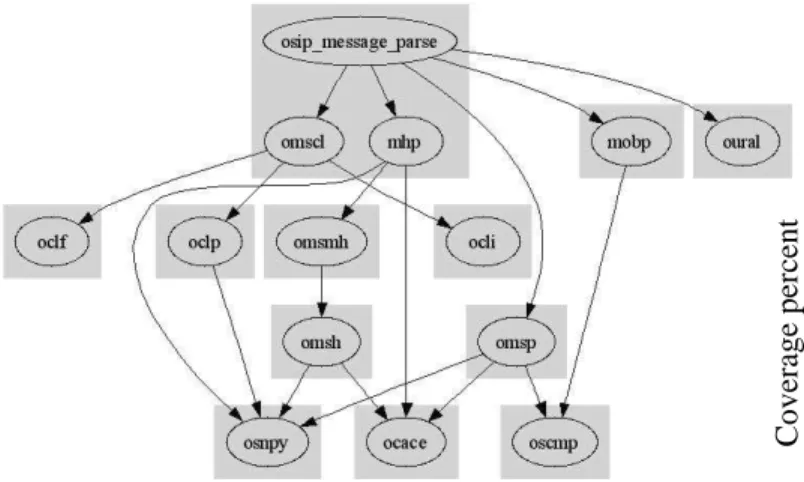
and thus cannot be reallocated later to another unit. Figure 1 shows a small fragment of theosip call-graph, chosen for simplicity. The shaded boxes show the partition
Figure 1: The call-graph, and the partition created bysc7
Figure 2: The partition created by cp1i
created by runningsc7 on the graph. On the same graph, runningcp1ipartitions the functions as shown by Figure 2. Note that each of the functions in the big fragment have 1 or 0 callers, whereasoscmp, osnpy, and ocace are more generic, having multiple callers. Runningcp3partitions the functions into two groups: {osnpy}and the rest; osnpy is the only function with more than three callers.
5.
EXPERIMENTAL RESULTS
We have implemented the algorithms presented in the pre-vious section in a prototype tool for partitioning programs written in C. In order to evaluate the effectiveness of these algorithms, we applied our tool to a large1
software appli-cation: oSIP, an open-source implementation of the Ses-sion Initiation Protocol. SIP is a telephony protocol for call-establishment of multi-media sessions over IP networks (including “Voice-over-IP”). oSIP is a C library available at http://www.gnu.org/software/osip/osip.html. The oSIP library (version 2.2.1) consists of about 30,000 lines of C code. Two typical applications are SIP clients (such as 1
From a unit testing and verification point of view.
sml cp3 big r6 r11 r16 r21 r26 r31 r36 r41 r46 r51 cp1i sc7
10
20
30
40
0
80
false
none
Number of units
0
20
40
60
50
60
Coverage percent
100
Figure 3: Coverage and incidences of false alarms
softphones to make calls over the internet from a PC) and servers (to route internet calls). SIP messages are transmit-ted as ASCII strings and a large part of the oSIP code is dedicated to parsing SIP messages.
Our experimental setup was as follows. We considered as our program P a part of the oSIP parser consisting of the functionosip message parseand of all the other oSIP functions called (directly or indirectly) by it. The result-ing program consists of 55 functions, which are described by several thousands lines of C code.2 The call graph of this program is actually acyclic, which we believe is fairly common. (Note that our partitioning algorithms are not customized to take advantage of this property.) It is worth observing that the “popularity” (as defined earlier) distri-bution in this program is far from uniform: about half the functions (25 out of 55) are very unpopular, being called by only 1 or 2 callers, about 20 have around 5 callers each, and the remaining 8 are very popular, with 20 or more callers.
We used an extension of the DART implementation de-scribed in [17] to perform all our testing experiments. For each unit, the inputs controlled by DART were the argu-ments of the unique toplevel function of that unit, and DART was limited to running a maximum of 1,000 executions (tests) for testing each unit. In other words, if DART did not find any error within 1,000 runs while testing a unit, testing would then move on to the next unit, and so on. Since the oSIP code does not contain assertions, the search per-formed by DART was limited to finding segmentation faults (crashes). Whenever DART triggered such an error, the testing of the corresponding unit was stopped. Because of the large number of errors generated by all these experi-ments (see below), we could not visually inspect each of those; we therefore assumed that the overall program could not crash on any of its inputs and hence that all the errors 2The C files containing all these functions represent a total of 10,500 lines of code.
big r6 r11 r16 cp3 r21 r26 cp1i r31 r36 r41 r46 r51 sml sc7
0
5
10
15
20
25
30
0
10
20
30
40
50
60
Coverage percent
Number of units
Figure 4: Overall branch coverage
found by DART were spurious, i.e., false alarms. Thus, in this experimental setup, at most one false alarm can be re-ported per unit. Coverage is defined as branch coverage. Test coverage while testing a specific unit is defined and measured with respect to the code (branches) of that unit only.
We performed experiments with partitions generated by several partitioning algorithms: the symbolcp1idenotes the partition generated byboththe partitioning algorithm that uses “callee popularity” iterativelyorwith a cutoff of 1, as both partitioning algorithms happened to generate the same partition for the oSIP code considered here;cp3represents the partition generated by “callee popularity” with a cutoff of 3; andsc7denotes the partition generated by the “shared code” partitioning algorithm with a policy value of 7. The above parameter values were chosen arbitrarily. To calibrate our results, we also performed experiments with the extreme partition consisting of a single unit containing all the func-tions, denoted bybig, and with the other extreme partition where each unit consists of a single function, denoted by
sml. Finally, we also performed experiments with a set of randomly generated partitions, each denoted byrnwheren is the number of units of the corresponding partition.
Our experimental results are shown in a series of figures. Figure 3 shows for each partition, the coverage obtained for each unit in the partition, and whether a false alarm was reported for that unit. A (blue)×mark indicates no false alarm was reported (i.e., the unit could be successfully tested 1,000 times with different inputs), while a (black) + mark indicates that DART reported a false alarm (i.e., found a way to crash the unit within a 1,000 runs). (Thus, fornunits, there arenmarks on the corresponding column, but some of these are superposed and not distinguishable.) All those experiments took about one day of runtime on a Pentium III 800Mhz processor running Linux. Note the low coverage of 1% inbig; this indicates that monolithic testing is severely ineffective. Also from this figure (and subsequent figures), it can be seen that the increase in coverage in the units of partitions to the right (which contain more units)
big r6 r11 r16 cp3 r21 r26 cp1i r31 r36 r41 r46 r51 sml sc7
0
5
10
15
20
25
30
35
40
45
0
10
20
30
40
50
60
False Alarm Count
Number of units
Figure 5: Number of false alarms
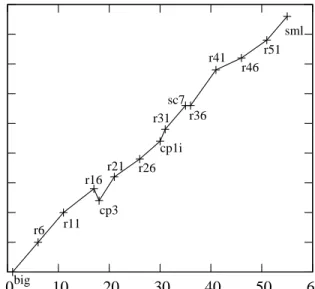
is not free of cost since it also yields more false alarms. For each partition considered, Figure 4 shows the over-all branch coverage obtained after testing over-all the units in the corresponding partition. As is clear from Figure 4, the branch coverage in a partition tends to increase as the num-ber of units in the partition rises and the average size of each unit in the partition gets smaller. At the extremes, coverage rises from about 1% inbigto about 27% insml.
These perhaps seemingly low coverage numbers can be ex-plained as follows: the total number of program branches is large (1,162), not all the branches are executable in general or in our specific experimental setup –for instance, we do not inject errors for calls tomalloc,free, etc. so branches that are executed in case of errors to calls to these functions are not executable–, testing of a unit stops as soon as an error is found or after 1,000 tests have been run, and finally, whenever DART cannot reason symbolically about some in-put constraint, it reduces to random testing [17] and random testing is known to usually yield very low code coverage [32, 17].
Note that the increase frombigtosmlis not monotonic: there are peaks corresponding to each of our partitioning algorithms cp3, cp1i and sc7. Thus, even though overall coverage rises as the number of units in the partition in-creases, our partitioning algorithms are able to select the units cleverly enough to raise the inter-unit cohesion suffi-ciently to consistently beat the overall coverage obtained by random partitions with similar numbers of units.
From Figure 4 it is clear that coverage on the whole rises as the number of units in a partition increases, and that
smlis the best partition with respect to coverage. However, this higher coverage is obtained at the cost of an increased number of false alarms, as can be seen from Figure 5, which gives the absolute number of false alarms found for each partition.
We thus have a tension between two competing objec-tives: maximizing overall test coverage while minimizing the number of false alarms. In order to evaluate how the dif-ferent partitioning algorithms satisfy these two competing
r6 r11 r16 cp3 r21 r26 cp1i r31 r36 r41 r46 r51 sml sc7
0.3
0.4
0.5
0.6
0.7
0.8
0.9
5 10 15 20 25 30 35 40 45 50 55
Coverage/False Alarm Count
Number of units
Figure 6: Ratio of coverage to false alarm
objectives, Figure 6 shows the ratio of the overall coverage obtained with a partition divided by the number of false alarms reported for the partition. (The value of this ratio is undefined forbigas it has zero false alarms; however, big
is not a serious contender for the title of best partitioning scheme as it leads to very low code coverage.) Observe that
cp3, cp1i, and sc7 each correspond to clear peaks in the graph, although of steadily decreasing magnitude, indicat-ing that cp3is the best suited partitioning scheme among those considered for the specific code under analysis. These peaks mean that all three algorithms clearly beat neighbor-ing random partitions, even though these three algorithms exploit only simple control interface definitions ignoring all data dependencies. Whether using more elaborate interface definitions like those discussed in Section 3 can significantly improve those results is left for future work.
6.
DISCUSSION AND OTHER RELATED
WORK
Interfaces are defined in the previous sections assyntactic
notions, which are computable via static analysis, and the complexity of interfaces is then used as aheuristicmeasure of how intertwined functions are. However, an ideal software partitioning algorithm would cut apart a functionf calling another functiong only if any input ofg isvalid, i.e., does not trigger a false alarm. For instance, if functiong takes as input a boolean value, it is very likely that both 0 and 1 are valid inputs. In contrast, if g takes as argument a pointer or a complex data structure, its inputs are likely to beconstrained(e.g.,gmay assume that an input pointer is non-null, or that the elements of its input array are sorted): gassumes that all its inputs satisfy aprecondition.
Unfortunately, inferring preconditions automatically from program analysis (dubbed theconstraint inference problem
in [16]) is obviously as hard as program verification itself. Another strategy would be to perform piecemeal testing (see Section 2), then hide interfaces where false alarms were gen-erated, and repeat the process until all false alarms have
been eliminated. This strategy looks problematic in practice because it would require the user to examine all the errors generated to determine whether they are spurious or not, the number of iterations before reaching the optimum could be large, and the partition resulting from this process may often end up being the entire system, that is, no partition at all. Another impractical solution would be to generate and evaluate all possible partitions to determine which one is best. All these practical considerations explain why we seek in this workeasily-computable syntactic heuristicsthat can generate analmost optimalpartition at acheap cost.
In spirit, our work is closest to work on automatically de-composing hardware combinatorial and sequential circuits into smaller pieces for compositional circuit synthesis, opti-mization, layout and automatic test-pattern generation (e.g., [21, 12, 33]). Circuit topology has also been exploited for defin-ing heuristics for BDD variable orderdefin-ings and for finddefin-ing upper bounds on the sizes of BDD representations of com-binatorial circuits (e.g., [4, 28]). However, the components, interfaces and clustering algorithms used for hardware de-composition are fairly different from those discussed in this paper. Indeed, a digital hardware component is always finite state and its interface to the rest of the world is simply a set of pins (booleans). In contrast, defining exactly what the interface of a software component (say a C program) is al-ready challenging (the flow of control between functions can be hard to determine, functions may take unbounded data structures as inputs, side-effects through global variables are possible and sometimes hard to predict, etc.), and program verification for Turing-expressive languages is in general un-decidable due to their possibly infinite state spaces.
Our work is also related to metrics for defining software complexity, such asfunction points(e.g., [14]) among others, and to work onsoftware architecture reconstruction(e.g., [35]) that aim to facilitate the understanding of legacy code for reuse and refactoring purposes. Work on code reuse usu-ally consider more sophisticated notions of “components” and “interfaces”, which are often obtained through a com-bination of static, dynamic and manual analyses, but do not attempt to automatically partition code for facilitating a subsequent more precise automated program analysis.
Software partitioning for effective unit testing is related to compositional verification, which has been extensively dis-cussed in the context of the verification of concurrent reac-tive systems in particular (e.g., see [18, 7, 1]). Composi-tional verification requires the user to identify components that can be verified in isolation and whose abstractions are then checked together. To the best of our knowledge, we are not aware of any work on heuristics for automatic soft-ware partitioning with the goal of compositional verification. The software partitioning heuristics presented in this work could also be used for suggesting good candidates of units suitable for compositional verification. However, it is worth emphasizing that the focus of this work has been (so far) the decomposition of sequentialprograms described by a set of functions, whose behaviors are typically more amenable to compositional reasoning than those of concurrent reactive systems, where compositional analysis (testing or verifica-tion) is arguably more challenging.
Algorithms for inter-procedural static analysis (e.g., [24, 9, 20]) and pushdown model checking (e.g., [8, 2]) are also compositional, in the sense that they can be viewed as an-alyzing individual functions in isolation, summarizing the
results of these analyses, and then using those summaries to perform a global analysis across function boundaries. In contrast, the software partitioning techniques we describe in this paper are more light-weight since they provide only heuristics based on an analysis of function interfaces only (not the full function code), and since no summarization of unit testing nor any global analysis is performed. Software partitioning could actually be used to first decompose a very large program into units, which could then be analyzed in-dividually using a more precise inter-procedural static anal-ysis (since a single unit may contain more than one func-tion). However, evaluating the effectiveness of a partitioning scheme when used in conjunction with static analysis tools (including static software model checkers like SLAM [3] or BLAST [23], for instance) would have to be done differently than in this paper since (1) static analysis usually performs a for-all path analysis and hence does not measure code cover-age as is done during testing, and (2) static analysis reports (typically many) false alarms due to abstraction and the imprecision that it always introduces, in addition to false alarms simply due to missing environment assumptions as with testing. Another interesting problem for future work (first suggested in [16]) is how to perform automatic dy-namic test generation compositionally using a summariza-tion process similar to what is done in inter-procedural static analysis.
Finally note that, although we used a DART implementa-tion to perform the experiments reported in the previous sec-tion, the software partitioning problem and the techniques that we proposed to address it are independent of any par-ticular automated test generation framework. We refer the reader to [17, 16] for a detailed discussion on other auto-mated test generation techniques and tools.
7.
CONCLUSION
We studied in this paper how to automatically partition a large software program into smaller units that can be tested in isolation using automated test generation tech-niques without generating (too many) false alarms due to unrealistic inputs being injected at unit interfaces exposed by the partitioning. We proposed an approach that identifies control and data inter-dependencies between program func-tions using static analysis, and divides the source code into units where highly-intertwined functions are grouped to-gether. We presented several partitioning algorithms based on this idea.
Preliminary experiments show that, perhaps surprisingly,
even partitioning algorithms exploiting only simple control dependencies can already significantly increase test coverage without generating too many false alarms. These experi-ments also seem to validate the intuition behind these al-gorithms, namely thatgrouping together highly-intertwined functions in the same unit improves the effectiveness of test-ing, since those algorithms are able to consistently beat ran-dom partitions with similar numbers of units for our bench-mark.
More experiments are needed to confirm these observa-tions. Also we do not claim that our specific partitioning algorithms are the best possible: we have only shown that
there exist some simple partitioning algorithms that can beat random partitions, but other partitioning algorithms (and parameter values) should be experimented with. Whether
using more elaborate interface definitions like those discussed in Section 3 can improve those results is also left to be in-vestigated.
Still, we believe our preliminary results are an encourag-ingfirst step towards defining light-weight heuristics to par-tition large software applicationsinto smaller units that are amenable to (otherwise intractable) more precise analyses, such as dynamic software model checking.
Acknowledgements
We thank Nils Klarlund for helpful comments on preliminary ideas that led to this work. This work was funded in part by NSF CCR-0341658.
8.
REFERENCES
[1] L. Alfaro and T. A. Henzinger. Interface Theories for Component-Based Design. InProceedings of the 1st International Workshop on Embedded Software (EMSOFT), pages 148–165. Springer-Verlag, Tahoe City, October 2001.
[2] R. Alur, M. Benedikt, K. Etessami, P. Godefroid, T. Reps, and M. Yannakakis. Analysis of Recursive State Machines.ACM Transactions on Programming Languages and Systems (TOPLAS), 27(4):786–818, July 2005.
[3] T. Ball and S. Rajamani. The SLAM Toolkit. In
Proceedings of the 13th Conference on Computer Aided Verification (CAV), volume 2102 ofLecture Notes in Computer Science, pages 260–264, Springer-Verlag, Paris, July 2001.
[4] C. L. Berman. Circuit Width, Register Allocation and Ordered Binary Decision Diagrams. IEEE
Transactions on Computer-Aided Design, 10(8):1059–1066, August 1991.
[5] D. Beyer, A. J. Chlipala, T. A. Henzinger, R. Jhala, and R. Majumdar. Generating Test from
Counterexamples. InProceedings of the 26th International Conference on Software Engineering (ICSE). ACM Press, Edinburgh, May 2004. [6] C. Boyapati, S. Khurshid, and D. Marinov. Korat:
Automated testing based on Java predicates. In
Proceedings of the 2002 ACM SIGSOFT International Symposium on Software Testing and Analysis
(ISSTA), pages 123–133, ACM Press, Rome, July 2002.
[7] T. Bultan, J. Fischer, and R. Gerber. Compositional Verification by Model Checking for
Counter-Examples. InProceedings of the 1996 ACM SIGSOFT International Symposium on Software Testing and Analysis (ISSTA), pages 224–238. ACM Press, San Diego, January 1996.
[8] O. Burkart and B. Steffen. Model Checking for Context-Free Processes. InProceedings of the 3rd International Conference on Concurrency Theory (CONCUR), pages 123–137, Springer-Verlag, Stony Brook, August 1992.
[9] W. Bush, J. Pincus, and D. Sielaff. A static analyzer for finding dynamic programming errors.Software Practice and Experience, 30(7):775–802, 2000. [10] C. Cadar and D. Engler. Execution Generated Test
Cases: How to Make Systems Code Crash Itself. In
on Model Checking of Software (SPIN), volume 3639 ofLecture Notes in Computer Science, pages 2–23, Springer-Verlag. San Francisco, August 2005. [11] C. Csallner and Y. Smaragdakis. Check’n Crash:
Combining Static Checking and Testing. In
Proceedings of the 27th International Conference on Software Engineering (ICSE), pages 422–431, ACM Press, St. Louis, May 2005.
[12] S. R. Das, W.-.-B. Jone, A. R. Nayak, and I. Choi. On Testing of Sequential Machines Using Circuit
Decomposition and Stochastic Modeling.IEEE Transactions on Systems, Man, and Cybernetics, 25(3):489–504, March 1995.
[13] J. Edvardsson. A Survey on Automatic Test Data Generation. InProceedings of the 2nd Conference on Computer Science and Engineering, pages 21–28, Link¨oping, October 1999.
[14] S. Furey. Why We Should Use Function Points.IEEE Software, 14(2), 1997.
[15] P. Godefroid. Model Checking for Programming Languages using VeriSoft. InProceedings of the 24th ACM Symposium on Principles of Programming Languages (POPL), pages 174–186, ACM Press, Paris, January 1997.
[16] P. Godefroid and N. Klarlund. Software Model Checking: Searching for Computations in the Abstract or the Concrete (Invited Paper). InProceedings of 5th International Conference on Integrated Formal Methods (IFM), volume 3771 ofLecture Notes in Computer Science, pages 20–32, Springer-Verlag, Eindhoven, November 2005.
[17] P. Godefroid, N. Klarlund, and K. Sen. DART: Directed Automated Random Testing. InProceedings of the ACM SIGPLAN 2005 Conference on
Programming Language Design and Implementation (PLDI), pages 213–223, ACM Press, Chicago, June 2005.
[18] O. Grumberg and D. E. Long. Model Checking and Modular Verification.ACM Transactions on Programming Languages and Systems (TOPLAS), 16(3):843–871, 1994.
[19] N. Gupta, A. P. Mathur, and M. L. Soffa. Generating test data for branch coverage. InProceedings of the 15th IEEE International Conference on Automated Software Engineering (ASE), pages 219–227, IEEE Computer Society Press, Grenoble, September 2000. [20] S. Hallem, B. Chelf, Y. Xie, and D. Engler. A System
and Language for Building System-Specific Static Analyses. InProceedings of the ACM SIGPLAN 2002 Conference on Programming Language Design and Implementation (PLDI), pages 69–82, ACM Press, Berlin, June 2002.
[21] S. Hassoun and C. McCreary. Regularity Extraction via Clan-Based Structural Circuit Decomposition. In
Proceedings of the 1999 IEEE/ACM International Conference on Computer-Aided Design (ICCAD), pages 414–419, ACM Press, San Jose, November 1999.
[22] R. Hastings and B. Joyce. Purify: Fast Detection of Memory Leaks and Access Errors. InProceedings of the USENIX Winter 1992 Technical Conference, pages 125–138, Berkeley, January 1992.
[23] T. Henzinger, R. Jhala, R. Majumdar, and G. Sutre. Lazy Abstraction. InProceedings of the 29th ACM Symposium on Principles of Programming Languages (POPL), pages 58–70, ACM Press, Portland, January 2002.
[24] S. Horwitz, T. Reps, and M. Sagiv. Demand interprocedural dataflow analysis. InProceedings of the 3rd ACM SIGSOFT Symposium on the Foundations of Software Engineering (FSE), pages 104–115, ACM Press, New York, October 1995. [25] J. C. King. Symbolic Execution and Program Testing.
Journal of the ACM, 19(7):385–394, 1976. [26] B. Korel. A dynamic Approach of Test Data
Generation. InIEEE Conference on Software
Maintenance, pages 311–317, IEEE Computer Society Press, San Diego, November 1990.
[27] E. Larson and T. Austin. High Coverage Detection of Input-Related Security Faults. InProceedings of 12th USENIX Security Symposium, Washington D.C., August 2003.
[28] K. L. McMillan. Symbolic Model Checking. Kluwer Academic Publishers, 1993.
[29] G. J. Myers.The Art of Software Testing. Wiley, 1979. [30] G. C. Necula, S. McPeak, and W. Weimer. CCured:
Type-Safe Retrofitting of Legacy Code. InProceedings of the 29th ACM Symposium on Principles of
Programming Languages (POPL), pages 128–139, ACM Press, Portland, January 2002.
[31] The economic impacts of inadequate infrastructure for software testing. National Institute of Standards and Technology, Planning Report 02-3, May 2002.
[32] J. Offutt and J. Hayes. A Semantic Model of Program Faults. InProceedings of the 1996 ACM SIGSOFT International Symposium on Software Testing and Analysis (ISSTA), pages 195–200, ACM Press, San Diego, January 1996.
[33] M. R. Prasad, P. Chong, and K. Keutzer. Why is ATPG easy? InProceedings of the 36th Design Automation Conference (DAC), pages 22–28, ACM Press, New Orleans, June 1999.
[34] Valgrind. web page: http://valgrind.org/. [35] A. van Deursen, C. Hofmeister, R. Koschke,
L. Moonen, and C. Riva. Symphony: View-Driven Software Architecture Reconstruction. InProceedings of the 4th IEEE/IFIP Working Conference on Software Architecture (WICSA). IEEE Computer Society Press, Oslo, June 2004.
[36] W. Visser, C. Pasareanu, and S. Khurshid. Test Input Gen-eration with Java PathFinder. In Proceedings of the 2004 ACM SIGSOFT International Symposium on Software Test-ing and Analysis (ISSTA), ACM Press, Boston, July 2004.