Evaluation of the benefits of computer-aided scheduling for nurses‘ work
Häber A1, Eichstädter R2, Haux R1
Introduction
The scheduling of the nurses‘ work is an essential part of the patient care in a hospital. The care of clinical patients by nurses must be guaranteed 24 hours a day [1].
The university hospital of Heidelberg comprises 1700 beds in 103 wards. The planning of the scheduling is very time-consuming for the ward nurses. Legal considerations and individual arrangements have to be considered. Changes of the schedule due to e.g. an increased number of patients are difficult. Moreover, scheduling is an important economical factor. The senior nursing officer have to do statistics about patients and nurses and to guarantee the quality of patient care. All these tasks require high competence and very good knowledge of the ward, the nurses and relevant law. Moreover, filling out forms is time-consuming. All these documented data are used multiple times.
Because of all these reasons the scheduling of the nurses‘ work in the Heidelberg University Hospital should be done with the help of computers.
Objectives
Since 1997 the computer based application system 'DVDUKL-HD' is used in some departments of the Heidelberg University Hospital. Now it is to be introduced in the whole university hospital.
But before doing so the benefits of the software and the satisfaction of the users should be estimated [5]. Besides 'DVDUKL-HD' it should be tested considering weak spots concerning the functionality and the adaptation in the organisational structure.
Methods
The project was carried out by students of the graduate program Medical Informatics [3] in their practical training ”information systems management in health care” [2]. The study was planned and processed in summer 1998 as a prospective study with interviewing and observing two wards working with 'DVDUKL-HD' and two wards with paper based scheduling. In the planning phase valuation criteria were fixed and forms of completion were developed. After that data was collected and analysed. Moreover the students themselves tested 'DVDUKL-HD' to find weak spots [4].
1 University of Heidelberg, Institut for Med. Biometry and Informatics, Department of Med. Informatics
Results
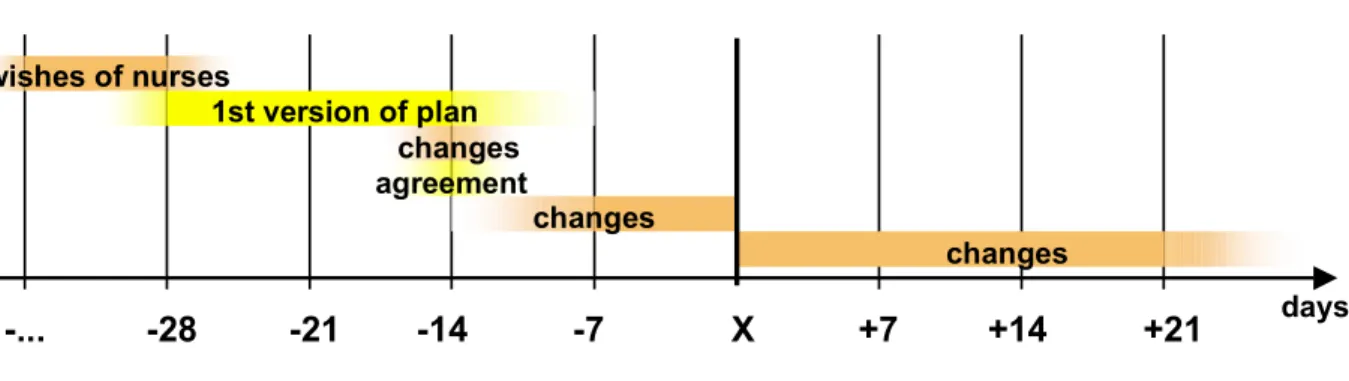
The process of scheduling is shown in figure 1 (it is shown relatively to the day the schedule table took effect). The schedule table is planed 1 month in advance. In the wards scheduling by computer the planning starts later, but the process itself is equivalent. First wishes of nurses are written down. These wishes will be considered in the 1st version if possible. After that the head nurse must have a look at the 1st version whether there are mistakes in the table.
Figure1 about here
By using the evaluation criteria it was found out that the quality of scheduling differs between computer aided and paper based scheduling in some ways (see table 1).
Table1 about here
In the print-out of the computer aided schedule table one can find manual corrections that will be manually registered in 'DVDUKL-HD' in the evening. This will be done because the screen is too small to allow grasp the whole of the table . It is based on Microsoft Excelâ, and the data is too much and the font is to small for a typical 15” monitor. However the legibility of paper based schedule tables depends on the handwriting of the senior nursing officer. One great advantage of computer aided scheduling is the help of 'DVDUKL-HD' in complying with legal demands. There are plausibility checks in the program code. In paper based scheduling the senior nursing officer has to watch legal demands by herself.
Table2 about here
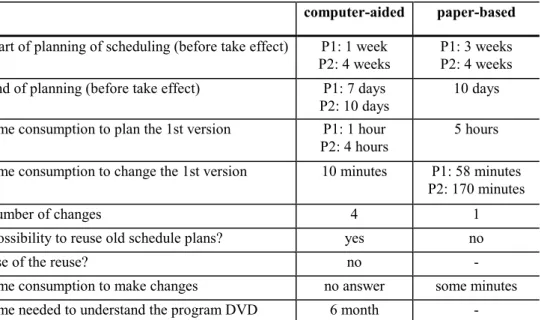
Another aspect of our analysis was the time consumption of scheduling (see table 2). It differs between the wards using computer aided scheduling (table 2, line 3) because of the knowledge and interest in computers of the senior nursing officers. One of them is very enthusiastic and familiar with computers and 'DVDUKL-HD', the other has had only a small introduction. She doesn't know anything about Microsoft Excelâ so the time of scheduling is nearly equivalent to the duration for paper based scheduling.
The time to change the first version of the schedule table in the wards scheduling with 'DVDUKL-HD' is quite short. The reason is that 'DVDUKL-HD' helps the senior nursing officer in the phase of
planning considering legal demands. So there are less mistakes in the table. In 'DVDUKL-HD' there is the possibility to assume older schedule tables but this won't be used. The collection of data for statistics must be done once every month. Senior nursing officers scheduling manually must fill in forms, take and summarise data from the schedule table. 'DVDUKL-HD' facilitates statistics by using data from the database. Statistics with 'DVDUKL-HD' can be done whenever the nursing head of the clinic wants to.
An essential part of our study is the analysis of user satisfaction. A computer program can only be as good as the motivation of the users therefore nurses were interviewed about their knowledge of computers and their impressions of 'DVDUKL-HD'. It was asked if they understood the program, if the program was reliable and fast enough, if they had good support and a lot more criteria. The answers of the users were very different. They depended on the interest in working with a computer. Those nurses who had an interest in computers were satisfied with the program and saw only small and functional related weak spots. But nurses for whom computers are unknown and suspect things are not so delighted. It was determined that it is necessary to introduce and motivate the staff to work with a computer in general or with a special program like 'DVDUKL-HD'.
Table3 about here
Motivated by the nurses we have tested the functionality of 'DVDUKL-HD', version 3.3. We have found a lot of small weak spots but most of them are eliminated in version 3.4. The inadequacies of version 3.4 are listed in table 3.
Conclusion
'DVDUKL-HD' facilitates the scheduling of the nurses‘ work. In particular it supports the multiple use of data, e.g. for filling in and evaluation of the statistical forms. The users are satisfied with the program but there are a few conditions that have to be adressed, e.g. at least 17‘‘-monitors to have a better overview of the planning table, exhaustive training of nurses because they often don't have any knowledge of computers, and software-support.
Nowadays 'DVDUKL-HD' is used in the whole university hospital of Heidelberg, in all wards and other departments working in shift. In 1998 all wards were equiped with 17‘‘ monitors and partially with new computers. DVD is available in version 3.5a. The software company (WMD, Hamburg) says that the weak spots are eliminated, but this must be checked.
The students were taught to plan and run projects systematically. They decided to interview and observe nurses, senior ward officers and their nursing heads. But these methods are open to criticism. Data resulting from interviews is bound to be subjective. It was difficult to compare the results of our study because most of the nurses, the senior nursing officers and the nursing head of one of the wards using the software were familiar with the computer in contrast with the staff of the second ward. These nurses only had short training in using 'DVDUKL-HD'. As an important result of the study it was seen, that a computer program can only be as good as the motivation and the knowledge of the users.
Literatur
(1) POTTER PA, PERRY AG (1993): Fundamentals of Nursing, Concepts, Process & Practice.
(2) KNAUP P, HAUX R, HÄBER A, LAGEMANN A, LEINER F (1998): Teaching the fundamentals of
information systems management in health care. Lecture and practical training for students of medical informatics. IJMI, 50, 195-206.
(3) LEVEN FJ, HAUX R (1998): Twenty five years of medical informatics education at
Heidelberg/Heil-bronn: Discussion of a specialised curriculum for Medical Informatics. IJMI, 50, 31-42.
(4) WULFF KJ, WESTPHAL JR, SHRAY SL, HUNKELER, EF (1997): Using automated continual
performance assessment to improve health care. MD Computing, 14, 24-33.
(5) OHMANN C, BOY O, YANG Q (1997): A systematic approach to the assessment of user
satisfac-tion with health care systems: constructs, models and instruments. In: PAPPAS C, MAGLAVERAS N,
-... -28 -21 -14 -7 X +7 +14 +21 wishes of nurses 1st version of plan changes agreement changes changes days
figure 1: Process of scheduling in wards, shown relatively to the day the schedule table take effect (day X). The nurses utter their wishes, after that the senior nursing officer drafts a first version, that must be agreed by the head nurse of the clinic.
Computer aided Paper based
Presentation of all necessary data
Presentation of all necessary data Manual corrections in the
print-out Partial presentation of vacationdays Scheduling for 1 month in
advance
Scheduling for 1 month in advance Bad legability due to much data
and small fonts
Good legability Changes in the table can be seen
promptly Changes in the table can be seenpromptly Wishes of nurses are taken into
account
Wishes of nurses are taken into account Printed version is posted in the
ward office, furthermore data can be watched at the screen
Last version is posted in the ward office Legal demands are taken into
consideration, DVD helps limitedly
Legal demands are taken into consideration
computer-aided paper-based
start of planning of scheduling (before take effect) P1: 1 week P2: 4 weeks
P1: 3 weeks P2: 4 weeks end of planning (before take effect) P1: 7 days
P2: 10 days
10 days time consumption to plan the 1st version P1: 1 hour
P2: 4 hours
5 hours time consumption to change the 1st version 10 minutes P1: 58 minutes
P2: 170 minutes
number of changes 4 1
Possibility to reuse old schedule plans? yes no
use of the reuse? no
-time consumption to make changes no answer some minutes time needed to understand the program DVD 6 month
-table 2: Time consumption for computer based and paper based scheduling (P1 is one senior nursing officer of the study group, P2 the second one).
- To enlarge password window
- To safe regional and self-defined public holiday for the next year - To permit the nurses to see the holiday plan
- To warn if the qualification of a nurse on the schedule table is not sufficient
table 3:Weak spots of the functionality of the program not eliminated with the update from version 3.3 to version 3.4.