The Predictive Ability and Value
Relevance of Accounting Measures
Abstract
Empirical accounting research sometimes assumes that the value relevance of accounting variables can be indirectly assessed by studying the ability of the variables to forecast future cash flow and earnings. This study investigates the relationships between short-term cash flow and earnings prediction tests and value relevance analyses. I find that earnings prediction tests might be good substitutes for value relevance analyses, whereas cash flow prediction tests merely provide indications with respect to value relevance. Cash flow prediction tests appear unable to capture the significant association between accounting accruals and the company value. Overall, this study suggests that the value relevance of accounting variables can be investigated through their ability to predict future earnings but not future cash flow.
1 Introduction
Financial statements have a variety of applications. Barth, Beaver, and Landsman (2001) list management compensation, debt-contracts, and equity investment as the most important. Holthausen and Watts (2001) claim that at least five factors influence the contents of financial reporting: contracting (including stewardship), taxes, regulation, litigation, and equity valuation. The papers of Holthausen and Watts (2001) and Barth et al. (2001) instructively illustrate that the usefulness of financial reporting can be analysed along several dimensions. The different user groups have varying preferences with respect to the information content of accounting information. Equity investors, one of the most important user groups of financial reporting, prefer that accounting information provide information relevant for the valuation of companies. The accounting information‘s usefulness for equity valuation is measured through value relevance studies. Thus, value relevance can be seen as a measure of accounting usefulness from the perspective of stock investors (Beisland, 2009). In practice, value relevance is typically measured as the statistical association between accounting information and stock prices or returns (Francis & Schipper, 1999). A significant statistical relation between accounting information and stock prices is seen as evidence that the accounting numbers are used for valuation purposes, and the accounting information is then termed value relevant. Over the last couple of decades, a huge number of value relevance studies have been published (Holthausen and Watts, 2001). The studies have proven that the usefulness of financial reporting to stock investors is sensitive to the accounting methods employed (Barth et al., 2001).
Value relevance research can be seen as one of several disciplines within the broader term capital market based accounting research (CMBAR). The ability of accounting variables to forecast future earnings and cash flow is another topic that is heavily investigated in CMBAR.
One reason for the popularity of such studies is that cash flow and earnings are drivers of company value. The studies tend implicitly to assume that there is a relationship between the accounting variables‘ ability to forecast relatively short-term earnings and cash flow and the accounting variables‘ statistical association with the market value (compare for instance Barth, Cram, & Nelson, 2001; Dechow, Kothari, & Watts, 1998). This assumption is sometimes also stated explicitly, for instance in Finger (1994): ―This paper examines the value relevance of earnings by testing their ability to predict two future benefits of equity investment: earnings and cash flow from operations‖ (Finger, 1994, p. 210). Francis and Schipper (1999) deepen Finger‘s statement: ―…financial information is value relevant if it contains the variables used in a valuation model or assists in predicting those variables‖ (Francis & Schipper, 1999, p. 325). These papers suggest that because the stock value is the present value of future cash flow/earnings, the value relevance can be indirectly assessed by studying the ability of accounting information to forecast future cash flow and earnings. The purpose of this study is to examine whether or not short-term prediction studies can act as substitutes for value relevance analyses. The study contributes to existing research by showing that earnings prediction tests can be relatively good substitutes for value relevance analyses, whereas cash flow prediction tests at best provide indications with respect to value relevance. The findings support the Financial Accounting Standards Board (FASB) statement that current earnings are a better predictor of long term cash flows, and thus company value, than are current cash flows (FASB, 1978).
A study by Kim and Kross (2005) is one of very few prior studies that discusses possible relationships between the ability of accounting variables to predict the future firm performance and their value relevance. Kim and Kross (2005) investigate the ability of current earnings to predict future cash flow. Based on the finding that the value relevance of
earnings has decreased over time (e.g., Francis & Schipper, 1999), they anticipate that the ability of earnings to predict cash flow has been reduced as well. However, Kim and Kross (2005) document that the relationship between the current earnings and future operating cash flow has increased over time. As such, they provide evidence that direct and indirect studies of value relevance may produce contradictory results. My study builds on the ideas of Kim and Kross (2005). In addition to analysing cash flow forecasts, I extend their analysis by also studying the predictive ability of current earnings for future earnings. Modern valuation theory does not solely focus on cash flow discounting. Even if all valuation models are deduced from the dividend discount model, when using the residual income model or the abnormal earnings growth model, the value driver of firm equity is accounting earnings, not cash flow. Analysts normally forecast earnings, and cash flow forecasts tend to be deduced from earnings forecasts, not the other way around (Penman, 2009). I draw particular attention to the accrual component of earnings because this measure to some extent is a function of the prevailing accounting framework and regulations, as well as subjective judgments by accountants and managers.
The relationship between prediction tests and value relevance studies is examined using a three-step analysis. Step 1 investigates the ability of cash flow and aggregate accruals, i.e., earnings, to predict the short-term firm performance. Step 2 of the study examines the relationship between cash flow and accruals with stock return. Step 3 of the study discusses possible relationships between the predictive ability of accounting numbers for future cash flow and earnings and their value relevance, i.e., the possible relationships between step 1 and step 2. This empirical study shows that the cash flow component of earnings is a significant predictor of the short-term firm performance as measured by future cash flow and earnings. The findings also assert that the accrual component is related to future earnings but not to
future cash flow. However, both cash flow and accruals are statistically related to the current stock return. Steps 1 and 2 illustrate that there is a close relation between cash flow and accruals‘ ability to forecast future earnings and their value relevance. I provide clear evidence that the seemingly contradictory results from the predictions tests and value relevance studies of Kim and Kross (2005) can be attributed to their exclusive focus on future cash flows. When earnings prediction tests are included in the study, the indirect value relevance analyses appear to be much more in line with the results from the so-called direct value relevance analyses. The findings are consistent with the notion that cash flows may be a noisy measure of value added in the short run. On average, the cash flows do not match the value gained with the value given up.
The findings of this study have several implications for both accounting researchers and equity investors. First, if researchers want to investigate how accounting numbers are related to stock prices, they should avoid using short term prediction tests, at least cash flow predictions, as proxies for value relevance studies. The conclusions from the two sets of studies are not necessarily equivalent. This finding is particularly topical in the wake of the recent crisis in the financial markets, as there is an urgent need for researchers to rethink their theories and methods for analysing and predicting future market behaviour. Second, for stock investors and analysts, the findings of the study suggest that the accrual component of earnings contains information relevant to the pricing of stocks even in cases where the accruals seem unrelated to short term future cash flows. In the long run accruals do provide information on the cash flow generating capabilities of the firms.
The empirical study is conducted on a Norwegian sample. Norway is selected for four reasons. First, Norway represents a stable environment of relatively high investor protection
and strict legal enforcement (La Porta, Lopez de Silanes, Sheifer, & Vishney, 1998), which induces a low and stable level of earnings management and more informative disclosures than in countries with lower investor protection (DeFond, Hung, & Trezevant, 2007; Leuz, Nanda, & Wysocki, 2003). Second, contrary to many other European countries, Norway has had a stable accounting regime over the past years. Most countries, for instance Sweden and Denmark (Hamberg, Novak and Paananen, Forthcoming; Thinggaard and Damkier, 2008) have had a gradual switch from International Financial Reporting Standards (IFRS) to local GAAP, whereas Norway chose to not incorporate any international standards in Norwegian GAAP prior to 2005. Third, and also in contrast to many other European countries, Norway has no remaining links to tax accounting. The strong links to tax accounting in continental Europe often lead to highly biased accounting estimates (Alexander & Archer, 2003). Fourth, the differences between Norwegian GAAP and IFRS (Gjerde, Knivsflå, & Sættem, 2008) and US GAAP (Brown, He, & Teitel, 2006) are moderate.1 Thus, the conclusion of this study is expected to hold in all countries with a high-quality accounting system and well-developed financial markets.
2 Prior Research
The time series properties of accounting numbers have been heavily investigated empirically. For instance, the FASB statement that current earnings provide better forecasts of future cash flows than do current cash flow is a frequently studied issue (FASB, 1978). Within this line of research, Finger (1994) finds that cash flow is a better short-term predictor of cash flows than are earnings, but that the two are approximately equivalent in the long term. On the other hand, Dechow et al. (1998) state that current earnings are a better forecast of future cash flows
1 Brown et al. (2006) measures the equivalence of various accounting systems through an ―accrual index‖.
Specifically, the accrual index measures the degree to which an accounting system moves away from a cash method measure of performance. Norway‘s score on the accrual index is close to the US score; 0.82, compared
than current cash flow. In a regression of cash flow on the lagged values of both earnings and cash flow, they find that earnings are consistently incrementally useful in forecasting future cash flows, while cash flows themselves exhibit only modest incremental forecasting power. Barth et al. (2001) disaggregate earnings into cash flow and accruals in order to predict future cash flows. They conclude that this disaggregation significantly improves the explanatory power of the specification.
The prediction of earnings is another subject frequently discussed within this line of research. In fact, earnings persistence is considered an important attribute of earnings quality (see for instance Francis, LaFond, Olsson, & Schipper, 2004). Finger (1994) reports that current earnings are a significant predictor of future earnings in 88% of her sample. Sloan (1996) estimates his models both in a pooled form and on an industry-level and reports that current earnings are a highly significant predictor of next year‘s earnings. He also disaggregates earnings into cash flow and accruals and finds that the accrual components of earnings exhibit lower persistence than the cash flow components (see also Collins & Hribar, 2000). Building on the ideas of Sloan (1996), Konan Chan, Jegadeesh, and Sougiannis (2004) find that the aggregate future earnings will decrease by $0.046 and $0.096, respectively, in the next one and three years for a $1 increase in current accruals.
Lev, Li, and Sougiannis (2005) study the predictive ability of both cash flow and accruals on future cash flow and earnings. They find that accruals do not improve the prediction of cash flow beyond that achieved by current cash flows. Accruals do marginally improve the prediction of earnings, but Lev et al. (2005) regard the improvement as economically insignificant. Overall, the evidence from the prediction studies suggests that both current cash flow and current earnings are significantly related to future values of themselves. There is
clear evidence that the accrual component of earnings is relevant for earnings predictions. However, with respect to accruals‘ predictive ability for future cash flows, the empirical evidence is mixed. For instance, while Finger (1994) and Lev et al. (2005) report that current earnings are not more highly associated with future cash flows than is current cash flow, Dechow et al. (1998) and Barth et al. (2001) reach the opposite conclusion. Several studies suggest that the accrual components of earnings exhibit lower persistence than the cash flow components of earnings (Sloan, 1996; Collins and Hribar, 2000; Lev et al., 2005).
The studies that focus strictly on the time-series properties of earnings, cash flows and accruals rarely look into the value relevance of the measures that they analyse. However, since Ball and Brown‘s seminal article from 1968, numerous studies on the relationship between accounting earnings and stock returns have been performed. For instance, Rayburn (1986) finds that earnings split into cash flow and accruals have a significant association with abnormal returns. Dechow (1994) concludes that there is a stronger contemporaneous association between stock returns and earnings than between stock returns and realised cash flows (see also Biddle, Seow, & Siegel, 1995; Francis, Schipper, & Vincent, 2003). The association of stock returns with cash flow does, however, improve relative to the association of stock returns with earnings as the measurement interval is increased. Subramanyam and Venkatachalam (2007) report that the value relevance of accrual-based earnings also dominates the relevance of operating cash flow when ex post intrinsic values of equity are considered.
Consistent with the previously stated finding that the accrual components of earnings exhibit a lower persistence than the cash flow components of earnings (Sloan, 1996; Collins and Hribar, 2000; Lev et al., 2005), Wilson (1986) states that, for a given amount of earnings, the
stock market reacts more favourably the larger the cash flow component. Sloan (1996), on the other hand, reports that even though the cash flow component of earnings is more persistent than the accrual component, stock prices do not reflect this difference. Investors ―fixate‖ on earnings and do not make use of the information contained in the accrual and cash flow components of current earnings until that information impacts future earnings. Lev and Nissim (2006) show that this ―accrual anomaly‖ persists and that it has not declined over time.
Several studies analyse either the predictive ability or the value relevance of accounting variables. Kim and Kross (2005) combine these two lines of research. Based on the conclusions from prior studies that the value relevance of earnings has been decreasing over time (e.g., Francis & Schipper, 1999), they expect that earnings‘ ability to predict future cash flow has decreased as well. Their expectation is founded on the fact that stock prices are the present value of future cash flow. Kim and Kross (2005) start out with a traditional value relevance analysis, in which stock prices are regressed on earnings and book values. They then analyse the over-time development in the explanatory power of the regression. Kim and Kross (2005) particularly focus on the incremental explanatory power of respectively earnings and book values, and, in accordance with their expectations, they find that the ability of earnings to explain stock prices has been decreasing over time. Kim and Kross (2005) hypothesise that the reduced value relevance of earnings can be attributed to a decrease in earnings‘ ability to predict future cash flows. They test this expectation by regressing one-year-ahead operating cash flows on current earnings and operating cash flows. Kim and Kross (2005) are surprised to find that the ability of earnings to forecast future operating cash flow has actually been increasing over the last decades: ―If stock price is the present value of future cash flows, the deterioration in the association between accounting earnings and stock prices
implies a growing inability of accounting numbers to forecast future cash flows, but that is not what we find‖ (Kim & Kross, 2005, p. 754). Kim and Kross (2005) test several explanations for their findings, including changes in accounting conservatism and firms‘ operating cycle length, but conclude that they are unable to reconcile the increasing ability of current earnings to predict future cash flows with the decreasing ability of current earnings to explain prices. They note that the empirical findings are consistent with market inefficiency, but suggest that the results may be attributed to a too short time horizon in the prediction study rather than inefficient stock markets. Kim and Kross (2005) analyse 100,266 firm-year observations from the US stock market over the time period 1972 to 2001.
3 Predictions and Research Design
3.1 Prediction Development and Variable Definitions
The purpose of this three-step study is to investigate the predictive ability (step 1) and value relevance (step 2) of cash flow and accruals and then to examine possible relationships between steps 1 and 2. This section discusses how the prediction analyses of step 1 may relate to the association studies of step 2. The discussion is founded on traditional valuation theory.
The ultimate return of every investment is the cash flow generated by the investment, and an asset‘s value is the present value of its future cash flows. One objective of financial reporting is to assist investors, creditors, and others in predicting cash flow. However, modern valuation theory has proven that different versions of cash flow discounting are not the only methods for computing intrinsic equity values. The residual income model shows that the company value can also be expressed as the book value of the equity plus the present value of all future residual income. In the abnormal earnings growth model, the equity value is computed simply by capitalising earnings and the present value of future abnormal earnings growth. Hence, the
equity value can be computed both as a function of cash flows and as a function of accounting earnings. The valuation models are all deduced from the dividend model and will therefore give the exact same equity estimate when applied consistently. In theory, the equity value is a function of the infinite cash flows or earnings. However, one may expect that the shorter-term firm performance, as measured by cash flow and earnings, provides an indication of the company value. For instance, numerous studies document that both cash flow and earnings are relatively persistent (Barth et al., 2001; Dechow et al., 1998; Finger, 1994; Kim & Kross, 2005; Sloan, 1996). Thus, the current accounting measures that predict the short-term future firm performance should also be associated with the current stock returns. This assumption is implicit in most papers studying the ability of accounting variables to forecast future cash flows or earnings (the indirect value relevance research). I expect that the accounting measures that are significant predictors of the future firm performance are also significantly related to the current stock return. Specifically, if accruals and cash flows are related to the short-term future firm performance as measured by accounting earnings and cash flow, it is reasonable to expect that they are also significantly associated with the current stock return.
The prediction is one-directional. It is easy to construct examples in which cash flow and accruals are totally unrelated to the short-term firm performance but are still value-relevant. Transitory cash flow and earnings items may be associated with the stock return even if they, by definition, are not related to the future cash flows or earnings. However, if the current earnings are highly related to the earnings and cash flows one to three years ahead, I suggest that the current earnings on average will also be related to the current stock return. Prior research strongly proposes that permanent cash flows and earnings are more value-relevant than transitory cash flows and earnings (Elliot & Hanna, 1996; Ramakrishnan & Thomas, 1998). It should be noted that, if there is no association between the relationship of accounting
variables to the short-term firm performance and their value relevance, then the previous studies of the predictive ability of accounting variables would give no indication of the value relevance whatsoever.
The primary focus of many value relevance and prediction analyses (e.g. Barth et al., 2001; Dechow, 1994) is the role of accruals. Accruals, and consequently earnings, are a function of subjective judgments and the prevailing accounting regime. As for cash flows, there are several versions of the cash flow valuation model. It is not obvious which cash flow measure should be analysed. However, regardless of the cash flow model used, the company value is generally a function of future free cash flows. Still, when prior research analyses the predictive ability and value relevance of cash flows, the focus is almost exclusively on cash flow from operations before investments (Barth et al., 2001; Biddle et al., 1995; Dechow, 1994; Dechow et al., 1998; Finger, 1994; Kim & Kross, 2005; Kim, Lim, & Park, 2007; Rayburn, 1986; Subramanyam & Venkatachalam, 2007). This may seem like a paradox, particularly because the research maintains that it focuses on cash flows because they are important drivers of company value. However, because this study investigates the possible connection between cash flow/earnings predictions and value relevance, it can be regarded as a follow-up paper of prior research. I leave, therefore, the choice of cash flow concept to future research and choose to employ the same cash flow definition as the other papers within this research tradition. Hence, cash flow from operations (CF) is defined as (Biddle et al., 1995; Finger, 1994; Klein & Marquardt, 2006; Rayburn, 1986):
CF = Net income before extraordinary items (EARN) - Accruals (ACC)
- Change in cash
- Change in total current liabilities
+ Change in interest-bearing short-term debt - Change in deferred taxes
- Depreciation and impairment
Consistent with prior research, I focus on EARN before extraordinary items because extraordinary items are expected to have little persistence (Dechow & Ge, 2006) and bear little value relevance (Landsman, Miller, & Yeh, 2007; Ramakrishnan & Thomas, 1998). All accounting variables are scaled by the market value of the equity at the beginning of each year; this is the preferred scaling factor according to Easton and Sommers (2003).
3.2 Econometric Model
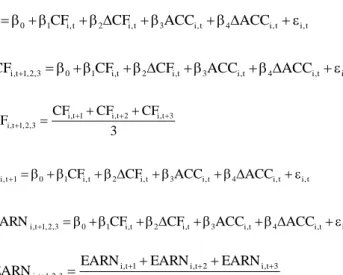
Step 1 of the study is to analyse the predictive ability of cash flow and accruals for future cash flows and earnings. Step 2 is a value relevance analysis of the same explanatory variables. The following regression specifications are used in steps 1 and 2, respectively (see Ali & Lee-Seok, 2000; Easton & Harris, 1991; Lev & Zarowin, 1999):
(1a) CFi,t1 0 1CFi,t2CFi,t3ACCi,t 4ACCi,t i,t
(1b) meanCFi,t1,2,3 01CFi,t2CFi,t3ACCi,t 4ACCi,ti,t
3 CF CF CF meanCFi,t 1,2,3 i,t 1 i,t 2 i,t 3
(1d) meanEARNi,t1,2,3 01CFi,t2CFi,t3ACCi,t4ACCi,ti,t 3 EARN EARN EARN meanEARNi,t1,2,3 i,t1 i,t2 i,t3
(2) RETi,t 0 1CFi,t2CFi,t3ACCi,t 4ACCi,t i,t
Step 1 begins by regressing next year‘s cash flow on the current cash flow and accruals. Instead of using aggregate earnings as the explanatory variable, I extend Kim and Kross‘ (2005) analysis by also studying if the two components of earnings, cash flow and accruals, have different informational contents (see for instance Barth et al., 2001; Dechow et al., 1998). Kim et al. (2007) state that the seemingly contradictory results of Kim and Kross (2005) may be driven by the value-unrelated noise in annual cash flows. To further investigate this claim, I also run a second cash flow prediction test where the mean of the next three cash flows (meanCFt1,2,3 for simplicity) replaces next year‘s cash flow in part b of step
1. The regression specifications (1a) and (1b) are in some sense based on the ―cash is king‖ perspective. The regression specifications (1c) and (1d) recognise that, according to modern valuation theory, the current equity value may be estimated as a function of future accounting earnings. Hence, the predictive ability of accruals and cash flow with respect to future earnings is as important as their ability to predict the future cash flow. Prior research has suggested that future earnings are related to several lags of earnings, but that the significance level of earnings numbers that lagged more than two years is relatively low (Barth et al., 2001; Dechow et al., 1998). The regression specifications (1a)-(1d), which also include the change in current earnings, are equivalent to regressing the cash flow and earnings on two years of historical earnings numbers. Note that only stationary variables can be used in step 1 of the study (see discussion in for instance Finger, 1994). However, the scaling of the
variables will induce stationarity of the otherwise non-stationary accounting variables. Scaling is also a remedy that reduces the well-known heteroscedasticity problems in these studies (Christie, 1987).
In step 2 of the analysis, the future cash flow and earnings are replaced by the current stock return as the dependent variable in order to evaluate the value relevance of cash flow and accruals. I apply an Easton and Harris (1991) framework because stock returns can be seen as functions of both earnings and the change in earnings.2 Note that prior research shows that the persistence and value relevance of earnings may depend on the sign of the earnings (Basu, 1997; Hayn, 1995; Joos & Plesko, 2005). To study if any of my findings are dependant upon the sign of earnings, the predictive ability and value relevance of cash flow and accruals are analysed not only for a pooled sample but also for positive and negative-earning sub-samples (Hayn, 1995).
4 Data
The sample consists of firms listed on the Oslo Stock Exchange. To ensure consistency with sample-selection criteria used in prior studies, the sample excludes financial services firms. All of the accounting data are obtained from the Oslo Stock Exchange accounting database for exchange-listed companies. The stock price data are collected from the Norwegian School of Economics and Business Administration‘s stock market database. All of the stock prices
2
The importance of both the level and the change in earnings as explanatory variables for stock returns can easily be illustrated by the residual income model. If the stock price is a function of the book equity and residual earnings, then the change in the stock price is a function of the earnings and the change in earnings. However, while Easton and Harris (1991) find that the level of earnings is consistently related to the stock return, the change in earnings is only significant in about half of their sample.
are adjusted for dividends, splits, etc. The stock values and returns are measured on the 30th of December each year.3
The observations are from 1992-2004. In 1992, the Norwegian accounting legislation was changed to introduce deferred tax liabilities and assets (An "accounting revolution", see Hope, 1999). A major tax reform was implemented at the same time. In 2005, European law required Norwegian quoted companies to report consolidated statements according to the International Financial Reporting Standards (IFRS). Because the introduction of IFRS may have influenced both the structural relationship between stock return and earnings numbers, as well as earnings numbers‘ ability to predict themselves, I do not include the IFRS observations in this study. The sample consists of 1664 observations before the data trimming. The observations belonging to the upper or lower percentile of the RET, CF, ∆CF, ACC and ∆ACC are deleted to avoid extreme observations with an unreasonably large influence on the regression results. Due to a large degree of overlap among the extreme observations, the actual number of observations deleted is 77 (4.9%), far less than the theoretical maximum of 10%. The final sample size is 1587 observations. The number of available observations differs among the regression specifications outlined in Section 3. I apply the maximum number of observations in all of the analyses. However, untabulated tests show that the empirical findings are unaffected if a constant sample is applied for the five different regression specifications.
[Insert Table 1 about here]
Table 1 shows the main descriptive statistics of the variables employed in the analysis. The distributional characteristics are found in panel A. The mean cash flow from operations is equal to 12.9% of the beginning market value of equity. The mean accruals are -11.7%, while the average earnings are only 0.8% of the market value of equity in this sample. The correlation coefficients among the variables are presented in panel B. The cash flow and accruals seem to be highly negatively correlated. The earnings are significantly correlated with the cash flow, but they have a lower correlation with the accruals. The measures of future firm performance are generally correlated with today‘s cash flow and accruals but not with the first difference of these variables. The stock return appears to be significantly correlated with earnings and cash flow, but not with accruals.
5 Empirical Results
5.1 Step One: Cash Flow and Earnings Predictions
The first step of the study analyses the predictive ability of current cash flow and accruals with respect to the future firm performance as measured by the cash flow and accounting earnings. Table 2 summarises the empirical findings from these regressions. In the total sample, the cash flow seems to be a significant predictor of the future cash flows.4 Consistent with the findings of Finger (1994) and Lev et al. (2005), for example, the results suggest that there is no significant relationship between future cash flows and current accruals in the total sample. These conclusions hold with respect to next year‘s cash flow as well as the mean of the next three cash flows. The annual cash flows appear to be more contaminated by noise than the mean of the next three cash flows; see the large difference in the explanatory power
4 Coefficients are termed ―significant‖ if they are significant at a 5% level, using two-sided tests. As the residuals
show some evidence of heteroscedasticity, the presented t-values are computed using White-adjusted standard deviations. I find no evidence of autocorrelated residuals (see also Section 6).
in the two cash flow predictions. The explanatory powers of the two specifications are 12% and 29%, respectively. Note that, if only the cash flow and its first difference are used as explanatory variables, the adjusted R values are respectively 12% and 28% (untabulated). 2 This further illustrates that accruals are not relevant explanatory variables in the regressions. Moreover, the results indicate that there is a positive autocorrelation for cash flows; a high cash flow in one year is typically followed by a high cash flow the next year as well. However, a high increase in cash flow seems to have a negative impact on future cash flows; compare the negative coefficients on the change in cash flow. This finding suggests that the cash flows to a certain extent mean revert. Table 2 shows that when the sample is split according to the sign of the earnings, the current cash flow has a much closer relationship to the future cash flows when the earnings are positive than when they are negative (compare Hayn, 1995).
[Insert Table 2 about here]
Table 2 also displays the findings from the regressions of the future earnings on today‘s cash flow and accruals. The results for the total sample clearly indicate that accruals are a relevant earnings predictor. In fact, both the cash flow and accruals are significantly associated with the future firm performance when the cash flow is replaced by the earnings as the dependent variable of the regressions. Large levels of accruals are typically associated with lower future earnings (note that the total accruals typically are negative). The explanatory power is the same in regression (1c) and (1d). In contrast to the cash flow regressions, it does not appear to be easier to forecast the mean of the next three earnings than the next year‘s earnings. This finding may be attributed to the higher variation in cash flow than in earnings (see Table 1). Accruals contribute to levelling out the earnings but not the cash flow. Note that untabulated
results show that the explanatory power of the earnings regressions falls dramatically if either the cash flow or the accruals are omitted as an explanatory variable. Specifically, the adjusted
2
R is only 2% when next year‘s earnings are regressed on either the cash flow or the accruals. As with the cash flow predictions, the predictability of earnings for future earnings is sign-dependent. While both the accruals and cash flow appear to be statistically related to the future earnings in the positive earnings sample, the explanatory variables are generally insignificant in the negative earnings sample.5
Overall, the findings of step 1 indicate that cash flow is a significant predictor of both future cash flows and future earnings. Accruals are significantly related to future earnings, but not to the future cash flow. The importance of accruals in the prediction tests is further illustrated by the change in the explanatory power if the accruals are excluded from the regressions: The explanatory power of the earnings regressions drops dramatically, whereas the explanatory power of the cash flow regressions is hardly affected at all. Step 1 also illustrates the importance of the sign of the earnings. Consistent with prior research (Basu, 1997; Hayn, 1995; Joos & Plesko, 2005), negative earnings do not appear to be persistent at all.
5.2 Step Two: Value Relevance
In the value relevance study of cash flow and accruals, the current stock return replaces the future cash flow and earnings as the dependent variable of the regression specification. The results from this regression are presented in Table 3. In this specification, all explanatory variables come up with significant coefficients in the total sample. Both the cash flow and
5 Note that multicollinearity could have been a challenge in these specifications since four related measures are
used as the explanatory variables. To analyse if the regressions suffer from multicollinearity, the variance inflation factor (VIF) is computed for each regression. The highest VIF is found when the mean of the next three earnings is used as the dependant variable (VIF = 4.644). All VIF‘s are significantly below the common cut-off threshold of 10. As a result, multicollinearity is not considered to be a problem in the regression analyses.
accruals are positively related to the stock return. Because the accruals typically are a negative earnings item, more accruals (in absolute terms) tend to be associated with a lower stock return. To illustrate the significance of accruals in this regression, it is worth mentioning that the explanatory power is halved if the accruals are deleted from the specification (not tabulated).
[Insert Table 3 about here]
All other things being equal, my findings suggest that for any given earnings, investors prefer higher cash flow proportions. Sloan (1996) found that investors fixate on earnings and fail to reflect the information contained in the accrual and cash flow components of earnings (the accrual anomaly). Contrary to Sloan (1996), my findings suggest that investors understand the different information content and consider this when valuing equity. Sloan (1996) reports that investors price the cash flow component and the accrual component of earnings identically, even if the cash flow component is far more persistent. The higher persistence of cash flow than accruals is also found in my sample. However, my findings suggest that investors see through this phenomenon and price the two earnings components differently.6
Split into positive and negative earnings, the sample shows that positive earnings are more highly associated with the stock return. All of the regression coefficients are significant when the earnings are positive. The explanatory power equals 13%. The adjusted R drops to 2% 2 when the earnings are negative. Briefly summarised, the stock returns seem to be associated with both the cash flow and accruals, but only when the earnings are positive.
5.3 Step 3: The Association Between the Predictive Ability and
Value Relevance
The prediction from Section 3 says that if the accruals and cash flows are related to the short-term future firm performance, as measured by the accounting earnings and cash flow, it is reasonable to expect that they are also significantly associated with the current stock return. The current cash flow is significantly related to both the future cash flow and future earnings, while the current accruals appear to be significantly related to the future earnings. Both variables are value-relevant. As such, one may claim that the empirical findings support the proposed prediction. However, the empirical results are consistent with Kim and Kross‘ (2005) findings when the cash flow predictions are analysed: The cash flow prediction studies do not at all present the complete picture about accounting variables‘ value relevance. What I have referred to as indirect value relevance studies do not seem to be equivalent to ―pure‖ or direct value relevance studies if only the cash flow predictions are investigated, and conclusions about the accounting variables‘ value relevance cannot be drawn based upon the short term cash flow prediction tests.
An empirical result of particular interest is the finding that accruals are related to the stock return even if they are not associated with the future cash flow in the short term. From a ―cash is king‖ perspective, one would have expected that the failure of accruals to predict the future cash flow would render them unrelated to the current stock return; see the discussion of Kim and Kross (2005) on the relationship between cash flow predictions and value relevance. However, even if accruals are unrelated to future cash flows, they appear to be significantly related to future earnings. Section 3 demonstrated that the company value could be expressed as a function of the accounting earnings; compare the residual income model and the abnormal earnings growth model. As such, there might be a relationship between the accruals‘ role as an earnings predictor and their value relevance. In addition, earnings have an
indirect role in cash flow valuation models, as many investors predict earnings and derive future cash flows from the earnings predictions. The use of earnings numbers in valuation models might explain why accruals are value-relevant even if they seem unrelated to future cash flows. The finding can also be related to the FASB statement that current earnings are a better predictor of future cash flows, and thus company value, than are current cash flows (FASB, 1978). My findings suggest that the statement does not hold in the short run; compare the lack of significance for the accruals component in the cash flow predictions. However, the company value is the present value of long term cash flows (in principle; all future cash flows), and there is clear evidence that accruals are related to ―the sum of all future cash flows‖, i.e., the company value. Thus, the results are consistent with the FASB-statement in the long run. The finding can be attributed to the fact that cash flows may be a poor measure of value-added in the short run. Cash inflow is not necessarily equal to the value gained for the company, and cash outflow is not necessarily equal to the value given up. This matching is, however, a vital aspect of the income statement.
Kim and Kross‘ (2005) conclusions are based on an analysis of the over-time development in earnings‘ value relevance and their ability to predict cash flow. Specifically, they are surprised to find that the development in earnings‘ ability to predict the one-year ahead cash flow is not identical to the over-time development in the earnings‘ value relevance. To further investigate the possible relationships between the short-term cash flow and earnings predictions and the value relevance, I examine if this phenomenon is present in my data sample as well. However, while Kim and Kross (2005) only focus on one-year cash flow predictions, I analyse both the three-year future cash flows as well as the one- and three-year future earnings. I split the sample in two, using 1999 as the cut-off year. This year is not randomly chosen as the cut-off year: The Norwegian Accounting Act of 1998 was put into
effect in 1999. However, the Accounting Act of 1998 did not introduce any revolutionary changes in the Norwegian accounting system. The main principle is still historic cost with traditional principles for revenues and cost recognition, such that revenues should be earned and costs matched with the earned revenues for the period (Gjerde et al., 2007). The most notable change was probably that fair value for liquid short-term financial instruments was introduced. Table 4 lists the results for the periods before and after 1999.
[Insert Table 4 about here]
The results are presented for the total sample and for the positive and negative earnings sub-samples. Table 4 reveals that the adjusted R is higher for the cash flow and earnings 2 predictions in the first period than in the second period. The results are opposite in the value relevance regressions. Here, the explanatory power increases from the first to the second period.7 The over-time development in the earnings‘ predictive ability is not identical to the over-time development in the earnings‘ value relevance.8 This result is robust when the cash flows are predicted. However, in the earnings predictions, the conclusion is sensitive to the sign of the aggregate earnings. When the earnings are positive, there is clear evidence of an increased explanatory power from the first period to the second. It does not matter whether the next year‘s earnings or the mean of the three next earnings is used as the dependent variable. Thus, when the earnings are positive, the over-time development in the earnings‘ ability to predict future earnings corresponds to the over-time development in the earnings‘
7 The result that the value relevance is higher in the second period than in the first is consistent with the
conclusion of Gjerde et al. (2007), who also find that the Accounting Act of 1998 has contributed to the increased value relevance of earnings.
8 Prior research has shown that the adjusted R2 may be incomparable across samples (Brown, Kin, & Lys, 1999;
Gu, 2007). Specifically, Brown et al. (1999) and Gu (2007) show that scale differences and/or sampling variations might lead to adjusted R2 differences even if the underlying economic relationship is identical in the two samples. The analysis of this section was repeated using scale-adjusted RMSE as the measure of the explanatory power, a methodology recommended by Gu (2007). The scale-adjusted RMSE gives exactly the same results as the ones reported in Table 4.
value relevance. According to the Cramer test (Cramer, 1987), the increase in the explanatory power is significant on a 1% level in both the value relevance test and in the prediction of the mean of the three future earnings.
Overall, the longitudinal study supports the evidence from the two first steps of the study. Those steps suggested that the short-term earnings prediction tests can be compared with the value relevance studies, whereas the cash flow prediction tests generally provide divergent results. The longitudinal study gives the equivalent results as long as the earnings are not negative. However, because the negative earnings sample is small, and the relationship between the negative earnings and future firm performance is weak and somewhat random, one may argue that little weight should be attached to the negative earnings sample.
6 Robustness Checks
Several alternative tests are performed in order to test the robustness of step 1 and step 2 of this study. First, simplified versions of the regression models have been tested. These models exclude the change variables as the interaction with the level variables can be somewhat hard to interpret when both the changes and levels are included in the regressions. The ―only levels‖ regressions are common in prediction studies (compare Dechow et al. (1998), Barth et al. (2001) and Sloan (1996)). The results from this alternative test are reported in Table 5.
[Insert Table 5 about here]
Table 5 shows that both the cash flow and accruals are value-relevant. The cash flow and accruals are highly significant explanatory variables in the earnings prediction tests, whereas
only the cash flow turns up as a significant variable in the cash flow prediction tests. The results are equivalent to those reported in the main analysis.
Within this line of research, stock prices are typically measured either at the end of December (e.g., Dechow, 1994) or sometime in the year after, typically at the end of March (e.g., Rayburn, 1986). Proponents of measuring stock prices t months after the year-end argue that financial reports are not published until this date; therefore, one has to delay the measurement interval to capture the full price effect of the accounting information. Others argue that investors know most of the accounting information at the year-end (through the announcements of the quarterly accounting information and preliminary earnings announcements at the year-end) and that the measurement after the year-end introduces ―noise‖ into the stock prices through other value-relevant incidents in this period. To study this effect, I have re-run all the regressions using price data from March 31st (not tabulated). These regressions do not alter any of the previously stated conclusions. In fact, the explanatory power of the value relevance regression is close to zero (3%) when the stock prices are measured in March. This suggests that the March prices are contaminated by ―noise‖ in the first quarter of the year after the fiscal year has ended. As another untabulated robustness check, I have re-run all of the value relevance regressions using RET defined as the stock return minus the market-wide return (see for instance Dechow, 1994). The regressions are, however, unaffected by this change. Moreover, all regressions are re-run inclusive of the previously deleted outliers. This alternative test reduces the explanatory power in all regressions, but it does not alter any conclusions. I have also run regressions in which extraordinary items have been added as an explanatory variable. The items appear to be correctly specified as extraordinary, as they have no predictive ability for future firm performance whatsoever.
In addition, some alternative statistical procedures have been used in order to further test the robustness of the conclusions:
Newey-West standard deviations that control for possible autocorrelation in the data sample have been computed.
Even though the upper and lower percentiles of all of the dependant and explanatory variables were deleted before the study was conducted, a small number of observations may still be influential on the results. I have run robust regressions on the sample to test for the possible effect of outliers. The robust regression first performs an initial screening based on a Cook‘s distance > 1 to eliminate gross outliers before calculating the starting values and then performs Huber iterations followed by biweight iterations.
Panel data techniques that apply various assumptions regarding heteroscedasticity and autocorrelation (random and fixed effects) have been performed (Wooldridge, 2002, pp. 247-298).
All of the robustness checks produce results that support the previously stated conclusions. The results of the robustness checks are available from the author upon request.
7 Concluding Remarks
Kim and Kross (2005) are surprised to find that earnings have become more related to one-year-ahead cash flows in a time period where earnings‘ value relevance has decreased. Because the stock value is the present value of future cash flow, they expect that the statistical association of earnings with the stock return will be a function of their ability to predict future
cash flows. However, even if the company value is a function of all future cash flows, Kim and Kross (2005) only look at one-year-ahead cash flows in their analyses. This study extends Kim and Kross‘ (2005) analyses by also investigating earnings‘ ability to predict the mean of the three next cash flows. The analyses show that the cash flow component of earnings is a significant cash flow predictor, while the accrual component appears to be unrelated to future cash flows. Both the cash flow and accruals are, however, related to the current stock return. Thus, the tests confirm Kim and Kross‘ (2005) general findings that there is not a one-to-one relationship between the earnings‘ ability as a cash flow predictor and their value relevance. However, this study also acknowledges that, according to modern valuation theory, the company value can be computed as a function of the future earnings. The empirical analyses show that both the cash flow component of earnings and the accrual component are significantly related to the future earnings. The earnings prediction tests turn out to be much better substitutes for value relevance analyses than the cash flow prediction tests. The findings support the FASB statement that earnings are a better predictor of long-term cash flows, and thus company value, than are current cash flows (FASB, 1978).
Kim and Kross (2005) state that their findings may be consistent with market inefficiency. Obviously, if cash flows appear to be incorrectly priced by the market, one may claim that capital markets are not efficient. The findings can also be used to challenge the assumption of stability in financial markets. Unstable markets, for instance in terms of varying degrees of market efficiency over time, may affect the statistical relations between accounting numbers and the market prices of financial instruments. In the wake of the financial crisis, there is a renewed interest in the theories of the free market and market efficiency, and the limitations of the prevailing market paradigm are heavily debated (see, e.g., Ball, Forthcoming). However, it is important to note that neither this study nor the study of Kim and Kross (2005)
provide evidence of lacking market efficiency per se. The explanations for the lack of equivalence between short term cash flow prediction tests and value relevance analyses might be less controversial than market inefficiency. One possible explanation for why the accrual component is statistically unrelated to future cash flows but still appears to be value-relevant may simply be that the two sets of studies apply different time horizons. Another plausible explanation is that empirical accounting studies use a ―wrong‖ cash flow definition in the cash flow prediction tests. These tests focus on operating cash flows (exclusive of investments), while all cash flow valuation models compute value as a function of free cash flows. Thus, the cash flow definition applied is not a value attribute. In addition, the fact that the accrual component is related to the future earnings and not to the future cash flow yet still remains value-relevant may suggest that earnings-based valuation models have replaced cash flow-based valuation models in practice. These three issues are, however, left for future research.
References
Alexander, D., & Archer, S. (2003) ‗Miller European Accounting Guide - 5th edition‘,
Harcourt Brace Professional.
Ali, A., & Hwang, L. S. (2000) ‗Country-Specific Factors Related to Financial Reporting and the Value Relevance of Accounting Data‘, Journal of Accounting Research, Vol. 38, No. 1, pp. 1-21.
Ball, R. (Forthcoming) ‗The Global Financial Crisis and the Efficient Market Hypothesis: What Have We Learned?‘, Journal of Applied Corporate Finance.
Ball, R., & Brown, P. (1968) ‗An Empirical Evaluation of Accounting Income Numbers‘,
Journal of Accounting Research, Vol. 6, No. 2, pp. 159-178.
Barth, M. E., Beaver, W. H., & Landsman, W. R. (2001) ‗The Relevance of the Value Relevance Literature for Financial Accounting Standard Setting: Another View‘,
Journal of Accounting and Economics, Vol. 31, No. 1-3, pp. 77-104.
Barth, M. E., Cram, D. P., & Nelson, K. K. (2001) ‗Accruals and the Prediction of Future Cash Flows‘, The Accounting Review, Vol. 76, No. 1, pp. 27-58.
Basu, S. (1997) ‗The conservatism principle and the asymmetric timeliness of earnings‘,
Journal of Accounting & Economics, Vol. 24, No. 1, pp. 3-37.
Beisland, L. A. (2009) ‗A Review of the Value Relevance Literature‘, The Open Business Journal, Vol. 2, pp. 7-27.
Biddle, G. C., Seow, G. S., & Siegel, A. F. (1995) ‗Relative versus Incremental Information Content‘, Contemporary Accounting Research, Vol. 12, No. 1, pp. 1-23.
Brown, S., Kin, L., & Lys, T. (1999) ‗Use of R² in accounting research: measuring changes in value relevance over the last four decades‘, Journal of Accounting & Economics, Vol. 28, No. 2, pp. 83-115.
Brown, W. D., He, H., & Teitel, K. (2006) ‗Conditional Conservatism and the Value Relevance of Accounting Earnings: An International Study‘, European Accounting Review, Vol. 15, No. 4, pp. 605-626.
Christie, A. A. (1987) ‗On Cross-Sectional Analysis in Accounting Research‘, Journal of Accounting and Economics, Vol. 9, No. 3, pp. 231-258.
Collins, D. W., & Hribar, P. (2000) ‗Earning-based and accrual-based market anomalies: one effect or two?‘, Journal of Accounting & Economics, Vol. 29, No. 1, pp. 101-123. Cramer, J. S. (1987) ‗Mean and Variance of R2 in Small and Moderate Samples‘, Journal of
Econometrics, Vol. 35, No. 2/3, pp. 253-266.
Dechow, P. M. (1994) ‗Accounting earnings and cash flows as measures of firm performance: The role of accounting accruals‘, Journal of Accounting & Economics, Vol. 18, No. 1, pp. 3-42.
Dechow, P. M., & Ge, W. (2006) ‗The persistence of earnings and cash flows and the role of special items: Implications for the accrual anomaly‘, Review of Accounting Studies,
Vol. 11, pp. 253-296.
Dechow, P. M., Kothari, S. P., & Watts, R. L. (1998) ‗The relation between earnings and cash flows‘, Journal of Accounting & Economics, Vol. 25, No. 2, pp. 133-168.
DeFond, M., Hung, M., & Trezevant, R. (2007) ‗Investor protection and the information content of annual earnings announcements: international evidence‘, Journal of Accounting & Economics, Vol 43, pp. 37-67.
Easton, P. D., & Harris, T. S. (1991) ‗Earnings as an Explanatory Variable for Returns‘,
Journal of Accounting Research, Vol. 29, No. 1, pp. 19-36.
Easton, P. D., & Sommers, G. A. (2003) ‗Scale and the Scale Effect in Market-based Accounting Research‘, Journal of Business Finance & Accounting, Vol. 30, No. 1/2, pp. 25-55.
Elliot, J. A., & Hanna, J. D. (1996) ‗Repeated Accounting Write-Offs and the Information Content of Earnings‘, Journal of Accounting Research, Vol. 34, No. 3, pp. 135-155. FASB - The Financial Accounting Standards Board (1978) ‗Objectives of Financial Reporting
by Business Enterprises‘, Statement of Financial Accounting Concepts No. 1.
Finger, C. A. (1994) ‗The Ability of Earnings to Predict Future Earnings and Cash Flow‘,
Journal of Accounting Research, Vol. 32, No. 2, pp. 210-223.
Francis, J., LaFond, R., Olsson, P. M., & Schipper, K. (2004) ‗Costs of Equity and Earnings Attributes‘, Accounting Review, Vol. 79, No. 4, pp. 967-1010.
Francis, J., & Schipper, K. (1999) ‗Have Financial Statements Lost Their Relevance?‘,
Journal of Accounting Research, Vol. 37, No. 2, pp. 319-352.
Francis, J., Schipper, K., & Vincent, L. (2003) ‗The Relative and Incremental Explanatory Power of Earnings and Alternative (to Earnings) Performance Measures for Returns‘,
Contemporary Accounting Research, Vol. 20, No.1, pp. 121-164.
Gjerde, Ø., Knivsflå, K. H., & Sættem, F. (2007) ‗The Value Relevance of Financial Reporting in Norway 1965-2004‘, The Norwegian School of Economics and Business Administration - Working Paper.
Gjerde, Ø., Knivsflå, K. H., & Sættem, F. (2008) ‗The Value-Relevance of Adopting IFRS: Evidence from 145 NGAAP Restatements‘, Journal of International Accounting, Auditing & Taxation, Vol. 17, pp. 92-112.
Gu, Z. (2007) ‗Across-Sample Incomparability of R2s and Additional Evidence on Value Relevance Changes Over Time‘, Journal of Business Finance & Accounting, Vol. 34, No. 7, pp. 1073-1098.
Hamberg, M., Novak, J., & Paananen, M. (Forthcoming) ‗The adoption of IFRS 3: The effects of managerial discretion and and stock market reactions‘, European Accounting Review.
Hayn, C. (1995) ‗The information content of losses‘, Journal of Accounting & Economics,
Vol. 20, No. 2, pp. 125-153.
Holthausen, R. W., & Watts, R. L. (2001) ‗The relevance of the value-relevance literature for financial accounting standard setting‘, Journal of Accounting & Economics, Vol. 31, No. 1-3, pp. 3-75.
Hope, O.-K. (1999) ‗Value Relevance Effects of the Introduction of Interperiod Tax Allocation: The Case of Norway‘, Advances in International Accounting, Vol. 12, pp. 157-191.
Joos, P., & Plesko, G. A. (2005) ‗Valuing Loss Firms‘, The Accounting Review, Vol. 80, No. 3, pp. 847-870.
Kim, M., & Kross, W. (2005) ‗The Ability of Earnings to Predict Future Operating Cash Flows Has Been Increasing — Not Decreasing‘, Journal of Accounting Research, Vol. 43, No. 5, pp. 753-780.
Kim, O., Lim, S. C., & Park, T. (2007) ‗The Value Relevance of Earnings and the Prediction of One-Year-Ahead Cash Flows‘, Working Paper - Available at SSRN.
Klein, A., & Marquardt, C. A. (2006) ‗Fundamentals of Accounting Losses‘, The Accounting Review, Vol. 81, No. 1, pp. 179-206.
Konan Chan, A., Jegadeesh, N., & Sougiannis, T. (2004) ‗The Accrual Effect on Future Earnings‘, Review of Quantitative Finance & Accounting, Vol. 22, No. 2, pp. 97-121. Landsman, W. R., Miller, B. L., & Yeh, S. (2007) ‗Implications of Components of Income
Excluded from Pro Forma Earnings for Future Profitability and Equity Valuation‘,
Journal of Business Finance & Accounting, Vol. 34, No. 3/4, pp. 650-675. La Porta, R., Lopez de Silanes, F., Sheifer, A., & Vishney, R. (1998) ‗Law and Finance‘,
Leuz, C., Nanda, N., & Wysocki, P. D. (2003) ‗Earnings management and investor protection: an international comparison‘, Journal of Financial Economics, Vol. 69, pp. 505-527. Lev, B., Li, S., & Sougiannis, T. (2005) ‗Accounting Estimates: Pervasive, Yet of
Questionable Usefulness‘, Working Paper - Available at http://pages.stern.nyu.edu/~blev/docs/Accounting%20Estimates.April%202005.pdf. Lev, B., & Nissim, D. (2006) ‗The Persistence of the Accruals Anomaly‘, Contemporary
Accounting Research, Vol. 23, No. 1, pp. 193-226.
Lev, B., & Zarowin, P. (1999) ‗The Boundaries of Financial Reporting and How to Extend Them‘, Journal of Accounting Research, Vol. 37, No. 2, pp. 353-385.
Penman, S. H. (2009) ‗Financial Statement Analysis and Security Valuation - Fourth Edition‘,
New York, USA: The McGraw-Hill Companies.
Ramakrishnan, R. T. S., & Thomas, J. K. (1998) ‗Valuation of Permanent, Transitory, and Price-Irrelevant Components of Reported Earnings‘, Journal of Accounting, Auditing and Finance, Vol. 13, No. 3, pp. 301-336.
Rayburn, J. (1986) ‗The Association of Operating Cash Flow and Accruals with Security Returns‘, Journal of Accounting Research, Vol. 24, No. 3, pp. 112-133.
Sloan, R. G. (1996) ‗Do Stock Prices Fully Reflect Information in Accruals and Cash Flows About Future Earnings?‘, Accounting Review, Vol. 71, No. 3, pp. 289-315.
Subramanyam, K. R., & Venkatachalam, M. (2007) ‗Earnings, Cash Flows, and Ex Post Intrinsic Value of Equity‘, Accounting Review, Vol. 82, No. 2, pp. 457-481.
Thinggaard, F., & Damkier, J. (2008) ‗Has financial statement information become less relevant? Longitudinal evidence from Denmark‘, Scandinavian Journal of Management, Vol. 24, No. 4, pp. 375-387.
Wilson, G. P. (1986) ‗The Relative Information Content of Accruals and Cash Flows: Combined Evidence at the Earnings Announcement and Annual Report Release Date‘,
Journal of Accounting Research, Vol. 24, No. 3, pp. 165-200.
Wooldridge, J. W. (2002) ‗Econometric Analysis of Cross Section and Panel Data‘, London, England: The MIT Press.
Table 1: Descriptive Statistics
Panel A: Distributional Characteristics
Variable Mean Q1 Median Q3 St. dev Obs.
CF 0.129 -0.001 0.061 0.201 0.293 1509 ∆CF 0.027 -0.059 0.005 0.106 0.358 1385 ACC -0.117 -0.163 -0.045 0.000 0.271 1509 ∆ACC 0.001 -0.079 -0.002 0.060 0.326 1385 EARN 0.008 -0.016 0.021 0.076 0.220 1587 ∆EARN 0.033 -0.030 0.004 0.050 0.243 1507 meanCFt+1,2,3 0.130 0.011 0.082 0.188 0.200 967 meanEARNt+1,2,3 0.018 -0.007 0.027 0.075 0.135 1033 RET 0.216 -0.270 0.076 0.458 0.792 1572
Panel B: Pearson (Spearman) Correlations Above (Below) the Diagonal
Variable CF ∆CF ACC ∆ACC EARN ∆EARN CFt+1 MeanCF EARNt+1 MeanEARN RET
CF 0.54 -0.70 -0.44 0.47 0.23 0.34 0.51 0.14 0.26 0.20 ∆CF 0.53 -0.34 -0.76 0.28 0.46 0.03 0.03 -0.01 0.07 0.14 ACC -0.69 -0.44 0.37 0.30 -0.03 -0.24 -0.44 0.13 -0.06 -0.07 ∆ACC -0.39 -0.70 0.53 -0.11 0.23 -0.06 0.01 0.03 0.01 0.03 EARN 0.59 0.22 -0.01 0.04 0.27 0.18 0.23 0.41 0.40 0.19 ∆EARN 0.22 0.42 0.02 0.15 0.40 0.00 0.16 0.07 0.23 0.24 CFt+1 0.39 0.05 -0.25 -0.04 0.34 0.06 0.74 0.45 0.32 -0.04 meanCFt+1,2,3 0.42 0.05 -0.32 0.00 0.31 0.09 0.67 0.35 0.44 -0.04 EARNt+1 0.41 0.10 -0.16 -0.03 0.51 0.16 0.59 0.45 0.68 0.12 meanEARNt+1,2,3 0.39 0.09 -0.18 -0.02 0.44 0.18 0.50 0.64 0.71 0.08 RET 0.24 0.12 -0.04 0.03 0.35 0.26 0.00 0.01 0.15 0.11
Table description
Panel A of Table 1 shows the descriptive statistics for a sample of Norwegian firms in the period from 1992 to 2004. The panel displays the mean, first quarter, median, third quarter, standard deviation and number of observations for each variable used in the analysis. Panel B lists the Pearson (Spearman) correlation coefficients above (below) the diagonal.
Variable definitions:
CF: Cash flow from operations. Cash flow = Earnings (EARN) – Accruals (ACC). EARN: Net earnings before extraordinary items.
ACC: Accruals = Change in total current assets – Change in cash – Change in current liabilities + Change in interest bearing short-term debt – Change in deferred taxes – Depreciation and impairment.
∆: Denotes the yearly change in the variables.
1 t 1
t andEARN
CF Next year‘s cash flow and earnings. 3 , 2 , 1 t 3 , 2 , 1 t andmeanEARN
meanCF The mean of the three next annual cash flows and earnings.
RET: Stock return, measured per December 30th.
All CF, EARN and ACC data are scaled by the market value of equity on December 30th in year t-1. The correlation coefficients marked in boldface denote a statistical significance at a 5% level, two-sided test.