Access Support Tree & TextArray:
A Data Structure for XML Document Storage & Retrieval
Dieter Scheffner
Johann-Christoph Freytag
Department of Computer Science
Humboldt-Universit¨at zu Berlin, Germany
scheffne
freytag
@dbis.informatik.hu-berlin.de
Abstract
The characteristics of XML documents require new ways of storing and querying such documents. Queries on both textual content and structural aspects must be supported ef-ficiently. For this reason, we examined existing work on both document storage approaches and models for query-ing documents derivquery-ing requirements that are essential for the storage of XML documents. As a result of our study, we designed the Access Support Tree and TextArray (AST/TA)
data structure. The important idea of the AST/TA data
structure is the separation of the (logical) structure of a doc-ument from its ”visible” text content, which is represented as a single contiguous string, at the same time providing a tight integration to guarantee consistent changes. We intro-duce the AST/TA data structure formally by its abstraction, namely the AST/TA model and compare requirements of our AST/TA approach with those found in current work. Finally, we demonstrate the superiority of the AST/TA model by de-scribing those operations that take advantage of the design principles of the AST/TA data structure.
1. Introduction
XML has become widely accepted for both data repre-sentation and exchange of information over the Internet. The amount of such data is rapidly growing. Thus, the de-mand increases for systems that are able to manage large numbers of such data which greatly vary in structural and access-related requirements in an efficient and reliable way. Since XML is a language to express semi-structured data, it is hard for conventional DBMSs to handle any kind of XML documents efficiently. In conventional DBMSs such data are mapped to physical storage layout that is designed for structured data in the first place, making query processing inefficient. For this reason, we decided to design a manage-ment system from scratch on basis of a data structure that is suitable for providing both efficient operations on XML documents and more flexibility for many applications.
In this paper, we introduce the first step of our ongoing research on physical storage implementation for XML doc-uments, namely the Access Support Tree (AST) and Text-Array (TA) data structure. It has already been implemented in main memory and provides our base concept for main-taining XML documents on persistent storage. We intend to build our XML query execution engine (XEE) based on the AST/TA data structure designed for persistent storage.
For convenience, we introduce an abstraction of our data structure, which we refer to as the AST/TA model. The AST/TA model takes advantage of merging well-known and established concepts from different fields in order to support search and update operations on large collections of XML documents, e.g., web sites of shops etc. The requirements for the physical storage design are mainly influenced by the requirements of ourXEEsystem as follows:
(1) Query evaluation is supported by integrating both the concept of database query languages and the concept of information retrieval, thus supporting such concepts of, e.g., the Information Retrieval Query Language (IRQL) [3] and the Proximal Nodes model [6]. (2) The idea of separating the layout from the structure and
content of a document is extended to the separation of structure and content, thus taking over the basic DBMS concept of partitioning data and meta data.
(3) The structure of documents to be stored is not neces-sarily constrained by any schema, i.e., it must be pos-sible to store such generic documents even if they do not come with any DTD.
(4) Efficient operations on documents must be supported, especially while updating the structure and the content of documents.
Our goal was to support information retrieval and struc-tural queries equally, and to accomplish a separation of structure and content. Thus, we decided to keep the en-tire ”visible” text content of an XML document as a sin-gle contiguous string maintaining the original order of
the text in the document. The ”visible” text content is what a user may have in mind when formulating a query. Consequentially, the text content is neither frag-mented nor interspersed with markup. Consider the fol-lowing sample query put to an electronic shop:
”Re-trieve documents containing Our Price: $11.96”.
Assuming that the price is tagged with markup, e.g.,
... Our Price: <price>$11.96</price> ...,
in our desired XML document, we recognize the following advantages: (1) As the storage representation is not stained with markup, the search string matches directly the presen-tation string—no filtering is needed. Furthermore, the tances in the ”visible” text of documents match to their dis-tances on storage. (2) By not fragmenting the text content, we need at most one access to fetch the complete string
”Our Price: $11.96” from storage. Consequently,
we are able to implement efficient search and browse oper-ations on the ”visible” text.
In addition, queries on document structure only, e.g.,
”Are there any priced books?”, may be handled without
looking at the text content at all. We experienced that the predominant part of XML documents—far more than 50%—consists of text content only. Thus, the separation of structure and content makes it possible to present the nav-igation structure of documents more densely. That is, with respect to an implementation of this concept on persistent storage, we expect to map document structures to much less pages than complete documents require. For this reason, navigating document structures becomes more efficient, due to shorter access paths within the page presentation of such structures.
By maintaining (unstructured) text content as a single contiguous string, we are able to provide operations that refine the structure of a document in a state of flux. That is, we add new ”markups” to the structure rather than we insert real markups into the text content of the document. For example, a shop administrator realizes that it might rea-sonable to make the price of a product explicitly available to customers by tagging it. Such a change only affects the structure of the document. Thus, the impact on the over-all system is much smover-aller. Technicover-ally, this means, our approach supports tag insertion which is addressed as the
tag insertion problem and is an important part of text
min-ing [18].
Another advantage of referring to the text content as a single contiguous string is that we may build multiple or in-dependent hierarchies [6] of logical structures on top of the same text content. For example, when we consider the sen-tence ”Max wears a hat.”, we may add structure as in
<txt><name>Max</name>wears a hat.</txt>
or as in <txt><subj>Max</subj><pred> wears</pred ><obj>a hat</obj>.</txt>.
Our data structure also supports different views of text
efficiently, i.e., text as a sequence of characters and as a sequence of words [10]. Considering text as a sequence of characters is a very simple and flexible way for manip-ulating and accessing texts. Nowadays, well-known rep-resentatives of such texts are descriptions of, e.g., protein sequences in molecular biology. However, for natural lan-guages, such as German or English, it is advantageous if we consider text as a sequence of words, because we may avoid repetition of characters which only indicate word bound-aries and layout. For this purpose, we take into account text normalization similar to the normalization in PAT [8], thus facilitating a more efficient access to words.
Eventually, our approach may be useful for replacing or supplementing existing storage structures, respectively. The latter alternative means, that those parts of XML doc-uments that conventional systems cannot handle efficiently are stored in our data structure. That is, the AST/TA data structure might be plugged into such systems as an ”XML data type”.
The concept we use in our approach, i.e., considering the text content as contiguous string and representing the logical structure of documents in a separate hierarchy, has already been introduced earlier. To our best knowledge, however, this was done only twice, that is, in the frame-work of the Structured Multimedia Document DBMS (SMD
DBMS) [2] and in the Proximal Nodes model [6]. With
re-gard to SMD DBMS, only few implementation issues are discussed in [7]. The Proximal Nodes model is, according to its authors, a purely logical model for querying document databases. Therefore, it does not mandate any specific im-plementation. Neither of these approaches refers to XML documents directly. Hence, we are convinced, it is worth-while to investigate deeper implementation details based on this concept, in particular with regard to XML documents.
2. Related Work
XML or SGML documents are often considered to be objects and thus stored and managed by OODBMSs. Alter-natively, documents are ”forced” into relational or object-relational DBMSs by managing documents as data in one or more tables. Moreover, we experienced that, according to the ANSI/X3/SPARC architecture model [11], most of these approaches more or less rely on the conceptual level rather than on the physical level, thus leaving the physical organi-zation to the DBMS.
In this section, we briefly examine storage and manage-ment concepts of documanage-ments in the XML Extender (IBM DB2 Extenders
TM
) [4], in HyperStorM (Hypermedia Doc-ument Storage and Modeling) [12], in the project of
Struc-tured Multimedia Document DBMS [2], and in NATIX
XML Extender. Based on the DB2 object-relational DBMS, the XML Extender manages XML documents in two different ways, namely as XML Column and as XML
Collection. XML Column supports the storage of
com-plete and marked up documents in a single table column.
User Defined Functions give access to documents and parts
of documents. To search the structure of a document ef-ficiently, the user must create indexed side tables referring to well-chosen elements and element attributes of the docu-ment. In contrast to an XML Column, an XML Collection is based on the idea of ”dismantling” documents. Elements or element attributes are mapped into columns of one or more tables. The text content of elements and the values of element attributes become table values. Document Access
Definitions take care of the structural glue of documents.
Dismantling and reconstructing documents is accomplished with the help of Stored Procedures.
HyperStorM. The objective of the HyperStorM project was to build an application database framework for storing structured documents [12] in a system coupling an object-oriented DBMS and an information retrieval system. In this approach we distinguish three strategies to represent SGML documents in an object-oriented database: (1) a completely structured database-internal representation of documents, i.e., each logical document component corresponds to a database object, (2) documents are stored as BLOBs in the database, and (3) the hybrid approach of (1) and (2), i.e., some ”non-flat” elements are represented by individ-ual database objects in an object hierarchy while ”flat” ele-ments represent parts of the document in their native form (text interspersed with markup). It is an administration task to decide which element becomes a ”flat” or a ”non-flat” element.
Structured Multimedia Document DBMS. Within the framework of the Structured Multimedia Document DBMS (SMDDBMS), an object-oriented MMDBS was developed for storage of SGML documents [2] in the presence of DTDs. The text content of documents is stored as a contigu-ous text string as a whole rather than being fragmented [7]. The logical structure of a document is represented by an object hierarchy of which the objects that refer to text con-tent reference to ”their text” with so-called annotations. An annotation is a logical reference that indicates the first and the last character of the substring to which the concerning object refers.
NATIX. NATIX is a repository for the storage and man-agement of large tree-structured objects, preferably XML documents [5]. Essentially, the idea of NATIXis to map the logical structure of an XML document directly into the cor-responding physical structure. Unlike the logical structure,
the physical tree structure is equipped with additional nodes that help manage large trees, such that the tree might be split up among several pages in storage. Since the materialized tree is the direct mapping of the logical structure of the doc-ument, the text content is fragmented and is interspersed with structural data like element and attribute names, etc. NATIXmay store generic documents that do not depend on any schema.
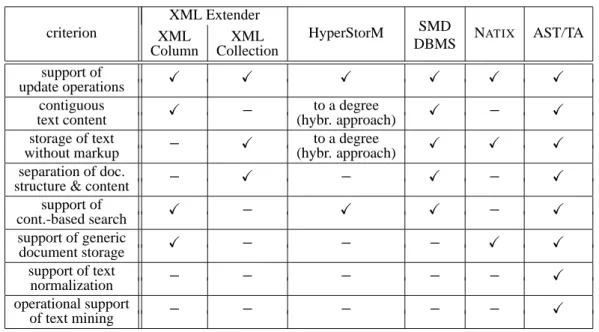
Comparing Approaches. Table 1 summarizes the prop-erties of the approaches introduced in the previous para-graphs and compares them with the requirements for our approach.
3. The Access Support Tree/TextArray Model
3.1. Motivation
The AST/TA model is the abstraction of the AST/TA data structure that is relevant and is used for representing XML documents in physical storage. The AST/TA model describes and summarizes the components of XML docu-ments and their relationship to each other with regard to their storage representation rather than to their conceptual models as provided by query models like the Document
Object Model [13], the XQuery 1.0 and XPath 2.0 Data Model [17] or the Proximal Nodes Model [6]. The AST/TA
model provides a base concept for maintaining XML docu-ments on persistent storage. Based on the concept of an per-sistent AST/TA model, we intend to implement the DOM, the XQuery 1.0 and XPath 2.0 Data Model, or the Proximal Nodes model on secondary storage.
Well-formed XML documents represent the actual in-stances of documents. They actually consist of only an XML [document element]1 each. XML declarations and
XML document type declarations are optional and provide additional information constraining XML document ele-ments. Since XML Schema [16] provides means for speci-fying schemata in the form of XML documents themselves, XML document type declarations may be reduced to just references to other XML documents. The AST/TA model is designed to support generic XML documents, i.e., doc-uments having no constraints other than well-formedness. For this reason, the AST/TA model devotes to XML docu-ment eledocu-ments only.
3.2. The static AST/TA Model
An important goal of our approach is to separate meta data from data. Therefore, we distinguish the Access Sup-port Tree from the TextArray of a document element. The
1We use the notation introduced in XML Information Set
Table 1. Overview of criteria and approaches XML Extender
criterion XML XML HyperStorM SMD NATIX AST/TA
Column Collection DBMS
support of
update operations
contiguous to a degree
text content (hybr. approach)
storage of text to a degree
without markup (hybr. approach)
separation of doc.
structure & content
support of cont.-based search support of generic document storage support of text normalization operational support of text mining
: criterion applies to the approach.
: criterion does not apply.
entire logical structure of the document element, including element attributes, comments etc., is incorporated in an or-dered tree—the AST—whereas the TA keeps the entire text content as a single contiguous string with regard to its orig-inal order in the document. Thus, the XML document ele-ment is represented by an AST/TA pair in physical storage. The relationship between AST and TA is established by logical references called text surrogate values. A text sur-rogate value is a vector indicating the start position and the length of a text segment referenced to in a TA. Every ver-tex of the logical structure receives a ver-text surrogate value, thus text segments might be reached from any vertex and ASTs become indexes. If we apply this linking concept to documents that do not change their text content in length, text surrogate values alone might be sufficient. We intro-duce offsets that adjust the text surrogate values after up-dates changing the length of the text in TAs. Hereby, the number of vertices to be modified is kept as small as pos-sible. Otherwise, all values that span or follow the location of update in the logical structure would have to be modi-fied, making such updates inefficient. The offset concept is also applied to text surrogate values by specifying the length rather than the end position of text segments. That is, when updating a surrogate value, in most cases, either the start position or the length must be updated only.
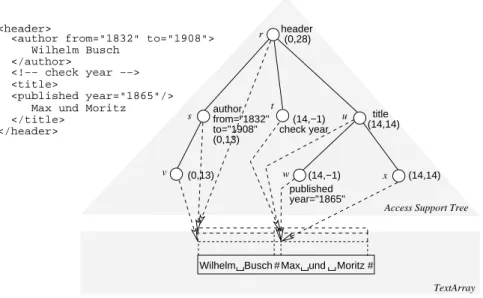
An AST/TA Example. Figure 1 shows an example of an AST/TA pair with its corresponding document element. This example is based on a normalized TA. The symbols and#act as substitutes for word separators. We address the
normalization of TAs in the next section.
The sample AST consists of seven vertices ( , ..., ) rep-resenting their corresponding document components, i.e., elements, a comment, and text components. For example, vertex labeled withheaderrefers to the document ele-ment itself. Vertex represents a comment. We label such vertices with their textual content only, e.g.,check year, leaving out syntactic additives as<!--and-->. On the contrary, text vertices such as and have no labels. They act as place holders for the text components they represent in the AST tree. In addition to labels, element vertices may have an attribute set assigned to. Thus, vertex (author element) comes with the refinements of from="1832"
andto="1908"representing the attributesfromandto
with their corresponding values"1832"and"1908". Edges (solid lines) link vertices of the tree. They refer to the immediate part-of relationship of the document com-ponents. For example, theauthorelement is a direct part (child) of theheaderelement. Thus, the AST tree matches the logical structure of the document element.
Expressions in parenthesis, e.g.,(14,14), depict text surrogate values. That is, the vertices and both refer to the text segment that starts at position14in the TA and has a length of14. Arrows give a notion of text surrogate values in the figure pointing to the start of corresponding text segments in the TA.
For an efficient implementation of update operations, all vertices do have a defined start position in their surrogate values, thus aligning vertices to text segments. Therefore, the comment vertex has the defined start position of 14
published year="1865"
Wilhelm Busch Max und# Moritz # author
from="1832" to="1908"
s u
(0,13) <author from="1832" to="1908">
<published year="1865"/> <header> </header> </author> Wilhelm Busch <!−− check year −−> </title>
Max und Moritz <title> TextArray (14,14) title (14,−1) (14,14) (14,−1) (0,13) check year r t header (0,28)
Access Support Tree x
w v
Figure 1. AST and normalized TextArray
in its surrogate value. Vertices representing processing in-structions and comments and vertices that stand for true
empty elements acquire a length of
in their surrogates. Addressing the problem of empty elements, we must dis-tinguish elements that do not span over any text content in a TA—true empty elements—and ”PCDATA elements” that refer to empty word content and, therefore, acquire a length of in their surrogates. Providing these different measures of length, the AST model satisfies the different semantics of such elements.
We left out the offsets in our example, since we assume the document not being updated yet. Therefore, all offsets are equal to 0.
Definitions. The Definitions 1, 2, and 3 summarize our AST/TA model. The identifiers we use in our definitions, namelyelement,PI,Comment,CharData,CDSect,
EntityRef, Attribute, and Name refer to the
left-hand sides of the corresponding productions in the XML
Standard [14]. As character references are only used for
overcoming limitations of the character encoding of docu-ments and for ”escaping” characters that would be other-wise interpreted as markup, we postulate character refer-ences to be expanded. Furthermore, we assume that val-idating XML parsers expand entity references, whenever it is possible. Otherwise, entity references are handled in their native form, e.g.,&entity-ref;, as ”normal” text of type #PCDATA. In Def. 3 we use the term textual content to refer to processing instructions and comments leaving out the syntacticle additives<--,-->,<?, and?>.
Formal definitions of our AST/TA data structure and its relationship to the well-known XML Information Set [15] can be found in [9].
Definition 1 (TextArray) A TextArray is the contiguous
sequence of characters in document order that
repre-sents all parts of an XML document referring to the type set
!
CharData" CDSect" EntityRef# . $
is the%'&)( character of , where%+* ",-,,."-/10.243658798: ;
# .
The following properties are valid for TextArrays: (1) all character references are expanded in TextArray seg-ments that refer to the type ofCharData, (2) CDATA sec-tions are stored as specified by the type ofCDSect leav-ing out the syntactic additives<![CDATA[and]]>, and (3) entity references are stored as specified by the type of
EntityRefreferring to their native form. <
Definition 2 (Normalized TextArray) A normalized
Text-Array is a TextText-Array with the following additional proper-ties. Sequences of white spaces (#x20,#x9,#xD,#xA) are reduced to a single space (#x20– word separator) or they are removed if they appear next to markup boundaries or next to the beginning of the TextArray. Markup bound-aries are represented by the character#x0(separator). We may use the character #x0for separators, since it is not part of any XML document [14]. For implementation rea-sons, we make markup boundaries explicit at the end of the
TextArray, however, not at its beginning. <
Definition 3 (Access Support Tree) An Access Support
Tree is an ordered tree 9)=>"@?:. A vertex A*B= represents
the corresponding structure component of an XML
docu-ment eledocu-ment. An edge CD*E? expresses the relationship
between parent and child vertices in= , thus?GFH=BI;= .
Siblings of one parent vertex are ordered with respect to a successor relation for any two neighbor siblings. There-fore, they may be counted from left to right starting with 0.
Every vertex has a typeJK* assigned to it. We may
separate
in two subsets: LKNMPORQTS'MPS'UWV;
with
MPORQTS'MPSTU X
element"PI" Comment# and
Y
CharData" CDSect" EntityRef# .
There is exactly one root vertex of typeelement. All vertices, except the root vertex, have a parent vertex of type
element.
Every vertex of typeJZ*
[MPORQTS'MPSTU
receives a label\]*_^
representing theNameor the textual content of the corre-sponding component. Vertices of typeJZ*
`
carry
the empty word a as label. Vertices of type element
may have a set of correspondingAttributesb4c ,
includ-ing their names and values, assigned to it.
Every vertex obtains a text surrogate valued]*feghIfi .
Text surrogate values are vectors consisting of the two com-ponentsd4j anddk, which refer to the start position and the length of the text segment in a TextArray referenced to by a
vertex. Thus, text surrogate values are logical references. Vertices of typeJl*
`
reference their correspond-ing character sequence in the TextArray that they represent in a document. Vertices of typeelementreference the text segment that is the ”concatenation” of all text segments to which their descendant vertices of typeJA*
.
ref-erence.
Offsetsmn*oi adjust the positiond j of a text surrogate
value, such that vertices reference their text segments via their text surrogate values correctly after updates. <
In the following, we discuss issues of integrating our pro-posed text normalization into the AST/TA model. For the integration of other relevant XML features such as handling of entities and XML namespaces, we refer to our technical report [9].
Text Normalization. It is easy to handle text content as a sequence of characters, because the text remains in its orig-inal form. However, when considering text content as a se-quence of words, we must be aware of separators and word
separators. If we disregard separators, words would merge
in a TA. The following example shows this effect—the sym-bol “ ” indicates single word separators:
Instance: <author>Wilhelm Busch</author ><title>Max und Moritz...
TextArray: Wilhelm BuschMax und Moritz...
BuschandMaxmerged intoBuschMaxwithin the TA,
thusMax may not be recognized as an independent word any longer.
Furthermore, we have to take into consideration differ-ent semantics of separators and word separators in a TA, if we intend to remove character sequences that cross markup boundaries. Let us take a look at the following example— for better reading, the symbol “#” replaces the#x0 charac-ter here, indicating separators:
Instance: <author>Wilhelm Busch</author ><title>Max und Moritz...
TextArray: Wilhelm Busch#Max und Moritz...
There is no problem in removing the stringhelm Bu, since the removal happens directly within theauthor ele-ment. However, if we want to remove, e.g.,sch#Ma, that crosses markup boundaries, we expect the markup bound-ary to be maintained:
Instance: <author>Wilhelm Bu</author ><title>x und Moritz...
TextArray: Wilhelm Bu#x und Moritz...
The separator must remain in the TA as long as the markup </author><title> remains part of the in-stance.
To handle these and other challenges which notably arise in text normalization, we encapsulate the access to TextAr-rays on behalf of both views of text in our implementation. Thus, we provide a generic interface for the operations that the AST/TA model specifies.
3.3. Operations of the AST/TA Model
The AST/TA model provides operations with respect to both the Data Definition Language and the Data
Manipu-lation Language similar to DBMSs. The AST/TA model
provides operations both to generate an AST/TA pair from an XML document and to restore an XML document from an AST/TA pair. The AST/TA DML includes operations such as search, insert, and delete that primarily work either on the AST, on the TA, or on both, respectively.
The DDL operations. We assume an XML processor to
generate both the AST and the TA from an XML document
at the same time. Furthermore, we expect an XML proces-sor to do any necessary normalization, e.g., the carriage-return and line-feed and the attribute-value normalization described in the XML Standard [14]. Additionally, the pro-cessor may perform the text normalization we proposed in Definition 2. During the process of generating an AST/TA pair, all character references are expanded; if schema infor-mation is available, entity references are expanded as well. Beyond that, text surrogate values are calculated and all off-sets are set being equal to 0.
The reverse operation of generating AST/TA pairs is
restoring XML documents from AST/TA pairs. This
pro-cess is mainly ruled by the serialization of the tree structures coming up with AST/TA pairs. With performing different kinds of normalization while generating AST/TA pairs, the restored XML document differs from its original source.
regarding offsets
TextArray Access Support Tree
text insertion
shifting the text in the TextArray
adjustment of the text surrogate values
adjustment of length adjustment of position author from="1832" to="1908" published year="1865" s u
<author from="1832" to="1908">
<published year="1865"/> <header> </header> </author> <!−− check year −−> </title>
Max und Moritz <title> (14,14) title (14,−1) (14,14) w (14,−1) (0,25) check year r t header (0,40) (0,25) [0] [0] Max und # Moritz Wilhelm Busch (1832−1908) [0] v [0] [0] x [12] [12] Wilhelm Busch (1832−1908) #
Figure 2. Inserting text into the TextArray
Manipulating TextArrays. Searching the TextArray means retrieving an arbitrary sequence of characters or words from the ”visible” text content of an XML document. The TA enables random access to arbitrary segments of the text content. For this purpose, we need to know the length of the desired text segment and its start position in the TA. Alternatively, the TA allows to scan its text.
By representing the text content of an XML document as a single contiguous string, the TA provides efficient opera-tions both for random access to and for scanning the text. As we do not need to rearrange the text, random access is performed in constant time, whereas scanning needs time depending on the length of the TextArray.
The TA facilitates insertions and deletions of arbitrary sequences of characters or words respectively, to change the text content of an XML document. Finding an inser-tion or deleinser-tion posiinser-tion is done in constant time. However, inserting or deleting a sequence of characters or words may take much more time, because all text that follows the corre-sponding position in a TA must be shifted, i.e.,/p0.243658798:rqts bytes on average. To improve the performance, we imple-ment TAs as Bu -trees as, e.g., described by Carey et al. in [1]. Insertions into or deletions from normalized TAs are additionally more complex, because the normalized state of those TAs must be maintained.
Deletions and insertions are similar to each other. In contrast to insertions, we must specify a valid deletion length referring to TAs. For example, we may delete up to 20 characters beginning at position 7 in the TA of Figure 1. If we delete 14 characters, the remaining TA
is Wilhelm#Moritz#. Again, normalized TAs must
be left in a normalized state afterwards. That is, if we specify deleting 13 characters, 14 characters must actu-ally be deleted; otherwise, the TA is in an ill-formed state:
Wilhelm# Moritz#. The separator sequence ”# ”
vi-olates the normalization. Adjusting the deletion length is integrated into our deletion algorithm.
After changing the length of TAs, it is necessary to adjust text surrogate values and offsets in ASTs. Figure 2 shows an example in which the text ”(1832-1908)” was inserted after the wordBusch. The example refers to a normalized TextArray. Thus, we must insert an additional space at the beginning of the text insertion causing an effective insertion length of
s . With respect to the example in Figure 2, we perform the AST adjustment as follows: We start in the root vertex and increment its text surrogate length by
s . In the next step, we search for the child vertex of that spans over the text insertion and increment its length also by
s . The offsets of all siblings vertices ( and ) that follow to the right of that child vertex ( ) are incremented by the inser-tion length of
s . (In Figure 2 we use square brackets to constitute offsets, e.g., [12].) This procedure continues until we reach the text vertex (the leaf) that directly spans over the insertion. By using offsets rather than none to ad-just text surrogate values, we do not need to visit all of the vertices that follow the location of an update within an AST. Thus, ifv is the maximum number of child vertices andw is the maximum depth in an AST, we must visit no more thanvEIfw vertices, using this approach.
As for deletions, updates of offsets and text surrogate values are analogous to updates after insertions. However, we need a more sophisticated algorithm when deleting
char-transformed space
</author>
<!−− check year −−> <title>
<published year="1865"/> Max und Moritz
</title> </header>
inserted stucture or
TextArray Access Support Tree
published year="1865" author from="1832" to="1908" Max und # Moritz # s u (14,14) title (14,−1) (14,14) w (14,−1) check year r t header [0] [0] v [0] [0] x [0] z y [0] Wilhelm Busch# (0,7) (0,5) (0,13) [8] (0,5) (0,28) surname [0] [0] <header>
<author from="1832" to="1908"> Wilhelm<surname>Busch</surname>
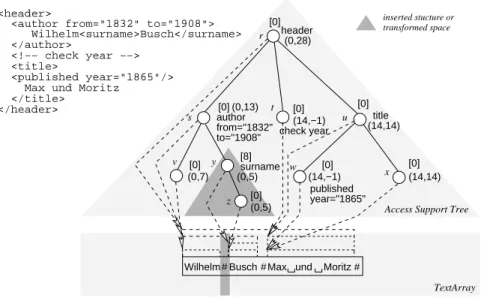
Figure 3. Inserting structure into the AST
acter or word sequences that go beyond markup boundaries. Unlike at insertions, the adjustment procedure for ASTs may reach a non-leaf vertex of which some children span only over parts of the deleted text. Therefore, this subtree must be traversed to adjust text surrogate values and offsets of the vertices according to their contributions.
Manipulating ASTs. The manipulation of ASTs refers to the structure of XML documents. For searching the struc-ture of a document, the AST provides operations navigating the tree to find vertices having specific characteristics. For example, we are able to search for vertices with specific el-ement names, attribute names, attribute values, specific po-sitions to siblings, or references to specific text segments according to their corresponding text surrogate value and offsets.
Insertions referring to ASTs are operations that refine the structure of documents only, therefore enhancing the structure of ASTs. For example, we might apply some refinement to our sample document, such that
<author from="1832" to="1908" >Wilhelm Busch</author>becomes<author from="1832" to="1908">Wilhelm<surname>Busch</surname ></author>. Such an insertion of a logical structure into a document is a tag insertion that might be the result of a text mining task [18]. Figure 3 illustrates the previous example based on a normalized TextArray. The AST receives two additional vertices x and y with x of type
elementrepresenting the newsurnamemarkup. Vertex
x is the parent of y which references the refined text segmentBusch. Since the underlying TA is normalized, the former word separator ( ) prefixing the word Busch
must be converted into a separator (#), making the new
markup boundary explicit in the TA. This is not necessary with non-normalized TAs, because there are no separators to consider.
In the following, we focus on ”simple” structural inser-tions as in our example that refine texts referenced by sin-gle text vertices rather than higher level structures in ASTs. For these simple insertions, we perform the following steps: After having found our desired sequence of characters or words that is to be marked by a new tag, we know the posi-tion and the length of this sequence. We search the AST— beginning from the root—for the text vertex that spans over this sequence. As all vertices of an AST come with text surrogate values, we follow exactly one path to the target vertex. This text vertex must be ”split” in such a way that the AST integrates its additional structure correctly. That is, the root vertex of the new structure becomes a sibling of this text vertex and the text surrogate values and offsets must be adjusted accordingly. With respect to Figure 3, the text vertex receives a new text surrogate length of z and the offset of the root vertexx is set to { , thus aligning all text surrogate values of the newly inserted structure.
We note that structural insertions do not have any impact on the overall AST; changes in the AST are rather limited to the location of insertion. Beyond that, if TextArrays hold sequences of characters rather than of words, there is no need to access TAs at all.
We also allow the user to delete structure from an AST. That means, vertices may be removed from ASTs. Remov-ing a vertex is simple. All children of the vertex to be re-moved become children of its grand parent. Only, if the cor-responding TextArray is normalized, separators might have to be exchanged by word separators.
regarding offsets
<lived>(1832−1908)</lived>
adjustment of position
TextArray shifting the text in the TextArray
adjustment of text surrogate values
text insertion
Access Support Tree
inserted AST adjustment of length published year="1865" <published year="1865"/> </header> </author> <!−− check year −−> </title>
Max und Moritz <title>
author from="1832" to="1908"
s u
<author from="1832" to="1908"> <header> (14,14) title (14,−1) (14,14) w (14,−1) check year r t header (0,40) (0,13) [0] Max und # Moritz [0] v [0] [0] x [12] [12] Wilhelm Busch#(1832−1908) (0,11) lived (0,11) [0] z Wilhelm Busch y [0] (0,25) [14] #
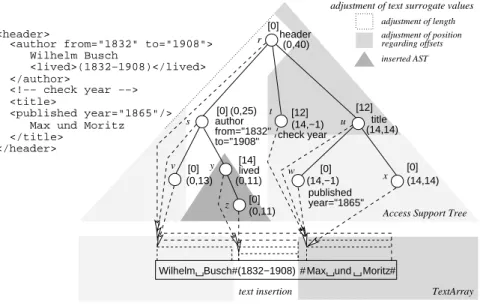
Figure 4. Insertion of an AST/TA pair into an AST/TA pair Structural updates of ASTs also involve updates of
el-ement names, attribute names, attribute values etc. These operations are simple operations mainly based on structural search, therefore we do not address them here.
Manipulating AST/TA pairs. In the previous sections, we considered the manipulation of ASTs and TAs sep-arately. We now focus on manipulating ASTs and TAs jointly.
A simple operation on AST/TA pairs is the search for the minimal enclosing element of an arbitrary text segment of a TA. For example, in Figure 1, the minimal enclosing element of the stringBusch#Maxis theheaderelement. Based on text surrogate values, this search needs to follow exactly one path from the root vertex to the desired element vertex in the AST. Ifv is, again, the maximum number of child vertices and w is the maximum depth in an AST, at mostvXI;w vertices must be processed.
Inserting an AST/TA pair into another AST/TA pair is equivalent to inserting one XML document into an-other. The position of such insertions depends on dif-ferent characteristics of the AST/TA pair in which to in-sert. On the one hand, insertion positions may depend on text positions. For example, consider the query:
”In-sert<b>y</b>into<a>xz</a>afterx” that results in
<a>x<b>y</b>z</a>. On the other hand, insertion po-sitions may depend on structural properties as in the query: ”Insert<b>y</b>into<a>xz</a>as the first child of
a” resulting in<a><b>y</b>xz</a>.
Figure 4 describes an example of the latter type of in-sertions. Here, the AST/TA pair representing the XML el-ement<lived>(1832-1908)</lived>is inserted as
last child into vertex (authorelement). The algorithm for non-normalized TextArrays works as follows: First, the vertex in which the insertion is to occur is searched. Dur-ing the search the length parameter of the surrogate values of and and the offsets of the siblings that follow the search path are incremented by the length of the additional text content ”(1832-1908)”. Finally, the root vertexx of the AST to be inserted is placed as the last child of vertex ; the new text is added to the TA. This kind of insertion needs to pass through the path from the root to the destination ver-tex exactly once.
Unfortunately, the insertion requires a second walk through the search path, when we insert into AST/TA pairs that are built on normalized TAs as shown in Figure 4. We do not know the real insertion length in the TA at the begin-ning; it might change, because of considerations of separa-tors. Thus, we cannot update the text surrogate values while searching the destination vertex. Therefore, the correspond-ing text surrogate values and offsets must be updated after the insertion of text into the TA requiring a second walk through the search path.
As for deletions, we provide operations on AST/TA pairs similar to insertions.
4. Future Work
Currently, we have implemented the AST/TA data struc-ture in main memory. We carefully review the interdepen-dence between the AST and the TA for possible improve-ments. For example, the AST/TA data structure relies on relative text surrogate values, which enable efficient update operations. However, we need absolute text surrogate
val-ues for vertices in ASTs to reference text segments in TAs correctly. For this reason, we must take into account the is-sue of providing absolute text surrogate values for arbitrary vertices of ASTs in an efficient way. Another issue of inter-est is to provide a suitable interface that enables convenient access to XML documents represented by AST/TA pairs.
Currently, we move our main memory implementation of AST/TAs into secondary storage. Thus, we provide persistent AST/TAs for handling large scale XML docu-ment collections within our XML query execution engine (XEE). In the framework ofXEE, we intend both to imple-ment a persistent DOM based on persistent AST/TAs and to map query languages to the AST/TAs. As for the map-ping of query languages, the integration of both the concept of database query languages and the concept of informa-tion retrieval data plays an important role. In addiinforma-tion, we take a look at optimizations with respect to AST/TAs and plan, therefore, to apply various kinds of indexes to both the AST and the TA to improve the performance. For this pur-pose, we have already proposed some indexes in [9], e.g., for XML namespaces, entities etc.
5. Conclusion
The AST/TA model introduces our approach for storing and retrieving generic XML documents without any DTD. The basic idea of the AST/TA data structure is the sepa-ration of meta data from data. This resulted in the design of two independent structures of the Access Support Tree for taking the meta data and of the TextArray for taking the data of XML documents. Moreover, TextArrays maintain the data in ”one piece” in document order. Based on this concept, our AST/TA data structure enables efficient access to documents based on both content and structure, thus fa-cilitating information retrieval and database-like querying equally. Although we pursue a generic approach, among other things, of supporting different views of text, we are able to provide the AST/TA data structure with efficient up-date operations. For example, the number of vertices pro-cessed in an textual insertion is reduced considerably by us-ing offsets for text surrogate values.
We addressed relevant aspects of our approach referring to XML. In addition, our approach incorporates further as-pects specific to XML that must not be ignored, e.g., the XML Information Set [15], white spaces handling, and han-dling of XML namespaces and entities. Due to space limita-tions, we could not address such issues here; hence, we re-fer to [9]. The AST/TA data structure immediately supports some of these aspects, namely by our proposed scheme to handle processing instructions and comments and by the text normalization we proposed. Furthermore, the AST/TA data structure facilitates additional aspects of interest, e.g., tag insertions.
References
[1] M. J. Carey, D. J. DeWitt, J. E. Richardson, and E. J. Shekita. Object and File Management in the EXODUS Extensible Database System. In Proceedings of VLDB, Kyoto, Japan, pages 91–100, 1986.
[2] Database Systems Research Group (University of Alberta). Multimedia Data Management.
http://www.cs.ualberta.ca/˜database/ multimedia/multimedia.html, 1998.
[3] A. Heuer and D. Priebe. IRQL – Yet Another Language for Querying Semi-Structured Data? Technical Report Preprint CS-01-99, Universit¨at Rostock, 1999.
[4] International Business Machines Corporation. XML Exten-der (Administration and Programming). IBM, 2000. [5] C.-C. Kanne and G. Moerkotte. Efficient Storage of XML
Data. In Proceedings of ICDE, San Diego, California. IEEE Computer Society, 2000.
[6] G. Navarro and R. A. Baeza-Yates. Proximal Nodes: A Model to Query Document Databases by Content and Struc-ture. Information Systems, 15(4):400–435, 1997.
[7] M. T. ¨Ozsu, D. Szafron, G. El-Medani, and C. Vittal. An Object-Oriented Multimedia Database System for a News-on-Demand Application. Multimedia Systems, 3(5-6):182– 203, 1995.
[8] A. Salminen and F. W. Tompa. PAT Expressions: An Al-gebra for Text Search. Acta Linguistica Hungarica, 41(1-4):277–306, 1992-93.
[9] D. Scheffner. Access Support Tree & TextArray: Data Structures for XML Document Storage. Technical Report HUB-IB-157, Humboldt Universit¨at zu Berlin, 2001. [10] F. W. Tompa. Views of Text. Digital Media Information
Base (DMIB ’97), November 1997.
[11] D. Tsichritzis and A. C. Klug. The ANSI/X3/SPARC DBMS Framework Report of the Study Group on Dabatase Management Systems. Information Systems, 3(3):173–191, 1978.
[12] M. Volz, K. Aberer, and K. B¨ohm. An OODBMS-IRS Cou-pling for Structured Documents. Data Engineering Bulletin, 19(1):34–42, 1996.
[13] World Wide Web Consortium. Document Object Model (DOM) Level 2 Core Specification, Version 1.0. Technical Report REC-DOM-Level-2-Core-20001113, W3C, Novem-ber 2000.
[14] World Wide Web Consortium. Extensible Markup Language (XML), Version 1.0 (Second Edition). Technical Report REC-xml-20001006, W3C, October 2000.
[15] World Wide Web Consortium. XML Information Set. Tech-nical Report REC-xml-infoset-20011024, W3C, October 2001.
[16] World Wide Web Consortium. XML Schema Part 1: Struc-tures. Technical Report PR-xmlschema-1-20010330, W3C, March 2001.
[17] World Wide Web Consortium. XQuery 1.0 and XPath 2.0 Data Model. Technical Report WD-query-datamodel-20010607, W3C, June 2001.
[18] S. Yeates and I. H. Witten. On Tag Insertion and its Com-plexity. In Proceedings of PRICAI 2000: International Workshop on Text and Data Mining, Melbourne, Australia, pages 52–63, 2000.