Procedia Computer Science 72 ( 2015 ) 638 – 646
1877-0509 © 2015 Published by Elsevier B.V. This is an open access article under the CC BY-NC-ND license (http://creativecommons.org/licenses/by-nc-nd/4.0/).
Peer-review under responsibility of organizing committee of Information Systems International Conference (ISICO2015) doi: 10.1016/j.procs.2015.12.173
ScienceDirect
The Third Information Systems International Conference
Application of Fuzzy AHP-TOPSIS Method for Decision
Making in Human Resource Manager Selection Process
Renny Pradina Kusumawardani, Mayangsekar Agintiara
Jurusan Sistem Informasi, Fakultas Teknologi Informasi, Institut Teknologi Sepuluh Nopember (ITS)Jl. Arief Rahman Hakim, Surabaya, 60111, Indonesia
Abstract
This paper investigates the use of the Fuzzy AHP-TOPSIS method to the problem of human resource selection. Results are reported on the application of this hybrid method to the case of manager selection process in a prominent telecommunication company in Indonesia which has a robust human resource management process, including for assigning its employees to different roles in the company. However, our experiments results seem to indicate that although there is a set of commonly known values in the company, the process of manager selection might not strictly adhere to these values. Emphasis on the evaluation aspects shows some variation in different regions, indicating that local values might also influence the selection process.
© 2015 Published by Elsevier Ltd. Selection and/or peer-review under responsibility of the scientific committee of The Third Information Systems International Conference (ISICO 2015)
Keywords: Manager Selection; AHP; TOPSIS; Fuzzy AHP-TOPSIS
1.Introduction
High-quality Human Resources (HR) is essential in determining the success of a company. The first step to ensure the availability of a work force to drive a company to success is to conduct an appropriate selection process. According to I.T. Robertson and M. Smith, HR selection process usually involves personality testing, interviewing, and evaluation of the curriculum vitae of candidates [1]. However, the final decision usually involves a large degree of human judgment. A shortcoming of this traditional method is humans are known to be prone to bias, even though more experienced managers tend to be less affected by it [2].
To overcome this, various metrics have been developed and used in the process of candidate selection. This is the case in one of the largest telecommunication company in Indonesia, which this paper takes as a study case. PT. XYZ has developed quite an elaborate system of metrics for the measurement its © 2015 Published by Elsevier B.V. This is an open access article under the CC BY-NC-ND license
(http://creativecommons.org/licenses/by-nc-nd/4.0/).
employees, including in the case of selecting candidates for promotion. This practice safeguards the candidate selection process in that it is difficult for the committee in charge of the selection process to
ignore facts about the candidate’s background and past performance. This would also give a higher
guarantee that the candidate selected will more strongly reflect the values of the organization.
However, human judgment still play an important role in making the decisions. Consequently, it is difficult to guarantee that the decisions are consistent and bias-free. Therefore, researchers explore various methods for computer-aided decision making, for example fuzzy logic, decision tree, and rough set theory. The problem of personnel selection is usually framed as a Multi Criteria Decision Making
(MCDM), in which the candidates’ performance are measured across various metrics. It is the combining
of these scores in which researchers attempt to produce a decision that is close to the actual results. One of the more popular MCDM methods for personnel selection is the Fuzzy Analytical Hierarchy Process (AHP). In this method, a set of criteria is produced and methodically weighted according to their importance. Candidates are measured based on these criteria and receives a final score which reflects this importance weighting. Another method that is also popular is the Fuzzy Technique for Order Preference by Similarity to Ideal Solution (TOPSIS). In this method, characteristics of the candidates are compared to that of an ideal. This mimics a common thought process in humans, in which people evaluate things not based on some criteria, but on comparison with an ideal instance of the same type.
To gain the benefits of these methods, this paper applies a combination of both: the Fuzzy AHP-TOPSIS method. It is applied to the case of Human Resources Manager selection in the seven regions into which the company divides its operation in Indonesia. Seven managers are selected; each from a set of five candidates. The criteria used are the measurement metrics developed by the HR department of the company. For the human judgment input in weighting these criteria, we asked five HR managers to give their opinions on the relative importance of the criteria. We also combine the opinions of these managers to gauge the overall employee perception of the company values, reflected in the criteria they think are more important.
The rest of this paper is organized as follows. This introduction is the first section of the main part of the paper, followed by a brief overview of related works in the Fuzzy AHP-TOPSIS method in the second section. The third section discussed the Fuzzy AHP-TOPSIS method itself. The fourth part is the implementation specifics of this work, and the results are presented and analyzed in the fifth section. The last section of this paper is the Conclusion, in which key takeaways from this paper are discussed, along with some suggestions for future work.
2.Related Works
Dursun and Karsak[3] found that the Fuzzy Multi Criteria Decision Making (MCDM) gives effective results in solving personnel selection process. They use a fusion of fuzzy information, 2-tuple linguistic representation model and Technique for Order Preference by Similarity to Ideal Solution (TOPSIS) [2]. The method is used because it can accurately manage the information that is assessed using a scale linguistic and numerical decision making problem with multiple resources and information which heterogeneous.
There are various techniques that could be used to solve MCDMs, such as Analytic Hierarchy Process (AHP), Technique for Order Preference by Similarity to Ideal Solution (TOPSIS), ELECTRE, rough sets theory and Multi-objective programming[4]. Hybrids of these methods in personnel selection has been explored by researchers [4][5][6][7][8], one of which combines Fuzzy AHP and Fuzzy TOPSIS.
3.The Fuzzy AHP-TOPSIS Method
The fuzzy AHP-TOPSIS method is basically a combination of the Fuzzy AHP method with the Fuzzy TOPSIS method. At the first stage, Fuzzy AHP is used to weight the relative importance of criteria when compared to each other. This weighted criteria are used to assign a score to the each candidate in every
evaluation criteria. This stage is followed by the Fuzzy TOPSIS, in which based on the scores that have been assigned, the proximity score of each candidate to the ideal is calculated, both for the positive ideal and for the negative ideal. The best candidate should be as near as possible to the positive ideal, while as furthest as possible to the negative ideal. A concise steps of the Fuzzy AHP-TOPSIS is as follows. 3.1 Fuzzy AHP
First proposed by Thomas L. Saaty, the AHP is one of the MCDM method for solving complex, unstructured problems by creating a functional hierarchy [10]. The main concept of AHP is to develop a preference weighting of each alternative decision. Preferences can be specified using natural language or numeric values to determine the importance of each attribute. To determine ordering, first each two elements are compared using a nine point scale of importance [11]. To introduce fuzziness, the pairwise numerics are then operated in a matrix using Triangular Fuzzy Number (TFN) [12]. The steps are as follows:
1.Developing a fuzzy comparison matrix
First the scale of linguistics is determined. The scale used is the TFN scale from one to nine. Then defined by the membership function refers to research Metin Celik (table 3.1) [6].
Table 3. 1 Scale of Interest
Scale of Interest Fuzzy Number Linguistic Variable Membership
Function
1 1 Equally important (1,1,3)
3 3 Weakly important (1,3,5)
5 5 Strongly more important (3,5,7)
7 7 Very strongly important (5,7,9)
9 9 Extremely important (7,9,9)
Then, using the TFN to make pair-wise comparison matrix for the main criteria and sub-criteria. Equation (1) shows the form of fuzzy comparison matrix.
ܣሚ ൌ
ͳ ڮ ܽଵ
ڭ ڰ ڭ
ܽଵ ڮ ͳ
൩ሺͳሻ
2.Define Fuzzy Geometric Mean
The fuzzy geometric mean is then calculated using Equation (2)[13]:
ݎǁൌ ሺܽଵٔ ܽଶٔ ǥ ٔ ܽሻଵൗሺʹሻ
where a ̃in is a value of fuzzy comparison matrix from criteria I to n. Result from the fuzzy geometric mean will be referred to later as local fuzzy number.
3.Calculate the weight of fuzzy of each dimension
The next step is to calculate the global fuzzy number for each evaluation dimension with Equation (3).
ݓൌ ݎǁଵٔ ሺݎǁଵْ ݎǁଵْ ǥ ْ ݎǁଵሻିଵሺ͵ሻ 4.Define the best non fuzzy performance (BNP)
The global fuzzy number is then converted to crisp weight value using the Centre of Area (COA) method to find the value of best BNP from the fuzzy weight in each dimension, calculated using Equation (4).
ܤܰܲ௪ൌ
ሾሺݑ௪െ ݈௪ሻ ሺ݉௪െ ݈௪ଵሻሿ
͵ ݈௪ሺͶሻ
3.2 Fuzzy TOPSIS
The Fuzzy TOPSIS is a MCDM method developed by Hwang and Yoon[14], in which the solution is the one with the Euclidean distance nearest to the best hypothesis, the Positive Ideal Solution (PIS), and the farthest with the worst hypothesis, the Negative Ideal Solution (NIS)[15]. Fuzzy TOPSIS needs information about the relative importance of each criteria for weighting. In Fuzzy AHP-TOPSIS, the weights has been calculated in the Fuzzy AHP step[16]. The steps are as follows:
1. Developing a fuzzy comparison matrix
Fuzzy values in this matrix looks at the scale of membership functions defined in Table 3.2[6].
Table 3. 2 Lingusitics scale for each candidate
Crisp Value Linguistic Variabel Membership Function
1 Very poor (VP) (0,1,3)
3 Poor (P) (1,3,5)
5 Fair (F) (3,5,7)
7 Good (G) (5,7,9)
9 Very Good (VG) (7,9,11)
Next is the normalization of value rij in the matrix using Equation (5).
ݎǁൌ ቆ ݈ ݑାǡ ݉ ݑାǡ ݑ ݑାቇሺͷሻ
2. Weighting a Normalized Matrix
Each member is given matrix normalized weight w = (w1, w2, w3 ..., wn), resulting in a matrix V. Then
the elements of the matrix V is VIJ = wij rij, for i = 1, ..., m and j = 1, ..., n, calculated with Equation (6). ݒൌ ݓٔ ݎǁǡ݅ ൌ ͳǡʹǡ Ǥ Ǥ ǡ ݉Ǣ ݆ ൌ ͳǡʹǡ ǥ ǡ ݊Ǥሺሻ 3. Identification of Fuzzy Positive Ideal Solution (FPIS) and Fuzzy Negative Ideal Solution (FNIS) Equations (7) and (8) give the formulae for calculating FPIS, denoted as A+, and FNIS, denoted as A-.
ܣାൌ ൛ݒ
ଵାǡ ݒଶାǡ ǥ ǡ ݒାǡ ǥ ǡ ݒାൟሺሻ
ܣିൌ ൛ݒ
ଵିǡ ݒଶିǡ ǥ ǡ ݒିǡ ǥ ǡ ݒିൟሺͺሻ where vj+ = (1,1,1) ٔ w ̃j and vj-= (0,0,0) , j = 1,2,…m
4. Definition of the Best Non Fuzzy performance (BNP)
Next, the BNP is calculated using the COA method, the same as in Equation (4). 5. Calculating the distance between the alternatives with FPIS and FNIS
Calculation of the distance of each candidate to FPIS and FNIS are given in Equations (9) and (10).
ܵାൌ ቐሺݒെ ݒାሻଶ ୀଵ ቑ ଵ ଶ ൗ ǡ݅ ൌ ͳǡʹǡ ǥ ǡ ݉ሺͻሻ
ܵିൌ ቐሺݒെ ݒିሻଶ ୀଵ ቑ ଵ ଶ ൗ ǡ݅ ൌ ͳǡʹǡ ǥ ǡ ݉ሺͳͲሻ
6. Calculating the relative proximity
Calculation for the relative proximity with ideal solution is performed using Equation (11).
ܿൌ ܵ
ି
ሺܵା ܵ ିሻ
ǡ݅ ൌ ͳǡʹǡ ǥ ǡ ݉ܿא ሼͲǡͳሽሺͳͳሻ
7. Develop ranking Preferences
The final stage of the Fuzzy AHP-TOPSIS is sorting of candidates in the order of Ci. The candidate with the highest Ci is selected, since it is closest to the positive ideal and farthest to the negative ideal.
4. Assessment Criteria and Data Processing
4.1 Candidate Assessment
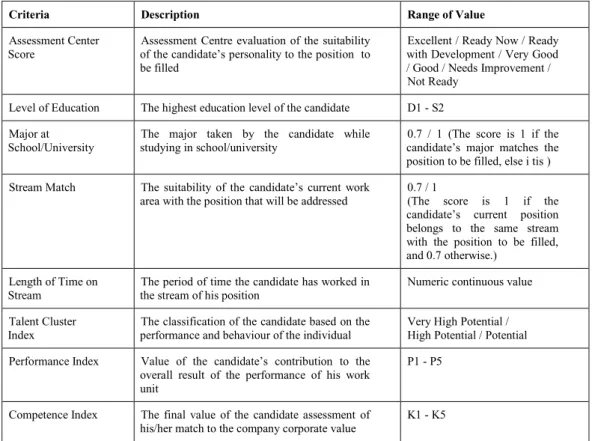
In evaluating candidates, the Division of Human Capital Center in PT XYZ performs an 360 degrees appraisal process, also known as the multi-rater feedback, multi-source feedback, full-circle appraisal, and report group performance[9]. The performance assessment covers the ten criteria in Table 4.1.
Table 4. 1 Ten candidate assessment criteria
Criteria Description Range of Value
Assessment Center Score
Assessment Centre evaluation of the suitability of the candidate’s personality to the position to be filled
Excellent / Ready Now / Ready with Development / Very Good / Good / Needs Improvement / Not Ready
Level of Education The highest education level of the candidate D1 - S2
Major at School/University
The major taken by the candidate while studying in school/university
0.7 / 1 (The score is 1 if the candidate’s major matches the position to be filled, else i tis )
Stream Match The suitability of the candidate’s current work
area with the position that will be addressed
0.7 / 1
(The score is 1 if the candidate’s current position belongs to the same stream with the position to be filled, and 0.7 otherwise.)
Length of Time on Stream
The period of time the candidate has worked in the stream of his position
Numeric continuous value
Talent Cluster Index
The classification of the candidate based on the performance and behaviour of the individual
Very High Potential / High Potential / Potential
Performance Index Value of the candidate’s contribution to the
overall result of the performance of his work unit
P1 - P5
Competence Index The final value of the candidate assessment of
his/her match to the company corporate value
Criteria Description Range of Value Length of Time on
Position Band
The length of time the candidate has spent in his rank
Numeric continuous value
Disciplinary Sanction
Whether the candidate has ever violated any of the company rule and received disciplinary sanctions
Yes / No
After several stages of assessments, a number of candidates are selected. These candidates are then invited to hearing sessions hosted by a committee of directors, which will eventually determines the candidate chosen to fill the position.
4.2 Data and Data Processing
For the process of criteria-weighting in the Fuzzy AHP, we ask five HR managers for pairwise comparisons on the ten assessment aspects. Furthermore, we use the assessment data for the selection of Human Resource (HR) Manager in seven regions into which the company divides its operational area in Indonesia. For each of the seven regions, five candidates are considered. The assessment data of these candidates, and the data on which candidate is selected, are the primary inputs to the Fuzzy TOPSIS method. As can be seen in Table 4.1, some assessment criteria are in nominal format, so it is necessary to map these to crisp values, especially retaining the order inherent in the value. These data are then processed using the Fuzzy AHP-TOPSIS method in Section 3 to determine the selected candidate. The results are presented and discussed in Section 5.
5.Results and Discussion
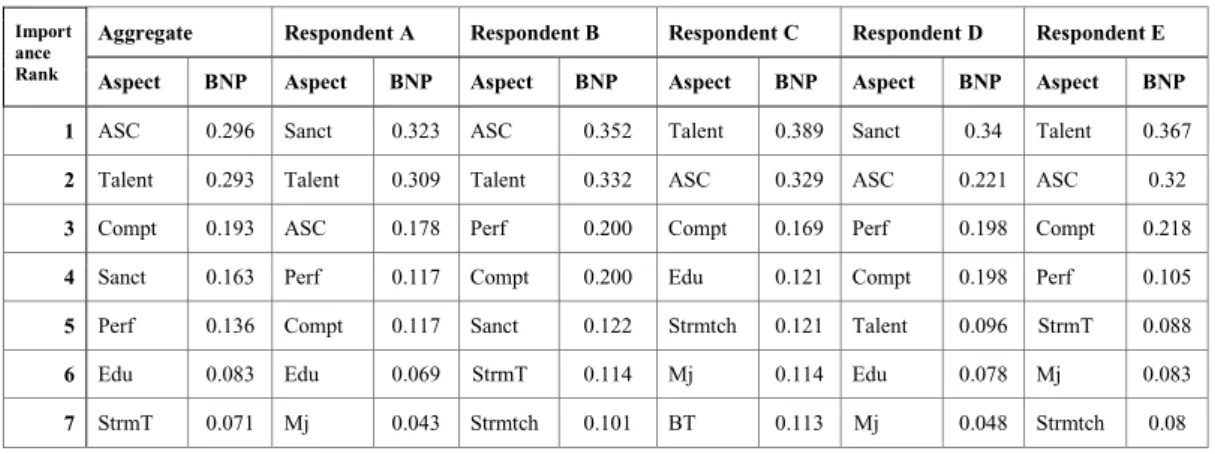
Table 5.1 shows the ranking and the BNP of the importance of the criteria according to the aggregated opinions of the respondents and their individual judgments. The rankings are calculated using the Fuzzy AHP method. It can be seen that the respondents seem to put somewhat similar emphasis to the criteria, demonstrating that there exist some company values guiding employees of what qualities matter the most. Table 5. 1 Importance Rank Based on the Fuzzy AHP Method
Abbreviations: ASC = assessment center score, Edu = level of education, Mj = major at school/university, Strmtch = stream match, StrmT = length of time working in stream, Talent = talent cluster index, Perf = performance index, Compt = competence index, BT = length of time working in current rank, Sanct = disciplinary sanction
Import ance Rank
Aggregate Respondent A Respondent B Respondent C Respondent D Respondent E
Aspect BNP Aspect BNP Aspect BNP Aspect BNP Aspect BNP Aspect BNP
1 ASC 0.296 Sanct 0.323 ASC 0.352 Talent 0.389 Sanct 0.34 Talent 0.367
2 Talent 0.293 Talent 0.309 Talent 0.332 ASC 0.329 ASC 0.221 ASC 0.32
3 Compt 0.193 ASC 0.178 Perf 0.200 Compt 0.169 Perf 0.198 Compt 0.218
4 Sanct 0.163 Perf 0.117 Compt 0.200 Edu 0.121 Compt 0.198 Perf 0.105
5 Perf 0.136 Compt 0.117 Sanct 0.122 Strmtch 0.121 Talent 0.096 StrmT 0.088
6 Edu 0.083 Edu 0.069 StrmT 0.114 Mj 0.114 Edu 0.078 Mj 0.083
Import Aggregate Respondent A Respondent B Respondent C Respondent D Respondent E
8 Mj 0.071 Strmtch 0.032 BT 0.088 StrmT 0.108 BT 0.044 Sanct 0.06
9 StrmT 0.064 BT 0.025 Edu 0.067 Sanct 0.098 Strmtch 0.036 Edu 0.059
10 BT 0.061 StrmT 0.023 Mj 0.058 Perf 0.062 StrmT 0.026 BT 0.055
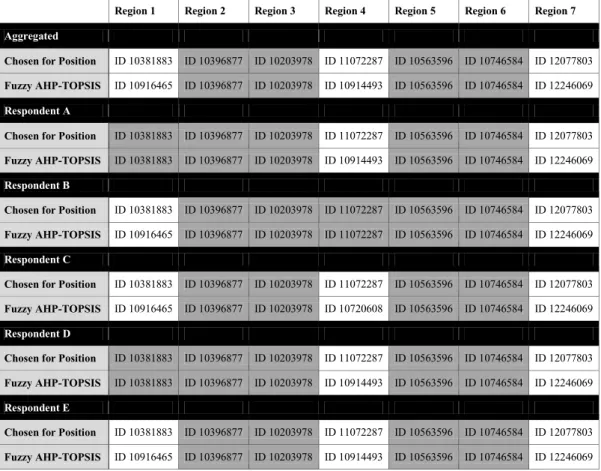
Table 5.2 shows for each region the candidate selected by Fuzzy AHP-TOPSIS versus the one who actually gets the position. In general, the results from the Fuzzy-AHP TOPSIS match, or nearly match the real decision taken. However, there are several regions in which exact match tend not to occur. These mismatches occur only on regions 1, 4, and 7, and the candidate actually chosen is consistent from evaluator to evaluator.
Table 5. 2 The candidate actually chosen for the HR Manager position for each region versus the one selected by Fuzzy AHP-TOPSIS. The cells are greyed-out when these two match.
Region 1 Region 2 Region 3 Region 4 Region 5 Region 6 Region 7
Aggregated
Chosen for Position ID 10381883 ID 10396877 ID 10203978 ID 11072287 ID 10563596 ID 10746584 ID 12077803
Fuzzy AHP-TOPSIS ID 10916465 ID 10396877 ID 10203978 ID 10914493 ID 10563596 ID 10746584 ID 12246069
Respondent A
Chosen for Position ID 10381883 ID 10396877 ID 10203978 ID 11072287 ID 10563596 ID 10746584 ID 12077803
Fuzzy AHP-TOPSIS ID 10381883 ID 10396877 ID 10203978 ID 10914493 ID 10563596 ID 10746584 ID 12246069
Respondent B
Chosen for Position ID 10381883 ID 10396877 ID 10203978 ID 11072287 ID 10563596 ID 10746584 ID 12077803
Fuzzy AHP-TOPSIS ID 10916465 ID 10396877 ID 10203978 ID 11072287 ID 10563596 ID 10746584 ID 12246069
Respondent C
Chosen for Position ID 10381883 ID 10396877 ID 10203978 ID 11072287 ID 10563596 ID 10746584 ID 12077803
Fuzzy AHP-TOPSIS ID 10916465 ID 10396877 ID 10203978 ID 10720608 ID 10563596 ID 10746584 ID 12246069
Respondent D
Chosen for Position ID 10381883 ID 10396877 ID 10203978 ID 11072287 ID 10563596 ID 10746584 ID 12077803
Fuzzy AHP-TOPSIS ID 10381883 ID 10396877 ID 10203978 ID 10914493 ID 10563596 ID 10746584 ID 12246069
Respondent E
Chosen for Position ID 10381883 ID 10396877 ID 10203978 ID 11072287 ID 10563596 ID 10746584 ID 12077803
Fuzzy AHP-TOPSIS ID 10916465 ID 10396877 ID 10203978 ID 10914493 ID 10563596 ID 10746584 ID 12246069
It is therefore interesting to investigate what might cause the mismatch. Inspection on the evaluation scores of each candidate reveals that in these regions, some aspects might be more emphasized compared to its relative importance in other regions. Table 5.3 shows that the candidate chosen in Region 1, ID10381883, only have one assessment score higher than that of the candidate selected by the Fuzzy AHP-TOPSIS method, ID10916465, while the proposed candidate is actually superior in four assessment aspects. This one aspect which seems to have a larger influence is Index Talent Cluster (ITC); the selected candidate is Very High Potential, while the candidate chosen by the Fuzzy AHP-TOPSIS is High
Potential. This result indicates that in Regional 1, the ITC value holds very high importance when compared to other criteria.
Table 5.3 Score details of candidates in Region 1
ID Position ACR Edu Mj Strmtch StrmT Talent Perf Compt BT Sanct
10381883 ASMAN LEARNING GOOD S1 0.7 1 1 Very HIPO P2 K2 4.1 No 10762224 FUNCTIONAL EXPERT GOOD S1 0.7 1 1.2 Potensial P3 K3 7.6 No 10916465 FUNCTIONAL EXPERT EXCELLENT S1 0.7 1 1.2 HIPO P3 K2 12.1 No 10880901 FUNCTIONAL EXPERT RWD S1 0.7 1 0.7 HIPO P3 K2 1.4 No 11392533 FUNCTIONAL EXPERT GOOD S1 0.7 1 1.2 HIPO P3 K2 8.4 No
Table 5.4 Score details of candidates in Region 4
ID Position ACR Edu Mj Strmtch StrmT Talent Perf Compt BT Sanct
11072287 ASMAN HR DEVELOPMENT
VERY GOOD
S1 0.7 1 1.2 Potential P3 K3 8.3 No
10914493 ASMAN PLAN & BUDGET CONTROL EXCELLENT S2 0.7 0.7 1.2 Very HIPO P2 K2 8.1 No 10413146 FUNCTIONAL EXPERT NR S1 0.7 1 1.2 Potential P3 K3 10.3 No 10720608 ASMAN RELATIONS GOOD S1 0.7 1 1 HIPO P3 K2 6.3 No 12413451 OFF 1 CAREER DEVELOPMENT EXCELLENT S2 0.7 1 0.7 HIPO P3 K2 2.9 No
Table 5.5 Score details of candidates in Region 7
ID Position ACR Edu Mj Strmtch StrmT Talent Perf Compt BT Sanct
12077803 ASMAN HR DEVELOPMENT GOOD S1 0.7 1 1.2 HIPO P3 K2 6.8 No 10569019 OFF 1 CAREER DEVELOPMENT NFI D3 0.7 1 1.2 HIPO P3 K2 6.1 No
12246069 OFF 1 LEARNING GOOD S1 0.7 1 1.2 HIPO P3 K2 8.3 No 10754166 OFF 1 UNION &
EMPLOYEE
RWD S1 0.7 1 1 HIPO P3 K2 4.1 No
10243282 OFF 1 COMPETENCY & CHARACTER
NR S1 0.7 1 0.7 HIPO P3 K2 0.5 No
However, in the last region where different result is returned, Region 7, it is less clearer as to what aspect is emphasised, since in fact the selected candidate is not better to the candidate chosen by the Fuzzy AHP-TOPSIS method in any aspects, who has at least been in his current rank longer than the selected candidate. The scores for the candidates are shown in Table 5.5. This reflects that some discretionary consideration has been taken by the committee in charge of the final manager selection process. A closer inspection to the current positions held by the candidate shows that the position held by candidate ID12077803, Assistant Manager in Human Resource Development, might be deemed more similar to the Human Resource Manager position, when compared to the First Officer in Learning Events position held by candidate ID12246069 selected by the Fuzzy AHP-TOPSIS.
6.Conclusion
We have seen from the results that in general the priorities in candidate selection in the telecommuni- cation company is quite similar from one evaluator to the others. This reflects the existence of a set of values that are known to be important in the company in selecting its employees for certain positions. The Fuzzy AHP-TOPSIS has succeeded in capturing this by consistently selecting the candidate who actually gets the HR Manager position in 4 out of the 7 regions across the five evaluators and their aggregation.
However, there are some regions in which the priorities given to the importance of the selection criteria seems to differ than the general norm, resulting in a miss for the Fuzzy AHP-TOPSIS. Therefore, we can conclude that the Fuzzy AHP-TOPSIS is in general give satisfactory results when applied in candidate selection process. However, it comes with the limitation that the person whose opinion is used as the input must have excellent understanding or values similar to the committee in charge of the selection process. On the other hand, the Fuzzy AHP-TOPSIS could serve as an excellent tool in giving inputs to a selection process which is expected to comply to a certain set of values, as it is more thoroughly objective when compared to humans.
For future works, it will be interesting to study the effect of local values as demonstrated in the results of this research. In that case, beside respondents who work at a national level, it is also necessary to gather the importance input from respondents working in the same region as the location of the position to be filled. The results from both types of respondents could then be compared to study what might be the differences of value between both.
References
[1] I.T. Robertson and M Smith, "Personel Selection," Journal of Occupational and Organizational Psychology, vol. 74, no. The British Psychological Society, pp. 441-472, 2001.
[2] Cynthia M. Marlowe, Sandra L. Schneider, and Carnot E. Nelson. “Gender and attractiveness biases in hiring decisions: Are
more experienced managers less biased?” Journal of Applied Psychology, vol. 81(1), American Psychological Association, pp.
11-21, 1996.
[3] Mehtap Dursun and E. Ertugrul Karsak, "A fuzzy MCDM approach for personnel selection," Expert System with Application, p. 3, 2010.
[4] Devendra Choudhary and Ravi Shankar, "An STEEP-fuzzy AHP-TOPSIS framework for evaluation and selection of thermal power plant location : A case study from India," Energy, pp. 510-521, March 2012.
[5] Turan Paksoy, Nimet Yapici Pehlivan, and Cengiz Kahraman, "Organizational strategy development in distribution channel
management using fuzzy AHP and hierarchical fuzzy TOPSIS," Expert Systems with Applications, 2012.
[6] Chia-chi Sun, "A performance evaluation model by integrating fuzzy AHP and fuzzy TOPSIS methods," Expert Systems with Applications, vol. 37, pp. 7745-7754, 2010.
[7] Metin Celik, Ahmet Kandakoglu, and I. Deha Er, "Structuring fuzzy integrated multi-stages evaluation model on academic personnel recruitment in MET institutions," Expert System with Application, vol. 36, pp. 6918-6927, 2009.
[8] Sachin K. Patil and Ravi Kant, "A fuzzy AHP-TOPSIS framwork for ranking the solutions of Knowledge Management adoption in Supply Chain to overcome its barriers," Expert Systems with Applications, vol. 41, pp. 679-693, 2014.
[9] Richard Lepsinger and Anntoinette D. Lucia, The Art and Science of 360-Degree Feedback, 2nd ed. San Fransisco, United
States of America: Jossey-Bass, 2009.
[10] T.L. Saaty, "What is the analytic hierarchy process?," Springer Berlin Heidelberg, pp. 109-121, 1988.
[11] Zulal Gungor, Gurkan Serhadlioglu, and Saadettin Erhan Kesen, "A fuzzy AHP approach to personnel selection problem,"
Applied Soft Computing, vol. 9, pp. 641-646, September 2009.
[12] Wiwik Anggraeni, Renny Pradina Kusumawardani, and Risky Dinal Ardianto, "Penerapan fuzzy analytical hierarchy process
pada sistem penilaian pegawai di rumah sakit onkologi Surabaya," Seminar Nasional Sistem Informasi Indonesia, September
2014.
[13] J. J. Bukley, "Fuzzy Hierarchical Analysis," Fuzzy Set and Systems, no. 17, pp. 233-247, 1985.
[14] Hwang C.L and Yoon K., "Multiple Attributes Decision Making Methods and Applications," Springer, 1981. [15] D. Sameer Kumar, S. Radhika, and K.N.S. Suman, "MADM Methods for Finding The Right Personnel in Academic
Institutions," International Journal of u- and -e Service, vol. 6, pp. 133-144, 2013.
[16] Gulcin Buyukozkan and Gizem Cifci, "A combined fuzzy AHP and fuzzy TOPSIS based strategic analysis of electronic service quality in healthcare industry," Expert Systems with Applications, vol. 39, pp. 2341-2354, 2012.