S T U D Y P R O T O C O L
Open Access
Gut-directed hypnotherapy in children with
irritable bowel syndrome or functional abdominal
pain (syndrome): a randomized controlled trial on
self exercises at home using CD versus individual
therapy by qualified therapists
Juliette MTM Rutten
1*, Arine M Vlieger
2, Carla Frankenhuis
1, Elvira K George
3, Michael Groeneweg
4,
Obbe F Norbruis
5, Walther Tjon a Ten
6, Herbert Van Wering
7, Marcel GW Dijkgraaf
8, Maruschka P Merkus
8and Marc A Benninga
1Abstract
Background:Irritable bowel syndrome (IBS) and functional abdominal pain (syndrome) (FAP(S)) are common pediatric disorders, characterized by chronic or recurrent abdominal pain. Treatment is challenging, especially in children with persisting symptoms. Gut-directed hypnotherapy (HT) performed by a therapist has been shown to be effective in these children, but is still unavailable to many children due to costs, a lack of qualified child-hypnotherapists and because it requires a significant investment of time by child and parent(s). Home-based hypnotherapy by means of exercises on CD has been shown effective as well, and has potential benefits, such as lower costs and less time investment. The aim of this randomized controlled trial (RCT) is to compare cost-effectiveness of individual HT performed by a qualified therapist with HT by means of CD recorded self-exercises at home in children with IBS or FAP(S).
Methods/Design:260 children, aged 8-18 years with IBS or FAP(S) according to Rome III criteria are included in this currently conducted RCT with a follow-up period of one year. Children are randomized to either 6 sessions of individual HT given by a qualified therapist over a 3-month period or HT through self-exercises at home with CD for 3 months. The primary outcome is the proportion of patients in which treatment is successful at the end of treatment and after one year follow-up. Treatment success is defined as at least 50% reduction in both abdominal pain frequency and intensity scores. Secondary outcomes include adequate relief, cost-effectiveness and effects of both therapies on depression and anxiety scores, somatization scores, QoL, pain beliefs and coping strategies.
Discussion:If the effectiveness of home-based HT with CD is comparable to, or only slightly lower, than HT by a therapist, this treatment may become an attractive form of therapy in children with IBS or FAP(S), because of its low costs and direct availability.
Trial registration:Dutch Trial Register number NTR2725 (date of registration: 1 February 2011)
Keywords:Irritable bowel syndrome (IBS), Functional abdominal pain (FAP), Functional abdominal pain syndrome (FAPS), Hypnotherapy, Children, Pediatrics, Hypnosis, Randomized controlled trial (RCT), Functional gastrointestinal disorders
* Correspondence:[email protected]
1Department of Pediatric Gastroenterology, Emma Children’s Hospital/Academic
Medical Center, PO Box 22700, 1100 DD Amsterdam, The Netherlands Full list of author information is available at the end of the article
Background
Irritable bowel syndrome (IBS) and functional abdominal pain (syndrome) (FAP(S)) are functional gastrointestinal disorders (FGIDs) that are characterized by chronic or recurrent abdominal pain in absence of an underlying organic disorder causing the symptoms [1]. These disor-ders affect approximately 20% of children in Western countries and are also prevalent in Asian countries such as Sri Lanka and China, affecting 12,5 to 20% of school-aged children [2-4]. Altered bowel movements and/or relief of abdominal pain after defecation are present in children with IBS, while defecation pattern is normal in children with FAP(S) [1].
Quality of life (QoL) is significantly impaired in most children with IBS or FAP(S): QoL scores are lower com-pared to healthy peers and comparable to children with inflammatory bowel diseases [5]. Children with IBS or FAP(S) have an increased risk for anxiety and/or depres-sion and have high rates of school absenteeism [6,7]. Health care costs associated with these FGIDs are consid-erable. Diagnostic workup for a child with IBS or FAP(S) in the United States costs approximately 6000 dollar. The exact costs of treatment of these children are not known, but are also likely to be significant since treat-ment of adult patients with IBS costs more than $20 bil-lion per year [8,9].
Pathophysiological mechanisms causing IBS and FAP(S) are not fully clarified to this date, but these FGIDs are thought to be a result of a complex interplay of multiple genetic, psychosocial and physiological factors [10]. Standard medical treatment of IBS and FAP(S) consists of a combination of dietary advice, education and pharma-cological therapy, such as pain medication, laxatives, anti-diarrheal medication and antispasmodics [11,12]. Despite these treatments, a significant part of children with IBS or FAP(S) continues to experience symptoms, even into adulthood [13].
In the last 30 years, multiple trials have demonstrated that gut-directed hypnotherapy (HT) is an effective ther-apy in patients with IBS [14-25]. In gut-directed HT, a hypnotic state is induced and a patient is guided to re-spond to suggestions towards control and normalization of gut functioning, stress reduction and ego-strengthening [26]. Adult IBS-trials have shown that patients receiving HT report significantly lower levels of abdominal pain and symptom scores compared to patients receiving various control treatments. In addition, these effects of gut-directed HT were shown to be long lasting, up to seven years after treatment [20-22]. Gut-directed HT by a therapist has also been studied in children with IBS or FAP(S) and, in accordance with results of adult studies, these trials show HT to be highly effective compared to standard care [23-25] with persisting positive effects after a period of approximately five years [27]. Although
these trials show that gut-directed HT is a valuable thera-peutic option, especially in children with persisting symp-toms, it is still unavailable to many children with IBS or FAP(S), because gut-directed HT performed by a therapist is costly and frequently not reimbursed by health insurance companies. In addition, the number of well-trained child-hypnotherapists is very limited in most countries and the treatment requires a significant investment of both children and parent(s), since visits to the hypnotherapist may cause work and school absences. Van Tilburg et al. studied the ef-ficacy of home-based HT using self-exercises on compact disc (CD) and showed that approximately two thirds of children receiving this home based treatment responded well with >50% reduction in abdominal pain scores [28]. Potential benefits of this treatment at home include that it is less time consuming and less costly compared to HT with a therapist.
Therefore, the primary aim of this study is to compare efficacy of individual HT performed by a qualified ther-apist with HT by means of CD recorded self-exercises at home in children with IBS or FAP(S). Secondary aims include adequate relief, the cost-effectiveness, effects on depression and anxiety scores, somatization scores, QoL, pain beliefs and coping strategies.
Methods/Design
Study design and population
A randomized controlled trial (RCT) with 1 year follow-up is currently conducted to evaluate the efficacy of indi-vidual HT performed by a qualified therapist versus HT at home with self-exercises on CD in children with IBS or FAP(S). This study has been designed in line with the methodological recommendations established by the Rome II consensus on ‘Design of treatment trials for gastrointestinal disorders’ [29]. Nine hospitals through-out the Netherlands participate in this RCT. Children are recruited at the outpatient clinic of the department of pediatric gastroenterology of the academic medical centers in Amsterdam and Maastricht and at the out-patient clinic of the departments of pediatrics of the Medical Center Alkmaar, the Flevo Hospital Almere, the Amphia Hospital Breda, St. Antonius Hospital Nieuwe-gein, the Maasstad Hospital in Rotterdam, the Maxima Medical Center Veldhoven and the Isala Clinics Zwolle. This RCT has been reviewed and approved by the med-ical ethics committees of all participating hospitals and has been registered in the Dutch Trial Register number NTR2725. It is granted by the Netherlands Organization for Health Research and Development, ZonMW.
protein, alanine transaminase (ALT), aspartate aminotrans-ferase (AST), glutamyltransaminotrans-ferase (GGT), creatinine, total bilirubin, amylase, celiac screening (anti-transglutaminase antibodies and IgA), urinalysis, stool parasite analysis and H pyloriantigens in stool. The need for further diagnostic testing is left to the discretion of the treating physician.
Verbal and written information about the study is given by the pediatrician/pediatric gastroenterologist and patients are asked to participate in this RCT if all criteria are met. Subsequently, verbal and written informed con-sent is obtained from the child and/or both parents. If the child or parent(s) decide not to participate in this RCT, the reason(s) for not participating are documented, if they want to reveal these.
Inclusion and exclusion criteria
Inclusion criteria
(1) Diagnosis of irritable bowel syndrome (IBS) or functional abdominal pain (syndrome) (FAP(S)) according to Rome III criteria [1]
(2) Age 8-18 years at inclusion Exclusion criteria
(1) Concomitant organic gastrointestinal disease (2) Treatment by another health care professional
for abdominal pain symptoms (3) Previous hypnotherapy (4) Mental retardation
(5) Insufficient knowledge of the Dutch language
After obtaining informed consent, children are randomly allocated using a computerized random-number generator for concealment, to either individ-ual hypnotherapy given by a qindivid-ualified therapist or home-based therapy with hypnotherapy exercises on CD. Randomization is performed on a 1:1 basis with varying block sizes of 2, 4 and 6. Stratification is based on the including hospital and school level (primary/secondary school).
Interventions
The HT protocol used in this RCT is based on the Man-chester protocol for gut-directed HT adapted for chil-dren [30] and is comparable to the treatment protocol used in a previous RCT on gut-directed HT in the Netherlands [24]. Hypnotherapy consists of exercises on general relaxation, control of abdominal pain and gut functioning and ego-strengthening suggestions. Several scripts for the exercises used in this RCT are based on scripts used in the van Tilburg et al. trial [28]. Given the nature of HT, blinding of patients and health care pro-fessionals involved in the treatment of the participants is not possible.
Individual hypnotherapy by a therapist
Individual HT consists of six sessions of 50-60 minutes over a period of three months and is carried out by 11 hypnotherapists affiliated to the recruiting hospitals. All participating hypnotherapists are qualified and have many years of experience in performing HT in children. They have been trained in working with the treatment protocol and instructed to use the same scripts that are used in the CD group, but are allowed to adapt contents and order of these scripts to the child’s interests and specific issues that may come up during therapy. The same protocol is used for children of all ages, but the language used is adapted to the child’s developmental age.
In the first HT session, therapists take a full history. Furthermore, it is explained to both child and parent(s) what hypnotherapy is and how it can help in reducing chronic abdominal pain.
Hypnotherapy through self-exercises on CD
Children assigned to the CD-group are visited at home by a specially trained research nurse. During this visit the research nurse explains the nature of HT and the exer-cises to the child and parent(s) and children receive the CD together with an instruction leaflet. In addition, chil-dren and parent(s) are instructed not to talk about the ab-dominal pain anymore. Children are asked to do the first exercise of the CD during this visit, to check whether the child understands the given instructions. The previous trial on home-based treatment has demonstrated that this method is very easy to understand and use [28]. The CD contains five standard scripts of the hypnosis exercises, which are identical to the exercises used by the hypno-therapists. These exercises consist of one exercise on breathing and progressive relaxation and four visualization exercises: ‘the favorite place exercise’, ‘the rainbow planet/air balloon exercise’(depending on devel-opmental age),‘the beach without worries exercise’ and ‘the slide exercise’). Two separate CDs are used to make sure that the language used is adapted to the child’s de-velopmental age: one CD for children visiting primary school and one CD for children visiting secondary school. Prior to this RCT, the CD has been tested by three children with chronic abdominal pain and no changes were required. Children are instructed to listen to the hypnosis exercises at least five times a week over a period of three months. Furthermore, they are encour-aged to practice the breathing exercise a few times a day. The frequency of listening to the CD will be re-corded by the participants in their instruction leaflet. The research nurse will make phone calls to the chil-dren after 4 and 8 weeks of treatment to stimulate treat-ment compliance.
Co-interventions
All children participating in this RCT are seen by their pediatrician or pediatric gastroenterologist after three months of HT to evaluate the effects of HT and to pro-vide standard medical care if considered necessary. In addition, children will also visit their physician after 6 months of follow up if necessary.
Outcomes
Outcomes are measured at baseline (T0), after 3 months of therapy (T1) and at 6 and 12 months follow-up after the end of therapy (T2, T3).
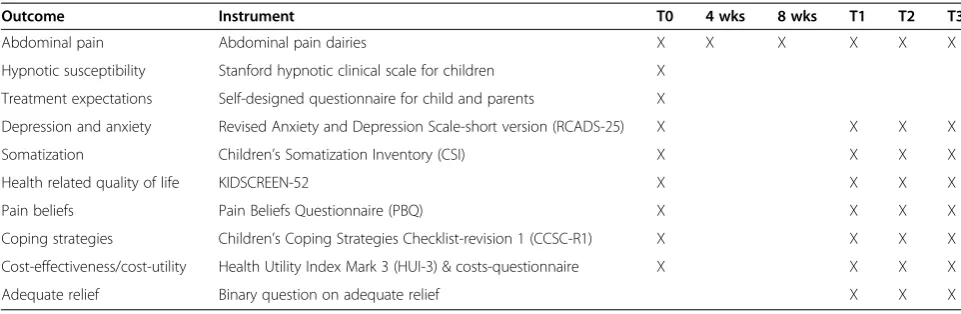
Outcomes are recorded by patients and/or parents at home. At inclusion, a questionnaire on demographics and clinical features is filled out by the treating physician. An overview of the assessments made in this RCT is shown in Table 1.
1. Abdominal pain
The main goal of treatment in IBS/FAP(S) patients is a reduction in levels of abdominal pain.
Abdominal pain is assessed with a diary, in which chil-dren record the frequency and intensity of abdominal pain episodes on seven consecutive days [14,24,27,31]. Pain frequencyis recorded in minutes of abdominal pain per day and is scored as 0 when there was no pain, 1 if children experience 1-30 minutes of pain, 2 for 31-120 minutes of pain and 3 if abdominal pain lasts more than 120 minutes. A pain frequency score (PFS) is subse-quently calculated by summing the scores of the seven days, giving a maximum PFS of 21 [24,27,31]. Pain in-tensity is scored using an affective facial scale with faces ranging from showing no pain at all (face A) to the most severe pain (face I). Scores on the facial scale are trans-ported to a daily 0-3 score. No abdominal pain is scored as 0, faces A-C are scored as 1, faces D-F score 2 and faces G-I score as 3. Again, scores of seven days are to-taled giving a pain intensity score (PIS), with a ma-ximum of 21 [24,27,31].
The primary outcomes in this RCT are the proportion of patients in which treatment is successful at the end of treatment and the proportion of successfully treated pa-tients after 1 year follow-up. Treatment success is de-fined as at least 50% reduction in both abdominal pain frequency and intensity scores.
2. Hypnotic susceptibility
Hypnotic susceptibility is defined as a generalized ten-dency to respond to hypnosis and hypnotic suggestions [32] and is assessed using a Dutch translation of the Stanford hypnotic clinical scale for children [33]. It is administered by the treating hypnotherapist in children assigned to the HT-group and by the research nurse in children assessed to the CD-group. The Stanford hyp-notic clinical scale for children consists of seven items. Scores are based on assessment of the child’s behavior and experiences which are verbally reported to the therapist/research nurse. Scores on this scale range from 0 to 7 and higher scores represent higher hypnotic susceptibility.
3. Treatment expectations
Expectations about the response to treatment are assessed for the child, mother and father separately. Child and parents are asked whether they expect the child to improve with treatment and this question is scored on a 11-point scale (0 = not at all; 10 = complete recovery). It is also assessed whether they have a (strong) preference for HT with a therapist or home-based with CD.
The short version of the Revised Anxiety and Depres-sion Scale (RCADS-25) is a valid and reliable instrument for the Dutch population to assess symptoms of depres-sion and anxiety [34]. It contains five subscales measuring symptoms of generalized anxiety disorders, separation anxiety disorder, social phobia, panic disorder and major depressive disorder. Each subscale consists of five items, which are scored on a 0 to 3 scale (0 = never; 3 = always). A total score on anxiety is calculated by summing scores on the four individual anxiety scales.
5. Somatization
Child somatization scores are assessed using the Dutch version of the Children’s Somatization Inventory (CSI), which has been shown to be a reliable and valid self-report instrument in children and adolescents [35]. It contains 35 items on the extent to which children expe-rienced somatic symptoms in the previous two weeks. Items are scored on a 5-point scale, ranging from 0 (=not at all) to 4 (=a whole lot). A total score is calculated by summing all 35 individual items and higher scores re-flect a higher intensity of somatic complaints experienced by the child. A separate CSI-score for non-gastrointestinal (GI) symptoms can be calculated by leaving out 7 items on GI-complaints: nausea, constipation, diarrhea, epigas-tric and abdominal pain, vomiting and bloating. To assess GI-complaints other than abdominal pain, items on all GI-symptoms but abdominal pain are summed.
6. Health related quality of life
The KIDSCREEN-52 questionnaire is a frequently used and reliable instrument to measure health related Qol in children and adolescents and has been validated in Dutch pediatric patient groups [36,37]. It contains items on ten dimensions of health related QoL: physical well-being, psychological well-being, moods and emotions, self-perception, autonomy, relations with parents and home
life, social support and peers, school environment, social acceptance (bullying) and financial resources. A 5-point Likert scale is used to score each item. Rasch scores for each individual dimension are computed from the individ-ual items and these are transformed into T-values. Higher T-values indicate a better health related QoL and well-being.
7. Pain beliefs
Negative and positive beliefs that children have about their abdominal pain are assessed using the Pain Beliefs Questionnaire (PBQ). A Dutch translation of the PBQ, which is reliable and validated in children and adoles-cents is used [38,39]. The PBQ consists of 32 items scored on a 5-point Likert scale. Negative beliefs can be divided into five subscales, namely condition frequency, condition duration, condition seriousness, episode spe-cific intensity and episode spespe-cific duration. The nega-tive beliefs scale is calculated by summing all 20 items on negative beliefs. The other 12 items assess problem focused coping potential (PFCP) and emotion focused coping potential (EFCP). The PFCP and EFCP scales are computed by averaging the 6 items belonging to both scales. Higher scores on a scale indicate that a child has such thoughts more frequently.
8. Coping strategies
The Dutch version of the Children’s Coping Strategies Checklist-revision 1 (CCSC-R1) is used to measure strat-egies for coping with everyday problems [40,41]. The CCSC-R1 includes 54 items, all starting with the same phrase‘if I have a problem…’and all items are scored on a 4-point Likert-scale (1 = never; 4 = always). This ques-tionnaire has sound psychometric properties and com-prises five dimensions: problem focused coping, positive cognitive reframing, distraction strategies, avoidance strategies and support seeking strategies. Scale scores on Table 1 Overview of outcomes
Outcome Instrument T0 4 wks 8 wks T1 T2 T3
Abdominal pain Abdominal pain dairies X X X X X X
Hypnotic susceptibility Stanford hypnotic clinical scale for children X
Treatment expectations Self-designed questionnaire for child and parents X
Depression and anxiety Revised Anxiety and Depression Scale-short version (RCADS-25) X X X X
Somatization Children’s Somatization Inventory (CSI) X X X X
Health related quality of life KIDSCREEN-52 X X X X
Pain beliefs Pain Beliefs Questionnaire (PBQ) X X X X
Coping strategies Children’s Coping Strategies Checklist-revision 1 (CCSC-R1) X X X X
Cost-effectiveness/cost-utility Health Utility Index Mark 3 (HUI-3) & costs-questionnaire X X X X
all five dimensions are calculated by averaging the indi-vidual items belonging to the five scales.
9. Cost-effectiveness/cost-utility
The Health Utility Index Mark 3 (HUI-3) is applied as a multi-attribute utility measure of health status and will be used in the cost-effectiveness and cost-utility analysis. It is suitable for assessing children, but because children may be too young to provide reliable and valid informa-tion about their own health status, proxy measurements are taken from parents [42-45]. The health utilities de-rived from the HUI-3 have been anchored with 1 indi-cating perfect health and 0 indiindi-cating death. Quality adjusted life years (QALY) will be calculated by taking the sum of the utility of health states over time by the time in between successive measurements.
In addition to the HUI-3, the Dutch Health and Labor Questionnaire (HLQ) has been adapted to the study set-ting to measure the direct and indirect costs of health care utilization, work absenteeism by parents, and school absenteeism by children.
10. Adequate relief
Adequate relief has been shown to be a well validated outcome measurement in trials on treatment for IBS [46]. Parents are asked whether their child has adequate relief of IBS-related abdominal pain or discomfort, using a dichotomous scale (yes/no).
Statistical analysis
Two hundred and sixty children diagnosed with IBS or FAP(S) will be included. The data will be analyzed fol-lowing the intention to treat principle. The primary ana-lyses will focus on the proportion of patients in both treatment arms in which treatment was successful (>50% reduction abdominal pain frequency and inten-sity) at T1 and the proportion of patients in which treat-ment was successful at T3. In addition, abdominal pain levels will be compared in its continuous form using all five moments of measurement during follow-up (after 4 and 8 weeks of treatment, at T1, T2 and T3). These data will be analyzed using linear mixed models to account for correlations of measurements within the same individ-ual. Similar longitudinal, repeated measurement analyses will be performed for the secondary outcomes including depression and anxiety, somatization, health related Qol, pain beliefs, coping strategies and adequate relief. Baseline values will be incorporated in these analyses to adjust for any imbalance at baseline despite randomization and to in-crease precision by removing between-person variability.
Two explanatory subgroup analyses are planned to evaluate whether there are indications that treatment
effects differ between clinical subgroups. Children diag-nosed with IBS will be compared to children with FAP(S). Additionally, children in pre-puberty age (13 years or younger) will be compared to older children, since our pre-vious RCT showed that younger children showed a better treatment response up till 6 months after treatment [24].
Economic evaluation will be performed from a societal perspective. Cost-effectiveness and cost-utility ratios will be calculated for the additional costs per extra patient with at least 50% reduction of abdominal pain scores and the additional costs per extra QALY.
Power
The primary analysis focuses on the proportion of patients with at least 50% reduction in abdominal pain levels com-pared to baseline at the end of therapy and after one year of follow up. Based on previous trials, we made a conserva-tive estimate of this percentage being around 75% in the group receiving HT performed by a therapist. In the group assigned to self-hypnosis with CD, we anticipated this percentage to be marginally lower at 65%. In order to be a reasonable alternative treatment, this percentage should not become lower than 50% in the CD group. This non-inferiority margin should be viewed in relation to success rated with standard medical care of around 30-40% in pre-vious trails [23,24,28]. Based on these expected propor-tions and a non-inferiority margin at 50%, a total of 115 patients per group are needed to achieve a power of 80% with a one-sided significance level of 5%. Since we expect less than 10% drop-out, our aim is to include 130 patients per group.
Discussion
therapist with regards to efficacy. By assessing secondary outcomes, such as depression, anxiety and somatization, it may become possible to predict response to HT, thereby allowing clinicians to select children that are likely to benefit from HT. A possible limitation of this study may be the fact that children and parents are not blinded for the received treatment, which is not possible due to the nature of HT. Recording of outcome measures by chil-dren and parents themselves at home, instead of recor-ding of outcomes by a health care professional during a visit to the hospital, however, reduces the risk of detec-tion bias. In addidetec-tion, the fact that symptoms of abdom-inal pain are recorded for seven consecutive days has the benefit that it corrects for individual variability of symptoms over time. Response expectancies are known to (partly) mediate effects of psychological treatments, such as HT [47]. We therefore record expectancies about HT from the child and both parents separately to assess the magnitude of expectation bias. Another pos-sible limitation of the design of this RCT may be the fact that we did not include a third treatment arm with chil-dren receiving standard medical care. This third treatment group however was waived, since reviewers considered it being not ethical to abstain children from treatment with HT, because previous studies have shown HT to be superior to standard medical care in this group of patients [23,24,28].
If this RCT will show that the effectiveness of home-based HT with CD is comparable to or only slightly lower than HT by a therapist, this treatment may become an attractive first line of treatment in children with IBS or FAP(S). Since it presumably is less costly and less time-consuming, it will benefit children, parents and society. In addition, the large number of children with IBS and FAP(S) combined with a shortage of qualified thera-pists, causes long waiting lists nowadays. Home-based HT can be started as soon as the diagnosis of IBS or FAP(S) has been made, without dealing with these long waiting lists. A potential scenario after this RCT might be that a significant proportion of children with IBS or FAP(S) can get this home-based treatment, prescribed by their general practitioner. This may subsequently lead to fewer referrals to pediatricians and/or pediatric gastroenterologists, which would lead to an additional decrease in health care costs. If this RCT indeed shows these results, the next step will be implementation of home-based HT into clinical care for children with IBS or FAP(S).
Abbreviations
CD:Compact disc; FAP: Functional abdominal pain; FAPS: Functional abdominal pain syndrome; GI: Gastrointestinal; HT: Hypnotherapy; IBS: Irritable bowel syndrome; PFS: Pain frequency score; PIS: Pain intensity score; QALY: Quality adjusted life years; QoL: Quality of life; RCT: Randomized controlled trial.
Competing interests
The authors declare that they have no competing interests.
Authors’contributions
JR is primary investigator and responsible for data collection, analysis and drafting the manuscript. Participated in the design of the study and contributed to developing of the research protocols. AV supervises the study and participated in the design of the study and contributed to developing of the research protocols. Supervised drafting of the manuscript and critically reviewed it. CF participated in the design of the study, contributed to developing of the research protocols en critically reviewed the manuscript. EG participated in the design of the study, contributed to developing of the research protocols en critically reviewed the manuscript. MG participated in the design of the study, contributed to developing of the research protocols en critically reviewed the manuscript. ON participated in the design of the study, contributed to developing of the research protocols en critically reviewed the manuscript. WT participated in the design of the study, contributed to developing of the research protocols en critically reviewed the manuscript. HW participated in the design of the study, contributed to developing of the research protocols en critically reviewed the manuscript. MD participated in the design of the study, contributed to developing of the research protocols en critically reviewed the manuscript. MM participated in the design of the study, contributed to developing of the research protocols en critically reviewed the manuscript. MB supervises the study, participated in the design of the study and contributed to developing of the research protocols. Supervised drafting of the manuscript and critically reviewed it. All authors read and approved the final manuscript as submitted.
Acknowledgements
Our study is granted by the Netherlands Organization for Health Research and Development, ZonMW (ZonMW project number 171102013).
Author details
1
Department of Pediatric Gastroenterology, Emma Children’s Hospital/Academic Medical Center, PO Box 22700, 1100 DD Amsterdam, The Netherlands.
2
Department of Pediatrics, St. Antonius Hospital, Nieuwegein, The Netherlands.
3Department of Pediatrics, Medical Center Alkmaar, Alkmaar, The Netherlands. 4
Department of Pediatrics, Maasstad Hospital, Rotterdam, The Netherlands.
5Department of Pediatrics, Isala Clinics, Zwolle, The Netherlands.6Department of
Pediatrics, Maxima Medical Center, Veldhoven, The Netherlands.7Department of Pediatrics, Amphia Hospital, Breda, The Netherlands.8Clinical Research Unit,
Academic Medical Center, Amsterdam, The Netherlands.
Received: 30 April 2014 Accepted: 30 May 2014 Published: 4 June 2014
References
1. Rasquin A, Di Lorenzo C, Forbes D, Guiraldes E, Hyams JS, Staiano A, Walker LS:Childhood functional gastrointestinal disorders: child/adolescent. Gastroenterology2006,130:1527–1537.
2. Chitkara DK, Rawat DJ, Talley NJ:The epidemiology of childhood recurrent abdominal pain in Western countries: a systematic review.Am J Gastroenterol2005,100:1868–1875.
3. Devanarayana NM, Mettananda S, Liyanarachchi C, Nanayakkara N, Mendis N, Perera N, Rajindrajith S:Abdominal pain-predominant functional gastrointestinal diseases in children and adolescents: prevalence, symptomatology, and association with emotional stress.J Pediatr Gastroenterol Nutr2011,53:659–665.
4. Zhou H, Yao M, Cheng G-Y, Chen Y-P, Li D-G:Prevalence and associated factors of functional gastrointestinal disorders and bowel habits in Chinese adolescents: a school-based study.J Pediatr Gastroenterol Nutr 2011,53:168–173.
5. Youssef NN, Murphy TG, Langseder AL, Rosh JR:Quality of life for children with functional abdominal pain: a comparison study of patients’and parents’perceptions.Pediatrics2006,117:54–59.
6. Youssef NN, Atienza K, Langseder AL, Strauss RS:Chronic abdominal pain and depressive symptoms: analysis of the national longitudinal study of adolescent health.Clin Gastroenterol Hepatol2008,6:329–332.
8. Dhroove G, Chogle A, Saps M:A million-dollar work-up for abdominal pain: is it worth it?J Pediatr Gastroenterol Nutr2010,51:579–583. 9. American College of Gastroenterology Task Force on Irritable Bowel Syndrome,
Brandt LJ, Chey WD, Foxx-Orenstein AE, Schiller LR, Schoenfeld PS, Spiegel BM, Talley NJ, Quigley EM:An evidence-based position statement on the management of irritable bowel syndrome.Am J Gastroenterol2009, 104(Suppl 1):S1–S35.
10. Drossman DA:The functional gastrointestinal disorders and the Rome III process.Gastroenterology2006,130:1377–1390.
11. Di Lorenzo C, Colletti RB, Lehmann HP, Boyle JT, Gerson WT, Hyams JS, Squires RH jr, Walker LS, Kanda PT:Chronic abdominal pain in children: a technical report of the American academy of pediatrics and the North American society for pediatric gastroenterology, hepatology and nutrition AAP subcommittee and NASPGHAN committee on chronic abdominal pain.J Pediatr Gastroenterol Nutr2005,40:249–261. 12. Weydert JA, Ball TM, Davis MF:Systematic review of treatments for
recurrent abdominal pain.Pediatrics2003,111:e1–e11.
13. Campo JV, Di Lorenzo C, Chiappetta L, Bridge J, Colborn DK, Gartner JC Jr, Gaffney P, Kocoshis S, Brent D:Adult outcomes of pediatric recurrent abdominal pain: do they just grow out of it?Pediatrics2001,108:E1. 14. Whorwell PJ, Prior A, Faragher EB:Controlled trial of hypnotherapy in the
treatment of severe refractory irritable-bowel syndrome.Lancet1984, 1:1232–1234.
15. Palsson OS, Turner MJ, Johnson DA, Burnett CK, Whitehead WE:Hypnosis treatment for severe irritable bowel syndrome: investigation of mechanism and effects on symptoms.Dig Dis Sci2002,47:2605–2614. 16. Galovski TA, Blanchard EB:The treatment of irritable bowel syndrome with hypnotherapy.Appl Psychophysiol Biofeedback1998,23:219–232. 17. Forbes A, MacAuley S, Chiotakakou-Faliakou E:Hypnotherapy and
therapeutic audiotape: effective in previously unsuccessfully treated irritable bowel syndrome?Int J Colorectal Dis2000,15:328–334. 18. Lindfors P, Unge P, Arvidsson P, Nyhlin H, Björnsson E, Abrahamsson H,
Simrén M:Effects of gut-directed hypnotherapy on IBS in different clinical settings-results from two randomized, controlled trials.Am J Gastroenterol2012,107:276–285.
19. Roberts L, Wilson S, Singh S, Roalfe A, Greenfield S:Gut-directed hypnotherapy for irritable bowel syndrome: piloting a primary care-based randomised controlled trial.Br J Gen Pract2006,56:115–121. 20. Gonsalkorale WM, Miller V, Afzal A, Whorwell PJ:Long term benefits of
hypnotherapy for irritable bowel syndrome.Gut2003,52:1623–1629. 21. Lindfors P, Unge P, Nyhlin H, Ljótsson B, Björnsson ES, Abrahamsson H,
Simrén M:Long-term effects of hypnotherapy in patients with refractory irritable bowel syndrome.Scand J Gastroenterol2012,47:413–420. 22. Moser G, Trägner S, Gajowniczek EE, Mikulits A, Michalski M, Kazemi-Shirazi
L, Kulnigg-Dabsch S, Führer M, Ponocny-Seliger E, Dejaco C, Miehsler W: Long-term success of GUT-directed group hypnosis for patients with refractory irritable bowel syndrome: a randomized controlled trial.Am J Gastroenterol2013,108:602–609.
23. Weydert JA, Shapiro DE, Acra SA, Monheim CJ, Chambers AS, Ball TM: Evaluation of guided imagery as treatment for recurrent abdominal pain in children: a randomized controlled trial.BMC Pediatr2006,6:29. 24. Vlieger AM, Menko-Frankenhuis C, Wolfkamp SCS, Tromp E, Benninga MA:
Hypnotherapy for children with functional abdominal pain or irritable bowel syndrome: a randomized controlled trial.Gastroenterology2007, 133:1430–1436.
25. Gulewitsch MD, Müller J, Hautzinger M, Schlarb AA:Brief
hypnotherapeutic-behavioral intervention for functional abdominal pain and irritable bowel syndrome in childhood: a randomized controlled trial.Eur J Pediatr2013,172:1043–1051.
26. Green JP, Barabasz AF, Barrett D, Montgomery GH:Forging Ahead: the 2003 APA Division 30 definition of hypnosis.Int J Clin Exp Hypn2005, 53:259–264.
27. Vlieger AM, Rutten JMTM, Govers AMAP, Frankenhuis C, Benninga MA: Long-term follow-up of gut-directed hypnotherapy vs. standard care in children with functional abdominal pain or irritable bowel syndrome. Am J Gastroenterol2012,107:627–631.
28. Van Tilburg MAL, Chitkara DK, Palsson OS, Turner M, Blois-Martin N, Ulshen M, Whitehead WE:Audio-recorded guided imagery treatment reduces functional abdominal pain in children: a pilot study.Pediatrics 2009,124:e890–e897.
29. Zanten Van Veldhuyzen SJ, Talley NJ, Bytzer P, Klein KB, Whorwell PJ, Zinsmeister AR:Design of treatment trials for functional gastrointestinal disorders.Gut1999,45(Suppl 2):ii69–ii77.
30. Gonsalkorale WM:Gut-directed hypnotherapy: the Manchester approach for treatment of irritable bowel syndrome.Int J Clin Exp Hypn2006, 54:27–50.
31. See MC, Birnbaum AH, Schechter CB, Goldenberg MM, Benkov KJ: Double-blind, placebo-controlled trial of famotidine in children with abdominal pain and dyspepsia: global and quantitative assessment. Dig Dis Sci2001,46:985–992.
32. Gur RC:Measuring hypnotic susceptibility: a guest editorial.Am J Clin Hypn1978-1979,21:64–67.
33. Morgan AH, Hilgard JR:The Stanford hypnotic clinical scale for children. Am J Clin Hypn1978-1979,21:148–169.
34. Muris P, Meesters C, Schouten E:A brief questionnaire of DSM-IV-defined anxiety and depression symptoms among children.Clin Psychol Psychoth 2002,9:430–442.
35. Meesters C, Muris P, Ghys A, Reumerman T, Rooijmans M:The Children’s Somatization Inventory: further evidence for its reliability and validity in a pediatric and a community sample of Dutch children and adolescents. J Pediatr Psychol2003,28:413–422.
36. Ravens-Sieberer U, Gosch A, Rajmil L, Erhart M, Bruil J, Power M, Duer W, Auquier P, Cloetta B, Czemy L, Mazur J, Czimbalmos A, Tountas Y, Hagquist C, Kilroe J, the KIDSCREEN Group:The KIDSCREEN-52 quality of life measure for children and adolescents: psychometric results from a cross-cultural survey in 13 European countries.Value Health2008,11:645–658.
37. The KIDSCREEN group:The KIDSCREEN Questionnaires-Quality of Life Ques-toinnaires for Children and Adolescents Handbook.Lengerich: Pabst Science Publishers; 2006.
38. Van der Veek SMC, De Haan E, Derkx HHF, Benninga MA, Lindauer RJL, Boer F:The Relative Contribution of Parental and children’s Cognitive and Behavioral Reactions to Pediatric Functional Abdominal Pain. InPhD Thesis: A Psychosocial Perspective on Pediatric Functional Abdominal Pain: Risk Factors and Treatment.Academic Medical Center, University of Amsterdam; 2012:80–94.
39. Walker L, Smith C, Garber J, Claar R:Testing a model of pain appraisal and coping in children with recurrent abdominal pain.Health Psychol2005, 24:364–374.
40. Ayers TA, Sandler IN:Manual for the Children’s Coping Strategies Checklist & How I Coped Under Pressure Scale.[http://prc.asu.edu/docs/ CCSC-HICUPS%20%20Manual2.pdf retrieved June 2010]
41. De Boo GM, Wicherts J:Assessing cognitive and behavioral coping strategies in children.Cognit Ther Res2007,33:1–20.
42. Feeny D, Furlong W, Torrance GW, Goldsmith CH, Zhu Z, DePauw S, Denton M, Boyle M:Multiattribute and single-attribute utility functions for the health utilities index mark 3 system.Med Care2002,40:113–128. 43. Hille ET, Weisglas-Kuperus N, Van Goudoever JB, Jacobusse GW, Ens-Dokkum
MB, De Groot L, Wit JM, Geven WB, Kok JH, De Kleine MJ, Kollée LA, Mulder AL, Van Straaten HL, De Vries LS, Van Weissenbruch MM, Verloove-Vanhorick SP, Dutch Collaborative POPS 19 study group:Functional outcomes and participation in young adulthood for very preterm and very low birth weight infants: the Dutch Project on Preterm and Small for Gestational Age Infants at 19 years of age.Pediatrics2007,120:e587–e595.
44. Eiser C, Morse R:The measurement of quality of life in children: past and future perspectives.J Dev Behav Pediatr2001,22:248–256.
45. Tarride J-E, Burke N, Bischof M, Hopkins RB, Goeree L, Campbell K, Xie F, O’Reilly D, Goeree R:A review of health utilities across conditions common in paediatric and adult populations.Health Qual Life Outcomes 2010,8:12.
46. Mangel AW, Hahn BA, Heath AT, Northcutt AR, Kong S, Dukes GE, McSorley D:Adequate relief as an endpoint in clinical trials in irritable bowel syndrome.J Int Med Res1998,26:76–81.
47. Milling LS, Reardon JM, Carosella GM:Mediation and moderation of psychological pain treatments: response expectancies and hypnotic suggestibility.J Consult Clin Psychol2006,74:253–262.
doi:10.1186/1471-2431-14-140
Cite this article as:Ruttenet al.:Gut-directed hypnotherapy in children
with irritable bowel syndrome or functional abdominal pain (syndrome): a randomized controlled trial on self exercises at home using CD versus