ANTECEDENTS OF FLOW AND THE FLOW-PERFORMANCE
RELATIONSHIP IN CRICKET
Stefan Koehn
1, Benjamin Donald
1, and Galina Paramei
21
Department of Health Sciences, Liverpool Hope University, Liverpool, United Kingdom
2Department of Psychology, Liverpool Hope University, Liverpool, United Kingdom
Original scientific paper https://doi.org/10.26582/k.50.2.6 UDC: 796.358:159.9
Abstract:
The present study aspires to elaborate on the conceptual framework of flow by further elucidating integration and conceptualization of a relationship between flow and objective and subjective measures of performance. The aims of the study were twofold: (1) to examine the relationship between flow and its key correlates: anxiety, motivation, and perceived ability; (2) to assess whether the relationship between these measures and performance is direct or mediated. Participant sample included a group of cricketers with varying performance level (n = 40) and a group of 20 non-cricket team athletes; all were between 18 and 35 years of age. Their performance was assessed objectively by batting average, along with administering the Dispositional Flow Scale (DFS), Sport Anxiety Scale (SAS), Sport Motivation Scale (SMS), and Perceived Sport Ability (PSA) questionnaires. Results show that the three flow correlates accounted for 77% of dispositional flow variance; individual correlates varied, however, in their predicting power, anxiety: 0%; motivation: 1%; perceived ability: 57%. In addition, total flow and flow correlates accounted for a total of 54% of variance in performance, whereas unique variance of 8% was accounted for by anxiety and perceived ability, each. Notably, flow and two correlates, anxiety and perceived ability, were found to have a direct impact on performance; in contrast, a weak partial mediation of flow was found between motivation and performance. Based on the findings on the flow-performance relationship, expansion of the flow theory is suggested; benefits for advancing intervention research in sport psychology are discussed.
Key words: optimal experience, anxiety, motivation, perceived ability, mediation
Introduction
The flow model by Kimiecik and Stein (1992) proposed a number of key personality vari-ables underlying the experience of flow in sports. Contentions of conceptual links indicated positive relationships between flow and intrinsic motiva -tion, perceived ability, and negative relationships with anxiety (Kimiecik & Stein, 1992). Although a number of studies found support for a number of dispositional variables being correlates of flow (e.g., Jackson, Kimiecik, Ford, & Marsh, 1998; Jackson, Thomas, Marsh, & Smethurst, 2001; Koehn, Morris, & Watt, 2013), one shortcoming of the model is the omission of performance and clear conceptual inte-gration of performance into the flow framework. The purpose of the study was to examine main tenets of flow theory and to assess the flow-perfor -mance relationship in a mediation model.
Flow has been conceptualised (Jackson, 1996) and operationalised (Marsh & Jackson, 1999) as a nine dimensional construct, consisting of
high skill perceptions, and dispositional flow. All associations showed significant small-to-moderate correlations (Jackson, et al., 1998).
The flow model does not explicitly concep -tualise the relationship between flow and perfor -mance, but Kimiecik and Stein (1992) advocated that frequent flow experiences should enhance athletes’ performance. Jackson et al. (2001) found significant relations between flow state and subjec -tive and objec-tive performance (errors, finishing position) measures. Extending this line of research, Koehn and Morris (2012) examined this associa -tion in a sample of 188 junior tennis players. The results generally supported the positive associa-tion between flow and performance percepassocia-tions. Comparing winners and losers on flow, binary logistic regressions showed that some flow char -acteristics were stronger for successful athletes. From an applied point of view, previous interven-tion studies aimed to enhance both athletes’ flow experiences and performance by using an imagery-based procedure (e.g., Koehn, Morris, & Watt, 2014; Pates, Karageorghis, Fryer, & Maynard, 2003). These case studies found a general increase in flow and performance after the intervention, and athletes also reported a stronger sense of confidence in the validation interview. Research provided evidence for positive relationships between flow and perfor -mance (e.g, Jackson, et al., 2001; Koehn & Morris, 2012), and between flow correlates of anxiety and confidence and performance (for a review and meta-analysis see Craft, Magyar, Becker, & Feltz, 2003). Baron and Kenny (1986) advocated that a media -tion model needs to be tested if the precondi-tion of substantial relationships between predictor and criterion variables is met. On the basis of empirical and statistical considerations we hypothesised that flow is a potential mediator between flow correlates and performance.
Empirical results supported conceptual consid-erations that motivation, perceived ability, and anxiety underlie athletes’ flow experience (Jackson, et al., 1998; Koehn, et al., 2013). Particularly Jackson and colleagues (1998) closely followed suggestions of general (Csikszentmihalyi, 1975) and sport-specific (Kimiecik & Stein, 1992) flow conten -tions. In this study we are aiming to re-examine the findings by Jackson et al. (1998), before extending research on the flow-performance relationship.
Previous research frequently used cross-sectional designs in order to test direct, linear asso-ciations between flow and a number of flow ante -cedents (Jackson, et al., 1998, 2001; Koehn, et al., 2013) and between flow and performance (Jackson, et al., 2001; Koehn & Morris, 2012). Despite these efforts, however, there is little evidence on the flow-performance relationship in team sports and whether indirect effects may be present when testing flow and performance. Therefore, mediation
analysis would provide additional information on direct or indirect effects on the flow-performance relationship in sports.The aims of the study were twofold: (1) to examine the relationship between flow and its key correlates: anxiety, motivation, and perceived ability; (2) to assess whether the relation-ship between these measures and performance is direct or mediated.
Methods
Participants
The sample consisted of 60 male athletes, 18-35 years of age (M = 24.43; SD = 3.63). Partici-pants competed in team sports, including cricket and football. All participants had been involved in their sports for at least two years and had extensive training and competition experience (M = 7.86; SD = 4.38). For this first aim (i.e., to examine the relation -ship between flow and its key correlates, anxiety, motivation, and perceived ability), all participants were included in the analyses. Football (n = 20) and cricket (n = 40) players had achieved a moderate to high skill level, but only the cricket players’ perfor-mance could be examined objectively (i.e., to assess whether the relationship between these measures and performance is direct or mediated). Cricket players had a batting average of 23.04 (SD = 9.52) with a minimum of 10.60 and a maximum of 37.30.
Measures
Dispositional Flow Scale (DFS; Marsh &
Jackson, 1999).The DFS assesses the frequency
of flow and consists of 36 items representing nine subscales, each comprising four items. Thus, the nine subscales represent the nine dimensions of flow: challenge-skills balance (CSB), action-awareness merging (AAM), clear goals (CG), unambiguous feedback (UF), concentration on the task at hand (CTH), sense of control (SC), loss of self-conscious-ness (LSC), time transformation (TT), and autotelic experience (AE). The response format is a 5-point Likert scale anchored by 1 (never) and 5 (always). The subscales showed acceptable Cronbach’s alpha values, ranging between .70 and .88 (Jackson, et al., 1998). Previous research has frequently used the DFS (e.g., Jackson, et al., 1998, 2001).
Sport Anxiety Scale (SAS; Smith, Smoll, &
Schutz, 1990). The SAS is a trait measure, which
was employed to assess athletes’ anxiety levels during previous performances. The SAS consists of three subscales, labelled concentration disrup-tion, worry, and somatic anxiety with five items per subscale. Responses are given on a 4-point Likert scale, ranging from 1 (not at all) to 4 (very much so).
Sport Motivation Scale (SMS; Pelletier, et
al. 1995). The SMS consists of a unidimensional
subscales are subdivided into measures of intrinsic motivation to know, intrinsic motivation to accom-plish, and intrinsic motivation to experience stimu-lation, and extrinsic motivation is assessed through subscales labelled identified, introjected, and external regulation. Each item is addressed based on the stem Why do you practice your sport? Each subscale includes four items; responses are provided using a 7-point Likert scale, anchored by 1 (does not correspond at all) and 7 (corresponds exactly).
Perceived Sport Ability (PSA; Lee, 1999). The
PSA is a 5-item unidimensional measure assessing athletes’ perception of their skills. Response format is a 7-point Likert scale, anchored by 1 (strongly disagree) and 7 (strongly agree). Overall score ranges between 5, indicating athletes’ perception of their low performing ability, and 35 indicating that they consider they can perform very well. The final item “I can’t play the sport very well” is revers-scored.
Performance. Performance was assessed for
a subsample of cricket players (n = 40). Athletes’ batting average was employed as an objective measure of performance. This information has been retrieved from public records on the cricket county championships. The batting average per match was 23.04.
Procedure
Following approval from the local University’s Ethics Committee, athletes from the North-West England were approached to participate in this study. Participants were selected based on a minimum of two-year involvement in team sports. Information statements and consent forms were handed out to coaches who passed on the information statements and consent form to their players. All participants who volunteered and provided informed consent, completed the various questionnaires at their home venue and returned the completed scales to the second author. All participants received oral and written information regarding the measures. These included instructions on their general experience in their sports and participants should reflect on the same time period when completing the various scales.
Statistical procedures
This study used a cross-sectional design. A rela-tionship between dispositional flow, its correlates: anxiety, motivation, perceived ability, and perfor-mance was explored employing Pearson product moment correlational coefficients, regression anal -yses and mediational anal-yses. The power analysis, based on the calculations by Cohen (1988), indicated that with a sample size of 60 participants there is a 78% chance to find significant correlations on a moderate level.
Examining mediation effects, Baron and Kenny (1986) have suggested that the assessment of three paths is crucial in detecting potential mediators, that is, (i) if changes in the independent variable account for changes in the mediator (Path a); (ii) whether changes in the mediator account for changes in the dependent variable (Path b); and (iii) if the associ-ation between the independent and the dependent variables changes from a significant (Path c1) to a
non-significant (Path c2) relationship when the
inde-pendent variable is controlled for by the mediator. Baron and Kenny (1986) proposed a full meditation model, i.e., when Path c2 shows almost zero
corre-lation, then the notion of a sole dominant mediator is tenable, whereas a partial mediation model, i.e., when Path c2 is still significant but weaker than Path
c1, indicates that more than one mediator affects the
relationship between independent and dependent variables.
Statistically, we employed the approach described and used by Short, Tenute, and Feltz (2005) in order to test a three-path mediation model. Short et al. (2005) proposed four steps to assess mediation effects, including regression analysis between the independent and mediation variables (step 1), between independent and dependent vari-ables (step 2), and “finally, hierarchically regressing the dependent variable on the mediator and then on the independent variable” (p. 956) (steps 3, 4).
Results
Reliability
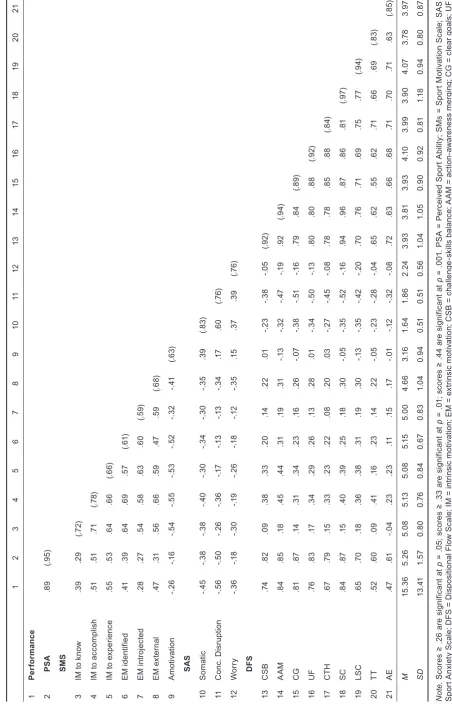
Cronbach’s alpha coefficients were acceptable for the DFS (.98), SAS (.85), SMS (.84), and PSA (.95). At a subscale level, Cronbach’s alpha indi-cated high values for DFS dimensions, anxiety sub-scales, and two (out of seven) motivation subscales (Table 1).
A relationship between flow, correlates of flow, and performance
Ta bl e 1 . C or re la tio n m at ri x, m ea ns , s ta nd ar d d ev ia tio ns , a nd C ro nb ac h’
s α (
in b ra ck et s) f or i nd iv id ua l s ub sc al es 1 2 3 4 5 6 7 8 9 10 11 12 13 14 15 16 17 18 19 20 21 1 Pe rf or m an ce 2 PS A .8 9 (.9 5) SM S 3 IM t o k no w .3 9 .29 (.7 2) 4 IM t o a cc om pl is h .51 .51 .71 (.7 8) 5 IM t o e xp er ie nc e .5 5 .5 3 .6 4 .6 6 (.6 6) 6 EM ide nt ifi ed .41 .3 9 .6 4 .6 9 .57 (.6 1) 7 EM in tro je ct ed .28 .27 .5 4 .5 8 .6 3 .6 0 (.5 9) 8 EM ex te rn al .47 .31 .5 6 .6 6 .59 .47 .59 (.6 8) 9 A m oti va tio n -.2 6 -.1 6 -.5 4 -.5 5 -.5 3 -.5 2 -.3 2 -.41 (.6 3) SAS 10 So m ati c -.4 5 -.3 8 -.3 8 -.4 0 -.3 0 -.3 4 -.3 0 -.3 5 .3 9 (.8 3) 11 C on c. D is ru pt ion -.5 6 -.5 0 -.2 6 -.3 6 -.1 7 -.1 3 -.1 3 -.3 4 .1 7 .6 0 (.7 6) 12 Wo rr y -.3 6 -.1 8 -.3 0 -.1 9 -.2 6 -.1 8 -.1 2 -.3 5 .1 5 .37 .3 9 (.7 6) D FS 13 C SB .74 .82 .0 9 .3 8 .3 3 .20 .1 4 .22 .01 -.2 3 -.3 8 -.0 5 (.92 ) 14 A AM .8 4 .8 5 .1 8 .4 5 .4 4 .31 .1 9 .31 -.1 3 -.3 2 -.47 -.1 9 .92 (.9 4) 15 CG .81 .87 .1 4 .31 .3 4 .23 .1 6 .26 -.07 -.3 8 -.51 -.1 6 .7 9 .8 4 (.8 9) 16 UF .7 6 .8 3 .1 7 .3 4 .29 .26 .1 3 .28 .01 -.3 4 -.5 0 -.1 3 .8 0 .8 0 .8 8 (.92 ) 17 CT H .67 .7 9 .1 5 .3 3 .23 .22 .0 8 .20 .0 3 -.2 7 -.4 5 -.0 8 .7 8 .7 8 .8 5 .8 8 (.8 4) 18 SC .8 4 .87 .1 5 .4 0 .3 9 .25 .1 8 .3 0 -.0 5 -.3 5 -.5 2 -.1 6 .9 4 .9 6 .87 .8 6 .81 (.9 7) 19 LS C .6 5 .7 0 .1 8 .3 6 .3 8 .31 .1 9 .3 0 -.1 3 -.3 5 -.42 -.2 0 .7 0 .7 6 .71 .6 9 .7 5 .7 7 (.9 4) 20 TT .52 .6 0 .0 9 .41 .1 6 .23 .1 4 .22 -.0 5 -.2 3 -.2 8 -.0 4 .6 5 .6 2 .5 5 .6 2 .71 .6 6 .6 9 (.8 3) 21 A E .47 .61 -.0 4 .23 .23 .11 .1 5 .1 7 -.01 -.1 2 -.3 2 -.0 8 .7 2 .6 3 .6 6 .6 8 .71 .7 0 .71 .6 3 (.8 5) M 15 .3 6 5. 26 5. 08 5.1 3 5. 08 5.1 5 5. 00 4. 66 3.1 6 1. 64 1. 86 2. 24 3. 93 3. 81 3. 93 4.1 0 3. 99 3. 90 4. 07 3.7 8 3. 97 SD 13 .41 1. 57 0. 80 0.7 6 0. 84 0. 67 0. 83 1. 04 0. 94 0. 51 0. 51 0. 56 1. 04 1. 05 0. 90 0.92 0. 81 1.1 8 0. 94 0. 80 0. 87 N ote . S co re s ≥ .2 6 ar e si gn ifi ca nt at p = .0 5; s co re s ≥ .3 3 a re s ig ni fic an t a t p = .0 1; s co re s ≥ .4 4 a re s ig ni fic an t a t p = . 00 1. P S
A = P
er ce iv ed S po rt A bi lit y; S M
s = S
po rt M ot iv at io n S ca le ; S AS = Sp or t A nx ie ty S ca le ; D FS = D is po si tio na l F lo w S ca le ; I M = in tri ns ic m ot iv at io n; E M = e xt rin si c m ot iv at io n; C S B = c ha lle ng e-sk ill s b al an ce ; A A M = a ct io n-aw ar en es s m er gi ng ; C G = c le ar g oa ls ; U F = un am bi gu ou s f ee db ac k; C
TH = c
on ce nt ra tio n o n t he t as k a t h an d; S
C = s
en se o f c on tro l; L
SC = l
os s o f s el f-c on sc io us ne ss ; T
T = t
im e t ra ns fo rm at io n; A
E = a
Unique variance explained in flow
We employed a hierarchical regres -sion analysis, following the methodology proposed by Short et al. (2005), in order to examine the unique amount of variance explained by the various predictors of flow (aim 1) and performance (aim 2). Testing unique variance among predictors of anxiety, motivation, and perceived ability, we first entered anxiety into the regression equa-tion, which allowed an overall assessment of explained variance without the interfer-ence of the other predictor variables. In the following analysis the same predictor was entered last into the regression equation, providing information on how much unique variance could be explained after all other constructs had been controlled for. This methodology was applied to each corre-late. The results showed that all predictors explained a substantial amount of variance in flow when entered into the regression first: 16% (anxiety), 13% (motivation), and 77% (perceived ability). After controlling for the other correlates, the amount of unique vari-ance accounted for in flow was substantially lower for anxiety (0%), motivation (1%), but relatively high for perceived ability (57%). For the second aim of this study, a total of 40 cricket players provided information on
Figure 1. Mediation model between motivation, flow, and performance. Ta bl e 2 . R eg re ss io n a na ly si s a ss es si ng f lo w a
s a m
ed ia to r b et w ee n i ts k ey c or re la te s a nd p er fo rm an ce A na ly si s C rit eri on Pr ed ic tor R R 2 R
2 a
dj . B SE β t SAS Eq ua tio n 1 Fl ow A nx ie ty .49 .24 .22 -0. 40 .1 2 -.4 9 -3 .4 5* * Eq ua tio n 2 Pe rfo rm anc e A nx ie ty .74 .5 4 .5 3 -1 6. 39 2. 43 -.74 -6 .7 4*** Eq ua tio n 3 Pe rfo rm anc e St ep 1 Fl ow .41 .1 7 .1 5 11 .0 8 4. 00 .41 2.7 7* * Pe rfo rm anc e St ep 2 Fl ow .74 .5 5 .52 1. 78 3. 42 .07 0. 52 A nx ie ty -1 5. 68 2. 82 -.71 -5 .5 7*** SM S Eq ua tio n 1 Fl ow M oti va tio n .20 .0 4 .01 0.1 4 0.1 1 .20 1. 24 Eq ua tio n 2 Pe rfo rm anc e M oti va tio n .57 .3 3 .31 11. 12 2. 59 .57 4. 30 *** Eq ua tio n 3 Pe rfo rm anc e St ep 1 Fl ow .41 .1 7 .1 5 11 .0 8 4. 00 .41 2.7 7* * Pe rfo rm anc e St ep 2 Fl ow .6 5 .42 .3 9 8. 35 3. 45 .31 2. 42 * M oti va tio n 9. 93 2. 48 .51 4. 00 *** PS A Eq ua tio n 1 Fl ow Pe rc ei ve d A bil ity .4 6 .21 .1 9 .20 .0 6 .4 6 3. 18* * Eq ua tio n 2 Pe rfo rm anc e Pe rc ei ve d A bil ity .7 3 .5 4 .52 8. 74 1. 32 .7 3 6. 63 *** Eq ua tio n 3 Pe rfo rm anc e St ep 1 Fl ow .41 .1 7 .1 5 11 .0 8 4. 00 .41 2.7 7* * Pe rfo rm anc e St ep 2 Fl ow .74 .5 4 .52 2. 56 3. 38 .1 0 0.7 6 Pe rc ei ve d A bil ity 8. 22 1. 49 .6 9 5. 51 *** N ote . * p < . 05 ; * * p < . 01 ; * ** p < .0 01.
their batting average. Applying the same methodology for performance as the crite-rion variable, the results varied consider-ably when predictor variables were entered first (17% flow; 54% anxiety; 33% motiva -tion; 54% perceived ability) or last (0% flow; 8% anxiety; 5% motivation; 8% perceived ability).
Flow as a mediator of performance
as a mediating variable for anxiety and perceived ability, although a weak partial mediation effect was found between motivation and performance.
Discussion and conclusions
The main aims of this study were to examine anxiety, motivation, and perceived ability as corre-lates of flow (aim 1), and flow as a potential medi -ator between flow correlates and performance (aim 2). This study closely followed theoretical conten-tions by Kimiecik and Stein’s (1992) flow model and methodologies previously used by Jackson and colleagues (1998). The findings provided support for the relationship between flow and its correlates. Particularly strong correlations between flow and perceived ability and between performance and anxiety and perceived ability can raise concerns about multicollinearity and potential suppressor effects (Hair, Black, Babin, & Anderson, 2010). In order to detect potential issues, we conducted multi-collinearity analyses with flow as the criterion vari -able (aim 1 of the study) and batting average as the criterion variable (aim 2 of the study), and a hier-archical regression analysis to examine the unique variance explained by each variable.
Further testing of the main psychological vari-ables were based on three specific criteria. First, independent variables need to show moderate-to-strong associations with dependent variables. Pedhazur (1982) suggested that a minimum corre-lation of .30 should exist for meaningful interpre-tations of relationships. Second, variable reliability need to be at satisfactory levels. Third, multicollin-earity analyses need to indicate acceptable values of collinearity statistics. Hair et al. (2010) proposed cutoff values for tolerance at .10 and a cutoff score of 10 for the variance inflation factor (VIF). The tolerance score reflects a minimum value; an increase in tolerance value indicates a smaller degree of collinearity, whereas the VIF represents a maximum score (Hair, et al., 2010). Reliability and correlation results suggested that assessments at a global rather than a subscale level would be preferable. With flow as the criterion variable, the tolerance value for the correlates ranged from .70 to .77 and the VIF score from 1.31 to 1.43. With batting performance as the criterion variable, the DFS, SAS, SMS, and PSA showed tolerance scores between .54 and .72, and VIF scores between 1.29 and 1.93. On the basis of the sum of these findings, global measures of flow, anxiety, motivation, and perceived ability were retained for further analysis.
Flow correlates shared a large amount of common variance, but only revealed a small amount of unique variance in the prediction of flow. This finding generally confirms results by Jackson et al. (2001), although perceived ability still accounted for 57% of the unique variance, which makes it a
key variable underlying flow. Jackson et al. (1998), who also looked into antecedents of flow, argued that anxiety would prevent the experience of flow, stipulating a negative association between anxiety and flow. In addition, the previous research find -ings (e.g., Jackson, et al., 1998) and theoretical suggestions (Csikszentmihalyi, 1975; Kimiecik & Stein, 1992) indicate that anxiety is not only a consequence but also an antecedent of flow. In this context we assessed anxiety as an antecedent of flow state. Interestingly, the results of this study only partly supported theoretical propositions that anxiety was significantly associated with flow, providing additional evidence for the results by Jackson and colleagues (1998), but no significant mediation effect emerged between anxiety, flow, and performance. It appears that anxiety is not only a consequence of flow, as suggested by Csikszent -mihalyi (1975) as a function of a mismatch between challenges and skills, but anxiety is also an ante-cedent, which showed significant associations with flow and performance (Table 2).
The second aim of the study showed a weak evidence for the flow mediation model between correlates and performance. Support has been found for direct effects on performance, providing further evidence for the positive flow-performance rela -tionship and that predictors of flow also functioned as performance predictors. The correlation results showed that independent variables shared substan-tial amounts of variance in their relationship to flow and performance. Although the mediation results were rather weak, the findings showed that each of the tested variables had a direct impact on perfor-mance. These results add more evidence to previous assessments by Jackson et al. (2001) and Koehn and Morris (2012). A small mediation effect emerged between motivation, flow, and performance, indi -cating that flow partially mediated this relationship. This may be due to the factor that flow is closely conceptually linked to intrinsic motivation, and, therefore, both constructs may share substantial amount of variance.
vari-ance should not have affected the results. Perceived ability appeared to be a very dominant variable in predicting flow and performance. Given the concep -tual similarities between perceived ability and confi -dence, future studies should focus on this construct when conducting research on flow and performance. The second limitation is related to the sample char-acteristics. The inclusion of team rather than indi-vidual athletes might have limited the detection of relevant flow processes, given the immediacy with which individual athletes experience performance in their sports compared to team athletes. Although evidence was found for an association between team flow and performance (Bakker, Oerlemans, Demer -outi, Bruins Slot, & Karamat Ali, 2011), future research should evaluate and compare flow levels in individual and team sports and how it effects performance in both settings. Flow in team events could have minimized the mediation effect, and it is possible that sport setting, i.e., individual versus team sports, is a potential moderating factor in the experience of flow.
The third limitation is related to the testing of alternative, such as equivalent vs. non-equiva-lent, models. We developed this specific mediation model on theoretical grounds and research find -ings. Although alternative mediation models can be contrasted statistically, and a “significant test of mediation may provide support for all of these models equally, it does not provide support for one model over the other” (Little, Card, Bovaird, Preacher, & Crandall, 2007, p. 214). Testing various models would go beyond the aim, design, and scope of this study. Nonetheless, conducting model comparisons in the context of mediation analysis would be a fruitful way forward to assess the rela-tionship between flow and performance in more depth and potential directional relationships. This would require the formulation of specific aims in conjunction with a complex design, and the devel-opment of models that are strongly based on theo-retical contentions in order to test different predic-tive chains (Little, et al., 2007).
The study provided relevant information in regard to practical applications for coaches, prac-titioners, and sport psychologists. A number of studies used imagery interventions to increase both flow and performance (Pates, et al., 2003; Koehn, et al., 2014), which were partly based on quanti-tative approaches, using questionnaire-based data from cross-sectional studies (Koehn, et al., 2013). Similarly to this study, the current findings could help develop flow interventions in team sports that incorporate motivational elements. Based on the imagery model by Hall, Mack, Paivio, and Hausen-blas (1998), the use of motivational imagery, such as motivational general mastery incorporating images of confidence, should have a positive effect on athletesʼ flow experience and performance. Future studies incorporating team rather than individual athletes could shed more light into the relationship between motivation, flow, and performance.
In conclusion, the association between flow and performance is intriguing and more research needs to be devoted to this particular relationship, given the positive reciprocity between positive experi-ence and successful performances. The findings provide support to extent research on a conceptual and applied level. The direct impact of anxiety, motivation, and perceived ability, alongside flow, on performance can point to new research avenues to improve performance. Extensions to Kimiecik and Stein’s (1992) flow model seem to be tenable, particularly the conceptual addition of perfor-mance. A number of imagery interventions indi-cated that an increase in flow also enhances perfor -mance (e.g., Koehn, et al., 2014; Pates, et al., 2003). Empirical results of cross-sectional studies can feed into the development of intervention programs, as outlined by Koehn and colleagues (2013, 2014). A tailored intervention that aims to enhance athletes’ flow experience, motivation, and perceived ability, and reduces anxiety could provide a strong method-ological approach to increase cricket performance.
References
Bakker, A., Oerlemans, W., Demerouti, E., Bruins Slot, B., & Karamat Ali, D. (2011). Flow and performance: A study
among talented Dutch soccer players. Psychology of Sport and Exercise, 12, 442-450.
Baron, R.M., & Kenny, D.A. (1986). The moderator-mediator variable distinction in social psychological research:
Conceptual, strategic, and statistical considerations. Journal of Personality and Social Psychology, 51, 1173-1182. Cohen, J. (1988). Statistical power analysis for the behavioral sciences. 2nd ed. Hillsdale, NJ: Lawrence Erlbaum.
Craft, L.L., Magyar, T.M., Becker, B.J., & Feltz, D.L. (2003). The relationship between the Competitive State Anxiety
Hair, J.F., Jr., Black, W.C., Babin, B.J., & Anderson, R.E. (2010). Multivariate data analysis: A global perspective (7th ed.). New Jersey: Pearson.
Hall, C.R., Mack, D.E., Paivio, A., & Hausenblas, H.A. (1998). Imagery use by athletes: Development of the Sport
Imagery Questionnaire. International Journal of Sport Psychology, 29, 73-89.
Jackson, S.A. (1996). Towards a conceptual understanding of the flow experience in elite athletes. Research Quarterly for Exercise and Sport, 67(1), 76-90.
Jackson, S.A., & Csikszentmihalyi, M. (1999). Flow in sports. Champaign, IL: Human Kinetics.
Jackson, S.A., Kimiecik, J.C., Ford, S.K., & Marsh, H.W. (1998). Psychological correlates of flow in sport. Journal of
Sport and Exercise Psychology, 20, 358-378.
Jackson, S.A., Thomas, P.R., Marsh, H.W., & Smethurst, C.J. (2001). Relationship between flow, self-concept,
psychological skills, and performance. Journal of Applied Sport Psychology, 13, 129-153.
Kimiecik, J.C., & Stein, G.L. (1992). Examining flow experiences in sport contexts: Conceptual issues and methodological
concerns. Journal of Applied Sport Psychology, 4, 144-160.
Koehn, S., & Morris, T. (2012). The relationship between performance and flow state in tennis competition. Journal
of Sports Medicine and Physical Fitness, 52, 437-447.
Koehn, S., Morris, T., & Watt, A.P. (2013). Correlates of dispositional and state flow in tennis competition. Journal
of Applied Sport Psychology, 25, 354-369.
Koehn, S., Morris, T., & Watt, A.P. (2014). Imagery intervention to increase flow state and performance in competition.
Sport Psychologist, 28, 48-59.
Lee, M.J. (1999). The effect of values, achievement goals, and perceived ability on moral attitudes in youth sport. Full Research Report, ESRC End of Award Report, R000222219. Swindon, ESRC.
Little, T.D., Card, N.A., Bovaird, J.A., Preacher, K.J., & Crandall, C.S. (2007). Structural equation modeling of mediation
and moderation with contextual factors. In T.D. Little, J.A. Bovaird & N.A. Card (Eds.), Modeling contextual
effects in longitudinal studies (pp. 207-230). Mahwah, NJ: Lawrence Erlbaum Associates.
Marsh, H.W., & Jackson, S.A. (1999). Flow experiences in sport: Construct validation of multidimensional, hierarchical
state and trait responses. Structural Equation Modeling, 6, 343-371.
Pates, J., Karageorghis, C.I., Fryer, R., & Maynard, I. (2003). Effects of asynchronous music on flow states and shooting
performance among netball players. Psychology of Sport and Exercise, 4, 415-427.
Pedhazur, E.J. (1982). Multiple regression in behavioral research. New York: Holt, Rinehart, & Winston.
Pelletier, L.G., Fortier, M.S., Vallerand, R.J., Tuson, K.M., Briere, N.M., & Blais, M.R. (1995). Toward a new measure
of intrinsic motivation, extrinsic motivation, and amotivation in sports: The Sport Motivation Scale (SMS).
Journal of Sport and Exercise Psychology, 17, 35-53.
Short, S.E., Tenute, A., & Feltz, D.L. (2005). Imagery use in sport: Mediational effects for efficacy. Journal of Sport
Sciences, 23, 951-960.
Smith, R.E., Smoll, F.L., & Schutz, R. (1990). Measurement and correlates of sport-specific cognitive and somatic trait
anxiety. The Sport Anxiety Scale. Anxiety Research, 2, 263-280.
Submitted: October 5, 2016 Accepted: April 24, 2018
Published Online First: July 13, 2018
Corresponding Author:
Stefan Koehn, Ph.D.
Liverpool Hope University, Department of Health Sciences
Hope Park Campus, Liverpool, L16 9JD, United
Kingdom