Article
Filtering Statistics on Networks
G. J. Baxter1, R. A. da Costa1*, S. N. Dorogovtsev1and J. F. F. Mendes1
1 Department of Physics, University of Aveiro de & I3N,
Campus Universitário de Santiago, 3810-193 Aveiro, Portugal * Correspondence: [email protected]
Abstract: We explored the statistics of filtering of simple patterns on a number of deterministic and random graphs as a tractable simple example of information processing in complex systems. In this problem, multiple inputs map to the same output, and the statistics of filtering is represented by the distribution of this degeneracy. For a few simple filter patterns on a ring we obtained an exact solution of the problem and described numerically more difficult filter setups. For each of the filter patterns and networks we found a few numbers essentially describing the statistics of filtering and compared them for different networks. Our results for networks with diverse architectures appear to be essentially determined by two factors: whether the graphs structure is deterministic or random, and the vertex degree. We find that filtering in random graphs produces a much richer statistics than in deterministic graphs. This statistical richness is reduced by increasing the graph’s degree.
Keywords: filtering; information; degeneracy; entropy; relevance; resolution; complexity; complex networks
1. Introduction
Filtering is the processing of an input signal to produce an output signal according to some rule, based on the content of the input. The filter does not add information, with the number of possible outputs being less than (or at most equal to) the number of possible inputs. Thus, outputs are degenerate: multiple inputs map to the same output. Even very simple filters can produce a
complex distribution of degeneracies [1]. This characteristic, of a nontrivial mapping of a configuration
space to a smaller set of final configurations, also appears in sampling, compression and more general
information processing [2,3], and in numerous complex systems, including the basins of attraction of
local minima in spin glasses, and deep learning neural networks [4–6]. Understanding the statistics of
degeneracies can give important insight into these systems. In a previous work [1], we showed that a
simple filtering problem produces analogous behaviour of the degeneracy distribution to these more complex systems, and that one can obtain exact results up to large system sizes that are simply not accessible in more complex problems.
Numerous studies have shown that the heterogeneous structure of interactions between elements of a complex system, usually represented as a complex network, can have a profound effect on the
properties of the system [7]. Here we examine a simple filtering process on a network. The input
consists of the binary states of nodes in a given network. The filter outputs a 1 for every instance of a particular pattern of states on a node and its immediate neighbours, and a 0 when the pattern is absent.
This generalises the filtering problem examined in Ref. [1] for binary inputs in a cyclical string (ring).
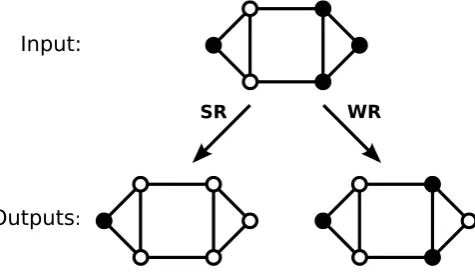
The process applied to a small graph is represented in Figure1. We studied this problem on a variety
of degree-regular graphs. We studied this problem on a variety of degree-regular graphs. We show that one may find the exact degeneracy distribution corresponding to the complete set of all possible inputs, up to relatively large system sizes, for any given graph. Just as in our previous study on rings,
we show that the principal characteristics of the degeneracy distribution are described asymptotically by three key numbers. These numbers may be obtained exactly by simple arguments.
SR WR
Input:
Outputs:
Figure 1.Application of different filters to a set of zeros and ones place on a graph. Each node of the input and output graphs is in one of two states, namely 0 (open circles) or 1 (closed circles). In the SR filter, an output node is one only when the corresponding input node is one and all its neighbours are zero. In the WR filter, an output node is one when the corresponding input node is one and one or more of its neighbours are zero.
This problem serves as a tractable simple model to explore information processing in complex systems. In a graph, the connections between nodes create complex interactions between the
filter output at each node. We show that the degeneracy distribution correctly captures this
complexity. In particular, the entropy of the degeneracy distribution, called therelevance[8] is lower
in deterministically constructed graphs, and higher in random graphs. We show that relevance is maximum when the graph degree takes its smallest value greater than two. We compared two different filters, and found that the stronger filter (detecting less easily satisfied conditions) is more informative,
because it is more sensitive to the state of neighboring nodes. Interestingly, as Figure6demonstrates,
our results for regular graphs of diverse architectures essentially depend only on a vertex degree.
2. Results
2.1. Filtering statistics on a ring
For orientation, we begin by studying nodes located on a ring. The input is a set ofNstrings of
zeroes and ones{xi},xi =0, 1, of lengthn, assuming the periodic conditionx1=xn+1. We consider
the complete set of all possible unique inputs. Its sizeNis determined by the sizenof inputs,N=2n.
The filter works as follows: every instance of a specific pattern in the input (a short sequence of ones and zeroes) is marked by a one in the corresponding position in the output. All other positions are marked with zeroes. Multiple inputs correspond to the same output, creating a distribution of
degeneracies of the outputs. We illustrate the results from a simple example filter pattern in Figure2(a)
and (b). We observe complex degeneracy distributions reminiscent of those observed in, for example,
Ref. [9].
The filter pattern may be arbitrary, but for illustrative purposes we will consider in particular a family of filters consisting of a string of ones with zeroes at either end: 010, 0110, 01110, etc. The
length of the filter,w, can be used as a crude control parameter to observe the effects on resolution and
relevance (see below). For convenience, we use the notation 1lto indicate a chain oflones. Thus the
filter of lengthwis 01w−20. In principle, for each of the 2npossible inputs we can obtain, one by one,
an output numerically. In practice, we use a more efficient algorithm described in Ref. [1]. Other types
101 103 105 107 109 d
100
101
102
103
104
105
106
N
(
d
)
(a)
n= 36
101 103 105 107 109 d
100
101
102
103
104
105
106
107
Ncum
(
d
)
(b)
101 103 105 107 109 d
100
101
102
103
104
105
106
N
(
d
)
(c)
6×6
101 103 105 107 109 d
100
101
102
103
104
105
106
Ncum
(
d
)
(d)
Figure 2.Degeneracy distribution (a) and cumulative degeneracy distribution (b) for the filter 010 on a ring, and for its generalization on a torus, which is a 1 with four neighboring 0’s [panels (c) and (d)].
2.1.1. Degeneracy distribution
We obtained the number of outputsN(d)for the full spectrum of degeneraciesdfor a variety
of filters. The degeneraciesdi,i=1, ...,D, form a discrete spectrum of values wheredDis the largest
degeneracy, andd1=1. A few examples of the degeneracy distributions and cumulative degeneracy
distributions are shown in Figure2. HereNcum(di)≡∑Dj=iN(dj). In particular, the total number of
outputs is given byM(n) =Ncum(d1). The cumulative degeneracy distribution is broad, but decays
more rapidly than a power law.
The tail of the cumulative distribution has a notably complex structure resembling a staircase, with steep jumps between steps. The heights of these jumps are especially large in the region of high degeneracies. Similar structures may be observed in real systems, see for example Figure 3 of Ref.
[9]. As shown in Ref. [1], when the number of ones in the output is few, and some or all of them
are separated by large gaps, such outputs have very similar but not exactly equal degeneracies for
finiten. These closely located degeneracies lead to the staircase structure observed in the cumulative
distribution.
Let us consider the evolution of the degeneracy distribution (and cumulative distribution) with
input sizen. The largest degeneracydD(n)corresponds to the output with all zeroes, and for large
n, grows asdD(n)∼=znd, where the value ofzddepends on the specific filter. NaturallyN(dD,n) =1.
The number of outputs with degeneracy 1 behaves asN(1,n)∼=zna. Meanwhile the total number of
outputs,M(n)is asymptoticallyM(n)∼=zng. Together, these three key constants,zd,zgandza, delimit
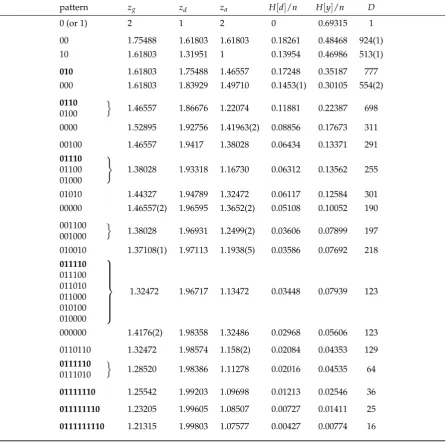
the asymptotic behaviour of the degeneracy distribution [1]. We list these numbers for a selection of
short filter patterns on a ring in Table1.
Rather surprisingly, one may obtain these asymptotic behaviours, and exact expressions for the
constantszg,zdandzathrough simple arguments. Each output consists of isolated ones separated
by strings of zeroes of various lengths. By careful consideration of how valid outputs for a larger
ncan be constructed by adding specific segments to shorter outputs, one may construct recursive
relations for the key quantitiesM(n),dD(n)andN(1,n), whose asymptotics are given byzg,zdandza.
To demonstrate this, we focus on the particular family of filter patterns consisting of a chain of ones with a zero at each end. The shortest such pattern is 010. Each member of this set may be indexed by
the length of the filter,w≥3. The filter pattern lengthwdetermines the minimum number of zeroes,
2.1.2. Effect of filter length
In analogy with complex systems, we can consider each filter pattern as sampling the hidden state
of a complex system [1]. The length of these filters acts as a crude control parameter of our sampling.
Intuitively, we expect shorter filters to be more informative. The resolution of a sampling process, defined as the entropy of a sample:
H[y] =−N1
N
∑
i=1
log
di N
=−
∑
d
dN(d,n)
N log
d N
(1)
is a measure of the ability to distinguish, at the output, between different input states [8]. It takes its
maximum value when there is a different output for each input. However in this case all outputs are
distinct, and so these filters are not informative about the system being sampled. As shown in Ref. [8],
the informativeness of a sample is captured by a different entropy measure, the relevance, defined as
H[d] =−
∑
d
dN(d,n)
N log
d
N(d,n) N
. (2)
Results for a variety of short filter patterns are given in Table1. The family of filters composed of
a string of ones with a zero at each end, 010, 0110, 01110, etc., are indicated in boldface in the Table. As can be seen in the Table, the relevance is greater for shorter filters, but is actually zero for the shortest possible filters 0 and 1. The filter pattern 1 trivially reproduces the input, while 0 it’s inverse, and
all outputs have degeneracy one. Within the family of filters 01w−20, the relevance is maximised for
w=3.
Filter patterns of length two begin to have nontrivial properties. For the pattern 01, the number of
outputs with degeneracy 1,N(1,n), is either 0 (whennis odd) or 2 (whennis even), soza =1. This is
because the only outputs that have degeneracy one are periodic sequences of alternating 0’s and 1’s —
there are two of these sequencesnis even, and none whennodd. The maximum degeneracydD(n)for
this pattern grows by an integer factor of 4 for an increment innof 5. In fact it can be written explicitly,
dD(n>11) =
3
44/5
−mod(n,−5)
4n/5, (3)
where the coefficient of 4n/5 equals(3/44/5)0 = 1, (3/44/5)4 = 0.959164, (3/44/5)3 = 0.969214,
(3/44/5)2= 0.979369, and(3/44/5)1=0.989631 formod(n, 5) =0, 1, 2, 3, and 4, respectively. As a
result, the numberzd, which gives the asymptotic behaviour of the maximum degeneracydD, is equal
to 41/5.
As can be seen in Figure 5 (c), the degeneracy distribution of the filter 01 does not have
the characteristic shape, and the broad tailed cumulative distribution seen in other filters. The
filter pattern 00 already produces more complexity, see Figure5(a). The degeneracy distribution
and the cumulative distribution already have the shape and complexity seen in longer filters [1].
CuriouslyN(1,n) =dD(n) +in+ (−i)n(whereiis the imaginary unit) where the last two terms give
0, 2, 0,−2, 0, 2, 0,−2, 0, . . . forn=3, 4, 5, 6, . . . . This means thatzd=za ≈1.618.
The largest degeneracies behave as∼=zndfor largen. The numberzdquickly approaches 2 as the
filter pattern length increases. SinceN=2n, this means that almost all outputs concentrate in a few
outputs, and in the limit, in a single state, i.e. all outputs are the same and the filter patterns are not
informative. For the shortest filter patterns, the value ofzdfalls rapidly, while the relevance increases,
indicating a transition to informative sampling. On the contrary,zg, which gives the total number of
outputsM(n), increases with decreasing filter length, as shorter filters have more possible outputs.
Taken together, these results indicate that the maximally informative sampling for a given family of filters is the shortest pattern having length greater than 1. This behavior is analogous to the transition
Table 1. Values of the numberszg,zd, andzafor different filters. Note that we also included filter patterns consisting of all zeroes. For each filter we also give the relevance per nodeH[d]/n(in nats) calculated from the degeneracy distribution and the resolution per nodeH[y]/n. For the sake of comparison, the standard entropy of the inputs of this size isH/n=ln 2=0.69315. Finally we include the number of distinct degeneraciesDfor each pattern. Inputs of sizen=36 were used except for filters 00 and 10, for whichn=34, and 000 for whichn=35. Values forDfor these three filters were extrapolated ton=36 for comparison with other results.
pattern zg zd za H[d]/n H[y]/n D
0 (or 1) 2 1 2 0 0.69315 1
00 1.75488 1.61803 1.61803 0.18261 0.48468 924(1)
10 1.61803 1.31951 1 0.13954 0.46986 513(1)
010 1.61803 1.75488 1.46557 0.17248 0.35187 777
000 1.61803 1.83929 1.49710 0.1453(1) 0.30105 554(2)
0110 o
1.46557 1.86676 1.22074 0.11881 0.22387 698 0100
0000 1.52895 1.92756 1.41963(2) 0.08856 0.17673 311
00100 1.46557 1.9417 1.38028 0.06434 0.13371 291
01110 )
1.38028 1.93318 1.16730 0.06312 0.13562 255 01100
01000
01010 1.44327 1.94789 1.32472 0.06117 0.12584 301
00000 1.46557(2) 1.96595 1.3652(2) 0.05108 0.10052 190
001100 o
1.38028 1.96931 1.2499(2) 0.03606 0.07899 197 001000
010010 1.37108(1) 1.97113 1.1938(5) 0.03586 0.07692 218 011110
1.32472 1.96717 1.13472 0.03448 0.07939 123 011100
011010 011000 010100 010000
000000 1.4176(2) 1.98358 1.32486 0.02968 0.05606 123
0110110 1.32472 1.98574 1.158(2) 0.02084 0.04353 129 0111110 o
1.28520 1.98386 1.11278 0.02016 0.04535 64 0111010
01111110 1.25542 1.99203 1.09698 0.01213 0.02546 36
011111110 1.23205 1.99605 1.08507 0.00727 0.01411 25
Note that one may also consider filters constructed as logical combinations of more than one
pattern. For example, there are 3 kinds of ‘OR’ filters of size 2+2 (in fact, there are(16−4)/2=6
combinations of different filters, but some are equivalent in terms of degeneracies). All of these OR filters have trivial degeneracies: 01 OR 10 detects when the next digit is different from the current one. Given the value of an input digit we can completely reconstruct that input, and, since the first input digit has 2 possible values, each output has degeneracy 2. The only degeneracy in the spectrum is 2
and its frequency is 2n−1, sozd=1 andzg=2. There are no outputs of degeneracy one,N(1,n) =0.
00 OR 11 detects when the next digit is the same as the current one. The same reasoning as for the filter 01 OR 10 applies here: we can reconstruct the input completely from the output if we know a single digit of the input. Finally 11 OR 10 (which is the same as 11 OR 01, 00 OR 10 and 00 OR 01) is equivalent to the filter 1 of length 1.
2.2. Filtering on graphs
The process described in the previous Section may be generalised to an arbitrary graph as follows. The input consists of the binary status for each node in the graph. We filter for a particular condition of the state of a node and of its immediate neighbors. If the state of the node and its neighbours matches the filter pattern, the output for that node is 1, otherwise it is 0. We consider two examples: Firstly, we set the output to 1 if the selected node has state 1 and all of its neighbours have state 0 (we refer to this filter as the strong rule, or SR). This filter applied on a ring is equivalent to the pattern 010 discussed in the previous Section. Secondly, we apply a less selective filter, outputting 1 if a node is in state 1 and
anyof its neighbours has state 0 (we call this filter the weak rule, or WR). We illustrate the application
of these two filter patterns to a small graph in Figure1.
These filters were applied to several families of degree-regular graphs. These were chosen to have a variety of structures and to vary in the degree of randomness in their construction, while being of comparable size and degree. We considered the following families of graphs: Small world graphs. These graphs created by placing all nodes in a ring, and adding shortcuts between nodes to reach the desired degree. The locations of shortcuts were either random – we use the code SW(q) for these
graphs, whereqis the graph degree – or in a deterministic way – SWB(q); Random regular graphs
(RRG); Tori, which are two dimensional square lattices with cyclic boundary conditions; Cages. These
are graphs defined by two numbers, the degreeqand the shortest cycle lengthg. A (q,g)-cage is the
graph fulfilling these properties while having the smallest possible numbersnof nodes [11]. For each
family of graphs we considered different sizes, up to at leastn=30, and where possible, degrees, from
q=2 up toq=5. Finally we investigated the second and third Apollonian networks (Apollonian 2
100 101 102 103 104 105 106 107 d 100 101 102 103 104 105 N ( d ) (a) RRG2 SR n= 30
100 101 102 103 104 105 106 107 d 100 101 102 103 104 105 106 Ncum ( d ) (b)
101 103 105 107 d 100 101 102 103 104 N ( d ) (c) RRG3 SR n= 30
101 103 105 107 d 100 101 102 103 104 105 Ncum ( d ) (d)
101 103 105 107 d 100 101 102 103 N ( d ) (e) RRG4 SR n= 30
101 103 105 107 d 100 101 102 103 104 105 Ncum ( d ) (f )
Figure 3.Degeneracy distributions (left) and cumulative degeneracy distributions (right) for outputs of the SR filter on random regular graphs of degree 2 (a,b) 3 (c,d) and 4 (e,f).
100 101 102 103 104 105 106 107 d 100 101 102 103 104 105 N ( d ) (a) ring SR n= 30
100 101 102 103 104 105 106 107 d 100 101 102 103 104 105 106 Ncum ( d ) (b)
101 103 105 107 d 100 101 102 103 104 105 N ( d ) (c) (3,8)-cage SR
101 103 105 107 d 100 101 102 103 104 105 Ncum ( d ) (d)
101 103 105 107 109 d 100 101 102 103 104 N ( d ) (e)
torus 6×5 SR
101 103 105 107 109 d 100 101 102 103 104 105 Ncum ( d ) (f )
We give some examples of the resulting degeneracy distributions and cumulative degeneracy
distributions, for the SR filter, in Figures3, for random graphs, and4, for deterministically generated
graphs. Note that the distributions for random graphs correspond to a single realization of the graph. We see that there is a dramatic difference in the distribution for random graphs between degree two and degree three. The degree two random regular graph necessarily consists of one or several closed
rings, and the distribution is little different than that shown in Figure2(a). For degree three, there
is a great deal of randomness in the formation of the graph, and this is reflected in the degeneracy distribution, which becomes much more dense, having a fine structure not observed in deterministic graphs. For higher degrees, the distribution becomes less broad, and as we will discuss below, this corresponds to a reducing relevance with increasing degree.
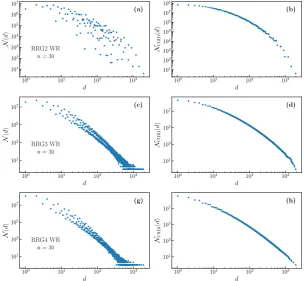
We have not included examples of the distributions for the "small world" graphs. The deterministic small world graphs, SWB(q), produce distributions almost indistinguishable from those for other deterministic graphs of the same degree, while the random small world graphs, SW(q), generate degeneracy distributions very similar to those found for random regular graphs. For completeness, we give the degeneracy distributions and cumulative distributions for the same graphs using the WR
filter in FiguresA1andA2in AppendixA.
100 101 102 103 104 105 106 d 100 101 102 103 104 105 106 N ( d ) (a)
n= 30 ‘00’ on a ring
100 101 102 103 104 105 106 d 100 101 102 103 104 105 106 107 Ncum ( d ) (b)
100 101 102 103
d 100 101 102 103 104 105 N ( d ) (c)
‘01’ on a ring n= 30
100 101 102 103
d 101 102 103 104 105 106 Ncum ( d ) (d)
100 101 102 103 104 d 100 101 102 N ( d ) (e) Apollonian SR n= 16
100 101 102 103 104 d 100 101 102 103 Ncum ( d ) (f )
100 101 102
d 100 101 102 103 104 N ( d ) (g) Apollonian WR n= 16
100 101 102
d 100 101 102 103 104 Ncum ( d ) (h)
We plot some examples of some less typical degeneracy distributions in Figure5. These are the 00 and 10 filters applied on a ring, and the SR filter applied to Apollonian networks (which are not degree regular).
2.0 2.5 3.0 3.5 4.0 4.5 5.0
q 0.05 0.10 0.15 0.20 H [ d ] /n (a)
2.0 2.5 3.0 3.5 4.0 4.5 5.0
q 0.1 0.2 0.3 0.4 0.5 0.6 0.7 H [ y ] /n (b) RRG SR SW SR SWB SR cages SR torus SR RRG WR SW WR SWB WR cages WR torus WR
2 3 4 5
q 1.2 1.4 1.6 1.8 2.0 n p d D ( n ) (d)
2 3 4 5
q 1.5 1.6 1.7 1.8 1.9 2.0 n p M ( n ) (e)
2 3 4 5
q 1.4 1.6 1.8 n p N (1 ,n ) (f )
2 3 4 5
q 102 103 104 D ( n ) (c)
n= 30
Figure 6. Dependence of key observables related to the degeneracy distribution on graph degree q. (a) The relevance entropyH[d]scaled by system sizen. (b) ResolutionH[y]. (c) Total number of degeneraciesD(n)forn=30. (d) Thenthroot of the largest degeneracydD(n), which tends tozd. (e) Thenthroot of the number of outputsM(n), tending tozg. (f) Thenthroot of the number of outputs of degeneracy onemN(1,n), tending toza.
In Figure6we represent various quantities of interest as a function of graph degree, for the
different graph families studied. We see that there is a clear separation in results between the two filters.
The weak filter (WR) detects when a node has state 1 while having at least one immediate neighbor with state 0. This neighbour condition is more easily satisfied the larger the number of neighbours
q. Thus for largeq, the number of possible outputsM(n)for the WR filter approaches the number of
possible inputs, 2n. We see in panel (e) that indeed thenthroot ofM(n), which tends tozgfor largen,
approaches 2 for largeq. By the same token, most outputs have a degeneracy of one, so the number of
outputs of degeneracy one,N(1,n)also approaches 2n(zaapproaching 2) for largeq[panel (f)], with
while the largest degeneracydD(n)(whose asymptotic behaviour is given byzd) grows only slowly
withn, [panel (d)]. The resolutionH[y]measures how well the filter distinguishes different inputs,
and as we see in panel (b) of Figure6, and in agreement with the above observations, the resolution
for the weak filter is high. The maximum possible value ofH[y]isnln 2, corresponding to a value of
The correct measure of how informative a sample of the observable variables of a complex system
is about the underlying system is the relevance [8],H[d]. Such sampling is represented in our problem
as the filtering process, and the interactions of the system by the graph structure. The importance of
the relevance is confirmed by our results, as shown in Figure6(a). A higher relevance is measured
in graphs having some randomness in their structure, while deterministic and regular graphs have lower relevance. This is particularly true for the strong filter SR, which produces a significantly higher relevance for random regular graphs (RRG) and rings with random shortcuts (SW), compared with rings with deterministic shortcuts (SWB) and cages. The effect for the WR filter is much less pronounced.
The highest relevance occurs at degreeq=3. The explanation for this is clear. As shown above,
and in [1], smaller filters generally produce higher relevance, as there are more outputs than for larger
filters, except in the extreme limit of perfect reproduction of the input (maximum resolution). Thus
we would expect lower values ofq, which correspond to smaller SR filters, to have higher relevance.
Meanwhile, and opposing this trend, graphs of degreeq =2 are necessarily either rings or sets of
rings, which thus have a (nearly) deterministic structure and suffer a penalty in relevance. Notice
also the similarity of the degeneracy distributions forq=2 in Figures3andA1. As can be seen in
the figure, the reduction in relevance in moving fromq=3 toq=2 due to this regularity outweighs
the expected increase due to the filter being smaller. To put it another way, the maximum relevance
occurs at the smallest value ofqfor which the graph is non deterministic. This echoes our finding for
filters on rings, for which the maximum relevance is found for the shortest filter which doesn’t trivially
reproduce the input [1]. We show the degeneracy ditribution forq=3 for a deterministic graph in
Figure4, and for a random graph in Figure3.
For the SR filter, in contrast to the weak filter, there is significant degeneracy of the outputs. The number of outputs is significantly less than the number of inputs, as is the number of outputs with degeneracy one. Similarly, the resolution is small for the SR filter, for all graph families, and decreases
withq. The largest degeneracy,dD, on the other hand, does become very large. In the limit of largeq, a
large fraction of possible outputs give the same single output (all zeroes). In Figure6(c), the behaviour
of the number of degeneracies,D(n)noticeably mirrors that of the relevance,H[d]. Note that data
points for random graphs are averaged over several realisations of the graph.
In Table2we list the key degeneracy distribution statistics for the SR filter, for all families of
graphs studied. Corresponding results for the WR filter may be found in TableA1. In addition to
representing the data highlighted in Figure6in the quantitative form, these tables demonstrate the
size effects with exponentially rapid convergence to the infinitenlimit. In this work, we are mainly
interested in regular graphs (graphs where nodes have a uniform degree), because we can better isolate the effects of varying the graph’s degree. Nevertheless, for the sake of completeness, we also
present results for a few examples of non-regular graphs, namely Apollonian networks. In Tables2
andA1, each group of rows delimited by horizontal lines represents a different class of graphs. The
four classes at the top of the tables, namely Apollonian networks, cage graphs, square lattices with periodic boundary conditions (torus), rings with deterministic shortcuts, are deterministic graphs, while the two remaining classes represent random models, namely random regular graphs, and rings with random shortcuts. The numbers presented for the random models result from averaging over 10 realizations sampled uniformly at random.
We include results for graphs of several sizes for each type of graph. This allows one to see
the convergence of values with increasingn. Within the set of consecutive rows of each class, the
graphs are ordered by ascending degree, then by ascending number of nodes. The exception to this organization is the two first rows, which are for the non-regular Apollonian networks. All of these
Table 2. Important values for the degeneracy distribution resulting from applying the strong rule (SR) filter to various graphs. The numbers pn M(n), pn dD(n)and n
p
N(1,n)approximatezg,zdandza respectively. We also give the relevance per nodeH[d]/nand the resolution per nodeH[y]/n. Numbers for RRG(q) and SW(q) were obtained by averaging over 10 random realizations.
graph n pn M(n) pn d
D(n) n p
N(1,n) H[d]/n H[y]/n
Apollonian 2 7 1.47236 1.94420 1.40854 0.08504 0.12919 Apollonian 3 16 1.52380 1.94596 1.49013 0.08148 0.13005
(3,5)-cage 10 1.54199 1.88916 1.42694 0.10463 0.22185 (3,6)-cage 14 1.54904 1.88549 1.46952 0.09741 0.22302 (3,7)-cage 24 1.54516 1.88688 1.42191 0.12412 0.22268 (3,8)-cage 30 1.54618 1.88722 1.44630 0.08763 0.22254 (4,5)-cage 19 1.48991 1.94458 1.37494 0.08094 0.13458 (4,6)-cage 26 1.50129 1.94386 1.44997 0.05243 0.13497 (5,5)-cage 1 30 1.44928 1.97192 1.34932 0.04164 0.07890 (5,5)-cage 2 30 1.44984 1.97191 1.35558 0.04602 0.07891 (5,5)-cage 3 30 1.44954 1.97192 1.35543 0.04201 0.07890 (5,5)-cage 4 30 1.44964 1.97191 1.35280 0.05264 0.07891
torus 3×3 9 1.47967 1.94480 1.42350 0.07165 0.13112 torus 4×4 16 1.51160 1.94843 1.46895 0.06205 0.13043 torus 5×5 25 1.50066 1.94752 1.41779 0.05857 0.13132 torus 6×5 30 1.50206 1.94754 1.42286 0.06159 0.13131 torus 10×3 30 1.48922 1.94678 1.39796 0.05933 0.13100 torus 8×4 32 1.50701 1.94785 1.44980 0.06251 0.13096 torus 6×6 36 1.50405 1.94756 1.44490 0.05890 0.13130
SWB(3) 10 1.55564 1.89336 1.48457 0.10987 0.21539 SWB(3) 20 1.55376 1.89450 1.46394 0.09850 0.21540 SWB(3) 30 1.55377 1.89450 1.46573 0.10256 0.21541 SWB(4) 12 1.48818 1.94653 1.40063 0.07107 0.13103 SWB(4) 21 1.48924 1.94678 1.39802 0.06401 0.13100 SWB(4) 30 1.48922 1.94678 1.39797 0.06211 0.13100 SWB(5) 12 1.43618 1.97359 1.32007 0.04433 0.07602 SWB(5) 20 1.43469 1.97223 1.31634 0.03927 0.07765 SWB(5) 32 1.43463 1.97225 1.31607 0.03597 0.07765
RRG(2) 10 1.55934 1.77122 1.41900 0.15869 0.32044 RRG(2) 20 1.60061 1.76297 1.45744 0.16195 0.33977 RRG(2) 30 1.61251 1.75289 1.46125 0.16997 0.35053 RRG(3) 10 1.49614 1.87903 1.30837 0.17514 0.21708 RRG(3) 20 1.52503 1.87847 1.37793 0.20373 0.22357 RRG(3) 30 1.54129 1.87706 1.41134 0.21442 0.22868 RRG(4) 10 1.44023 1.93770 1.30201 0.11648 0.13463 RRG(4) 20 1.48205 1.93399 1.36490 0.14077 0.14659 RRG(4) 30 1.48439 1.93797 1.37705 0.13959 0.14166 RRG(5) 10 1.41641 1.95111 1.27098 0.10038 0.11042 RRG(5) 20 1.42488 1.96513 1.30706 0.08722 0.08896 RRG(5) 30 1.43068 1.96825 1.31653 0.08344 0.08393
SW(3) 10 1.55356 1.87107 1.43216 0.16610 0.23788 SW(3) 20 1.55998 1.86334 1.43951 0.22050 0.24702 SW(3) 30 1.54842 1.88077 1.43167 0.21643 0.22839 SW(4) 10 1.47637 1.91449 1.33514 0.14321 0.16987 SW(4) 20 1.49157 1.93385 1.38141 0.14235 0.14885 SW(4) 30 1.49811 1.93505 1.39764 0.14519 0.14804 SW(5) 10 1.43017 1.95045 1.29919 0.09802 0.11240 SW(5) 20 1.44575 1.95995 1.33955 0.09722 0.09962 SW(5) 30 1.45251 1.96562 1.35962 0.08951 0.09047
For fully connected graphs, both the strong and the weak rules produce trivial output and
and all other inputsxj6=i=0. So, when there is a 1 in the output string, we haveyi=xi. There arenof
these outputs, and their degeneracy is 1. Since, there can be no more than a single 1 in the output string,
the only other possible output is a string ofnzeros, which has degeneracy 2n−n. In this case there are
only two degeneracies in the degree distributiond1 =1 andd2 =2n−n, and their frequencies are
N(d1,n) =n, andN(d2,n) =1, respectively.
On a fully connected graph under the weak rule, for an output nodeyi to be 1, it is enough to
havexi =1 and just one other inputxj6=i =0. Therefore, when one or more of the inputsxiis 0 the
output is equal to the input. The only situation in which the output does not match the input is for an input string of all 1’s, in which case the output is a strings of 0’s. The weak rule also produces only
two degeneraciesd1=1 andd2=2, with frequenciesN(d1,n) =2n−2, andN(d2,n) =1.
It is worth noticing the relation with the class of cage graphs, which we have studied here:
(q, 3)-cage graphs are fully connected graphs withq+1 nodes, while(q, 4)-cages are bipartite graphs
with two fully connected layers ofqnodes each. Bipartite graphs with two fully connected layers of
the same size also result in trivial degeneracy distributions in both the strong and weak rules. With the
strong rule applied to such a bipartite graph, for an outputyito be 1 we must have all inputs in the
opposite layer to bexi=0. Conversely, when one input of one of the layers isxi =1 all the outputs of
the other layer are 0. So, when all the input digits of one of the layers are all equal to 0 the outputs
equal the inputs,yi =xi, and when there are 1’s in both layers of the input, the output is all 0’s. In
this case the degeneracy distribution also contains just two degeneracies,d1=1 andd2=2n−2n/2+1,
with frequenciesN(d1,n) =2n/2+1andN(d2,n) =1, respectively (notice there aren/2 nodes in each
layer). With the weak rule applied to symmetrical fully connected bipartite graphs, for an outputyito
be 1 it is enough to have just onexi =0 in the opposite layer. Therefore, all inputs with at least a 0 in
each layer produce an outputyi=xi. All inputs with at least one 0 in layerαand only 1’s in layerβ
produce an output consisting of all 0’s in layerαand all 1’s in layerβ. Finally, if the input contains no
0’s in either layer, the output isyi =0 for alli. Therefore, we haved1=1,d2=2, andd3=2n/2−1,
with frequenciesN(d1,n) =2n−2n/2−1,N(d2,n) =1, andN(d3,n) =1, respectively.
From the trivial degeneracy distribution of these examples of graphs, i.e., fully connected and bipartite fully connected, we see that the entropies approach trivial limits for large system sizes.
Namely, for the strong rule, using Eqs. (1) and (2) for the output and degeneracy entropies, respectively,
we see the in both types of graphsH[y]andH[d]both approach 0, since the distribution is dominated
by a single degeneracyd∼=2nwithN(d,n) =1. With the weak rule,the entropyH[y]/napproaches
ln 2=0.693. . . andH[d]approaches 0. In general, we expect that the entropies approach these limits
was we increase the degree of the graphs generated by any model. Interestingly, this effect is already
quite visible in Tables2andA1, when we compare the values of the entropy for different degrees
within each class of graphs, even for degrees up to only 5.
3. Discussion
In Ref. [1] we introduced a simple filtering problem which produces a rich and complex
distribution of output degeneracies. The input is a cyclic sequence of zeroes and ones (a ring), and the process outputs a one in any position where a particular short pattern occurs, and a zero otherwise. The tractability of the problem means that we are able to give the complete degeneracy distribution, for the set of all possible inputs, up to relatively large system sizes.
three key features of the degeneracy distribution: the largest degeneracydD(n), the number of distinct
outputsM(n)and the number of outputs having degeneracy one,N(1,n)behave aszdn,zng andzna,
respectively, where the three numberszd,zgandzatake values from 1 to 2 depending on the graph
and the filter. We find precise values for these three numbers for all the graphs studied.
The two filter examples used give quite different results, and have different behaviour with
respect to graph degree. The key results are summarised by our main figure, Figure6. The weak rule
filter, WR, is only weakly sensitive to the neighborhood of a node, and hence the structure of the graph. For large degree, it almost always produces an output matching the input. Thus the WR filter produces large values for the ouput entropy, called the resolution, and small values for the degeneracy entropy, the relevance.
The strong rule filter, SR, on the other hand, imposes a condition on all the neighbours of the node where the filter is applied. This produces a much larger relevance (which is a measure of the informativeness of the filtering process) in random graphs, but much lower resolution, as the number of unique outputs is restricted. The relevance is largest for the smallest graph degree not equal to two. Deterministically constructed graphs do not demonstrate the same peak in relevance, underlining the importance of this measure for detecting complexity. For larger degree, the condition becomes more
restrictive, so the number of outputs is reduced. The resolution decreases with increasingq, but so
does the relevance. The reason that theq=2 graphs do not give the maximum relevance is that these
graphs necessarily have a highly predictable structure. All nodes lie in one or at most a few rings. One may observe that the degeneracy distributions and corresponding statistics are very similar for all
families of graphs studied whenq=2. The fact that results are largely determined by degree, indicates
that it should be possible to write a mean field theory for the degeneracy distribution.
Similar complexity is observed in various complex systems, particularly with regard to information processing. In such systems, degeneracy distributions has been shown to be an important
observation of the system. The entropy of this distribution, called the relevance, was shown [8] to be
the relevant measure of complexity, and we showed that our simple problem reproduces many of the important qualitative phenomena observed in such systems. The filtering problem is therefore a highly tractable problem illuminating some of the key features of information processing in more complex systems. The extension of this problem to arbitrary graphs, makes the interactions between nodes more complex, and the analogy with the complex interactions of real complex systems more explicit.
4. Materials and Methods
4.1. Calculation of degeneracy distributions
The distributions shown in Figures2-5,A1andA2, and the numbers presented in the Tables1,
2, andA1and plotted in Figure6were experimentally obtained by considering all 2nconfigurations
of theninput binary variablesxi individually. For a specified filter, or rule, we obtain the output
variablesyicorresponding to each input. From the frequency with which each output configuration
appears, we build the degeneracy distribution.
For the sake of simplicity in the implementation of the computational experiments, we apply
a basic indexing system to the output configurations. We start by initializing an array with 2n
positions populated with zeros, representing the frequency of observation of each output. Then, as
we systematically run through all the possible inputs and calculate the corresponding outputs{yi},
we increment by 1 the value in position∑iyi2i of the array, wherei = 0, 1, . . . ,n−1. In the end
configurations 2n. In the case of rings, a much more efficient algorithm may be used, as described in
Ref. [1].
4.2. Asymptotics of the degeneracy distribution on rings
Here we show how the asymptotic behaviour of the degeneracy distribution may be obtained. We focus on the particular family of filter patterns consisting of a chain of 1s with a 0 at each end. The shortest such pattern is 010. Each member of this set may be indexed by the length of the filter,
w≥3. Each output consists of isolated ones separated by strings of zeroes of various lengths. The
filter pattern lengthwdetermines the minimum number of zeroes,w−2, between each one.
Forw=3, chains of three or fewer zeroes in the output can only be produced in one way. Thus
outputs containing only such chains of zeroes have degeneracy 1. Possible such output sequences can
be built up out of three kinds of building blocks, 01, 001, and 0001, put together in a ring of lengthn.
We can thus find the number of outputs of degeneracy 1,N(1,n), by counting all possible ways of
building a ring of lengthnout of these blocks. We can do this recursively. For every configuration of
lengthn−2, we can obtain a valid configuration of lengthnby inserting the block 01 to the right, say,
of a particular positioniin the ring. This gives all the configurations of lengthnwith the block 01 to the
right ofi. Doing the same with configurations of lengthn−3 and blocks 001, we get all configurations
with a block 001 to the right of the block ofi. Finally, repeating the procedure for configurations of
lengthn−4 and blocks 0001, gives all configurations with a block 0001 to the right of the block ofi.
Since every block must be 01, 001, or 0001, the union of these three sets is the full set of configurations
of degeneracy 1 in rings ofndigits. Thus, we can write
N(1,n) =N(1,n−2) +N(1,n−3) +N(1,n−4). (4)
Starting from the first few values
N(1, 1)=0, N(1, 2)=2, N(1, 3)=3, N(1, 4)=6, (5)
we could build up the sequence and findN(1,n)for anyn. However it is not necessary to iterate
through all values ofn.
The explicit solution of this linear difference equation (4) can be written in terms of the roots,zi,
of the characteristic equationz4=z2+z+1:
N(1,n) =z1n+z2n+z3n+z4n, (6)
where the coefficients of the powers of the rootszi, all equal to one, are found form the initial condition,
Eq. (5). The rootz1≡za =1.46557... determines the largenasymptotics ofN(1,n).
Forw≥4, it becomes possible for there to be chains of ones in the input that are shorter than that
in the filter pattern. This means that only sequences ofw−2 orw−1 zeroes in the output are not
degenerate. Any sequence ofwor more zeroes in the output can be produced in more than one way.
One may therefore extend an input of degeneracy 1 only by inserting blocks of lengthw−1 andw.
Hence the recursion forN(1,n)becomes
N(1,n) =N(1,n−w+1) +N(1,n−w). (7)
The corresponding characteristic equation is
zw=z+1. (8)
For largen, then,
Wherezacorresponds to the dominant solution of Eq. (8).
The total number of possible outputs may be derived in a similar way. The presence of a 1 at a
given position in the output corresponds uniquely towfixed digits at the same position in the input.
Any degeneracy therefore arises in the parts of the input corresponding to strings of zeroes in the
output. The total number of possible outputs,M(n), is then the number of ways of arranging isolated
ones in a chain of lengthn, subject to this constraint. For every output of lengthn−1, we can create
an output of lengthnby inserting an additional 0. The same is not true for the digit 1, however.
Any 1 in the output must be accompanied by a sequence ofw−2 zeroes. We can account for this
condition precisely by inserting the sequence 10w−2into any valid output of lengthn−(w−1)in a
position immediately following a sequence ofw−2 zeroes (at least one such sequence must exist).
ThusM(n) =M(n−1) +M(n−w+1), with initial conditionsM(n=w) =2,M(n<w) =1. The
elements of the sequence may be written in terms of the roots of the characteristic equation [12–14]
zw−1=zw−2+1. (10)
Thenzgcorresponds to the largest root of this equation. We list values for various filter lengths (as
well as for some other filter patterns) in Table1.
The entire degeneracy distribution may be built up by considering chains of zeroes of different lengths in the output, and the number of different possible corresponding sections of the input. Let an
output withm≥1 ones containmstrings of zeroes with lengths`1,`2, ...,`m. Then the degeneracy of
this output equals
d= m
∏
i=1
˜
d(`i). (11)
Here ˜d(`)is the number of input strings of length`, having the first and last digits 0, that generate
an output string of`zeroes. This number plays an important role in our problem, similar to prime
numbers in number theory, so we call the ˜d(`)prime degeneracies. Suppose that the output containsµ`
strings of zeroes of length`,`=w−2,w−1,w, ..., where
m+
∑
`≥w−2
`µ`=n. (12)
Then Eq. (11) may be rewritten
d=
∏
`≥w−2
[d(˜`)]µ` (13)
form≥1.
The prime degeneracies ˜d(`)can be obtained recursively by taking into account three points:
(i) Relevant input configurations of length`are obtained by inserting 0 or 1 into each relevant
configuration of length`−1 between the first and second positions of the sequence. (Recall that the
first and last positions of the input sequence are fixed to 0.)
(ii) Input strings of length`beginning and/or ending with 01w−20 are irrelevant, and so they
should be removed from the set generated at the previous step. These configurations can be obtained
by inserting thew−1 digits 1w−20 into each relevant input string of length`−w+1 between its first
and second positions.
(iii) Finally, there exist input strings, compatible with the output string of`zeroes, that cannot be
obtained by inserting a single digit into relevant input strings of length`−1 between their first and
second positions. These are the input strings of length`beginning with 01w−10 (i.e. a string of ones
one digit longer than in the filter). These inputs can be obtained by inserting 1w−10 into each relevant
Following these rules, the degeneracy of a string of`zeroes at the output, prime degeneracy ˜d(`), can be written recursively as a linear difference equation:
˜
d(`) =2 ˜d(`−1)−d(˜ `−w+1) +d(˜ `−w) (14)
with the initial condition ˜d(1) = d(˜2) = 1, ˜d(`) = 2`−2for 3 ≤ ` < wandd(w) = 2w−2−1. The
solution of Eq. (14) may be explicitly expressed in terms of the complex roots of the characteristic
equation
zw =2zw−1−z+1. (15)
giving
˜
d(`) =C1z1`+C2z2`+C3z3`+...+Cwzw`. (16)
The largest real root of Eq. (15),z1, say, dominates for large`, and we identify it aszd:
˜
d(`)∼=C1z`d. (17)
The case of the periodic output of lengthnwith all digits 0 has to be considered separately.
Consider one digit of the input, at an arbitrary position. The number of input configurations where this
digit is 0 and the resulting output has only zeroes is given by ˜d(n+1), because the periodicity of the
input means that this digit 0 plays the role of both first and last digit of the configurations of a string
ofn+1 digits. If the digit is 1, then the number of input configurations equals 1+∑i6=w−2id(n˜ −i),
where the sum overiaccounts for the configurations where the digit is in a group oficonsecutive ones
whose length is notw−2, plus one configuration with all input digits equal to 1. Thus the degeneracy
of the output with all zeroes is given by
dD(n) =1+d(n˜ +1) + n−1
∑
i=1;i6=w−2
id(n˜ −i), (18)
which is the largest possible degeneracy of an output of a given length. Applying the recursion relation
for prime degeneracies ˜d, Eq. (14) to the terms on the right-hand side of Eq. (18) we find that the
largest degeneracydD(n)satisfies the same difference equation as Eq. (14) though with different initial
condition
dD(n) =2dD(n−1)−dD(n−w+1) +dD(n−w) (19)
with the initial conditiondD(n) = 2nforn < w, anddD(w) = 2w−w. For largen, the solution is
dominated by a single solution,
dD(n)∼=znd. (20)
Author Contributions: All authors contributed equally substantially in all parts and aspects of the work.
Funding: This work was developed within the scope of the project i3N, UIDB/50025/2020 & UIDP/50025/2020, financed by national funds through the FCT/MEC. This work was also supported by National Funds through FCT, I. P. Project No. IF/00726/2015. R. A. d. C. acknowledges the FCT Grant No. CEECIND/04697/2017.
Conflicts of Interest:The authors declare no conflict of interest.
Appendix A Further results for the weak rule filter
100 101 102 103 d 100 101 102 103 104 105 106 107 N ( d ) (a) ring WR n= 30
100 101 102 103
d 101 103 105 107 Ncum ( d ) (b)
100 101 102 103 104
d 101 103 105 107 N ( d ) (c) (3,8)-cage WR
100 101 102 103 104
d 101 103 105 107 Ncum ( d ) (d)
100 101 102 103
d 101 102 103 104 105 106 107 108 N ( d ) (e)
torus 6×5 WR
100 101 102 103
d 102 104 106 108 Ncum ( d ) (f )
Figure A1.Degeneracy distributions (left) and cumulative degeneracy distributions (right) for outputs of the WR filter on selected deterministic graphs of degree 2 (a,b) 3 (c,d) and 4 (e,f).
100 101 102 103
d 101 102 103 104 105 106 107 N ( d ) (a) RRG2 WR n= 30
100 101 102 103
d 101 102 103 104 105 106 107 108 Ncum ( d ) (b)
100 101 102 103
d 101 103 105 107 N ( d ) (c) RRG3 WR n= 30
100 101 102 103
d 101 103 105 107 Ncum ( d ) (d)
100 101 102 103
d 101 103 105 107 N ( d ) (g) RRG4 WR n= 30
100 101 102 103
d 101 103 105 107 Ncum ( d ) (h)
Table A1. Important values for the degeneracy distribution resulting from applying the weak rule (WR) filter to various graphs. The numbers pn M(n), pn dD(n)and n
p
N(1,n)approximatezg,zdandza respectively. We also give the relevance per nodeH[d]/nand the resolution per nodeH[y]/n. Numbers for RRG(q) and SW(q) were obtained by averaging over 10 random realizations.
graph n pn M(n) pn d
D(n) n p
N(1,n) H[d]/n H[y]/n
Apollonian 2 7 1.95461 1.21901 1.91660 0.11519 0.66045 Apollonian 3 16 1.94788 1.43435 1.91189 0.09594 0.64711
(3,5)-cage 10 1.91202 1.21481 1.84295 0.13705 0.62974 (3,6)-cage 14 1.91394 1.34590 1.83757 0.12271 0.63149 (3,7)-cage 24 1.91348 1.25055 1.83511 0.11462 0.63259 (3,8)-cage 30 1.91330 1.34897 1.83337 0.10559 0.63275 (4,5)-cage 19 1.95248 1.21101 1.91027 0.08217 0.65878 (4,6)-cage 26 1.95322 1.37995 1.91085 0.07188 0.65902 (5,5)-cage 1 30 1.97461 1.16392 1.95220 0.04494 0.67453 (5,5)-cage 2 30 1.97461 1.18854 1.95219 0.04495 0.67453 (5,5)-cage 3 30 1.97461 1.21540 1.95220 0.04496 0.67453 (5,5)-cage 4 30 1.97461 1.17585 1.95220 0.04495 0.67453
torus 3×3 9 1.95698 1.16653 1.92324 0.10088 0.66192 torus 4×4 16 1.95546 1.38485 1.92191 0.09024 0.65777 torus 5×5 25 1.95475 1.21993 1.91904 0.08076 0.65828 torus 6×5 30 1.95475 1.28517 1.91898 0.07568 0.65831 torus 10×3 30 1.95626 1.22522 1.91924 0.07072 0.66127 torus 8×4 32 1.95510 1.38392 1.91932 0.07475 0.65813 torus 6×6 36 1.95475 1.38400 1.91883 0.07034 0.65833
SWB(3) 10 1.91492 1.35588 1.85212 0.14568 0.62873 SWB(3) 20 1.91523 1.30100 1.84849 0.12731 0.62956 SWB(3) 30 1.91523 1.35620 1.84851 0.11281 0.62956 SWB(4) 12 1.95603 1.17605 1.91983 0.09152 0.66087 SWB(4) 21 1.95626 1.21231 1.91923 0.08079 0.66127 SWB(4) 30 1.95626 1.20790 1.91924 0.07071 0.66127 SWB(5) 12 1.97929 1.17605 1.96131 0.05848 0.67803 SWB(5) 20 1.97927 1.16442 1.96025 0.04881 0.67840 SWB(5) 32 1.97927 1.14893 1.96021 0.04144 0.67842
RRG(2) 10 1.76075 1.33214 1.62827 0.16029 0.53010 RRG(2) 20 1.81141 1.29593 1.65746 0.14345 0.56553 RRG(2) 30 1.83115 1.27447 1.67090 0.11728 0.58305 RRG(3) 10 1.86350 1.31014 1.73760 0.18497 0.59914 RRG(3) 20 1.88987 1.28690 1.78608 0.13766 0.61721 RRG(3) 30 1.89895 1.27941 1.80483 0.11537 0.62310 RRG(4) 10 1.92754 1.24293 1.86647 0.13602 0.64106 RRG(4) 20 1.93917 1.25076 1.88272 0.09610 0.65019 RRG(4) 30 1.94507 1.25247 1.89654 0.07819 0.65347 RRG(5) 10 1.93764 1.26982 1.88340 0.12318 0.64808 RRG(5) 20 1.95952 1.23790 1.92369 0.07520 0.66371 RRG(5) 30 1.96616 1.22872 1.93641 0.05720 0.66839
References
1. Baxter, G.; da Costa, R.; Dorogovtsev, S.; Mendes, J. Complex distributions emerging in filtering and compression.Physical Review X2020,10, 011074.
2. Song, J.; Marsili, M.; Jo, J. Emergence and relevance of criticality in deep learning. arXiv preprint arXiv:1710.113242017.
3. Baek, S.K.; Bernhardsson, S.; Minnhagen, P. Zipf’s law unzipped. New Journal of Physics2011,13, 043004. 4. Hartmann, A.K.; Weigt, M.Phase Transitions in Combinatorial Optimization Problems; Whiley-VCH, Weinheim,
2005.
5. Mézard, M.; Parisi, G.; Virasoro, M.Spin Glass Theory and Beyond: An Introduction to the Replica Method and Its Applications; World Scientific, Singapore, 1987.
6. Keskar, N.S.; Mudigere, D.; Nocedal, J.; Smelyanskiy, M.; Tang, P.T.P. On large-batch training for deep learning: Generalization gap and sharp minima. arXiv preprint arXiv:1609.048362016.
7. Dorogovtsev, S.N.; Goltsev, A.V.; Mendes, J.F.F. Critical phenomena in complex networks. Rev. Mod. Phys. 2008,80, 1275. doi:10.1103/RevModPhys.80.1275.
8. Cubero, R.J.; Jo, J.; Marsili, M.; Roudi, Y.; Song, J. Minimally sufficient representations, maximally informative samples and Zipf’s law. arXiv preprint arXiv:1808.002492018.
9. Marsili, M.; Mastromatteo, I.; Roudi, Y. On sampling and modeling complex systems. J. Stat. Mech.: Theory and Experiment2013,2013, P09003.
10. Cubero, R.; Marsili, M.; Roudi, Y. Minimum Description Length codes are critical. Entropy2018,20, 755. 11. Meringer, M. Fast generation of regular graphs and construction of cages. Journal of Graph Theory1999,
30, 137.
12. Hoggatt Jr., V.E.Fibonacci and Lucas Numbers; Houghton Mifflin, Boston, MA, 1969.
13. Graham, R.L.; Knuth, D.E.; Patashnik, O.; Liu, S.Concrete Mathematics: A Foundation for Computer Science; Addison-Wesley Publishing Company, Reading, Massachusetts, 1994.
![Figure 2. Degeneracy distribution (a) and cumulative degeneracy distribution (b) for the filter 010 on aring, and for its generalization on a torus, which is a 1 with four neighboring 0’s [panels (c) and (d)].](https://thumb-us.123doks.com/thumbv2/123dok_us/1051986.1605450/3.595.148.447.88.289/figure-degeneracy-distribution-cumulative-degeneracy-distribution-generalization-neighboring.webp)



![Table 2.q) and SW(qnfor RRG(respectively. We also give the relevance per node( H[d �]n/n and the resolution per node�(SR) filter to various graphs](https://thumb-us.123doks.com/thumbv2/123dok_us/1051986.1605450/11.595.140.454.145.724/table-qnfor-respectively-relevance-resolution-lter-various-graphs.webp)