Publicly Accessible Penn Dissertations
1-1-2015
Discrete and Continuous Optimization for Motion
Estimation
Ryan Kennedy
University of Pennsylvania, [email protected]
Follow this and additional works at:http://repository.upenn.edu/edissertations Part of theComputer Sciences Commons
This paper is posted at ScholarlyCommons.http://repository.upenn.edu/edissertations/1075
For more information, please [email protected]. Recommended Citation
Kennedy, Ryan, "Discrete and Continuous Optimization for Motion Estimation" (2015).Publicly Accessible Penn Dissertations. 1075.
Abstract
The study of motion estimation reaches back decades and has become one of the central topics of research in computer vision. Even so, there are situations where current approaches fail, such as when there are extreme lighting variations, significant occlusions, or very large motions. In this thesis, we propose several approaches to address these issues. First, we propose a novel continuous optimization framework for estimating optical flow based on a decomposition of the image domain into triangular facets. We show how this allows for occlusions to be easily and naturally handled within our optimization framework without any post-processing. We also show that a triangular decomposition enables us to use a direct Cholesky decomposition to solve the resulting linear systems by reducing its memory requirements. Second, we introduce a simple method for incorporating additional temporal information into optical flow using "inertial estimates" of the flow, which leads to a significant reduction in error. We evaluate our methods on several datasets and achieve state-of-the-art results on MPI-Sintel. Finally, we introduce a discrete optimization framework for optical flow
computation. Discrete approaches have generally been avoided in optical flow because of the relatively large label space that makes them computationally expensive. In our approach, we use recent advances in image segmentation to build a tree-structured graphical model that conforms to the image content. We show how the optimal solution to these discrete optical flow problems can be computed efficiently by making use of optimization methods from the object recognition literature, even for large images with hundreds of thousands of labels.
Degree Type
Dissertation
Degree Name
Doctor of Philosophy (PhD)
Graduate Group
Computer and Information Science
First Advisor
Camillo J. Taylor
Keywords
Computer Vision, Motion, Optical Flow
Subject Categories
Computer Sciences
Ryan Kennedy
A DISSERTATION
in
Computer and Information Science
Presented to the Faculties of the University of Pennsylvania
in
Partial Fulfillment of the Requirements for the
Degree of Doctor of Philosophy
2015
Supervisor of Dissertation
Camillo J. Taylor, Professor, Computer and Information Science
Graduate Group Chairperson
Lyle Ungar, Professor, Computer and Information Science
Dissertation Committee
Kostas Daniilidis, Professor, Computer and Information Science
Jean Gallier, Professor, Computer and Information Science
Jianbo Shi, Professor, Computer and Information Science
ESTIMATION
COPYRIGHT
2015
Acknowledgements
This thesis would not exist if not for the help of many people along the way. First,
a sincere thanks to my advisor C.J. Taylor. Working with him then has been
incredibly productive and fun. He seems to always have new ideas that he’s eager
to share and his support in all aspects of my work at Penn has been astounding.
He has my sincere gratitude for all his help.
I’d also like to thank Jianbo Shi, with whom I worked for several years after
joining Penn. Before starting grad school, I had no knowledge of computer vision
whatsoever, and Jianbo was able to show me how interesting computer vision really
is. He has been a fantastic teacher and I owe much of my success in computer
vision to what he taught me.
Thanks as well to Kostas Daniilidis, with whom I worked with for a time and
who has been supportive all along, and is also the head of my thesis committee.
I’d also like to thank Jean Gallier, with whom I worked with on a paper during
my first year at Penn and who is also a member of my thesis committee. Jean is
certainly one of the most fun people I have had to chance to work with, with his
unique and wonderful combination of mathematical rigour and silly jokes. Finally,
thanks also to the external member of my thesis committee, Rick Szeliski, for his
time and help.
I’ve also had the great opportunity to collaborate with Laura Balazano, now at
the University of Michigan, and I have learned a huge amount working with her.
I would also not even be at Penn were it not for the initial help of Lyle Ungar and
my undergraduate advisor Rob Knight in my admission. There are many others
for their huge administrative help, Vijay Kumar for briefly working with me at
the start of my program, and Ben Taskar and Mitch Marcus for whom I was a
teaching assistant.
I also would like to thank my colleagues, including David, Katerina, Cody, Weiyu,
Kosta, and many others, who made my time at Penn very enjoyable. Finally,
ABSTRACT
DISCRETE AND CONTINUOUS OPTIMIZATION FOR MOTION
ESTIMATION
Ryan Kennedy
Camillo J. Taylor
The study of motion estimation reaches back decades and has become one of
the central topics of research in computer vision. Even so, there are situations
where current approaches fail, such as when there are extreme lighting variations,
significant occlusions, or very large motions. In this thesis, we propose several
approaches to address these issues. First, we propose a novel continuous
opti-mization framework for estimating optical flow based on a decomposition of the
image domain into triangular facets. We show how this allows for occlusions to
be easily and naturally handled within our optimization framework without any
post-processing. We also show that a triangular decomposition enables us to use
a direct Cholesky decomposition to solve the resulting linear systems by reducing
its memory requirements. Second, we introduce a simple method for incorporating
additional temporal information into optical flow using “inertial estimates” of the
flow, which leads to a significant reduction in error. We evaluate our methods on
several datasets and achieve state-of-the-art results on MPI-Sintel. Finally, we
in-troduce a discrete optimization framework for optical flow computation. Discrete
approaches have generally been avoided in optical flow because of the relatively
large label space that makes them computationally expensive. In our approach,
we use recent advances in image segmentation to build a tree-structured graphical
model that conforms to the image content. We show how the optimal solution to
optimization methods from the object recognition literature, even for large images
Table of Contents
Acknowledgements iii
Table of Contents vii
List of Tables x
List of Figures xi
1 Introduction 1
1.1 Applications of Optical Flow . . . 6
1.1.1 Video interpolation . . . 6
1.1.2 Tracking . . . 6
1.1.3 Action recognition . . . 7
1.1.4 Relationship to stereo correspondence . . . 7
1.1.5 Relationship to general image correspondence . . . 8
1.2 Modeling Optical Flow . . . 8
1.2.1 Brightness Constancy Assumption. . . 9
1.2.2 Smoothness Assumption . . . 9
1.3 Challenges . . . 10
1.3.1 Lighting Variation . . . 10
1.3.2 Imaging and Atmospheric Effects . . . 11
1.3.3 Occlusions . . . 12
1.3.4 Complex Motions . . . 12
1.3.5 The Aperture Problem . . . 13
1.3.6 Optimization . . . 14
1.4 Contributions of this thesis. . . 15
2 Preliminaries and Related Work 17 2.1 Basic Approach to Optical Flow Estimation . . . 17
2.2 Robustifying brightness constancy to lighting variations . . . 22
2.3 Robustifying the smoothness constraint . . . 25
2.4 Large displacements . . . 27
2.5 Occlusions . . . 29
2.6 Multi-frame optical flow . . . 32
2.7 Fusion methods . . . 34
2.8.1 Exact minimization of discrete MRFs . . . 38
2.8.2 Approximate minimization of discrete MRFs . . . 39
2.8.3 Application to optical flow . . . 40
2.9 Datasets and evaluation . . . 42
3 Triangulation-Based Optical Flow 45 3.1 Problem setup. . . 47
3.2 Cost function . . . 49
3.2.1 Data term . . . 50
3.2.2 Feature matching term . . . 51
3.2.3 Smoothness terms . . . 52
3.2.3.1 First-order smoothness . . . 53
3.2.3.2 Second-order smoothness . . . 54
3.3 Occlusion reasoning . . . 55
3.4 Optimization . . . 56
3.4.1 Ensuring thatH is symmetric positive-definite . . . 57
3.4.2 Cholesky-based optimization . . . 59
3.5 Experiments . . . 63
3.5.1 Evaluation of Cholesky-based Newton’s method . . . 64
3.5.1.1 Computational complexity on synthetic linear sys-tems . . . 64
3.5.1.2 Computational complexity on optical flow problems 65 3.5.1.3 Effect of linear solvers of endpoint error . . . 67
3.6 Summary . . . 69
4 Multi-Frame Fusion of Inertial Estimates 71 4.1 Inertial estimates . . . 72
4.2 Classifier-based fusion . . . 73
4.3 Experiments . . . 75
4.3.1 Middlebury . . . 76
4.3.2 MPI-Sintel. . . 76
4.3.2.1 Violation of inertial estimate assumptions . . . 78
4.3.3 KITTI . . . 79
4.3.4 Timing. . . 81
4.3.5 Tears of Steel . . . 81
4.4 Summary . . . 82
5 Hierarchically-Constrained Optical Flow 83 5.1 Problem setup. . . 84
5.1.1 Hierarchical segmentation . . . 85
5.1.3 Cost function . . . 88
5.1.3.1 Spatial prior term . . . 89
5.1.3.2 Matching term . . . 89
5.1.3.3 Smoothness term . . . 91
5.2 Optimization . . . 91
5.2.0.4 Computation using generalized distance transforms 94 5.2.1 Implementation details . . . 95
5.3 Multi-frame optical flow . . . 98
5.4 Experiments . . . 100
5.4.1 Middlebury . . . 101
5.4.2 MPI-Sintel. . . 101
5.4.3 Effect of segmentation error . . . 104
5.4.4 Synthetic Dataset . . . 107
5.4.5 Tracking Dataset . . . 110
5.4.6 Computational Requirements . . . 112
5.4.7 Effect of Sub-Pixel Localization . . . 113
5.4.8 Effect of approximations . . . 114
5.5 Limitations . . . 116
5.6 Summary . . . 116
6 Conclusion 118
A Additional examples of multi-frame fusion 120
List of Tables
3.1 Effect of graph and re-ordering on Cholesky solver . . . 64
4.1 Endpoinr error on the Middlebury test dataset. . . 77
4.2 Results on the MPI-Sintel test set. . . 78
4.3 Results on the KITTI test set . . . 80
4.4 Results on a validation set from KITTI . . . 81
5.1 Endpoint error on Middlebury . . . 101
5.2 Evaluation on the Final training dataset of MPI-Sintel. The use if inertial estimates improves results. . . 103
5.3 Evaluation on the Final test dataset of MPI-Sintel. We report end-point error for all pixels, and also based on the groundtruth speed.. 105
5.4 Effect of segmentation error on MPI-Sintel. . . 107
List of Figures
1.1 Scenes where motion is an important cue. . . 2
1.2 The setup of the cylinder used in Ullman’s experiment . . . 3
1.3 The barber’s pole illusion. . . 4
1.4 An example of the optical flow problem. . . 5
1.5 An example of the optical flow problem. . . 11
1.6 A depiction of the aperture problem. . . 14
2.1 Graphical depiction of the aperture problem . . . 19
2.2 Example of the difficulties that occlusion causes. . . 30
2.3 A situation where muti-frame optical flow is essential . . . 32
2.4 4- and 8-connected MRF neighborhoods. . . 35
2.5 Examples from optical flow datasets. . . 43
3.1 A triangulated section of an image. . . 46
3.2 Matching errors are well-fit by a Cauchy distribution . . . 51
3.3 Depiction of our occlusion term. . . 55
3.4 Examples of our occlusion estimation on MPI-Sintel. . . 56
3.5 Comparison of time taken by linear solvers for optical flow. . . 68
3.6 Effect of linear solvers on mean endpoint error . . . 69
4.1 Inertial flow estimates used in multi-frame fusion . . . 72
4.2 Examples of our multi-frame fusion on the MPI-Sintel training set . 74 4.3 Examples of our multi-frame fusion on the KITTI training dataset . 75 4.4 Violation of the assumption of inertial estimates on MPI-Sintel . . . 79
4.5 Qualitative results on Tears of Steel . . . 82
5.1 Depiction of our segmentation-based hierarchical model . . . 85
5.2 Estimated optical flow on two images from the Middlebury dataset 86 5.3 Distribution of offsets in MPI-Sintel. . . 89
5.4 Compressing the Voronoi diagram . . . 97
5.5 Depiction of our multi-frame term . . . 99
5.6 Results on the Middlebury training set . . . 102
5.7 Results on several images from the Final training dataset of MPI-Sintel. . . 104
5.8 Example images show the effect of segmentation on optical flow results on MPI-Sintel using HCOF . . . 106
5.10 Results on the synthetic dataset. . . 108
5.11 An example of a result from the Tracking dataset. . . 110
5.12 Effect of sub-pixel localization on a portion of the RubberWhale image from the Middlebury dataset. . . 114
5.13 Results on the Middlebury training set . . . 115
A.1 Examples of our multi-frame fusion on the MPI-Sintel training set . 120
A.2 Examples of our multi-frame fusion on the MPI-Sintel training set . 121
A.3 Examples of our multi-frame fusion on the MPI-Sintel training set . 122
A.4 Examples of our multi-frame fusion on the MPI-Sintel training set . 123
A.5 Examples of our multi-frame fusion on the KITTI training dataset . 124
A.6 Examples of our multi-frame fusion on the KITTI training dataset . 125
A.7 Examples of our multi-frame fusion on the KITTI training dataset . 126
1
Introduction
In one of the more iconic scenes from the filmJurassic Park, two children Lex and Tim Murphy are trapped in their jeep during a rainstorm while aTyrannosaurus rex attacks them. Coming to their rescue, Dr. Grant runs to the jeep and tells them to stay still: “Don’t move. He can’t see us if we don’t move.” To the viewers’ relief, the plan works, and the fearsome dinosaur is unable to locate them despite
being just a few feet away.
Of course, the idea that T. Rex was unable to separate people form the back-ground without the aid of motion is simply untrue. In fact, theT. Rex likely had exceptional vision (Stevens, 2006), although this would have resulted in a much
shorter movie with a less happy ending. Even so, it is certainly true that motion
can provide essential information for our understanding of the visual world. A
similar situation to that ofJurassic Park can be seen through the camouflage that animals use in nature. Consider, for example, Figure 1.1a, which depicts a lion
hidden in tall grass as it stalks its prey. From static visual information alone, it
may be extremely difficult to tell that the lion is there. In this case, motion can
indeed prove to be an extremely valuable cue for detecting predators. Another
(a) A lion hiding in the grass. (Dupont, 2014)
(b) A street scene involving
pedestrians. (Wang et al.,2007)
Figure 1.1: Scenes where motion is an important cue. In (A), the tall grass
obscures a lion. Without motion, the lion may be difficult to see. In (B), the motions of the pedestrians are necessary for determining where to walk down the street.
pedestrians are walking down the street. In order for us to walk down the street
ourselves, it is necessary to determine the motion of each person and plan a path
to avoid them. Situations such as this that involve path planning around moving
objects show up in robotics and autonomous driving applications.
Motion can play an essential role for scene understanding even in extremely simple
situations, as was convincingly demonstrated in an experiment by Ullman (Ullman,
1979). In his experiment, Ullman constructed constructed two cylinders that were
invisible aside from a set of random dots on their surfaces. One cylinder was placed
within the other and they were rotated in opposite directions. This setup is shown
in Figure1.2. Only the orthographic projection of the cylinders from the side was
made visible, and so at any point in time the image on the screen appeared to be
just a random collection of dots. However, when the cylinders were rotated, the
Figure 1.2: The setup of the cylinder used in Ullman’s experiment (Ullman,
1979). Two concentric transparent cylinders rotate in opposite directions. The cylinders are depicted in gray, although they are were not visible in the exper-iment. The random dots on the cylinder appear as just a collection of random dots at a single frame, but as the cylinders rotate the correct object
segmen-tation and 3D structure is perceived. Figure adapted by author from (Ullman,
1979).
put it,
[W]hen the changing projection was viewed, the elements in the motion across the screen were perceived as two rotating cylinders whose shapes and angles of rotation were easily determined. Both the segmentation of the scene into objects and the 3-D interpretation were based in this case on the motion alone, since each single view contained no information concerning the segmentation or the structure.
This demonstration shows that, indeed, motion is a very important cue for
vi-sual perception. Motion aids in our understanding of the structure and semantic
meaning of scenes.
Unfortunately, motion cues can also fool us. Consider the classic barber’s pole
illusion, as shown in Figure 1.3. As the pole spins, our perception is that the
Figure 1.3: The barber’s pole illusion. As the pole spins around its vertical axis, it appears that the motion of the pole has a vertical component when there is none. The is due to the aperture problem.
around its vertical axis. An illusion of this type demonstrates that, even with
motion, a visual interpretation of a scene can be ambiguous. In this case, the
illusion is caused by the fact that is only possible to estimate local motion that is
perpendicular to an edge, which is known as the aperture problem. In reality, the barber pole could be moving one of many different directions based on our limited
view of it, and our minds choose just one of these interpretations. Thus, the
underlying algorithms that we use to estimate motion – and their associated biases,
both implicit and explicit – play a significant role in our resulting interpretation
of the world.
The barber’s pole illusion also illustrates the difference between the true motion field and the apparent motion oroptical flow of a scene. While the true motion of the pole is a rotation around its vertical axis, the apparent motion is ambiguous
(a)Image 1 of the Grove2
se-quence.
(b) Image2 of the Grove2
se-quence.
(c)Groundtruth optical flow. (d)Color key for groundtruth optical flow values. Direction is indicated by hue while mag-nitude is indicated by satura-tion of the colors.
Figure 1.4: An example of the optical flow problem, taken from the
Middle-bury dataset (Baker et al.,2011)
is spinning may have a very large motion but impart zero optical flow.
Computa-tionally, images are all that we have access to and so the optical flow of a scene is
all that we can estimate. Its estimation is the topic of this thesis.
An example of optical flow estimation on a real image is shown in Figure 1.4.
Given a sequence of images, the goal of optical flow estimation is to determine the
offset that each pixel in the image at time t moves to at time t+ 1. We display
the estimated flow field using a color image, where the hue at each pixel indicates
1.1
Applications of Optical Flow
We begin by outlining several concrete applications of optical flow to further
mo-tivate the issues studied in this thesis.
1.1.1
Video interpolation
While a video may be pre-recorded and fixed, in many cases it is desirable to look
at the scene from a viewpoint – in either time or space – that is not captured at any
of the frames of the video. In (Zitnick et al., 2004), a method was proposed that
used motion estimation between a set of cameras to interpolate to novel viewpoints
in the scene. In (Mahajan et al., 2009), a method closely related to optical flow
was used to obtain high-quality interpolation between frames in a single video.
1.1.2
Tracking
Optical flow has an clear application to tracking: if an accurate motion field can
be obtained, then tracking an object can be done just by tracking each associated
point using the estimated flow. Local methods for optical flow have also been used
to directly track individual points (Shi and Tomasi, 1994). Features derived from
flow fields can also be used indirectly as features within a more complex tracking
system, such as for tracking a human pose (Sapp et al., 2011; Fragkiadaki et al.,
1.1.3
Action recognition
When attempting to estimate the actions that occur in a video, motion can be
an important cue. For example, in (Wang et al.,2011;Bhattacharya, 2013; Fathi
and Rehg,2013), dense motion estimates were used to generate features for action
recognition.
1.1.4
Relationship to stereo correspondence
Optical flow is also closely related to the stereo correspondence problem. In
con-trast to optical flow where two frames are typically of the same scene but separated
in time, stereo uses two images of a scene from the same point in time but different
spatial locations. This results in a slightly different problem, since the scene is
completely rigid with respect to the stereo images and all motion is due to the
camera. For every pixel, the set of possible correspondences in the other image are
no longer the set of all pixels in the other image since the correspondence must lie
on an epipolar line (Szeliski, 2010; Hartley and Zisserman, 2003). If the images
are rectified first (Hartley and Zisserman,2003), then this is equivalent to finding
only the horizontal offset for each pixel, rather than both horizontal and vertical
as is the case for optical flow. In this way, optical flow methods can be applied
directly to the stereo problem as well. However, because the problem is somewhat
different, a different set of algorithms that include the use of discrete optimization
(Boykov et al., 2001; Kolmogorov and Zabih, 2001) or segmentation (Yang et al.,
1.1.5
Relationship to general image correspondence
Optical flow is also related to the general image correspondence problem. In this
setup, a correspondence is estimated between two semantically similar images
which may not be from the same scene. Because the images may be from different
scenes, color or image intensity are not useful features, and more complex
descrip-tors such as SIFT (Lowe, 2004; Liu et al., 2011) need to be used. The models
for image correspondence may also need to account for difficulties such as scale
changes (Hassner et al., 2012; Kim et al., 2013a), but in general the approach is
similar to that of optical flow (Liu et al.,2011). One particularly useful application
of image correspondence is for label transfer, where labels from one image can be
transfered to another by aligning an image to a pre-labeled database (Liu et al.,
2009). This approach can also be used in medical imaging (Kybic and Unser,
2003) to align a given medical image to a model image in order to analyze it or
detect irregularities.
1.2
Modeling Optical Flow
The basic problem of optical flow can be stated simply: for each pixel in an image,
determine its corresponding location in a subsequent image. To gain tractability
on solving this problem, a set of simplifying assumptions are used to
mathemati-cally formalize the idea of what constitutes a “good” solution. Optical flow models
generally rely on two assumptions about objects within our physical world. First,
it is assumed a physical object maintains a similar appearance through time – at
least over a short time span. Second, it is assumed that physical objects tend to
correlated; points that are very close to each other in the image are likely to be
part of the same object and have a similar motion due to the motion of that object.
These two assumptions – that objects maintain a similar appearance through time
and that nearby points have correlated motions – will be referred to as the bright-ness constancy assumption and the smoothness assumption. Although the term “brightness constancy” originally comes from models where the images have only
a single, grayscale “brightness” channel, we may refer to this assumption as the
idea that objects have a similar apperance through time, even if that appearance
is measured using color or more complex features.
1.2.1
Brightness Constancy Assumption
The simplest form of brightness constancy states that for grayscale images, two
corresponding pixels have a similar intensity value. This is easily written as a
mathematical constraint, and forms the basis of all optical flow algorithms. In
an ideal situation, this is the only constraint that is needed: each pixel can be
corresponded with its closest match in the next image. However, simple pixel
intensities are often insufficiently discriminative and the optical flow problem is
underconstrained. Instead, more information can be used, such as color or even
more complex features. Additionally, a smoothness assumption can be used as a
regularization in order to impose more structure on the resulting motion fields.
1.2.2
Smoothness Assumption
Due to the coherence of objects in our world, two points near each other in an
in different ways, and boradly splits algorithms into two categories: local and
global methods. In local algorithms, the smoothness assumption assumes that a separate local parametric model exists to describe the motion of each pixel
indi-vidually. This allows for information to be aggregated over local neighborhoods
in the image. The motion of each pixel is then solved for independently. In
con-trast, global algorithms define a single, global cost function which encodes both
the brightness constancy assumption as well as a penalty for when nearby pixels
have significantly different motion estimates. A global cost function is generally
more difficult to solve since it is often non-convex and cannot be as easily
paral-lelized as local cost functions. However, incorporating information globally, over
the entire image domain, can result in much more accurate solutions. Modern
optimization methods have improved the speed and reliability of global methods,
and the most accurate optical flow algorithms today typically use some form of
global optimization.
1.3
Challenges
The basic brightness constancy and smoothness assumptions are not hard to model
mathematically, and in many cases simple approaches are able to produce
high-quality motion estimates relatively efficiently. However, these basic assumptions
can break down.
1.3.1
Lighting Variation
Lighting variations lead to violations of the brightness constancy assumption. For
(a) A pair of images from the KITTI dataset (Geiger et al., 2012).
Shadows cause violations of the brighness constancy constraint and low contrast grayscale images make feature matching difficult.
(b)A pair of images from the MPI-Sintel dataset (Butler et al.,2012).
Large motions result in motion blur, making matching difficult.
(c)A pair of images from the MPI-Sintel dataset (Butler et al.,2012).
Large occluded regions have no match in the second frame.
Figure 1.5: An example of the optical flow problem.
image. This is a major problem in, for example, the KITTI dataset as shown in
Figure 1.5a, where a combination of low-contrast grayscale features and outdoor
scenes results in gross violations of brightness constancy. Even when color images
are used, however, differences in lighting can cause significant changes in color.
1.3.2
Imaging and Atmospheric Effects
The imaging process itself is imperfect, and this can lead to violations in brightness
constancy as well. Again, in the KITTI dataset as shown in Figure 1.5a, the
cameras produce only low-contrast grayscale images. In the MPI-Sintel dataset
as shown in Figure1.5b. A related problem is caused by atmospheric effects, where
fog or glare can prevent the camera from capturing the true color of the object
represented at each pixel.
1.3.3
Occlusions
The brightness constancy assumption has an underlying assumption that each
point in an image has a correct correspondence in the other image. When objects
are occluded, this is no longer the case. Instead, points may go out of frame or
be blocked by an occluding object, and brightness constancy can not possibly be
used in these regions to find an accurate solution. Occlusions also cause problems
for the smoothness assumption. If multiple objects are moving in the same image,
then pairs of pixels on the border between objects or an object and the background
may refer to two completely different positions in 3D space, even though they are
adjacent in the image. The motions of these pixels are no longer correlated, and
assuming that the motion field is smooth across these occlusion boundaries will
give the wrong solution. Figure 1.5c shows a pair of frames exhibiting a large
occluded regions for which no matches are present in the second frame.
1.3.4
Complex Motions
The simplest form of the smoothness assumption simply penalizes adjacent pixels
that have different motions. More complex motions, however, will violate this. For
example, articulated or non-rigid objects – such as a waving flag or a deforming
piece of paper – are penalized by this smoothness constraint. Additionally, even
parallel to the image plane. This assumption is heavily violated in the KITTI dataset (Geiger et al., 2012), where the camera is mounted to a forward-moving
car and so pixels move significantly more as they are closer to the camera. This
is also seen as a change in scale for objects that move towards or away from the
camera. Large motions can also cause issues for local optimization methods (Brox
and Malik, 2011).
1.3.5
The Aperture Problem
The aperture problem pervades all optical flow datasets, regardless of the type of
image or model used. This problem is demonstrated in Figure 1.6. The problem
is that any region of an image has only a limited view. Consider an image
re-gion that views the center of a textureless, white piece of paper. If the paper is
shifted slightly, the image does not change! In this case, there is no possible way
to determine the motion from that region alone. Similarly, for an image region
centered on a line, only motionsperpendicular to the line can be determined. The aperture problem is commonly seen in barbershop poles (Figure1.3). The
appar-ent motion of a barber pole is exactly the same if the pole is moving vertically or
spinning. Our mind chooses a single interpretation, but the motion is ambiguous.
The aperture problem is especially difficult for local methods, where information
in the image is aggregated over only a small area. Global methods, in contrast, are
able to propogate the motion from areas that are highly-discriminative to those
Figure 1.6: A depiction of the aperture problem. For a local corner region, the motion of the associated pixel can be reliably matched the second image. However, for non-corner regions, such as those within the rectangle, the motion is ambiguous.
1.3.6
Optimization
A slightly different problem is how a model should be optimized. For example,
the set of possible motions that can be assigned to a pixel can be thought of
as either a continuous or a discrete space, and different methods with different
advantages and disadvantages can be applied depending on the choice. Within
both discrete and continuous approaches, there are a large number of possible
optimization methods: gradient descent, Newton’s method, mean-field methods,
message passing, etc. The choice of optimization methods has expanded and
improved significantly in the last few years, and it depends largely on the choice
of model. There is a tradeoff here as well: more complex models may be more
realistic and more closely relate to the data, but they are often more difficult to
optimize. Any optical flow method must decide where in this tradeoff to position
1.4
Contributions of this thesis
This thesis provides three main contributions. First, we present a novel optical
flow model which is based on a triangulation of the image domain. The basis of
our model is similar to past approaches in that it involves estimating the motion
of an image by imposing both data and smoothness terms over a discretization
of the image. However, in our model we view the triangles as discrete geometric
pieces over which motion is estimated. We show how this triangulation allows for
occlusions to be directly and naturally incorporated into the optimization problem.
This approach is continuous in nature, and we use Newton’s method to find a local
optimum, which is typically avoided due to computational reasons. In fact, we
show how a triangulated image allows for an exact Cholesky factorization to be
used within Newton’s method by reducing the memory requirements of Cholesky
factorization.
Second, we introduce the idea of inertial estimates of optical flow. Inertial esti-mates are estiesti-mates of image motion that are taken from adjacent frames. These
inertial estimates can be fused using a classifier, resulting in significant
improve-ments in accuracy. This method is a simple, effective approach to using temporal
information from a video sequence. When used together with our triangulated
model, this results in state-of-the-art optical flow estimates on the difficult
MPI-Sintel dataset.
Finally, we present a discrete approach to motion estimation. Discrete
optimiza-tion is frequently used in related domains such as stereo correspondence, and
has the advantage that a near-optimal solution can be found in many situations.
label space that makes many discrete approaches impractical. We propose a novel
method that combines a hierarchical Markov random field with optimization
tech-niques from the literature on object detection. We show that this problem can
be solved optimally even for label spaces with hundreds of thousands of labels. We also show how this discrete approach allows for inertial estimates to be easily
added, which reduces the runtime requirements for their use.
The outline of this thesis proposal is as follows. In Chapter 2, we review current
methods for optical flow and how they relate to our approach. Our
triangulation-based model is then presented in3. In Chapter 4, inertial estimates are proposed
and we show how they can be fused using a classifier into a single motion estimate.
We also evaluate our triangulation-based model with the inertial estimates, which
results in a state-of-the-art optical flow algorithm. Our discrete approach to optical
flow is then proposed and evaluated in Chapter5. Finally, we conclude in Chapter
2
Preliminaries and Related Work
In this chapter, we review related work in motion estimation to provide context for
the contributions of this thesis. We begin by presenting a brief outline of a very
common approach to optical flow estimation. We then review modern techniques
and how they differ from this model with a focus on approaches that are related
to the algorithms proposed in subsequent chapters.
2.1
Basic Approach to Optical Flow Estimation
A fundamental assumption made in optical flow is the brightness constancy as-sumption, which says that a pixel’s appearance remains relatively constant
be-tween frames. Formally, let I(x, y, t) be a time-dependent image sequence, such
that our goal is to estimate the motion from I(x, y, t) toI(x, y, t+ 1). The
bright-ness constancy assumption then says that
where u and v are the estimated horizontal and vertical displacements at each
pixel. Mathematically, we can write this as a constraint
I(x+u, y+v, t+ 1)−I(x, y, t) = 0 (2.2)
or as an`2 penalty [I(x+u, y+v, t)−I(x, y, t)]2.
If we linearize this constraint by taking its first order Taylor expansion around the
current estimate, we have
Ixu+Iyv+It= 0, (2.3)
where Ix, Iy and It are the partial derivatives of I with respect to x, y and t,
respectively. To aid in its interpretation, we rewrite this constraint as
Ix Iy
q I2
x+Iy2 u v
= q −It I2
x+Iy2
. (2.4)
This constraint is a line, and it says that the displacement vector
u v
is
per-pendicular to the image gradient
Ix Iy
with a projected magnitude of √−It
I2
x+Iy2 in
that direction. This is depicted in Figure 2.1. From the figure, it is clear that the
linearized brightness constancy equation is insufficient to determine the
displace-ment at that pixel uniquely. Indeed, only the component of the flow orthogonal
to the image gradient can be determined. This is a mathematical depiction of the
aperture problem.
Because a single constraint at each pixel leads to an under-constrained system
of equations, it is necessary to impose regularization in order to obtain a unique
v
u
(Ix, Iy)
−It
√
I2
x+Iy2
Figure 2.1: Graphical depiction of the aperture problem due to the linearized brightness constancy constraint. The standard linearized brightness assumption constraints the displacement vector [u, v] to be on a line perpendicular the image gradient at that point. Thus, the displacement is undefined from only one such equation.
divided into distinct, compact, solid objects and thus pixels that are nearby in the
image likely belong to the same object and have a similar motion. This constraint
was used by Lucas and Kanade (Lucas et al.,1981), who impose the constraint that
the motion field is constant in a small region around each pixel. Then, for each pixel, there are now multiple equation rather than just one. For example, using
a 5×5 neighborhood around each pixel results in 25 equations, still with only 2 unknowns. The linear system is now over-determined, and a least-squares solution
can be found using standard linear solvers. However, this solution is only valid for
small displacements since the brightness constancy equation was linearized, and
so the equations are re-linearized around the new solution estimate. This process
is repeated until convergence.
The Lucas Kanade method works well in many cases, and the local approach
has computational benefits: solving small linear systems can be done extremely
local nature of this approach makes it useful in other contexts as well, such as
object tracking (Shi and Tomasi,1994), where a dense motion field is not required
and tracking discriminative points on an object can be done independently from
each other. There are, however, drawbacks of this approach. First, the aperture
problem (see Section1.3.5) forces us to use neighborhoods that are sufficiently large
so that they include local texture information. However, larger neighborhoods
also have a greater chance of including irrelevant points that are not part of the
object. This tradeoff on neighborhood size is known as the generalized aperture problem (Jepson and Black, 1993). One hybrid solution is to have a contextual neighborhood that varies from pixel to pixel (Baker and Matthews, 2004; Mei
et al., 2011). Still, the neighborhoods may be inaccurate, and the Lucas-Kanade
approach often has errors in regions without sufficient texture. An error analysis
for this and similar problems can be found in (Kearney et al.,1987).
Another drawback of this approach is the sum-of-squares cost function. This
`2 cost function disproportionately penalizes outliers, which can be a problem
when the brightness constancy constraint is violated or a pixel is occluded. One
approach to combat this is to use a robust cost function which is less susceptible to
outliers, as proposed in (Cohen,1993;Black and Anandan,1996). This approach
is commonly used in modern methods and can produce high-quality results.
Many extensions of this local method have been proposed to improve its
perfor-mance (Baker and Matthews, 2004; Simoncelli et al., 1991). However, the local
nature of the computation limits the accuracy of local models. Instead, it would
be useful to define a single global cost function across the entire image using
vari-ational methods. This was the approach taken by Horn and Schunck (Horn and
Schunck, 1981). Rather than assume a constant flow within a small neighborhood
smooth. The cost function is then
E(u, v) =
ZZ
(Ixu+Iyv+It) 2
+λkOuk2+k
Ovk2 dx dy . (2.5)
The penalty here on the gradient of the motion estimates ensures that the flow
field is locally smooth across the entire image domain. Because the brightness
constancy constraint has been linearized, the Horn-Schunck functional is purely
quadratic for each linearization and can be optimized efficiently using an iterative
update found by solving the Euler-Lagrange equations. The advantage of this
approach over the local method of Lucas-Kanade can be seen by considering what
happens in image locations where the gradients are not diverse enough to overcome
the aperture problem. In such locations, the smoothness constraint of Horn-Schuck
will propagate motion estimates from neighboring regions with more texture and
more certain flow estimates.
The Horn-Schunck method here relies on sequential linearizations of the cost
func-tion. This iteration will work well only when the image changes smoothly and
the global solution can be reached using gradient descent optimization. In many
cases, the image is noisy and motions are large, which introduces many local
op-tima into the cost surface and prevent convergence to a good flow esop-timate. A
common way to deal with this is to use a coarse-to-fine optimization. First, an
image pyramid is generated (Burt and Adelson, 1983), which results in a series
of images at decreasing resolutions. As the image resolution decreases, the
high-frequency components of the image are removed and only larger structures remain.
In addition, because the images are lower resolution, the motions become smaller
between images. The optimization then proceeds by beginning at the coarsest end
next level of the pyramid, and continuing until all levels have been processed. In
this way, the algorithm begins by finding large flow values and iteratively refining
the estimate to incorporate more high-frequency information (Anandan, 1989).
At each level of this coarse-to-find optimization procedure, convergence is obtained
by iteratively linearizing the cost function around the current solution and solving
the resulting linear system. This inner linear system can be solved by standard
linear techniques, such as successive over-relaxation (SOR), which is itself an
iter-ative method. Direct methods such as Cholesky factorization have not been often
used in global optical flow problems due to memory issues.
This general framework – a global cost function incorporating a brightness and
smoothness constraint within a coarse-to-fine optimization – forms the basis of
most modern approaches to optical flow. Recent examples of this framework are
given in (Brox and Malik, 2011) and (Sun et al., 2010a). In the remainder of
this chapter, we review modern techniques and how they deviate from this model,
focusing on methods related to the contributions of this thesis.
2.2
Robustifying brightness constancy to
light-ing variations
The brightness constancy assumption is violated when there are lighting variations
between the two images. This has been addressed in the literature by altering
the brightness constancy assumption. In (Negahdaripour, 1998; Seitz and Baker,
equation, changing it from
I(x, y, t) =I(x+u, y+v, t+ 1) (2.6)
to
I(x, y, t)m(x, y) +a(x, y) =I(x+u, y+v, t+ 1). (2.7)
In order to make the problem well-defined, it was further assumed that m(x, y)
and a(x, y) vary smoothly over the image domain by penalizing the gradient of
these terms. Thus, this allows for locally-smooth variations in image brightness.
Another approach is to use a different feature than brightness. In (Brox et al.,
2004), it was assumed that brightness gradients remain constant, rather than just intensities. This was extended to other derivative features including Laplacian and
Hessian constancy in (Papenberg et al.,2006). These various constancy constraints
were simply combined using a weighted sum. However, it is better – although
more complicated – to adjust the weighting based on the location in the image.
For example, in well-lit image regions a standard brightness constancy might be
preferable since it is less affected by noise than higher-order derivatives, while in
regions that have brightness changes a gradient-based term may be best. In (Xu
et al.,2012), the brightness and gradient constancy terms were weighted differently
at each image location, where the weights evolved as a function of the relative data
costs, allowing the algorithm to select the best-performing features at each point.
A similar approach was taken in (Kim et al.,2013b), where features were combined
based on the “discriminitability” of the features at a given point.
Another approach to dealing with lighting variations is to use a normalized
brightness. NCC was shown to give good results in datasets where lighting
varia-tions are prevalent (Steinbrücker et al.,2009; Vogel et al.,2013) . Images can also
be made more robust to lighting variations by altering how they are represented.
In (Werlberger et al.,2009;Wedel et al.,2009b), the image is first decomposed into
a “structure” and a “texture” component using denoising algorithms, and more
weight is given to the texture component which is less affected by shadows and
imaging irregularities. A color image can also converted into HSV or Lab color
space (Zimmer et al., 2009, 2011), which allows for the lightness channel to be
separately penalized from the color channels.
Violations in brightness constancy can also be overcome by changing the features
that are used. For example, census transforms (Zabih and Woodfill, 1994)
en-code local difference information and have been successfully applied to optical
flow problems, especially those involving low-contrast images (Vogel et al., 2013;
Yamaguchi et al.,2013;Vogel et al.,2014;Yamaguchi et al.,2014). More complex
features such as SIFT (Lowe, 2004) and HOG (Dalal and Triggs, 2005) have also
been used to provide robustness while remaining discriminative. These features
have mainly been used as a supplementary feature-matching term rather than
a replacement of the data cost (Brox and Malik, 2011; Xu et al., 2012;
Wein-zaepfel et al., 2013), although in (Leordeanu et al., 2013; Revaud et al., 2014)
a more extreme matching-based approach is used where sparse matches are
in-terpolated into a dense motion field and subsequently refined using continuous
optimization. One difficulty of these approaches is that they suffer from a similar
generalized aperture problem as was seen in the Lucas-Kanade algorithm since
they are neigborhood-based features: if the neighborhood is too small then the
features are not discriminative enough, while if it is too large then the features may
have attempted to overcome this issue using modified descriptors. In (Weinzaepfel
et al., 2013), a SIFT-like descriptor was proposed where the distance function
al-lows for a deformation of the descriptor itself to allow for variation in the motion
in the descriptor’s neighborhood. Another approach was taken by (Byrne and Shi,
2013), where the basis of the descriptor are nested circles that are all centered on
the same image pixel, along with robust non-metric matching cost that allow for
explicit removal of outliers.
One approach – which can be applied to any method regardless of the descriptor
used – is to make the cost function robust to outliers, as was proposed in (Cohen,
1993; Black and Anandan, 1996). The Horn-Schunck method uses a standard
least-squares `2 data cost function, which implicitly models all noise as Gaussian.
Outliers can be handled by using a more robust cost function. The`1 cost function,
for example, remains convex but allows to discontinuous flow estimates. Even more
robust, non-convex functions can also be used. These robust methods have been
shown to work very well on a variety of problems (Sun et al., 2010a; Werlberger
et al.,2009;Zach et al.,2007), and this is a standard approach in modern methods.
2.3
Robustifying the smoothness constraint
An obvious drawback of the Horn-Schunck method is that the quadratic penalty
on the image gradient results in a very smooth motion field, even across boundaries
in the image where sharp discontinuities exist. In (Nagel and Enkelmann, 1986),
Nagel and Enkelmann proposed an oriented smoothness constraint that reduces the smoothness constraint in directions perpendicular to the image gradient,
al-lowing for sharper discontinuities at image edges. This approach has been used in
(Zimmer et al., 2009,2011;Alvarez et al., 2002), where rather than adjusting the
smoothness constraint to not cross image edges, the constraint was made to not cross flow edges. This change results in a data and smoothness term that work well together and produce quite accurate results. Another approach to
modify-ing the smoothness constraint is to use more parametric models, such as splines
(Szeliski and Coughlan, 1994; Szeliski and Shum, 1996).
A related approach is to modify the weight of each smoothness term in the
dis-cretized cost function to avoid smoothing across image boundaries (Wedel et al.,
2009a;Alvarez Leon et al., 1999;Xu et al.,2012). This approach was extended to
non-local smoothness terms in (Werlberger et al., 2010;Bao et al., 2014;
Krähen-bühl and Koltun,2012). In this case, each pixel is connected to a set of neighboring
pixels where the neighborhood is defined by the similarity and distance to the
cen-ter pixel. This both reduces the amount of smoothing along image edges as well as
increases the smoothness between non-adjacent pixels that are nonetheless likely
to have the same motion. We take a similar approach in our own algorithm in
Chapter3, where we use a triangulation that allows us to naturally have non-local
smoothness constraints with no additional computation.
A very common approach in modern methods is to use a robust cost function
rather than the sum of squared differences (Black and Anandan, 1996;Sun et al.,
2010a). This is the same approach that was taken to make the data cost robust
to lighting variations, and can be seen as a general method for making any cost
2.4
Large displacements
If displacements are not too large in optical flow problems, a standard
coarse-to-fine image pyramid can be used. However, if the motion of an object between
frames is significantly larger than the size of the object itself, then a coarse-to-fine
approach will not work. The reason for this is that as the image is downsized
in the image pyramid, large displacements will become smaller. For very large
displacements with small objects, by the time the displacement is small enough the
object has been completely blurred out and local optimization will fail. This was
pointed out in (Brox and Malik,2011). To overcome this issue, (Brox and Malik,
2011) proposed incorporating global feature matching into the variational optical flow problem. In their framework, (Brox and Malik,2011) had a discrete matching
term that encouraged features to be globally matched to similar matches, as well
as a term that encouraged the flow estimate to be similar to the global feature
matches. In this way, the global feature matching pushes the solution towards the
true global optimum. The addition of feature matching as an additional unary
data term has been used often in modern methods (Xu et al., 2012; Weinzaepfel
et al., 2013; Chen et al., 2013). Another method to avoid oversmoothing small
objects is to “explode” an intensity feature vector into a histogram of values so that
only location information is smoothed and not feature values, as was presented in
(Sevilla-Lara et al., 2014). We incorporate a feature matching term into our own
algorithm using SIFT features in Chapter 3.
A different method, which uses no image pyramid, was proposed in (Steinbrucker
u0, v0, using the cost function
E(u, v, u0, v0) =
ZZ
Edata(u, v)+λ0Esmooth(u0, v0)+λ1 h
(u−u0)2+ (v−v0)2i dx dy,
(2.8)
where the last term encourages the flow estimate u, v to be similar to u0, v0. Now,
if Edata(·) is convex ((Steinbrucker et al., 2009) use an `1 cost), then E(·) can
be optimized globally with respect to u0, v0 using standard gradient descent
al-gorithms. If u0, v0 are held constant, then u, v can be solved for using a global
matching procedure which can be parallelized on GPUs efficiently. The method
then proceeds by alternately estimating u, v and u0, v0 until convergence. The
pa-rameter λ1 begins as a small value and is gradually increased, encouraging the
two flow estimates to eventually come to a compromise between the data and
smoothness terms. Although this method is computationally interesting due to its
unique optimization that does not involve an image pyramid, it has not seen much
use since its publication. One of the algorithms presented in this thesis (Chapter
5) is related in that it also computes optical flow without the need for an image
pyramid. In addition, our method can compute the global optimum of the full model.
Another approach to dealing with large displacements was proposed in (Barnes
et al.,2009) and is known as PatchMatch. The PatchMatch algorithm is a
stochas-tic method that involves three steps. First, patches are randomly assigned to
cor-responding matches in the second image. Next, good matches are propagated to
their neighboring pixels. Finally, each pixel performs a local search for a better
match. This process is repeated until convergence. While PatchMatch has no
guarantees of optimality, it is useful in that it is extremely efficient and produces
changes in scale, rotations, and more general data costs. PatchMatch was shown
to work well for optical flow algorithms in (Bao et al., 2014), which used
Patch-Match along with non-local smoothness constraints and resulted in an algorithm
with very good performance on difficult optical flow problems while taking only a
fraction of a second to compute.
2.5
Occlusions
Occlusions often cause difficulties in optical flow algorithms. Most easily, they
can be handled using a robust cost function and simply treated as a violation
of the brightness constancy assumptions (Black and Anandan, 1996). However,
for image sequences with large occluded regions, the occlusions are no longer just
sparse outliers and are better handled by explicitly detecting and handling them.
This is demonstrated in Figure 2.2, which shows how occlusions can be a very
significant issue for some datasets.
A simple way to locate these occluded regions is using aforward-backward consis-tency check, as in (Proesmans et al.,1994). This check is based on the idea that if a pixel is occluded in the second image, the first image will not have a match while
if the flow were estimated in the reverse direction a match might exist. These
lo-cations that are only matched in one direction are considered occluded. This was
extended by (Alvarez et al., 2002) where a symmetrical cost function was defined
within which a forward-backward check is used.
A disadvantage of the forward-backward approach is that the computation is
im-mediately doubled since flow estimates must be computed in two directions.
(a) First image (b)Second image
(c)Groundtruth flow (d) Groundtruth occlusions
Figure 2.2: Example of the difficulties that occlusion causes. For difficult image sequences, occlusions may involve a large section of the image and cannot be dismissed simply as outliers.
same location. This was used in (Xu et al., 2012; Kim et al., 2013b). Once
oc-cluded regions are detected, they are filled in using bilateral filtering, as was also
done in (Sand and Teller,2008).
A simpler approach simply marks pixels as occluded that have a high data cost,
indicating that they are poor matches. In (Xiao et al., 2006), these regions were
then filled in using bilateral filtering. In (Strecha et al., 2004), a visibility map
was added to a probabilistic framework to estimate occluded regions in a more
principled manner. A joint model for estimating both flow and occlusion is also
proposed in (Ayvaci et al., 2012). Because occluded pixels do not participate in
the data cost function, an additional term penalizes the number of occluded pixels.
Occlusions can also be estimated separately from optical flow. In (Stein and
Hebert, 2009), motion and appearance features were used to identify occlusion
boundaries, separate from motion estimation itself. In (Humayun et al.,2011), this
to detect occluded pixels. Improved results were obtained by (Sundberg et al.,
2011), who also classify occlusion boundaries. They take the estimated motion
boundaries and the optical flow map, and look at the difference of flow on both
sides of the boundary to determine occlusions and figure-ground relationships.
Another approach that naturally deals with occlusion is to use layered models. Layered models were successfully used for modern optical flow methods in (Sun
et al., 2010b). If an image can be successfully divided into separate layers, each
representing primarily one motion estimate, then the flow for each layer can be
es-timated separately and occlusion reasoning naturally comes from reasoning about
which layers occlude which others. In (Sun et al.,2010b), the layers were initialized
by computing standard optical flow without considering occlusions and then
clus-tering the motion vectors using K-means. In (Sun et al., 2012), this was extended
to operate over multiple frames to improve the layer estimation. Their method
also use a discrete, move-making algorithm rather than continuous optimization.
The MRF used for estimating layer membership was made fully-connected in (Sun
et al.,2013), and mean-field optimization within an EM framework allowed for
effi-cient optimization, although only two layers were used. In (Sun et al.,2014), layers
were used to improve the estimation of optical flow generated without considering
occlusions. In particular, after estimating a flow field, the image is segmented and
each segment is used as its own layer, which allows for occlusion estimation to
refine the solution. In Chapter 3, we present a method for estimating occluded
regions by discretizing the image into distinct triangular regions. Our approach
can be considered a layered model where each triangle in our model is a separate
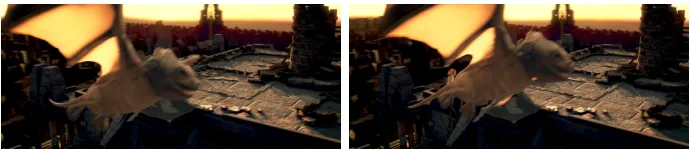
(a) Image att−1 (b) Image att (c) Image att+ 1
Figure 2.3: A situation where multi-frame optical flow is essential. The
dragon’s wing in the frame at time t goes out of frame at time t+ 1,
mak-ing it nearly impossible to recover its motion of usmak-ing two-frame optical flow.
The wing, however, is visible in frame t−1, which provides information about
its motion.
2.6
Multi-frame optical flow
Optical flow is often posed as a two-frame problem: estimate the apparent motion
from the frame at timetto timet+1. While this works for simple situations, there
is sometimes insufficient information in only two frames for a good correspondence
to be found. An example of this situation is shown in Figure 2.3. In this figure,
the dragon’s wing at timetis no longer visible at timet+1, and thus no amount of
smoothness constraint could propagate flow to this occluded region since the entire
region is occluded. However, in the previous frame at timet−1 the dragon’s wing is still visible and this provides information about the motion of the wing. The
use of more than two frames in optical flow can thereby provide useful information
and improve results.
Despite the relative lack of modern multi-frame optical flow algorithms, attempts
have been made to model temporal consistency back to the work of (Murray and
Buxton,1987). The most common idea is to impose a sort of temporal regularity
similar to the spatial regularity term. In particular, it is assumed that the flow
estimates are smooth over time. In (Nagel, 1990), Nagel extended the idea of
A related flow-driven temporal smoothness constraint was proposed subsequently
in (Weickert and Schnörr, 2001).
However, in contrast to the spatial term where pixels can be connected with a
static set of neighbors in a grid, a temporal continuity constraint works better if
it is paired with the pixel that it matches to in the subsequent image. A primary reason why simply enforcing smoothness across the same pixel location over time
does not work well is that many image sequences have a low frame-rate relative
to their motions and thus temporal derivatives are meaningless. Of course, this
pixel correspondence is not known beforehand, leading to a difficult optimization
problem. In (Black and Anandan, 1990), the motion of a pixel was compared
with an average of the same track point’s previous velocities. In (Salgado and
Sánchez,2007), a model is used that penalizes deviations between velocity vectors
in subsequent frames for matched pixels. A novel parameterization of temporal
smoothness was presented in (Volz et al., 2011), where a constraint was imposed
by parameterizing all flow values with respect to a center frame. In this model,
five frames are used for motion estimation. Rather than having a separate flow
estimate between all successive pairs of frames and needing to track points over
time, the flow values are estimated as an offset such that flow from the center frame to any other frame can be obtained by summing the flow estimates at the
same pixel location. This allows for temporal constraints to be naturally placed
along the temporal dimension.
Temporal consistency has also been enforced in layered models. In (Sun et al.,
2010b, 2012), a term of the cost function encourages pixels connected based on
the current flow estimate to have similar layer assignments.
stereo. In multi-view stereo, more than two images are used for reconstruction and
the result is a 3D surface of the imaged scene. In this case, a single point on the
object is seen from multiple images. In (Newcombe et al., 2011), the data costs
from multiple images are averaged, while in our method we take the minimum
of several data costs to allow for occlusions. A similar approach was also taken
in (Szeliski and Coughlan, 1997) and (Okutomi and Kanade, 1993). In (Szeliski
and Coughlan, 1997; Sun et al., 2000) in particular, linear flow was assumed for
multi-frame flow estimation. In (Kang et al.,2001), multiple frames were handled
within a stereo correspondence problem by selecting a subset of frames for each
pixel that were likely to be unoccluded.
In Chapter 4, we present a novel method of incorporating temporal information
into any optical flow algorithm with minimal complexity, leading to very
high-quality flow estimates on difficult image sequences.
2.7
Fusion methods
Fusion methods are an interesting optical flow technique, where multiple estimates
of optical flow are combined in order to improve results. Most often, this is done
by using multiple algorithms or parameter values to estimate the same two-frame
motion. In (Lempitsky et al., 2008), flow estimates were generated using the
Horn-Schunck and Lucas-Kanade algorithms with various parameter settings. The
objective of the fusion step in (Lempitsky et al.,2008) was to directly minimize the
energy of a global MRF model. This was done by considering two flow estimates
at a time and performing optimization using a discrete move-making algorithm
(Boykov et al., 2001). In (Jung et al., 2008), multiple local minima of an MRF
(a) 4-connected neighborhood
(b)
8-connected neighborhood
Figure 2.4: 4- and 8-connected MRF neighborhoods. A 4-grid is more
com-monly used due to its simplicity.
related method in (Chen et al.,2013) produced a set of proposal motion models and
then assigned each pixel to the models using an energy minimization framework.
Fusion can also be cast within a classification framework. In (Mac Aodha et al.,
2013), a random forest classifier was trained to estimate how accurate the optical
flow estimate is at each pixel. This confidence could potentially be used to combine
several algorithms based on which is more confident. A similar approach was
taken in (Mac Aodha et al.,2010), where a classifier was used to determine which
algorithm from a set of them would likely give the most accurate solution at each
pixel. In Chapter4, we show how a related fusion method can be used to not only
fuse multiple algorithms, but also to fuse temporal information that we call the
inertial estimates of optical flow.
2.8
Discrete optimization
In the methods discussed so far, optical flow has been treated as a continuous
optimization problem, where the offset assigned to each pixel location is potentially