STUDY ON SOLID WASTE
GENERATION IN KUANTAN,
MALAYSIA: ITS POTENTIAL FOR
ENERGY GENERATION
Mohd Shahir Zahari1, Wan Mohd Faizal Wan Ishak1, Mohd Armi Abu Samah2
1
Faculty of Civil Engineering and Earth Resources, University Malaysia Pahang,
Lebuhraya Tun Razak, 26300 Kuantan, Pahang Darul Makmur, Malaysia.
2
Department of Environmental Sciences, Faculty of Environmental Studies,
Universiti Putra Malaysia, 43400 UPM Serdang, Selangor, Malaysia.
Abstract
In Malaysia, most of the municipal solid waste goes to the landfill or dumping sites. The non-hazardous and general industrial waste are often treated together. The existing dumping sites mostly are not properly engineered and managed. Pollutants that are released or discharged from the disposal sites could contaminate groundwater system, flora and fauna which will eventually cause direct and indirect impact to human’s life (Mahmood, 2000). Presently, the amount of solid waste was produced in Kuantan is about 500 tons daily, consisting of 60% domestic waste and 40% of industrial and construction waste. However, the present sanitary landfill is nearly filled up (Ismail, 2006). In order to overcome this problem, an alternative by using incineration (waste to energy) system should be applied. By using this technology, solid waste will combusted to generate energy from burning heat. A study was conducted in Kuantan area to determine the daily solid waste generation. These waste generated rates were then calculated for the energy conversion. The results indicated that average value of total energy produced from solid waste of Kuantan is 19.3808kWh for year 2008 and 17.8942kWh for year 2009 and could be utilized as electricity, in order to save amount of energy and cost used.
Keywords: Municipal solid waste; Waste to energy; Incineration; Burning heat; Solid waste generation 1. Introduction
In the last two decades, MSW management became a major concern and is presently one of the main public subjects under discussion. This is probably due to the considerable increase of MSW production in both absolute and per capita values. The amount of MSW produced increases with economic growth and the demand for efficient management solution (Magrinho et. al., 2006). The Malaysian population has been increasing at a rate of 2.4 % per annum or about 600,000 per annum since 1994. With this population growth, the MSW generation also increases, which makes MSW management crucial (Mohd Armi, 2009).
. Statistics show that the world population reached six billion in 2001 with 46% of this population residing in urban areas (HMGN and MoPE, 2003). Global municipal solid waste generated in 1997 was about 0.49 billion tons with an estimated annual growth rate of 3.2–4.5% in developed nations and 2–3% in developing nations (Suocheng et al., 2001). Rapid urbanization and industrialization changed the characteristics of solid waste generated. As a consequence, the solid waste management system (SWMS) needs to be updated to suit the waste quality, quantity and composition (Latifah et al., 2009). Increasing of population growth in Malaysia has brought along with the increasing of the amount of waste generated. The national average of waste generated is at 0.5 – 0.8kg/person/day, but in the cities the figures have escalated to 1.7 kg/person/day.
incineration system to be implemented in Malaysia as an alternative to the old concept of just dumping all the waste that is generated (Kathirvale, 2003).
Waste to energy is a valorisation process and in some European countries the energy from incinerators accounts for a considerable proportion of the national usage (Agamuthu, 2001). However, burning of MSW to produce energy would reduce the usage of fossil fuel and hence the conservation of natural resources which otherwise would become depleted.
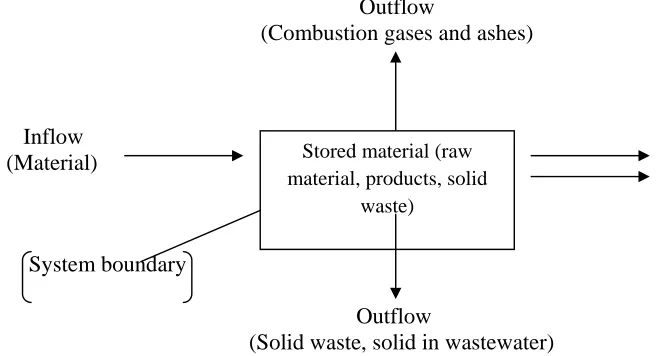
The generation and movement of solid wastes can be determined by performing a detailed material balance analysis for each sources of waste generation (Tchobanoglous et al., 1993). The amount of wastes can be calculated if the amount of a manufactured product and the fate of the products during consumption is known (Salleh, 2003). Figure 1 has show the sketch for material balance analysis.
Outflow
(Combustion gases and ashes)
Inflow
(Material)
System boundary
Outflow
(Solid waste, solid in wastewater)
Figure 1: Sketch for material balance analysis used to determined solid waste generation rates Source: Tchobanoglous et al., 1993.
To prolong the life of that landfill, Kuantan Municipal Council has embarked on 3R program five years ago but it not receiving good respond from the residents. Therefore, other alternatives should also be implemented in order to reduce the burden of the landfill and also open opportunities for new technologies in treating the municipal solid waste (MSW). Hence, this paper will present the solid waste generation in Kuantan and its potential for energy generation by using alternative; incineration system.
2. Methodology
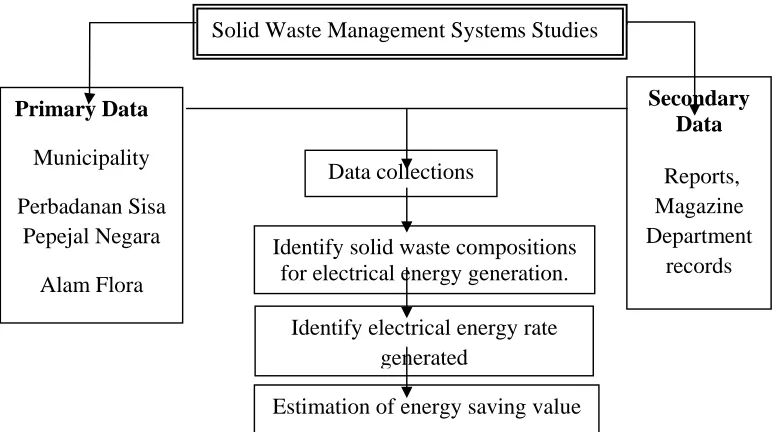
Solid waste management systems at Kuantan were studied. Two types of data sources is referred in this studies, primary and secondary. Primary sources is obtained by interviewing local authorities related to waste management such as Kuantan municipality and Perbadanan Pengurusan Sisa Pepejal and also private operator appointed by the local council, Alam Flora Sdn. Bhd. Secondary data sources obtained from yearly reports, magazine and local council department record.
Data collected from both types is then groups into solid waste characteristic either they are trash, rubbish, refuse, garbage, animal solid waste and organic waste, gaseous liquid or semi liquid waste, semi solid or solid waste. Trash, rubbish, refuse and garbage are our main focus in these studies.
The location of this study is located at Jerangau Jabor Landfill, Kuantan. All data of solid wastes collected will be studied further in order to know the total quantity and composition of solid wastes collected in Kuantan and below is the solid waste management flow for this study
Stored material (raw material, products, solid
Figure 2: Solid Waste Management Systems Studies
These solid wastes have been collected by contractors and will focus at residential, open areas, industrial and commercial sectors only. Then, the total average of solid waste generation per hour by its source should be identified first before potential of energy could be evaluated. There are some formulas to determine the potential electrical energy generation rate:
Total of average solid waste generation per hour:
= Average of solid waste per capita (kg/day) x 2.2046 24 hours
= lb per hour
P = Total of average solid waste generation per hour x heat value x efficiency 3412 Btu per hour
= kWh
3. Results and discussion
Based on the result, the conversion of net weight of solid wastes collected to total of average of solid waste generation per hour is being calculated in Table 4.4a and Table 4.4b below. It seems that in every month for year 2008, the total average of solid waste generation per hour (lb/hours) for solid wastes from residential area is 8.8748 lb/hours followed by open areas is 2.1089 lb/hours, industrial is 4.2558 lb/hours and commercial is 0.0147 lb/hours. (Figure 2).
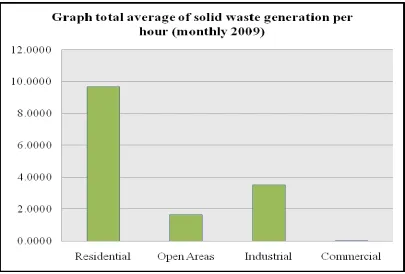
While, monthly analysis data for year 2009 shows that total average of solid waste generation per hour for residential area is 9.6534 lb/hours, open areas is 1.6224 lb/hours, industrial is 3.5132 lb/hours and commercial is 0.0135 lb/hours. (Figure 3). The value of total average of solid waste generation per hour will then is being used in calculating potential energy formula.
Solid Waste Management Systems Studies
Primary Data
Municipality
Perbadanan Sisa
Pepejal Negara
Alam Flora
Secondary
Data
Reports,
Magazine
Department
records
Data collections
Identify solid waste compositions
for electrical energy generation.
Identify electrical energy rate
generated
Figure 3 Total average of solid waste generation per hour (monthly 2008)
Figure 4 Total average of solid waste generation per hour (monthly 2009) Heat Value
Efficiency
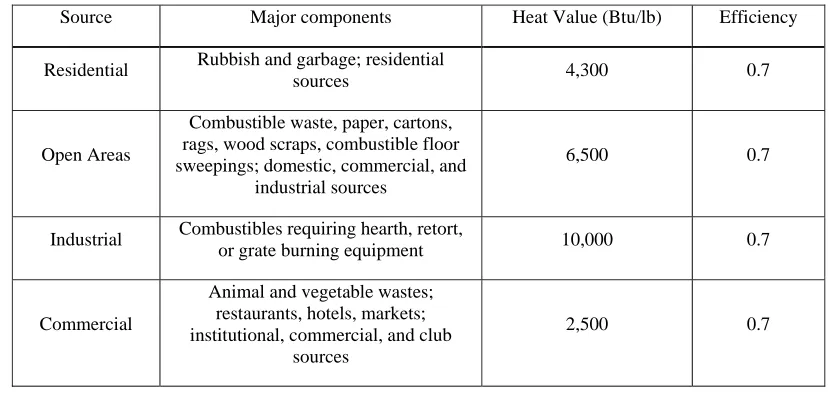
Various types of incinerators are currently manufactured. Efficiency of waste combustion is depend on the incineration technologies, the wastes’ combustibility characteristics, such as ignition temperature, flash point, and flammability limits determine the necessary operating temperature, O2 concentration, and residence time for
greatest waste minimization. Efficiency of waste combustion commonly can reach at range 50% to 85%. And there can reach 70% complete combustion of waste for incinerator which converts heat to electricity. Therefore, take efficiency equal to 70% (0.7) (Eugene, et.al., 1996)
Table 1 Heat Value and Efficiency of Component of Solid Wastes
Source Major components Heat Value (Btu/lb) Efficiency
Residential Rubbish and garbage; residential
sources 4,300 0.7
Open Areas
Combustible waste, paper, cartons, rags, wood scraps, combustible floor sweepings; domestic, commercial, and
industrial sources
6,500 0.7
Industrial Combustibles requiring hearth, retort,
or grate burning equipment 10,000 0.7
Commercial
Animal and vegetable wastes; restaurants, hotels, markets; institutional, commercial, and club
sources
2,500 0.7
3.1 Analysis Potential Energy Generation
In order to proceed with the next step of converting energy, there is formula that must be used to calculate the potential energy generation. That formula is given below:
Energy, P:
= Total of average solid waste generation/hour * heat value * efficiency 3412 Btu per hour
= kWh
**The value of 3412 Btu/hour is being used because to obtain value in electrical energy produced that is kWh. 1 kWh equal to 3412 Btu/hour or 1.341 hp (Pulkrabek, 1997).
Example of calculation:
To calculate potential energy of solid waste from residential area in January 2008;
Total average of solid waste generation per hour = 8.2836 lb/hours
Heat value (residential) = 4,300 Btu/lb
Thermal Efficiency = 0.7 Therefore;
Energy, P = 8.2836 lb/hours * 4,300Btu/lb * 0.7 3412
= 7.3076 kWh
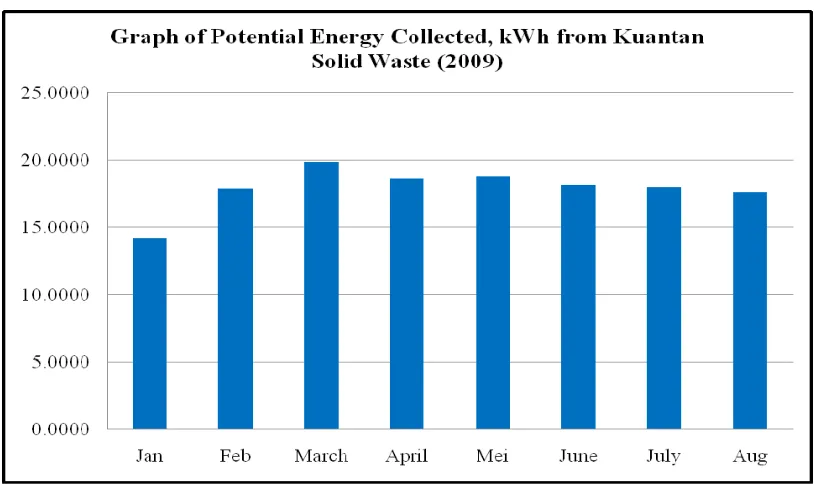
Average value of total energy potential collected in 2008 = 19.3808 kWh Average value of total energy potential collected in 2009 = 17.8942 kWh
(Complete conversion can be referred to Figure 4 and 5.)
Figure 5 Conversion of Potential Energy Generation (monthly 2008)
Figure 6 Conversion of Potential Energy Generation (monthly 2009)
Conclusion
development, education and many more. Finally, when evaluating the amount of energy that could be recovered by incinerate of solid wastes, it could be said that incineration does give high returns on energy while staying low on environmental effect and on the energy consumed to treat the municipal solid waste. Hence, this technology needs to be developed and understood in order to be implemented for treating the waste generated in Kuantan.
Acknowledgement
The authors are gratefully acknowledged to Universiti Malaysia Pahang for financial support in this research. References
[1] Agamuthu, P. 2001. Solid waste: Principles and management with Malaysian case studies. Institute of biological Science University of Malaya 50603 Kuala Lumpur.
[2] Eugene, A.A and Theodore, B. 1996. Mark’s Standard Handbook for Engineering, 10th Edition., New York, McGraw Hill.
[3] HMGN, MoPE, 2003. Nepal population report 2060. Published by His Majestys Government of Nepal (HMGN), Ministry of Population and Environment (MoPE) (in Nepali).
[4] Ismail, N. 2006. Action Plan of Kuantan City, AUICK First 2006 Workshop, Asian Urban Information Center of Kobe.
[5] Kathirvale, S., Muhd Yunus, M. N., Sopian, K., & Samsuddin, A. H. 2003. Energy Potential from municipal solid waste in Malaysia.
Renewable Energy 29 , 559-567.
[6] Latifah.A.M; Mohd Armi.A.S and Nur Ilyana. M.Z. 2009. Municipal solid waste management in Malaysia: Practices and challenges. Waste management 29 (2009) 2902–2906
[7] Magrinho, A., Filipe, D. and Viriato, S. 2006. Municipal solid waste disposal in Portugal. Waste Management. (26): 1477-1489. [8] Mahmood. N. Z .2000. Solid waste management in Malaysia: a comparison study. Water, Sanitation and Hygiene: Challenges of the
millennium, Dhaka, Bangladesh.
[9] Mohd Armi. A.S. 2009. An expert system for selecting an appropriate solid waste treatment technology. Thesis Master of Science UPM.
[10] Pulkrabek, W.W. 1997. Engineering Fundamentals of the Internal Combustion Engine, New Jersey, Prentice-Hall International Inc. [11] Salleh, M.N. 2003. Physical and chemical characteristic of solid wastes disposed at Taman Beringin landfill, Kuala Lumpur. Thesis
Master of Science UPM.
[12] Suocheng, D., Tong, K.W., Yuping, Y., 2001. Municipal solid waste management in China: using commercial management to solve a growing problem. Utilities Policy 10, 7–11
[13] Tchobanoglous, G., Thiesen. H. and Vigil S. A. 1993. Integrated solid waste management, engineering principles and management issues. New York: Mc Graw-Hill International Edition.