ISSN (Online): 2320-9364, ISSN (Print): 2320-9356
www.ijres.org Volume 4 Issue 12 ǁ December. 2016 ǁ PP.67-72
Fast Integer Ambiguity Resolution Based on Real-Coded
Adaptive Genetic Algorithm
Qingming Yi
1, Xidong Yi
1, Min Shi
1 1(School of Information Science and Technology, Jinan University, China)
ABSTRACT :
In view of the weak real-time performance in integer ambiguity resolution, an adaptive genetic algorithm based on real-coding is proposed in this paper. The float solution of integer ambiguity is calculated with kalman filter method, the ordering and multi-time(inverse) paired cholesky decomposition are adopted to decorrelate the float solution and its covariance matrix ,so we can eliminate the correlation of each ambiguity float estimation. With the given baseline, we can determine the integer ambiguity search space and search the integer ambiguity optimization results with adaptive genetic algorithm on the basis of real-coding. Numerical simulation results show that the proposed algorithm can resolve the integer ambiguities in a shorter time than Lambda method, and has stronger convergent ability than simple genetic algorithm. So it’s an efficient algorithm for fast integer ambiguity resolution.Keywords:
Integer ambiguity, kalman filter,cholesky decomposition,real-coding,adaptive genetic algorithmI.
INTRODUCTION
Fast integer ambiguity resolution is the key to high-precision real-time relative positioning when using GPS carrier phase as observation [1]. Lambda algorithm is the most widely used method and is of complete theories [2]. However, it has low search efficiency because of its large search space and high computational complexity. Genetic algorithm,proposed by professor J Holland, is of inherent parallelism, global optimization and robustness, but it's easy to trap in local optimum because of its constant crossover probability and mutation probability during the actual search process[3].Therefore, an adaptive genetic algorithm based on real-coding is proposed in this paper to simplify the search process and improve optimization ability.
II.
FLOAT SOLITION OF AMBIGUITY AND SEARCH SPACE
In order to eliminate the ionosphere error, troposphere error, satellite clock error, receiver clock error, etc,we often adopt double-differenced carrier phase observables in precision positioning. Suppose k,i receivers observed j,o satellites at time t, then observed double-differenced carrier phase equation can be denoted as follows[4]:
)
(
)
(
)]
(
)
(
)
(
)
(
[
1
)
(
, ,t
V
t
N
t
R
t
R
t
R
t
R
t
ko io kj ij joo
j
(
1
)
Where:
(
)
,
t
o j
means double-differenced carrier phase observables;
N
j,o(
t
)
meansdouble-differenced integer ambiguity;
means carrier wavelength;R
(t
)
means distance between satellites andreceivers;
V
(t
)
means residual vector. For the sake of modeling and simulation, constant-acceleration kalman filter model is conducted after linearization[5]. The equation of state and measurement are presented:1 1 1 1 ,
kk k k kk
X
W
X
(
2
)
k k k k
H
X
V
Z
(
3
)
Where:
X
kmeans state vector that contains receiver’s position and double-differenced ambiguity;1 ,
kkmeans state transition matrix;
Z
kmeans double-differenced observation vector;H
kmeans measurementmatrix;
V
kmeans observation noise.On the basis of the theory of surveying adjustment[6], suppose there is tepochs and j+1 satellites, covariance matrix of estimated parameters is as follows:
Q
(
2H
TM
-1H
)
-1(
4
)
Because there’s no integer constraints, integer ambiguity obtained from kalman equations are real
numbers, which is float solution
N
ˆ
of ambiguities.With the float solution,we find fixed solution of integer ambiguities by searching the minimum value of the following objective function:)]
ˆ
(
)
ˆ
[(
min
N
N
Q
N
N
N
J
(
)
T
(
5
)
Where N means the vector of j double-differenced integer ambiguities. For the baseline (L in
length),interval of each double-differenced integer ambiguity
N
n(n=1,2,...,j) is presented[7]:
/
/
-
L
N
n
L
(
6
)
Where
=19.03cm,which isL
1carrier.III.
INTEGER AMBIGUITY RESOLUTION BASED ON REAL-CODED ADAPTIVE
GENETIC ALGORITHM
Real-coded adaptive genetic algorithm,as a highly effective , robust, and parallel global search method, can simplify variables and adjust the probability of crossover and mutation adaptively during the search process, so as to obtain the global optimum solution.On the basis of the float solution and search space from formula (6), we search the objective function from formula (5) by designing genetic algorithm operation in this paper, including coding,setting fitness function and genetic operators,etc.
3.1 Cholesky Decomposition Based On Ordering
In order to keep the excellent schema of each chromosome, float solution and it's covariance matrix need to be decorrelated before the search. In view of the numerical instability of gauss decomposition and its twice amount in computation,we adopt cholesky decomposition. Continuous decomposition can be achieved by
continuously conducting improved upper(
UDU
T ) and lower(LDL
T ) triangular cholesky decomposition repeatedly[8]. Before the cholesky decomposition, we sort the diagonal entries (in ascending or descending order),to reduce the condition number of matrix, ameliorate the decomposition of matrix effectively, and improve the effectiveness and quality of ambiguity discrete search. With the ultimate transition matrix Z, we canobtain transformed ambiguity covariance matrix
Q
zand float solutionN
ˆ
z[9]:Q
ZQZ
N
zZ
N
T
z
,
ˆ
ˆ
(
7
)
By formula (5), (7), object function (8) after decorrelation is presented:
)]
ˆ
(
)
ˆ
[(
min
N
N
z TQ
z1N
N
zN
G
(
)
(
8
)
3.2 Real coding
The coding of genetic algorithm is to convert feasible solution from its solution space to search space that genetic algorithm can cope with.Its primary coding mode is binary encoding,nevertheless, integer ambiguity search process is to find integer and nonlinear optimization results, therefore real coding is much more accord with the inherent architectural feature of the process.The length of individual coding is shorter,computer's memory occupation is less, and hamming cliff is non-existed[10]. After the float solution and
its accuracy are obtained, according to the experiment, baseline L=2m, search space is between
10 cycles,each ambiguity
N
n (n=1,2,...,j) is coded as one code element, the code length of integer ambiguity is j. mj m m j
j
N
N
N
N
N
N
N
N
N
11 12...
1,
12 22...
2,...,
1 2...
form the initial population, m is population size.
3.3 Fitness Function And Genetic Operators
After real coding, we search the objective function by designing the fitness function and genetic operators. Fitness function is determined by objective function in genetic algorithm, to determine the optimum solution.For objective function (8), we choose formula (9) as fitness function in general[11]:
))
(
lg(
)
(
N
b
G
N
f
(9)
Where, b is a positive number, big enough to guarantee f(N)>0. Logarithm to objective function is to narrow the differences among ambiguities, prevent premature convergence of GA in this paper,and avoid trapping in local optimum.
proportion of its fitness value in average fitness value of the polulation.According to the ratio,the bigger fitness of individual is, the more likely it's being chosen[12]; crossover is to generate new individuals by the integration information of parenting mating population, crossover operator of reference [13] is adopted in this paper;mutation is the change generated by the small probability perturbation of child gene.Combined symmetrical and random mutation is adopted in this paper[14].
3.4 Adaptive Adjustment
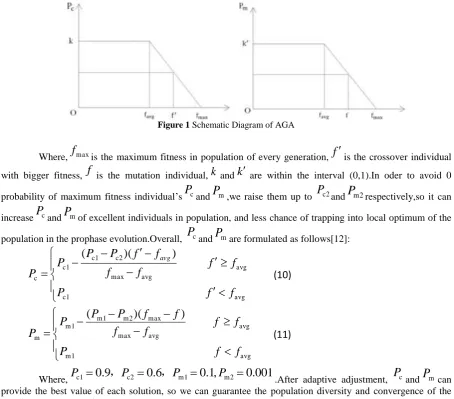
An adaptive genetic algorithm(AGA) was proposed by Srinvivas[15].For those whose fitness are higher than the average, the corresponding probability of crossover and mutation are lower, so they can be protected into next generation; for those whose fitness are lower than the average, the corresponding probability of crossover and mutation are higher,so they can be eliminated. Its schematic diagram is shown in Figure 1:
Figure 1 Schematic Diagram of AGA
Where,
f
maxis the maximum fitness in population of every generation,f
is the crossover individualwith bigger fitness,
f
is the mutation individual,k
andk
are within the interval (0,1).In oder to avoid 0probability of maximum fitness individual’s
P
candP
m,we raise them up toP
c2andP
m2respectively,so it canincrease
P
candP
mof excellent individuals in population, and less chance of trapping into local optimum of thepopulation in the prophase evolution.Overall,
P
candP
mare formulated as follows[12]:
avg c1 avg avg max c2 c1 c1 c)
)(
(
f
f
P
f
f
f
f
f
f
P
P
P
P
avg(10)
avg m1 avg avg max max m2 m1 m1 m)
)(
(
f
f
P
f
f
f
f
f
f
P
P
P
P
(11)
Where,
P
c1
0
.
9
,
P
c2
0
.
6
,
P
m1
0
.
1
,
P
m2
0
.
001
.After adaptive adjustment,P
candP
mcanprovide the best value of each solution, so we can guarantee the population diversity and convergence of the algorithm at the same time
3.5 Resolution procedure
Figure 2 Resolution Flow Chart
IV.
SIMULATION AND RESULTS ANALYSIS
Methods above are simulated with the example from paper [16].In order to analyze the effectiveness of decorrelation algorithm in this paper, decorrelation coefficient R and spectral conditional number of matrixes E are applied as evaluation criterion of covariance matrix decorrelation degree after transformation[9],and the corresponding data is shown in Table 1:
Table 1 Analysis of decorrelation degree
Before decorrelation After decorrelation Decorrelation coefficient (R) -6
10
9
.
0
0
.
73
Spectral conditional number of matrixes
(E)
195
2
.
52
From table 1,before decorrelation,R is small, approaching to 0,which means there is strong correlation among ambiguities;E is big,which means searching ellipsoid is extremely prolate stretched and ambiguities are strongly correlated.After decorrelation,R is increasing significantly, approaching to 1, meanwhile,E is substantially decreasing, covariance matrix is much more closed to diagonal matrix,correlation among ambiguities is lowered,which means decorrelation algorithm in this paper is pretty much effective and it’s well suited for GA to find the optimization.
Let population size=20, max-epoch=200[12],simulation results of ambiguities search and resolution with improved AGA in this paper are shown in Figure 3:
Figure 3 Simulation Result
With the premise that correct ambiguities are found, time consumption of Lambda method,simple GA[17],and our algorithm are presented as Table 2:
Table 2 Contrast of time consumption
Lambda Simple GA Proposed algorithm
Time/s 91.5 47.4 14.7
From Table 2,time consumption of proposed algorithm is significantly less than Lambda method and simple GA.It’s because Lambda starts the search process centred on a certain initial float solution,and the choice of this initial point is involved with the effectiveness of the whole process; and a single point is incapable of presenting much search information.When there’s too many observations,its search space may become larger with higher computational complexity and bigger time consumption;during the decorrelation,Lambda adopts gauss decomposition,which is of numerical instability and mass computation.Simple GA’s coding mode is binary coding,the shortcoming of hamming cliff is unavoidable,and the number of coding parameters is relatively large,as for genetic operators,constant probabilities of crossover and mutation severely affect the effectiveness of GA's search process.
V.
CONCLUSIONS
Integer ambiguity resolution in DGPS positioning model is studied systematically in this paper.Kalman filtering is applied to solve the float solution,cholesky decomposition based on ordering is adopted in decorrelation,finally,with the given baseline,improved AGA is proposed to search the integer ambiguity optimization results. Numerical simulation and comparison results show that the proposed algorithm takes mush less time than Lambda method,and its convergence rate is far higher than simple GA,accordingly,it’s highly efficient for fast integer ambiguity resolution and the research in this paper can be referred in further research of RTK technique.
ACKNOWLEDGEMENTS
The project is sponsored by the Science and Technology Project of Guangdong Province( NO.2015B090910001)and Science and Technology Project of Guangzhou City(NO. 201604010007)The authors would like to thank the editor and the reviewers for their constructive comments and suggestions which improved the quality of this paper.
REFERENCES
[1]. Liu Jing-nan.Review of GNSS ambiguity validation theory[J].Geomatics and Information Science of Wuhan University,2014,39(9):1009-1016.
[2]. Teunissen P J G.The least-squares ambiguity decorrelation adjustment:a method for fast GPS integer ambiguity estimation[J].Journal of Geodesy,1995,70(1-2):65-82.
[3]. Xing Ji. Ambiguity resolution based on improved genetic algorithm[J].Science of Surveying and Mapping,2011,36(3):110-113.
[4]. Teunissen P J G.The invertible GPS ambiguity transformations[J].Manuscript Geodesy,1995,20(6):489-497. [5]. Li Zheng-hang.GPS Surveying and data processing [M].Wuhan:Wuhan University Press,2005:135-141.
[6]. Teunissen P J G,et al.Integer ambiguity estimation with the Lambda method[J].Proceedings of IEEE Symposium on Position Location and Navigation,1996,21(7):280-284.
[7]. Liu Jing-nan.Ambiguity Resolution of Single Epoch Single Frequency Data with Baseline Length Constraint Using LAMBDA Algorithm [J]. Geomatics and Information Science of Wuhan University,2005,30(5):444-446.
[8]. Zhou yangmei.A new practical approach to GNSS high-dimensional ambiguity decorrelation[J].GPS Solutions,2011,15(4):325-331.
[9]. Huang Zhang-yu.Modified GPS ambiguity white-filtering algorithm [J].Journal of Southwest Jiaotong University,2010,45(1):150-155.
[10]. Goldberg D E.Genetic algorithms in search optimization and machine learning[M].New York:Addision Wesley,1989.
[11]. Zheng Qing-hui.OTF Ambiguity Resolution Based on Genetic Algorithm[J].Journal of National University of Defense Technology,2001,23(3):12-17.
[12]. Wang Xiao-ping.Genetic Algorithm-Theory,application and software implementation [M].Xi’an: Xi’an Jiaotong University Press,2002:18-38,73-74.
[13]. Xia Chuan-jia.Integer ambiguity resolution of GPS short-baseline based on real-coded genetic algorithm[J].Journal of Geodesy and Geodynamics,2012,32(1):136-140.
[14]. Liu Jing-nan.Ambiguity resolution of GPS short baseline using genetic algorithm[J].Geomatics and Information Science of Wuhan University,2006,31(7):607-609.
[16]. Paul de Jonge.The LAMBDA method for integer ambiguity estimation:implementation aspects[J].Delft Geodetic Computing Center LGR Series,1996,12:1-49.