An Optimal Savitzky-golay Filtering Based
Vertical Handoff Algorithm in Heterogeneous
Wireless Networks
Dan Tong
School of Information Science and Engineering, Xinjiang University, Urumqi 830046, China E-mail:[email protected]
Zhenhong Jia, Xizhong Qin
School of Information Science and Engineering, Xinjiang University, Urumqi 830046, China
Chuanling Cao, Chun Chang
China Mobile group Xinjiang Co., Ltd., Urumqi 830063, China
Abstract—Vertical handoff is of great significance to achieve seamless connectivity in heterogeneous networks. It is necessary to enhance the location awareness of the mobile station (MS) as well as to reduce the adverse effect of fading so that it is able to predict future network conditions accurately. An optimal Savitzky-Golay filtering based vertical handoff algorithm is adopted in this essay, which equips the MS to decide network coverage boundaries accurately. Simulation results show that this method can reduce the effects of fading in the received signal, thereby reducing the ping-pong effect availably. It can also improve the performance of the network.
Index Terms—vertical handoff, seamless connectivity, heterogeneous networks, Savitzky-Golay filtering
I. INTRODUCTION
With the development of wireless network and communication technology, different wireless network systems have appeared such as WiMax, WMAN, UMTS, and WLAN. As the development trend of next generation network, heterogeneous network integration is the integration of merits of different networks, in order to obtain the most satisfactory quality of service (QoS). Network selection could not only affect the quality of service to users directly, but also have vital impacts on resource utilization of networks and load balancing of services. Handoff algorithm for heterogeneous network may guarantee the quality of service, and it can also maximize the utilization of network resources. The handoff between access networks with different link layer technologies is defined as vertical handoff (VHO), whereas handoff between different access points within
the same link layer technology is defined as horizontal handoff (HHO) [1]. Compared with horizontal handoff, vertical handoff is more significant on research. In the world, Wireless Local Area Network (WLAN) has got ever-broader applications. Vertical handoff between WLAN and other networks will become more important. An optimal handoff method can improve the quality of service to users, so we need to create an accurate handoff algorithm.
The critical contributions of this paper can be stated as follows. Firstly, the impacts of velocity of the MS on the performance have been illustrated in the proposed network model. Secondly, it should be observed that the fading effects play a significant role on networks handoff. The severity of shadow fading on the performance will be solved by the proposed method. Finally, solving the problem which various effects give rise to in different areas, an optimal vertical handoff algorithm based on Savitzky-Golay filtering is proposed .
The rest of this paper is organized as follows. In Sect. II, we describe the related works about handoff algorithm. In Sect. III, the system model, as well as the corresponding parameters. The proposed vertical handoff algorithm based on Savitzky-Golay filtering is presented in Sect. IV. The performance of the proposed vertical handoff algorithm is verified by simulations in Sect. V. Finally, Sect. VI provides the conclusions of the paper.
II. RELATED WORKS
Although there have been a lot of researches about vertical handoff algorithm in [2-5], but they are mostly fixed threshold algorithms. They may be effective to reducing ping-pong effect, but due to the static values and the preset mode, the handoff timing selection policy which is fixed and single may delay handoff triggering and decrease handoff efficiency largely. Ref.[6] proposed a type-2 fuzzy multi-parameter based vertical handoff decision algorithm. It considers five parameters of
network and user, and applies a multi-mode smart terminal based speed adaptive vertical handoff policy. But it could not consider the effects of RSS. In [7], a cross-layer-based polynomial regression predictive RSS approach with the MDP-based optimal network selection for handoff in heterogeneous wireless networks is proposed. However it doesn’t evaluate the necessity of mobile node (MN) access to WLAN. In Ref.[8], the authors proposed a distributed vertical handoff strategy for vehicle to vehicle and vehicle to infrastructure communication. The communication cost and transmitting time is discussed. It is mainly developed from the hysteresis-based and dwelling-timer-based algorithms, which is widely used in horizontal handoff of cellular network. In vertical handoff, the velocity factor has more imperative effects on handoff decision than in horizontal handoff.
As a matter of fact, network conditions have an important influence on vertical handoff decisions. In Ref.[9], the authors propose a number of VHO algorithms for two new network models considering integration of WLAN and 3G networks. In [10], a vertical handoff algorithm based on Q-learning is proposed. Q-learning can provide the decider with self-adaptive ability for handling the terminal handoff requests with different motion types and channel conditions. In Ref.[11], a new adaptive vertical handoff algorithm based on compensating time is devised to analyze the necessity of access to WLAN. They could reduce the ping-pong effect. The previous researches, however, could be considered insufficiently the influences of fading effects on RSS. In this paper, a vertical handoff algorithm using Savitzky-Golay filtering will be proposed for different fading effects. The handoff between WLAN and LTE in wireless access technology is a typical representation. Meanwhile, the paper introduces the basic principles and the decision processes. The algorithm is able to reduce effectively the fading effect and the unnecessary handoff. It is also applicable to vertical handoff among other wireless access technologies.
III. SYSTEM MODEL AND PARAMETERS
In this section, we assume that a heterogeneous wireless network consists of WLAN and LTE. The diagrammatic representation of the simulation model is given by Fig.1.
The fading effect can be widely classified into fast fading and slow fading [12]. Rayleigh fading distribution
can adapt to calculate the fast fading because of the forward scattering property. The proposed algorithm, in particular, ought to apply to the Jake’s Model for Rayleigh distribution since it is the most accurate and fastest algorithm [13]. In order to reduce the fading effect in the MS, a smoothening filter named Savitzky-Golay filter is employed [14].
A. Velocity and Location
Velocity and location are calculated through the coordinates from the GPS device of the MS. After gaining the coordinates of the MS, the distance can be expressed as,
(
) (
2)
22 1 2 1
d
=
x
−
x
+
y
−
y
(1) where(x1, y1)and(x2, y2)represent the previous and present coordinates of the MS respectively.The velocity is given by vMS=d/t, where t represents
time interval of which MS is from the initial coordinates to the present coordinates.
B. Slow Fading
The path loss for free space can be expressed as,
32.44+20log 20log
L
P = f + d (2)
where PL is the path loss in dB, d is the distance between
MS and the Transceiver in Km, f is the frequency in MHz. The path loss for WLAN PLWLAN in dB can be expressed as,
( )
00
10 log
WLAN d
PL =PL d + n ⎛⎜⎝ d ⎞⎟⎠+Xσ (3)
where PL(d0) is the path loss w.r.t the reference distance
d0 , n is the path loss exponent, d is the separation between
transceiver and MS in meter. Xσ is a zero mean Gaussian distributed random variable with standard deviation σ. The reference distance d0, the path loss exponent n and the
standard deviation σ, statistically describes the path loss for an arbitrary distance between transceiver and MS.
Commonly, the path loss is given by Advanced Okumara and Hata Empirical model [15]. The LTE path loss in dB is estimated by,
( )
69.55 26.16log 13.82log[44.9 6.55log ]log
LTE b m
b
PL f h a h
h d
= + − −
+ − (4)
where hb is the height of the transceiver in meters, hmis
the height of the MS in meters, a(hm) is the antenna
height correction factor in dB. For sub urban and urban areas,
( ) (
m = 1.1log 0.7)
m(
1.56log 0.8)
a h f − h − f − (5) Slow fading calculation as following:
slow WLAN LTE shadow
F
=
PL
+
F
(6) where Fshadow denotes shadow fading.C. Fast Fading
Fast fading calculation [16]:
( )
(
)
(
2)
10lg ,
fast
F = E R t k (7)
where E(│R(t,k)│2) is the mean value of R(t,k). AP
BS LTE
MS
WLAN
D. Calculation of Received Signal Strength(RSS)
(
)
T slow fast
RSS
=
P
−
F
+
F
(8) where PT represents transmit power.E. Savitzky-Golay Filtering
Savitzky-Golay filter was proposed by Savitzky and Golay in 1964. It is widely used to smooth data and de-noise, which is a special low pass filter (LPF) in essence. The algorithm is the best method based on least–square polynomial approximation. Compared with other similar methods, one of the merits of the Savitzky-Golay smoothening filter is that it tends to preserve established features of the time-series as local minima and maxima [17].The algorithm computes a local polynomial regression on the input data by solving the equation:
2 0 1
k k
Y a x a x
=
+
+ +
"
a x
(9) S-G filter can be regarded as a moving average filter widely. You could derive the filter coefficients by performing an un-weighted linear least-squares fit using a polynomial of a given degree. The Savitzky-Golay filtering method is often made use of frequency data or spectroscopic (peak) data. For frequency data, the method is effective at preserving the high frequency components of the signal. For spectroscopic data, the method is effective at preserving higher moments of the peak such as the line width. By comparison, the moving average filter tends to filter out a significant portion of the signal high-frequency content, and it can only preserve the lower moments of a peak such as the center of mass. Savitzky-Golay filtering can be less successful than a moving average filter to de-noise. However, it should note that a higher degree polynomial makes it possible to achieve a high level of smoothing without attenuation of data features [13].IV. PROPOSED SAVITZKY-GOLAY FILTERING BASED
VERTICAL HANDOFF ALGORITHM
Vertical handover is divided into up and down handoff, and it is a certain asymmetry. Vertical handover can be divided into three processes: the judgment on trigger handoff event; handoff initialization; perform handoff.
As shown in the flowchart Fig.2, firstly, the velocity and location of MS can be determined by the GPS model. When calculating the RSS, we consider fast fading and slow fading. Then after S-G filtering, trigger handoff event will be judged. Therefore, we ought to set it under initialization. Finally, it could execute handoff.
V. PERFORMANCE EVALUATION
In this section, we depict the performance on our proposed algorithm based on S-G Filtering. As shown Fig.1, we assume that the LTE range is set to be 1km, the WLAN range is set in the range 0.3km, and the shortest distance is set to be 35m between them. Their corresponding frequencies are 2.0GHz and 2.5GHz respectively. The maximum transmission powers of WLAN and LTE are set to 23dBm and 33dBm respectively. The base station coordinates are set to (0,0) and (600,0) respectively. Detection interval of signal is 0.5s, and handoff delay is 1s in simulation cases. Assuming the initial coordinates of MS are (100,0), they will arrive at (1000, 0) in 90s.
The simulation describes the change of network performance in this process, and according handoff decision algorithm we will know when the vertical handoff occurs. There are several kinds of scenes in MS moving as following:
Scene 1, the MS lies in the LTE coverage area at first. Thus according to the metrical values of received signal strength (RSS) and the decision algorithm, we ought to choose LTE;
Scene 2, when MS has arrived at the WLAN coverage range, we can select either LTE or WLAN. And then according to the received signal strength (RSS) and the decision algorithm, we determine when to do them;
Scene 3, when MS exceeds the WLAN coverage range, the LTE network is optional at this moment. And then MS will switch into the LTE network.
Fast fading calculation GPS Model
location velocity
HO Trigger
Slow fading calculation
RSScalculation
S-G filter
HO Initializatio
HO Execution
Figure.3 The performance of the usual algorithm
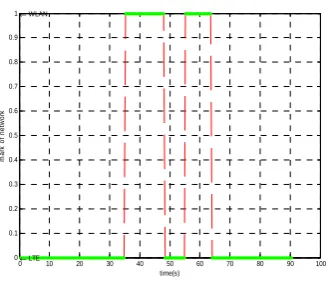
In following simulation results, as shown in Fig.3, we take into account that the shadow fading effect is nil in Eq. (6) . They are the changing and switching chart of the received signal strength (RSS) in the two networks when MS is moving in the process. In Fig.3 (a), it is the changing figure of the received signal strength, which is non-smoothed processing by S-G filtering. The horizontal axis represents the time and the vertical axis represents the value of received RSS in a period of time. Fig. 3 (b) is the switching graph on the state of MS in two networks.
In Figure.4 and Figure.5, we consider that the value of the shadowing effect is non-zero in Eq. (6). They are the changing and switching graph of the received signal strength (RSS) in the two networks when MS is moving in the process. Fig.4 (a) is the result of smoothing without S-G filtering and Fig.4(b) is the state of MS. Fig.5 (a) is the result of smoothing with S-G filtering and Fig5(b) is state of MS in two networks. The handoff time of each algorithm was shown in Table.1. Obviously, handoff times have been reduced after the S-G filtering.
Figure.4 The performance of the proposed algorithm TABLE I
HANDOFF TIMES FOR EACH ALGORITHM
Algorithm algorithm Usual The proposed algorithm The optimized algorithm Handoff times 8 6 4
0 10 20 30 40 50 60 70 80 90 100 -115
-110 -105 -100 -95 -90 -85
time(s)
RS
S
(d
B
m
)
LTE WLAN
(a) The RSS of two networks with shadowing effect
0 10 20 30 40 50 60 70 80 90 0
0.1 0.2 0.3 0.4 0.5 0.6 0.7 0.8 0.9 1
time(s)
m
ar
k
of
n
et
w
or
k
← LTE
← WLAN
(b) The state of MS in two networks
0 10 20 30 40 50 60 70 80 90 100 -115
-110 -105 -100 -95 -90 -85
time(s)
R
SS(
d
B
m)
LTE WLAN
(a) The RSS of WLAN and LTE networks
0 10 20 30 40 50 60 70 80 90 0
0.1 0.2 0.3 0.4 0.5 0.6 0.7 0.8 0.9 1
time(s)
m
a
rk
of
net
w
o
rk
← LTE
← WLAN
(b) The state of MS in two networks
0 10 20 30 40 50 60 70 80 90 100 -115
-110 -105 -100 -95 -90
time(s)
R
SS(
d
Bm
)
LTE WLAN
Figure.5 The performance of the proposed new algorithm
Simulation results show that compared with usual algorithm, the frequency of vertical handoff has been significantly decreased by S-G filtering. We consider the shadow effect is assumed to be non-zero in Fig. 4 and in Fig.5, whereas the shadow effect is assumed to be nil in Fig. 3. The comparison between Fig. 3 and Fig. 4 reveal that the latter is more sufficient on fading effect. Several handoff times have been decreased in Table.1 finally. For comparison, it shows that the proposed S-G filtering vertical handoff algorithm is able to avoid unnecessary handoff and reduce "ping-pong" effect.
VI. CONCLUSION
For the integration of LTE and WLAN, an optimized Savitzky-Golay filtering based vertical handoff algorithm is proposed in this paper. Considering the path loss and shadow fading effects while MS is moving, we establish hybrid network model in LTE and WLAN hotspot coverage area. Simulation results show that our method is better than other methods that use the received signal strength. It should be noted that the performance of S-G filtering algorithm rarely relies on the set value of RSS threshold, because it utilizes the trajectory of MS to perform handover decision. S-G filtering algorithm can smooth fluctuations of the signal and prevent the MS from making unnecessary handoffs. It demonstrates that the algorithm can reduce "ping-pong" effect in the vertical handoff and the quality of service can be enhanced.
ACKNOWLEDGMENT
This work was supported by the Foundation of China Mobile Communications Corporation Xinjiang Co. Ltd. Research and Development Project under contract No.XJM2013-2788. The authors gratefully acknowledge the support of the Foundation of the China Mobile Communications Corporation Xinjiang Co. Ltd.
REFERENCES
[1] F. Siddiqui, and S. Zeadally. “Mobility management across hybrid wireless networks: Trends and challenges”,
Computer Communications, vol. 29, no. 9, 2006. pp. 1363-1385.
[2] Yang, K., Gondal, B., Qiu, B., and Dooley, L. S. (2007)
“Combined SINR based vertical handoff algorithm for next generation heterogeneous wireless networks”. In Proc. Globe com , Washington DC. pp. 4483–4487.
[3] Ayyappan, K., and P. Dananjayan. “RSS measurement for vertical handoff in heterogeneous network.” Journal of Theoretical & Applied Information Technology ,vol. 10, no.4, pp. 989–994, 2008.
[4] Peng Yi, Zheng Yong. “A Novel Spectrum Handoff Method Based On Spectrum Reservation”. TELKOMNIKA Indonesian Journal of Electrical Engineering. 2014, 12(1): 653-660.
[5] Kumar J. “Broadcasting Traffic Load Performance Analysis of 802.11 MAC in Mobile Ad Hoc Networks (MANET) Using Random Waypoint Model (RWM)”. International Journal of Information and Network Security, 2012, 1(3): 223-227.
[6] Ma, Bin, Xiaofeng Liao, and Xianzhong Xie. “Vertical Handoff Algorithm Based on Type-2 Fuzzy Logic in Heterogeneous Networks.” Journal of Software, vol. 8. No. 11, 2013.
[7] Chang B J, Chen J F. (2008) “Cross-layer-based adaptive vertical handoff with predictive RSS in heterogeneous wireless networks”. Vehicular Technology, IEEE Transactions on, vol.57, No.6, pp.3679-3692.
[8] K. Shafiee, A. Attar, and V. C. M. Leung, “Optimal distributed vertical handoff strategies in vehicular heterogeneous networks,” IEEE Journal on Selected Areas in Communications,vol.29, no. 3, pp. 534–544, 2011. [9] Roy, Sanjay Dhar, and S. Reddy Vamshidhar Reddy.
“Signal Strength Ratio Based Vertical Handoff Decision Algorithms in Integrated Heterogeneous Networks.” Wireless Personal Communications (2014): 1-21.
[10] Limin Li, Lin Ma, Yubin Xu, and Yunhai Fu. “Motion adaptive vertical handoff in cellular/WLAN heterogeneous wireless network.” The Scientific World Journal , March 2014 .
[11]Ling J, Hui Z, Long-Xiang Y. “An Adaptive Vertical Handoff Algorithm Based on UMTS and WLAN.”
TELKOMNIKA Indonesian Journal of Electrical Engineering, vol.12, no.5, 2014.
[12] Rappaport T S. Wireless communications: principles and practice. New Jersey: Prentice Hall PTR, 1996.
[13] R. Nagarjun, A. Boniface, and T. Velmurugan. (2013) “A Novel Vertical Handoff Algorithm Using Savitzky-Golay Filtering Method For Heterogeneous Networks”.
Automation, Computing, Communication, Control and Compressed Sensing (iMac4s), 2013 International Multi-Conference on. IEEE, 2013. pp.286-291.
[14] R. W. Schafer. (2011) “What is a Savitzky-Golay filter?[lecture notes]”. Signal Processing Magazine, IEEE, vol. 28, no. 4, pp. 111-117.
[15] J. M. Casaravilla, G. A. Dutra, N. Pignataro, and J. E. Acuna. (2009) “Propagation Model for Small Urban Macro Cells”, IEEE Transactions on Vehicular Technology, vol. 58, no. 7, pp. 3094-3101, Sep, 2009.
[16] B. Cha, S. Seo, Y. Choi, and J. Song. (2008) “Mobile-velocity adaptive vertical handoff in integrated WLAN and wibro networks”. Information and Automation for Sustainability, 2008. ICIAFS 2008. 4th International Conference on. IEEE, 2008. pp. 384-389.
[17] Tianjing Cai, Hang Tang. (2011) “The principle of least squares fitting on Savitzky-Golay smoothing filters”.
Digital communications, vol. 1, no. 17, pp. 63-68.(In Chinese)
0 10 20 30 40 50 60 70 80 90 100 0
0.1 0.2 0.3 0.4 0.5 0.6 0.7 0.8 0.9 1
time(s)
ma
rk
o
f
n
e
tw
o
rk
← LTE
← WLAN
Dan Tong was born in 1989 at Xi’an, Shaanxi province, China. She is a master at Xinjiang University. Her research interests include handoff technology for heterogeneous wireless networks, communication and information systems etc. Email:[email protected].
Zhenhong Jia was born in1964, Doctoral tutor, Professor at the Xinjiang University of China. His current research interests lie in optical communication technology, signal and information processing etc. Email:[email protected].
Xizhong Qin was born in 1964, Master tutor. His research interests include mobile communication, signal and information processing etc.
Chuanling Cao was born in 1979, Master. She is the chief engineer in China Mobile group Xinjiang Co., Ltd. Her research interests include business network.
Chun Chang was born in 1963, Master. He is the director of planning Ministry of construction in China Mobile group Xinjiang Co., Ltd. His research interests include network planning research and development, engineering and management.