99 | P a g e
SMS FOR ANDROID APPLICATION BY USING 3D-AES, PGP AND STEGNOGRAPHY
Namrata A. Kale1
Computer Engineering SCSMCOE, Nepti Ahmednagar, India [email protected]
Seema A. Darekar Computer Engineering
SCSMCOE, Nepti Ahmednagar, India [email protected]
Abstract— Today the age of information technology has transformed the ways we communicate with each other. We send emails, send SMS, send message using social networking sites and many more. The uses of computers, smart phones and clouds have become an integral part of our life for sharing information with each other. Thus introduction of all these means have also given rise to misuse of information by third party which can steal our private information.
Thus we are thinking of using cryptography for securing our information. Today there are many cryptographic algorithms available for securing data but those are common from AES to RSA. So we are thinking of enhancing the security by using an advanced version of AES called as 3D-AES which generates a symmetric key by shuffling the original key array three times and making the key better each time it is shuffled. Thus the final output key will be more
strong then a normal AES key. It will help secure the data more accurately than the normal one. The studies should reflect a lower encryption time and more security then the normal one. The other technique is used PGP for encryption and Compress the encrypted message to reduce its length, using Shannon fano algorithm technique.
Keywords- 3D-AES; Encryption; Block cipher; Security; Compression; Message; Mobile Application.
Introduction
SMS stands for Short Message Service. It is a technology that enables the sending and receiving of messages between mobile phones. Adding text messaging functionality to mobile devices began in the early 1980s. The first action plan of the CEPT Group GSM was approved in December 1982, requesting that, "The services and facilities offered in the public switched telephone networks and public data networks, should be available in the mobile system." This plan included the exchange of text messages either directly between mobile stations, or transmitted via message handling systems in use at that time.
The SMS concept was developed in the Franco-German GSM cooperation in 1984 by Friedhelm Hillebrand and Bernard Ghillebaert. The GSM is optimized for telephony, since this was identified as its main application. The key idea for SMS was to use this telephone-optimized system, and to transport messages on the signaling paths needed to control the telephone traffic during periods when no signalling traffic existed. In this way, unused resources in the system could be
used to transport messages at minimal cost. However, it was compulsory to limit the length of the messages to 128 bytes (later improved to 160 seven-bit characters) so that the messages could fit into the existing signaling formats. SMS could be applied in every mobile station by updating its software.
Hence, a large base of SMS capable terminals and networks existed when people began to use SMS. SMS first performed in Europe in 1992. Later it was ported to wireless technologies like CDMA and TDMA.
The GSM and SMS standards were originally developed by ETSI. ETSI is the abbreviation for European Telecommunications Standards Institute.[1] Now the 3GPP (Third Generation Partnership Project) is responsible for the development and maintenance of the GSM and SMS standards. The rapid development in mobile communication
has transformed SMS as common tool for business and public messaging. SMS services are growing day by day. With SMS, people can easily share personal and official messages in a cost effective way. SMS enables the transmission of up to 1120 bits alphanumeric messages between mobile phones and external systems. It uses SMS center (SMS-C) for usage is weak with security concerns, such as eavesdropping, interception and modification. SMS messages are transmitted as plaintext between the mobile stations and the SMS center using the wireless network. SMS content are stored in the systems of the network operators and can easily be read by their personnel. The A5 algorithm, which is the GSM standard for encrypting transmitted information, can easily be compromised. Therefore, there is a need to provide an additional encryption on the transmitted messages. As suggested by the name Short Message Service, the data that can be held by an SMS message is very limited. One SMS message can contain at most 140 bytes (1120 bits) of data, so one SMS message can contain up to:
160 characters if 7-bit character encoding is used.
100 | P a g e the call, short messages travel over and above the radio
channel using the signaling path. Using communications protocols such as Short Message Peer-to-Peer (SMPP) allow the interchange of short text messages between mobile telephone devices as shown in Fig. 1 that describe traveling of SMS between parties.
Fig.1 Basic traveling of SMS
SMS messages do not require the mobile phone to be active and within range, as they will be held for a number of days until the phone is active and within range. SMS are transmitted within the same cell or to anyone with roaming skill. The SMS is a store and forward service, and is not sent directly but delivered via an SMS Center (SMSC). SMSC is a
network element in the mobile telephone network, in which SMS is stored until the destination device becomes available. Each mobile telephone network that supports SMS has one or more messaging centers to handle and manage the short messages.
Short Message Service architecture
The network architecture of short message service in GSM is illustrated in Fig 2. In this architecture, the short message is first delivered from the Mobile Device A to a short message service center (SM-SC) through the base station system (BSS), the mobile switching center (MSC). The SM-SC then forwards the message to the GSM network through a specific GSM MSC called the short message service gateway MSC (SMS GMSC). The SM-SC may connect to some GSM networks and to some SMS GMSCs in a GSM network. Following the GSM roaming protocol, the SMS GMSC locates the current MSC of the message receiver and forwards the message to that MSC. The MSC then broadcasts the message through the BSS to the destination Mobile Device A.
Fig.2 GSM short message service network architecture
SMS Security:
SMS Security Threats understanding the basics of SMS security opens the door to preventing some common security
threats in SMS usage: [3]
Man-in-middle Attack: This is the network that authenticates users. The user does not authenticate network so the attacker can use a false BTS with the same mobile network code as the subscriber's authentic network to impersonate himself and perform a man-in-the-middle attack.
Replay Attack: The attacker can misuse the previously exchanged messages between the subscriber and network in order to perform the replay attacks.
Message Disclosure: Since encryption is not applied to short message transmission by default, messages could be intercepted and snooped during transmission. In addition, SMS messages are stored as plain text by the SMSC before they are successfully delivered to the intended recipient. These messages could be viewed by users in the SMSC who have access to the messaging system.
Spamming: While using SMS as a legitimate marketing channel, many people have had the inconvenience of receiving SMS spam. The availability of bulk SMS broadcasting utilities makes it easy for virtually everyone to send out mass SMS messages.
Denial of Service (DoS) Attacks: DoS attacks are made possible by sending repeated messages to a target mobile phone, making the victim's mobile phone inaccessible.
SMS Phone Crashes: Some vulnerable mobile phones may crash if they receive a particular type of malformed
short message. Once a malformed message is received, the infected phone becomes inoperable.
SMS Viruses: There have been no reports of viruses being attached to short messages, but as mobile phones are getting more powerful and programmable; the potential of viruses being spread through SMS is becoming greater.
SMS Phishing: SMS phishing is a combination of SMS and phishing. Similar to an Internet phishing attack using email, attackers are attempting to fool mobile phone users with bogus text messages. When users are taken in by a bogus text message, they may connect to a website provided in the SMS message, and be tricked into download a malware application into their mobile phones.
I. LITERATURE SURVEY OF DIFFERENT TECHNIQUES FOR SECURING SMS
All the fancy encryption algorithm that we have talked about earlier are mostly used for two different types of encryption:
Symmetric key algorithms use related or identical encryption keys for both encryption and decryption.
Asymmetric key algorithms use different keys for encryption and decryption-this is usually referred to as Public-key Cryptography.
Symmetric-key Encryption
101 | P a g e so forth to make the data unreadable, invisible or
meaningless during transmission or storage is termed Encryption. And main aim of cryptography is to take care of data secure from invaders. The opposite process of getting back the original data from encrypted data is Decryption, which restores the original data. To encrypt data at cloud storage both symmetric-key and asymmetric-key algorithms can be used. But its having serious issues while handling huge database and transaction
Fig 3: Symmetric-key Encryption
Symmetric-key algorithms are algorithms for cryptography that use the same cryptographic keys for both encryption of plaintext and decryption of ciphertext. The keys may be identical or there may be a simple transformation to go between the two keys. The keys, in practice, represent a shared secret between two or more parties that can be used to maintain a private information link. This requirement that both parties have access to the secret key is one of the main drawbacks of symmetric key encryption, in comparison to public-key encryption.
Asymmetric Key Encryption
In an asymmetric key system Fig .4, Bob and Alice have separate padlocks, instead of the single padlock with multiple
keys from the symmetric example. Note: this is, of course, a greatly oversimplified example of how it really works, which is much more complicated, but you’ll get the common idea. First, Alice asks Bob to send his open padlock to her through regular mail, keeping his key to himself. When Alice receives it she uses it to lock a box containing her message, and sends the locked box to Bob. Bob can then unlock the box with his key and read the message from Alice. To reply, Bob must similarly get Alice’s open padlock to lock the box before sending it back to her.
Fig. 4. Asymmetric Key Encryption
The serious advantage in an asymmetric key system is that Bob and Alice never need to send a copy of their
keys to each other. This prevents a third party (perhaps, in the example, a corrupt postal worker) from copying a key while it is in transit, allowing said third party to spy on all future messages sent between Alice and Bob.
II. DEVELOPED SYSTEM ARCHITECTURE
Fig.5 Proposed System 3D-AES/PGP Architecture
I. 3D-AES Block Cipher:
The 3D-AES block cipher [5] is based on the AES block cipher [6][7] which is a key-alternating block cipher, composed of rotation key function, minimum 3 iterations of roundfunction and key mixing operations. The round function consists of nonlinear substitution function, permutation function and transposition function. A block diagram
of the 3D-AES block cipher is given in Fig. 2 in the form of 4 x 16 bytes. The original message is called the plaintext,
denoted Pi, where i = {0, 1, 2, 3}. The unreadable form is called the ciphertext, denoted by Ci, where i = {0, 1, 2, 3}. The secret master key is denoted by K. The
transformation of P into C is called encryption and the reverse process is
called decryption. The P, as it goes through each round of the cipher, is referred to as the cipher state, denoted as F. The
3D-AES block cipher is improved confusion performance [10] of round transformation.
A detailed description of all the layers of 3D-AES block cipher follows:
102 | P a g e
P is a plaintext for ith slice at nth cube.
C is a ciphertext for ith slice at nth cube.
Q is a rotation key .
D is the output of nth cube from arranging function at rotation key Q.
Ei is an encryption function for ith slice.
F is a output block of encryption function for ith slice at cipher state for nth cube in round r.
Kr is the sub key used in round r.
AK is key scheduling function.
L is a output block of linear transformation function for ith slice at Q rotation key at nth cube.
Si is a nonlinear transformation of the ith slice at round function .
N is a rotation function at arranging function of ith slice and q degree at nth cube.
Mi is a linear transformation of the ith slice at round function.
Bi is a XOR operation.
The 3D-AES block cipher identified the encryption and decryption functions. When r = 3, the output cipher state is the ciphertext. The third round of the 3D-AES block cipher operates on plaintext size of 16 x 4 bytes to produce an output ciphertext 64 bytes. The secret key size required by the 3D-AES block cipher is 16 bytes. All the operations in the 3D-AES block cipher are performed in the finite field of order 28, denoted by GF(28).This immune-inspired block cipher adopted amino acid sequences model that can be rotate with a different angle. The q degree is based on the rotation angel for every ith Slice where i = {1, 2, 3, 4} and q = {0, 1, 2, 3}.
II. Steganography
Text-Based Steganography: It makes use of features of English Language like inflexion, fixed word order and use of periphrases for hiding data rather than using properties of a statement. The steganography program for each user is easy. It further protects against eavesdropping on the embedded information. It is most secured technique and provides high security.
III. PGP (Pretty Good Privacy)
Pretty Good Privacy (PGP) is a data encryption and decryption computer program that provides cryptographic privacy and authentication for data communication. PGP is often used for signing, encrypting, and decrypting texts, e-mails, files, directories, and whole disk partitions and to increase the security of e-mail communications. It was created by Phil Zimmermann in 1991. Encryption: PGP combines some of the best features of both conservative and public key cryptography.
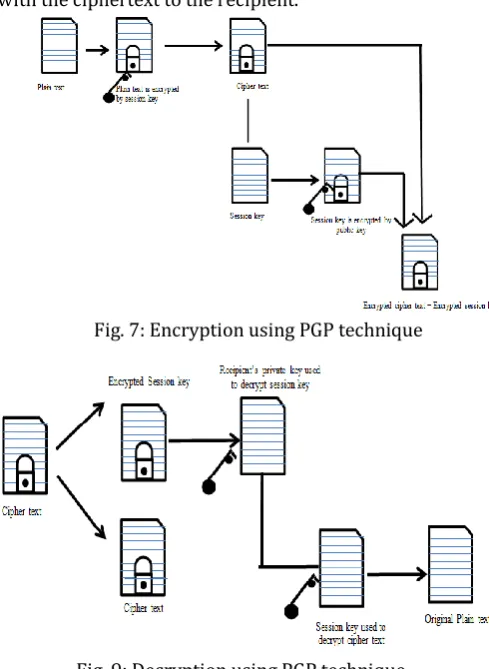
PGP is a hybrid cryptosystem. When a user encrypts plaintext with PGP, PGP first compresses the plaintext. Data
compression saves transmission time and disk space and, more importantly, strengthens cryptographic
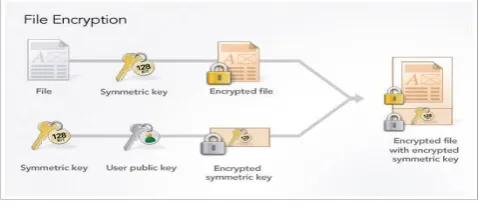
security. PGP then creates a session key as shown in Fig. 6 which is a one-time-only secret key. This key is a random number generated from the random movements of your mouse and the keystrokes you type. This session key works with a very secure, fast conventional encryption algorithm to encrypt the plaintext; the result is ciphertext. Once the data is encrypted, the session key is then encrypted to the recipient's public key. This public key-encrypted session key is transmitted along with the ciphertext to the recipient.
Fig. 7: Encryption using PGP technique
Fig. 9: Decryption using PGP technique
IV. Compression:
The second step is compression. The encrypt message usually gets larger than the original message leading to excessive charge in sending SMS encrypted message. Therefore data compression will be used on the encrypted message; this will reduce it bit size. Thereby reducing the additional cost incurred in sending SMS encrypted message[4]. When data compression is used in a data transmission application, speed is primary goal. Speed of transmission depends upon the number of bits sent. Compression can be classified as either lossy or lossless [6].
V. Case study of Secured Mobile Messaging for Android application:
103 | P a g e Step 2: SMS Encryption module takes a input as a short
message and by using DES keys encrypt the SMS for security.
Step 3: At receiver side, receiver recive encrypted msg, it uses one time session key, receiver public key and N value for decrypting messages.
VI. Result Analysis
So by using triple layer encryption, 3D-AES, PGP and Shannon Fanosecurity algorithm we are able to provide more
security of Mobile Messaging in Android application i.e. precision and recall value more than 95%.
Sr.
No. Messaging Security Technique Precision % Recall %
1 Reliability-based 21.4 15.4
2 DFT 31.4 45.8
3 Eventset 24.2 91.7
4 Developed System 95 97.43
Conclusion
The developed technique combines the encryption and compression process. It encrypts the SMS using 3D-AES algorithm and PGP. Since encrypted SMS compressed using a lossless algorithm, Shannon Fano algorithm. The advantage of this technique is achieving the protection criteria such as confidentiality and authenticity between two communication parties and at the same time decreasing the message lengths. This application is running on smartphones and does not require any other encryption device. Users can exchange the sensitive information via SMS through the developed technique that prevents from attackers. By practically using we can say that our developed approach is giving security results more than 95% in terms of precision and 97.43% in terms of recall.
References
[1] A. Medani, A Gani, O.Zakaria, A.A. Zaidan “Review of mobile short message service security issues and techniques towords the solution”,
Scientific Reaserch and Essays voI.6(6),pp. I 147-1 165,18 March, 201 IJ. Clerk Maxwell, A Treatise on Electricity and Magnetism, 3rd ed,vol. 2.
Oxford: Clarendon,1892,pp.68-73.
[2] Tarek M Mahmoud, Bahgat A. Abdel-Iatef, Awny A Ahmed & Ahmed M Mahfouz, “Hybrid compresion encryption techniques for securing SMS”, International
Journal of Computer Science and
Security(UCSS),Volume(3):issue(6)K Elissa,”Title of paper if known,” unpublished.
[3] NJ Croft and M.S Olivier, “Using an approximated one-time pad to secure short messaging service(SMS)”, Information and Computer Security
Architecture(ICSA) Research Group.
[4] S.R. Koituwakku,U,S. Amrasinghe, “Compression of lossless data compression algorithm for text data”. India journal of computer science and
[5] S.Ariffin, R.Mahmod,A. Jaafar and M.R.K. Arffin, “Byte Permutations in Block cipher Based on Immune Systems”, International Conference on
Software Technology and Engineering 3rd(ICSTE 2011), ASME Press,New York,NY,2011.
[6] NIST, “Fips197: Advanced Encryption Standard(AES)”, FIPS PUB 197 Federal Information Processing Standard Publication 197,Technical
report, National Institue of Standard and Technology,2001.
[7] J.Daemen, V. Rijmen, V. ,”The Design of Rijndael, AES-The Advanced Encryption Standard”,Springer-Verlag.2002.
[8] Songyang Wu, ChengxiangTan , "A high security framework for SMS",IEEE-2009, 978-I-4244-4134-I/09. [9] W. Stallings, “Cryptography and network security”, Prentice Hall,New Jersey, United State, 2006.
[10] D. Lisonek and M. Drahansky, “SMS encryption for mobilecommunication”, International Conference on Security Technology,Hainan Island,
104 | P a g e [11] J. P. Albuja and E. V. Carrera, “Trusted SMS
communication onmobile devices”, 11th Brazilian Workshop on Real-Time andEmbedded
Systems, Pernambuco, Brazil, 2009, pp.165- 170.
[12] M. Toorani and A.A.B. Shirazi, “SSMS-A secure SMS messagingprotocol for the m-payment systems”, Proceedings of the 13th
IEEESymposium on Computers and Communications (ISCC'08),Marrakech, 2008, pp. 700-705.
[13] RashmiChavan, ManojSabnees“Secured Mobile Messaging” 2012 International Conference on Computing, Electronics and Electrical
Technologies [ICCEET].