Proceedings of Second Shri Chhatrapati Shivaji Maharaj QIP Conference on Engineering Innovations Organized by Shri Chhatrapati Shivaji Maharaj College of Engineering, Ahmednagar In Association with Novateur Publications JournalNX-ISSN No: 2581-4230 February, 22nd and 23rd, 2019
OPTIMIZATION OF FLY ASH CONTENT FOR
MANUFACTURING OF LIGHT WEIGHT BLOCKS
Sonbhadre Shubham Vasantrao (1) Bhosle Abhijeet Ashok(3)
Sherkar Shweta Rajendra (2) Mustapure Yogesh Sopan
(4)
(1, 2, 3, 4) Department of Civil Engineering
Dr. V.V.P. College of Engineering Ahmednagar, India
Abstract— In this study Expanded Polystyrene (EPS) in
granulated form with fly ash are taken under consideration to manufacture the light weight masonry blocks. It’s a novel concept of using EPS (granulated form) as an addition of raw material for the production of light weight fly ash based masonry blocks.The innovative application of moderate volume EPS (granulated form) in reducing the density of the composite material proved to improve the engineering properties of the material.
An extensive experimental investigation has been carried out to represent the varied engineering properties of the material consisting of fly ash and EPS (granulated form). There is reduction in unit weight and compressive strength with the addition of EPS granules, however, with the mixing of small percentage of admixture like cement the light weight material can enhance the strength in addition to improve overall properties.
Keywords— Expanded Polystyrene (EPS) in granulated form
I. INTRODUCTION
Fly ash hallow blocks have an important place in modern building industry. They are cost effective and better alternative burnt clay bricks. Concrete hollow blocks being usually larger in size than the normal clay building bricks and less mortar is required, faster of construction is achieved. Also building construction with cement concrete hollow blocks provides facility for concealing electrical conduit, water and sewer pipes wherever so desired and requires less plastering.
In India Besides, the production of cement is not
environmentally friendly. The manufacturing of cement is not only a high energy consuming process, but the production of each ton of cement releases approximately 1 ton of carbon dioxide (CO2) into the environment due to the calcinations of the raw materials and the combustion of fuels. In light of the economic benefits, conservation of natural resources, energy
saving and environmental friendliness, the use of alternative materials from waste products has become the main focus of engineers and researchers. This project aims at producing lightweight hollow bocks by using the expandable polystyrene. Polystyrene is chosen due to its lightweight properties, with good energy absorbing characteristic and good thermal insulator.
Now a days, Hollow Blocks (HCB) and bricks are becoming very popular. These blocks are being widely used in construction of residential buildings, factories and multistoried buildings. These hollow blocks are commonly used in compound walls due to their low cost. These hollow blocks are more useful due to their lightweight and ease of ventilation. The blocks and bricks are made out of mixture of fly ash, cement, sand, GGBS and EPS. Hollow blocks construction provides facilities for concealing electrical conduit, water and soil pipes. It saves cement in masonry work, bringing down cost of construction considerably. Economy of the structure is one of the basic aspects upon which any design is based. The stability plays an important role but the best designer is one who comes out with design which gives the stable and economics structure. The development of the construction technology is closely related to development of adequate mechanization and handling technology. Hollow block is an important addition to the types of masonry units available to the builders and its use for masonry is constantly increasing
II. LITERATURE SURVEY RECTIFA RIO (APRIL-2016):-
Proceedings of Second Shri Chhatrapati Shivaji Maharaj QIP Conference on Engineering Innovations Organized by Shri Chhatrapati Shivaji Maharaj College of Engineering, Ahmednagar In Association with Novateur Publications JournalNX-ISSN No: 2581-4230 February, 22nd and 23rd, 2019
suitably workable for mixing the hollow concrete block as well as the target compressive strength.
JAY.M.PAWAR (JUNE-2015):-
He is prepared paper name was "Effect a Strength and Durability of Fly Ash Based Hollow Concrete Blocks Having Different Configurations Using Polypropylene Fibers". Any type of waste materials which can increase the concrete that can be used to make this kind of hollow concrete blocks so that this blocks should be made eco-friendly. Here I use the fly ash as a partially replacement of cement to made these hollow concrete blocks lighter in weight.
Manolia (2012)
Polystyrene concrete is a lightweight concrete made with expanded polystyrene beads, it is known for its good thermal and caustic insulation properties, and it has also been considered for use as core material in sandwich panels, beams and slab. The mixing of it was done by adding the dry cement and sand together in to mixer and mixed for approximate one minute. It is possible to produce various type of self-compacting polystyrene concrete (SC-PC) by the addition of polystyrene beads as a partial replacement of fine aggregate and using (SBR) polymer with ratio of (10 %) by weight of cement and superplastisizer.
Xu and Jiang (2011)
Has study on lightweight concrete in application of expanded polystyrene (EPS) as substituted to fine aggregate on mechanical properties. The cement content about 500 kg/m3, the volume of EPS is about 25 % and 35 % of sand ratio have result to minimum density of concrete. A saving the sand content could be achieved.
AMAN JATALE
He studied the effects on compressive strength when cement is partially replaced by fly ash and observed that the use of fly ash slightly retards the setting time of concrete. It was also found that the rate of strength development at various ages is related to the w/c ratio and percentages of fly ash in the concrete mix. The modulus of elasticity of fly ash concrete also reduced with the increase in fly ash percentage for a given w/c ratio
III. MAIN AIMS AND OBJECTIVES OF THE PROPOSED WORK
The primary aim of this study was to investigate the feasibility of using a significant portion of fly-ash and EPS granules for beneficial purpose in civil engineering applications that is cost effective and environmentally friendly. The detailed laboratory investigations were planned and carried out for the
fly-ash and EPS mixes such as compressive strength, Water absorption, Dry and Wet Bulk unit weights and to select the optimal mixture of EPS among experiments under consideration to manufacture the light weight fly ash, EPS blocks.
IV. MATERIALS
A new alternative light weight building material is prepared by using EPS granules, fly ash, cement, sand, GGBS and water. The EPS granules used for the preparation of light weight building material were irregular in shape having diameter in the range 3-4 mm. These highly compressible EPS granules had density 11 to 32 kg/m 3. The fly ash was collected in dry state from Dirk industry, Nasik, India. The percentage of basic chemical compounds present in the fly ash were SiO2 (57.2%), Al2O3 (31.1%), Fe2O3 (3.3%), CaO (2.3%). The ordinary Portland cement of 53 grade is used as a binding material. Potable water is used to mix these materials.
V. EXPERIMENTAL PROGRAM
The experimental program was planned with an objective to understand and investigate the suitability of fly ash-EPS, GGBS, Sand &Cement mix as a building material. Laboratory model experiments were carried out for the determination of the best mix design so as to select the optimal mixture of EPS among experiments under consideration to manufacture the light weight EPS blocks.
A. Mix proportion for trial numbers
The mix ratio is defined as the ratio of materials by weight. There is no consistent mix proportion adopted for all the cases. In all the mixes, the aim was to reach the target unconfined compressive strength after 28 days, after mixing. The work plan comprise of Mix proportions and preparation of specimens with several different combinations of EPS granules, Fly ash, Sand, GGBS and Cement at suitable W.C. (%). However, it is noted that the compressive strength is obviously influenced by the moulding water content. A pilot project work was also conducted before deciding the range of limits of different mix ratios
B. Experimental Test
Experimental test for investigation of – Compressive strength,
Water Absorption Test,
Acid Attack Test.
Proceedings of Second Shri Chhatrapati Shivaji Maharaj QIP Conference on Engineering Innovations Organized by Shri Chhatrapati Shivaji Maharaj College of Engineering, Ahmednagar In Association with Novateur Publications JournalNX-ISSN No: 2581-4230 February, 22nd and 23rd, 2019
Mix No
Fly Ash
Sand EPS GGBS Crumb Rubber
Cement
1 60 15 5 5 10 10
50 10 5 10 1.95 10
2 30 30 5 20 10 10
20 50 5 10 10 10
3 30 20 5 30 10 10
20 20 5 40 10 10
4 30 30 5 150 15 10
60 15 5 5 10 10
5 35 30 5 10 13 12
50 15 5 10 1.95 10
VI. METHODOLOGY
The aim of the present study is to get the optimum percentage of various ingredients like fly ash, GGBS, EPS, cement and crumb rubber to get the maximum compressive strength of hollow block. In this study two variation of the ingredient is selected from from various research papers.
To carry out the experimental investigation total 30 blocks of size 450mm x 210mm x 100mm were casted. For all mixes 3 blocks are casted to determine the compressive strength of 7 days, 14 days and 28 days compressive strength. Normal water sprinkling curing is given to each block. Compression Testing Machine of 2000kN capacity was used to determine the total compressive load taken by blocks at different ages. This ultimate load divided by the cross-sectional area of the blocks [(450mm x 210mm)-(2 x 110 x 110)] yields the compressive strength of blocks.
VII. RESULT
30 blocks of various proportion are prepared as stated above and this blocks will be tested for the Compressive strength, Water Absorption Test, Acid Attack Test. after 7, 14 and 28 days of gaining compressive strength and curing from the time of removal of blocks from the mould.
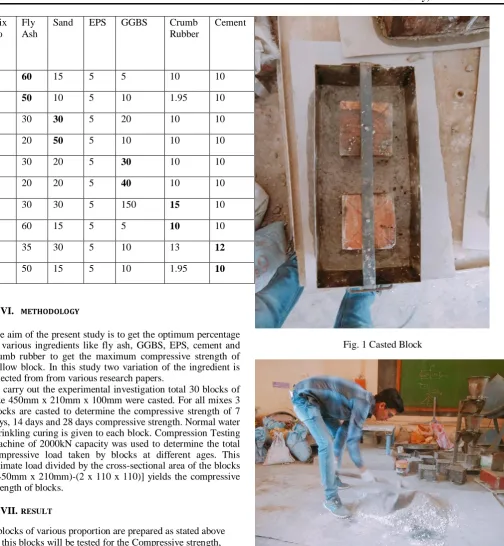
Fig. 1 Casted Block
Proceedings of Second Shri Chhatrapati Shivaji Maharaj QIP Conference on Engineering Innovations Organized by Shri Chhatrapati Shivaji Maharaj College of Engineering, Ahmednagar In Association with Novateur Publications JournalNX-ISSN No: 2581-4230 February, 22nd and 23rd, 2019
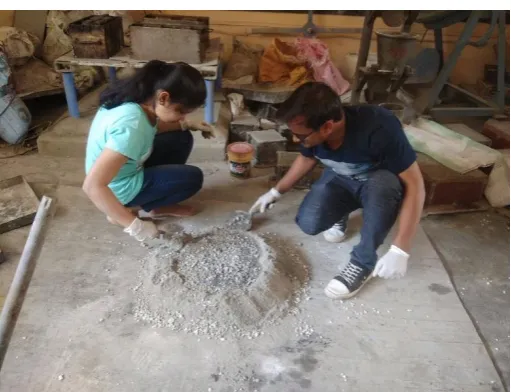
Fig. 3 Dry Mixing Of Material Fig. 5 Initial Setting of Blocks
Acknowledgment
We are honored to express our deep sense of gratitude
towards our guide Dr. S. L. Hake,
Department of Civil Engineering, D.V.V.P. College of
Engineering, Ahmednagar for his creative suggestions,
helpful discussion, unfailing advice and constant
encouragement during the project work. We sincerely
appreciate the interactive help, received from him by the
way of advice, suggestions.
At the outset, we take this opportunity to express our
sincere gratitude to Dr. U. R. Kawade, Head of Civil Engineering Department, for giving us an opportunity to
pursue our studies for the present work and availing various
ultramodern facilities, library facility for the project work.
We are also thankful to Dr. U. P. NAIK, Principal, D.V.V.P College of Engineering, for his helpful support
during the project work.
We are also thankful to our family and friends.Their
kind support and motivation have helped us to complete
References
1. Overview of different type of fly ash and their use as a building and construction material Conference Paper · January 2011 Nirdosha Gamage, Kasuni Liyanage, RMIT University Memorial University of Newfoundland
2. Partial Replacement of Cement with GGBS in Concrete Chalamcharla Venu Gopal, V. Gokul Nath Saveetha School of Engineering, Saveetha.
University, Chennai
3. Cement Concrete Hollow Blocks To Replacing Cement By Fly Ash Vinay Kumar.S.R1,
Abhijith.M.Arer2, Sangeetha.B.K3, Suma.U.Pateela4, Sweta.C.Patil5 1,2,3,4 Students, Dept. of civil engineering, S.T.J.I.T College, Ranebennur,
Karnataka, India. 5 Sweta.C.Patil, Professor, Dept., of Civil Engineering, S.T.J.I.T Ranebennur, Karnataka, India.
4. Ashik Kumar Parashar, Rinko Parashar, “Bricks with Total Replacement of Clay by FlyAsh Mixed with Different Materials”, International Journal of Scientific and Research, July 2012.
5. Tutunlu and U. Atalay, “Utilization of fly ash in manufacturing of building bricks,” in International Ash Utilization Symposium, Center for Applied Energy Research‟, 2001
Proceedings of Second Shri Chhatrapati Shivaji Maharaj QIP Conference on Engineering Innovations Organized by Shri Chhatrapati Shivaji Maharaj College of Engineering, Ahmednagar In Association with Novateur Publications JournalNX-ISSN No: 2581-4230 February, 22nd and 23rd, 2019
Engineering, KGiSL Institute of Technology, Coimbatore
7. IS 2185-3(1984): Concrete masonry units, Part 3: Autoclaved cellular Aerated concrete blocks. 8. BOTTOM ASH AS REPLACEMENT OF
SAND FOR MANUFACTURING MASONRY BLOCKS A.J.M.S.S Abeykoon Faculty of Engineering University of Ruhuna Email: [email protected] C.S.K.R Anthony Faculty of Engineering University of Ruhuna Email: [email protected] G.H.M.J Subashi De Silva Faculty of Engineering University of Ruhuna Email:
9. Development of Light Weight Geoblocks for Wall Building Units using EPS Beads and Fly Ash Soni Kumari, Department of Civil Engineering, Shri Ramdeobaba College of Engineering and Management, Nagpur, India
10. Cement Concrete Hollow Blocks To Replacing
Cement By Fly Ash Vinay Kumar.S.R1,
Abhijith.M.Arer2, Sangeetha.B.K3,
Suma.U.Pateela4, Sweta.C.Patil5 1,2,3,4 Students,
Dept. of civil engineering, S.T.J.I.T College, Ranebennur, Karnataka, India. 5 Sweta.C.Patil,
Professor, Dept., ofCivil Engineering, S.T.J.I.T Ranebennur, Karnataka, India.
11. 11th International Conference on Modern Building Materials, Structures and Techniques, MBMST 2013 Experimental Research of Hollow Concrete Block Masonry Stress Deformations Bronius Jonaitisa , Robertas Zavalisb, *