DOI:10.21276/ijprhs.2018.01.30
Malathi Get al CODEN (USA)-IJPRUR, e-ISSN: 2348-6465
Original Article
Diversity and Distribution of Macro-Algae in the Gulf
of Mannar
G Malathi
1, S Arunprakash
2, M Arul Kumar
3, A Baskara Boopathy
3, P Rama
41
PG and Research Department of Botany, Kandaswami Kandar’s College, Periyar University, Salem, India 2
PG & Research Department of Botany, Arignar Anna Government Arts College, Periyar University, Salem, India 3
Centre for Advanced Studies in Botany, Guindy Campus, University of Madras, Chennai, India 4
Department of Biotechnology, Padmavani Arts & Science College for Women, Periyar University, Salem, India
A R T I C L E I N F O A B S T R A C T
______
1. INTRODUCTION
India is one of the richest countries for biodiversity of seaweeds in the world. A myriad of economically and environmentally valuable species are present in the southern coastal region of Tamil Nadu because of different ecosystems. In comparison with the Gulf of Kutch in Gujarat, Lakhsadweep, Andaman and Nicobar Islands in India, Gulf of Mannar is the major coral reef region that stretches about 1076 km length which is in Ramanthapuram district (9.4071° N, 78.7023° E) 236.8kms.
Seaweeds are the important renewable living resources for human welfare and are highly diversified tropical species
International Journal of Pharma Research and Health Sciences
Available online at
www.pharmahealthsciences.net
Received: 08 Feb 2018 Accepted: 26 Feb 2018
This study examines the presence of seaweeds in the Gulf of Mannar comprising five coastal regions, and determines the distribution and diversity of macro algae found along the coastal area. From this field investigation, Chlorophyta, including four species and Phaeophyta, nine species and Rhodophyta are nine species are found in different localities of Gulf of Mannar. A total of 22 species of seaweeds were identified and characterized by standard methods.
Keywords:Gulf of Mannar, Coastal Region, Diversity, Distribution, Seaweeds, Thallus.
Corresponding author * G Malathi
PG and Research Department of Botany, Kandaswami
commonly found on rocks, pebbles, dead corals and shells with a maximum depth of 180 m at the bottom of the shallow coastal region. Chlorophyceae (green algae), Phaeophyceae (brown algae) and Rhodophyceae (red algae) are the predominant classes with 900, 1500, and 4000 species, respectively, in nature.
Seaweeds are highly potential of biomass and widely used in various forms and also as direct food1, 2. Products of macro-algae are defensive against various diseases and enhance health 3. Seaweeds are also used in animal fodder used as fertilizer for agriculture and used as food, gels and/or act as emulsifiers in various sectors4. Macroalgae have interesting physiological properties when compared to higher plants. This study examines species diversity of seaweeds to have a better understanding of the features of macro algae conditions in the Gulf of Mannar coastal region of five locations.
2. MATERIALS AND METHODS
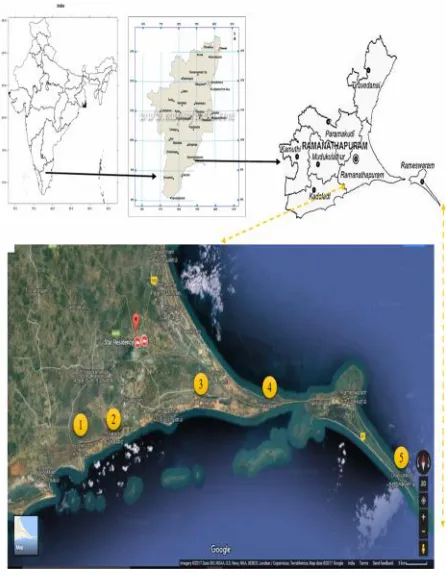
The present diversity study was carried out in five localities along the coast of the Gulf of Mannar in southeast coast of India, such as Pudumadam (9.27702°N 78.993845°E), Kilakarai (9.2343° N, 78.7836° E), Ervadi (9.2192° N, 78.7108° E), Mandapam (9.2770° N, 79.1252° E) and Dhanushkodi (9.1794° N, 79.4183° E) (Figs 1–7). Macro alga were collected in the month of February 2017 from the intertidal zone during low tide. To remove extra debris from the collected seaweeds, they were thoroughly rinsed. The samples were stored in polythene bags filled with fresh sea water for identification and for further uses. The collected macro algae samples were fixed using 4% formaldehyde for further studies. Collected seaweeds were examined under stereo and light microscope following standard manual5,6,7,8,9,10,11.
3. RESULTS
A total of 17 genera and 22 species of seaweeds were recorded from the Gulf of Mannar at five region (Fig. 1). Rhodophyta division containing 9 species, Chlorophyta division containing 4 species and Phaephyta division had 9 species from five regions of our study area (Table 1). During the entire study period, the seaweeds were collected from sandy, pebbles and rocky environmental condition.
Chaetomorpha antenina (Bory) Kützing12
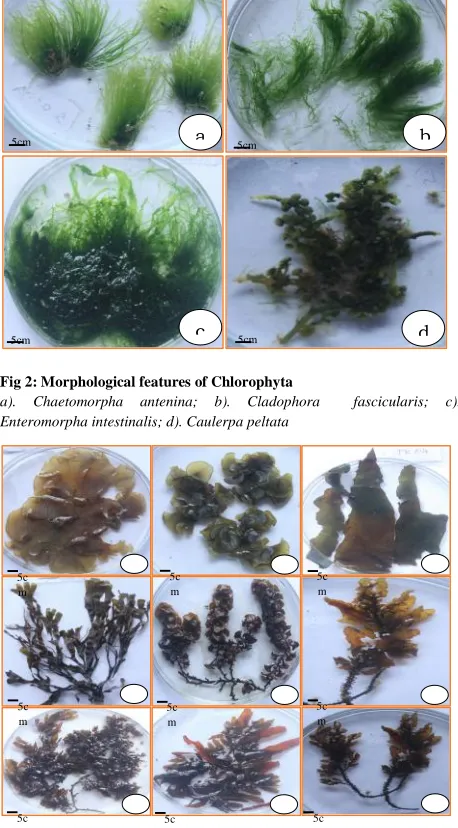
Thalli about 3–15 cm in tall, firm and crisp in texture, unbranched filamentous, attached, long branches; strong surge, spongy mass, basal holdfasts short rhizoids; light green in colour (Fig. 2a).
Cladophora fascicularis (Mertens ex C.Agardh) Kützing
13
The main axis of thalli is stout, sparingly, densely fasciculated about 1–3.5 mm in tall, ultimate indefinite branched about 25–60 cm in tall; crowded at the end of tips,
pectinate arrangements; fresh samples are greenish colour (Fig. 2b).
Enteromorpha intestinalis (Linnaeus) Nees14
Light green membranous, gregarious or solitary, thallus about 25–70 cm tall; stalk elongated, tubular, attenuated, clevated and cylindrical; membrane thickness about 15–45 micron length; fresh samples are greenish in colour (Fig. 2c).
Caulerpa peltata Lamouroux15
Thalli are small plats, size of thallus is generally 5–30 cm tall; stolons freely forked; peltate branchlets, slender pedicel; rhizoid-bearing branches, foliar and erect branches about 5– 50 mm tall; fresh samples are greenish with light brown colour (Fig. 2d).
Padina gymnospora (Kützing) Sonder16
Thallus are blades about 9–25 cm long and broad tall; hair lines, tufted, lower parts – stupose, dark lines of spongia, broad rounded or split into narrower portions; fresh samples light red with brownish colour (Fig. 3a).
Padina tetrastromatica Hauck17
Thallus are blades about 9–25 cm long, broad and tall; flabelliform thallus, several small lobes, divided in to several times in lobes; fresh samples are dark brown with green in colour (Fig. 3b).
Spatoglossum asperum J.Agardh18
Thalli foliar, variable in size from 10 to 80 cm; broad tall about 1–3 mm diameter; narrow segments, flat, sub-dichotomously, palmate, lobes with smaller and larger, elongated lobes; 300–600 micron thickness, apex acute or rounded, sinvate margin; fresh samples dark brown colour (Fig. 3c).
Stoechospermum marginatum (C.Agardh) Kützing19
Thalli reach from 15 to 50 cm in tall, rigorously forking; dichotomously branches, 6 – 15 mm thickness; thalli flat, spathulate, erect, entire margin is flatly truncate or bifid apex; fresh samples are apex light yellow and dark brown in colour (Fig. 3d).
Turbinaria conoides (J.Agardh) Kützing19
Thalli about 8–26 cm in tall; erect, subcylindrical, alternative, polystichously; thalli thickness about 10–15 mm long; tape stalk, triangular; vesiculate blade margin or evesiculate, 10–20 mm in long; sharp prominent teeth; fresh samples are dark brown in colour (Fig. 3e).
Sargassum myriocystum J.Agardh18
Thalli about 10–80 cm in tall; discoid holfast, cylindrical with rough out growth, alternately arranged branches, vesicles, stalk about 1–18 mm in diameter; oblong tapered leaves, blades leaf-like; air bladders bulbous, obvious, emarginated or retuse; serrated margin, apices are round, acute outer margin; prominent midrib; cryptostomates blade, pedunculated vesicles; fresh samples are yellowish brown in colour (Fig. 3f).
Sargassum plagiophyllum C. Agardh20
stalk about 3–22 mm in diameter; oblong tapered leaves, blades leaf-like; air bladders bulbous, obvious, emarginated or retuse; serrated margin, apices are round, acute outer margin; prominent midrib; cryptostomates blade, pedunculated vesicles; fresh samples are yellowish brown in colour (Fig. 3g).
Sargassum wightii Greville ex J.Agardh21
Thallus is about 15–40 cm in tall; holdfast, branched; axes are cylindrical, glabrous; leaves are about 4–9 cm long and 2–10 mm broad, tapering base, midrib; vesicles large, ellipsoidal or spherical, long tip, receptacles are clusters; fresh samples dark brown colour (Fig. 3h).
Sargassum polycystum C.Agardh22
Thalli is about 10–60 cm in tall; discoid holfast, cylindrical with rough out growth, alternately arranged branches, vesicles, stalk about 1.5–15 mm in diameter; oblong tapered leaves, emarginated or retuse; serrated margin, apices are round, acute outer margin; prominent midrib; cryptostomates blade, pedunculated vesicles; fresh samples are yellowish brown in colour (Fig. 3i).
Amphiroa fragilisima (Linnaeus) Lamouroux23
Thallus is multiaxial, articulate, height of 5–6 cm length; branches are calcified, cylindrical, thin, segmented, dichotomous; extremely fragile, multi-tiered genicula, dichotomies arising from genicula, basal genicula are prominent and brownish; fresh specimens have a light purple colour (Fig. 4a).
Jania adherence Lamouroux24
Thallus are erect about 0.8–3.0 cm in height, highly branched and wide angled, fresh specimens are light brown with purple colour, branches are 100–250 µm in diameter, sometimes less in the uppermost branches. The segments are 2.5–7.8 µ m in diameters long; articulation present at the base of branch, apices conical, acute (Fig. 4b).
Cheilosporium spectabile Harvey ex Grunow25
Thalli about 1–3.5 cm in tall, clump-like growth, tufted, forming a compact tuft; alternate-dichotomously branched, irregular, conceptacles, frond cylindrical or sub-cylindrical; genicula present; segments, Intergenicula compressed apically, prominent midrib; 0.6 mm length. Fresh samples are pinkish red in colour (Fig. 4c).
Hypnea valantiae (Turner) Montagne26
Thallus is about 90–350 mm in tall, definite upright branches bearing. Branches are erect, laxly, radial side, stichidia, filiform and lightly spine-like branches, distinct cylindrical main axis. Fresh samples are purple with light green in colour (Fig. 4d).
Hypnea musciformis (Wulfen) Lamouroux24
Inflated and hooked main branches, branchlets are simple, slender with dense clothing, length of the thallus is about 10–20 cm. Fresh samples are pink with light greenish in colour (Fig. 4e).
Gracilaria corticata (J.Agardh) J.Agardh22
Thallus 10–15 cm long containing bundles of flat and divided blades with 1–3 mm length; dichotomous branching
at young blades; mature thallus possess numerous marginal projection lines the edges with 1–2½ cm long; fresh samples are dark purple to green colour (Fig. 4f).
Chondrococcus hornemanni (Lyngbye) F.Schmitz27
Thallus about 3–8 cm in tall; usually caespitose, disc-shaped holdfast; four or more times pinnately branched in distichoalternate manner, subftabellately expanded, thickened but entire from the base upward; branches are prominently in-rolled; reddish colour (Fig. 4g).
Champia parvula (C.Agardh) Harvey25
Thallus is densely tufted, crisply membranous in texture and 2–13 cm in length; alternate branching system with 0.3–2.5 mm. tapering, segmented, 0. 9–1.8 µ m diameter long segments, the tips of the branches obtuse. Fresh samples are pinkish brown or greenish in colour (Fig. 4h).
Acanthophora specifera (M.Vahl) Børgesen28
Thallus is bushy, filamentous and tall about 3–8 m, wing clumps; lower branches are creeping and entangled; attached to the substrate by rhizoids; branching is irregular with subdichotomous; fresh samples are purplish brown in colour (Fig. 4i).
Fig 1: Map showing study area of Gulf of mannar.
1). Pudumadam (9.27702°N 78.993845°E); 2). Kilakarai (9.2343° N, 78.7836°
E); 3). Ervadi (9.2192° N, 78.7108° E); 4). Mandapam (9.2770° N, 79.1252° E);
Fig 2: Morphological features of Chlorophyta
a). Chaetomorpha antenina; b). Cladophora fascicularis; c). Enteromorpha intestinalis; d). Caulerpa peltata
Fig 3: Morphological features of Phaephyta.
a). Padina gymnospora; b). Padina tetrastromatica; c). Spathoglossum
asperum; d). Stoechospermum marginatum; e). Turbinaria conoides; f). Sargassum myriocystum; g). Sargassum plagiophyllum; h). Sargassum wightii; i). Sargassum polycystum
Fig 4: Morphological features of Rhodophyta and Chlorophyta a). Amphiroa fragilisima; b). Jania adhaerens; c). Cheilosporium
spectabile; d). Hypnea valantiae; e). Hypnea musciformis; f). Gracilaria
corticata; g). Chondrococcus hornemanni; h). Champia parvula; i). Acanthophora spicifera
4. DISCUSSION
From the studied five localities of Gulf of Mannar are widely and densely distributed with seaweeds on sandy, corals, and rocky habitats. We have reported, Amphiroa fragilisima, Jania adhaerens, Cheilosporium spectabile, Hypnea valantiae, Hypnea musciformis, Gracilaria corticata, Champia parvula, Acanthophora spicifera from the Gulf of Mannar, which was early reported by Desikachary et al. (1990 & 1998)5,6. Similarly, Padina tetrastromatica were recorded in the Gulf of Mannar region (Sahayaraj et al., 2014)29. According to Baluswamy (2006) 30, 125 taxa red algae were reported previously, in contrast our present data only 9 taxa to the maximum were recorded followed by 9 green algae and only 4 brown algae. From previous literature, the alien taxa of Hypnea sp. are present in the Gulf of mannar (Sahayaraj et al., 2014)29. The natural resources are being depleted even under the sea. It is an alarming ecological imbalance being created due to various human factors that have to be identified.
Diversity of seaweeds are distributed all over the coastal region. But numerous seaweeds are still now unclear taxa. In near, we need more drug for various pharmagological aspects, the seaweeds could be a remedy for the upcoming problem.
5. ACKNOWLEDGEMENTS
Authors are thankful to Periyar University for permitting us to do the research as Faculty Improvement Programme.
6. REFERENCES
1. Skjermo J, Aasen IM, Arff J, Broch OJ, Carvajal A, Christie H, Forbord S, Olsen Y, Reitan KI, Rustad T et al. A New Norwegian bioeconomy based on cultivation and processing of seaweeds: opportunities and R&D needs. SINTEF Fisheries and Aquaculture Report A 2014; 25981:48.
2. Mahre HK, Malde MK, Eilertsen KE, Elvevoll EO. Characterization of protein, lipid and mineral contents in common Norwegian seaweeds and evaluation of their potential as food and feed. Journal of Science and Food Agriculture. 2014; 94:3281–3290.
3. Nancy N Shahin, Maha M Mohamed. Nano-Sized Titanium Dioxide Toxicity in Rat Prostate and Testis: Possible Ameliorative Effect of Morin. Toxicol Appl Pharmacol. 2017; 334, 129-141.
4. Yende, S. R., Harle, U. N., & Chaugule, B. B. Therapeutic potential and health benefits of Sargassum species. Pharmacognosy Reviews. 2014; 8(15): 1. 5. Desikachary, T.V., V. Krishnamurthy and M.S.
Balakrishnan. Rhodophyta Vol. II. Part- II (A). Madras Science Foundation, Chennai. 1990; 2: 279.
d c
a 5cm b
5cm
5cm 5cm
g
d e f
c b
h i
5c m 5c
m 5c
m
5c m 5c
m 5c
m
5c m
5c m
5c m a
a b
g h
d e f
i c 1c
m
1c m
1c m
5c m 5c
m 1c
m
5c m 1c
m 5c
6. Desikachary, T.V., V. Krishnamurthy and M.S. Balakrishnan.Rhodophyta Vol. II. Part-II (B). Madras Science Foundation, Chennai. 1998; 359.
7. Krishnamurthy, V. Algae of India and neighbouring countries Chlorophycota; Oxford & IBH Publishing Co. Pvt. Ltd., New Delhi. 2000; p. 210.
8. Krishnamurthy, V. and M. Baluswami. Phaeophyceae of India and neighbourhood. Krishnamurthy Institute of Algology, Chennai. 2010; 1: 192.
9. Silva, P.C., P.W. Basson and R. L. Moe. Catalogue of the benthic marine algae of the Indian Ocean. University of California press, London. 1996; p. 1259.
10. Christopher S. Lobban, Antoine Nyeurt. Provisional keys to the genera of seaweeds of Micronesia, with new records for Guam and Yap. Micronesica. 2006; 39(1): 73–105.
11. Cordero JR., Paciente A.Studies on Philippine marine red algae. Special publications from the SETO marine biological laboratory. 1997; 4: 1-258.
12. Kützing, F.T. Phycologia generalis oder Anatomie, Physiologie und Systemkunde der Tange. Mit 80 farbig gedruckten Tafeln, gezeichnet und gravirt vom Verfasser. 1843; pp. [part 1]: [i]-xxxii, [1]-142, [part 2:] 143-458.
13. Kützing, F.T. Diagnosen und Bemerkungen zu neuen oder kritischen Algen. Botanische Zeitung. 1847; 5: 1-5, 22-25, 33-38, 52-55, 164-167, 177-180, 193-198, 219-223.
14. Nees, C.G. Horae physicae Berolinenses collectae ex symbolis virorum doctorum H. Linkii...; edicuravit Christianus Godof. Nees ab Esenbeck..1820; pp. [i-xii], 1-123.
15. Lamouroux, J.V.F. Essai sur les genres de la famille des thalassiophytes non articulées. Annales du Muséum d'Histoire Naturelle, Paris 20: 1813; 21-47, 115-139, 267-293, pls 7-13.
16. Sonder, O.G.. Die Algen des tropischen Australiens.
Abhandlungen aus dem Gebiete der
Naturwissenschaften herausgegeben von dem
Naturwissenschaftlichen Verein in Hamburg. 1871; 5(2): 33-74.
17. Hauck, F. Ueber einige von J.M. Hildebrandt im Rothen Meere und Indischen Ocean gesammelte Algen III, IV. Hedwigia. 1887; 26: 18-21, 41-45.
18. Agardh, J.G. Species genera et ordines algarum, seu descriptiones succinctae specierum, generum et ordinum, quibus algarum regnum constituitur. Volumen Primum. Algas fucoideas complectens. 1848; 1: 363. 19. Kützing, F.T.Tabulae phycologicae; oder, Abbildungen
der Tange. 1860; 10: 1-39.
20. Agardh, J.G. Analecta algologica, observationes de
speciebus algarum minus cognitae earumque
dispositione. Continuatio I. Lunds Universitets Års-Skrift, Andra Afdelningen, Kongl. Fysiografiska Sällskapets i Lund Handlingar. 1894; 29(9): 1-144.
21. Agardh, J.G. Species genera et ordines algarum, seu descriptiones succinctae specierum, generum et ordinum, quibus algarum regnum constituitur. Volumis secundi: Algas florideas complectens. Part 2, fasc. 2. 1852: 577-700.
22. Agardh, C.A. Systema algarum. 1824; pp. [i]-xxxvii, [1]-312.
23. Lamouroux, J.V.F. Observations sur la physiologie des algues marines, et description de cinq nouveaux genres de cette famille. Nouveau Bulletin des Sciences, par la Société Philomathique de Paris. 1809; 1: 330-333. 24. Lamouroux, J.V.F. Histoire des polypiers coralligènes
flexibles, vulgairement nommés zoophytes. 1816; pp560.
25. Harvey, W.H. Nereis boreali-americana; or, contributions towards a history of the marine algae of the atlantic and pacific coasts of North America. Part II.
Rhodospermeae. Smithsonian Contributions to
Knowledge. 1853; 5(5): 258.
26. Montagne, C. Plantae cellulares. In: Histoire naturelle des Iles Canaries. (Barker Webb, P. & Berthelot, S. Eds). 1841; Vol. 3, pp. 161-208.
27. F.Schmitz.Chondrococcus hornemannii (Lyngbye): ('hornemanni'). 1895; 140. 168-170.
28. Børgesen, F. Some new or little known West Indian Florideae. II. Botanisk Tidsskrift. 1910; 30: 177-207. 29. Sahayaraj K, S. Rajesh, A. Asha, J. M. Rathi, Patric
Raja. Distribution and diversity assessment of the marine macroalgae at four southern districts of Tamil Nadu, India. Indian Journal of Geo-Marine Sciences. 2014; 43(4), 607-617.
30. Baluswamy, Available at http://
www.tnenvis.nic.in/Envis_tamil/html/images/ Algal_Database. Pdf, 2006.
Conflict of Interest: None