CLINICAL REPORT
Guidance for the Clinician in Rendering Pediatric CarePromoting Optimal Development:
Screening for Behavioral and Emotional
Problems
Carol Weitzman, MD, FAAP, Lynn Wegner, MD, FAAP, the SECTION ON DEVELOPMENTAL AND BEHAVIORAL PEDIATRICS, COMMITTEE ON PSYCHOSOCIAL ASPECTS OF CHILD AND FAMILY HEALTH, COUNCIL ON EARLY CHILDHOOD, AND SOCIETY FOR DEVELOPMENTAL AND BEHAVIORAL PEDIATRICS
abstract
By current estimates, at any given time, approximately 11% to 20% of children in the United States have a behavioral or emotional disorder, as defined in the Diagnostic and Statistical Manual of Mental Disorders, Fifth Edition. Between 37% and 39% of children will have a behavioral or emotional disorder diagnosed by 16 years of age, regardless of geographic location in the United States. Behavioral and emotional problems and concerns in children and adolescents are not being reliably identified or treated in the US health system. This clinical report focuses on the need to increase behavioral screening and offers potential changes in practice and the health system, as well as the research needed to accomplish this. This report also (1) reviews the prevalence of behavioral and emotional disorders, (2) describes factors affecting the emergence of behavioral and emotional problems, (3) articulates the current state of detection of these problems in pediatric primary care, (4) describes barriers to screening and means to overcome those barriers, and (5) discusses potential changes at a practice and systems level that are needed to facilitate successful behavioral and emotional screening.Highlighted and discussed are the many factors at the level of the pediatric practice, health system, and society contributing to these behavioral and emotional problems.
SCOPE OF THE PROBLEM AND NEED FOR THIS REPORT
Behavioral and emotional problems during childhood are common, often undetected, and frequently not treated despite being responsible for significant morbidity and mortality. By current estimates, approximately 11% to 20% of children in the United States have a behavioral or emotional disorder at any given time.1,2Estimated prevalence rates are
similar in young 2- to 5-year-old children. Developmental and behavioral health disorders are now the top 5 chronic pediatric conditions causing functional impairment.3,4Even greater numbers of children have
This document is copyrighted and is property of the American
Academy of Pediatrics and its Board of Directors. All authors havefiled
conflict of interest statements with the American Academy of
Pediatrics. Any conflicts have been resolved through a process
approved by the Board of Directors. The American Academy of Pediatrics has neither solicited nor accepted any commercial involvement in the development of the content of this publication.
Clinical reports from the American Academy of Pediatrics benefit from
expertise and resources of liaisons and internal (AAP) and external reviewers. However, clinical reports from the American Academy of
Pediatrics may not reflect the views of the liaisons or the
organizations or government agencies that they represent.
The guidance in this report does not indicate an exclusive course of treatment or serve as a standard of medical care. Variations, taking into account individual circumstances, may be appropriate.
All clinical reports from the American Academy of Pediatrics
automatically expire 5 years after publication unless reaffirmed,
revised, or retired at or before that time.
www.pediatrics.org/cgi/doi/10.1542/peds.2014-3716
DOI:10.1542/peds.2014-3716
PEDIATRICS (ISSN Numbers: Print, 0031-4005; Online, 1098-4275).
behavioral or emotional problems causing impairment or distress that do not meet criteria of theDiagnostic and Statistical Manual of Mental Dis-orders, Fifth Editionfor a disorder. The purpose of this report is to provide pediatricians with a rationale for and guidance to implement screening for behavioral and emo-tional problems in primary care set-tings. However, in evaluating and promoting optimal child development and well-being, the domains of de-velopment and behavior must be considered together within the con-text of the family. These domains are not separate constructs but rather parts of a whole. Therefore, this report emphasizes that behavioral screening must always be 1 compo-nent of a comprehensive develop-mental and behavioral screening program that extends through child-hood and adolescence.
EPIDEMIOLOGY OF BEHAVIORAL AND EMOTIONAL DISORDERS
It is estimated that 25% to 40% of children with 1 disorder will have at least 1 additional mental health or behavioral diagnosis at a given time.1,5,6The most common
co-occurring conditions are attention-deficit/hyperactivity disorder (ADHD) and oppositional defiant disorder, but co-occurrence of anxiety and depression is also common.
Between 37% and 39% of children will have a behavioral or emotional disorder diagnosed by 16 years of age, with the most common diagnoses being impulse control/disruptive behavior problems, anxiety, and mood disorders.1,7,8Between 23% and
61% of children with a diagnosis at 1 time will have a diagnosis in the future, although it is not always the same diagnosis.1
Approximately 50% of adults with behavioral health problems report that their disorders emerged in early adolescence.9Anxiety disorders and
ADHD are the earliest disorders to emerge, often in the preschool and
early school-age years, with substance abuse being the latest to emerge. An approximately 2- to 4-year period between symptom appearance and disorder has been demonstrated, suggesting that there may be opportunities for secondary prevention or early intervention.6
FACTORS AFFECTING THE EMERGENCE OF BEHAVIORAL AND EMOTIONAL PROBLEMS
In 2010, more than 1 in 5 children were reported to be living in
poverty.6,10Economic disadvantage is
among the most potent risks for behavioral and emotional problems due to increased exposure to environmental, familial, and
psychosocial risks.11–13In families in
which parents are in military service, parental deployment and return has been determined to be a risk factor for behavioral and emotional
problems in children.14Data from the
2003 National Survey of Children’s Health demonstrated a strong linear relationship between increasing number of psychosocial risks and many poor health outcomes, including social-emotional health.15
The Adverse Childhood Experience Study surveyed 17 000 adults about early traumatic and stressful experiences. Two-thirds of
respondents experienced at least 1 type of childhood psychosocial risk, and 20% experienced more than 3. Adverse early experiences were related to increased rates of health problems in adulthood including obesity and cardiovascular disease as well as substance abuse, mental health problems, and poor health-related quality of life. As the Adverse Childhood Experience Study score increased, so did the number of risk factors for the leading causes of death.16,17Shonkoff uses the phrase
“toxic stress”to describe high cumulative psychosocial risk in the absence of supportive caregiving18,19;
this type of unremitting stress ultimately compromises children’s ability to regulate their stress
response system effectively and can lead to adverse long-term structural and functional changes in the brain and elsewhere in the body. The 2012 American Academy of Pediatrics (AAP) Policy Statement“Early Childhood Adversity, Toxic Stress, and the Role of the Pediatrician:
Translating Developmental Science Into Lifelong Health”advocated viewing the causes and consequences of toxic stress from the same perspective as other biologically based health impairments.19
POLICIES IN PLACE
In 2004, the AAP established the Task Force on Mental Health, which
“articulated mental health competencies for primary care; developed guidance for addressing systemic andfinancial barriers to providing mental health care in primary care settings; and provided tools and strategies to assist
pediatricians in applying chronic care principles to children with mental health problems.”20The Task Force
also provided guidance (through identifying tools and describing strategies) to providers on adapting current practice to include mental health care. A recent publication articulated an initial blueprint for behavioral and emotional screening in pediatric practice.21The current
statement supports the Task Force guidance by providing the evidence supporting screening for emotional and behavioral concerns.
CURRENT STATE OF DETECTION OF BEHAVIORAL AND EMOTIONAL PROBLEMS IN PEDIATRIC SETTINGS
Behavioral and emotional problems and concerns in children and adolescents are not being reliably identified or treated in the US health system.6,22–25Current estimates
50% of those with clinically
significant behavioral and emotional problems are detected.23Other
investigators have found similarly high failure of detection rates ranging from 14% to 40%.22,24 Surveyed
pediatricians, however,
overwhelmingly endorse that they should be responsible for identifying children with ADHD, eating disorders, depression, substance abuse, and behavior problems.26
Clinicians’ability to identify developmental and behavioral problems in primary care, on the basis of clinical judgment alone in the absence of a standardized measure, has been shown to have low
sensitivity, ranging from 14% to 54% and a specificity ranging from 69% to 100%.27Providers are less likely to
identify problems in minority or non–English-speaking children and adolescents.25
In a study of clinicians in more than 200 practices, pediatric providers reported using a standardized measure to assess mental health problems in 20.2% of all visits, with 50.2% of providers reporting never using any formal measure.28Fewer
than 7% of providers reported using a standardized measure during 50% or more of visits.28
BARRIERS TO SCREENING
Pediatricians report a lack of confidence in their training and ability to successfully manage children’s behavioral and emotional problems29with only 13% of
pediatricians reporting confidence.30
Common barriers to adopting new screening practices in pediatrics include lack of time,30long waits for
children to be seen by mental health providers, and lack of available mental health providers to refer children.31,32 Liability issues have
been identified as a barrier to screening and managing children with behavioral and emotional problems. Pediatricians have also raised concerns about the increasing
number of mandates outlined in practice guidelines with ever-shrinking time for health maintenance visits as a result of reimbursement pressures.33
AVAILABLE TOOLS TO SCREEN FOR BEHAVIOR AND EMOTIONAL PROBLEMS
Behavioral and emotional screening instruments have many of the same advantages and limitations as developmental screening instruments. They involve a time commitment for parents or guardians to complete and for staff and clinicians to score, interpret, and report the results.32
Screening instruments can be used to predict risk of a disorder but do not make the diagnosis. There are global (broadband) scales that may screen for several conditions, and there are domain-specific (single-condition) tools are most useful for screening for a specific problem, such as substance use or adolescent depression and suicidality.32
Pediatricians should be aware of the sociodemographic characteristics of populations enrolled in validation studies as they make decisions regarding any screening instruments used. Pediatricians need to consider the literacy and health literacy levels of parents, guardians, children, and adolescents completing screens, whether the instrument should be administered in English or another language, and whether the person completing the screen will need additional help.
Pediatricians should be familiar with the psychometric properties of an instrument and under what
conditions reported sensitivities and specificities were obtained.32Like
developmental screening tools, behavioral and emotional screening tools should have a sensitivity and specificity of$0.70.34
Once the patient is old enough to answer reliably, self-report versions can provide information about
feelings not noticed by outside observers, such as those associated with anxiety or depression. Most self-report versions are normed on patients 8 years and older.
The research on behavioral and emotional screening in younger children is more limited than in school-age children, but increasingly, reliable, brief measures suitable for use in primary care exist, and new ones are being developed,35,36
making it possible to screen children and adolescents from aged 6 months through 18 years of age.
Behavior and emotional screens available in the public domain can be found in Appendix 1.
OVERCOMING BARRIERS TO SCREENING
The policy statement“The Future of Pediatrics: Mental Health
Competencies for Pediatric Primary Care”outlined the skills pediatricians need in the area of mental health.37
The AAP Task Force on Mental Health has developed materials to help pediatricians assess their current practice and readiness to change and to code accurately for mental health screening and services.38,39 The AAP
also developed a Web site providing resources and materials free of charge (http://www2.aap.org/ commpeds/dochs/mentalhealth/ KeyResources.html)40as well as
“Addressing Mental Health Concerns in Primary Care: A Clinician’s Toolkit,”41 which is available for
a fee.
Professional organizations, including the AAP, Society for Developmental and Behavioral Pediatrics, American Academy of Child and Adolescent Psychiatry, and National Alliance on Mental Illness, provide ongoing continuing medical education and resources.
LESSONS LEARNED FROM DEVELOPMENTAL SCREENING
those identified when developmental screening was proposed as a regular part of pediatric care. In 2006, the AAP policy statement“Identifying Infants and Young Children With Developmental Disorders in the Medical Home: An Algorithm for Screening and Surveillance”42was
published. Since the publication of the statement, 44.8% of pediatricians reported using standardized developmental screening tools more often, and 72.2% reported using standardized autism screening tools more often.43National demonstration
projects including the Assuring Better Child Development Screening Academy44and the AAP’s
Developmental Surveillance and Screening Policy Implementation Project45achieved high levels of
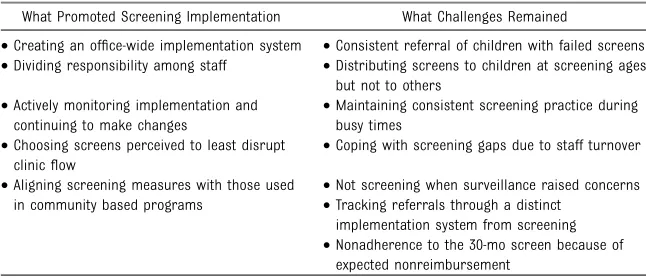
screening in primary care. These projects provided valuable lessons about implementing a screening program (Table 1) and behavioral and emotional screening may follow similar patterns. Similar large-scale initiatives may need to be developed to determine the best practices for implementing a behavioral and emotional screening program.
GUIDANCE FOR PEDIATRICIANS
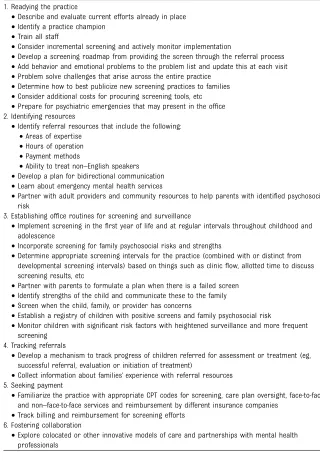
The following steps and Table 2 are designed to give pediatricians a clear road map to implement behavioral and emotional screening in practice. Although distinct from screening, pediatricians should familiarize themselves with evidence-based
programs that have been shown to promote children’s social-emotional development through positive parenting,46–51possibly preventing
the emergence of problems.
1. Readying the Practice. As was seen in developmental screening, front-end work is needed to train and prepare an office to adopt screen-ing practices. It may be helpful to enlist the assistance of local men-tal health professionals or developmental-behavioral pedia-tricians in selecting and imple-menting screening procedures. 2. Identifying Resources. Before
ini-tiating a behavioral and emotional screening program, pediatricians need to determine what they will do when a child or parent has a positive screening result. Pedia-tricians should familiarize them-selves with local resources and identify referral sources. In the absence of this, pediatricians are likely to feel frustrated and over-whelmed when they identify chil-dren and adolescents in need of services but are unable tofind appropriate, high-quality treat-ment of them. Pediatricians will need to work with the community to advocate for more treatment and intervention services.
Increasing numbers of practices have colocated a mental health provider (eg, psychologist, licensed clinical social worker, licensed therapist) within the practice. These pro-viders are integrated into the
practice and can provide timely assistance for behavioral emergen-cies as well as support the primary care provider in implementing and interpreting the office screening program.
Another model of a successful col-laboration program between pri-mary providers and child psychiatrists, the Massachusetts Child Psychiatry Access Project, promotes access to psychiatric consultation for primary care providers through a network of children’s mental health collabo-ration teams. The overall aim is to improve access to treatment of children with mental health con-cerns (http://www.mcpap.com/ about.asp). This type of program currently is being implemented in more than 30 states.
3. Establishing Office Routines for Screening. As with developmental screening, children should be screened at regular intervals for behavioral and emotional prob-lems with standardized, well-validated measures beginning in infancy and continuing through adolescence. Screening beginning in thefirst year of life can identify disturbances in attachment, regu-lation, and the parent-child re-lationship, although the optimal approaches to screening infants and very young children are less clear-cut than screening children at older ages. Ongoing care involves maintaining a good his-tory regarding factors that can
in-fluence the early parent-child relationships, such as discipline practice, parenting stress, psycho-social risks, and positive parenting.
Currently, developmental and behavioral/emotional screenings are viewed as separate constructs, and most well-validated measures screen for them independently. Developmental screening is commonly perceived as identifying disordered expressive and receptive language,fine and gross motor skills, self-help skills, and
TABLE 1 Lessons Learned From Implementing a Screening Program
What Promoted Screening Implementation What Challenges Remained
•Creating an office-wide implementation system •Consistent referral of children with failed screens •Dividing responsibility among staff •Distributing screens to children at screening ages
but not to others •Actively monitoring implementation and
continuing to make changes
•Maintaining consistent screening practice during busy times
•Choosing screens perceived to least disrupt clinicflow
•Coping with screening gaps due to staff turnover
•Aligning screening measures with those used in community based programs
•Not screening when surveillance raised concerns •Tracking referrals through a distinct
implementation system from screening •Nonadherence to the 30-mo screen because of
cognitive milestones, whereas behavioral and emotional screening identifies problems in areas including social-emotional regulation, mood and affect, attention, and
interpersonal skills. There is a significant yet incomplete overlap between developmental and behavior problems. Studies have revealed that children with cognitive, language, and social impairments and
developmental disabilities, in general, are far more likely to manifest behavioral and emotional problems.12
Beginning in early adolescence, screening for substance use should be implemented.21,52Substance use and
dependence have consistently been found to be 1 of the most prevalent behavioral health diagnoses in adolescents. Identifying and treating a behavioral or emotional problem without detecting and treating co-occurring substance use will likely lead to ineffectual treatment. The US Preventive Services Task Force recommends screening all
adolescents (12–18 years of age) for
depression, when systems are in place, to ensure accurate diagnosis, treatment, and follow-up.53
Pediatricians should use targeted screening for other problems, such as suicidality or anxiety, if there is concern raised by the provider, patient, or parent or the child is at high risk.
Children’s behavioral and emotional problems are frequently associated with family psychosocial risk. Family psychosocial screening can provide important information about potential protection or lack thereof for a child who may or may not yet show signs of behavioral or emotional problems. Early detection and treatment of family psychosocial risk may potentially avert the emergence of problems in the child. Only a limited number of well-validated screens suitable for use in primary care for broad screening of family psychosocial risk and family support and functioning are available, although a few show promise.54–56
There are screening measures for specific psychosocial stressors, such as maternal depression, and these have been shown to be feasible in pediatric settings.57,58Family
screening for psychosocial risk within pediatric settings, however, raises a number of dilemmas, including concerns about liability and payment and who is responsible for an adult’s well-being after a problem is detected.59
4. Tracking Referrals. If the child was referred for services after screen-ing, it is important for pediatricians to inquire as to whether referrals were completed and services were obtained or understand what bar-riers parents have experienced and how these can be overcome. Fur-thermore, it is important for pediatricians, with parental per-mission, to obtain information from the referral and to learn whether services obtained were effective and whether symptoms in the child have been reduced or eliminated.
TABLE 2 Steps to Implement Behavioral and Emotional Screening in Practice 1. Readying the practice
•Describe and evaluate current efforts already in place •Identify a practice champion
•Train all staff
•Consider incremental screening and actively monitor implementation
•Develop a screening roadmap from providing the screen through the referral process •Add behavior and emotional problems to the problem list and update this at each visit •Problem solve challenges that arise across the entire practice
•Determine how to best publicize new screening practices to families •Consider additional costs for procuring screening tools, etc •Prepare for psychiatric emergencies that may present in the office 2. Identifying resources
•Identify referral resources that include the following: •Areas of expertise
•Hours of operation •Payment methods
•Ability to treat non–English speakers •Develop a plan for bidirectional communication •Learn about emergency mental health services
•Partner with adult providers and community resources to help parents with identified psychosocial risk
3. Establishing office routines for screening and surveillance
•Implement screening in thefirst year of life and at regular intervals throughout childhood and adolescence
•Incorporate screening for family psychosocial risks and strengths
•Determine appropriate screening intervals for the practice (combined with or distinct from developmental screening intervals) based on things such as clinicflow, allotted time to discuss screening results, etc
•Partner with parents to formulate a plan when there is a failed screen •Identify strengths of the child and communicate these to the family •Screen when the child, family, or provider has concerns
•Establish a registry of children with positive screens and family psychosocial risk
•Monitor children with significant risk factors with heightened surveillance and more frequent screening
4. Tracking referrals
•Develop a mechanism to track progress of children referred for assessment or treatment (eg, successful referral, evaluation or initiation of treatment)
•Collect information about families’experience with referral resources 5. Seeking payment
•Familiarize the practice with appropriate CPT codes for screening, care plan oversight, face-to-face and non–face-to-face services and reimbursement by different insurance companies
•Track billing and reimbursement for screening efforts 6. Fostering collaboration
This follow-up may require a sepa-rate office system than screening procedures.
5. Seeking Payment. One of the big-gest“systems”hurdles facing pediatricians is the difficulty obtaining payment for screening patients for behavioral and emo-tional problems and for screening families for psychosocial risk and functioning. The adoption of the proposed screening and surveil-lance practices, may lengthen visit time to discuss results without ad-ditional payment to support that time and create significant non– face-to-face work.60This includes
referring patients and families to appropriate resources, tracking referrals, communicating with other professionals (which may require reviewing lengthy reports and school plans), and following up with children and families. Over-coming this critical barrier is fun-damental to transforming pediatric practice to a medical home model. With the advent of reimbursable billing codes for screening, in-cludingCurrent Procedural Termi-nology(CPT) codes 96110 and 99420, some practices are begin-ning to see somefinancial payment for the addition of screening pro-grams. Additionally, a new CPT code for brief behavioral assess-ment, 96127, has been included in
CPT 2015to allow the separate reporting of this service.
6. Fostering Collaboration. Innovative collaborations have been well de-scribed and include colocation and integrated and consultative models, such as the Massachusetts Child Psychiatry Access Project, the North Carolina Chapter AAP/NC Pediatric Society (ICARE), and the Washington Partnership Access Line.61–64Innovative means of
consultation and collaboration will continue to evolve with emerging technology.65These relationships
help build the capacity of pedia-tricians to manage various
behavioral and emotional problems in the office. This is particularly true for the management of sub-threshold problems not meeting the severity level warranted to re-fer for treatment.
FUTURE DIRECTIONS
As medical practice continues to shift into more electronic formats,
standardized screening instruments will need to be formatted for electronic health record systems, to facilitate a wide implementation of screening. Automating guidelines and scoring of screening measures, providing decision support that is integrated into electronic health records, and providing patients with opportunities for greater
participation in their health care via portals into their electronic medical record have already shown
promise.66,67 Paper-and-pencil
screening methods will need to be transformed into Web-based versions, smartphone apps, and waiting room tablets to successfully harness available technology.65,68
These changes will be critical areas needing further evaluation to determine best practices.69
Additional system challenges that will need to be addressed are included in Appendix 2.
SUMMARY
Evaluating and promoting optimal child development and well-being includes assessing developmental and behavioral domains in the context of the family. Behavioral and emotional problems are common, persistent, and cause significant functional impairment for many children and adolescents. A 2- to 4-year window may exist between initial
presentation of symptoms and the development of a disorder, suggesting an opportunity to intervene before problems become more serious in children.6In recent years, many
pediatricians have taken advantage of more widely disseminated public
domain screening tools and have used emerging computer technology to facilitate behavioral/emotional screening. There have been many examples of colocated practices, and national organizations, such as the AAP, have strongly advocated for payment for these integrated practice models. The lessons learned through developmental screening
implementation have been used to make behavioral and emotional screening a more routine component of pediatric health supervision. The investments described in this report,
financial and otherwise, are critical to ensure a future of thriving and strong infants, children, and adolescents who will mature into healthy adults.
LEAD AUTHORS
Carol Weitzman, MD Lynn Mowbray Wegner, MD
CONTRIBUTING AUTHORS
Laura Joan McGuinn, MD Alan L. Mendelsohn, MD Patricia Gail Williams, MD Terry Stancin, PhD
SECTION ON DEVELOPMENTAL AND BEHAVIORAL PEDIATRICS EXECUTIVE COMMITTEE, 2013–2014
Nathan J. Blum, MD, Chairperson Michelle M. Macias, MD, Immediate Past Chairperson
Nerissa S. Bauer, MD, MPH Carolyn Bridgemohan, MD Edward Goldson, MD Laura J. McGuinn, MD Carol Weitzman, MD
LIAISONS
Pamela High, MD–Society for Developmental and Behavioral Pediatrics
Susan Levy, MD–Council on Children with Disabilities
CONSULTANT
Lynn Mowbray Wegner, MD
STAFF
Linda B. Paul, MPH
COMMITTEE ON PSYCHOSOCIAL ASPECTS OF CHILD AND FAMILY HEALTH, 2013–2014
Benjamin S. Siegel, MD, Chairperson Michael W. Yogman, MD, Chairperson-Elect Thresia B. Gambon, MD
Gerri Mattson, MD Laura Joan McGuinn, MD Jason Richard Rafferty, MD Lawrence Sagin Wissow, MD, MPH
LIAISONS
Ronald T. Brown, PhD–Society of Pediatric Psychology
Terry Carmichael, MSW–National Association of Social Workers
Jody K. Gurtler–National Association of Pediatric Nurse Practitioners
Mary Jo Kupst, PhD–Society of Pediatric Psychology Leonard Read Sulik, MD–American Academy of Child and Adolescent Psychiatry
CONSULTANT
George J. Cohen, MD
STAFF
Stephanie Domain, MS, CHES
COUNCIL ON EARLY CHILDHOOD, 2013–2014
Elaine Donoghue, MD, Co-Chairperson Danette Swanson Glassy, MD, Co-Chairperson Mary Lartey Blankson, MD, MPH
Beth A. DelConte, MD Marian Frances Earls, MD Dina Joy Lieser, MD Terri Denise McFadden, MD Alan L. Mendelsohn, MD Seth J. Scholer, MD, MPH Elaine E. Schulte, MD, MPH Jennifer Cohen Takagishi, MD Douglas Lee Vanderbilt, MD Patricia Gail Williams, MD
LIAISONS
Abbey D. Alkon, RN, PNP, PhD–National Association of Pediatric Nurse Practitioners
Victoria Chen–Section on Medical Students, Residents, and Fellowship Trainees
Barbara U. Hamilton, MA–Maternal and Child Health
Bureau Child, Adolescent and FamilyHealth
Claire Lerner, LCSW–Zero to Three Stephanie Olmore–National Association for the Education of Young Children
ADVISOR
Susan S. Aronson, MD
STAFF
Jeanne M. VanOrsdal, MEd Charlotte O. Zia, MPH, CHES
SOCIETY FOR DEVELOPMENTAL AND BEHAVIORAL PEDIATRICS BOARD OF DIRECTORS, 2012–2013
Michelle M. Macias, MD, President John C. Duby, MD, President-Elect Marilyn Augustyn, MD, Secretary-Treasurer Desmond Kelly, MD, Immediate Past President Carolyn E. Ievers-Landis, PhD
Robert Needlman, MD Nancy Roizen, MD Franklin Trimm, MD Lynn Wegner, MD Beth Wildman, PhD
CONSULTANT
Terry Stancin, PhD
EXECUTIVE DIRECTOR
Laura Degnon, CAE
REFERENCES
1. Costello EJ, Mustillo S, Erkanli A, Keeler G, Angold A. Prevalence and development of psychiatric disorders in childhood and adolescence.Arch Gen Psychiatry. 2003;60(8):837–844
2. Report of the Surgeon General’s Conference on Children’s Mental Health: A National Action Agenda. Washington, DC: US Department of Health and Human Services, US Department of Education, US Department of Justice; 2000
3. Slomski A. Chronic mental health issues in children now loom larger than physical problems.JAMA. 2012;308(3): 223–225
4. Halfon N, Houtrow A, Larson K, Newacheck PW. The changing landscape of disability in childhood.Future Child. 2012;22(1):13–42
5. Merikangas KR, He JP, Burstein M, et al. Lifetime prevalence of mental disorders in U.S. adolescents: results from the National Comorbidity Survey Replication
—Adolescent Supplement (NCS-A).J Am Acad Child Adolesc Psychiatry. 2010; 49(10):980–989
6. O’Connell ME, Boat TF, Warner KE; National Research Council (US) and Institute of Medicine (US) Committee on Prevention of Mental Disorders and Substance Abuse Among Children Youth and Young Adults: Research Advances and Promising Interventions.Preventing Mental, Emotional, and Behavioral Disorders Among Young People: Progress and Possibilities. Washington, DC: National Academies Press; 2009. Available at: http://www.ncbi.nlm.nih. gov/books/NBK32775. Accessed November 26, 2014
7. Jaffee SR, Harrington H, Cohen P, Moffitt TE. Cumulative prevalence of psychiatric disorder in youths.J Am Acad Child Adolesc Psychiatry. 2005;44(5):406–407
8. Kim-Cohen J, Caspi A, Moffitt TE, Harrington H, Milne BJ, Poulton R. Prior juvenile diagnoses in adults with mental disorder: developmental follow-back of a prospective-longitudinal cohort.Arch Gen Psychiatry. 2003;60(7):709–717
9. Kessler RC, Berglund P, Demler O, Jin R, Merikangas KR, Walters EE. Lifetime prevalence and age-of-onset
distributions ofDSM-IVdisorders in the National Comorbidity Survey Replication [published correction appears inArch Gen Psychiatry. 2005;62(7):768 (Note: Merikangas, Kathleen R added)].Arch Gen Psychiatry. 2005;62(6):593–602 10. Gills J. Screening practices of family
physicians and pediatricians in 2 southern states.Infants Young Child. 2009;22(4):321–331
11. Briggs-Gowan MJ, Carter AS, Skuban EM, Horwitz SM. Prevalence of social-emotional and behavioral problems in a community sample of 1- and 2-year-old children.J Am Acad Child Adolesc Psychiatry. 2001;40(7):811–819
12. Qi CH, Kaiser AP. Behavior problems in preschool children from low-income families: review of the literature.Top Early Child Spec Educ. 2003;23(4): 188–216
13. Evans GW, Kim P. Multiple risk exposure as a potential explanatory mechanism for the socioeconomic status-health gradient.Ann N Y Acad Sci. 2010;1186(1): 174–189
14. Chartrand MM, Frank DA, White LF, Shope TR. Effect of parents’wartime
deployment on the behavior of young children in military families.Arch Pediatr Adolesc Med. 2008;162(11): 1009–1014
15. Larson K, Russ SA, Crall JJ, Halfon N. Influence of multiple social risks on children’s health.Pediatrics. 2008;121(2): 337–344
16. Felitti VJ, Anda RF, Nordenberg D, et al. Relationship of childhood abuse and household dysfunction to many of the leading causes of death in adults. The Adverse Childhood Experiences (ACE) Study.Am J Prev Med. 1998;14(4): 245–258
17. Anda RF, Felitti VJ, Bremner JD, et al. The enduring effects of abuse and related adverse experiences in childhood. A convergence of evidence from
Psychiatry Clin Neurosci. 2006;256(3): 174–186
18. Shonkoff JP, Garner AS; Committee on Psychosocial Aspects of Child and Family Health; Committee on Early Childhood, Adoption, and Dependent Care; Section on Developmental and Behavioral Pediatrics. The lifelong effects of early childhood adversity and toxic stress. Pediatrics. 2012;129(1). Available at: www.pediatrics.org/cgi/content/full/129/ 1/e232
19. Garner AS, Shonkoff JP; Committee on Psychosocial Aspects of Child and Family Health; Committee on Early Childhood, Adoption, and Dependent Care; Section on Developmental and Behavioral Pediatrics. Early childhood adversity, toxic stress, and the role of the pediatrician: translating developmental science into lifelong health.Pediatrics. 2012;129(1). Available at: www.pediatrics. org/cgi/content/full/129/1/e224
20. Foy JM; American Academy of Pediatrics Task Force on Mental Health. Enhancing pediatric mental health care: report from the American Academy of Pediatrics Task Force on Mental Health. Introduction.Pediatrics. 2010;125(suppl 3):S69–S74
21. American Academy of Pediatrics. Appendix S4: the case for routine mental health screening.Pediatrics. 2010;125 (suppl 3):S133–S139
22. Costello EJ, Edelbrock CS. Detection of psychiatric disorders in pediatric primary care: a preliminary report.J Am Acad Child Psychiatry. 1985;24(6): 771–774
23. Lavigne JV, Binns HJ, Christoffel KK, et al; Pediatric Practice Research Group. Behavioral and emotional problems among preschool children in pediatric primary care: prevalence and pediatricians’recognition.Pediatrics. 1993;91(3):649–655
24. Dulcan MK, Costello EJ, Costello AJ, Edelbrock C, Brent D, Janiszewski S. The pediatrician as gatekeeper to mental health care for children: do parents’ concerns open the gate?J Am Acad Child Adolesc Psychiatry. 1990;29(3):453–458
25. Brown JD, Wissow LS. Screening to identify mental health problems in pediatric primary care: considerations for practice.Int J Psychiatry Med. 2010; 40(1):1–19
26. Stein REK, Horwitz SM, Storfer-Isser A, Heneghan A, Olson L, Hoagwood KE. Do pediatricians think they are responsible for identification and management of child mental health problems? Results of the AAP periodic survey.Ambul Pediatr. 2008;8(1):11–17
27. Sheldrick RC, Merchant S, Perrin EC. Identification of developmental-behavioral problems in primary care: a systematic review.Pediatrics. 2011;128 (2):356–363
28. Gardner W, Kelleher KJ, Pajer KA, Campo JV. Primary care clinicians’use of standardized tools to assess child psychosocial problems.Ambul Pediatr. 2003;3(4):191–195
29. Cunningham PJ. Beyond parity: primary care physicians’perspectives on access to mental health care.Health Aff (Millwood). 2009;28(3):w490–w501
30. Olson AL, Kelleher KJ, Kemper KJ, Zuckerman BS, Hammond CS, Dietrich AJ. Primary care pediatricians’roles and perceived responsibilities in the identification and management of depression in children and adolescents. Ambul Pediatr. 2001;1(2):91–98 31. Horwitz SM, Kelleher KJ, Stein RE, et al.
Barriers to the identification and management of psychosocial issues in children and maternal depression. Pediatrics. 2007;119(1):e208–e218 32. Stancin T, Palermo TM. A review of
behavioral screening practices in pediatric settings: do they pass the test?J Dev Behav Pediatr. 1997;18(3): 183–194
33. Stein MT, Plonsky C, Zuckerman B, Carey WB. Reformatting the 9-month Health Supervision Visit to enhance developmental, behavioral and family concerns.J Dev Behav Pediatr. 2005;26 (1):56–60
34. Glascoe FP. In: Jacobson JW, Mulick JA, Rojahn J, eds.Developmental and Behavioral Screening: Handbook of Intellectual and Developmental Disabilities. New York, NY: Springer Publishing Company; 2007:353–371 35. Sheldrick RC, Henson BS, Neger EN,
Merchant S, Murphy JM, Perrin EC. The baby pediatric symptom checklist: development and initial validation of a new social/emotional screening instrument for very young children.Acad Pediatr. 2013;13(1):72–80
36. Sheldrick RC, Henson BS, Merchant S, Neger EN, Murphy JM, Perrin EC. The Preschool Pediatric Symptom Checklist (PPSC): development and initial validation of a new social/emotional screening instrument.Acad Pediatr. 2012;12(5):456–467
37. Committee on Psychosocial Aspects of Child and Family Health and Task Force on Mental Health. Policy statement—The future of pediatrics: mental health competencies for pediatric primary care.Pediatrics. 2009;124(1):410–421 38. American Academy of Pediatrics.
Appendix S5: coding for the mental health algorithm steps.Pediatrics. 2010; 125(suppl 3):S140–S152
39. American Academy of Pediatrics. Appendix S3: mental health practice readiness inventory.Pediatrics. 2010;125 (suppl 3):S129–S132
40. American Academy of Pediatrics. Children’s Mental Health in Primary Care: Key AAP Resources. 2011. Available at: http://www2.aap.org/commpeds/ dochs/mentalhealth/KeyResources.html. Accessed November 26, 2014
41. Task Force on Mental Health.Addressing Mental Health Concerns in Primary Care: A Clinician’s Toolkit. Elk Grove Village, IL: American Academy of Pediatrics; 2010
42. Council on Children With Disabilities; Section on Developmental Behavioral Pediatrics; Bright Futures Steering Committee; Medical Home Initiatives for Children With Special Needs Project Advisory Committee. Identifying infants and young children with developmental disorders in the medical home: an algorithm for developmental
surveillance and screening.Pediatrics. 2006;118(1):405–420
43. Arunyanart A, Fenick A, Ukritchon S, Imjaijitt W, Northrup V, Weitzman C. Developmental and Autism Screening: A Survey Across Six States.Infants Young Child. 2012;25(3):175–187
44. Earls M. Expanding innovation through networks: the Assuring Better Child Health and Development (ABCD) Project. N C Med J. 2009;70(3):253–255
46. Sanders MR, Markie-Dadds C, Turner KMT.Theoretical, scientific and clinical foundations of the Triple P-Positive Parenting Program: A population approach to the promotion of parenting competence, vol. 1. Brisbane, Australia: Parenting and Family Support Centre, The University of Queensland; 2003
47. Eyberg S. Parent-child interaction therapy.Child Fam Behav Ther. 1988; 10(1):33–46
48. Webster-Stratton C. The incredible years. Available at: http://www.incredibleyears. com. Accessed November 26, 2014
49. Foster EM, Olchowski AE, Webster-Stratton CH. Is stacking intervention components cost-effective? An analysis of the Incredible Years program.J Am Acad Child Adolesc Psychiatry. 2007; 46(11):1414–1424
50. McNeil CB, Hembree-Kigin TL. Parent-child interaction therapy. New York, NY: Springer Publishing Company; 2010
51. Centers for Disease Control.Essentials for Childhood: Steps to Create Safe, Stable, and Nurturing Relationships. Atlanta, GA: National Center for Injury Prevention and Control Division of Violence Prevention Center for Injury Prevention
52. Levy SJ, Kokotailo PK; Committee on Substance Abuse. Substance use screening, brief intervention, and referral to treatment for pediatricians. Pediatrics. 2011;128(5). Available at: www.pediatrics.org/cgi/content/full/128/ 5/e1330
53. US Preventive Services Task Force. Screening and treatment for major depressive disorder in children and adolescents: US Preventive Services Task Force Recommendation Statement. Pediatrics. 2009;123(4):1223–1228
54. Garg A, Butz AM, Dworkin PH, Lewis RA, Thompson RE, Serwint JR. Improving the management of family psychosocial problems at low-income children’s well-child care visits: the WE CARE Project. Pediatrics. 2007;120(3):547–558
55. Dubowitz H, Feigelman S, Lane W, Kim J. Pediatric primary care to help prevent child maltreatment: The Safe
Environment for Every Kid (SEEK) Model. Pediatrics. 2009;123(3):858–864 56. Perrin E. The Survey of Wellbeing of
Young Children. 2012. Available at: http:// www.theswyc.org. Accessed November 26, 2014
57. AAP Taskforce on Mental Health.Mental Health Screening and Assessment Tools for Primary Care. Addressing Mental Health Concerns in Primary Care: A Clinician’s Toolkit. Elk Grove Village, IL: American Academy of Pediatrics; 2012:1–20 58. Earls MF; The Committee on Psychosocial
Aspects of Child and Family Health. Incorporating Recognition and Management of Perinatal and Postpartum Depression Into Pediatric Practice.Pediatrics. 2010;126(5): 1032–1039
59. Chaudron LH, Szilagyi PG, Campbell AT, Mounts KO, McInerny TK. Legal and ethical considerations: risks and benefits of postpartum depression screening at well-child visits.Pediatrics. 2007;119(1):123–128
60. Meadows T, Valleley R, Haack MK, Thorson R, Evans J. Physician“costs”in providing behavioral health in primary care.Clin Pediatr (Phila). 2011;50(5): 447–455
61. Honigfeld L, Nickel M.Integrating Behavioral Health and Primary Care: Making It Work in Four Practices in Connecticut. Farmington, CT: Child Health and Development Institute; 2010
62. Sarvet B, Gold J, Bostic JQ, et al. Improving access to mental health care for children: the Massachusetts Child Psychiatry Access Project.Pediatrics. 2010;126(6):1191–1200
63. Weitzman CC, Edmonds D, Davagnino J, Briggs-Gowan M. The association between parent worry and young children’s social-emotional functioning.J Dev Behav Pediatr. 2011;32(9):660–667
64. Fenick AM, Dorsey KB.Brief Motivational Interviewing Training for Obesity Management in Pediatric Residency: BMI:4. Poster presentation, Pediatric Academic Societies Annual Meeting; 2011; Boston, MA
65. Kelleher KJ, Stevens J. Evolution of child mental health services in primary care. Acad Pediatr. 2009;9(1):7–14
66. Anand V, Carroll AE, Downs SM. Automated primary care screening in pediatric waiting rooms.Pediatrics. 2012;129(5). Available at: www. pediatrics.org/cgi/content/full/129/5/ e1275
67. Wald JS, Middleton B, Bloom A, et al. A patient-controlled journal for an electronic medical record: issues and challenges.Stud Health Technol Inform. 2004;107(pt 2):1166–1170
68. Sturner R. The Child Health and Development Interactive System (CHADIS). Paper presented at the Seventh Annual National Institutes of Health Small Business
Innovation Research/Small Business Technology Transfer Research Conference; 2005
APPENDIX 2 System Challenges
Resources •Identify national programs to assist parents and pediatricians in identifying mental health resources such as Help Me Grow,69which has
established a centralized call center
•Advocate for a greater workforce of mental health providers and developmental-behavioral pediatricians •Advocate for additional community mental health services and ensure they are of high quality Screening •Develop additional well-validated screens to identify psychosocial risk
•Develop and validate screens appropriate for use in low-literacy and non–English-speaking populations
Payment •Advocate for payment for
behavioral, emotional, and substance abuse screening
non–face-to-face time including care plan oversight, complex chronic care coordination and prolonged services •Evaluate enhanced payment systems for medical-home practices and monitorfinancial viability of hiring care coordinators •Consider payment incentives for medical homes that include potentially enhanced reimbursement for behavioral and emotional
screening, family psychosocial, or substance use screening and all follow-up care, case management, care plan oversight, and prolonged services in their capitation calculations.
•Evaluate cost savings associated with the detection and treatment of behavioral and emotional problems Collaboration •Establish payment for collaborative care models that include telephone communications between providers, etc.
•Develop efficient methods to ensure that results of community-based screening are reported to the medical home
Other •Develop quality improvement initiatives related to behavioral and emotional screening as a part of maintenance of certification •Develop electronic health records that incorporate screening but maintain patient privacy regarding behavioral and emotional problems
DOI: 10.1542/peds.2014-3716 originally published online January 26, 2015;
2015;135;384
Pediatrics
SOCIETY FOR DEVELOPMENTAL AND BEHAVIORAL PEDIATRICS
CHILD AND FAMILY HEALTH, COUNCIL ON EARLY CHILDHOOD, AND
OF
BEHAVIORAL PEDIATRICS, COMMITTEE ON PSYCHOSOCIAL ASPECTS
Carol Weitzman, Lynn Wegner and the SECTION ON DEVELOPMENTAL AND
Problems
Promoting Optimal Development: Screening for Behavioral and Emotional
Services
Updated Information &
http://pediatrics.aappublications.org/content/135/2/384
including high resolution figures, can be found at:
References
http://pediatrics.aappublications.org/content/135/2/384#BIBL
This article cites 41 articles, 8 of which you can access for free at:
Subspecialty Collections
al_issues_sub
http://www.aappublications.org/cgi/collection/development:behavior
Developmental/Behavioral Pediatrics
ental_behavioral_pediatrics
http://www.aappublications.org/cgi/collection/section_on_developm
Section on Developmental Behavioral Pediatrics
social_aspects_of_child_and_family_health
http://www.aappublications.org/cgi/collection/committee_on_psycho
Committee on Psychosocial Aspects of Child and Family Health
childhood_adopt_dept_care
http://www.aappublications.org/cgi/collection/committee_on_early_
Council on Early Childhood
http://www.aappublications.org/cgi/collection/current_policy
Current Policy
following collection(s):
This article, along with others on similar topics, appears in the
Permissions & Licensing
http://www.aappublications.org/site/misc/Permissions.xhtml
in its entirety can be found online at:
Information about reproducing this article in parts (figures, tables) or
Reprints
http://www.aappublications.org/site/misc/reprints.xhtml
DOI: 10.1542/peds.2014-3716 originally published online January 26, 2015;
2015;135;384
Pediatrics
SOCIETY FOR DEVELOPMENTAL AND BEHAVIORAL PEDIATRICS
CHILD AND FAMILY HEALTH, COUNCIL ON EARLY CHILDHOOD, AND
OF
BEHAVIORAL PEDIATRICS, COMMITTEE ON PSYCHOSOCIAL ASPECTS
Carol Weitzman, Lynn Wegner and the SECTION ON DEVELOPMENTAL AND
Problems
Promoting Optimal Development: Screening for Behavioral and Emotional
http://pediatrics.aappublications.org/content/135/2/384
located on the World Wide Web at:
The online version of this article, along with updated information and services, is
by the American Academy of Pediatrics. All rights reserved. Print ISSN: 1073-0397.