PROBLEM UNDERSTANDING WITHIN
PSYCHOLOGICAL INTERVIEWING
Jeremy J. Monsen
University College London
A thesis submitted in fulfilment of the requirements
for the degree of Doctor of Philosophy
University of London
ProQuest Number: 10014387
All rights reserved
INFORMATION TO ALL USERS
The quality of this reproduction is dependent upon the quality of the copy submitted. In the unlikely event that the author did not send a complete manuscript and there are missing pages, these will be noted. Also, if material had to be removed,
a note will indicate the deletion.
uest.
ProQuest 10014387
Published by ProQuest LLC(2016). Copyright of the Dissertation is held by the Author. All rights reserved.
This work is protected against unauthorized copying under Title 17, United States Code. Microform Edition © ProQuest LLC.
ProQuest LLC
789 East Eisenhower Parkway P.O. Box 1346
ABSTRACT
ACKNOWLEDGEMENTS
I would like to thank my supervisors at University College London, Dr Norah Frederickson and Professor Adrian F. Furnham for their scholarship, humour and advice offered during the course of this research, especially the quality o f written comments on earlier drafts o f this thesis.
I would also like to thank Associate Professor Viviane Robinson (University of Auckland, New Zealand - Te Whare Wanaga o Tamiki Makaurau Aoteoroa) who acted as a discussant in the early stages o f this research and whose guidance and clarity o f thought were most helpful. In addition Dr Jan Halliday (University of Auckland, New Zealand — Te Whare Wanaga o Tamiki Makaurau Aoteoroa) and her earlier research study (with Dr Robinson) which was the inspiration for this thesis is gratefully acknowledged.
Appreciation is also expressed to the following:
The educational psychologists in training (1994-95, 1995-96) who helped me develop the teaching o f problem-analysis, interviewing and critical dialogue skills on the training course at University College London.
The educational psychologists in training (1996-97) and the teachers' who gave so freely o f their time, energy and enthusiasm to be involved with this research.
The course tutors who returned questionnaires and those tutors who bravely let me interview them.
Allison Dean and Deborah Took whose skills as actors greatly enhanced the quality o f the interview simulation tasks used in this thesis.
Beverley Graham who shared the "journey" with me at UCL.
Jocelyn Burlton-Bennett, Dr Sean Cameron, Helen Charles, Brian Coffey, Dinah
Gill, Ashley Hay, Helen Hosier, Natasha Hosier, Lynn Jenner, Dr Richard
Mander, Denise Moulton, Rachel Nelson, Rosemary Rees, Dr Anna Schlottman,
Julia Westera and Ninel Wiseman who provided support and guidance in various forms.
Barbara, Kneale, Vanessa, Michelle, Anne, Nicholas, Sophie, Lucy, Puki and Smudge.
Finally very special thanks and appreciation go to Stewart Clark who encouraged and supported me on what proved to be a saga of truly Norsk proportions. This thesis is warmly dedicated to him.
"He tangata maku e ki atu he tangata. Ma mangu, me whero e oti ai te maki
e, Whatungarongaro, he tangata toitu, he whenua. Hutia te rito o te harakeke
kei hea to komako e ko? Kia kit mat koe ki ahau he aha te mea nui i te ao
maku e ki atu he tangata, he tangata, he tangata " (excerpt from He Tangata
by Oceania, 1999).
TABLE OF CONTENTS
Abstract 2
Acknowledgements 4 Table of Contents 6
List of Tables 10
List of Figures 16
CHAPTER 1 : INTRODUCTION 17
1.1. B ackground to the problem 17
1.2. Overview o f the thesis 22
CHAPTER 2: REVIEW OF THE LITERATURE 24
2.1. Overview and introduction 24
2.2. The training o f educational psychologists 25
2.3. Problem-solving within educational psychology practice 31 2.4. Information-processing theory and the problem-understanding task 40 2.5. The characteristics o f the problems with which educational 48
psychologists work
2.6. The hypothesis-testing framework to guide problem understanding 51 2.7. The characteristics o f expert and novice problem solvers 54 2.8. Argyris and Schon's theory of interpersonal effectiveness 60 2.9. Robinson and Halliday’s research on accessible reasoning 70
2.10. Petty, Heesacker and Hughes alternative model 76
CHAPTER 3: STUDY ONE 82
A survey o f educational psychology training courses in England, Wales and Northern Ireland, investigating views on interviewing and problem solving
3.2. Method 83
3.3 Results 92
3.4. Discussion 102
3.5. Limitations of study one 108
3.6. Conclusions 112
CHAPTER 4: STUDY TWO 116
A longitudinal experimental investigation into the development and relationship o f selected interviewer behaviours to problem-analysis quality in a group o f educational psychologists in training (EPITs)
4.1. Rationale for study two 116
4.2. Aims of study two 121
4.3. Method 126
4.4. Results 146
4.5. Discussion 169
4.6. Limitations of study two 172
4.7. Conclusions 178
CHAPTER 5: STUDY TWO (A) 182
The relationship o f interviewer personality and communication style to perceptions o f the interview task, self-ratings of problem-analysis quality, interview strategies used and problem-analysis quality
5.1. Rationale for study two (a) 182
5.2. Aims of study two (a) 186
5.3. Method 189
5.4. Results and discussion 196
5.5. Limitations of study two (a) 211
CH A PTER 6: STUDY TW O (B) 216 An investigation into the effects training has on the number and type of
written hypotheses (attributions) EPITs use to integrate aspects of the teacher's problem situation following an initial interview
6.1. Rationale for study two (b) 216
6.2. Aims of study two (b) 223
6.3. Method 224
6.4. Results and discussion 243
6.5. Limitations of study two (b) 247
6.6. Conclusions 249
CH A PTER 7: STUDY TH R E E 253
A descriptive investigation o f course tutors reactions to some o f the main findings o f the research studies described within this thesis
7.1. Rationale and aims for study three 253
7.2. Method 256
7.3. Results and discussion 270
7.4. Limitations of study three 287
7.5. Conclusions 289
CH APTER 8: CONCLUSIONS 292
8.1. Contributions of this thesis 292
8.2. Limitations of this thesis 300
REFERENCES 322
APPENDICES 344
Appendix A: Appendix One: Appendix Two: Appendix Three: Appendix Four:
The problem-analysis framework Material related to study one Material related to study two Material related to study two (a) Materials related to study three
List of Tables
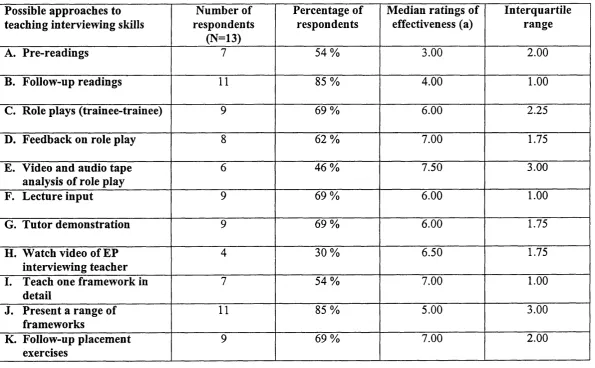
Table 3.1 Approaches used to teach interviewing, and ratings o f effectiveness
89
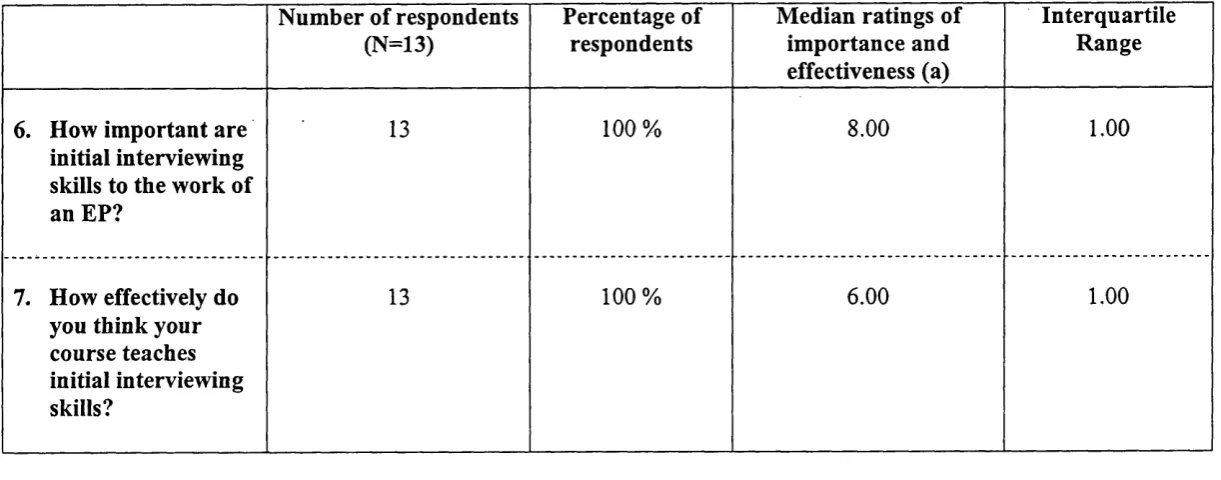
Table 3.2 Ratings of importance o f interviewing skills, and how effectively taught
90
Table 3.3 Interview strategies taught, and ratings of importance 91
Table 3.4 Ratings of importance o f personality and communication style factors to interviewing
93
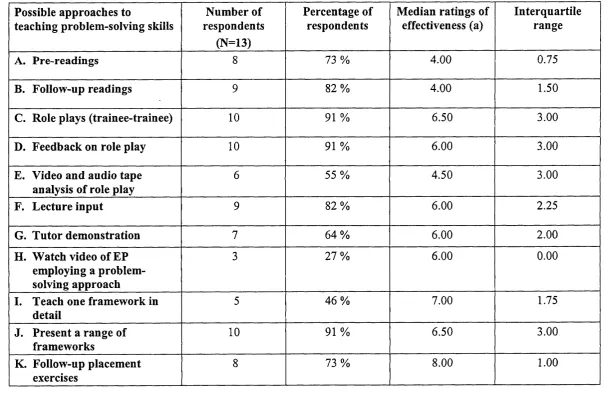
Table 3.5 Approaches used to teach problem solving, and ratings of effectiveness
94
Table 3.6 Ratings of importance o f problem-solving skills, and how effectively taught
95
Table 3.7 Problem-solving steps taught, and ratings of importance 97
Table 3.8 Ratings of importance o f personality and communication style factors to problem solving
99
Table 3.9 Wilcoxon scores for comparison o f tutors' perception of relevance o f personality and communication style factors to interviewing and problem solving
100
Table 4.1 Medians and interquartile ranges of EPITs' and Controls' perceptions o f interview task at time 1 and time 2
Table 4.2 Mann-Whitney scores for between group comparisons of perceptions of interview task at time 1 and time 2
144
Table 4.3 Wilcoxon scores for within group comparisons of perceptions of interview task at time 1 and time 2
145
Table 4.4 Medians and interquartile ranges of EPITs' and Controls' problem-analysis subscale and total scores at time 1 and time 2
147
Table 4.5 Mann-Whitney scores for between group comparisons o f problem-analysis ratings at time 1 and time 2
148
Table 4.6 Wilcoxon scores for within group comparisons of problem-analysis ratings
149
Table 4.7 Intercorrelations among participants' problem-analysis quality ratings at time 1
152
Table 4.8 Intercorrelations among participants' problem-analysis quality ratings at time 2
153
Table 4.9 Correlations between participants' self-ratings and actual ratings o f problem-analysis quality at time 1 and at time 2
154
Table 4.10 Correlations between participants' perceptions of
Interview task and problem-analysis quality at time 1 and time 2
Table 4.11 Intercorrelations between participants' interviewer 158 behaviour scores at time 1 and time 2
Table 4.12 Medians and interquartile ranges o f EPITs’ and Controls' 159 use o f open questions, closed questions, number of
utterances and accessible reasoning at time 1 and time 2
Table 4.13 Mann-Whitney scores for between group comparisons of 160 interviewer behaviours at time 1 and time 2
Table 4.14 Wilcoxon scores for within group comparisons of 161 interviewer behaviours at time 1 and time 2
Table 4.15 Correlations between interviewer behaviour and 162 problem-analysis quality at time 1 and time 2
Table 5.1 Medians and interquartile ranges o f EPITs'and Controls' 194 scores on the Big-5
Table 5.2 Mann-Whitney scores for between group comparisons 195 on the Big-5
Table 5.3 Medians and interquartile ranges o f EPITs' and Controls' 197 scores on the Norton
Table 5.4 Mann-Whitney scores for between group comparisons 198 on the Norton
Table 5.6 Correlations between participants' problem-analysis ratings 200 and the Big-5
Table 5.7 Correlations between participants'problem-analysis ratings 201 and the Norton
Table 5.8 Correlations between participants' interviewer behaviour 202 Scores and the Big-5
Table 5.9 Correlations between participants' interviewer behaviour 203 Scores and the Norton
Table 5.10 Correlations between participants' perceptions of interview 207 task, self-ratings o f their problem-analysis quality and the
Big-5 at time 2
Table 5.11 Correlations between participants' perceptions o f the 208 Interview task, self-ratings of problem-analysis quality
and the Norton at time 2
Table 6.1 Summary o f causal factors identified by teachers 217
Table 6.2 Number, percentages, medians and interquartile ranges 228 of EPITs and controls number and type o f attributions
used at time 1 and time 2
Table 6.3 Mann-Whitney scores for between group comparisons 229 o f number and type of attributions at time 1 and time 2
Table 6.5 EPITs attributions to "within" child factors for the origins 231 O f the teacher's problem situation at time 1
Table 6.6 Controls attributions to "within" child factors for the origins 232 O f the teacher's problem situation at time 1
Table 6.7 EPITs attributions to "within" child factors for the origins 233 O f the teacher's problem situation at time 2
Table 6.8 Controls attributions to "within" child factors for the origins 234 O f the teacher's problem situation at time 2
Table 6.9 EPITS and controls attributions to "home" factors for the 235 origins of the teacher's problem situation at time 1
Table 6.10 EPITS and controls attributions to "home" factors for the 236 origins of the teacher's problem situation at time 2
Table 6.11 EPITS and controls attributions to "teacher" factors for 237 the origins o f the teacher's problem situation at time 1
Table 6.12 EPITS and controls attributions to "teacher" factors for 238 the origins o f the teacher's problem situation at time 2
Table 6.13 EPITS and controls attributions to "environmental" factors 239 for the origins of the teacher's problem situation at time 1
Table 6.15 EPITS and controls attributions to "interactional" factors for the origins of the teacher's problem situation at time 2
241
Table 6.16 EPITS and controls attributions to "interactional" factors for the origins o f the teacher's problem situation at time 2
242
Table 7.1 Ways course tutors report that they teach hypothesis-testing 274 to EPITs
Table 7.2 Way course tutors report that they teach sharing thinking to EPITs
List of Figures
Figure 2.1 Problem-solving frameworks 32
Figure 2.2 The problem space within the Tower of Hanoi problem 41
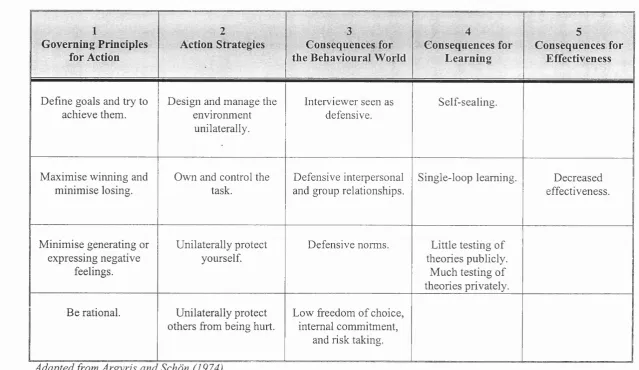
Figure 2.3 Model I 63
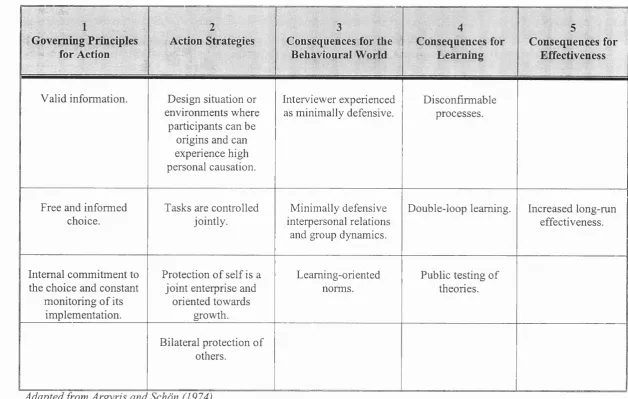
Figure 2.4 Model II 64
Figure 2.5 Critical dialogue 68
Figure 2.6 Four rules of critical dialogue 69
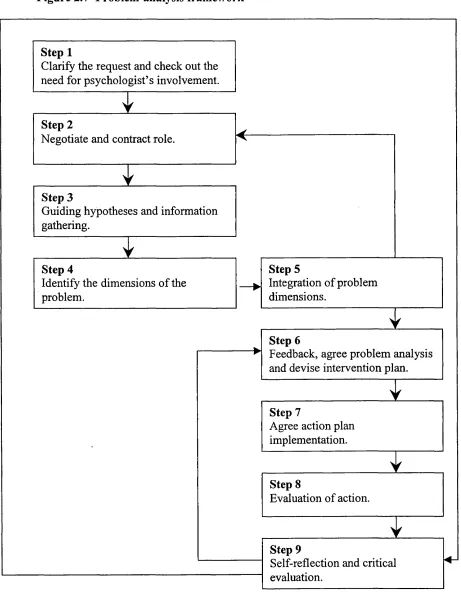
Figure 2.7 Problem-analysis framework 74
CHAPTER ONE
INTRODUCTION
"Psychology cannot dispense with experience, nor can experience, i f it is to be rational,
dispense with psychology. It is possible to make actual practice less a matter o f mere
experiment and more a matter o f reason; to make it contribute directly and
economically.... because (of) rational, experience. And this the educational psychologist
attempts to do by indicating in what directions help is likely to be found; by indicating
what kind o f psychology is likely to help and what is not likely; and, finally, by indicating
what valid reasons there are fo r anticipating any help at all. " (Dewey & McLellan, 1895, cited in Archambault, 1964, p. 195-196)
1.1. BACKGROUND TO THE PROBLEM
The British Psychological Society (BPS) is charged with setting the core curriculum for all initial training courses for educational psychologists in England, Wales and Northern Ireland, and in monitoring its implementation and effectiveness on a five yearly cycle. The BPS's core curriculum, under the headings "Background", and "Personal skills and communication", clearly views interviewing and problem solving as being central skills to effective practice. The place of problem solving is given added prominence as an integrating framework with which to guide all other practice. The document states that, while the BPS recognises "that each course brings its own orientation and specialism to training, they should nevertheless adopt a problem-solving approach (BPS Core Curriculum, 1999, p.l).
it is produced". Applicable knowledge "fits" with the external environment: hence it has external validity. "Actionable knowledge" specifies how "applicable knowledge" can be implemented in everyday life. It specifies the actual behaviour or actions that must be produced if the relevance or fit is to be actualised" (Argyris, 1993b, p.29). Having guidelines stated in prescriptive applicable knowledge terms would probably lead to training courses developing their own unique solutions to address the BPS requirements and guidelines on interviewing and problem solving.
Given the pre-eminent role that interviewing and problem solving play in the work o f contemporary educational psychologists (and other related practitioners), it is surprising that very little is published, in actionable knowledge terms, on what models are being promulgated within training courses, what skills underpin these models, how are they taught, and most importantly how effective are they (Reynolds, Gutkin, Elliott & Witt, 1984; Peterson, 1991; Sigston, Curran, Labram & Wolfendale, 1996; Wolfendale, Bryans, Fox, Labram & Sigston, 1992). This lack o f primary information provided a rationale for surveying all training courses in England, Wales and Northern Ireland. The information obtained provided a context and a link with the experimental and correlational studies reported within this thesis.
The basic assumption underlying this thesis was that the initial teacher interview with which educational psychologists are routinely involved, represents a complex set o f cognitive behaviours involving information-processing strategies. This view sees the interviewer and interviewee as both being actively involved in an inquiry process during the initial interview, as "meaning seekers" and "problem solvers" (Dewey, 1929). This view was supported by certain theoretical models o f how experts go about solving complex and ill-structured real-life problems (Argyris, 1982; Argyris & Schon, 1974, 1996; Chi, Feltovich & Glaser, 1981; Chi, Glaser & Farr, 1988; Elstein, Shulman & Sprafka, 1990; Ericsson & Chamess, 1994; Ericsson & Lehmann, 1996; Lichtenberg,
1997), and related research into memory (Rose, 1999), cognition, and information processing (Dawson, 1998; Glaser, 1984; Green, 1996; Greeno, 1997, 1998; Schraagen,
1993; Simon, 1973, 1978; Wiley, 1998).
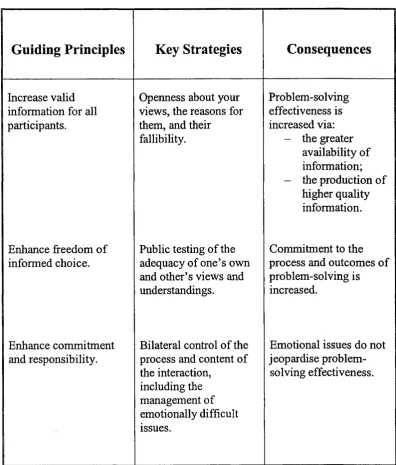
psychologists in New Zealand, and the subsequent quality of their written analyses of clients' presenting problems. Accessible reasoning describes the process by which the interviewer makes explicit to the client their thinking about the information the client has given them during the course of their interview. Such a view was informed by previous theoretical and practical work by Argyris and Schon (1974,1996), and their Model I and Model II frameworks. Within their model of interpersonal problem solving, explicit reasoning is a key strategy. By making thinking and reasoning accessible, it allows both the interviewer and interviewee to check upon the accuracy, relevance and usefulness of the information shared. This is likely to increase the availability o f valid information leading to the possibility of a higher quality understanding being developed by the interviewer (and interviewee) (Argyris & Schon, 1974, 1996; Argyris, 1982, 1993; Robinson, 1993). This thesis aimed to investigate further the role played by accessible reasoning (explicit reasoning), and other selected interviewer behaviours, in enabling a group of EPITs to reach "high quality" understandings o f a teacher's problem. It was assumed that when educational psychologists, and EPITs during their training, assist teachers to solve real-life work-related problems, the quality o f such assistance will be dependent upon the interviewer's own ability to understand and reason with the details of the teacher's problem situation.
This view o f initial teacher interviews does not mean that effective human relationship skills are seen in any way as being irrelevant, or at best o f secondary importance. It is conjectured that little will be achieved if interviewer problem understanding is developed in some sort o f detached pseudo-rational manner. Feelings and perceptions are integral and legitimate areas o f concern for the interviewer who is trying to understand a client's problem. Interviewers who ignore clients' feelings and perceptions do so at their own peril. However, it is doubtful whether a high quality understanding could be achieved without both effective rational cognitive processing and interpersonal skills.
trusts the interviewer. An interviewer who communicates to the client their genuineness in trying to understand their problem, and that they have the competence to do so, is more likely to be perceived positively by the client.
An interviewer who actively involves the client in the process o f helping them reach an understanding o f their problem, avoids many o f the intended and unintended consequences which can follow if judgements (i.e. attributions and evaluations) are not publicly tested out (Argyris & Schon, 1974,1996; Argyris 1982,1993). Interviews that are comprised largely of unilateral and unillustrated assumptions and judgements are more likely to increase misunderstandings and defensiveness in both the interviewee, and the interviewer (Argyris, 1982,1993). It is likely that involving the client will improve the overall understanding o f the problem by both parties. Argyris (1982) suggests that, "the best way to achieve this, is to state our views in ways that allow them to be publicly tested and falsified. To do so, we must make our reasoning explicit, and organise it in such a way that it is testable" (p.xx, included within the introduction to the book).
Within this process o f making one's thinking accessible, Argyris (1982) stresses the importance o f both parties giving and receiving valid feedback on the accuracy and validity o f their views. In discussing feedback the importance o f not only cognitive but also interpersonal processes is again stressed: "feedback must have at least two features: it must contain valid information, and it must be communicated in a way that does not make the receiver defensive and hence unlikely to hear the information" (p.96). Accessible reasoning would be one way o f enabling the interviewer and interviewee to gain such "critical feedback", and thus potentially lead to greater problem understanding and clarity.
addition, there are secondary level skills, such as probing for meanings and patterns, and challenging, or what some refer to as "disputing techniques" (Dryden, 1990). These strategies are used to "explore more deeply the problem or feelings (the client) is trying to express" (ibid, p.322).
The main conclusion reached from surveying this disparate literature is that one of the primary goals of counselling (and interviewing) is for the counsellor to improve the client's understanding o f their problem. In fact, in a survey of counsellors the most frequently cited reason for undertaking counselling was to help "the client's self- understanding and self-awareness", and for those who sought counselling it was "the desire for greater understanding of feelings and behaviour", (ibid, p.323). For the purposes o f this thesis, the ability to assist a teacher to understand their problem is very much dependent upon the interviewer's own ability and competence to understand that very problem. Competence within this thesis is used very much within Argyris' (1982) terms, that is, "competence may be defined as designing and implementing matches (between intentions and outcomes), including the detection and correction of mismatches. In order to know whether they have implemented a match or corrected a mismatch, people require feedback' (p.96, emphasis added).
Finally, this thesis also explored other factors which might have a bearing upon EPITs' ability to develop accurate problem understanding. The possible mediating effects o f interviewer personality characteristics and communication style were investigated. It was hypothesised that these aspects could act as constraints to accurate reasoning, such as the ".... tendency to notice instances that corroborate a favourite belief more readily than those that contradict it" (Dewey, 1933, in Archambault, 1964, p.220).
More recent research by Snyder (1981) demonstrated that some people "selectively seek evidence that confirms the hypothesis currently under consideration (reported in Arkes, 1981, p.326). Dewey himself recognised that, "methods alone will not suffice personal dispositions" (ibid, p.223), which could influence the way people construct and interpret information.
training, than those trainees who had lower scores on these personality factors. Though this research does not directly relate to our area o f interest it none-the-less makes the point that personality and communication style factors could influence the way and effectiveness with which interviewers go about gaining an understanding o f a client's problem (Mischel & Shoda, 1998).
1.2. OVERVIEW OF TH E THESIS
C hapter two provides a review of the literature which builds up a rationale for why the various research studies reported within this thesis were undertaken. Where relevant, the specific hypotheses for each study are detailed in the introductory section o f those chapters.
Chapter three reports the results of study one, a descriptive postal questionnaire survey o f training courses in England, Wales and Northern Ireland. A questionnaire survey was used as this was considered the best way of collecting information on course tutor perceptions o f the importance of interviewing, problem solving, personality and communication style to educational psychology practice, and the teaching strategies and curriculum used. This was the first survey of its kind and provided a useful context for study two, and a baseline for other researchers.
Chapter four reports the results of study two, a longitudinal experimental study. A longitudinal design was chosen as this approach was considered essential to the examination o f change and development, in response to learning opportunities in interviewing, problem solving, and other skills related to initial interviews with teachers.
C hapter five reports the results o f study two (a), a correlational study of personality and conununication style characteristics, and their relationship to selected data derived from study two on interviewer behaviours and the quality o f their subsequent problem understanding.
C hapter seven reports the results of study three a descriptive investigation of course tutors' reactions to some of the main findings of this thesis. It employed a semi structured face-to-face interview format and provided a means of drawing the various investigations reported within thesis to a conclusion.
CHAPTER TWO
REVIEW OF THE LITERATURE
2.1. OVERVIEW AND INTRODUCTION
This chapter begins with an overview o f the context within which the training o f educational psychologists in England, Wales and Northern Ireland occurs. The role of problem-solving theories within educational psychology practice are critiqued, with emphasis being given to what these theories have to say about how a "high quality" understanding of a teacher's problem is achieved by an interviewer. It then critiques the progression-by-steps approach to problem solving with reference to information- processing theory (e.g., Newell & Simon's (1972) problem-space theory). Information- processing theory is presented as a means o f understanding how educational psychologists may approach the types of complex and ill-defined problems with which they work. Then the characteristics of these ill-defined problems are described, with attention being given to the contribution that hypothesis-testing frameworks could make to the problem-understanding task. The characteristics of expert and novice problem solvers are discussed, before highlighting aspects of Argyris and Schon's work (1974, 1996), as it precursors research which is then described by Robinson and Halliday (1988) on accessible reasoning. The problem-analysis model is outlined. This framework teaches accessible reasoning and other related skills to EPITs, and is used to inform and unify teaching on the University College London training course from which the EPIT sample was drawn for the research studies outlined in this thesis. Finally an alternative framework described by Petty, Heesacker and Hughes (1997) is outlined and critiqued. In addition to the references acknowledged within this chapter some of the material included has appeared in different form in earlier publications (Gill & Monsen, 1996; Monsen, Graham, Frederickson & Cameron, 1998; Cameron & Monsen, 1998; Rees & Monsen, 2000).
practitioners) undertake is to assist teachers to solve important real-life work-related problems (Cole & Siegel, 1990; Frederickson, Webster & Wright, 1991; Robinson & Halliday, 1988; Miller, Leyden, Steward-Evans & Gammage, 1992; Sigston et al, 1996). Whether this assistance is delivered primarily via counselling, consultation or case work models o f practice, all can be seen to involve problem-reasoning and solving processes. In each context, the relationship between the educational psychologist and the teacher is focused upon transforming specific undesirable aspects of the presenting problem situation into more desirable states (Reynolds et al, 1984; Robinson & Halliday, 1988; Rosenfield, 1987).
Within the range of problem-solving approaches used by educational psychologists, the common element to all is the importance placed upon understanding the client’s problem. It is argued that the effectiveness of any assistance provided to teachers by educational psychologists will largely be dependent upon their competence and ability in analysing and reasoning about a teacher’s presenting problem situation. Although training courses and associated statutory and professional bodies (e.g., the BPS and the Association o f Educational Psychologists) acknowledge the importance of obtaining an accurate understanding of a teacher's problem, there is little published literature on how such an understanding is achieved, how it develops, and what factors support or hinder its development (Argyris, 1993,1999; Maliphant, 1998; Robinson and Halliday, 1987, 1988).
2.2. THE TRAINING OF EDUCATIONAL PSYCHOLOGISTS
"The profession o f educational psychology is undergoing a period o f reflection and
change. The Green Paper has indicated a commitment by the government that, by the
year 2002, 'there will be a national agreement on ways o f reducing the time spent by
educational psychologists on statutory assessments and maximising their contribution
in the classroom, and the training necessary fo r their developing role’ (DfEE, 1997, p. 68)
Within England, Wales and Northern Ireland the practice of educational psychology has become increasingly tied to the agendas of a range of, often competing and hostile, stakeholders. This has resulted in greater emphasis being placed upon accountability to employers and clients, on the development o f coherent policies within educational psychology teams, and on consistency between the service delivered by different educational psychologists within and between services. In the remainder of this section we will briefly consider some perspectives on training ftrom the USA, and then two themes pertinent to training in England, Wales and Northern Ireland will be discussed; the relationship between training and practice, and the relationship between psychological theory, research and practice (Farrell & Lunt, 1995; Frederickson et al,
1998; Lunt, 1996, 1998).
2.2.1. Perspectives on training from the United States of America
Within Europe there have been moves to try and facilitate the movement o f applied psychologists between the various member countries. Within the European Union apphed psychologists are usually regulated at a national level. The minimum number of years that a European psychologist will spend at the university varies from between four to six years, with five years being usual. In most countries this level of training is roughly equivalent to a masters degree, although in Europe such a degree almost always has a strong practical component (i.e. practicum and internship).
Unhke the United Kingdom and Europe the USA has had a much longer history o f training applied psychologists at both masters and doctoral levels. Within the USA there are a vast variety of university based training models which have evolved since 1947 to structure the teaching and practice of doctoral level training within all branches of applied psychology.
psychology as an academic discipline. In practice such a view has been interpreted by training course tutors to mean that applied psychologists should be trained in the methods (e.g., scientific research paradigm and methods) and knowledge base in psychology, and in the specific skills needed to practice as an applied practitioner. This training has usually been undertaken within the format of a research degree at Ph.D. level (Barlow, Hayes & Nelson, 1984).
During the 1950's and 1960's there was a great expansion o f applied Ph.D. programmes based upon the "scientist-practitioner" model. However, a growing body o f research suggested that practising psychologists did not use the majority of the skills they had been taught. In practice very few conducted research after graduation, though they did apply to a greater or lesser extent frameworks based upon scientific principles to guide critical thinking and practice. Some of the course tutors began to question the appropriateness o f the "scientist-practitioner" model to guide training and practice. They argued that it was costly in terms of the time needed to train such skills and in most cases was an irrelevance to the actual demands o f applied settings (Garfield & Kurtz, 1976).
What emerged from this debate was an alternative "scholar-practitioner" training model. This framework placed much less emphasis upon logical empiricist research skills, and expanded the focus on to competency based training and making direct links with practice. Such training occurred within applied doctorate rather than Ph.D. programmes, and are generally referred to as Psy.D. programmes.
The view that an applied psychologist could be seen to be an educated "consumer" of research rather than a "producer" of research gained credibility as did the view that both types of training produced "practitioners" of psychology. The practitioner-model, as reflected in the Psy.D. programmes began to expand slowly from about the early 1960's. It is important to note that even now university departments still offer both Ph.D. and Psy.D. degrees.
and the evaluation and improvement of those services, the Doctor o f Psychology degree is appropriate. Where the primary emphasis is upon the development o f a new knowledge in psychology, the Ph.D. is appropriate" (Korman, 1974, p.443).
Currently there are important divisions beginning to be seen between those who assert that the Ph.D. is "the" model for the scientist-practitioner, and the Psy.D. being seen as the best model for applied psychologists. However, both models can be criticised as being deficient. Research has highlighted that the two models do not actually produce significantly different types of practitioners. Snepp and Peterson (1988) found in their comparative study of interns firom these two groups that they did not significantly differ in terms of core skills or competencies. Ratings were made by the interns’ placement supervisors.
Although doctoral training is the dominate model in the USA, masters degree programmes still endure. There are still states where it is possible to practice psychology or related fimctions with a masters degree. In some states such practice is limited to specific areas such as school psychology, while in other states the practice of masters level providers is that of an "associate" or "assistant", who must work under the guidance of a doctoral level supervisor.
2.2.2. The relationship between training and practice in England, Wales and Northern Ireland
balance in the work o f EPs will have implications for their training. New patterns o f training will be needed to reflect their developing role...."(Department for Education and Employment, 1997, p.67).
When one compares and contrasts international and local level provisions for the training o f educational psychologists, the area is characterised by a lack of coherence and consistency in the solutions being implemented (Eraut, 1994). For example, in New Zealand there has been an integrated period of three-year training, leading to a post masters level diploma, for over 30 years, though the national system o f training educational psychologists in New Zealand is currently under major review. In most states in the United States o f America there is a tiered system of registration from masters level assistant psychologist status (sometimes referred to as psycho-metricians), to full doctoral level registration as a practising psychologist.
Currently in England, Wales, Northern Ireland, New Zealand and some states o f Australia, there are attempts to remove teacher training as a prerequisite for entry to courses. Yet in France, some states in the United States o f America, and Eastern Europe they are attempting to head in the opposite direction (Eraut, 1994). In England and Wales clinical psychology training has for the most part moved from masters degree level to a three-year applied doctorate. This situation has put increased pressure upon educational psychology to do the same, for fear of becoming more marginalised, and being perceived as a second rate "Cinderella" service (Frederickson et al, 1998).
In 1984 the then Department for Education and Science (DES), the University Grants Council (UGC), the Local Government Association (EGA), the BPS and the Association o f Educational Psychologists (AEP) agreed that the period of initial training for educational psychologists needed to be increased and recommended a move from one year to two years' training (DES, 1984). This recommendation was never implemented, and the resultant dilemma has been concealed in many Local Education Authorities (LEAs) by involving educational psychologists in predominately statutory assessment functions. Paradoxically this child assessment role is very reminiscent o f the type o f work undertaken by the very first educational psychologists in the United Kingdom. In the late 1940s they administered psycho-educational tests to assign children to appropriate special educational provision (Maliphant, 1998). The proposed changes to the role of educational psychologists, as outlined in the Green Paper and by Miller and Leyden (1999), have once again brought into focus the insufficiency o f current initial training provided in England, Wales and Northern Ireland.
As a result o f these challenges, and indeed threats, has come renewed interest within educational psychology in the behaviours which make up competent applied practice. The idea is that such information, once identified, could be incorporated into training courses, and provide guidelines for evaluating practice both during and subsequent to training. It could be argued that such a perspective when applied to complex practice is naïve and simplistic (Morgan, 1998; Searle, 1999; Stevenson & Cooper, 1997). It is acknowledged that there are controversies surrounding competency- based research. However, it will be assumed in this thesis that it is possible to define and measure specific behaviours which are associated with particular outcomes (Morgan,
1998). For example, that the increased use of accessible reasoning by interviewers during initial teacher interviews is related to higher quality understandings being produced.
2.2.3. THE RELATIONSHIP BETWEEN PSYCHOLOGICAL THEORY, RESEARCH AND PRACTICE
practitioners (Robinson, 1993, 1998). As a result o f this dilemma new techniques and approaches may gain widespread popularity and use amongst practitioners despite limited or no evidence regarding their effectiveness. Robinson (1998) argues that the majority o f research questions being proposed by university-based educational psychology researchers (and other related colleagues) would not be identified as priorities by practitioners. She states that, if it is the intention of researchers to have a genuine impact upon applied practice, then alternative methodologies need to be employed, such as problem-based methodology (Robinson, 1998). For those researchers who hope that their research will contribute to a real change in practice (i.e. generating both applicable and actionable knowledge) then a much closer relationship between themselves and practitioners is needed (see Robinson, 1993, 1998; and Meyer, Park, Grenot-Scheyer, Schwartz & Harry, 1998).
The late early part o f the 2T‘ century is proving to be a formative period for applied educational psychology in United Kingdom. Clearly, there will always be a role for a group o f practitioners who are able to make an effective contribution to assisting parents (carers), school staff and administrators deal with the policy, organisational, learning, behaviour and social-emotional difficulties surrounding childhood and adolescence. Whether this assistance is applied at an individual, group or systems level is, in some senses, secondary to the need for practitioners to demonstrate that they do in fact have a unique, relevant and potent contribution to make. The future for educational psychologists will be fought and decided largely against these criteria (Monsen & Swanson, submitted).
2.3. PROBLEM-SOLVING WITHIN EDUCATIONAL PSYCHOLOGY PRACTICE
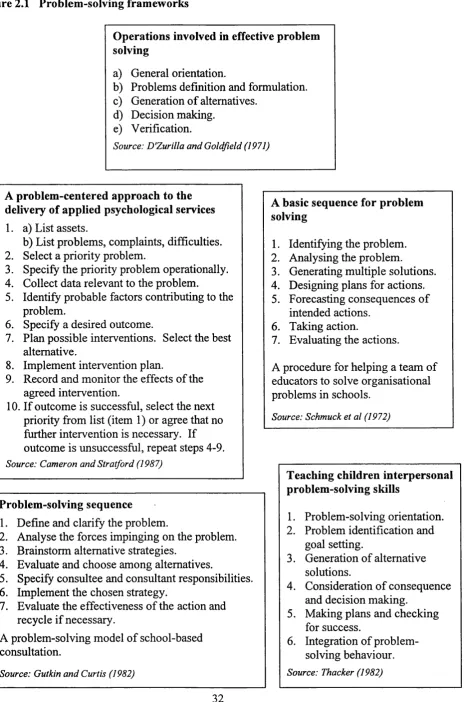
Figure 2.1 Problem-solving frameworks
Operations involved in effective problem solving
a) General orientation.
b) Problems definition and formulation. c) Generation o f alternatives.
d) Decision making. e) Verification.
Source: D'Zurilla and Goldfield (1971)
A problem-centered approach to the delivery of applied psychological services
1. a) List assets.
b) List problems, complaints, difficulties. 2. Select a priority problem.
3. Specify the priority problem operationally. 4. Collect data relevant to the problem.
5. Identify probable factors contributing to the problem.
6. Specify a desired outcome.
7. Plan possible interventions. Select the best alternative.
8. Implement intervention plan.
9. Record and monitor the effects of the agreed intervention.
10. If outcome is successful, select the next priority from list (item 1) or agree that no further intervention is necessary. If outcome is unsuccessful, repeat steps 4-9.
Source: Cameron and Stratford (1987)
Problem-solving sequence
1. Define and clarify the problem.
2. Analyse the forces impinging on the problem. 3. Brainstorm alternative strategies.
4. Evaluate and choose among alternatives.
5. Specify consultée and consultant responsibilities. 6. Implement the chosen strategy.
7. Evaluate the effectiveness of the action and recycle if necessary.
A problem-solving model of school-based consultation.
A basic sequence for problem solving
1. Identifying the problem. 2. Analysing the problem. 3. Generating multiple solutions. 4. Designing plans for actions. 5. Forecasting consequences o f
intended actions. 6. Taking action.
7. Evaluating the actions.
A procedure for helping a team of educators to solve organisational problems in schools.
Source: Schmuck et al (1972)
Source: Gutkin and Curtis (1982)
Teaching children interpersonal problem-solving skills
1. Problem-solving orientation. 2. Problem identification and
goal setting.
3. Generation of alternative solutions.
4. Consideration o f consequence and decision making.
5. Making plans and checking for success.
6. Integration of problem solving behaviour.
as a teacher wanting assistance with a challenging child in his or her class (Edenborough, 1996). It is this latter interview situation and the problem-reasoning processes used which are explored within this thesis.
Pearson and Howarth (1982), viewed applied psychology "as a problem-solving profession" (p.375). The interpersonal and technical skills required in gathering information about a client's problem, implementing and evaluating a solution are similar in all branches o f applied psychology. Initial training provides psychologists with core skills (including interviewing and problem-solving frameworks), which can be used to respond to a wide range o f client requests.
When developing a core curriculum for EPITs, and specifying the key competencies for practising educational psychologists, the working group set up by the BPS (DECP Standing Committee on Core Curriculum and Competencies), faced the question, “What discriminates the work o f educational psychologists from that o f other support personnel?” The conclusion (or assumption) reached by this committee was that educational psychologists not only draw upon a broad knowledge base within psychological theory and research, but also employ a systematic approach to solving problems. In this way, educational psychologists are able to understand and manage human problems from a more holistic perspective.
2.3.1. The progression-by-steps approach to problem-solving
"Thinking begins in what may fairly enough be called forked-road situation, a situation
which is ambiguous, which presents a dilemma, which proposes alternatives. As long
as our activity glides smoothly along from one thing to another, or as long as we permit
our imagination to entertain fancies at pleasure, there is no call fo r reflection. Difficulty
or obstruction in the way o f reaching a belief bring us, however, to a pause. In the
suspense o f uncertainty, we metaphorically climb a tree; we try to fin d some standpoint
from which we may survey additional facts and, getting a more commanding view o f the
situation, may decide how the facts stand related to one another" (Dewey, 1933, p. 11)
Within the context o f educational psychology training successful problem solving has been characterised by a progression through a set of clearly defined steps. Figure 2.1 summarises some o f the more commonly referred to problem-solving frameworks. All o f these frameworks, and most of the published ones, can be seen to have built upon the five phases o f reflective thinking first described by Dewey (1933, cited in Archambault,
1964):
1. "the identification o f the problem,
2. the clarification o f the problem,
3. the use o f hypotheses,
4. reasoning about the possible results o f acting on one or another
hypothesis and choosing one, and,
Dewey's description of reflective thought was developed from his observations o f how ordinary people went about processing information when confronted with a complex real-life problem. In Dewey's terms, when a person is faced with a problem that is meaningful to them they progress through a sequence of steps before a solution is tried out. Dewey's model is based upon applying classical scientific method to real-life experience, so that "transformation of scientific findings into rules of action" can result (Dewey, 1929, p .19). The progression-through-steps theory o f problem solving has proved to be far more prescriptive than it has been descriptive. Dewey him self acknowledged that the progression was not fixed or linear in real life, with some steps being passed through quickly, while other needed more time and/or a number o f reruns. When things went wrong with the process Dewey suggested that it was helpful to go back and review the problem-solving steps so far undertaken to see where an error of logic or judgement may have occurred.
Subsequent writers have developed, often without direct reference to Dewey's work, the prescriptive use o f variants of his framework. Such writers argue that an educational psychologist's problem-solving competency is greatly enhanced if the steps are made explicit and presented in a linear maimer and adhered to conscientiously (Cameron & Stratford, 1987; de Mesquita, 1992; D'Zurilla & Goldfield, 1971; Gutkin & Curtis, 1982; Monsen et al, 1998). Dewey himself makes the point that the advantage o f applying the scientific method to real-life problems is that it provides a means o f "control, public test, and the possibility o f proof and reasonable consensus" (Archambault, 1964, p.xv).
2.3.2. Possible limitations of contem porary problem-solving approaches
2.3.2.1. Context-constraints
The issue o f context has received attention by a number o f writers, both within and outside the field o f educational psychology. Schon (1983), for example, has critiqued the "technical rationality" view o f applied practice. This "consists in instrumental problem solving made rigorous by the application of scientific theory and technique" (ibid, p.21). While acknowledging the existence o f some "high, hard ground where practitioners can make effective use o f research-based theory and technique" (ibid, p.42), he argues that practitioners are more likely to find themselves in a swamp where many of the problems o f greatest human concern exist as confusing real-life messes, "incapable o f technical solution," (ibid, p.42). Schon (1983) maintains that real-world problem solving should be seen as a "craft" or, as Wright (1998) refers to it, as "professional artistry", not open to analysis but involving structured reflection both during and after the actual process of doing. Here the influence o f Deweyian thinking is most evident.
Checkland and Scholes (1990) argue that problem solving can be analysed and translated into a methodology which includes an element of structured reflection. While they call into question the usefulness and relevance of scientific problem solving to the "soft" social science problems, they nevertheless support the use of approaches which “introduce some o f the kind o f rigour normal in natural science into this more difficult field o f applied social science” (ibid, p.290).
In discussing the uses of both Soft Systems Methodology (SSM) and o f Cameron and Stratford's (1987) problem-centred approach, Frederickson (1990) argued that in educational psychologist practice straightforward human problems are rare (i.e. well- structured problems about which there is general consensus and an obvious solution). While it may be possible to identify a well-defined area of concern and apply a problem solving approach, most situations encountered by educational psychologists seem much closer to the SSM description o f "real-life messes".
attention must be given to the more interpersonal and systemic aspects o f problem solving within applied contexts, very much as Argyris (1982) had suggested earlier.
23.2,2, User-constraints
In comparison to context-constraints, issues concerning user-constraints have been given little attention within the literature. The assumption appears to be that training psychologists in problem-solving approaches should proceed by teaching a set of well- researched principles (not actionable skills), selected to maximise the probability of high quality solutions being generated. Indeed D'Zurilla and Goldjfried (1971) drew attention to the fact that there was a remarkable degree of agreement as to the general kinds of operations involved in effective problem solving, although the precise terminology and the steps involved vary greatly between vmters. These observations are hardly surprising given that the vast majority o f contemporary problem-solving frameworks can be traced back, conceptually at least, to the pioneering work of Dewey.
Even i f those being trained attempted to faithfully apply the problem-solving approach (es) they are taught, it is likely that differences will be apparent between what Argyris and Schon (1974, 1996) refer to as their "espoused theories" (what people say they are doing) and what they actually do, (or the "theories-in-use") apparent from their practice. It was hypothesised that the primary focus of much training would be at this espoused level. As a consequence many EPITs (and similar trainees) are probably being educated in ways which fail to assist them in identifying the incongruities between their espoused theories and theories-in-use.
De Mesquita (1992) observed that practising school psychologists do not always adhere to the systematic assessment approaches which they claim to be applying. In his study, experienced practitioners did not differ significantly from trainee school psychologists in their problem solutions or strategies. The only difference found was in the relative "efficiency" o f the experienced practitioners who spent less time on information processing and problem solving.
was seen as effective. However, in terms of the accuracy of their clinical judgements, the amount of training and experience did not appear to be significantly related to differences between novices and experienced counsellors. The characteristics o f expert and novice problem solvers will be outlined in more detail in a later section. The research reviewed in this upcoming section would tend to imply that attempting to measure interviewer behaviours which correspond to steps in a given problem-solving process would not be likely to help in discovering what behaviours actually lead to successful problem understanding during an initial teacher interview.
Miller et al (1992) argued that "problem solving is not a mechanical operation, and the potential problem solver brings to the situation, and must be aware of, his or her own personal assumptions, values and prejudices" (p.37). When the problem solvers are educational psychologists they will also bring to the situation different psychological theory and research. Reynolds et al (1984) describe a vision of school psychologists as problem solvers whose actions originate fi*om sound psychological theories and research, and recommends problem solving as a process by which different theories and content can be accommodated.
The practice of problem solving cannot be content or value firee. In carrying out a step such as "collect data relevant to the problem" (Cameron & Stratford, 1987), the theoretical bases which inform the educational psychologist's work are likely to influence the type of information he or she will collect. The use of behavioural firameworks would lead to the collection of information on antecedents and consequences, while cognitive approaches would place more emphasis upon the sense the teacher (and child) was making of the child's challenging behaviour, whilst those employing a situative approach would try to combine aspects o f both behavioural and cognitive orientations (Greeno, Collins & Resnick, 1996).
Frederickson et al (1991), have argued that educational psychologists have paid insufficient attention to the theoretical bases which have informed their problem-solving practice. This may be due to an implicit over-reliance upon behaviourally-based approaches to problem solving (Sigston et al, 1996). Frederickson et al (1991) emphasise the need to focus upon the "why" questions in the formulation of hypotheses about the problems being experienced. Monsen et al (1998) build upon this position by stressing the need for such hypotheses to be made explicit, arguing that they would be more open to challenge, and feedback within Argyris' use of the word. Frederickson et al (1991) also put forward the view that the unique contribution o f educational psychologists lies in the broad range o f hypotheses they are able to draw upon in understanding a client's problem. Unfortunately the authors do not address the central question of how such an approach helps the practitioner and client gain an accurate understanding of the problem.
Frederickson et al (1991) also expressed concern that educational psychologists tended to consider too narrow a range of possible hypotheses. Support for this concern was found in a study which looked at the use of problem solving within a group of American school psychologists (de Mesquita, 1992). De Mesquita reported that most psychologists used a solution by elimination ("rule out") strategy. This involves testing out a small number and range of hypotheses which are perceived to be most probable and eliminating any when disconfirming evidence is found.
2.3.3. Conclusions
The discussion so far, indicates that there is little research evidence that experienced practitioners follow the problem-solving steps they were taught when trained. To the extent that they do conform, their behaviour is characterised by the flexibility and adaptation suggested by Dewey. Several writers acknowledge that a progression-by- steps approach to problem solving is helpful for the purposes o f training and study rather than as a description of a naturally occurring process (D'Zurilla & Goldfield, 1971; de Mesquita, 1992). For the purposes of this thesis any research attempting to measure interviewer behaviours which correspond with the various steps in a given problem solving sequence is unlikely to be helpful. This thesis will focus instead upon the task o f identifying what interviewer behaviours are associated with the formulation of a "high quality" understanding of a teacher's problem.
The problem-solving frameworks referred to in this chapter provide little guidance as to the skills involved in this critical task o f understanding the teacher's presenting problem. It is assumed in all of the progression-by-steps frameworks that the educational psychologist has the component problem-solving skills. However, there is no evidence that this is in fact correct, especially when the skills have not been made explicit within the various frameworks.
2.4. INFORMATION-PROCESSING THEORY AND THE PROBLEM UNDERSTANDING TASK
Another approach to understanding problem solving is that provided by information- processing theory. This approach is concerned with the identification o f the component skills involved in effective problem solving rather than in describing the progression-by- steps which might underlie such a process (Dawson, 1998).
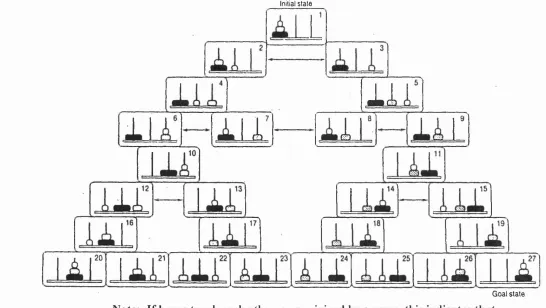
Figure 2.2 The problem space of legal moves in the Tower of Hanoi problem
Initial s ta t e
m
CL SÙ 1
Goal state
Note: If boxes touch each other, or are joined by arrows, this indicates that one can move from one state to the other using a legal operator
needed would far exceed that available. Even if there were the time available the human brain has a limited capacity for processing information at any one time. While long-term memory provides a considerable storage capacity, working memory is far more limited. Working memory is defined as the "conscious ability to process information on-line while performing cognitive tasks" (Rose, 1999, p.44). It is working memory where problem solving takes place, and current thinking indicates that, at best, it can process between five to nine separate new pieces o f information at any one time (Anderson, Reder & Lebiere, 1996; Rose, 1999; Woolfolk, 1998).
A further constraint to successful problem solving is the amount of domain specific knowledge which is available to the problem solver. Such knowledge (and experience) is needed by problem solvers to deal with the types o f situations with which they are presented. This area is often omitted or given much less emphasis in discussions on problem solving. The assumption appears to be that process skills are more important than content knowledge (i.e. you do not need to know much about a given area as long as you are good at organising interpersonal processes). Clearly content knowledge is as essential to effective problem solving as are interpersonal and cognitive strategies (Schraagen, 1993).
Inadequate performance could also be attributed to a mismatch between the client's representation of his or her problem, and the problem solvers' own construction (Ranyard et al, 1997). The skills involved in solving real-life problems are very dependent upon the problem solver's ability to use cognitive strategies, which help make connections between the large amounts of information available to them, and the limited capacity o f their working memory. Information-processing theory would suggest that the problem solver must proceed by processing a limited amount o f this information, at any one time, and operating on it in a serial manner.
2.4.1. Newell and Simon's problem-space theory
in the area o f interviewer reasoning. The current debate between the classical and the connectionist views of information processing is beyond the scope of this thesis, however readers are referred to Dawson (1998) who provides an excellent coverage o f the issues involved.
Newell and Simon (1972) conducted a wide range of experiments under controlled laboratory conditions into how people (usually undergraduates), approached a range of three-dimensional puzzles, and in particular the Tower o f Hanoi problem. In the Tower o f Hanoi problem participants were presented with three vertical pegs in a row, the first of which had three disks piled on it in order of size; that is the largest disk was at the bottom, the next on top, and so on. The goal o f the problem was to have all the disks piled in the same order on the last peg. However, disks could only be moved in certain ways. Only one disk could be moved at a time, and a larger disk could not be placed on top o f a smaller disk (Eysenck & Keane, 1995, p.363).
Figure 2.2 presents the problem space o f legal moves for the Tower o f Hanoi problem which will be referred to in the discussions below. From Newell and Simon's perspective people went about solving problems by first exploring a range o f possible ways (paths) o f finding a solution. Puzzles, such as the Tower of Hanoi, begin with a point outside the problem space (or maze), and then progress through a series o f moves to the centre - the solution. To achieve the goal o f getting to the centre, the person comes across many junctions where they have to make decisions (e.g., go straight, turn left, and so on). Each of these alternative paths may branch again and again, with some leading to the centre and the solution, and some not. Different strategies can be employed to find one's way inside the problem space (e.g., mark where you have come from, initially take left turns, and so on). These strategies provide the person with a systematic way of searching the problem space, and selecting one path firom a range o f alternative paths to get closer to the solution.
States until they reached a goal state. Each of these alternative states can also have alternatives. The number o f these alternatives increases greatly as one moves away from the initial state to the goal state.
In order for people to solve the Tower of Hanoi problem they have to employ a range of cognitive strategies to reduce the number of states which they have to pass through to reach the goal state. Newell and Simon describe such strategies as heuristics. A heuristic strategy is in essence a nonrigorous way of achieving a solution to a problem. While heuristic procedures often lead to solutions, they offer no guarantee o f doing so (Bruner, 1996). Heuristics are contrasted with algorithms, which are methods that produce a definite solution. For example, in the Tower of Hanoi problem, a person could check every state, by starting at the beginning and systematically checking every alternative state until the goal state were achieved. This procedure would take far too long to be efficient, but is guaranteed to solve the problem. Heuristics, on the other hand are "rules of thumb", that may not guarantee a solution to a given problem every time, but most o f the time, thus saving time and effort.
One of the most important heuristic principles proposed by Newell and Simon was means-ends analysis. It consists of three main steps: first, the person notes the difference between the initial state and the goal state, second, they create subgoals to reduce this observed difference, and third, they select an operator that will solve this subgoal. Moves from one state to another are achieved by the application o f "mental operators". As problems may have a large number o f alternative paths, people use strategies to move from the initial state to the goal state efficiently. Thus, people's conception of a problem (i.e. the nature of the initial state), and the knowledge they bring to it (the operators and strategies available to them), make contributions to their problem solving behaviour (Newell & Simon, 1972).
theory allows for the structure of the problem to be specified and the best solution to the problem to be defined. In puzzle-based research from the 1950s to the present day, it is possible to elaborate the problem space and identify the correct or best solution to the problem by tracing the shortest sequence of moves from the initial state to the goal state. It provides a normative model o f what an "expert" problem solver would do, and how and why people's behaviour diverges from that o f the "expert".
2.4.2. Sum m ary of Newell and Simon's problem-space theory
Newell and Simon's (1972) information-processing theory o f problem solving suggests that when people move from an initial problem state towards a solution state they form a mental representation of the problem, which in this thesis is called a problem map. Research on expert problem solvers (outlined in section 2.7 o f this chapter) shows that they acquire through experience mechanisms for internally representing the problem space. This internal model acts as a precondition for planning, reasoning, anticipating and controlling subsequent cognitive behaviour (Ericsson & Lehmann, 1996).
The problem map undergoes a series of transformations as the problem solver tries to move from the initial problem state to a solution state. These transitions are achieved by the problem solver employing a series of cognitive operations, or strategies, such as means-ends analysis (this is the strategy whereby the problem solver evaluates the difference between the initial problem and the solution state). In summary, Newell and Simon's theory suggests that:
1. Problems have a large number o f alternative paths from the initial problem state to the solution state.
2. The total number o f such states, as generated by mental operators, is called the 'basic problem' space.
4. People use their knowledge and various heuristic methods (i.e. means-ends analysis) to search through the problem space to find an efficient path from the initial state to the goal state.
5. All o f these processes occur within the limitations o f the individual's cognitive system, that is their working memory and information processing limitations (i.e. sorting and retrieving information from long-term memory).
6. The contents of people's short-term memory are open to conscious reporting by the individual. This assumption guided much of their work in which they used think-aloud protocols. This is a method whereby individuals say out loud what is going through their minds as they solve problems. The researcher records responses which are analysed later (Eysenck & Keane, 1995, p.363).
2.4.3. Cautions with information-processing (problem-space) theory
While information-processing theory, and in particular problem-space theory, does aid our understanding o f some aspects of the problem-understanding task, six cautions about the framework's explanatory usefulness and methodology arise:
1. There is a concern about the ecological validity and generalisability o f the results o f puzzle-based problems. The theory was developed on the basis o f laboratory research undertaken with people (mostly undergraduates) solving highly structured problems like the Tower o f Hanoi, maths, chess or logical reasoning tasks. These highly structured activities contrast greatly with the ill-defined problems characteristic o f most o f those presented to educational psychologists. Ill-defined problems require substantial amounts of domain specific knowledge. This is needed to define what is and is not part o f the initial problem state, to develop and experiment with a range o f operators, and to define what the goal state may be.
contrast many of the problems encountered by educational psychologists require considerable amounts o f prior specialist knowledge in order to work effectively with them (Schraagen, 1993).
3. The knowledge required to solve puzzle problems is usually present in the statement o f the problem itself. In real-life ill-defined problem situations much o f the information required to solve the problem is not initially present. Much o f the difficulty faced by an educational psychologist during an initial teacher interview is trying to sort out what information derived firom the teacher, the environment and firom their own memory is relevant to solving the problem.
4. The requirements of puzzle problems are usually straightforward, the start state and the goal state are clearly specified. In applied problems much time is spent attempting to specify what the goal state is actually going to be.
5. The theory focuses upon the strategies used in solving problems in the later parts of the problem-solving process, whereas the focus in this thesis is on how EPITs reach problem understanding in the earlier phases of the process.