© 2016 IJSRST | Volume 2 | Issue 3 | Print ISSN: 2395-6011 | Online ISSN: 2395-602X Themed Section: Science and Technology
Performance Appraisal System in Medical College Libraries in Karnataka
State - A study
Pushpalatha K
1, Poornima G. Rao
2,
T Y Mallaiah
31
Assistant Librarian, Mangalore University, Karnataka, India
2
Assistant Librarian, SDM College of Dental Sciences, Dharwad,Karnataka, India
ABSTRACT
It is necessary to understand the socio-economic and personal elements, which influence an employee‟s behaviour and opinion. Libraries need professionally qualified librarians to plan, direct and supervise various library operations where professional knowledge is important. The number of such professionals required in each library depends on the tasks to be performed. The present study has concentrated only on the professionals and semi-professionals and did not cover the non-semi-professionals and management people. This paper reports on the respondent‟s views and perceptions on common pitfalls of performance appraisal, its concerns and issues and also common rating errors influencing job satisfaction).
Keywords: Socio-Economic, Age-Wise Distribution, Health Sciences Standards, Personal Observation, Regression Analysis , Lack of Seriousness
I.
INTRODUCTION
The rapid changing humankind of today is also varying the concepts of performance to remain aggressive and even to survive. Obviously, the measures of their appraisal also must to change. It is not enough to have the correct measure only but its correct application is the „final‟ to determine the intended performance item. Normally, persons stay „engaged‟ to the organization for about half of their life time. Their performance and appraisal justify looks and re-looks to recognize them and to meet out fairness to them. The main power of an organization lies in the excellence of its human resource. In a fast and rapid working environment, performance appraisals have become main tool for assessing and formatting the importance of each individual in relation to the organization.
Gopinath (1990) suggested a plan for performance appraisal which included: the definition of work to be performed; defining the units of a job; the time taken for doing the jobs; the present performance levels of the library staff; improvement in the behaviour of the library staff, consistency of the objects of library services, and feedback on the performance of the library staff. Yehuda (1996) outlined the possibilities for the use of
self-appraisal as a valuable source of information and as a feedback tool. The study conducted by Lyons (1996) focused on the structural aspects of appraisals developed in the healthcare industry as a meaningful addition to the traditional performance appraisal methods.
II.
METHODS AND MATERIAL
1. Review of Literature
In the study, Moynihan (2008) stated that without consistent alignment in work, performance appraisal became an exercise in futility instead of a vital control measurement, resulting in not only personnel dissatisfaction, but also an impediment to systematic strategy implementation. The performance appraisal helped performance evaluators to manage more effectively to meet employee‟s expectations.
newcomer can be a motivator and help to reinforce the enthusiasm with which most newcomers tackle their job.
Williams and O‟Connor (2003) argued for the evaluation of libraries in the light of varying accreditation judgment of the academic programmes and the effect of such changes on library assessment. It is believed that the prime standards against which the library should be judged is its ability to support the academic programmes of the institution, which the library supports.
Leanne (2005) investigated the factors, which influenced a leader‟s reactions to 360° feedback and subsequent development activities and changes in leader behaviour.
A one-day library space planning conference about reducing the print collection, adjusting library services, and defining emerging roles for librarians was made by Valerie and Marie (2011). As librarians developed new roles and services, there is a need of in-depth knowledge of electronic licensing agreements, close placement with the institutional mission; informatics, information literacy, e-science, metadata design, and open access are some of the areas in which librarians can play a positive role.
2. Objectives of the Study
The central purpose of this research study is to critically examine and evaluate the efficacy of the components of the performance appraisal system as applicable to medical college library professionals in Karnataka. The objectives include the following:
1. To examine and evaluate the key features of the performance appraisal system being operated in the organizations;
2. To highlight the strengths and weaknesses of the performance appraisal system in existence;
3. To raise major implications to strengthen the performance management system.
3. Methodology
The list of medical college libraries in the state along with the number of professionals working in different cadres in each of the libraries is got. As per the information, there are 39 medical colleges in the state till 2014. There is no comparison as far as the professionals
and designations are concerned in the libraries between the Government and Deemed medical colleges. Keeping in mind the objectives, an interview questionnaire is arranged after sequentially arranging the features to be covered. Completed questionnaire was pre-tested in a nearby medical college libraries and required modifications were prepared. The information, opinions, perceptions and attitudes of library professionals was collected and analyzed.
III.
RESULT AND DISCUSSION
4. Analysis of Data
The results of the study presented pertain to the following aspects.
a) Demographic information of the respondents like qualification, gender, age, scale of pay, residential locality, etc., classified according to the organization to which they belong.
b) Responses to the questions in the questionnaire. Issues like views and perceptions of different factors affecting performance appraisal and satisfaction.
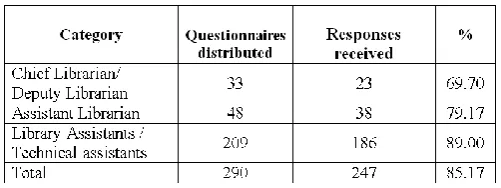
Table 4.1: Response rates of library professionals (Designation-wise)
The library professionals of medical colleges of Karnataka state consisted of Chief Librarians, Senior Librarians, Assistant Librarians, Library Assistants, and Technical Assistants with professional qualification. The total number of questionnaires distributed was 290. The researcher received 247(85.17%) filled questionnaires.
given for Library Assistants/ Technical Assistants 186 (89.00%) questionnaires were received.
Age Composition
Age is an important factor influencing the opinion of employees about the human resource management practices in the department. Age is a poor predictor of job performance. Age-wise distribution of the respondent employees in the libraries selected for the study are classified and presented in Table 4.2.
Table 4.2 : Age-wise classification of respondents
It can be noticed from the above table that comparatively, the younger age group is more in the medical college libraries.
Educational Status of the Respondents
Selection of sufficient number of qualified professional librarians is the first and primary significant step towards maintaining library quality.
Table 4.3 : Educational status of the respondents
It is evident from the data presented in Table 4.3, that majority, 129(52.23%) of the respondents have obtained Bachelors degree in Library Science.
Level of the job position (Designation-wise)
Placing the professionals in suitable pay scale is very important. Women are working nowadays in every
sphere. The details on the level of the job held by the respondents are presented in Table 4.4
Table 4.4 : Level of the job positions (Designation-wise / Gender-wise)
It is evident from the data presented in Table 4.4 that out of 186(75.31%) respondents 133 Library Assistants, /Technical Assistants, were males and 53 were females.
Gender Ratio
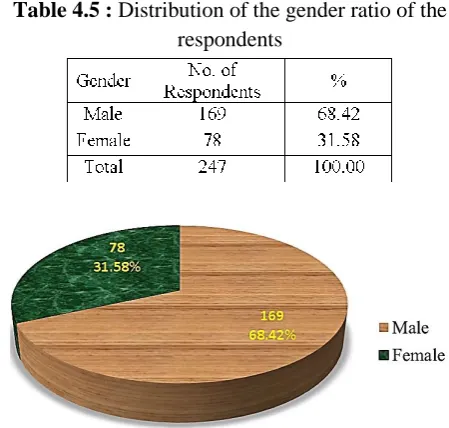
Gender differences in the workplace stem from social factors, which affect the behaviours of men and women. The respondents are classified in accordance with their gender as presented in table 4.5.
Table 4.5 : Distribution of the gender ratio of the respondents
Figure 4.1 Gender Ratio of the respondents
The data collected from different medical college library professionals are shown in Table 4.5. It indicates that out of 247 employees 169(68.42%) were male employees and 78(31.58%) were female employees.
It is usually held that better pays attract qualified, talented and skilled person for organizational jobs. The Rajiv Gandhi University of Health Sciences Standards has included clear statements relating to the pay, status and promotion of library professionals. Table 4.6 presents the salary structure of library staff in different categories.
Table 4.6 : Pay Scale
Table 4.6 indicates that majority 128(51.82%) of the medical college library professionals are getting a salary as decided by the management which is lesser than the prescribed pay scale. Present study found that in very few medical colleges, library professionals were appointed on the UGC/AICTE pay scale.
Origin and Background of Respondents (residential locality)
Rural or urban background of the employees becomes significant when we analyze the performance and behavioural aspects of the employees in the Indian context. The data on the rural/urban background of respondents are presented in Table 4.7
Table 4.7 : Rural/ Urban background of Employees
Performance Appraisal
Staff appraisal illustrates very well the nature of management and the reasons as to why it is a complex activity with a variety of consequences. Appraising people is a natural and popular activity. It is a continuous process in a majority of the libraries, in the sense that it occurs most of the time. It aims to reduce to objective terms, the experience and personal qualities of every person in the library. At work, such appraisals are most likely to concentrate on the personal strengths and weaknesses and job performance. It is especially difficult for an effective appraisal to be carried out openly where a subordinate has little professional regard for the appraiser.
The respondents were asked to specify the authority that constructs the performance appraisal in the organization, bases of appraisal, ability and awareness of employee performance of the appraiser, the view on the system, and the ideas of the respondents to improve the system. Their responses are summarized in Tables 4.8 to 4.15.
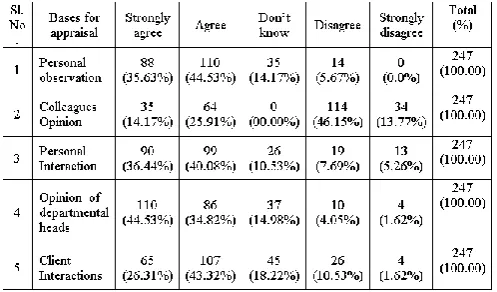
Table 4.8 : Bases for Appraisal Ratings
Table4.8 stated that regarding “personal observation”, 88(35.63%) respondents strongly agreed, and about the criteria, “Colleagues Opinion”, 114(46.15%) respondents disagreed, about personal interaction during performance appraisal period most of the employees 99(40.08%) agreed, 107(43.32%) professionals agreed to the criteria of client interaction.
Majority, 169(68.42%) of the respondents feel that the appraisal is conducted formally.
Table 4.10 : Views on Authority for appraisal ratings
The above result reveals that 75(30.36%) respondents in the library responded that they were appraised by the senior librarian of the library and 21(8.50%) respondents did not respond to this question.
Performance appraisal system in Medical College Libraries
Performance appraisal helps the librarian to evaluate the performance and to know the potential of their subordinates and to assign work, which suits the individual and facilitates the correct placement of library staff members.
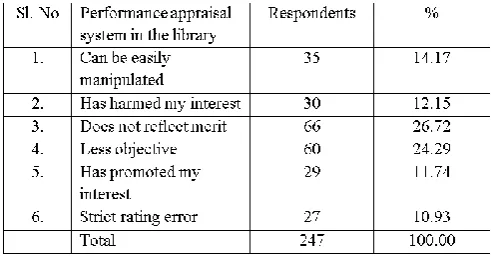
Table-4.11: Opinion on performance appraisal system adopted by the Library
The Data in the table 4.11 stated that 66(26.72 %) respondents opined that it does not reflect merit and 27 (10.93 %) respondents said that existed strict rating error. Furthermore, strict rating error takes place when there is a strong tendency among appraisers to be exceedingly harsh while judging the performance of the employees.
Table 4.12: Issues considered during appraisal
Table 4.12 indicates that 110(44.53%) respondents said that the performance appraisal system followed in the library was based on work performance.
Table 4.13 : Suggestions to improve the appraisal system
Table 4.14: Accuracy of performance appraisal
Appraisal and Satisfaction
Appraisal and supervision are some of the most important factors in job satisfaction.
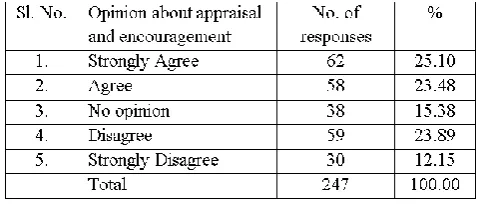
Table 4.15 : Appraisal provide satisfaction & encouragement
Table 4.15 illustrates that 62(25.10%) respondents strongly agreed that appraisal provided satisfaction and encouragement.
Table 4.16 : Multiple regression equation of appraisal scores on socio-demographic variables
p<0.05 R²=0.0642, F(6,240)=2.7480 p<0.0133, Std. Error of estimate: 10.683
Looking at table 4.16, R square value is 0.0642 (p<0.05). The regression coefficients for variables qualifications, age, and residential location are found to have significant relationship.
Even though, there exists some relationship between the qualification and the performance appraisal variables, the regression analysis clearly shows that the qualification exerts negligible influence on the perceived importance level of employees (B = -5.9428; p = 0.0382).
IV.
CONCLUSION AND SUGGESTIONS
Study shows that appraisal establishes link between organizational and individual performance. In most of the colleges there is lack of seriousness about appraisal interviews. Findings recommend that the librarians should take strategic planning into consideration and pay attention to human resources. In some medical colleges pay structure used to be somewhat flat. Therefore, salary and compensation should be in the direction rather than being flat. Study recommended that all performance appraisal techniques need thorough training of the appraisers and appraises by the human resource department. It should provide relaxed and motivated encouragement to the employees.
V.
REFERENCES
[1] Gopinath, M. A. (1990). Towards Performance Appraisal in libraries. Library Science with a Slant to Documentation and Information Studies, 27(3), 183-191.
[2] Leanne E. A. & Joan F. B. (2005).Antecedents and consequences of reactions to developmental 360° feedback. Journal of Vocational Behavior, 66(3), 532-548. [3] Lyons, T. F. & Callahan, T. J. (1996). A Third Role in Performance Appraisal: Suggestion from the Medical Care Quality Appraisal Systems. Public Personnel Management, 25(2), 133.
[4] Moynihan, D.P. (2008). The big question for performance management: why do managers use performance e information? Journal of public administration research & theory, 20, 849-866.
[5] Robertson, P. (1980). Systematic Induction, Guidelines for Training in Libraries. London: Library Association. [6] Valerie A. L., Marie F. & Cynthia K. R. (2011).
Special report: symposium on transformational change in health sciences libraries: space, collections, and roles. Med.Libr. Assoc., 99(1), 82-87.
[7] Williams, D. & O'Connor, D. (2003). Accreditation and the academic library.
Encyclopedia of Library and Information Science (pp. 64-75). New York: Marcel Dekker.
[8] Yammarino, F. J., Spangler, W., & Dubinsky, A. (1998). Transformational and contingent reward leadership: Individual, dyad, and group levels of analysis. Leadership Quarterly, 9(1), 27-54.
[9] Yehuda, B. (1996). Self-performance appraisal vs direct-manager appraisal: A case of congruence. Journal of Managerial Psychology, 11(6), 50 – 65.
[10] Yeung, A., Brockbank, J. W., & Ulrich, D. O. (1991). Organizational culture and human resources practices: An empirical assessment. Research in Organizational Change and Development, 5, 59-81.