International Journal Advances in Social Science and Humanities
Available online at: www.ijassh.com
RESEARCH ARTICLE
The Study of the Interventional Role of the Type of Power Relations in
Influencing of Status Inconsistency on Wife Abuse
Mohammad Abbaszadeh
*, Kamal Koohi, Pouyan Ehyayi
Department of Social Sciences, Faculty of Law and Social Sciences, Blv 29 Bahman, University of Tabriz, Tabriz, Iran.
*Corresponding Author: Email: [email protected]
Abstract
The present study tries to investigate the rate of wife abuse among married women in metropolitan of Tabriz and some factors affecting it. The research method has been performed with a quantitative approach and it has been tried to investigate the intended purpose among 275 subjects of the selected sample in city of Tabriz (Iran) by multi-stage sampling and using a questionnaire. The results indicate the existence of wife abuse in the studied population. Also, among the most important and influencing variables, the variable of power relations has had the greatest impact on the rate of wife abuse; in addition, the variable of the status inconsistency, by affectability of the variable of power relations, has had a significant effect on the dependent variable, such that the used variables could explain 27% of the variance of changes in wife abuse variable.
Keywords: Wife abuse, Status inconsistency, Type of power relations, Married women.
Introduction
Family is the smallest social unit, and at the same time is the most important, effective supporting and training unit. People’s need to peace and tranquility necessitates that a relationship based on affection and wisdom is formed in family such that as sense of security, confidence, health, protection and satisfaction for both parties is brought about. The constructive role of family in the creation of moral and emotional bonds of family members is undeniable, but this goal is not achievable except by creating a quiet, safe and free of violence environment for all family members. Family is the sterling mirror of society that is influenced by it and also influences on it, and if the spirit governing on a society is based on injustice, the family will not be an exception. However, despite the interaction between the public sphere (community) and the private sphere (family limits), the amount and type of violence in the families is different and is changeable based on the relationships within the family, the resources available to spouses and so on. Domestic violence is a means to consolidate power and domination that not only tarnish the peace and security in family, but also discolor the human reputation and dignity [1].
Today, the role and importance of domestic violence phenomenon and spouse abuse is obvious
range from psychological abuse to physical violence.
The statistics published by World Health Organization suggest that 16 to 52 percent of women are the victims of violence by their partners. A study of 36 countries in 1999 showed that 10 to 60 percent of married women or those who have a partner at home, at least once have experienced physical violence from their partner [3]. One of the vast researches on violence against women was a national plan carried out during the last years of the presidency of Mohammad Khatami by Social Bureau of the Ministry of Interior and the Center for Women’s Participation. This study shows that 66 percent of Iranian women have been violated at least once from the beginning of their life. However, the amount and types of domestic violence in the various provinces of Iran are various and have significant differences. Based on the findings of that research, in sum all the subjects studied at the national level have experienced 7.4 cases of different domestic violence on average. This average for people involved in domestic violence is 1.7 percent. These statistics mean that every woman in her life has been involved in domestic violence, and on average has experienced seven cases of the violence [4]. The above-mentioned matters show the importance of the subject under discussion; a problem that can be affected by many factors. For example, Mohammadi [5] pointed out the effect of the man’s authoritative imagination of his role in the occurrence of violence against women. Azam Azadeh and Dehghanfard [1], Farhadi [6] and Schumacher [7] have considered the type of relations within family as the main factors in the formation of domestic violence in families. What is important is to pay attention to this point that the women’s authority in the family structure could be a predictor variable associated with husbands’ violence against their wives, although the role of other factors such as believe in patriarchal ideas [8,7], social and cultural structure of society, women’s access to valuable resources and power [9,10] cannot be ignored. According to the high number of variables affecting violence against women, the present study was carried out to investigate the effects of factors such as the type of power relations between spouses and status inconsistency on violence against women, among the married women in Metropolitan of Tabriz. Therefore, this paper seeks to answer the questions that, how much is the rate of violence against women in society? And which factors have the most impact on the case mentioned? To
answer the above questions, the use of the results of previous researches would be very efficient.
Body text
independence (economic capital) and education (cultural capital) have changed traditional balance of power in the family in the favor of them.
Elizabeth Baht refers another form of interaction between spouses in the family. She introduces two different models of family relationships. She calls the first model the separated relations of marital roles. The model describes the relationships in which the couples consider significant differences in their duties, separate the family roles precisely, and have separated interests, benefits, and activities. She refers to the second model as relations of the joint roles, which is the opposite of Parsons’ theory of separation of roles. In this type of relationship, the husband and wife cooperate and engage in many activities and the contradiction of their interests is at minimum level. Baht theory specifically refers to the network of family and social relationships and therefore concludes that the families in which the division of tasks is traditional, social networks appear to be connected and limited, but a couple that lives cooperatively has discrete social network, and in this case the violence is minimized [16].
The second variable that its effect on women abuse has been examined in the present study is the status inconsistency that to explain it, O’Brien and Golz’s theory is used which modifies Good’s
theory of resources and based on which the status inconsistency theory has been developed. According to this theory, if husbands have fewer skills and resources than their wives do such that their husbands threaten their alleged status, they use the violence as a tool to maintain their alleged status. When there is a status gap and difference between husband and wife in terms of education, income and job and men are placed in a position lower than their wives and feel their within-family status is threatened by their wives, the possibility that they resort to violence is high [17].
Summary and Presentation of Analytical Model
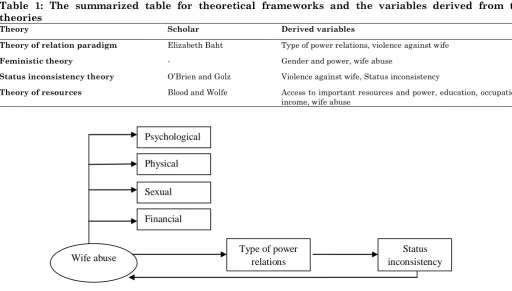
As stated previously, domestic violence and accordingly violence against wife (spouse) is not an uncommon phenomenon that can be ignored. Due to this reason, the present research by reviewing the researches conducted within and outside the country tries, by using new variables, such as status inconsistency and type of power relations within family, to study this problematic phenomenon in the society. Therefore, for theoretical and experimental explanations in this field, resources theory, feministic theory and O’Brien and Golz’s status inconsistency and also the results of similar researches in this field have been used to enrich the present study. Then, to demonstrate the applicability of the theoretical framework, table 1 has been organized.
Table 1: The summarized table for theoretical frameworks and the variables derived from these theories
Theory Scholar Derived variables
Theory of relation paradigm Elizabeth Baht Type of power relations, violence against wife
Feministic theory - Gender and power, wife abuse
Status inconsistency theory O’Brien and Golz Violence against wife, Status inconsistency
Theory of resources Blood and Wolfe Access to important resources and power, education, occupation and income, wife abuse
Figure 1: Theoretical model of research Psychological
Physical
Financial Sexual
Status inconsistency Type of power
Overall, relying on the theoretical framework, the conceptual model, and the literature, the following hypotheses can be proposed:
The average of wife abuse among married women is different in terms of the type of marriage.
There is a significant relationship between the type of power relations in the family and the rate of wife abuse.
There is a significant relationship between status inconsistency and the rate of wife abuse in the family.
The variable of power relations is effective on wife abuse through status inconsistency.
Methods
The present study is a survey in terms of its type that can be considered as an extensive research. Also, it is on the basis of cross-sectional criteria, because it was conducted in 2014. To collect data, the closed-response questionnaire (in the form of Likert scale) and to analyze the data, SPSS software has been used. The statistical population of the present research consists of all married women in Tabriz that according to the census of 2011 their number was 1457339 individuals that 275 individuals were selected as the sample size based on Cochran formula. The sampling method used in this study was stratified random
sampling. In this way, the questionnaires were distributed and collected in 10 districts of municipality proportion to the population in each area.
Validity and Reliability of Questionnaire
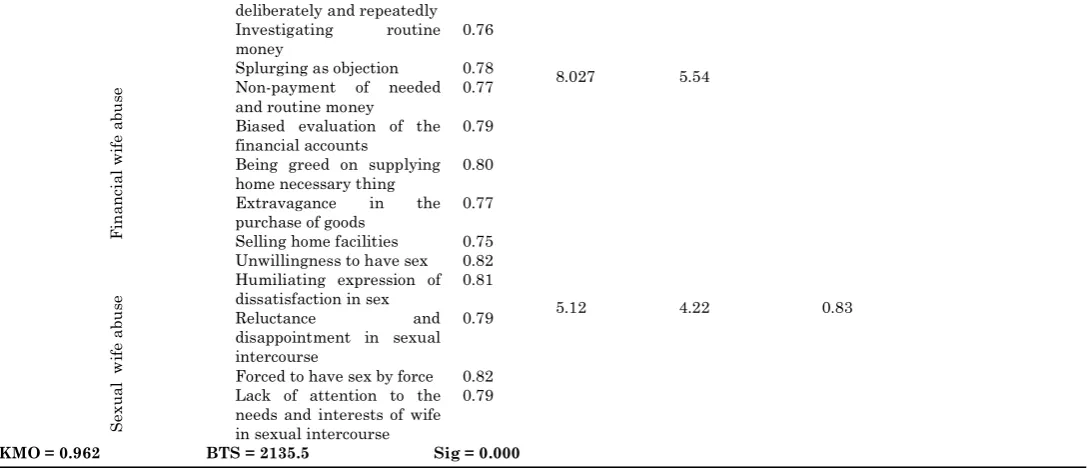
To measure the variable of domestic violence (wife abuse), a questionnaire including 30 items with six options based on Likert scale was developed. In order to separate and classify the 30 questions related to violence against wife, factor analysis technique was used based on principal components that according to the results of the test, the value of KMO was obtained equal to 0.96, since this value is greater than 0.6, we conclude that the number of samples is very appropriate to perform factor analysis. Also, the value of Bartlett with a significance of 0.000 shows that the separation of factors has been carried out accurately and the questions contained in each factor have high fundamental correlation with each other. Overall, all four factors with eigenvalues greater than one can explain about 82% of variance of the structure of violence against wife. The rotated factorial weights were done by varimax method. Also, the reliability analysis of items of each dimension of variables of domestic violence and power relations within the family and status inconsistency indicate the high inter-rater reliability between the studied variables.
Table 2: The results of factor analysis and reliability analysis of items related to structure of wife abuse
Variable Dimension Items Weight factor Explained variance Eigenvalues Cronbach’s alpha Total Cronbach's alpha
V
io
len
ce
w
if
e
a
b
u
se
Ps
yc
h
ol
og
ic
al
w
ife
a
bu
se
Shouting, loud talking 0.77
57.93 8.15 0.73
0.97 Insults and threats and
curses out 0.82.
disrespectful look and assigning inappropriate attributes
0.80
Despising pride and character
0.79
Despising the appearance of a person's body
0.80
Humiliation and insult to
the friends and
acquaintances
0.83
Removing the sanctity of mother before children
0.81
Blame, humiliation and criticism of spouse 0.81 Damaging the reputation of
spouse 0.83
Humiliating interests and
ideas 0.81
Ph
ys
ic
al
w
ife
a
bu
se
Pushing while quarrelling 0.78
11.09 6.73 0.76
Beating and kicking 0.82
Slap in the face 0.85
Pulling up hair or dress 0.85
Spiting 0.80
Knocking and bruising the
wife’s body 0.84
Attacking by equipments
within home 0.82
deliberately and repeatedly
Fi
n
an
ci
al
w
ife
a
bu
se
Investigating routine
money 0.76
8.027 5.54
Splurging as objection 0.78 Non-payment of needed and routine money
0.77
Biased evaluation of the financial accounts
0.79
Being greed on supplying home necessary thing
0.80
Extravagance in the
purchase of goods 0.77
Selling home facilities 0.75
S
ex
u
al
w
ife
a
bu
se
Unwillingness to have sex 0.82
5.12 4.22 0.83
Humiliating expression of dissatisfaction in sex 0.81
Reluctance and
disappointment in sexual intercourse
0.79
Forced to have sex by force 0.82 Lack of attention to the needs and interests of wife in sexual intercourse
0.79
KMO = 0.962 BTS = 2135.5 Sig = 0.000
Table 3: Results of Cronbach’s alpha coefficient for independent variable
Variables Number of items Cronbach’s alpha
Type of power relations in the family 11 0.93
Status inconsistency 4 0.98
Conceptual and Operational Definitions of Research Variables
Wife Abuse
Conceptual Definition: The treatment applied by
men to control their wives, which causes psychological, physical, and social injuries, social isolation, and economic deprivation, such that the wife lives with fear [1]
Operational definition: wife abuse has been
investigated in four dimensions as following:
Psychological wife abuse: it is any kind of violent behavior and speech that endangers the mental health of women, or a violent behavior that damages the honor, dignity and confidence of a woman [18].This variable is measured by items such as undue criticism, contempt, verbal abuse, ridicule, insults, cursing, and taunting.
Financial wife abuse: It is any violent behavior that is intentionally pressures on women and discriminate them in matters of employment, economy and assets [19]. This variable is measured by items such as checking the routine money, splurging with objection, biased evaluation of the financial accounts, and being greedy in home supplies, etc.
Physical wife abuse: It is any antisocial violent behavior that physically abuses a woman, or any behavior that is intended to demonstrate the
man’s power to monitor the woman [18]. This variable is measured by items such as pushing, kicking, beating, and throwing objects, etc.
Sexual wife abuse: It includes forcing the wife to sexual intercourse without complete agreement or any kind of violent sexual behavior that is intentionally done to threaten, abuse, and harm sexually [11]. This variable is measured by items such as unwillingness to have sex, degrading expression of dissatisfaction in sexual intercourse, reluctance, and disappointment in sexual intercourse, forcing to have sex.
The Type of Power Relations between Couples
Conceptual definition: The relationship or social
interaction of series of social behaviors that is created based on an interactional bilateral act. In other words, it is an emotional process through which two or more people apply the language and gestures to affect the thoughts, expectations and behavior of each other [11].
Operational definition: In the present research, the
five types of interaction (collaboration,
consultation, empathy, collaboration, and
discourse) between husband and wife in the joint life have been measured that are as follows:
Consultation: The purpose of this variable is how to make decisions which is done horizontally (cooperatively) or vertically (hierarchical and one takes decision), which is measured by items such as wife-centered decisions, areas of decision-making, the right to make decision, consultation to have a child or children, consultations for accommodation, and consultation on how to use the property and assets, etc.
Empathy: It is the sense of belonging and emotional relationship between the partners and expressing it through words and behavior, which is measured by items such as satisfaction of the emotional relationship, and the level of understanding each other in times of sorrow and trouble.
Collaboration: It means a mutual compromise and forgiveness of one another, which is measured by items such as interactional understanding when necessary, forgiveness in the event of errors, and friendly dialogue and understanding.
Status Inconsistency
Conceptual definition: Status consistency in stratification literature refers to the appropriateness and adaptation of the individual’s situation to access the valuable resources of the society, i.e., property, power, and
prestige, etc. The impairment and non-compliance in each of these aspects break down this consistency.
Operational definition: This variable is measured by four items including economic capital (income and wealth), cultural (education), organizational (power) and positional (occupational status) items.
Results and Discussion
The information obtained from Table 4 shows that, since the mean value obtained for the variable of wife abuse (93.44) is slightly less than the average range, so it can be said that all women have typically experienced domestic violence. The information obtained from the table shows that the rate of psychological wife abuse is average and higher, the rate of sexual violence is average and lower, the rate of physical wife abuse is average and higher, and the rate financial wife abuse is average among the respondents. The level of power relations in the family with mean of 24.16 is evaluated as average, that is, the rate of cooperation, collaboration, consultation, empathy, forgiveness, and mutual understanding among respondents is at an average level. Also, the variable of status inconsistency has a mean of 19.12, and since its mean is higher than mean range, so the rate of status inconsistency among the respondents is high.
Table 4: Descriptive statistics of variables
Variables Range Min. Max. Mean
range Obtained mean Skewness
wife abuse 129 30 159 94.5 93.44 0.83
Psychological wife abuse 50 10 60 35 36.47 1.10 Physical wife abuse 40 8 48 28 29.72 1.12 Sexual wife abuse 25 5 30 17.5 10.93 1.07 Financial wife abuse 35 7 42 24.5 24.11 1.09 Type of power relations 35 7 42 24.5 24.16 -0.31 Status inconsistency 25 5 30 17.5 19.12 -0.32
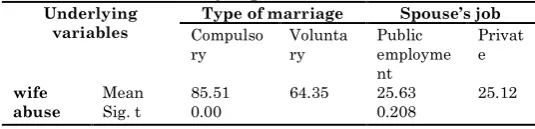
Now, the hypotheses are tested. The information of Table 5 shows that the rate of wife abuse differs in terms of the type of marriage, and the mean of wife abuse among women with compulsory marriage is 85.51 and among women with voluntary marriage is 64.35, which means that women who had compulsory marriage have experience more domestic violence than women who had voluntary marriage. The results also show that having public or private employment by husband does not have any impact on wife abuse among the respondents.
To test the relationship between the variables of type of power relations and status inconsistency
with wife abuse,
Table 5: Analytical results of the relationships between the underlying variables and wife abuse
Underlying
variables CompulsoType of marriage Spouse’s job ry Voluntary Public employme
nt
Privat e
wife abuse
Mean 85.51 64.35 25.63 25.12
Sig. t 0.00 0.208
meaning that the more asymmetric the type of power relations between subjects (i.e. the rate of collaboration, empathy, cooperation and consultation is lower), the level of wife abuse increases and vice versa. Also, there is a significant inverse correlation between status inconsistency and wife abuse; that is, by reducing the status consistency, the level of wife abuse increases.
Table 7: Pearson correlation coefficient (the relationship between variables)
The relationship between variables
Correlati on
Sig. Hypothes is test results The relationship between
wife abuse and the type of power relations
-0.45 0.00
0
Temporar y
confirmed The relationship between
wife abuse and status inconsistency
-0.27 0.00
0
Temporar y
confirmed
Finally, after analyzing the correlation between variables, the fitness of regression model was done by controlling of its assumptions including the t-value of Watson Camera that tests the hypothesis of independence of errors or remainders. The range of this quantity is between 0 and 4, and typically the range of 1.5-2.5 is acceptable and reflects the independence of the remainders from each other. In the present study, the value of Watson Camera was obtained equal to 1.5 which shows the remainders are independent from each other. The statistical value of the F-test also shows a linear relationship between the variables. And the statistical value of the VIF-test is in the acceptable range (less than 2.5), which means that there is no significant overlapping between the predictive variables of research. Therefore, the assumption of non-existence of relationship between the predictive variables is confirmed. Considering these cases, the results of stepwise regression show that the relationship between the dependent and independent variables has been confirmed, and the adjusted explaining coefficient shows that 20% of the changes of dependent variable have been explained by these variables. Also, the standardized beta coefficients indicate that for one unit increase in the variable of the type of power relations (consultation, collaboration, empathy, cooperation) between couple, the rate of violence against wife decreases by a factor of 0.41, and also for one unit increase in the variable of status consistency, the rate of violence against wife decreases with a factor of -0.09.
Finally, to test the hypothesis of the effectiveness of status inconsistency through the variable of the
Table 8: Statistics of multi-variable regression analysis for wife abuse
Variable Beta T Sig. Explaining coefficient 0.28 Type of
power
relations -0.41
-6.80 0.000
Explaining
modified coefficient 0.27 Status
consistency -0.09
-1.53 0.03
durbin-Watson
quantity 1.5
Analysis of variance F quantity 36.25
Sig 0.00
type of power relation on wife abuse, the path analysis method was used by applying LISREL software. One of the indicators of goodness of fit to adapt empirical data with the proposed theoretical model is rate of error that this has been optimally realized. In other words, the low value of the model error, i.e., RMSEA shows that the collected experimental data support the theoretical model. According to the path model coefficients, the direct effect of the status inconsistency variable on violence against wife is -0.09, and its indirect effect through the variable of type of power relations is -0.18, and its total effects equal to -0.27. The remarkable point is that the major influence of the variable of status inconsistency on violence against wife is not by direct way, but is in an indirect way which is through the variable of type of power relations.
Chi-squire=0.00, df=0, p-value=1.00000, RMSEA=0.000 Figure 1: The influencing path of the status inconsistency through the variable of power relations
Conclusion
and investigation of domestic violence among families is necessary.
According to the findings of the present research, the phenomenon of violence against wife with the mean of 93.44 has been evaluated in average and also this rate is increasing.
It is notable that several theories have been proposed to explain domestic violence that each of them explains a part of truth. In this study, we have focused on Elizabeth Baht’s theory of power relations, feministic theory, theory of resources, O’Brien and Golz’s theory of status inconsistency. We have also used survey technique to collect data from the sample by designing items related to the subject. The inferential analysis of data indicates the conformity of the proposed hypotheses with a high degree of confidence. Therefore, the variables of power relations, status inconsistency, and the type of the marriage have influenced on violent behaviors against women.
Based on the results of testing hypotheses, a significant inverse relationship was observed between power relations and domestic violence against wife. Accordingly, the more the level of cooperation, consultation and collaboration, and empathy between couples is reduced, the more the domestic violence against spouse increase between married couples. Based on the above theories (especially Elizabeth Baht’s theory), there is a clear relationship between power and resources among spouses, because the more the pattern of family relationships is separated and isolated from each other, the power is
concentrated in one of the two genders, especially the men, and the feeling of more power causes the men have higher influences and consequently they show more violence against their wives, but if the husband and wife have a joint pattern of power, they will have more cooperation and collaboration in the most of their activities and the conflict of their interests will be minimized and in this case, violence is reduced. This result is somehow congruent and compatible with the results obtained by Mohammadi [5] and Farhadi [6].
According to theory of status inconsistency which states that when there is a status gap and difference between husband and wife in terms of education, income and employment and the men are at higher levels than their wives, they do more violence against their wives; therefore, there is a significant inverse relationship between the status inconsistency variable and violence against wife, because by reducing the status consistency, the domestic violence is increased, and this finding explains the above theory. This result is in agreement with that of Azam Azadeh and Dehghanfard [1].
Also, there is a significant direct relationship between the type of marriage (mandatory or voluntary) and violence against wife; that is, the more the couples can freely choose their spouses, the less the level of violence against women will be in the family and vice versa. Therefore, the women who have had mandatory marriage, they have experienced more violence than women who have had voluntary marriage.
References
1. Azam Azadeh M, Dehghanfard R (2006) Violence against women in Tehran: The role of gender socialization, resources available to women and family relations, Women in Development (Women’s Policy Research), 4:159-175 (Persian).
2. Sam Gase B (1998) “Why the Men Annoy Their Wives?” June, the first issue, No. 21.
3. A
moakohene ML (2004) Violence against women in Ghana: A look at women’s perceptions and review of policy and social responses, Social Sciences & Medicine, 59:2373-23858.
4. Ghazi Tabatabai M (2004) “The situation of domestic violence in Iran” Tehran: Tehran University publications
5. Mohammadi F (2005) “The study of domestic violence in the city of Ravansar in Kermanshah province” M.A. Thesis, Al-Zahra University, School of Social and Economic Sciences.
6. Farhadi M (2008) “Social analysis of the violence of husbands against their wives: an empirical test of multiple theoretical theories”, Master Thesis, Mazandaran: Mazandaran University.
8. Mohseni Tabrizi A, Kaldi A, Javadianzadeh M (2013) “The Study of domestic violence in married women admitted to yazd legal medicine organization and welfare organization”, The Journal of Toloo-e-behdasht, 11(3):11-24 (Persian).
9. Medina J, Braberet (2003) “Intimate partner violence in Spain. Findings form a national survey”, Violence against Women, 9:302-322.
10.Fortune M, Enger J (2005) Violence against women and the role of religion. National online resource center on violence against women, VAW net Applied Research Forum. 2-7.
11.Sa’adati M (2011) Investigating the Relationship between Social Capital on Mental Health and Domestic Violence. MA thesis, Faculty of Law and Social Sciences, University of Tabriz (Persian). 12.Darvishpour M (1999) Why men are encouraged to
do violence against women? Women Studies, No. 56. 13.Blanca M (2004) Life time abuse and mental health distress among english-speaking Latinas. Affiliate fall, 19:239-256.
14.Abbott P, Wallace K (1997) Introduction to the Sociology of Gender Attitudes; (Translated by Maryam Khorasani and Hamid Ahmadi). Tehran: Donia-e Madar publication.
15.Shams Esfandabad H, Imamipour S (2003) The study of the prevalence of domestic violence and the factors affecting it, Journal of Women Studies, 5:59-81.
16.Roy M (1998) The beaten women, (translated by Mehdi Gharedaghi), Tehran: Elemi Publication. 17.Tarzi T (2007) “The role of patriarchy in domestic
violence,” Social Security Studies Quarterly, 3(8-9):115-136.
18.Kar MA (2008) “A Research on Violence Against Women”, Tehran: Rawshangar an Publication and Women Studies.