© 2017 IJSRST | Volume 3 | Issue 8 | Print ISSN: 2395-6011 | Online ISSN: 2395-602X Themed Section: Science and Technology
Assessment of Inertial Frequency Support Provided by Variable Speed Wind
Generators
A Shyam Sunder1, Gaddam Srikanth2
1PG Scholar in EEE Department at University College of Engineering (A), Osmania University Hyderabad, Telangana, India 2Assistant Professor in EEE Department at University College of Engineering (A), Osmania University Hyderabad, Telangana,
India
ABSTRACT
The enormous incorporation of wind control utilizing power converters forced a few difficulties to the future power framework. One of them is identified with the decoupling impact of new power sources from the AC control network, crippling a characteristic recurrence reaction. This circumstance contrarily influences the framework recurrence reaction. The point of this paper is to assess the inertial recurrence bolster gave by factor speed wind generators. Time space recreations of a test framework are utilized for an assessment of the inertial reaction gave by the breeze turbines. Two noteworthy commitments of this paper are: (I) to feature the beneficial outcome of the inertial reaction on the framework recurrence reaction considering distinctive load variety conditions; and (ii) to essentially recognize a breaking point of the engineered latency parameter, past that the breeze turbine slows down contrarily influencing the power framework.
Keywords : Frequency Controller, Frequency Stability, Power System, Protection Scheme, Wind Turbine Generator
I.
INTRODUCTION
The recurrence control is in effect customarily performed by customary synchronous generators in all power frameworks [1]. Generally, wind ranches have not added to framework recurrence bolster. Be that as it may, as the worldwide entrance of twist control into the power framework builds, the lattice code necessities are progressively ending up all the more requesting. Aside from the outstanding deficiency ride through ability for wind cultivates the recurrence soundness bolster is additionally turning into an imperative part of network codes the world over. Gigantic reconciliation of wind control is relied upon to be a piece of the power framework and subsequently a few nations have begun to set up new lattice codes applicable to wind ranches. A few transmission framework administrators have talked about the incorporation of recurrence reaction in matrix code. Amid a framework recurrence unsettling influence (SFD) the age/request control adjust is lost, the framework recurrence will change at a rate at first controlled by the aggregate framework latency [2]. Notwithstanding, future power frameworks will expand the introduced control limit (MVA) yet the compelling
framework inertial reaction will remain a similar these days [2, 3]. The outcome is more profound recurrence journeys of framework aggravations.
Numerous cutting edge wind turbines (WT) can control dynamic power yield in light of network recurrence in ways that are imperative to general matrix execution and security. A few productions relate the principle angles and contemplations about demonstrating [4] and recreation [5] of the inertial reaction of wind turbine generators (WTG) and some of them give general thoughts regarding conceivable effects on control frameworks and their consequences for transient under-recurrence reaction [6]-[7].
paper, time area reproductions are utilized to assess the framework recurrence reaction SRF gave by assessing the inertial recurrence bolster gave by a variable speed wind generator. The primary commitments of this paper are: (I) to feature the positive commitment of shrouded latency controller under various load variety conditions; and (ii) to for all intents and purposes recognize there is a conceivable bring up that high estimations of the manufactured dormancy parameter, may slow down the breeze turbine adversely influencing the power framework. At long last, Section VI finishes up.
II.
POWER FRAMEWORK RECURRENCE
REACTION
The framework recurrence (f) is identified with the rotational speed of the rotor of every single synchronous machine straightforwardly associated with the lattice. Any variety of the electric request or power age will create changes in the framework recurrence. Hence, the recurrence is an electrical variable that must be controlled step by step by second utilizing controllers to protect the quick harmony between framework request and aggregate age.
A dynamic power change (ΔP), anytime of the system, is spread all through the entire power framework by an adjustment in the electric recurrence (Δf). Subsequently, the framework recurrence is the helpful list to recognize framework age and load unbalance.
For a superior comprehend of the portrayed recurrence wonders, let us consider an electric power framework representing N synchronous generators. For the non specific ith synchronous machine, it is conceivable characterizing the accompanying connection between the individual incremental confuse control (Δpi) and individual the recurrence (fi):
where Pmech,i is the pu mechanical power of prime mover, Pelec,i the pu electrical power, ΔPi is the load/generation imbalance, in pu , Hi is the inertia constant in seconds, fi is the frequency in Hz and f0 is the rated frequency.
Assuming a strong coupling between the generation units, it is possible obtaining a relation similar to (1) but extended for the entire power system:
where Pmech,T, Peelec,T, and ST are respectively the algebraic sum of the individual synchronous machine electric power, mechanical power and rating capacity, while the total system frequency inertia (HT) and the frequency of the centre of inertia (fCOI) can be written as:
Examining (2) and (3), it is clear that the system frequency dynamic strongly depends on the overall value of the system inertia (HT). Increasing the number of generators connected to the grid using power converter increases the total installed capacity (ST) but the inertial contribution of those generators is zero because the power converter interface hides the inertial contribution of its generation. Enabling the inertial response of power converter-based generators requires proper controllers for that purpose. Therefore, installing fully rated power converter generation units produces a reduction of the total system inertia that can lead to a quick and dangerous drop of system frequency adversely affecting the frequency stability of the electric power system. On this aspect, wind turbine generators (WTG) can play an important role providing the support of
frequency response (FR). A WTG has the inertia of their
rotating parts such as blades, gearbox, generator, etc. The overall value of wind turbine inertia is up to 500 kg/m2 and it represents a relevant amount of kinetic energy stored in rotating components of the WTG. Using appropriate control strategies at converter level, it is possible to extract the kinetic energy of the WTG and uses it to support the FR of the power system.
III.
FREQUENCY CONTROL IN WIND TURBINES
investment of all age unit, including WTG. Despite the fact that generators electronically interfaced to the network don't give a commitment to the FR, this capacity can be acquired by the extra control to the power converters [1]. Different control plans can be attracted to empower the WTG to give dynamic power commitment to FR, it can be separated into three-level pecking order [1]: (I) wind turbine (WT) controller – neighborhood control, (ii) wind cultivate (WF) controller, (iii) control framework level controller.
Neighborhood control at WT level is utilized to give essential recurrence control and other extra assistant administrations then WF level controller permits coordination between the focal and nearby control keeping in mind the end goal to accomplish the coveted age for the framework. Power framework level controllers are utilized for auxiliary recurrence control; it gives better framework recurrence conduct by the coordination between the AGC and the WFs. The WT level controllers are neighborhood controllers added to the variable speed wind turbines (VSWT) subsystems keeping in mind the end goal to empower recurrence bolster. The WT controller can empower the essential recurrence control by two vital parts of the FR [8]: (I) Inertial reaction by the utilization of the inertial controller and (ii) representative reaction, a moderate reaction by utilizing the senator controller. In this paper, the fundamental concern is identified with the dynamic conduct of the dormancy controller on framework recurrence bolster. The inertial controller can be actualized utilizing a few methodologies, nonetheless, there are two essential ideas: (I) Releasing "Shrouded Inertia" and (ii) Fast Power Reserve Emulation. Those controllers are depicted in subtle elements in the following sub-segments.
3.1 Releasing "shrouded dormancy" control
Present day WTGs utilize control hardware converters to empower variable speed operation with a specific end goal to catch twist vitality over an extensive variety of velocities. Be that as it may, the power converter segregates the rotational speed from the framework recurrence as a result the WTGs in light of consecutive AC/DC/AC converters offer no common reaction to framework recurrence [9], [4].
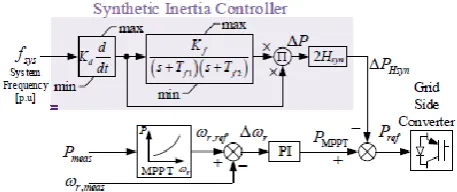
The WT business has made a few controllers for present day WTG's with a specific end goal to give inertial reaction (and representative reaction now and again) for huge recurrence deviation for, brief span, discharging shrouded idleness. There are a few names for this kind of controllers: Artificial, Emulated, Simulated, or Synthetic Inertial. Cases of manufactured idleness controlled industrially accessible for WTG are [10]: General Electric WindINERTIA™ [11], ENERCON Inertia Emulation [12]. The goal of the engineered dormancy control is "to separate the put away inertial vitality from the moving part on WTGs" [13]. There are a few forms of manufactured latency controllers; be that as it may, they can be arranged into two principle approaches: (a) Releasing "shrouded" idleness and (b) Reserve limit in pitch. In this paper, the concealed idleness approach is considered and it is named engineered latency from here on.
Figure 1. Representative block diagram of Maximum
Power Point Tracking (MPPT) controller and releasing
hidden inertia controller.
Synthetic inertia concept is based on a controller which
allows taking the kinetic energy from a WT rotating mass. This controller has been comprehensively explained in several scientific publications [5], [14]. This control loop increases the electric power output of the WTG during the initial stages of a significant downward frequency event. The active power, sometimes called inertial power, ΔP, of the controller is achieved by the use of the following mathematical formulation:
3.2 Fast Power reserve emulation control
The fast-power reserve emulation controller is designed
to provide a short-term constant power, this power provides FR for a short period of time [15], [16], [17].
The fast-power reserve (PHsyn) is derived from a simple
integration of kinetic energy stored in the wind turbine rotor:
where t (t<tmax) is the lasting time of the fast-power reserve since the beginning of the frequency disturbance, ωr,0 is the initial rotational speed and ωr,f is the rotor rotational speed corresponding to t.
This controller acts on the reference rotational speed
(ωr,ref) creating an artificial change in the rotational
speed to allow release kinetic energy from the wind turbine rotor. The change in the rotational speed (ωr,ref) is obtained as:
A general scheme for the fast-power reserve emulation controller is depicted in Figure 2. The fast power reserve provides FR for a short period and saves time for other slower generators to participate in the frequency control.
Figure 2. A representative block diagram of Maximum Power Point Tracking controller and fast power reserve
emulation.
3.3 Droop control strategy
If the two previously described control strategies aim at supporting the initial frequency response of the system, the droop control strategy is designed with the aim of providing support to the frequency in a longer time. This is in accordance to the to the classical control strategy of the conventional power plant where the droop approach allows sharing the load variation among the generators to achieve and acceptable steady state frequency until secondary control will not act.
The governor control refers to control actions that are done locally (at the power plant level) based on the set-points for frequency and power.
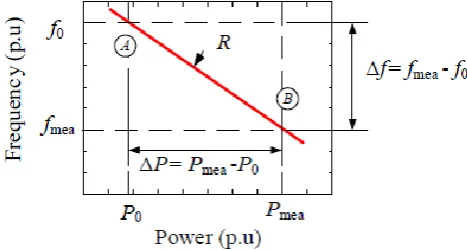
The steady-state properties of the governor controller are defined by the permanent droop (ρ), which is defined as the change in frequency (Δf), normalised to the nominal frequency (f0), divided by the change in power output (ΔP), normalised to a given power base, (Pbase).
The inverse of the droop is R and it is referred to as the
stiffness of the generation unit (ρ).
The droop controller is described by a steady-state
frequency characteristic as shown in Fig. 3. It produces an active power change that is proportional to the frequency deviation.
Figure 4. A representative block diagram of a Frequency Droop Control for full converter rated
VSWT.
The droop control in WTG emulates the similar frequency droop characteristic to the synchronous generators. However, the power increase (ΔP) during a sudden drop in system frequency must be obtained from the kinetic energy of the rotation parts of WTG, it causes a decrease in rotational speed due to the Maximum
Power Point Tracking (MPPT) operation. The support of
steady-state frequency requires extra-steady-state power to reduce the frequency deviation; this extra-power is provided in the long term from the prime-mover in classical generation units.
.
Droop controller has not high impact on the initial ROCOF after frequency disturbance but it largely influences the frequency in the most critical condition of the transient. However, a decrease in rotational speed on wind turbines equipped with droop controllers may be not avoided because extra wind speed cannot be obtained, for this reason, droop controller requires the support of other wind turbine components to avoid turbine stall by rotational speed falling too low. This issue can be solved using two approaches: stopping frequency droop contribution or de-loading the wind turbine.
Frequency droop controller can be equipped with a triggering system to allow finishing the action control in time to avoid a potential stall condition on the wind turbine. This triggering off system is similar to one use in fast power reserve emulation. This solution is easily implemented, however, its real benefit is in doubt because power contribution will be interrupted creating a potential risk of frequency disturbance.
IV.
4 WIND TURBINE GENERATOR MODEL
This section presents the system modelling used in this paper. A very simple test system is considered, as shown in Fig, 5.
Figure 6. Test system: Representative transmission system including an equivalent WTG.
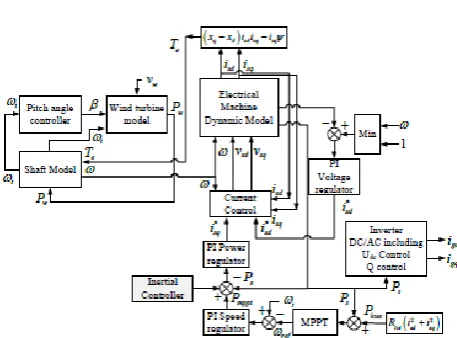
It consists of a large equivalent external grid (GEQ) connected to a WT using a multi-voltage level transmission system. For simplicity, this is a lossless transmission system and reactances of transformer and transmission system can be combined together (bus 3 and 4 disappear) and an equivalent reactance (xEQ) used instead. The next subsections present details of the modelling of the different aspects relevant for SFR. The main grid is assumed to be characterized by a total inertia (Hnet) equal to 40.0 s (on machine power base) and a 5% equivalent droop. Fig. 5 depicts the general structure of a variable-speed wind turbine (VSWT) with
a direct-drive (DD) permanent magnet synchronous
generator (PMSG). This wind turbine uses a full-rated
power converter in the form of back-to-back topology. The models used full-rated converter and their details are taken from [8, 10, 20]. Models parameters used are escalated to simulate an equivalent 5 MW wind turbine.
Figure 6. The general structure of a VSWT with a direct-drive synchronous generator and a full-rated
power converter.
Fig. 5 shows a block diagram of the main components and controller considering on the modelling of VSWT with a DD synchronous generator with a FRPC as an interface to the grid. A time series can be used as input to wind turbine rotor model, for simplicity in this paper
constant speed is assumed during the simulation time.
The variable speed wind turbine rotor model consists of the classical polynomic relationship between wind speed and mechanical power. The model for the mechanical shaft consists of a simple a classical two mass representation. Maximum power point tracking controller is included in order to provide the speed control of the wind turbine and it is aimed to maximize its power production. Pitch angle controller is included in the model aiming to reduce the power extracted from the wind at very high wind speed. As far as the generator side converter is concerned, two main control loops are present, namely: the active power/speed control loop and the voltage control loop. Such loops will provide the reference signals for the two inner current control loops. The grid side converter is composed of basically two outer control loops, regulating the voltage (Udc) on the DC link and the reactive power (Qnet) delivered to the network. Again, such loops will provide the reference signals for the two inner current control loops. Details of control modelling are beyond the scope of this paper, however, further details can be found on [21], [22].
V.
SIMULATIONS AND RESULTS
Utilizing the system structure depicted in Section 4, an arrangement of recreations is exhibited in this area. Reproductions are utilized to demonstrate the dynamic power commitment gave by the Releasing "Shrouded Inertia" procedure on the SFR, and it is contrasted and the established conduct of completely appraised converter twist turbines without controller empowering the recurrence bolster.
An identical synchronous generator and a heap are utilized as a delegate comparable model of a conventional power framework and, an equal transmission framework is incorporated amongst age and request considering two voltage levels. Power framework model and wind turbine controllers are actualized utilizing Matlab®/SimulinkTM. In this paper, framework recurrence aggravation comprises of
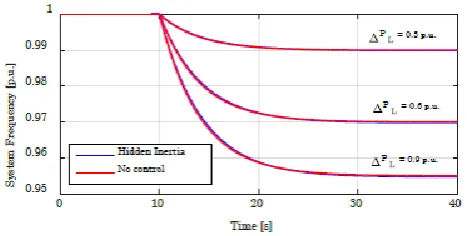
generator blackout, which is reenacted by a sudden increment in dynamic power request (ΔPL). The framework recurrence unsettling influence is embedded at t0 = 10.0 s. In the primary case, the engineered inertial (Hsynt) is accepted equivalent to the 25% of the general dormancy of the WTG (HWTG) and the framework execution is assessed in three unique states of energy irregularity (ΔPL = 0.30, 0.60 and 0.90 pu considering the WTG control as a base).
As should be obvious from Fig. 8 and Fig. 9 the underlying transient of the recurrence is upheld by the commitment of the inactivity controller turn out to be less and less affecting while the recurrence transient tent to quench. In addition, the inertial control activity and the recurrence bolster commitment are higher for greater power irregularity, related with a more extensive diminishing rate of recurrence. The dynamic execution of generator rotor speed is appeared in Fig. 10; the activity of the inertial controller at first gives a deceleration of the generator that after a swing return to the ideal speed characterized by the MPPT of the turbine.
Figure 8. System frequency dynamic response during system frequency disturbance considering three different
power imbalances (ΔPL), Hsyn = 0.25HWTG.
Figure 10. Rotor speed response during system frequency disturbance. Inertia controller gain adjusted at
Hsyn = 28.0 sec.
It should be noticed, the implementation of this kind of frequency support strategy has to be properly designed since as high value of the synthetic inertia may lead to a problem in the wind turbine dynamic. In Fig. 10 and 11 show the system frequency response and generator rotor speed in case of inertial controller gain adjusted to three times the wind generator inertia (Hsyn = 3HWTG) and system frequency disturbance of 0.90 pu
Figure 11. System frequency response: System frequency disturbance ΔPL = 0.90 pu and inertia
controller gain Hsyn = 3HWTG.
Figure 12. Rotor speed response: ΔPL = 0.90 pu and inertia controller gain Hsyn = 3HWTG.
Fig. 12 shows a clear condition where the wind turbine generator stalls by means of a drift of the rotor speed and the consequent shut down of the WTG. This is a very critical condition for frequency stability since it produces a further system frequency disturbance by losing wind turbine generation and decreasing in frequency. Analysing the mathematical rule of the synthetic inertia controller (5), it is possible to notice that its contribution does not provide a change in the possible steady-state equilibrium point of the power system, since the additional term is proportional to the time derivative of frequency. This suggest that the frequency instability problem is not related to the feasibility of the system equilibrium point but is probably related to the interaction between the WTG controller and the synthetic inertia one.
The limit value of the synthetic inertia controller gains for the stable operation of the system vary in accordance with the amplitude of the frequency disturbance. In this paper, the limit values of stable conditions are obtained by means of dedicated simulations, Table 1 shows the results for the three-power imbalance conditions used in the previous simulations.
Table 1: Hidden Inertia limits for stable operation.
VI.
Conclusion
Utilizing the system structure depicted in Section 4, an arrangement of recreations is exhibited in this segment. Recreations are utilized to demonstrate the dynamic power commitment gave by the Releasing "Shrouded Inertia" methodology on the SFR, and it is contrasted and the traditional conduct of completely appraised converter twist turbines without controller empowering the recurrence bolster.
considering two voltage levels. Power framework model and wind turbine controllers are actualized utilizing Matlab®/SimulinkTM. In this paper, framework recurrence unsettling influence comprises of generator blackout, which is reproduced by a sudden increment in dynamic power request (ΔPL). The framework recurrence unsettling influence is embedded at t0 = 10.0 s. In the principal case, the manufactured inertial (Hsynt) is expected equivalent to the 25% of the general latency of the WTG (HWTG) and the framework execution is assessed in three unique states of energy unevenness (ΔPL = 0.30, 0.60 and 0.90 pu considering the WTG control as a base).
As should be obvious from Fig. 8 and Fig. 9 the underlying transient of the recurrence is upheld by the commitment of the idleness controller turn out to be less and less affecting while the recurrence transient tent to quench. Additionally, the inertial control activity and the recurrence bolster commitment are higher for greater power lopsidedness, related with a more extensive diminishing rate of recurrence. The dynamic execution of generator rotor speed is appeared in Fig. 10; the activity of the inertial controller at first gives a deceleration of the generator that after a swing return to the ideal speed characterized by the MPPT of the turbine.
VII.
REFERENCES
[1]. F. Gonzalez-Longatt, "Frequency Control and Inertial Response Schemes for the Future Power Networks," in Large Scale Renewable Power Generation, J. Hossain and A. Mahmud, Eds., ed: Springer Singapore, 2014, pp. 193-231.
[2]. F. Gonzalez-Longatt, "Impact of emulated inertia from wind power on under-frequency protection schemes of future power systems," Journal of Modern Power Systems and Clean Energy, pp. 1-8, 2015/08/12 2015.
[3]. F. Gonzalez-Longatt, E. Chikuni, W. Stemmet, and K. Folly, "Effects of the synthetic inertia from wind power on the total system inertia after a frequency disturbance," in Power Engineering Society Conference and Exposition in Africa (PowerAfrica), 2012 IEEE, 2012, pp. 1-7.
[4]. S. Yuan-Zhang, Z. Zhao-Sui, L. Guo-jie, and L. Jin, "Review on frequency control of power
systems with wind power penetration," in Power System Technology (POWERCON), 2010 International Conference on, 2010, pp. 1-8. [5]. J. Ekanayake and N. Jenkins, "Comparison of the
response of doubly fed and fixed-speed induction generator wind turbines to changes in network frequency," Energy Conversion, IEEE Transactions on, vol. 19, pp. 800-802, 2004. [6]. R. Doherty, A. Mullane, G. Nolan, D. J. Burke, A.
Bryson, and M. O'Malley, "An Assessment of the Impact of Wind Generation on System Frequency Control," Power Systems, IEEE Transactions on, vol. 25, pp. 452-460, 2010.
[7]. I. Erlich, W. Winter, and A. Dittrich, "Advanced grid requirements for the integration of wind turbines into the German transmission system," in Power Engineering Society General Meeting, 2006. IEEE, 2006, p. 7 pp.
[8]. F. M. Gonzalez-Longatt, "Impact of emulated inertia from wind power on under-frequency protection schemes of future power systems," Journal of Modern Power Systems and Clean Energy, pp. 1-8, 2015/08/12 2015.
[9]. G. Lalor, A. Mullane, and M. O'Malley, "Frequency control and wind turbine technologies," Power Systems, IEEE Transactions on, vol. 20, pp. 1905-1913, 2005.
[10]. F. M. Gonzalez-Longatt, "Activation schemes of synthetic inertia controller for full converter wind turbine generators," in PowerTech, 2015 IEEE Eindhoven, 2015, pp. 1-5.
[11]. N. Miller, K. Clark, and R. Walling, "WindINERTIA: Controlled Inertial Response from GE Wind Turbine Generators," presented at the 45th Annual Minnesota Power Systems Conference, Minneapolis, Minnesota, 2009. [12]. S. Wachtel and A. Beekmann, "Contribution of
Wind Energy Converters with Inertia Emulation to Frequency Control and Frequency Stability in Power Systems," presented at the 8th International Workshop on Large-Scale Integration of Wind Power into Power Systems as well as on Transmission Networks for Offshore Wind Farms, Bremen, Germany, 2009.
Conference (UPEC), 2012 47th International, 2012, pp. 1-6.
[14]. J. Morren, S. W. H. De Haan, W. L. Kling, and J. A. Ferreira, "Wind turbines emulating inertia and supporting primary frequency control," Power Systems, IEEE Transactions on, vol. 21, pp. 433-434, 2006.
[15]. K. Ping-Kwan, L. Pei, H. Banakar, and B. T. Ooi, "Kinetic Energy of Wind-Turbine Generators for System Frequency Support," Power Systems, IEEE Transactions on, vol. 24, pp. 279-287, 2009. [16]. A. Teninge, C. Jecu, D. Roye, S. Bacha, J. Duval, and R. Belhomme, "Contribution to frequency control through wind turbine inertial energy storage," Renewable Power Generation, IET, vol. 3, pp. 358-370, 2009.
[17]. N. R. Ullah, T. Thiringer, and D. Karlsson, "Temporary Primary Frequency Control Support by Variable Speed Wind Turbines— Potential and Applications," Power Systems, IEEE Transactions on, vol. 23, pp. 601-612, 2008. [18]. Y. Jeong and C. S. o. M. D. o. Engineering,
Comparison and Testing of Active Power Control Strategies for Grid-connected Wind Turbines: Colorado School of Mines, 2011.
[19]. J. Duval and B. Meyer, "Frequency behavior of grid with high penetration rate of wind generation," in PowerTech, 2009 IEEE Bucharest, 2009, pp. 1-6.
[20]. F. M. Gonzalez-Longatt, "Activation schemes of synthetic inertia controller on full converter wind turbine (type 4)," in Power & Energy Society General Meeting, 2015 IEEE, 2015, pp. 1-5. [21]. O. Anaya-Lara, Wind energy generation :
modelling and control. Oxford: Wiley, 2009. [22]. T. Ackermann, Wind power in power systems.