R E S E A R C H
Open Access
Towards natural language question
generation for the validation of ontologies
and mappings
Asma Ben Abacha
1*, Julio Cesar Dos Reis
2, Yassine Mrabet
1, Cédric Pruski
1and Marcos Da Silveira
1Abstract
Background: The increasing number of open-access ontologies and their key role in several applications such as decision-support systems highlight the importance of their validation. Human expertise is crucial for the validation of ontologies from a domain point-of-view. However, the growing number of ontologies and their fast evolution over time make manual validation challenging.
Methods: We propose a novel semi-automatic approach based on the generation of natural language (NL)
questions to support the validation of ontologies and their evolution. The proposed approach includes the automatic generation, factorization and ordering of NL questions from medical ontologies. The final validation and correction is performed by submitting these questions to domain experts and automatically analyzing their feedback. We also propose a second approach for the validation of mappings impacted by ontology changes. The method exploits the context of the changes to propose correction alternatives presented as Multiple Choice Questions.
Results: This research provides a question optimization strategy to maximize the validation of ontology entities with a reduced number of questions. We evaluate our approach for the validation of three medical ontologies. We also evaluate the feasibility and efficiency of our mappings validation approach in the context of ontology evolution. These experiments are performed with different versions of SNOMED-CT and ICD9.
Conclusions: The obtained experimental results suggest the feasibility and adequacy of our approach to support the validation of interconnected and evolving ontologies. Results also suggest that taking into account RDFS and OWL entailment helps reducing the number of questions and validation time. The application of our approach to validate mapping evolution also shows the difficulty of adapting mapping evolution over time and highlights the importance of semi-automatic validation.
Keywords: Ontology validation, Mapping validation, Question generation, Knowledge management
Introduction
An ontology can be defined as a formal, explicit specifi-cation of a shared conceptualization [1] that can play a key role in many different applications [2]. In the med-ical domain, ontologies are becoming popular to repre-sent clinical knowledge. Several ontologies became a de factostandard in the domain (e.g., SNOMED CT1, NCI2). As multiple ontologies can describe the same domain,
*Correspondence: [email protected]
1Luxembourg Institute of Science and Technology (LIST), Esch-sur-Alzette, Luxembourg
Full list of author information is available at the end of the article
semantic mappings are often defined to link ontology ele-ments that refer to the same real-world entity but belong to different domain-related ontologies [3]. These links play a key role for systems interoperability tasks as they allow them to reconcile data annotated using different ontologies [4].
New ontologies and mappings are frequently published and updated on the Web. For instance, Bioportal3 is a biomedical ontology repository where more than 350 dif-ferent ontologies are published and maintained. CISMeF4 is another example of how biomedical ontologies can be used to retrieve relevant information on the Web. The successful application of ontologies brings new challenges
related to their construction, maintenance and validation. Natural Language Processing (NLP) techniques have been extensively used to retrieve and extract information from textual sources in order to automatically identify con-cepts, instances, and relations used in a specific domain. This led to the rapid growth of biomedical ontologies, and consequently, to an increasing need of content validation. Erroneous facts can be included in ontologies because of several factors; including automated concept and rela-tion extracrela-tion methods, disagreements between different human actors involved in ontology design, and ontol-ogy evolution. The ontolontol-ogy validation process can target different aspects depending on the requirements of vali-dation [5]: e.g., human understanding, logical consistency, modeling issues, ontology language specification, real-world representation and semantic applications (a sum-mary of specific techniques for ontology evaluation can be found in [6]).
While a wide range of approaches tackled logical con-sistency, few approaches considered the validation of the conceptualization itself from a domain point of view. In this article, we propose a semi-automatic approach for the conceptual validation of ontologies and their mappings. By conceptual validation we refer to the assessment of whether a given fact is true or false with regards to real-world knowledge: i.e., is the real-real-world model compliant with the formal model (ontology)? [7]. We propose a semi-automatic approach to conceptual validation based on the automatic generation of natural language questions and the processing of experts answers to these questions. We propose an optimization method to reduce the number of questions required to validate a given ontology using RDFS and OWL entailment [8].
Our second goal is to validate mapping relations between different ontologies (e.g., equivalentClass, sub-ClassOf, equivalentProperty, subPropertyOf ). We partic-ularly focus on the context of evolving ontologies and the validation of automatically-generated mapping adap-tations. We propose an adapted semi-automatic validation approach based on the automatic generation of natural language questions. When the expert invalidates a given mapping, Multiple-Choice Question (MCQ) are automat-ically generated to propose correction alternatives from the ontology itself [9].
Our contributions can be summarized as follows:
• We propose a semi-automatic approach to simplify the human intervention during the validation of an existing ontology. The proposed technique automatically generates well-formulated questions from the target ontology using pattern-based methods. The introduced patterns are instantiated with ontology labels to generate Boolean questions, which are submitted to domain experts. The answers
returned by the experts are used to prune a subset of the remaining questions using inverse RDFS entailment. To this end, the initial question sets are ranked according to their impact on the remaining questions following RDFS entailment rules. This approach can also be applied to subsets of ontologies corresponding to their evolution (i.e., new and modified facts).
• We extend our approach to address the problem of mapping validation. We propose a novel approach to support human experts to validate recommended modifications in mappings affected by ontology evolution. We investigate techniques to generate MCQ that allow suggesting new decisions in the mapping modification process. The proposed approach analyses both the old and the updated context of concepts to propose alternative choices if the initial adapted mappings are invalidated by the experts.
• We experimentally assess our approaches conducting evaluations using real-world biomedical ontologies and mappings established between them. We measure different aspects to observe the quality and effectiveness of the questions and the defined approaches. Our results show innovative findings regarding the way that questions are generated and their relevance for the validation of ontologies and mappings.
We present and discuss research work related to ques-tion generaques-tion and the validaques-tion of ontologies and map-pings in Section “Background”. In Section “Methods” we present our approaches for the validation of ontologies (Section “Ontology validation method”) and their map-pings (Section “Mapping validation method”). Our exper-iments and results are detailed and discussed in Sections “Experimental evaluation” and “Discussion and Future work”.
Background
In this section, we review existing techniques related to ontology evaluation (e.g., ontology verbalization) and methods related to the validation of ontologies and mappings. We also present the original aspects of our approach with regard to related works.
Ontology evaluation criteria
In their work in the PERTOMED project, Baneyx and Charlet [11] introduced several relevant criteria for the evaluation of ontology quality at various moments of its life-time (i.e., construction, evolution and maintenance) with a particular focus on the biomedical domain and its specifics. Some of the criteria deal with the struc-tural and logical aspects of the ontology, while others tackle the conceptualization of the represented domain. Among those related to the conceptualization, they dis-cuss the ontological commitment as essential. They advo-cate that when designing an ontology, a minimal number of hypotheses must be assumed to represent the domain. The authors also stress the usability of the ontology as well as its ability to fulfill the set of requirements it has been designed for.
Stvilia [12] defines a model with twelve different crite-ria to evaluate the quality of an ontology. He also con-siders statistical criteria which exploit explicitly-defined ontological elements, including: the number of classes or properties, subjective aspects like semantics and struc-tural consistency. He also considers volatility as a new criterion to evaluate the duration for which an ontology remains valid by measuring the period of time elapsed between two successive updates. Therefore he takes into account, to a certain extent, the evolution of the con-sidered ontology. As noted by Baneyx and Charlet [11], this work also considers the usability of an ontology by counting the number of applications that are using it.
Djedidi and Aufaure [13] proposed an approach to assess the quality of an OWL ontology at evolution time. They proposed a set of quality criteria dealing with complexity, cohesion (e.g., average number of connected components), conceptualization (e.g., average number of object properties per classes), abstraction (e.g., maximum number of classes between the root and the leaves of the ontology), completeness and comprehension (i.e., number of annotated classes or individuals). Nevertheless, the pro-posed approach is clearly dependent on the OWL model, since the implementation of the metrics relies on OWL primitives.
Sabou and Fernandez [6] introduced two other dimen-sions to consider when evaluating ontologies. The first one consists in finding relevant criteria for the selection of an existing ontology, instead of creating a new ontol-ogy from scratch. This makes sense because of the large number of available ontologies through the Web. The sec-ond criterion deals with the modularity of an ontology. They proposed to evaluate modules that require combina-tion for a given purpose, or for a particular applicacombina-tion, to decide the relevance of an ontology.
More recently, Rico et al. [14] presented the OntoQual-itas framework. In this work, no new type of criterion addressing the quality of an ontology has been introduced, but the metrics to calculate them have been improved and
refined. The authors also provided a concrete case study to assess the framework.
Question generation and verbalization of ontology content
Several efforts have addressed the automatic generation of NL questions5. Most of them focused on the generation of questions from text (text-to-question task) [15]. The ques-tion generaques-tion process can rely on manual patterns [16] and/or on statistical techniques [17].
AUTOQUEST [15] stands for one of the first question generation systems proposed to assess text understand-ing. More recently, Heilman [17] proposed to generate WH questions from text, relying on hand-crafted trans-formation patterns and a statistical ranking model. For a related e-learning task, Liu et al. [16] proposedG-Asks, an automatic question generation system. To support learn-ing through writlearn-ing,G-Asksgenerates specific questions using manual patterns that are associated with different question types. Mitkov and Ha [18] tackled the generation of multi-choice questions from instructional documents. The main proposed process employs NLP techniques for domain term extraction and shallow parsing. Their work also defined hand-crafted transformational rules to gener-ate the questions from declarative sentences with minimal modification to the original words.
The current volume of dense ontologies requires novel techniques to guarantee the semantic precision of the contents. Papasalouros et al. [19] suggested an automatic approach to generate MCQs from ontologies that remains independent from linguistic resources and domain-specific constraints. They proposed ontology-level strate-gies according to the basic RDFS types and primitives (e.g., classes, properties and subClassOf axioms). The approach defined these strategies to produce distractors in the scope of computer-assisted assessment. However, they do not explore advanced NL generation methods. For example, the same stem, “Choose the correct sentence" is used in all questions. Similarly, Cubric and Tosic [20] examined the same type of ontology-related strategy for e-assessment, by defining a generic questions ontology and linking it to domain ontologies.
of ICT experts to support domain experts through the validation process.
In another application, Teitsma et al. [22] presented an ontology-based generation approach for situation deter-mination. A traffic accident ontology and two databases on accidents were used to: (i) generate questions from infons (sets of field values describing the situation; such as weather or injuries) and (ii) get validation answers from human observers who watched video scenes describ-ing the target situations. They used rule-based logical optimization techniques (e.g., if the observers validated ’rain’ for weather the system does not ask if the road is ’wet’). However, this work does not provide details on the NL level of the generation process, which seems adhoc with respect to the concepts of the selected domain ontologies.
Ontology validation
As discussed above, a significant amount of work tack-led the study and proposition of a set of metrics dealing with the quality of ontologies. These metrics are based on measurable properties such as the number of classes, indi-viduals and properties. While it can be argued that such metrics can give a relevant evaluation of the quality of an ontology, they cannot be used to validate the ontology content, i.e., an ontology with a “good” quality can contain more erroneous facts that an ontology with an estimated “lower” quality.
Gangemi et al. introduced a model for evaluating and validating ontologies [23]. Based on a meta-ontology called O2 and semiotics, the authors propose to evalu-ate ontologies by considering structural, functional and usability-profiling measures. The validation is then com-plemented with an ontology calledoQualaiming at pro-viding necessary criteria to select an ontology to answer a particular need.
Köhler et al. provided a rule-based methodology (i.e., a set of conventions) to establish well-defined labels for Gene Ontology (GO)concepts [24]. The rules aim at avoid-ing circular definitions (i.e.,term of the label that are also in the definition of the considered concept) and obscure language (i.e.,labels of concepts must be understood by non expert persons). Although interesting, this work can hardly be applied to other ontologies because GO labels are very domain specific. They are not only built on lin-guistic aspects, but they use a lot of alphanumeric symbols to denote gene and proteins.
A similar argument is used by Verspoor et al. [25]. The authors proposed a methodology to classify medical terms that denote the same meaning but use different linguis-tic conventions in order to standardize them. Such kind of approaches addresses an important aspect which is the choice of the terminology to describe ontological ele-ments. However, elements that are implicitly defined (e.g.,
concepts that are logically defined by inference) are not standardized.
Dimitrova et al. designed theROOtool for supporting domain experts designing OWL ontologies [26]. This pro-vides a controlled language interface and offers systematic guidance throughout the whole ontology construction process with an aim of optimizing the quality of the result-ing ontology. However, nowadays ontologies are rather built automatically from the textual content of relevant documents or data [27, 28], or rather slightly modified by virtue of knowledge evolution. Accordingly domain experts are mostly involved in the validation phase and less and less from the beginning of the ontology life cycle. In their work [29], vor der Bruck and Stenzhorn described a method to validate ontologies using an automatic theorem prover and MultiNet axioms. To this end, the authors focused on the logical structure and ignored the conceptualization part. Therefore, their method requires formal ontologies expressed in logic-based languages, which is not always the case in the biomedical domain. The system implementing the pro-posed algorithm, is accompanied with a user friendly software interface to speed up the fixing of the detected erroneous axioms facilitating users intervention.
More recently, Poveda-villalón et al. [5] proposed the OOPS! system. This consists of detecting pre-defined anomalies or bad practices in ontologies to enhance their quality. However, the real-world representation dimen-sion is neglected in this approach, which refers to how accurately the ontology represents the domain intended for modelling. This is left to the discretion of domain experts.
Other families of approaches have been proposed addressing the validation of the domain-conceptualization side. Some of them emphasize on user interface devel-opment to better present large amount of (structured) data without overwhelming users [30] to support the validation effort. Other research work promotes the use of NLP techniques to better involve domain experts in the ontology validation process [21].
Mapping validation
logically expressive ontologies. This motivates further research on alternative methods to validate the adap-tation of mappings. Similarly, Serpeloni et al. [33] proposed a semi-automatic process to validate map-pings through graph algorithms that select instances for verification.
In order to take human aspects into account, recent studies have examined the interactive aspect to validate mappings. Some approaches tackled the design of interac-tive tools to support the ontology mapping process with relevant visualizations [34]. Other studies proposed ontol-ogy alignment and validation based on users in commu-nity [35] and crowdsourcing [36]. However, these users are not necessarily experts in the (sub-)domain represented by the ontology.
Positioning
Although several studies addressed recently the tasks of ontology validation, mapping validation and question gen-eration, little attention has been given to the problem of validating ontology contents (including semantic align-ments) from the perspective of domain conceptualization. In this context, our first contribution is a semi-automatic approach to reduce and simplify the human interven-tions required to validate ontology contents and mappings from a domain point of view. Our approach is based on the generation of boolean questions from the ontol-ogy. Expert answers to these questions are then processed automatically to validate and correct the ontology. We also use the expert feedback incrementally to prune a subset of the remaining questions using inverse RDFS entailment.
On the other hand, to the best of our knowledge, there are no studies that tackle particularly the possibility of validating ontology mappings via automatic question gen-eration. We propose a mapping validation approach that tackles the special characteristics of modifications in map-pings over time, taking the involvement of users into account. More precisely, our second contribution aims to support human experts during the mapping validation process.
Methods
We briefly present the preliminary definitions needed to describe our approach. We first introduce the for-mal notions of ontology and mapping before defining the problem of conceptual validation and mapping val-idation (Section “Definitions and problem statement”). In the second part of this section we present our optimisation approach for the generation of boolean questions to validate ontologies (Section “Ontology validation method”) and our method to search for correction alternatives for invalid mappings (Section “Mapping validation method”).
Definitions and problem statement
An ontology O = (Concepts,Relationships,Attributes) consists of a set ofConceptsinterrelated by directed Rela-tionships. We define a set of concepts of an ontologyOx at timetasConcepts(Otx)= {C1t,C2t, ...,Ctn}. Each concept C ∈ Conceptshas a unique identifier and is associated with a set of attributes Attributes(C) = {a1,a2, ...,ap} (e.g., label, definition, synonym,etc.). A relationship r ∈ Relationshipsinterconnects two concepts and has a spe-cific type, e.g., ’is_a’ or ’part_of ’.
The context of a concept (CT(Ci)) in the ontology stands for the union of the sets ofsuper concepts(sup(Ci)), sub concepts(sub(Ci)) and sibling concepts ofCi(sib(Ci)), as following:
CT(Ci)=sup(Ci)∪sub(Ci)∪sib(Ci) (1) where
sup(Ci)= {Ck|Ck∈Concepts(O),CiCk∧Ci=Ck}
sub(Ci)= {Ck|Ck∈Concepts(O),CkCi∧Ci=Ck}
sib(Ci)={Ck|Ck∈Concepts(O),∃a,bs.t.Ca∈sup(Ck)andCa∈sup(Ci)}
whereCiCkmeans that “CksubsumesCi”. An ontology mapping MtO
A,OB, established at time t, interlinks a set of given concepts Ca and Cb from two different ontologiesOA/OBby so-called correspondences: MOt
A,O={B (C t
a,Cbt,semTypetab,conft,statust)|Ca∈Concepts
(OA),Cb∈Concepts(OB),confidence∈[ 0, 1] , semanticType∈ {≡,≤,≥,≈},
status∈{"valid","invalid","inactive","handled","to−verify"}} A correspondence corCA,CB = (CA,CB,confidence, semanticType) links two concepts CA ∈ Concepts(OA) andCB ∈ Concepts(OB). Theconfidencevalue represents the semantic similarity between CA and CB (indicating the confidence of their relation [3]). The higher the value, the more related are both concepts. The semanticType incorCA,CB refers to the semantic relation connectingCA andCB. We consider the following types of semantic rela-tions:unmappable[⊥],equivalent [≡],narrow-to-broad [≤],broad-to-narrow[≥] andoverlapped[≈].
Theconceptual validation problemconsists of defin-ing a method to get feedback from domain experts on the correctness of ontology facts (or mappings) and interpret their answers to modify the ontology/mapping accord-ingly. We propose to examine question generation tech-niques to cope with the conceptual validation problem. Two issues have to be investigated in particular:
• How to formulate Natural Language (NL) questions that would lead to expert answers that are both relevant and computer-interpretable? (clarity problem)
We define the mapping validation problem as follows: starting from an ontology OA at time t, notedOtA, and another different ontologyOBat time t, notedOtB, a set of correspondences exist between themMOt
A,OtB. In par-ticular, the investigated problem consists in validating the correspondences if the ontologyOtAevolves to a new ver-sionOtA at timet. We divide the problem by considering the evolution of only one ontology at a time (i.e., the target ontology remains unchanged).
In the following, we define our methods for ontol-ogy validation (Section “Ontolontol-ogy validation method”) and mapping validation (Section “Mapping validation method”).
Ontology validation method
Approach overview
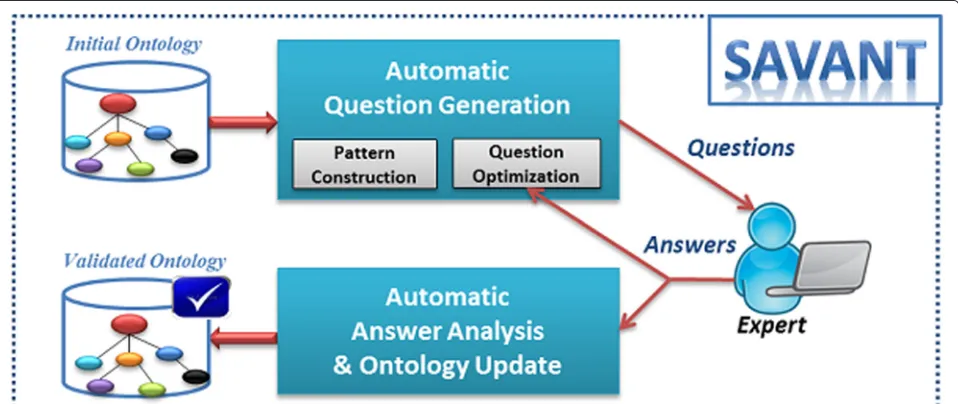
We propose a semi-automatic approach based on ques-tion generaques-tion to validate ontologies. Figure 1 describes our ontology validation system, called SAVANT. The first step consists of automatically generating a list of boolean questions from the ontology under validation.
These questions are submitted to domain experts who provide an agreement decision (Yes/No) and a textual feedback. The next step consists on interpreting expert’ feedback to validate or modify the ontology. The novelty of our approach relies on the fact that manual interven-tions are performed only by Health Professionals (HPs), who will lead the ontology validation process. ICT experts are required only when the error cannot be solved auto-matically. This increases the quality of exchanges between actors and reduce errors and time consumption.
We explore the proposed approach to (i) validate ontolo-gies constructed automatically from medical texts (e.g.,
clinical guidelines) and also (ii) to re-validate ontologies (constructed manually or automatically), since medical knowledge evolves quickly over time.
We focus on validating the following types of ontology statements:
• A rdfs:subClassOf B (class A is a subclass of B) • P rdfs:subPropertyOf Q (property P is a sub-property
of Q)
• P rdfs:domain D (D is the domain class for property P) • P rdfs:range R (R is the range class for property P) • I rdf:type A (I is an individual of class A)
• I P J (the property P links the individuals I and J)
The proposed approach uses manually constructed pat-terns for each kind of ontology element as described in the following section.
Pattern-based method for boolean question generation We start from the hypothesis that all the elements of a medical ontology must be validated. This involves validat-ing concepts (e.g., Substance), relations between concepts (e.g., administrated for), concept instances (e.g., activated charcoal is an instance of Manufactured Material), rela-tions between concept instances (e.g., chest X-ray can be ordered for Chronic cough) or between concept instances and literals (e.g., “give oral activated charcoal 50 g” indi-cates the dose of the substance to be administrated “50 g”). These ontology elements provide the main keywords of the question patterns through the labels of concepts, rela-tions and instances.
We constructed manually question patterns associated to each type of ontological element (5 different elements in our preliminary experimentations). A question pattern
consists of a regular textual expression with the appro-priate “gaps” [37]. For instance, the pattern “Is DOSE of DRUG well suited for PATIENTS having DISEASE?” is a textual pattern with 4 gaps: DOSE, DRUG, PATIENTS and DISEASE. This question pattern aims to validate a drug dose administrated to a patient having a particular disease. The singular or plural form of the verb in the expression is determined using the Stanford parser6. Sin-gular is used by default if the detection is not possible, a frequent case that occurs because of the heterogeneity of ontology labels.
Table 1 presents examples of boolean-question patterns.
Question optimization strategy
At this level, our main objective is to investigate a technique to build relevant questions from formalized knowledge in order to validate the maximum number of assertions with the minimum number of questions.
We propose an optimization strategy relying on the RDFS logical rules to rank the questions according to the elements that imply the more changes in the ontology.
For instance, if we have the following data:
• hasSuitedAntiobioticsTyperdf:subPropertyOf hasTreatment
• Antibioticsrdfs:subClassOf Treatment
• hasSuitedAntiobioticsTyperdfs:range Antibiotics
and the expert invalidates “Antibioticsrdfs:subClassOf Treatment", than the propertyhasSuitedAntiobioticsType cannot be declared as a sub-property of hasTreatment because the hasSuitedAntibioticType relation has not a common range with the property hasTreatment, which leads to a formal error regarding the RDFS entailment rules.
We consider all RDFS entailment rules7. Table 2 presents some inversed forms of these rules to show the impact of invalidating each one of the target ontology statements.
This technique enables ranking questions in a manner that allows to delete some of the remaining questions if one of the RDFS entailment rules apply. This leads to the following validation order:
1. A rdfs:subClassOf B
2. P rdfs:domain D and P rdfs:range R
3. P rdfs:subPropertyOf Q 4. I rdf:type A
5. I P J
Answer analysis and ontology update
The second step of our approach refers to the exploitation of expert’ feedback to validate or modify the target ontol-ogy. The ontology under validation might contain con-cepts, individuals and relations defined between concepts or individuals.
Feedback consists of two main parts: (i) an assertion on the correctness of the target knowledge and (ii) a free textual explanation if provided8. In the scope of this arti-cle, we take into account ontologies that are formally-valid (with no inconsistencies) and emphasize the validation of domain conceptualization.
In this context, “Yes” answers have no impact on the ontology. The ontology is modified on the “No” answers provided by the domain experts. Invalidating an ontol-ogy element implies different impacts according to the element type.
We use the same RDFS entailment rules to update the ontology. The ontology item invalidated by the expert and the inferred invalidations are deleted from the ontology, as well as the questions associated to them.
Mapping validation method
Approach overview
We consider as input a set of adapted correspondences MOt
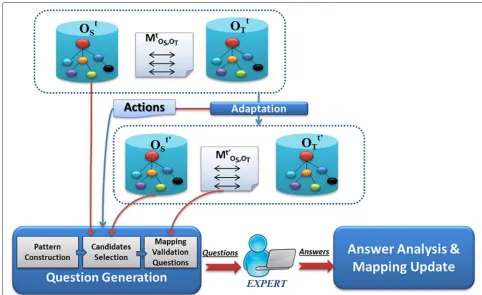
A,OtB. Adaptation here refers to the automatic mapping adaptation that occurs after the evolution of the source ontologyOtA. We consider that the old mappings are cor-rect and we want to validate only the new ones. Similarly to the ontology validation method, our approach to val-idate mappings relies on the generation of NL questions from the new mappings. Figure 2 describes our proposed approach for mapping validation. Figure 3 presents our method for question generation through a state transition diagram.
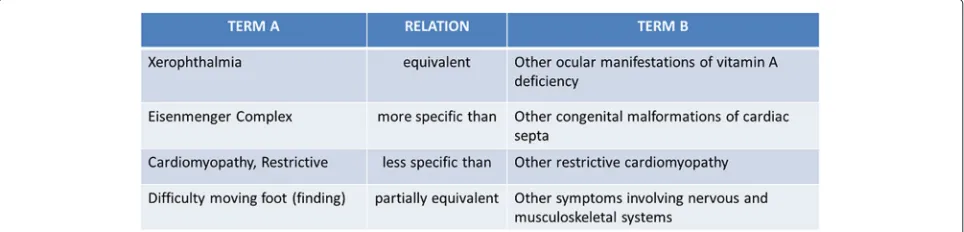
Table 3 presents examples of correspondences between SNOMED-CT and ICD9. Figure 4 shows examples of more or less ambiguous correspondences retrieved between the biomedical ontologies SNOMED-CT and ICD9. This selection provides concrete examples of the issues related to the heterogeneity and broadness of some
Table 1Examples of boolean-questions patterns used for ontology validation
Question pattern Example of instance
Does a(n) CLASS have a PROPERTY Does an effect have a measurement method?
Does a treatment have an administration scheme?
Is CLASS a type of CLASS? Is statistical evidence a type of evidence?
Table 2Examples of ontology update rules with respect to invalidated elements used for ontology validation
NOT A rdfs:subClassOf B ⇒ NOT A rdfs:subClassOf C s.t. C rdfs:subClassOf B
NOT P rdfs:domain A ⇒ NOT P rdf:subPropertyOf Q s.t. Q rdfs:domain A
NOT I rdf:type A ⇒ NOT<I, P, J>s.t. P rdfs:domain A
NOT<J, P, I>s.t. P rdfs:range A
concept definitions. Dealing with this problem requires to define flexibleanswer typesto ensure a relevant interac-tion with the human validators.
STEP 1: Boolean questions
In the first step, our method translates the proposed adapted correspondences into a NL question using tex-tual patterns associated to each relation type. LetXbe the source concept label andYbe the target concept label, the main patterns are as follows:
1. (Is|Are)X<equivalent to>Y ?
2. (Is|Are)X<more specific meaning than>Y ? 3. (Is|Are)X<less specific than>Y ?
4. Do(es)X<partially correspond to>Y ? 5. X <cannot be matched with>Y ?
These patterns are instantiated with the involved concepts of a correspondence. We present three instanti-ation examples from our dataset in the following:
1. Are intestinal diseases equivalent to vascular disorder of intestines?
2. Does the Trousseau sign partially correspond to ill-defined and unknown causes of morbidity and mortality?
3. Is the Eisenmenger Complex more specific than other congenital malformations of cardiac septa?
STEP 2: multiple choice questions
In the second and main step, negative answers trigger multiple choice questions (MCQs) that are submitted to the expert in order to detect alternative correct mappings betweenCat (the source concept) and the conceptCtb in
Fig. 3The question generation process as a state-transition diagram
target ontologyOtB. MCQ consists of (i) a problem known as thestemand (ii) a list of suggestedalternatives. In our approach, we have three categories of stems/questions (cf. Fig. 3):
1. Revision ofCa. This suggests revising the source
concept by candidate proposals from the new source ontologyOtA. This category preserves the semantic mapping-relation between the source conceptCat
and the target conceptCbt, and proposes candidate concepts fromOtA that are semantically close to the initial source conceptCat. In this MCQ category, we propose stems of the form:
“What concept<semanticType> <target concept>?” corresponds to the revision of the candidate source concept, where
<semanticType>refers to the type of mapping relationsemanticTypetab and
Table 3Examples of correspondences between SNOMED-CT and ICD9CM
Concept source label semanticType Concept target label
Intestinal diseases equivalent to [≡] Vascular disorders of intestine
Nail-Patella syndrome more specific than [≤] Congenital malformation syndromes
predominantly involving limbs
Respiratory tract infections less specific than [≥] Acute upper respiratory infection, unspecified
Abnormality of gastric inhibitory
Fig. 4Examples of ambiguous correspondences between SNOMED-CT and ICD9CM
<target concept>consists of the label of the target conceptCbt. For instance, an instantiation of this stem pattern is:What concept is more specific than other restrictive cardiomyopathy? The alternatives for this stem stand for thetop n most semantically-close concepts to the initial source concept (e.g., Cardiomyopath, Restrictive). Section “Selection of alternative concepts and mapping relations” presents the selection of alternative candidate concepts.
2. Revision of mapping relation(MR). This category
of questions proposes revising the type of mapping relation. More precisely, in case of a negative answer in the previous MCQ option, our method preserves the initial concept candidateCta and modifies the semanticType of the adapted correspondence, selecting another alternative mapping relation (cf. Section “Selection of alternative concepts and mapping relations”). We propose stems of the form “Choose the correct mapping relation alternative”. The proposed alternatives are declarative sentences derived from the question patterns.
3. Revision of both. In case of a negative answer in the
previous option, our method revises both candidate proposals and semantic relation types, aggregating both option 1 and 2 in a single multiple choice question. We formulate stems of the form“Choose the correct source concept and relation type” corresponding to the revision of both the candidate source concept andsemanticType of mapping. We present alternatives for the question generation in 3 columns format, where the first column consists of the list of selected source concept alternatives, the second column presents the list of new suggested types of semantic relations and the third column contains the target concept.
We present two instantiation examples from our dataset in the following:
1. Is Other spontaneous pneumothorax more specific than closed pneumothorax?
Alternative source concepts:
• Iatrogenic pneumothorax
• Secondary spontaneous pneumothorax
2. Is Gastroparesis more specific than Diabetic Gastroparesis associated 2 diabetes mellitus? Alternative source concepts:
• Acute dilatation of stomach
• Dyspepsia and other specified disorders of function of stomach
Selection of alternative concepts and mapping relations The defined approach based on MCQ (cf.Section “STEP 2: multiple choice questions”) requires selecting candi-date concepts and different semanticType relations as suggested alternatives in question generation to support mapping validation over time. For this purpose, we pro-pose an algorithm to select similar concepts to the original source concept.
Selection of alternative concepts
In the scope of source concept revision, we generate alter-natives in MCQs by using candidate concepts from the context of the initial source concept in the ontology. We aim at combining the answers from these questions to propose re-adapting correspondences if necessary. For example, if a given correspondence between source con-cept Ct
a and target concept Ctb is adapted, such that a conceptCt
k ∈Concepts(Ot
A)replaces the original concept Ct
a, this generates an adapted correspondence at timet
betweenCktandCbj ∈Concepts(OtB).
Therefore, we retrieve from the ontological contextCT (cf. Eq. 1) a set of other concepts which differs from Ckt, Candidates = {(Cati,simi)i ∈[ 1..n]}, whereCt
i ∈
CT(Cat).
measure following the observations of [38] on its suit-ability for ontology matching tasks. For two given labels, Bigram similarity is computed as the euclidean dis-tance, using all possible bigrams from both labels as dimensions. In our approach, we compute the similarity between pairs of comparable attributes that are selected beforehand as a parameter (e.g., the name and syn-onym attributes). We denote the similarity function as simAtt(ati.value,atj.value) between two attribute values ati.valueandatj.value.
Algorithm 1:Find candidate concepts in context
Require: Cat ∈Concepts(OtA);CT(Cat)⊂OtA;Ckt ∈ Concepts(OtA);n∈N;Attributes(Cti)forallCti ∈ Concepts(OtA)
Ensure:
Candidates= {(c1,sim1),(c2,sim2), ...,(cn,simn)} Candidates← ∅;maxSim←0;
for allatp∈Attributes(Cta)do for allCti ∈CT(Cat)do
ifCit =Ctkthen
for allati ∈Attributes(Cit)do s←simAtt(atp.value,ati.value); ifmaxSim<sthen
maxSim←s; end if
end for Candidates←
Candidates∪ {(Cti,maxSim)};maxSim←0; end if
end for end for
return Candidates←sort(Candidates,n); {Select top
nconcepts}
Given all attributes of the original source concept, the algorithm retrieves all concepts in context CT at time t. For all retrieved concepts different from the concept Ctk, to which the adapted mapping is associated, the algo-rithm selects their attributes and calculates the similarity between the attribute values (between attributes of the source concept and attributes of concepts inCT). For each candidate concept, the algorithm keeps the maximal sim-ilarity value calculated among the attributes. Finally, the algorithm sorts the top n retrieved candidate concepts according to the calculated similarity. We use these can-didates as alternative answers in our MCQ approach, so they play a central role for the automatic generation of the questions.
Selection of alternative mapping relations
Revising the semantic relation semanticType in our question generation method demands retrieving alter-natives for the second category of proposed MCQ (cf. Section “STEP 2: multiple choice questions”). To this end, we recover a set of semantic relations Relalternatives =
{(semanticTypei)i ∈[ 1..n]} where semanticTypei ∈ {≡ ,≤,≥,≈} such that semanticTypei = semanticTypet
ab. We use theRelalternativesto formulate the question in the revision ofMRcategory. The alternative relations are pro-posed from the most precise one to the more general one (i.e.,≡,≤,≥, then≈).
Experimental evaluation
We selected a set of ontologies and mappings and designed a series of experiments to evaluate the pro-posed methods. In this article, we considered medical ontologies and mappings in English language, but our approaches can be applied to other languages as well. We present the obtained results in Sections “Exper-iments on ontology validation” and “Exper“Exper-iments on mapping validation” and discuss our findings in Section “Discussion and Future work”.
Experiments on ontology validation
Materials
We tested our ontology validation approach on three different medical ontologies that cover different aspects of the medical domains (Treatment-Disease vs. mental health) and constructed using different methods:
• Caries Ontology (CO). CO was developed manually by a dentistry expert in our company.
• Disease-Treatment Ontology (DTO). We constructed an OWL translation of the ontology proposed by Khoo et al. [39].
• Mental Diseases Ontology (MDO). This ontology is publicly available.
Results of ontology validation
For the first step of the experiment, Table 4 presents the number of questions with respect to the num-ber of classes, properties and instances of each ontology (DTO, MDO and CO) without question optimization.
Table 4The number of ontology elements (OE) and the number of generated questions for different medical ontologies without optimization
Ontology Number of classes Number of properties Number of instances Total number of OE Number of questions
DTO 49 148 0 197 165
MDO 149 76 18 243 243
CO 26 266 13 305 290
with more NO answers (i.e. more invalid elements), the number of deleted questions will increase.
For the DTO ontology, the concepts have no instances and all facts were evaluated as correct by the expert, con-sequently the initial number of questions was conserved. The ontologies used in these experiments were con-structed manually and semi-automatically. More experi-ments should be conducted on automatically constructed ontologies when available in order to evaluate more accu-rately the benefits of question optimization.
In the case of ontologies with few invalid elements (few NO answers), other methods should be used to optimize the presentation and reduce the time needed to answer the questions. For example, the following presentation methods can be studied: (i) question factorization accord-ing to an ontology element (concept, relation or individ-ual) and (ii) logical chaining (A hasRelation1With B, B hasRelation2With C, etc.). Such organization can be effec-tive in helping medical experts understand and answer the questions more quickly.
Experiments on mapping validation
Materials and experimental procedure
We evaluate the NL quality of the questions generated automatically to validate mappings. We use two biomed-ical ontologies SNOMED-CT9 (SCT) and ICD-9-CM10 (ICD9) including different versions of official mappings established between them.
We aim to investigate to which degree it is possible to generate NL sentences that can adequately describe mappings. For this purpose, we evaluate the generated questions according to three standard measures in NL generation: grammaticality, fluency and meaning preser-vation. Since our approach aims to facilitate human inter-vention in mapping adaptation, we assume that it is relevant to assess the NL quality of the automatically-generated questions.
We presented the generated questions to three differ-ent human assessors who were asked to associate a score value between 1 and 10 for each dimension and each ques-tion. Assessors were ontology experts and familiar with the biomedical domain. We evaluated the approach for the validation of 20 randomly-selected adapted mappings generated from the evolution of mappings between SCT and ICD9.
We measure the Inter-Assessor Agreement (IAA) for grammaticality, fluency and meaning preservation. IAA corresponds to the average κ measure defined in [40]. Theκ measure indicates how much the assessors’ agree-ment is above the probability of an agreeagree-ment by chance, and it is commonly used in computational linguistics. In order to have relevant measures, we define 3 score inter-vals for grammaticality, fluency and meaning preservation which are: [0..3], [4..6], [7..10]. We use these intervals as categories in the calculation of theκ measure, which corresponds to:
κ= P(a)−P(c)
1−P(c) (2)
where P(a) refers to the observed inter-assessor agree-ment andP(c)is the probability of a chance agreement.κ values range from -1 to 1 (cf.Table 5 for results).
Results of mapping validation
Table 5 presents the obtained results for the 20 Boolean questions that are generated for the 20 targeted mappings. They present the measures of IAA for grammaticality, fluency and meaning preservation.
Our second focus is to evaluate the usefulness of each question type. To this end, we count (i) the number of returned answer-types for the set of 20 questions accord-ing to the different question types and (ii) the number of validation/invalidation according to the observed adapted mappings (examining the evolution of the two official
Table 5Quality of the NL generated questions for mapping validation and averageκInter-Assessor Agreement
Grammaticality Fluency Meaning
Min. Max. Avg. Min. Max. Avg. Min. Max. Avg.
Assessor 1 0.4 1 0.775 0.4 1 0.81 0.4 1 0.915
Assessor 2 0.4 1 0.745 0.4 1 0.77 0.4 1 0.86
Assessor 3 0.6 0.9 0.735 0.6 0.9 0.745 0.6 0.9 0.77
releases mappings in our dataset) (cf.Table 6). In this sec-ond independent evaluation, we asked the assessors to find a common agreement on the semantic correctness of the correspondences.
The overall assessment of the generated initial Boolean Questions (cf.Section “STEP 1: Boolean questions”) indi-cates good values for grammaticality and fluency because the attained average values are satisfactorily high regard-ing the used metric. The most important criterion for the mapping validation, which is meaning preservation, had the best score by the assessors. TheκInter-Assessor Agreementis also relatively high (κis not negative), which provides a positive test on the reliability of the assessors’ ratings. In short-term perspectives, further tests will be made with a correlation-based approach to have a more precise view on the levels of agreement.
Table 6 shows the percentage of different answer types returned during the validation of the adapted mappings. Results indicate that 80 % of the initial adapted mappings were validated or led to the validation of another new mapping (i.e., re-adaptation) (cf.“Final output validation” row in table 6), discovered during the validation process. On the test set of 20 mapping adaptations, only one ques-tion was rated as ambiguous, due to an incomplete con-cept label. The low percentage ofYes answersfor the initial Boolean questions indicates that the automatic selection of mapping adaptations using the approach described in [31] were insufficient for this dataset. The 3rd type of question, revising only the mapping relation, allowed to validate 40 % of the mappings. Revising the source con-cepts alone fails to validate more mappings, but together with the revision of the mapping relation it allowed to val-idate 40 % of the mappings (cf.see 4thtype of questions “revision of both” in Table 6).
Discussion and Future work
The experiments on ontology validation showed the need to add other specific types of questions and answer types. In some observed cases an answer can be YES but for a specific kind of patients (e.g. Infant) or alsoNOfor a specific kind of patient, or under a specific condition. In our experiments the experts answered NO for such cases.
Table 6Answer types according to question types Answer type
Yes answers No answers Ambiguous
source/target
Question type
Boolean question 0 % 95 % 5 %
Revision ofcs 0 % 95 % 5 %
Revision ofMR 40 % 55 % 5 %
Revision of both 40 % 55 % 5 %
Final output validation 80 % 15 % 5 %
Therefore, it would be interesting to give to the expert the possibility to specify a contextual element or an additional condition to their YES/NO answers. A possible solution can be to integrate factual questions as possible question type, which will also contribute to enrich the ontology during the validation process.
On the other hand, even if our optimization method may allow significantly reducing the number of questions, it is still challenging to validate very large ontologies with natural language questions. In this context, advanced con-tent selection techniques such as summarization can play an important role. As suggested by Sure et al. [41], a sum-mary of an ontology might include a couple of top levels in the ontology’s class hierarchy, and also the ontology’s hub concepts (i.e.concepts with the largest number of links).
To validate huge ontologies, we are considering approaches based on summarization. A possible solu-tion can be by using the Key Concepts Extracsolu-tion (KCE) algorithm which automatically extracts the most repre-sentative classes of an ontology. More particularly, sum-marization can be adapted to the validation task by taking into account several features such as the number of ques-tions needed to validate a given extract or summary and the number of key concepts.
On the level of Mapping Validation, the conducted liter-ature survey indicated that the generation of NL questions for mapping validation was not investigated. Our proposal originally evaluated the quality of generated NL questions to help human experts judge the quality of correspon-dences under evolution. The proposed method uses the context of the source concept to select similar concepts as alternatives in case of invalidated mappings.
In the conducted experiments on mapping validation, the analysis of quality-deficient Boolean questions pro-duced by the NL generation system highlighted to two main error causes:
• The heterogeneity and length of the literal attributes that led to some inadequacies with the conceived patterns, e.g., “Are other eye disorders more specific than family history degenerative disorder of macula? ” • Errors in the concepts’ attributes (mainly labels), e.g.
“Is other more specific than mechanical complication of suprapubic catheter? ”.
if needed. According to our experiments, multiple choice questions with 5 correction alternatives for each invalid mapping proved to be efficient to locate the correct map-ping relation and/or mapmap-ping target.
Conclusions
The methods for automatic ontology construction have highlighted the problems of validation of ontologies and mappings. Research efforts and interests have grown more and more, but mostly at a formal level. In this article, we addressed the problem of ontology validation including mappings from a conceptual and a semantic point of view. We proposed novel semi-automatic approaches based on the generation of questions and answers interpreta-tion to facilitate the communicainterpreta-tion with domain experts. The defined methods generates natural language ques-tions from medical ontologies and mappings and uses the answers from the expert to update/correct them.
Our approach implementing automatic methods might guide domain experts in the validation process. Relying on domain experts to monitor the validation can lead to var-ious benefits, ensuring reliable communication between heterogeneous systems.
We evaluated the proposed methods based on several real datasets from different releases of biomedical ontolo-gies and their associated mappings. The achieved results underscored the feasibility of our general approach for the validation of ontologies and mappings, and its relevant role in the completion of the their adequate evolution over time.
Endnotes
1http://ihtsdo.org/snomed-ct/
2http://ncit.nci.nih.gov/
3http://bioportal.bioontology.org/
4http://www.chu-rouen.fr/cismef/
5An international workshop is also held on question
generation since 2008.
6http://nlp.stanford.edu/software/lex-parser.shtml
7http://www.w3.org/TR/rdf-mt/#RDFSRules
8Free textual explanation is considered for future
per-spectives and is not used in this work.
9www.nlm.nih.gov/research/umls/licensedcontent/
snomedctarchive.html
10www.cdc.gov/nchs/icd/icd9cm.htm
Acknowledgements
We thank the SMBM 2014 program committee members for their feedback and for the opportunity to extend our original submission [9] in the scope of this special issue. We would also like to thank our anonymous reviewers for their insightful comments that helped to improve our paper. This research work was funded in part by the the São Paulo Research Foundation (FAPESP) granted to JDR (Grant #2014/14890-0). The opinions expressed in this work do not necessarily reflect those of the agency that funded one of the authors.
Authors’ contributions
ABA, CP and MDS designed the proposed approach for ontology validation using natural language questions. CP constructed the OWL translation of the Disease-Treatment ontology. ABA designed the approach for question optimization, implemented and evaluated the question generation system for ontology validation and wrote the first manuscript. All authors contributed to the manuscript. ABA and JDR designed the proposed approach for mapping validation. ABA implemented the system for mapping validation using boolean questions for new mappings and multiple choice questions with suggested alternatives for invalid mappings. JDS implemented the generation of candidate concepts from the context of the initial source concept in the ontology. ABA, JDR and YM evaluated the mapping validation system. All authors read and approved the final manuscript.
Competing interests
The authors declare that they have no competing interests.
Author details
1Luxembourg Institute of Science and Technology (LIST), Esch-sur-Alzette, Luxembourg.2Institute of Computing, University of Campinas, Campinas, Brazil.
Received: 5 March 2015 Accepted: 22 June 2016
References
1. Gruber TR. A translation approach to portable ontology specifications. Knowl Acquis. 1993;5(2):199–220.
2. Bullinger Angelika. Innovation and Ontologies. In: Structuring the Early Stages of Innovation Management. Wiesbaden: Gabler Verlag; 2009. p. 160–161. 10.1007/978-3-8349-9920-7.
3. Euzenat J, Shvaiko P. Ontology Matching. New York: Springer; 2007. 4. Lambrix P, Strömbäch L, Tan H. Information Integration in Bioinformatics
with Ontologies and Standards In: Bry F, Małuszy ´nski J, editors. Semantic Techniques for the Web: the REWERSE Perspective. Berlin, Heidelberg: Springer Berlin Heidelberg; 2009. p. 343–376.
doi:10.1007/978-3-642-04581-.
5. Poveda-villalón M, Suárez-figueroa MC, Gómez-pérez A. Validating Ontologies with OOPS!. In: Knowledge Engineering and Knowledge Management, EKAW 2012. Berlin: Springer; 2012. p. 267–81. 6. Sabou M, Fernandez M. Ontology (network) evaluation In:
Suárez-Figueroa MC, Gómez-Pérez A, Motta E, Gangemi A, editors. Ontology engineering in a networked world. Springer; 2012. p. 193–212. http://www.springer.com/.
7. Gómez-Pérez A. Ontology evaluation In: Staab S, Studer R, editors. Handbook on Ontologies. Berlin, Heidelberg: Springer Berlin Heidelberg; 2004. p. 251–273. doi:10.1007/978-3-540-24750-.
8. Ben Abacha A, Silveira M, Pruski C. Medical ontology validation through question answering In: Peek N, Marin Morales R, Peleg M, editors. Artificial Intelligence in Medicine. Lecture Notes in Computer Science, vol. 7885. Murcia, Spain: Springer; 2013. p. 196–205.
9. Ben Abacha A, Dos Reis JC, Mrabet Y. Question generation for the validation of mapping adaptation. In: the 6th International Symposium on Semantic Mining in Biomedicine (SMBM 2014), University of Aveiro, Portugal, October; 2014.
10. Yao H, Orme AM, Etzkorn L. Cohesion metrics for ontology design and application. J Comput Sci. 2005;1(1):107.
11. Baneyx A, Charlet J. Évaluation, évolution et maintenance d’une ontologie en médecine: état des lieux et expérimentations. Revue I3 -Information, Interaction, Intelligence, numéro spécial Corpus et ontologies. 2007; 147–173.
12. Stvilia B. A model for ontology quality evaluation. First Monday. 2007;12(12).
13. Djedidi R, Aufaure MA. ONTO-EVO AL an ontology evolution approach guided by pattern modeling and quality evaluation. In: Proceedings of the 6th International Conference on Foundations of Information and Knowledge Systems. Berlin, Heidelberg: Springer-Verlag; 2010. p. 286–305. 10.1007/978-3-642-11829-6_.
heterogeneous systems. Computers in Industry. 2014;65(9):1291–1300. doi:10.1016/j.compind.2014.07.
15. Wolfe JH. Automatic question generation from text — an aid to independent study. 1976;8(1):104–12. doi:10.1145/952989.803459. SIGCSE–SIGCUE joint symposium on Computer science education. 16. Liu M, Calvo RA, Rus V. G-asks: An intelligent automatic question
generation system for academic writing support. Dialogue Discourse. 2012;3(2):101–24.
17. Heilman M. Automatic factual question generation from text. PhD thesis: Carnegie Mellon University; 2011.
18. Mitkov R, Ha LA. Computer-aided generation of multiple-choice tests. In: Proceedings of the HLT-NAACL 2003 Workshop on Building Educational Applications Using NLP. Edmonton, Canada; 2003. p. 17–22. http://clg. wlv.ac.uk/papers/ruslan-NAACL-03.pdf. Accessed Feb 2016. 19. Papasalouros A, Kanaris K, Kotis K. Automatic generation of multiple
choice questions from domain ontologies. In: Proceedings of the IADIS International Conference on e-Learning Amsterdam, The Netherlands 22-25 July 2008; 2008. p. 427–34.
20. Cubric M, Tosic M. Towards automatic generation of e-assessment using semantic web technologies. In: Proceedings of the 2010 International Computer Assisted Assessment Conference; 2010. Accessed Feb 2016. 21. Pammer V. Automatic support for ontology evaluation review of entailed
statements and assertional effects for OWL ontologies. PhD thesis: Graz University of Technology; March 2010.
22. Teitsma M, Sandberg J, Maris M, Wielinga B. Using an ontology to automatically generate questions for the determination of situations In: Hameurlain A, Liddle SW, Schewe K-D, Zhou X, editors. Database and Expert Systems Applications: 22nd International Conference, DEXA 2011, Toulouse, France, August 29 - September 2, 2011, Proceedings, Part II. Berlin, Heidelberg: Springer Berlin Heidelberg; 2011. p. 456–63. doi:10.1007/978-3-642-23091-.
23. Gangemi A, Catenacci C, Ciaramita M, Lehmann J. Modelling Ontology Evaluation and Validation. In: Proceedings of the 3rd European Conference on The Semantic Web: Research and Applications. Budva, Montenegro: Springer; 2006. p. 140–54.
24. Köhler J, Munn K, Rüegg A, Skusa A, Smith B. Quality control for terms and definitions in ontologies and taxonomies. BMC bioinformatics. 2006;7(1):212.
25. Verspoor K, Dvorkin D, Cohen KB, Hunter L. Ontology quality assurance through analysis of term transformations. Bioinformatics. 2009;25(12): 77–84.
26. Dimitrova V, Denaux R, Hart G, Dolbear C, Holt I, Cohn AG. Involving domain experts in authoring OWL ontologies In: Sheth A, Staab S, Dean M, Paolucci M, Maynard D, Finin T, Thirunarayan K, editors. The Semantic Web - ISWC 2008: 7th International Semantic Web Conference, ISWC 2008, Karlsruhe, Germany, October 26-30, 2008. Berlin, Heidelberg: Springer Berlin Heidelberg; 2008. p. 1–16. doi:10.1007/978-3-540-88564-. 27. Medelyan O, Witten IH, Divoli A, Broekstra J. Automatic construction of
lexicons, taxonomies, ontologies, and other knowledge structures. Wiley Interdiscip Rev: Data Min Knowl Discov. 2013;3(4):257–79.
doi:10.1002/widm.1097.
28. Zhao L, Ren H, Wan J. Automatic ontology construction based on clustering nucleus. Wuhan Univ J Nat Sci. 2015;20(2):129–33. 29. Vor der Bruck T, Stenzhorn H. Logical Ontology Validation Using an
Automatic Theorem Prover. In: Proceedings of the 2010 Conference on ECAI 2010: 19th European Conference on Artificial Intelligence. Lisbon, Portugal: IOS Press; 2010. p. 491–6.
30. Pohl M, Wiltner S, Rind A, Aigner W, Miksch S, Turic T, Drexler F. Patient development at a glance: An evaluation of a medical data visualization In: INTERACT 2011 PartIV, Campos P, Graham N, Jorge J, Nunes N, Palanque P, Winckler M, editors. Vortrag: HumanComputer Interaction -INTERACT 2011, Lissabon. Springer Berlin/Heidelberg; 2011. p. 292–9. 31. Dos Reis JC, Dinh D, Pruski C, Da Silveira M, Reynaud-Delaitre C.
Mapping adaptation actions for the automatic reconciliation of dynamic ontologies. In: Proceedings of the 22Nd ACM International Conference on Information & Knowledge Management. New York, NY, USA: ACM; 2013. p. 599–608. doi:10.1145/2505515.2505564.
32. Meilicke C, Stuckenschmidt H, Tamilin A. Reasoning Support for Mapping Revision. J Logic Comput. 2009;19(5):807–829. doi:10.1093/logcom/exn047.
33. Serpeloni F, Moraes R, Bonacin R. Ontology mapping validation. Int J Web Portals. 2011;3:1–11.
34. Falconer SM, Noy NF. Interactive techniques to support ontology matching In: Bellahsene Z, Bonifati A, Rahm E, editors. Schema Matching and Mapping. Berlin, Heidelberg: Springer Berlin Heidelberg; 2011. p. 29–51. doi:10.1007/978-3-642-16518-.
35. McCann R, Shen W, Doan A. Matching schemas in online communities: A web 2.0 approach. In: 2008 IEEE 24th International Conference on Data Engineering; 2008. p. 110–9. doi:10.1109/ICDE.2008.
36. Sarasua C, Simperl E, Noy N. Crowdmap: crowdsourcing ontology alignment with microtasks In: Cudré-Mauroux P, Heflin J, Sirin E, Tudorache T, Euzenat J, Hauswirth M, Parreira JX, Hendler J, Schreiber G, Bernstein A, Blomqvist E, editors. The Semantic Web – ISWC 2012: 11th International Semantic Web Conference, Boston, MA, USA, November 11-15, 2012, Proceedings, Part I. Berlin, Heidelberg: Springer Berlin Heidelberg; 2012. p. 525–41. doi:10.1007/978-3-642-35176-. 37. Hearst M. Automatic acquisition of hyponyms from large text corpora. In:
Proceedings of the 14th Conference on Computational Linguistics -Volume 2. Stroudsburg, PA, USA: Association for Computational Linguistics; 1992. p. 539–45. doi:10.3115/992133.992154.
38. Cheatham M, Hitzler P. String similarity metrics for ontology alignment In: Alani H, Kagal L, et al., editors. ISWC 2013. LNCS. vol. 8219. Sydney, Australia: Springer; 2013. p. 294–309.
39. Khoo CSG, Na JC, Wang VW, Chan S. Developing an ontology for encoding disease treatment information in medical abstracts. DESIDOC J Libr Inform Technol. 2011;31(2):103–15.
40. Cohen J. A coefficient of agreement for nominal scales. Educ Psychol Meas. 1960;20:37–46.
41. Sure Y, Gomez-Perez A, Daelemans W, Reinberger ML, Guarino N, Noy NF. Why evaluate ontology technologies? because it works!. IEEE Intell Syst. 2004;19(4):74–81.
42. Buitelaar P, Cimiano P, Haase P, Sintek M. Towards linguistically grounded ontologies. In: The Semantic Web: Research and Applications. Lecture Notes in Computer Science, vol. 5554. Berlin Heidelberg: Springer; 2009. p. 111–25.
• We accept pre-submission inquiries
• Our selector tool helps you to find the most relevant journal
• We provide round the clock customer support
• Convenient online submission
• Thorough peer review
• Inclusion in PubMed and all major indexing services
• Maximum visibility for your research
Submit your manuscript at www.biomedcentral.com/submit