ISSN: 2278-7461, www.ijeijournal.com
Volume 1, Issue 7 (October2012) PP: 29-35
INVESTIGATION OF PACKET TRANSMISSION
STRATEGIES OF MIMO EQUIPPED MOBILE ADHOC
NETWORK USING SPACE-TIME CODING
Swati Chowdhuri
1, Dr. Sheli Sinha Chaudhury
2, Dr. Arun Kumar Mondal
3, Dr.
P.K.Baneerjee
41
Asst. Professor, ECE, Seacom Engineering College, Howrah -711302 ,
2Reader, ETEC, Jadavpur University, Kolkata-700032,
3Professor, ECE , Budge Budge Institute of Technology , Kolkata -700137, 4Professor, ETCE, Jadavpur University, Kolkata-700032,
Abstract:––With the rapid growth of wireless communication infrastructure over the recent few years, new challenges has been posed on the system and analysis on wireless ad hoc networking. Implementation of MIMO communication in such type of network is enhancing the packet transmission capabilities. There are different techniques for cooperative transmission and broadcasting packet in MIMO equipped Mobile Adhoc Ntwork. Studying and investigating the different broadcasting algorithm, we propose a new scheduling algorithm which improves the packet transmission rate and energy performance of the network which is illustrated in this paper. The system model employed in the OPNET environment and simulated to show the packet transmission rate and some data are collected are shown in the tabular form. Also simulate the network for generating a comparative statement for each mobile node. And performance analysis is also done for the model network.
Keywords: Multi Input Multi Output (MIMO), Space-time coding, Ethernet Delay, ad hoc networks.
I.
INTRODUCTION
The coding and signal processing are the major elements for successful implementation of MIMO communication system. The communication channel over which the MIMO system operates has an unprecedented complexity to exploit the channel space time resources to access the potential performance of practical multi antenna links between the transmitter and receiver. The signal transmission technique at the two sides of the MIMO communication links has a great potential to significantly improve the transmission efficiency of the wireless communication system without the need for extra operational frequency bandwidth [1,2,3]. The multi input multi output (MIMO) is envisaged for the purpose of next generation communications because of the MIMO technique has a lot of benefits over the traditional single input single output (SISO) signal transmission with respect to the Capacity, Bit-Error-Rate (BER), and transmission efficiency. Formal wireless networks are usually formed by hexagonal cells each with a base station(BS) and many mobile stations (MS), where the mobile terminal communicate with the base station which organizes multiple access to the intended MS user [4,5].To implement MIMO system with standard mobile communication system wills MS-BS have to be equipped with multiple antennas and their impact of antenna element properties – such as directivity , polarization, and mutual coupling- antenna array configuration and radio frequency (RF) architecture and communication behavior as well as suitable signal processing algorithms are to be considered judiciously at the mobile nodes. For the formal wireless network topology changes depends on distribution of BS-MS where in MANET technology, topology changes are distributed among the mobile nodes; No BS-MS concept is here. MIMO ad hoc network using different number of transmitting and receiving antennas combination shows that high channel capacity and high spectral efficiency compared to SISO network It has been observed that Spectral Efficiency has the limitation with the number of antenna [6]. And further studied are carried out with multi carrier modulation techniques-OFDM on MIMO combination of ad hoc network , OFDM technique reduces the equalization complexity by applying IFFT at the transmitter and FFT in the receiver to obtain the wideband signal [7]. The implementation of IFFT and FFT enhances the processing speed and reduces the processing complexity of large multiplication and addition for long data processing before transmission and reception through multiple numbers of antennas in MIMO system. Fading severity of the MIMO channel channels are measured by means the co-efficient variation (CV) of the amplitude and phase of the transmitted signal[7]. The Rayleigh and the Rician fading along with the Doppler Shift are considered to measure the AFD and LCR of the MIMO channel [8]. A new scheduling algorithm is discussed which is related with the firing of the network nodes. These changes the energy of the network i.e. transmission efficiency of the network by discussing Energy-Performance Metric (EPM).
II.
SYSTEM MODEL
Fig1: system model with space-time encoder
To simulate an adhoc network with 40 number of nodes randomly deployed in the area of 10,000 (100*100) sqft in the OPNET environment. The model is devised to operate the nodes in AODV protocol based on IEEE 802.11b distribution coordination function (DCF) [17]. The deployed network is shown in Fig 2.
Fig2: Randomly distributed MANET with 40 nodes
The specifications for the above model network are given in table 1.
Table1:
Node Transmission Power .005Watt Operational Mode 802.11b standard Data rate 11 Mbps Adhoc routing protocol AODV Technology WLAN (adhoc)
Fig3: Internal model for each node
In our proposed algorithm the scheduling time depends on the requests of the application, which ranges from processing node, data to network bandwidth, signal filters, etc., where requests are defined as jobs, which consists of information about the requirement on the resource that are necessary to execute a particular job firing for the node in the network environment. The system architecture of scheduling request can be categorized as centralized scheduling, hierarchical scheduling and decentralized scheduling. In centralized scheduling, central scheduler collects the information of network resources. In Hierarchical a scheduling different policy are used for local and global scheduling, and not depends on the single scheduler. In decentralized scheduling the distributed schedulers interact with each other and schedule jobs at remote nodes for execution. Local schedulers can submit jobs to/from each other through direct communication or a central job pool. Mobile ad hoc scheduling algorithms is responsible for firing of the network node as well as the job scheduling process. The congestion control decides which packets to be injected into the flows in each time. The next packet to be transmitted is determined by the job-scheduling algorithm. Scheduling request with firing node can be controlled by Network Utility Maximization (NUM) which is defined as
ff
X
U
Max
subject to
X
f
C
e wheref
S
ewhere
C
e be the capacity of the server,S
ebe the set of flows passing through the server andX
f be the current injection rate into flowf
.
Uf
.
is defined as the utility function that represents the “benefit to the system” achieved by the given packet transmission rate.[16]. Joint energy-performance metric (EPM) for mobile ad hoc networks that allows routing protocols are evaluated for both performance and energy consumption. A good metric will capture the average behavior of a system, as common-case events determine the total utilization of a network. A family of energy-performance metrics is defined in our proposed scheduling method using the following equations:
ormance
Averageerf
rgy
Averageene
EPM
where α is a parameter that determines the weighting between energy and performance [19]. Lower EPM values correspond to higher efficiency and better joint energy-performance. First it needs to define how we measure energy and performance in such networks. The average energy of a network is simply the total network energy over the number of nodes. Measuring average network performance of an ad hoc network is more difficult. We choose to measure the average performance of a network based on its ability to successfully deliver packets, and we call this the transmission efficiency which is defined as the ratio of Network packet received to Network packet transmitted. Now substituting these definitions into our prior definition of EPM (α).
EPM
(Network energy per node) (Transmission efficiency)-α
EPM
(Network energy/ node) (Network packet transmitted/network packet received)-αThe choice of
is more important and difficult to get suitable EPM metric (the unit of energy). As for example at
0
non-Fig4: 50% Packet sent
Fig5: 75% Packet sent
Fig6: 100% Packet sent
Packet transmission strategies for the model network are shown in Table2.
Fig 7: Comparative study of packet transmission strategies
0 5 10 15 20 25 30 35 40
0 50 100 150 200 250 300
Firing of adhoc network
number of nodes
F
ir
in
g
t
im
e
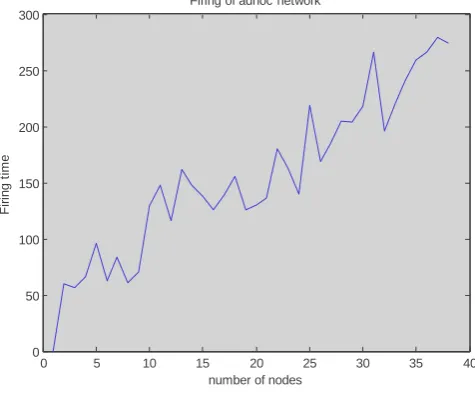
Fig 8: Firing of adhoc node
IV.
CONCLUSION
We have simulated a network with different number of nodes. The analysis result for a particular network is depicted here. Further studies are required for future analysis of the network studies.
REFERENCES
1. Liu, Bialkowski, wang, ”Investigations into capacity of MIMO adhoc network including effects of antenna mutual coupling”, Wireless Sensor network,2009,1,425-433.
2. G.J. Foschini, “Layered space-time architecture for wireless communication in a fading environment when using multielement antennas.” Bell Labs Technical Journal, vol 1, pp 41-59, 1985.
3. G.J.Foschini and M.J. Gans, “On limits of wireless communications in a fading environment when using multiple antennas.” Wireless personal communications, vol 6, pp 311-335, 1998.
4. B.Chen and M.J. Gans, “MIMO communications in adhoc networks.” IEEE transactions on signal processing, vol 54, no 7, July 2006.
5. K. Fakih, J. Diouris and G. Andrieux, “On the capacity optimization for MIMO adhoc networks”, IEEE VTC Spring, Singapore,pp 1087-1091,May 2008.
6. S.Chowdhuri,A.K.Mondal,P.K.Banerjee “MIMO Ad-Hoc Networks-Mutual Information and Channel capacity”, COSIT 2011,Part1, CCIS 131,pp 225-235, Springer-Verlag Berlin Heidelberg,2011.
7. Swati Chowdhuri, Dr. Arun Kumar Mondal, Dr. P.K.Baneerjee,“Implementation of MIMO-OFDM system in Mobile AD-Hoc Networks”,International Journal of Engineering Research and Applications (IJERA) ISSN: 2248-9622 Vol. 1, Issue 3, pp.753-757,2011.
8. S.Chowdhuri,A.K.Mondal,P.K.Banerjee “Analysis of Fading in MIMO based Mobile Ad-Hoc Network”. International Journal of Distributed and Parallel Systems (IJDPS), Vol.2, No.4, July 2011.
9. RFC 802.11n Standard for MIMO communication. www.802.11n standard.
10. S.M. Alamouti. A simple transmit diversity technique for wireless communications. IEEE JSAC, 16(8):14511458, 1998.
11. [11] V. Tarokh, H. Jafarkhani, and A. R. Calderbank. Spacetime block codes from orthogonal designs. IEEE Transactions on Information Theory, 45(5):744–765, 1999.
12. Jyoteesh Malhotra, Ajay K Sharma and R S Kaler, ―On the Performance Analysis of Wireless Receiver using Generalized-Gamma Fading Model, in annals of telecommunications-annales des télécommunications,international journal, Springer , Vol. 64, No 1-2, pp. 147-153,January-February 2009. 13. Lei Wan, V. K. Dubey, “Bit error probability of OFDM system over frequency nonselective fast Rayleigh fading
channels”, IEEE Electronics letters, Vo. 36, No. 15, pp1306- 1307, July 2000.
14. A Paulraj, R. Nabar, D. Gore, “Introduction to Space-Time Wireless Communications,” Cambridge University Press 2003.
15. D. Gesbert, M. Shafi, D. Shiu, P. J. Smith, and A. Naguib. “From Theory to Practice: An Overview of MIMO Space-Time Coded Wireless Systems,” IEEE JSAC, 21(3):281–301, April 2003.
16. Phillip M. Dickens, Vinod Kannan, “Application Level Congestion Control Mechanisms for Large Scale Data Transfers Across Computational Grids”. In Proceedings of The International Conference on High Performance Distributed Computing and Applications, 2003.
17. E.Teltar, “Capacity of multi-antenna gaussian Channels”, European Transaction on Telecommunications, vol 10, no 6, pp 585-596, Nov 1999.
18. Umut Akyol, Matthew Andrews, Piyush Gupta, John Honny, Iraj Saniee and Alexander Stolyar, “Joint Scheduling and Congestion Control in Mobile Ad Hoc Networks”, Proc. IEEE INFOCOM , pp. 619–627,2008.
19. MANET: Mobile Ad Hoc NETwork IETF research group: www.ietf.org/html.charters/manet-charter.html. 20. Amira Soliman, Amr Kamel, Reem Bahgat, Walaa Sheta, “Semantic Grid Architecture for P2P Mobile Ad Hoc
Networks”, Fourth International Conference on Intelligent Computing and Information Systems, pp:365- 373, 2009.