TO STUDY THE EFFECT OF FRICTION STIR
PROCESSING ON MECHANICAL
PROPERTIES OF AL 5251 ALLOY
Onkar Singh1, Baljinder Ram1,Amandeep Singh2
1Department of Mechanical Engineering, Punjabi University, Patiala 2BBSBE, College, Fatehgarh sahib.
ABSTRACT
In the current study Al 5251 alloy based surface composite are produced by using SiC and Al2O3 reinforcements with the help of friction stir processing. Effect of different combinations of process parameters (tool speed, number of passes and reinforcements) on mechanical properties viz. tensile strength, hardness and impact strength is investigated. The optical images shown that the reinforcement uniformly distributed in the matrix. It is also observed that the mechanical properties of Al 5251 alloy surface composites are improved as compared to unreinforced alloy. The hardness of the processed alloy reached up to 44 HRB which is significant higher than the unprocessed alloy. The tensile strength of Al alloy increased up to 229 MPa by double pass of FSP without any reinforcement. Impact strength is improved by formation of surface composite on alloy. The overall properties of the Al 5251 alloy are improved by FSP.
Keywords: Friction stir processing, tensile strength, hardness, impact strength.
1. INTRODUCTION
Aluminum based materials are always center of attention for the automobile industries due to its low weight and good specific strength. Aluminum 5251 alloy is one of these aluminum alloy which have good mechanical and corrosion resistance properties with very less weight compared to other conventional materials. Due to these advantages the Al 5251 alloy is used in many engineering applications like automobile, aerospace, speed boats industries. The mechanical properties of Al 5251 alloy can be further enhanced by using secondary processing technique or by adding suitable reinforcements which can modify this alloy to fit in desire need of application. Friction stir processing is one of the advance techniques to fabricate the surface composites and modify the mechanical properties [1-4].
In friction stir processing generally a cylindrical tool with cylindrical, cylindrical threaded, square, taper pin is used to process metal plate. The tool with a specific rotational speed and tool travel speed plunged into the plate where FSP has to done. The tool has a small diameter pin with a larger diameter shoulder. When the tool pin is inserted into the plate, the rotating pin shoulder contact the surface and rapidly heats the plate surface due to friction between plate and shoulder. This heating of plate facilitating the transverse movement of the tool through the material. The length of the probe control the depth of penetration, its usually kept smaller than plate thickness [5]. During FSP, generally tool is moved relative to plate with overlapping passes, until the entire selected area is processed. The processed zone is generally defect free and refined microstructure [6, 7]. Mishra et al [1] studied that by friction stir processing the surface modification of aluminum alloys can easily be done and mechanical properties can also be enhanced. Sun et al [8] investigated that the tensile strength of magnesium bulk composite was increased by FSP. The hardness of the bulk composite was also increased by FSP. Thangarasu et al [9] fabricated surface composite on aluminum 1050 alloy by reinforcement of TiC particle with FSP. The hardness of processed zone was increased by 45% then base metal. Aruri et al [10] fabricated a surface hybrid composite on the surface of aluminum 6061-T6 alloy by the help of FSP. Due to presence of SiC and alumina particles the micro-hardness was increased of processed alloy. Tensile strength of the alloy was decreased. It was because of increase in brittleness of the processed material. Akramifard et al [5] used FSP technique on copper and made surface composite on it. They find that the grain structure of the processed material finer then unprocessed material. The hardness was increased by FSP and SiC particles distribution in matrix was uniform. Nakata et al [6] applied multipasses FSP to die cast aluminum alloy and concluded that the hardness, tensile strength significantly improved and microstructure improved after FSP. Mahmoud et al fabricated
So from literature it is clear that the FSP technique is very useful to improve the mechanical and microstructure of aluminum based materials. Aluminum 5251 alloy is used in many applications but due to its low hardness it is used in a limited range of applications. In this study the surface composite is fabricated on the surface of aluminum 5251 alloy matrix with SiC and Al2O3 reinforcements by the help of friction stir processing. The mechanical properties and microstructure is investigated after fabrication of composite.
2. EXPERIMENTAL PROCEDURE
In this experiment 5251-Al alloy plates (Length: 80mm, Width: 80mm and Thickness 3mm) are processed with friction stir processing. A semi-automatic milling machine is used for prepare the composites on the surface of aluminum alloy. The fixture for holding the base plate while carrying out FSP designed and fabricated at Onkar Agro Iron Works, Amloh. The fixture consisted of a rectangular base of dimensions 150mm x 120mm x 20mm. Two flat rods having X-section (10mm x 25mm) and length 130mm are used to fix the base plate on fixture by the help to four bolts of M10 as shown in Fig. 1.
Fig. 1 Fixture for hold the square plate and plate of Al 5251 alloy with a groove for filling of reinforcement
These two rods are fixed at the ends of rectangular base plate. Fixture is mounted on the bed of the milling machine which holds aluminum plate rigidly by the help of two supports which grip the aluminum alloy plate. After fixing the aluminum plate by the help of fixture on milling machine a groove of 1mm width, 1.5mm deep and 80mm length is produced in the center of the plate as shown in Fig. 1. Then this groove is filled by the reinforcement. The circular tool with cylindrical pin is used for friction stir processing. Tool is made of with material EN31 which is tempered up to hardness of 62 HRC. The tool is rotating in clockwise rotation with a tool speed according to the experiment. Then tool is plunged into the starting of the groove. When the shoulder of the tool touched the surface of plate a constant feed of 60 mm/min is given to the bed of the tool in X axis. Due to this feed tool start moving in the direction of groove and friction between tool surface and shoulder material gets deform plastically and mixing of aluminum and reinforcement present in the groove starts. A stir zone is created on the surface of aluminum alloy plate as shown in Fig. 2.
Fig. 2 Processed aluminum alloy plate
In this stir zone recrystallization process and composite formation process is done by friction stir processing. When tool reaches to the end of groove, the tool unplugged from the aluminum alloy plate and friction stir process completes. In the experiments where double pass FSP is used the tool with same speed again plunged in the starting of the stir zone and gives a same constant feed to complete the friction stir process. This whole process repeated again and again for different experiments with different parameters and reinforcement. After friction stir processing specimens are cut from processed plate for testing. Each processed plate is tested for hardness, impact strength, tensile strength and microstructure. Hardness of processed zone is tested by Rockwell hardness testing machine at B scale. Impact strength is measured by Charpy impact testing machine. From each processed plate a single specimen is cut for impact test which is perpendicular to the stir zone and the notch is formed in the center of the stir zone.
3. RESULTS AND DISCUSSION
After testing the specimens of processed plate a comparison is made between processed alloy’s properties and unprocessed alloy’s properties as given below.
3.1 HARDNESS
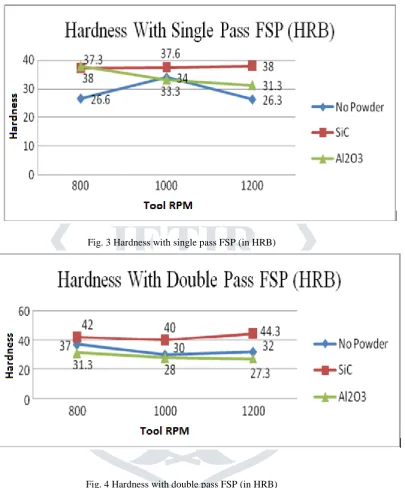
Hardness results of FSProceesed plates are shown in Fig. 3 and Fig. 4. The hardness of friction stir processed aluminum alloy 5251 gets increase due to the reinforcement and recrystallization of the stir zone. Rockwell hardness of each processed specimen is measured by three trails on the stir zone at different places and mean of three values is evaluated.
Fig. 4. The base aluminum alloy has hardness 21 HRB which is approx. 50% less than the highest hardness achieved by friction stir process. The effect of the tool speed with different reinforcement and number of passes is explained by the graphs which are given below.
Fig. 3 Hardness with single pass FSP (in HRB)
Fig. 4 Hardness with double pass FSP (in HRB)
In these graphs X-axis shows the RPM of the tool and Y-axis shows the hardness number in HRB. In these graphs reinforcements are compared with each other at different tool RPM. As shown in Fig 3 & 4 SiC reinforcement gives maximum hardness values as compare to other reinforcements. When SiC reinforcement is used hardness is increased in every experiment with both single and double pass FSP. But double pass FSP is more effective as compare to single pass FSP it is because of particles distribution becomes more uniform in double pass. In case of Al2O3 reinforcement single pass FSP gives better results as compare to double pass FSP. Without any reinforcement tool speed of 800 RPM with double pass FSP gives much better result of hardness as compare to any other combination of parameter.
3.2 IMPACT STRENGTH
Fig. 5 Impact strength of processed plate with single pass FSP (in Joules)
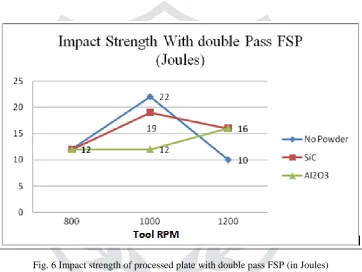
Fig. 6 Impact strength of processed plate with double pass FSP (in Joules)
As shown in Figs there are no effective effect of FSP is recorded on the impact strength of processed aluminum
plate. The tool speed of 1000 RPM gives better results as compare to other speeds and reinforcement of SiC gives better
results at tool speed of 1000 RPM and 1200 RPM with both single pass and double pass FSP. The tool speed of 800
RPM has no effect on impact strength in both case of single pass and double pass FSP.
3.4 TENSILE STRENGTH
Fig. 7 Tensile strength of processed plate with single pass FSP (in MPa)
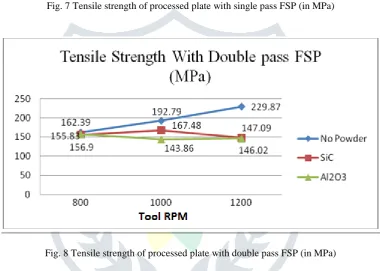
Fig. 8 Tensile strength of processed plate with double pass FSP (in MPa)
In this graph X-axis shows speed of tool in RPM and Y-axis shows tensile strength of the processed aluminum alloy in MPa. According to these graphs when no reinforcement is used in FSP the tensile strength of the processed aluminum alloy is greater than the unprocessed aluminum alloy accept a single case in which double pass FSP is used at 800 rpm of tool. These graphs also shows that with increase in tool speeds the tensile strength of the processed metal also increased. These results shows that the double pass FSP without any reinforcement at 1200vrpm gives most suitable results for tensile strength of Al 5251 alloy. This increase in tensile strength is due to refinement of grain structure of processed metal alloy. In case of SiC reinforcement with increase in tool speed the tensile strength gets decreased. The minimum value of tensile strength among all cases of this study is given by single pass FSP with SiC reinforcement at 1200 rpm tool speed which is 138.37 MPa. Double pass FSP gives less tensile strength then unprocessed aluminum alloy when alumina reinforcement is used.
3.5 MICROSTRUCTUE Optical Microscope Results
Optical microscopy of processed specimen is clearing that the particle distribution of reinforcement is homogeneous in metal matrix of Al 5251 alloy as shown by Fig. 9. The no sign of particle clusters are observed on the processed surface. Refined microstructure is observed in the optical image, which verdict that the FSP is an effective tool to improve the microstructure and refine the grains. The porosity and surface crack type defects were also not observed on the surface.
4. CONCLUSIONS
Following conclusions are drawn from the present research work
1. The aluminum metal matrix surface composite have been successfully fabricated by Friction stir processing with both silicon carbide and alumina reinforcement in Al 5251 alloy matrix. The surface composite gives better mechanical properties as compare to unprocessed aluminum alloy.
2. Hardness of processed aluminum alloy is more than unprocessed material. With the help of friction stir processing hardness can be increased up to 44 HRB which is 50% more than the unprocessed aluminum alloy.
3. Impact strength can also be improved by FSP. The tool speed of 1000 rpm is very suitable for increase the impact strength of Al 5251 alloy by FSP.
4. Without any reinforcement the tensile strength of the aluminum alloy can be increased up to 229 MPa from 175 MPa by double passes of friction stir processing.
REFERENCES