Doctoral Dissertations Theses, Dissertations, Capstones and Projects
Fall 12-13-2019
Examining the Experiences of Chinese Multilingual
Therapists in Training
Stephanie Li-Wei Lin
University of San Francisco, [email protected]
Follow this and additional works at:https://repository.usfca.edu/diss Part of theClinical Psychology Commons
This Dissertation is brought to you for free and open access by the Theses, Dissertations, Capstones and Projects at USF Scholarship: a digital repository @ Gleeson Library | Geschke Center. It has been accepted for inclusion in Doctoral Dissertations by an authorized administrator of USF Scholarship: a digital repository @ Gleeson Library | Geschke Center. For more information, please [email protected].
Recommended Citation
Examining the Experiences of Chinese Multilingual Therapists in Training
A Clinical Dissertation Presented to
The University of San Francisco
School of Nursing and Health Professions
Department of Integrated Healthcare
Clinical Psychology PsyD Program
In Partial Fulfillment of the Requirements for the Degree
Doctor of Psychology
By
Stephanie Li-Wei Lin, M.S.
Committee Members
Committee Chair: David A. Martinez, Ph.D
Assistant Professor, School of Nursing and Health Professions
University of San Francisco
Committee Member: Dellanira Garcia, Ph.D
Associate Professor, School of Nursing and Health Professions
University of San Francisco
Committee Member: Rita Chang, Ph.D
Adjunct Professor, School of Nursing and Health Professions
University of San Francisco
Committee Member: Peggy H. Yang, Ph.D
Director of Institutional Wellness, Office of the Provost
Assistant Professor, Menninger Department of Psychiatry and Behavioral Sciences
Table of Contents
Abstract vi
Introduction 7
Literature review 10
Purpose 19
Methods 21
Recruitment Procedures 21
Participants and Setting 23
Analysis 25
Results 27
Themes
Discussion 54
Limitations 61
Future research 62
References 64
Tables and Figures 65
Table 1 Demographics 25
Table 2 Themes 27
Appendices
Appendix A: Recruitment Flyer 70
Appendix B: Participant Screening Form 71
Appendix C: Consent Form 73
Appendix: Tables 80
Table 1: Participant Demographics 80
Abstract
According to the 2015 Census, 44% of people ages five and older in California speak a
language other than English in their household, indicating the growth of multilingual persons in
California. Among the top three languages spoken at home in California, Chinese takes third
following English and Spanish. The demand for multilingual mental health services may continue
to grow with the increase of multilingual individuals. Although there is an increase in need for
multilingual mental health services, there remains a lack of formal training and clinical supervision
for multilingual trainees. This study adopted a qualitative approach and utilized semi-structured
interviews and a thematic analysis to examine the experiences of multilingual therapists in training
providing therapeutic services in a Chinese dialect. The purpose was to provide more research on
experiences and needs of multilingual trainees. Thirteen participants of Chinese descent were
interviewed via VSee, a telemedicine platform. The results yielded eight emerging themes that
highlighted the various emotions and challenges experienced by multilingual therapists in training,
as well as their suggestions for future trainings. Results indicated multilingual trainees face unique
challenges in their experience when providing services in a Chinese dialect, further highlighting
the need for additional research and attention towards improving training to support multilingual
therapists in training.
Introduction
Chinese Americans comprise 31% of California’s 35.9 million population (U.S. Census
Bureau, 2010). Given the large number of Chinese Americans in the United States and increased
number of multilingual people, the demand for multilingual therapists is expected to increase.
However, research geared towards providing mental health providers with adequate training is
limited. The research highlighting the need for culturally sensitive mental health services for
underserved populations has recently increased (Kim et al., 2011), but the research on types of
available and necessary services for Chinese Americans is still lacking. Chinese Americans
commonly underutilize services despite reporting more symptoms as compared to other ethnic
minorities (Kim & Zane, 2016). Barriers such as lack of knowledge of resources available,
stigmatizing ideas around help-seeking, and not having resources provided in the client’s
language of choice all contribute to the lack of mental health service utilization in Chinese
Americans (Saechao et al., 2012). Consequently, there remains a crucial aspect of research
needed which explores how to best equip service providers to address barriers faced by minority
populations.
The American Psychological Association’s (APA) Multicultural Guidelines 3 clearly
states: “Guideline 3. Psychologists strive to recognize and understand the role of language and
communication through engagement that is sensitive to the lived experience of the individual,
couple, family, group, community, and/or organizations with whom they interact. Psychologists
also seek to understand how they bring their own language and communication to these
interactions” (APA, p. 47, 2002). However, APA does not specifically address clinical and
ethical issues that may arise for multilingual supervisees providing services in a language that is
Supervision is a crucial component to therapists in training, providing an opportunity to
develop competencies including assessment, values, and social context (APA, 1993; Faldendar,
et al., 2004). Verdinelli and Beiver (2009) examined the experiences of 13 Spanish/English
multilingual supervisees. One prominent theme that emerged across all participants’ experiences
was feeling burdened, particularly having extra work as a multilingual provider given the lack of
multilingual professionals. This “extra work” reported by participants started as early as their
first or second year of training, which included having to educate non-Spanish speaking peers or
supervisors of minority needs, despite not having this training themselves (Verdinelli & Biever,
2009). This study highlights the continued lack of adequate training and supervision issues that
multilingual therapists in training face, which can be extended to Chinese multilingual therapists
(Verdinelli & Biever, 2009; Santiago-Rivera, 2002).
Specific Aims
A majority of research in this area has been conducted on Spanish/English speaking
therapists in training. As such, the goal of this study was to explore themes that emerge for
multilingual Chinese/English speaking therapist in training and provide an understanding of the
unique challenges multilingual therapists may encounter when providing services with or
without language-specific clinical supervision. This study aimed to offer more awareness around
the difficulties that emerge when providing multilingual services as a multilingual therapist in
training. Another goal involved providing an improved understanding of how participants
navigated challenges, which can inform future training programs for multilingual therapists to
facilitate confidence in providing services. This study utilized a qualitative research design to
examine the experiences of multilingual (Chinese/English) therapists in training currently
the following research questions: (a) What are the experiences U.S. based English-Chinese
multilingual therapists in training of Chinese descent providing psychotherapy to Chinese clients
in Chinese? (b) How does having or not having multilingual supervision impact the development
of the multilingual therapist?
In this study, the term “multilingual” will be utilized to embody Chinese American
participants who were fluent in two or more languages. Given that many participants were
multilingual in English and more than one Chinese dialect, such as Mandarin and Cantonese, the
term “multilingual” was used rather than “bilingual.” Utilizing “Multilingual” provided an
inclusive term for any individual who spoke more than one language and assisted in expanding
Literature Review
This critical literature review explores the growing population of Asian Americans in the
United States, while highlighting the underrepresentation of this population in research studies.
The review of literature will also explore multilingualism in therapy, discussing present research
dissecting how different emotions can be associated strongly with the language utilized through
that experience. As research on multilingualism with Asian Americans is limited in research
studies, this review explores research studies focused on Spanish-English bilingual individuals. It
includes their experiences as multilingual providers, as well as how clinical supervision plays a
role in experiences for therapeutic service providers. Lastly, this review explores existing
training programs for Spanish-English bilingual therapists, including the model implemented in
these programs.
Chinese Americans in the United States
According to the 2010 Census, Asian Americans were the fastest growing racial group in
the U.S., comprising 6% of the nation’s population. The 2010 U.S. Census clarified that those
who identified as “Chinese” or “Other Asian” were included in the Asian American category.
Among ethnic minorities, Asian Americans are often underrepresented in research, particularly
in studies aimed at improving services due to their low utilization of resources (Saechao et al.,
2011). While underutilization of mental health services appears to be common among Asian
populations in the United States, the prevalence of mental health problems experienced does not
reflect this low need for services. For instance, Han and Pong (2015) examined Asian American
students attending four-year colleges and found that Asian American college students are often
conceptualized through the model minority stereotype, such as having high academic
Disease Control and Prevention (2008), suicide is the 10th leading cause of death for adult Asian
Americans, and the 2nd leading cause of death for Asian Americans between the ages of 15 to 24,
implying that Asian Americans do suffer from mental health problems but may be reluctant to
seek help. This perception of Asian Americans not requiring mental health services may have a
significant impact on the lack of research examining improvements in mental health services for
this population (Kiang et al., 2016).
Utilization of Services Among Chinese Americans
While awareness for the need of mental health services is beginning to become more
apparent in the United States, many barriers exist among accessing these services, especially for
non-English speaking populations. The literature on Asian American mental health highlights
numerous stressors and barriers that may contribute to low utilization of mental health resources.
Several of these barriers to receiving mental health services include stigma, lack of knowledge of
resources, and language barriers (Saechao et al., 2011). One effort to address language barriers
for healthcare utilization included increasing the number of providers that speak languages such
as Chinese and Spanish. While increasing the number of multilingual providers appears to be the
next step in addressing the language barrier issue, there is a lack of formal training that prepares
providers for this experience. However, Castaño and colleagues (2007) discussed the dimensions
of communication and cultural competence among multilingual providers. They suggested that
while speaking the same language can increase understanding and communication between client
and therapist, this does not guarantee cultural competence. This further highlights the necessity
of increased training that addresses the diverse language needs of emerging trainees, training on
cultural awareness, and culturally adaptive ways to work with diverse populations. It is notable
Multilingualism in Therapy
Different languages can be associated with different emotional states and memories
(Altarriba, 1994). “For individuals who are multilingual and speak two language or more in their
day-to-day lives, research has demonstrated how their different languages can be associated with
different interactional contexts” (Kapasi & Melluish, p. 458, 2015). The importance of
multilingual services is becoming more apparent due to the continuous growth of people who
speak more than one language and demand for culturally and language-congruent services (Kim
et al., 2011).
Language switching. There has been a great deal of research that explored the benefits
of being multilingual (Kapasi & Melluish, 2015). More recently, “language switching” has been
explored in research to understand the impact of multilingualism in the therapeutic setting
(Kapasi & Melluish, 2015). Language switching, as defined in Kapasi and Meluuish’s study
(2015), is changing from one language to another, thus using a combination of both languages
within a therapy session, whether planned or spontaneous. Language switching may be a
common way of verbal expression for multilinguals and can have potentially positive effects in
the therapy setting, such as facilitating building a strong therapeutic alliance (Kapasi & Melluish,
2015; Dawaele & Costa, 2013). This form of communication and interaction unique to
multilingual/bicultural individuals further emphasizes the importance of multilingual mental
health service providers. This study also highlights the notion that multilingual people make
sense of their world multilingually. Therefore, multilingual therapy may allow clients to explore
their lives with more fluidity. A multilingual therapist can be encouragement for minority clients
Primary language communication. Communicating in a multilingual client’s primary
language can elicit certain affect or different emotions compared to communicating in the
non-dominant language (Kapashi & Melluish, 2015). Language switching can elicit increased
emotional expression in one language and also provide emotional distancing, as many
multilingual individuals may feel more strongly when sharing information in their native tongue
(Kapashi & Melluish, 2015). Besides solely understanding this concept, it is imperative for
multilingual therapists to undergo training on ways to effectively draw upon language switching
to utilize it as an effective method in building the therapeutic alliance (Kapasi & Melluish,
2015).
Consequences of language switching without proper training. Although language
switching can lead to positive therapeutic engagement, the lack of training for multilingual
therapists can pose detrimental effects. Lack of training and practice on how to use multilingual
abilities in a therapeutic setting can make what was originally an asset become a challenge for
therapists. Verdinelli and Beiver (2009) explored multilingual therapists’ development of their
skills delivering multilingual services. They found that many therapists were often self-taught
and utilized trial-and-error methods. Additionally, these therapists often felt that the lack of
multilingual professionals made providing multilingual services a challenge, suggesting more
support from other multilingual therapists would assist in skill acquisition (Verdinelli & Beiver,
2009).
Although language switching is viewed as a positive factor for building a therapeutic
alliance, the lack of conversation and training in application of language switching in therapy
may be a challenge for multilingual therapists in training. The research findings indicate the
language that is most comfortable for the client (Verdinelli & Beiver, 2009). Simultaneously,
there is a lack of research in understanding the necessary components to adequately and
effectively train and support therapists in training. The present study aims to understand specific
issues that are unique to multilingual Chinese-speaking therapists in the U.S. and to build on
necessary training components to improve this area of training.
Existing Research on Multilingual Therapists’ Experiences
The literature on students’ multilingual clinical training experiences is largely
unexplored. However, the current literature focuses solely on multilingual English/Spanish
participants. For example, Verdinelli and Biever’s (2009) study looked at the supervision
experiences of multilingual therapists in training who provided multilingual services to
Spanish-speaking clients. In this qualitative study, the authors found common themes and categories that
emerged through participant experiences (Verdinelli & Biever, 2009). These included burden,
training concerns, language issues, and beneficial training. Of the categories, burden had the
most themes, which primarily consisted of participants feeling stressed by added responsibility
and a sense of obligation to their Spanish-speaking clients. The multilingual therapists reported a
strong sense of obligation to educate their peers and supervisors about cultural issues, despite
being a student therapist in training themselves. However, they often felt looked at as “experts”
of Spanish-speaking clients because of their multilingual capacity (Verdinelli & Biever, 2009).
Aside from pressure to be an expert in this area, multilingual therapists may feel added
pressure to provide additional services when compared to their non-multilingual counterparts
(Verdinelli & Biever, 2009). Another theme that emerged in this study (Verdinelli & Biever,
2009) and another conducted by Biever and colleagues (2004) included multilingual therapists in
translation services. The study highlighted how therapists in training felt pressure because of
their Spanish language abilities. Also given how therapists in training were early in their training,
this appeared to cause many multilingual therapists in training to feel inadequate having not been
trained even in English (Verdinelli & Beiver 2009). They additionally reported a sense of
obligation to take Spanish-speaking clients to prevent long wait times. Inadequate translation
was another added burden for the multilingual therapists in training (Vermicelli & Beaver 2009).
These themes highlight the potential for ethical dilemmas, which are especially common
for multilingual therapists and well-known within the psychology field as a whole.
Spanish-speaking clients may often be denied or delayed services if not taken by the multilingual
therapist, despite the possibility that these multilingual therapists are providing services outside
their area of competence (Beiver et al., 2011). These added burdens often led to reported feelings
of burnout from participants, especially stemming from feelings of frustration or inadequacy.
Participants in a study by Verdinelli & Beiver reported they felt an obligation to see
Spanish-speaking clients without multilingual supervision, which reportedly left them feeling strained and
unprepared (Verdinelli & Biever, 2009). Another study highlighted the unique expectation for
multilingual trainees due to their language abilities, yet there is no requirement of assessment of
their actual language skills in providing clinically relevant services (Valencia-Garcia &
Montoya, 2018). Multilingual clinical supervision appears to be an important forum to address
these concerns (Biever et al., 2009).
Multilingual Clinical Supervision
Multilingual supervision can be defined as “when one member of the
client-counselor-supervisor triad is communicating primarily in a language other than English” (Gonzales et al.,
professionals who can provide multilingual supervision, potentially contributing to multilingual
trainees reported self-inadequacy in providing services. Multilingual supervision can have many
benefits for multilingual trainees, such as the ability to directly state what was discussed during
sessions, providing the supervisor with a clear understanding of events within session. For
multilingual trainees who have had multilingual supervision, there were clear benefits (Gonzales
et al., 2015). They often reported feeling that they could better explain what happened during
sessions with clients when they were able to speak in Spanish. They also reported that being able
to clearly state what the client had said in Spanish to their multilingual supervisor, without
having to translate and educate their supervisor about other cultural issues was very helpful
(Gonzales et al., 2015).
Similarly, supervisors have also found themselves experiencing feelings of inadequacy
when providing supervision in English for supervisees who provided services in another
language (Gonzales et al., 2015). Multilingual trainees that do not have multilingual supervision
reported searching for support outside of supervision to assist in enhancing their training or
practice using Spanish therapeutically with clients (Biever et al., 2009). Some participants in
Gonzales and colleagues’ study (2015) suggested having group supervision in Spanish, or the
opportunity to conduct case presentations of their clients in Spanish. This may provide space for
conceptualizing cases effectively, as well as providing an opportunity to experience speaking in
Spanish about psychological interventions and terminology. While most trainees identified as
fluent Spanish-speakers, they all discussed the idea that providing therapy in Spanish was very
different than having a conversation in Spanish, indicating the myth that speaking another
language directly translates to being able to provide services in that language. Again, this
training, as they are a crucial component to serving marginalized communities with already
limited mental resources and low service utilization.
Clinical Supervision is an essential component to developing clinical competencies,
learning appropriate therapeutic skills, and acquiring knowledge for training psychologists
(Rieck, Callahan, & Watkins, 2015). Supervision enables trainees to provide competent services,
and multilingual supervision is also a crucial component to the development of multilingual
trainees (Gonzales, 2015; Trepal, Ivers, & Lopez, 2014). Multilingual therapists in training often
reported that supervision was less productive or helpful because their training on psychological
interventions was been solely in English (Biever et al., 2009). This contributed to the experience
of isolation and burnout (Biever et al., 2009). However, the fear of being evaluated as
incompetent while holding a responsibility of advocacy for Spanish speaking clients often
prevented multilingual therapists in training from addressing this issue with their supervisors,
especially when their supervisors were not multilingual. The present study attempted to provide
an understanding of the experiences of multilingual trainees, which can help address issues
specific to multilingual therapy, and hopefully enhance training programs in clinical settings as
well as graduate programs that utilize trainees in providing multilingual therapy (Verdinelli &
Biever, 2009).
There continues to be research on multicultural training for mental health professionals,
but rarely are the training needs of clinicians providing therapy in a language other than English
examined (Castaño et al., 2007). “Proficiency is context dependent, which makes it difficult for
English-trained multilingual psychologists to translate the concepts and therapeutic process into
the contexts of working with clients using a language other than English” (Castaño et al., 2007,
terminology, etc. for other languages commonly spoken in the U.S. in order to enhance the
multilingual therapists’ overall confidence in providing therapy in a language other than English.
Training needs to include multilingual supervision to provide multilingual therapists with a place
to express and explore challenges specific to providing services in another language. This type of
training could possibly lead to more positive experiences for both the therapist and client while
increasing the quality of mental health services (Gonzales et al., 2015; Valencia-Garcia &
Montoya, 2018).
Training Programs
Despite having limited multilingual mental health professionals, there has recently been a
growth in training programs designed to help develop competencies for multilingual therapists in
training when providing therapy in Spanish (Beiver et al., 2011). While there are gaps in research
on training programs for Chinese/English multilingual therapists, there are many positive aspects
of Spanish/English training programs that can assist future training programs for therapists
providing services in other languages to enhance their skills. This training program include the
Psychological Services to Spanish-Speaking Populations (PSSSP; Beiver et al., 2011), as well as
the guidelines from APA and guidelines set by the National Latino Psychological Association
(NLPA).
The Psychological Services to Spanish-Speaking Populations (PSSSP) program was a
model created by Beiver and colleagues (2011) for training mental health professionals to deliver
services to Spanish-speaking clients and consisted of two components: language proficiency
taught by a Spanish-language instructor, and cultural competency and application. Their program
highlighted how many therapists in training, with some degree of proficiency in Spanish, are
so. Notably, the language proficiency, cultural competency, and application components
highlighted in the PSSSP model may be applied to Chinese/English multilingual therapists in
training.
Purpose
The APA (2002) provides several guidelines for working with multilingual individuals.
Namely, Guideline 3 discusses encouraging psychologists to utilize diversity, culture, and
multiculturalism in education (APA, 2002). This implies supervisors may be best suited for
education of diversity issues rather than placing this burden on multilingual therapists in training.
Additionally, Guideline 5 suggests that psychologists utilize skills that are appropriate for the
client’s culture (APA, 2002). Although multilingual therapists in training may have the
knowledge of the client’s native language, it is unknown whether this clinician is a competent
multilingual therapist without the support of a supervisor who also is fluent in both languages
and knowledgeable of both cultures.
Similarly, The National Latinx Psychological Association (NLPA) denotes guidelines for
psychologists working with Latinx individuals (NLPA, 2018). These guidelines highlight justice
and advocacy, which underscores teaching students in training to become competent therapists.
A significant portion of this section is dedicated to advocating for trainee education about
multilingualism and ensuring there are competent multilingual supervisors. The NLPA (2018)
highlight the distinction between bilingualism and competency in therapy, suggesting
bilingualism is not the only requirement to provide adequate services to multilingual clients.
Additionally, the need for qualified supervisors who are fluent in both languages and cultures
appears to be an important tenet of the NLPA, suggesting it is ethically questionable if a student
together, these models and standards serve as a solid foundation for the current study, which
examines the experience of Chinese/American multilingual therapists in training.The models
outlined in the PSSSP (Beiver et al., 2011), NLPA (2018), and APA (2002) highlight the
qualitative investigation proposed by this study, aimed at understanding the experience of
Chinese/English multilingual therapist in training. These questions include: 1) how does
language proficiency impact the experiences of multilingual trainees providing multilingual
services, and 2) how is cultural competency addressed and understood through this process? This
study also focused on understanding what themes emerged with Chinese multilingual therapists,
what are some ways they navigated challenges, and how this could be addressed through future
training programs to better serve the Asian American population. This study elucidates the
additional barriers to patient care, training, and supervision that perhaps we have not yet
Methods
This study utilized a qualitative research design to enhance the understanding of
multilingual (Chinese/English) therapists in training’s current experience with providing
multilingual psychotherapy services in the U.S. A qualitative approach was chosen to explore
common themes that emerged from the participants’ unique experiences as providers of
multilingual services. The qualitative method allowed us to utilize a semi-structured interview
with an open-ended question format to identify the experiences of Chinese speaking multilingual
therapists in training. The semi-structured interview consisted of open-ended questions that
focused on the participant’s experience as an identified Chinese multilingual therapist providing
services in Chinese, e.g., “Can you tell me about your experience providing multilingual services
to the Chinese community? What has been helpful? What have been challenges and barriers?”
(See Appendix D for complete interview guide.) Furthermore, this qualitative design helped to
examine the various difficulties that arise for multilingual psychotherapy providers. The overall
aim of utilizing this methodology with the participants was to permit for natural report of their
experiences in a natural setting.
Recruitment Procedures
This study was approved by the Institutional Review Board (IRB) at the University of
San Francisco, and no major foreseeable risks were anticipated for participants who agreed to
participate. Utilizing a convenience, purposive sampling method, 23 individuals were screened
and a total of 13 participants were recruited and interviewed. Participants were recruited via
flyers posted at community mental health centers known to provide services to both
Chinese-speaking populations and non-Chinese Chinese-speaking populations throughout the San Francisco Bay
listservs (e.g., the American Psychological Association, Asian American Psychological
Association, etc.) and graduate programs nationally within the U.S. In addition, flyers (Appendix
A) were posted on social media platforms including Facebook, Instagram, and Twitter.
Participants that expressed interest communicated with the researcher through e-mail and phone
to receive additional information and complete participant screening questions (Appendix B) to
determine eligibility.
Twenty-three individuals were screened for eligibility, and 13 were recruited to
participate. Participants for this present study included 13 multilingual Chinese-American
graduate students. If participants were screened by phone, the participant screening questions
were read to them (See Appendix B). If participants were screened electronically, the participant
screening questions were communicated via e-mail.
Individuals that met inclusion criteria were scheduled for an individual in-depth interview
that lasted approximately 30-60 minutes. Four individuals that were screened were ineligible due
to not having experience providing direct therapeutic services in Chinese to Chinese speaking
clients. Additionally, six individuals that were screened were lost to attrition. One out of the 13
participant interviews was not utilized due to inaudible recording. This individual met all of the
inclusion criteria and had experience in a practicum setting that provided both Chinese
supervision and Chinese therapeutic services in Chinese and English.
Prior to beginning the interview, participants were asked to sign an informed consent
(Appendix C) detailing their participation, terms of confidentiality informing participants that all
identifying information will be de-identified to protect their confidentiality, and compensation.
Participant interviews were audio-recorded to ensure authenticity. Confidentiality of each
participant’s identity was protected throughout this study.
Steps to protect confidentiality included utilizing pseudonyms during transcription
process for data analysis. Upon completion of interviews, audio recordings were transcribed
verbatim utilizing the transcription program, Rev.com. Rev.com is an online service that
provides transcription services. Audio files were uploaded to this program and returned with
word documents of direct transcription of interviews. Following the interviews with participants,
regardless of whether they completed the interview, a 15- 20-minute debriefing session was
offered if needed. Debriefing sessions were not structured and did not encompass any
pre-planned questions from researcher. Instead, debriefing sessions provided a space for participant’s
additional thoughts, questions, or comments on their experience. All 12 participants utilized
debriefing time to share their interest in this topic, as well as reporting the interview was helpful
in processing their experience as a multilingual therapist in training. Participants that completed
interviews were offered a $25 Amazon gift card for their participation at the end of the interview,
which was electronically sent via email. Two participants declined the incentive.
Participants and setting
This study interviewed a total of 13 participants, comprising 11 doctoral-level
psychology graduate students and two masters level students. Twelve total interviews were
utilized in data collection due to the audio recording for participant 13 being inaudible. The
inclusion criteria for this study included: (1) identifies as being of Chinese ethnicity (defined as
having at least one parent with that ethnic background); (2) identifies as multilingual (defined as
master’s level or doctoral level graduate program related to psychology; and (4) has experience
providing therapy in Chinese to Chinese speaking clients while enrolled in a graduate program.
The term multilingual was utilized to provide a more inclusive term for participants who
were fluent in both English and multiple Chinese dialects. To provide inclusivity, there were no
limitations on Chinese dialects spoken by Chinese graduate students to expand recruitment
criteria. In addition, exclusion criteria included individuals who identified as Chinese and
multilingual but did not have experience providing therapy in Chinese. This was included due to
the purpose of this study, which was to examine the experience and training for Chinese
American students enrolled in graduate programs providing therapy in Chinese.
All participants interviewed were pre-licensure, enrolled in a psychology related graduate
programs in the U.S., currently in training at various clinical sites (e.g., community clinics,
hospitals, schools), and had experience offering multilingual psychotherapy services to the
Chinese-speaking community. Participants were eligible if they had any graduate experience
during their current program providing therapy in Chinese. Participants who were not currently
providing services but have had past experience providing services in Chinese while enrolled in
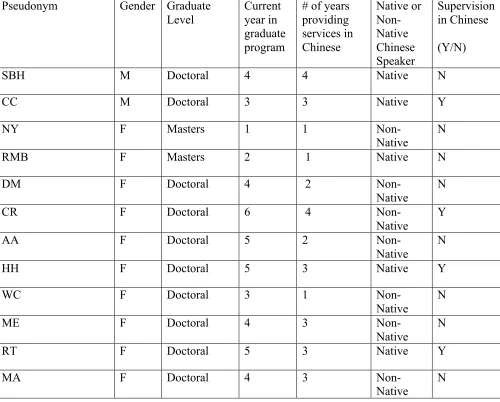
their graduate program were also included. Of the 12 participants, 10 were enrolled in doctoral
level graduate programs while the remaining two were enrolled in masters level programs (See
Table 1). Of the 10 doctoral students, four were completing their internship year, and six were
enrolled at a practicum site. All participants identified as being of Chinese descent and were
multilingual in English and at least one Chinese dialect and had experience providing therapy in
one or more of their Chinese dialects (See Table 1). Of the two masters level students, both are
currently at placements where they were providing therapy in Chinese and English. Three out of
Cantonese while the remaining nine were fluent in English and one Chinese dialect. Of the 12
participants, 4 have had supervision experience with a supervisor of Chinese descent who also
spoke the same Chinese dialect the participant was providing therapy in.
Table 1.
Pseudonym Gender Graduate
Level
Current year in graduate program
# of years providing services in Chinese Native or Non-Native Chinese Speaker Supervision in Chinese (Y/N)
SBH M Doctoral 4 4 Native N
CC M Doctoral 3 3 Native Y
NY F Masters 1 1
Non-Native N
RMB F Masters 2 1 Native N
DM F Doctoral 4 2
Non-Native
N
CR F Doctoral 6 4
Non-Native
Y
AA F Doctoral 5 2
Non-Native
N
HH F Doctoral 5 3 Native Y
WC F Doctoral 3 1
Non-Native
N
ME F Doctoral 4 3
Non-Native N
RT F Doctoral 5 3 Native Y
MA F Doctoral 4 3
Non-Native N
Analysis
A thematic analysis approach with this study allowed flexibility in using open-ended
analysis framework helped highlight both positive and negative aspects of trainee experiences
and may help future training programs enhance quality of training for multilingual services.
Study findings will assist in stimulating more awareness and understanding of what future
research is needed to improve quality of training for multilingual therapists.
The qualitative data was analyzed using a thematic analysis framework (Braun & Clarke,
2006) to identify major themes that emerged from the data, providing researchers with real-life
examples of the participants and their experiences providing multilingual services with or
without multilingual supervision and training. Thematic analysis provides flexibility for complex
and nuanced experiences through interviews with participants. Following Braun and Clarke’s
(2006) “Six Phase Framework for Doing a Thematic Analysis,” the researcher began by
becoming familiar with the data by reviewing field notes kept during the interview process,
including thoughts and reactions during the interview. After the transcription process was
completed, the researcher reviewed data to form initial ideas and preliminary codes. Following
this step, preliminary codes were further explored for emergent themes. Emergent themes were
reviewed with data repeatedly to ensure they captured an accurate representation of participant
experiences, which were subsequently reviewed to ensure authenticity. Finalized themes were
then defined accordingly to embody participant experiences. Lastly, themes were reviewed and
discussed in detail utilizing participant quotes to support themes (Braun & Clarke, 2006;
Appendix C). Given the research on Spanish-English bilingual trainees highlighting themes of
supervision (Verdinelli & Beiever, 2009), this study utilized both an a priori and post hoc
themes. The study utilized a deductive approach to formulate interview questions with previous
research, and an inductive approach was utilized to derive themes as they emerged through data
Results
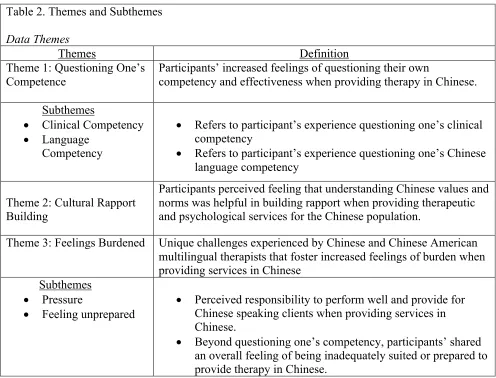
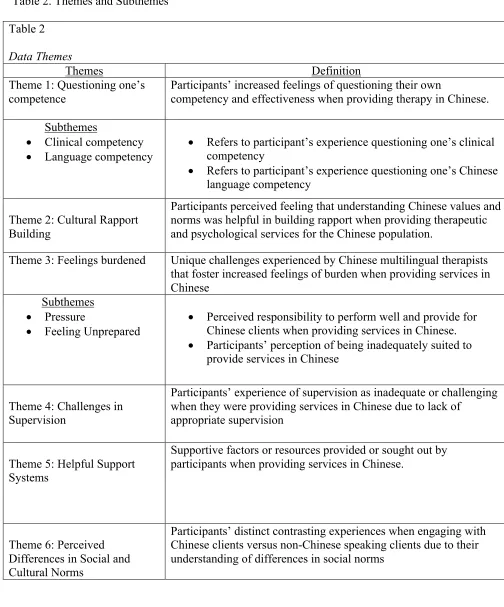
The results of the analysis identified eight emerging themes from data (Table 2). The
themes that emerged are as follows: (1) questioning one’s competency; (2) cultural rapport
building; (3) feelings burdened; (4) challenges in supervision; (5) helpful support systems; (6)
perceived social norm differences; (7) personal identity exploration; and (8) training
opportunities. The themes that emerged from the interviews provided a range of information
about their experiences as multilingual providers of Chinese therapeutic services and the unique
stressors they experienced. The themes also provided helpful suggestions for training and
supervision.
Table 2. Themes and Subthemes
Data Themes
Themes Definition
Theme 1: Questioning One’s Competence
Participants’ increased feelings of questioning their own
competency and effectiveness when providing therapy in Chinese.
Subthemes
• Clinical Competency
• Language
Competency
• Refers to participant’s experience questioning one’s clinical competency
• Refers to participant’s experience questioning one’s Chinese
language competency
Theme 2: Cultural Rapport Building
Participants perceived feeling that understanding Chinese values and norms was helpful in building rapport when providing therapeutic and psychological services for the Chinese population.
Theme 3: Feelings Burdened Unique challenges experienced by Chinese and Chinese American
multilingual therapists that foster increased feelings of burden when providing services in Chinese
Subthemes
• Pressure
• Feeling unprepared
• Perceived responsibility to perform well and provide for
Chinese speaking clients when providing services in Chinese.
• Beyond questioning one’s competency, participants’ shared
Theme 4: Challenges in Supervision
Participants’ experience of supervision as inadequate or challenging when they were providing services in Chinese due to lack of
appropriate supervision
Theme 5: Helpful Support Systems
Supportive factors or resources provided or sought out by participants when providing services in Chinese.
Theme 6: Perceived Differences in Social Cultural norms
Participants’ distinct contrasting experiences when engaging with Chinese clients versus non-Chinese speaking clients due to their understanding of differences in social and cultural norms
Theme 7: Personal identity exploration
Participants’ increased consideration, evaluation, and reflection of their identity as a Chinese speaking multilingual therapist resulting from their experience providing services for the Chinese-speaking population
Theme 8: Training Opportunities
Participants’ suggestions and hopes for future training opportunities that can be helpful for multilingual participants
Theme 1:Questioning One’s Competency
The theme, “questioning one’s competency,” refers to participants’ questioning of their
own competency and effectiveness when providing therapy in Chinese. All 12 of the participants
described experiencing difficulty providing effective interventions when using Chinese language
in therapy sessions. The theme of questioning one’s own competency was broken down into two
subthemes: (1) clinical competency, defined as participants’ perceived clinical effectiveness; and
(2) language competency, defined as participant’s perceived language proficiency. Participant
interviews highlighted that while they provided services in Chinese, they often perceived
themselves as less effective with their interventions. Simultaneously, participants shared that
their comfort level of using Chinese, or self-perceived language proficiency in session
Participants self-perceived Chinese language competency and clinical competency, or
effectiveness, appeared to be closely related in participant experiences. This poses difficulty in
distinguishing “questioning one’s competence” as deriving more heavily from clinical or
language competency. Given the interrelated nature relation of the subthemes, quotes that were
utilized were coded for both clinical competency and language competency to highlight overall
questioning of one’s competence. For example, this participant expressed experiencing
increased uncertainty when using Chinese in session, often questioning whether their
interventions were as effective in Chinese as in English, which caused significant levels of
frustration. She stated,
I felt sad. Because first, like, I know if I had delivered it in English it would be better. So,
like, I could do it, maybe it would be 90%, like the way I want it (NY, 1st year masters
level student).
Another participant stated they perceived themselves to be unprepared and unsure of
whether they could adequately provide services in Chinese, as they lacked certain vocabulary in
Chinese. In this case, this participant’s “questioning one’s competency” appears to be more
related to language competency, and as a result she is considering its impact on how she
perceives her overall effectiveness.
I felt like I needed to be more careful, just because…I didn't really feel like I had as big of
a vocabulary of just what I was gonna be able to say and…it's not always true, but people
of Chinese backgrounds can be a little bit more difficult to reach in a therapeutic context,
so I want to still approach them in a way that is still empathetic, but also trying to come
able to necessarily ask them as many questions maybe around their emotion as I would've
if we were doing therapy in English (MA, 3rd year doctoral student).
In addition, the subtheme of language competency was further explored, as 10 out of 12
participants expressed difficulty finding words in Chinese that would effectively capture their
targeted therapeutic interventions. Furthermore, nine out of 10 participants discussed how word
finding difficulties contributed to increased feelings of incompetence during session. For
example, one participant shared,
So there are certain terms that are different… and sometimes if I forget a word, I'm just
like oh shoot like what is that? I can't substitute it for English you know? (WC, 3rd year
doctoral student).
CC, a 2nd year masters-level student, shared how she experienced difficulty verbalizing
what she had in her mind while translating between English and Chinese in session:
Your interpretations in your head is like 'Oh it's perfect.' 'I could have said that.’ ‘Let's sit
with the feeling.' Or something like that. There's no way to say that in Chinese. And even if
you do, it sounds very weird. And then, your client may not get it because of the cultural
thing and then the lingo thing and, the interpretation and translation and all that (CC, 2nd
year masters level student).
These participant experiences highlight the strong relation between language competency
and participants perceived effectiveness or clinical competency and comfort level in session.
These data also suggest that future trainings that focused specifically on utilizing psychological
terminology in Chinese can enhance multilingual trainees’ confidence when providing services
There’s a lot of terminology in Chinese that we don’t have. It’s not developed yet in
Chinese than in English… let’s say ‘depression.’ What is a word for depression and how
do you say it in a way that’s not judgmental, stigmatized, and doesn’t hold so much
weight… that’s one of my questions still (ME, 4th year doctoral student).
Although there may be research on vocabulary for certain diagnostic terms, many
participants shared they did not have any prior trainings or awareness of these resources. This
appeared to contribute to their feelings of competency surrounding language in session.
Participant RT shared:
I have a master in psychology as well. So back then in the masters program I had
colleagues who study psychology in China. So for them it's easier to talk about things like
depression, psychosis, those technical words. Those kind of words. And I don't know if they
have clinical psychology classes in China. I never studied psychology in China. So for me
if I had like the translation of everything, that might be helpful. I mean a lot of the things
we say, like, ;Oh it must be very painful for you,’ if you said it in Chinese therapy to me, I
might be like, what the hell is wrong with you (RT, 5th year doctoral intern).
Participant RT’s experience further highlights certain frustrations related to questioning
one’s competency when they do not feel confident in their Chinese language proficiency in
session. She shared how there may be resources that exists addressing terminology or vocabulary
for diagnostic terms, which she feels may have been beneficial in her feeling confident in
sessions using Chinese.
Theme 2:Cultural Rapport Building
Cultural rapport building is defined as participants’ perception that their cultural
providing therapeutic services for the Chinese population. In addition, participant’s
self-perceived ability to create a safe environment for Chinese speaking clients to express their
cultural background was an important component of cultural rapport building. The cultural
rapport building theme comprised one subtheme, connection through the Chinese language. This
subtheme was defined as participants’ identification that speaking the language of the client’s
choice acted as a bridge between them to help build rapport. Cultural rapport building
highlighted participants’ perceived knowledge of how to provide therapeutic and psychological
services for the Chinese population in a culturally adaptive way. Specifically, participants shared
that their ability to be mindful of Chinese norms and social values was helpful in building and
maintaining rapport, as well as feeling connected with their clients. All 12 participants discussed
their realization that their awareness of Chinese culture, as well as customs and traditions, made
an impact in their relationship and rapport with clients.
For example, CC shared:
I think this is something to do with, family system. We often respect seniors and we value
the integrity of family. So, we're not focused on being open to discuss our feelings to
others, because we don't want to disrupt any harmony, right, in the system. I think this is
an important piece in our work with Chinese clients (CC, 3rd year doctoral student).
This participant’s experience also highlights the importance of cultural competency or
awareness. It also shares that there may be a need for training on social norms and traditions for
the Chinese population, as this is also an important piece in addition to both client and therapist
speaking Chinese.
Another quote depicts the link between the cultural rapport building theme and the
I think we communicate with subtle differences. Like we (Chinese) express our ideas a little
bit different from people born and raised in Western culture. I think it's about the use of
language and the focus of the nuances. Our education shapes us to think linearly. Like
being straightforward, right? But unlike Western culture, the education system trains
people to think about imagining a circle… but not jumping into the core ... so when I think
of handling a Western client, I will ask questions around the problem, right? Help them to
feel more awareness about the impacts of the problem of their life. But for, I think for an
Asian or Eastern client, I will ... somehow be more directive, didactic, and
solution-oriented (HH, 5th year doctoral student).
In this example, HH discusses how he adapts his approach to be more solution-focused when
working with Chinese clients, given his own understanding that directness is more widely
accepted within the Chinese culture.
HH’s experience highlighted how he was more direct with interventions and strategies.
Participant ME shared that in her experience, how she adapted her approach was through
utilizing more indirect statements with Chinese clients. ME shared:
Definitely different approaches. I think because I came from a westernized training, I was
more direct with my clients. I was more explicit on questions I was gonna ask you know, I
could focus more on the clients versus if I were to ask questions in Chinese I felt like I
have to be, almost dancing around a question to get to my point because, from my
experience, clients usually get a little upset or offended if I ask too direct questions. (ME,
4th year doctoral student).
These differences may be due to participant backgrounds, as well as their perception of
identifying as a Chinese American born in the US, while HH (5th year doctoral intern) identified
as Chinese and immigrated to the US for her current doctoral program. This highlights
differences among both clients and clinicians, despite sharing the same ethnicity. This also
suggests the need to create a safe space to discuss and address differences when providing
services for Chinese speaking populations, perhaps through conversations, supervision or
trainings.
Connection through Chinese language. In addition to awareness around cultural values
and beliefs, understanding how nuances of these values are embedded within the Chinese
language is important. Another subtheme that emerged was a sense of connection through
Chinese language, defined as participants feelings that utilizing Chinese in session helped them
feel connected with their clients. Eight out of 12 participants identified the importance of
understanding and respect of unspoken values and norms in building rapport, as well as in
understanding client concerns and experiences. Participants shared how this emphasized the need
for supervisors that have the language capacity to provide supervision in the language in which
therapy is provided. In this case, participants stressed the need for Chinese supervision to help
capture the nuances of work with Chinese-speaking clients. Another participant shared how they
believed cultural awareness and language are intertwined and crucial, stating,
It's in the language that we both like understand very well, and we both also understand
the culture behind that language. So, I think these two levels are the main thing (RMB,
2nd year master’s student).
Participants’ experiences of a heightened connection to their clients through utilizing Chinese
stresses the need for multilingual therapists to provide for Chinese-speaking populations.
She was fluent in English, but you could tell it was just kind of very surface level and so
we'd like transitioned into Chinese and then that went like a lot deeper for her. DM (4th
year doctoral student)
Again, participants reflected on the value of having multilingual therapists, and their
capacity to provide services in the preferred language of clients, which appears to have a positive
impact on client engagement. This quote expressed that AA noticed there was a clear change in
her client’s presentation when her client spoke in Chinese, as she described the client appeared to
feel much more comfortable during session. AA (5th year doctoral student) shared
So there's like this constant back and forth and, um, whenever I do, whenever she and I
do switch to Chinese it like, her shoulder drops and she's just, her, her voice gets excited
and she, I feel like her personality comes out and she identifies with me and connects
with me so much more. AA (5th year doctoral student)
Consistently across the experiences of 10 other participants, being able to speak Chinese,
regardless of their self-perceived proficiency, influenced the participants’ level of connection
with their client.
I feel like if you do speak a language that they speak and they feel like they can connect
with you on a different level, it's always gonna be more helpful rather than not (WC, 3rd
year doctoral student).
This participant’s experience was congruent with others, which depicted participants’
perception of the importance of speaking Chinese with clients, and how shared language
continues to act as a main factor in building rapport with clients.
The theme, “feeling burdened” is defined as unique challenges experienced by Chinese
multilingual therapists that foster increased feelings of burden when providing services in
Chinese. This theme was broken into two subthemes of “pressure” and “feeling unprepared.”
Pressure. Pressure is defined as the perceived responsibility to perform well and provide
for Chinese clients. Eleven participants expressed feeling pressured when seeing
Chinese-speaking clients, which appears to derive from the assumption of their language competence. As
a result, participants shared experiencing burdened with pressure to perform well despite not
necessarily feeling prepared. Out of 11 participants, four participants reported they were assessed
for language proficiency informally through casual conversation or roleplay with a Chinese
supervisor on site. Participant AA shared how she was never assessed for language proficiency
but experienced an expectation to be the “expert.” AA stated,
I think the, I think whatever institution is just so happy to have a Chinese speaking
person… I am a Chinese speaking person. Not a Chinese speaking therapist. They don't
assess for proficiency, they don't ask if I have other resources or people to consult with and
there’s just this pressure like I suddenly became the expert (AA, 5th year doctoral student).
AA’s experience underscores an expectation of multilingual trainees to assume the role of
providing for Chinese clients and being the expert for these cases, especially at sites without
Chinese-speaking providers. This could be potentially burdensome, especially for multilingual
trainees early in their careers.
Participant MA (4th year doctoral student) also shared her experiences starting at an agency
that also did not assess her language proficiency but expected her to provide services in Chinese.
I haven’t been assessed (language proficiency) yet. I think moving forward that’s
something I want to think about before doing therapy [in Chinese]. The places that I was
at, there wasn’t even an option. It was kind of like, ‘well you’re doing it’ (MA, 4th year
doctoral student).
Both participants highlight an important consideration of whether it is appropriate for
multilingual trainees to provide services in Chinese without assessment of their language
proficiency. Additionally, this emphasizes the added pressure and burden new trainees may
experience when required to engage in a role using a language they do not feel confident in using
therapeutically. Another added burden multilingual trainees may experience is the pressure to see
these Chinese-speaking clients despite their own discomfort. Choosing not to see these clients
may result in these clients not having services due to lack of language providers.
Feeling unprepared. The second subtheme of feelings of burden was feeling unprepared.
Feeling unprepared is defined as beyond questioning one’s competency, participants’ shared an
overall feeling of being inadequately suited or prepared to provide therapy in Chinese.
Participants shared how they felt when initially starting services with their Chinese-speaking
clients, and the level of preparedness they perceived going into session. Eleven out of 12
participants shared feeling unprepared in their first time providing services in Chinese. This is
important as it stresses the need to be additional support for these multilingual trainees.
However, it is necessary to indicate how participants’ year in program and number of years
providing services in Chinese may contribute to their level of preparedness. A first-year
multilingual participant may feel unprepared similar to an English-speaking trainee seeing their
level student) shared her experience with her first session with a Chinese-speaking client. NY
reported:
I felt, again, really unprepared. It was challenging to engage her and there some issues I
wasn’t very sure I was saying right… But at the same time… like better me than no one at
all speaking to her… there weren’t really any other options to back up to (NY, 1st year
master’s student).
These reported feelings of unpreparedness continue to emphasize the potential added
burden and stress on multilingual trainees. When asked whether she felt prepared seeing her first
Chinese-speaking client, RMB responded,
Honestly? No. because I feel like we’re just being pushed. I don’t feel prepared at all (RMB, 2nd
year masters student).
Again, there is an overall theme of feeling burdened to perform well. There is also a
pressure to provide for Chinese-speaking clients, despite multilingual trainees not feeling
confident or prepared to do so. Participant RT also shared a similar experience where she was
required to provide services in Chinese, without training or awareness that she would need to use
Chinese in session, which led her feeling rushed an unprepared. RY stated:
I just jumped in. They said ‘this Chinese speaking client is assigned to you because they’re
Chinese… you’re Chinese, you know what they speak, just get in there and to therapy.’
That’s what I felt like happened (RT, 5th year doctoral student).
This allows for an understanding of the unique challenges and stressors multilingual trainees
encounter, especially without having adequate training or supervision. However, all 12
increased since they have had multiple opportunities to work in Chinese with clients, regardless
of whether they received additional training or supervision in Chinese. Participant SBH shared:
I'm totally different. You think things different; you understand things different. Your
education really can change you. You’ll see a person and you learn new things. You're
exposed to the culture, and you can always learn some new things and change yourself
(SBH, 4th year doctoral student).
Theme 4: Challenges in Supervision
The theme of “challenges in supervision” was defined as participants’ experience of
supervision as inadequate or challenging when they were providing services in Chinese due to
lack of appropriate supervision. All 12 participants expressed feeling having a Chinese
supervisor who also spoke Chinese would be extremely helpful. Out of the 12 participants, four
had experiences with a Chinese supervisor and utilizing Chinese in supervision. For example,
one participant CR (6th year doctoral student) had a previous supervision experience in Chinese
with a Chinese supervisor and shared how this helped prepare her for utilizing Chinese in
session. She stated:
I had a supervisor that spoke Cantonese. What was different was that we would role play,
and she would help me with what I needed or give me a heads up on what would be helpful
for this population… it was super helpful, she just wanted me to feel comfortable about it…
otherwise I would’ve felt a lot of insecurity with the floundering of the language…I wish I
had that now… it’s just not available.
This participant expressed a difference in her comfort level as a result of having a Chinese
speaking supervisor and feeling insecure without it. For this participant, she was able to compare
areas that provided her with more support as a multilingual therapist. Another participant who
did not have the experience of supervision with a Chinese supervisor reported her experience
terminating with a Chinese client when she did not have a Chinese supervisor:
She and I worked together for maybe four or five sessions, and…but when she terminated
I felt both um, worried, well I felt worried, disappointed, but I also felt relieved because it
was such a strain for me to do therapy in Chinese and any time I went to a supervisor
about it their response was, ‘I don't know,’ (AA, 5th year doctoral student).
In AA’s experience, she was unable to find a supervisor that could accommodate her needs when
providing services in Chinese. As a result, AA expressed feeling strained during her work with
this client. AA’s experience continues to accentuate the sense of inadequate training and
challenges faced by multilingual trainees when providing services without a Chinese supervisor.
One participant shared the positive impact he felt when he had the opportunity to work with a
Chinese supervisor for a brief period of time, stating:
I have only got two sessions with a Chinese supervisor, but… he was there to cover my
supervisor when she's on leave... I think I felt more grounded and empowered. Having a
Chinese supervisor on board, he wasn’t guiding me to deal with the situation, but he will
let me know how to approach this or that in working with their [Chinese clients’] mental
health challenges. It was also supportive consultation (CC, 3rd year doctoral student).
Participants appear to feel more comfortable staffing cases and seeking consulting for Chinese
clients with supervisors who speak the language and have an understanding of Chinese culture.
From CC’s quote of his experience above, he shared that his experience with a Chinese
supervisor felt similar to supportive consultation, which was more helpful for his work with
Participants experience highlighted that they did not feel as supported or felt they had not
received enough direction to feel confident in providing services to their clients without Chinese
supervision. One participant specifically shared how the development of her identity as a
Chinese service provider impacted her work with her clients, and the asset of having a Chinese
supervisor who also spoke Chinese fluently facilitated development of her identity as a
multicultural and multilingual therapist. This participant shared:
I'm not just a Western, English speaking psychologist anymore, I'm somebody who's also
Asian and Chinese, and yeah I think having a supervisor who is able to identify those
things with me and provide support and feedback and insight on those things…those are
like the major needs that I would have as a like, multilingual therapist (MA, 4th year
doctoral student).
In MA’s experience above, we see that Chinese supervision is crucial for developing
multilingual trainees’ clinical skillset. Additionally, Chinese supervision is desired by these
trainees, as it appears to help develop their professional selves as multilingual service providers.
Moreover, there appears to be an experience of not being seen, or perhaps participants’ cultural
identities not being considered or explored without a Chinese supervisor. This continues to
highlight a consistent theme of inadequate or challenging supervision experiences for
multilingual trainees, specifically as a result of the absence of Chinese supervision. This also
alludes to the importance of not just Chinese supervisors, but clinical supervisors in general to
acknowledge the value of conversations about diversity in trainees to help them develop their
awareness and confidence as multicultural therapists.
Another important area of challenging or inadequate supervision experiences was the