© 2016 IJSRSET | Volume 2 | Issue 3 | Print ISSN : 2395-1990 | Online ISSN : 2394-4099 Themed Section: Engineering and Technology
A Joint approach of Mining Trajectory Patterns according to
Various Chronological Firmness
S. Devanathan
*, M. Mohankumar, Dr. P. Murugeswari
Computer Science and Engineering, Sri Vidya College of Engineering & Technology, Virudhunagar, Tamilnadu, India
ABSTRACT
Analysing the trajectories of moving objects is most complex and challenging work when dealing with the
real time data. These trajectory patterns play a vital role in getting various kinds of information’s about the
moving objects. Those information and patterns explains the behaviour of the mobility devices. Generally
trajectories contain spatial and activist information about the movements. Various kinds of trajectory
patterns were discussed in the literature to get a clear cut and better learning about the patterns, but
existing methods can be only applicable for specific type of trajectory patterns. This drawback and
inconsistency raise the pattern analysing a most discussing field in global industry. Since the inefficiency
of the users to obtain which kind of trajectory pattern behind the data set grabs the attention of the
researchers deeply to find a better approach in learning the patterns. Our major work involves in arranging
the huge trajectory patterns according to the strength of temporal constraints. In this paper, we propose
unifying trajectory patterns (UT-patterns) which is developing a modern framework for mining the
trajectory patterns according to its temporal tightness. It has two phases such as initial pattern discovery
and granularity adjustment. The initial pattern discovery is the concept of covering initial pattern set and
granularities is adjusting like split and merge according to the levels of details obtained. By the obtained
result a structured is constructed known as pattern forest to show various patterns detected from the data
set. These phases guided by an information-theoretic formula without user intervention and the
experimental results shows the efficiency of our proposed work on discovering the patterns from the
real-world trajectory data.
Keywords: Trajectory pattern mining, moving object trajectories, trajectory clustering, synchronous movement patterns, UT patterns
I.
INTRODUCTION
Data mining is the methodology of extracting
information from the huge amount of data. The
major to be concerned is memory size and time
taken for retrieving the required information
according to the user concern. Data mining is a
wide area which has various fields in which
trajectory mining is a peculiar filed dealing with
learning of patterns among the moving objects.
These data are not easy to understand and comes to
get a conclusion from the result gained by trajectory
Figure 1 :
Sample Trajectory patterns
The above fig1 shows how the trajectory patterns
and how they are collected from the various source
as in the real time environment. As state before
during communication trajectory patterns are
gained like social networking and other mobile
devices. The mobility manager organized the
patterns and stored in the database. From which the
pattern are study according to which data set. These
tracking of huge data are still difficult which raise
the intention and importance of actual pattern. For
this below section shows various raise and growth
of approaches dealing with trajectory patterns.
II.
METHODS AND MATERIAL
A. Related Works
In which Sharma et al [1] proposed two step processes which is based on nearest neighbor forming pre-processed training trajectory data and it is classified by using label. In this technique the important issue is distance similarity which does not process patterns effectively during training set. Most of the literature works deals in studying the data mining and computational geometries such as flock patterns convoy patterns swarm patterns moving clusters, time-relaxed trajectory joins, hot motion paths, and sub-trajectory clusters [2] – [12]. These work are succeeded in dealing one specifying type which are fail to handle multiple types of trajectory data. According Akasapu et al [13] he developed DBSCAN algorithm for dealing uncertain positions into account but density-based line-segment suffers from time management and suffers from computation of distances between the neighborhoods. Lee et al [14] proposed in his work partition and group
frame based trajectory, he uses in his work Minimum Description Length (MDL) based on the principle of discovering common sub-trajectories from a trajectory database. According to papers [15], [16],[17],[18] it sates the working of network based generator of moving objects dealing with large trajectory patterns but the code length is huge and not that much effective in dealing pattern unity. Next to this Hidden Markov Model (HMM) [19][20] is proposed in which time-series classification is discussed by using the traditional methods which are dealing with shapes of trajectories but class labeling of new samples and whose class is unknown as a major issue still in developing stage.
B. Background
The existing system deals with three major divisions on trajectory patterns such as flock patterns, temporal variation and sub-trajectory clusters. These three factors depend on the tightness of the trajectory patterns.
Figure 2: Existing trajectory patterns
C. Proposed System
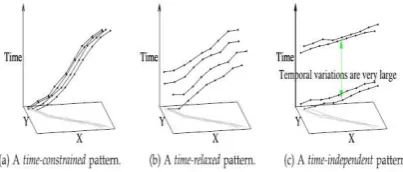
By the overall discussion, in this paper we propose forming a framework of unifying trajectory patterns (UT-patterns). The proposed system discusses the initial pattern and adjusts as per levels, which forms a cluster by means of information-theoretic formula without user intervention. The UT-patterns covers three phases such as time –constrained, time-relaxed and time-independent patterns. The granularities are based on adjusting levels as per shown in the below figure.
Figure 3 : Three types of UT-patterns
The proposed work is carried by dealing with dataset extracted from [21][22][23][24][25], which are processed under the guide of information-theoretic formula and the data set has details of moving objects. By which navigating the patterns at all different levels were noted and forms clusters.
Clustering in Trajectory Data
The related data are collected from the dataset is portioned and grouped according to its pattern. In other words, we can say grouping of similar patterns by calculation distance length between them. Before this Minimum Description Length is used in finding the shortest length and forming sub-trajectory clustering results in UT-Pattern clustering.
Figure 4 : Architecture of proposed system
The fig 4 shows the working mechanism of proposed system in which from the collected data the unified frame work has the UT patterns. This has the thousands of pattern which are not belonging to specific type but multiple as discussed; it is one of the major drawbacks of existing system. It undergoes filtering by means of following information-theoretic formula basis on set of reference movements according to its location, time and space. This principle maximizes the data compression and thus an optimize data compression is derived as result. Below works shows the algorithm used in proposed system and results were discussed in the next section.
1. Input set of trajectories I {ST1,....STnum}
2. Output set UT-Patterns
3. Q{UT1,....UTnum}
4. /* Phase I:Initial pattern Discovery*/
5. Perform Sub-Trajectory Clustering over I Based on classification-and –group Frame Work[7]
6. Get a set Call of Sub-trajectory Clusters;
7. For each CCall do
8. Execute Initial Pattern Generation Over C 9. Get a set
P
{
UT
}
Patterns Generation over C; 10. Accumulate Pinto set Pall11. End for
12. /* Phase II:Initial pattern Discovery*/
13. Execute pattern for forest Construction Over Pall
14. Return the Set of UT-Patterns In the Forest 15. Classify The Three patterns into three Types
III.
RESULTS AND DISCUSSION
Performance Comparison
Figure 5: Accuracy of UT-Patterns
According to the results obtained the UT clusters were below or equal to 6 which shows the high accuracy level (80 ~100 percent) under various conditions rather than odd cases.
k 2 3 4 5 6 7 8 9 10
m=2 69 50 46 45 44 41 39 38 32
m=3 24 21 16 14 12 10 10 9 9
m=4 5 3 3 3 1 0 0 0 0
m=5 1 0 0 0 0 0 0 0 0
m=6 0 0 0 0 0 0 0 0 0
This proposed work is compared with flock patterns by comparing the minimum number of objects (m) increases or the minimum duration (k) increases, a smaller number of flock patterns were achieved and the below table show that the proposed mechanism is more efficient than the other existing works in the tem of finding the trajectory patterns.
IV.
CONCLUSION
By the overall work, proposed unifying framework is developed for UT- pattern which deals with different temporal tightness like time-constrained, time-relaxed, and time-independent effectively and successfully. The data compression is maximized and pattern construction discovers more patterns than the traditional methods. The extracted results from the experiments prove the accuracy is high such as nearly to 100 for various movement characteristics. It achieves accuracy on hidden pattern on the data set and support large data set thus overcomes the real-time issues and proves its performance efficiency.
V.
REFERENCES
[1] Sharma, L. K., Vyas O. P., Scheider S. and
Akasapu A. 2010. Nearest Neibhour Classification for Trajectory Data. ITC 2010, Springer LNCS CCIS 101. 180–185.
[2] P. Bakalov, M. Hadjieleftheriou, and V. J. Tsotras,
"Time relaxed spatiotemporal trajectory joins," in Proc. 13th ACM Int. Symp. Geograph. Inf. Syst., Bremen, Germany, Nov. 2005, pp. 182–191.
[3] P. Laube and S. Imfeld, "Analyzing relative
motion within groups of trackable moving point objects," in Proc. 2nd Int. Conf. Geograph. Inf. Sci., Boulder, CO, USA, Sep. 2002, pp. 132–144.
[4] P. Laube, M. J. van Kreveld, and S. Imfeld,
"Finding REMO— Detecting relative motion patterns in geospatial lifelines," in Proc. 11th Int. Symp. Spatial Data Handling, Leicester, U.K., Aug. 2004, pp. 201–214.
[5] P. Laube, S. Imfeld, and R. Weibel, "Discovering
relative motion patterns in groups of moving point objects," Int. J. Geograph. Inf. Sci., vol. 19, no. 6, pp. 639–668, Jul. 2005.
[6] J.-G. Lee, J. Han, and K.-Y. Whang, "Trajectory
clustering: A partition- and-group framework," in Proc. ACM SIGMOD Int. Conf. Manag. Data, Beijing, China, Jun. 2007, pp. 593–604.
[7] D. Sacharidis, K. Patroumpas, M. Terrovitis, V.
Kantere, M. Potamias, K. Mouratidis, and T. K. Sellis, "On-line discovery of hot motion paths," in Proc. 11th Int. Conf. Extending Database Technol., Nantes, France, Mar. 2008, pp. 392– 403.
[8] H.-P. Tsai, D.-N. Yang, and M.-S. Chen, "Mining
group movement patterns for tracking moving objects efficiently," IEEE Trans. Knowl. Data Eng., vol. 23, no. 2, pp. 266–281, Feb. 2011.
[9] M. Benkert, J. Gudmundsson, F. Hubner, and T.
Wolle, "Reporting flock patterns," in Proc. 14th Eur. Symp. Algorithms, Zurich, Switzerland, Mar. 2006, pp. 660–671.
[10] J. Gudmundsson and M. J. van Kreveld,
"Computing longest duration flocks in trajectory data," in Proc. 14th ACM Int. Symp. Geograph. Inf.. Syst., Arlington, VA, USA, Nov. 2006, pp. 35–42.
[11] P. Kalnis, N. Mamoulis, and S. Bakiras, "On
Databases, Angra dos Reis, Brazil, Aug. 2005, pp. 364–381.
[12] Y. Li, J. Han, and J. Yang, "Clustering moving
objects," in Proc. 10th ACM SIGKDD Int. Conf. Knowl. Discovery Data Mining, Seattle, WA, USA, Aug. 2004, pp. 617–622.
[13] Akasapu A., Sharma L. K., Satpathy S. K.
Srinivasa P. 2011. Density-Based Trajectory Data Clustering with Fuzzy Neighbourhood Relation. Int. Conf. On Intelligent Systems & Data
Processing, 24-25 January, 2011, Vallabh
Vidyanagar, India
[14] Lee J., Han J., and Whang K. 2007. Trajectory
clustering: a partition-and-group framework. In Proceedings ACM SIGMOD Int. Conf. on Management of Data. 593 – 604, 2007.
[15] A. R. Kelly and E. R. Hancock, "Grouping
line-segments using eigenclustering," in Proc. 11th British Mach. Vis. Conf., Bristol, U.K. , Sep. 2000, pp. 59–68.
[16] J. Han, M. Kamber, and J. Pei, Data Mining:
Concepts and Techniques, 3rd ed. San Mateo, CA, USA: Morgan Kaufmann, 2011.
[17] J. Cohen, Statistical Power Analysis for the
Behavioral Sciences, 2nd ed. Mahwah NJ, USA: Lawrence Erlbaum Associates, Publishers, 1988. [27] A. A. Ager, B. K. Johnson, J. W. Kern, and J. G. Kie, "Daily and seasonal movements and habitat use by female rocky mountain elk and mute deer," J. Mammal., vol. 84, no. 3, pp. 1076– 1088, Aug. 2003.
[18] T. Brinkhoff, "A framework for generating
network-based moving objects," GeoInformatica, vol. 6, no. 2, pp. 153–180, Jun. 2002.
[19] Andrienko , G. Andrienko , N and Wrobel W.
2007. Visual Analytics Tools for Analysis of Movement Data. ACM SIGKDD. 38-46.
[20] Lee J, Han J., Li X, and Gonzalez H. 2008.
TraClass- Trajectory classification Using
Hierarchical Region Based and Trajectory based Clustering. In: ACM, VLDB, New Zealand, pp.1081-1094.
[21] P. Bakalov, M. Hadjieleftheriou, and V. J. Tsotras,
"Time relaxed spatiotemporal trajectory joins," in Proc. 13th ACM Int. Symp. Geograph. Inf. Syst., Bremen, Germany, Nov. 2005, pp. 182–191.
[22] F. Giannotti, M. Nanni, F. Pinelli, and D.
Pedreschi, "Trajectory pattern mining,, " in Proc. 13th ACM SIGKDD Int. Conf. Knowl. Discovery
Data Mining, San Jose, CA, USA, Aug. 2007, pp. 330–339.
[23] H. Jeung, M. L. Yiu, X. Zhou, C. S. Jensen, and
H. T. Shen, "Discovery of convoys in trajectory databases," Proc. VLDB Endowment, vol. 1, no. 1, pp. 1068–1080, Sep. 2008.
[24] P. Laube and S. Imfeld, "Analyzing relative
motion within groups of trackable moving point objects," in Proc. 2nd Int. Conf. Geograph. Inf. Sci., Boulder, CO, USA, Sep. 2002, pp. 132–144.
[25] P. Laube, M. J. van Kreveld, and S. Imfeld, "Finding REMO— Detecting relative motion patterns in geospatial lifelines," in Proc. 11th Int. Symp. Spatial Data Handling, Leicester, U.K., Aug. 2004, pp. 201–214.