for inferential sensing
in the process industries
by
Melissa Kistner
Thesis presented in partial fulfilment
of the requirements for the degree
of
M
ASTER IN
E
NGINEERING
(Extractive Metallurgical Engineering)
in the Faculty of Engineering
at Stellenbosch University
Supervisor
Dr Lidia Auret
Co-supervisor
Prof. Chris Aldrich
ii
Declaration
By submitting this thesis electronically, I declare that the entirety of the work contained therein is my own, original work, that I am the sole author thereof (save to the extent explicitly otherwise stated), that reproduction and publication thereof by Stellenbosch University will not infringe any third party rights and that I have not previously in its entirety or in part submitted it for obtaining any qualification.
Melissa Kistner 20 September 2013
Signature Date
Copyright © 2013 Stellenbosch University
iii
Summary
The measurement of key process quality variables is important for the efficient and economical operation of many chemical and mineral processing systems, as these variables can be used in process monitoring and control systems to identify and maintain optimal process conditions. However, in many engineering processes the key quality variables cannot be measured directly with standard sensors. Inferential sensing is the real-time prediction of such variables from other, measurable process variables through some form of model.
In vision-based inferential sensing, visual process data in the form of images or video frames are used as input variables to the inferential sensor. This is a suitable approach when the desired process quality variable is correlated with the visual appearance of the process. The inferential sensor model is then based on analysis of the image data.
Texture feature extraction is an image analysis approach by which the texture or spatial organisation of pixels in an image can be described. Two texture feature extraction methods, namely the use of grey-level co-occurrence matrices (GLCMs) and wavelet analysis, have predominated in applications of texture analysis to engineering processes. While these two baseline methods are still widely considered to be the best available texture analysis methods, several newer and more advanced methods have since been developed, which have properties that should theoretically provide these methods with some advantages over the baseline methods. Specifically, three advanced texture analysis methods have received much attention in recent machine vision literature, but have not yet been applied extensively to process engineering applications: steerable pyramids, textons and local binary patterns (LBPs).
The purpose of this study was to compare the use of advanced image texture analysis methods to baseline texture analysis methods for the prediction of key process quality variables in specific process engineering applications. Three case studies, in which texture is thought to play an important role, were considered: (i) the prediction of platinum grade classes from images of platinum flotation froths, (ii) the prediction of fines fraction classes from images of coal particles on a conveyor belt, and (iii) the prediction of mean particle size classes from images of hydrocyclone underflows.
Each of the five texture feature sets were used as inputs to two different classifiers (K-nearest neighbours and discriminant analysis) to predict the output variable classes for each of the three case studies mentioned above. The quality of the features extracted with each method was assessed in a structured manner, based their classification performances after the optimisation of the hyperparameters associated with each method.
In the platinum froth flotation case study, steerable pyramids and LBPs significantly outperformed the GLCM, wavelet and texton methods. In the case study of coal fines fractions, the GLCM method was significantly outperformed by all four other methods. Finally, in the hydrocyclone underflow
iv
case study, steerable pyramids and LBPs significantly outperformed GLCM and wavelet methods, while the result for textons was inconclusive.
Considering all of these results together, the overall conclusion was drawn that two of the three advanced texture feature extraction methods, namely steerable pyramids and LBPs, can extract feature sets of superior quality, when compared to the baseline GLCM and wavelet methods in these three case studies. The application of steerable pyramids and LBPs to further image analysis data sets is therefore recommended as a viable alternative to the traditional GLCM and wavelet texture analysis methods.
v
Opsomming
Die meting van sleutelproseskwaliteitsveranderlikes is belangrik vir die doeltreffende en ekono-miese werking van baie cheekono-miese– en mineraalprosesseringsisteme, aangesien hierdie verander-likes gebruik kan word in prosesmonitering– en beheerstelsels om die optimale prosestoestande te identifiseer en te handhaaf. In baie ingenieursprosesse kan die sleutelproseskwaliteits-veranderlikes egter nie direk met standaard sensors gemeet word nie. Inferensiële waarneming is die intydse voorspelling van sulke veranderlikes vanaf ander, meetbare prosesveranderlikes deur van ‘n model gebruik te maak.
In beeldgebaseerde inferensiële waarneming word visuele prosesdata, in die vorm van beelde of videogrepe, gebruik as insetveranderlikes vir die inferensiële sensor. Hierdie is ‘n gepaste benadering wanneer die verlangde proseskwaliteitsveranderlike met die visuele voorkoms van die proses gekorreleer is. Die inferensiële sensormodel word dan gebaseer op die analise van die beelddata.
Tekstuurkenmerkekstraksie is ‘n beeldanalisebenadering waarmee die tekstuur of ruimtelike organisering van die beeldelemente beskryf kan word. Twee tekstuurkenmerkekstraksiemetodes, naamlik die gebruik van grysskaalmede-aanwesigheidsmatrikse (GSMMs) en golfie-analise, is sterk verteenwoordig in ingenieursprosestoepassings van tekstuuranalise. Alhoewel hierdie twee grondlynmetodes steeds algemeen as die beste beskikbare tekstuuranalisemetodes beskou word, is daar sedertdien verskeie nuwer en meer gevorderde metodes ontwikkel, wat beskik oor eienskappe wat teoreties voordele vir hierdie metodes teenoor die grondlynmetodes behoort te verskaf. Meer spesifiek is daar drie gevorderde tekstuuranalisemetodes wat baie aandag in onlangse masjienvisieliteratuur geniet het, maar wat nog nie baie op ingenieursprosesse toegepas is nie: stuurbare piramiedes, tekstons en lokale binêre patrone (LBPs).
Die doel van hierdie studie was om die gebruik van gevorderde tekstuuranalisemetodes te vergelyk met grondlyntekstuuranaliesemetodes vir die voorspelling van sleutelproseskwaliteits-veranderlikes in spesifieke prosesingenieurstoepassings. Drie gevallestudies, waarin tekstuur ‘n belangrike rol behoort te speel, is ondersoek: (i) die voorspelling van platinumgraadklasse vanaf beelde van platinumflottasieskuime, (ii) die voorspelling van fynfraksieklasse vanaf beelde van steenkoolpartikels op ‘n vervoerband, en (iii) die voorspelling van gemiddelde partikelgrootteklasse vanaf beelde van hidrosikloon ondervloeie.
Elk van die vyf tekstuurkenmerkstelle is as insette vir twee verskillende klassifiseerders (K-naaste bure en diskriminantanalise) gebruik om die klasse van die uitsetveranderlikes te voorspeel, vir elk van die drie gevallestudies hierbo genoem. Die kwaliteit van die kenmerke wat deur elke metode ge-ekstraheer is, is op ‘n gestruktureerde manier bepaal, gebaseer op hul klassifikasieprestasie na die optimering van die hiperparameters wat verbonde is aan elke metode.
vi
In die platinumskuimflottasiegevallestudie het stuurbare piramiedes en LBPs betekenisvol beter as die GSMM–, golfie– en tekstonmetodes presteer. In die steenkoolfynfraksiegevallestudie het die GSMM-metode betekenisvol slegter as al vier ander metodes presteer. Laastens, in die hidrosikloon ondervloeigevallestudie het stuurbare piramiedes en LBPs betekenisvol beter as die GSMM– en golfiemetodes presteer, terwyl die resultaat vir tekstons nie beslissend was nie.
Deur al hierdie resultate gesamentlik te beskou, is die oorkoepelende gevolgtrekking gemaak dat twee van die drie gevorderde tekstuurkenmerkekstraksiemetodes, naamlik stuurbare piramiedes en LBPs, hoër kwaliteit kenmerkstelle kan ekstraheer in vergelyking met die GSMM– en golfiemetodes, vir hierdie drie gevallestudies. Die toepassing van stuurbare piramiedes en LBPs op verdere beeldanalise-datastelle word dus aanbeveel as ‘n lewensvatbare alternatief tot die tradisionele GSMM– en golfietekstuuranalisemetodes.
viii
Acknowledgements
On this journey, many have walked with me.
To my supervisor, Dr Lidia Auret, thank you for your sound advice, mentorship and guidance. You have inspired me with your dedication and never-ending stream of brilliant ideas from the moment that you walked in on my project. I truly appreciate the selfless effort that you have put in, over and above what would be expected, to help me make the best of this study.
To my wonderful husband, Ralf, thank you for your loving support and optimism through the ups and the downs of this journey. Thank you for being such a great sounding board, and for your optimism, patience and understanding.
Thank you to Prof. Chris Aldrich, who has gotten me interested in image analysis in the first place, and without whose encouragement and motivation I would not even have embarked on this road. Thank you for the opportunity to have learnt so much over the past two years.
To my parents, thank you for always being there for me, believing in me and encouraging me in everything that I set out to do, including this project.
Thank you to Dr Gorden Jemwa for introducing me to many of the techniques used in this work, and for guiding me through the first stretch of this journey.
To the staff and my fellow students at the Process Monitoring and Systems research group, thank you for your technical assistance and friendship.
I also express my gratitude towards the Department of Process Engineering at Stellenbosch University for their financial assistance during my post-graduate study.
Finally, I would like to thank my two cockatiels for their significant contribution of typos to this thesis by insisting that my keyboard is the perfect playground.
“Engineers like to solve problems. If there are no problems handily available, they will create their own problems.” – Scott Adams
ix
Table of Contents
Chapter 1
Introduction ... 1
1.1 Inferential sensing in the process industries... 2
1.2 Vision-based inferential sensing ... 2
1.2.1 Framework ... 3
1.2.2 Image analysis in the process industries ... 3
1.3 Texture analysis ... 4
1.3.1 Texture feature extraction ... 4
1.3.2 Classification ... 5
1.4 Case studies ... 6
1.4.1 Case study I: Platinum flotation froths ... 6
1.4.2 Case study II: Coal on a conveyor belt ... 7
1.4.3 Case study III: Hydrocyclone underflows ... 7
1.5 Objectives... 8
1.6 Scope ... 8
1.7 Layout ... 9
Chapter 2
Vision-based inferential sensing ... 10
2.1 Introduction ... 11
2.2 Inferential sensing ... 11
2.2.1 Inferential sensor tasks ... 11
2.2.2 Inferential sensor models ... 13
2.2.3 Framework ... 13
2.3 Image analysis ... 15
2.3.1 Machine vision ... 15
2.3.2 Image analysis for inferential sensing ... 17
2.3.3 Multivariate image analysis ... 19
2.4 Applications in the process industries ... 20
2.4.1 Froth flotation ... 21
2.4.2 Rock particles on a conveyor belt ... 23
2.4.3 Hydrocyclones ... 24
2.5 Conclusions ... 25
x
3.1 Introduction ... 28
3.1.1 Texture modelling approaches ... 28
3.1.2 Tasks in texture analysis ... 29
3.1.3 Texture feature extraction ... 29
3.1.4 Properties of texture analysis algorithms... 30
3.2 Grey-Level Co-occurrence Matrices ... 31
3.2.1 GLCM calculation ... 31
3.2.2 Feature extraction from GLCMs ... 33
3.2.3 Applications in the process industries ... 34
3.3 Wavelet analysis ... 35
3.3.1 From Fourier transform to wavelet transform ... 36
3.3.2 Continuous and discrete wavelet transform ... 38
3.3.3 Wavelet transform of two-dimensional images ... 40
3.3.4 Feature extraction from the wavelet representation ... 42
3.3.5 Applications in the process industries ... 43
3.4 Steerable pyramids ... 44
3.4.1 Filters for the steerable pyramid ... 45
3.4.2 Steerable pyramid decomposition ... 47
3.4.3 Extracting features from the steerable pyramid ... 48
3.4.4 Applications in the process industries ... 50
3.5 Textons ... 50
3.5.1 A texton algorithm ... 51
3.5.2 Filter bank for the texton algorithm ... 52
3.5.3 Applications in the process industries ... 53
3.6 Local Binary Patterns ... 53
3.6.1 Calculation of LBP features ... 53
3.6.2 Alternative versions of the LBP operator ... 55
3.6.3 Applications in the process industries ... 56
3.7 Comparison between texture analysis methods ... 57
3.8 Classification ... 58
3.8.1 K-nearest neighbours ... 58
3.8.2 Discriminant analysis ... 59
3.9 Conclusions ... 60
Chapter 4
Materials and methods ... 62
4.1 Introduction ... 63
4.2 Case studies ... 65
xi
4.2.2 Case study II: Coal on a conveyor belt ... 67
4.2.3 Case study III: Hydrocyclone underflows ... 69
4.3 Data partitioning, cross-validation and testing ... 70
4.3.1 Data partitioning ... 70
4.3.2 Cross-validation ... 73
4.3.3 Testing ... 77
4.4 Pre-processing ... 79
4.4.1 Cropping and resizing ... 79
4.4.2 Conversion to greyscale ... 80
4.4.3 Image normalisation ... 80
4.5 Dimensionality reduction ... 81
4.5.1 Grey-level co-occurrence matrices ... 82
4.5.2 Wavelets... 83
4.5.3 Steerable pyramids ... 83
4.5.4 Textons ... 84
4.5.5 Local binary patterns ... 86
4.5.6 Feature set normalisation ... 87
4.5.7 Principal component analysis ... 87
4.6 Modelling ... 88 4.6.1 K-nearest neighbours ... 88 4.6.2 Discriminant analysis ... 88 4.7 Performance evaluation ... 88 4.7.1 Confusion matrices ... 88 4.7.2 Sensitivity analysis ... 89 4.8 Summary ... 90
Chapter 5
Results and discussion: Platinum flotation froths ... 92
5.1 Introduction ... 93
5.2 Classification results ... 93
5.2.1 Feature extraction methods ... 94
5.2.2 Classifiers ... 96
5.2.3 Comparison between validation and test results ... 96
5.3 Hyperparameters ... 99
5.4 LD projection ... 100
5.5 Computer running times... 105
5.5.1 Training ... 105
5.5.2 Testing ... 106
xii
Chapter 6
Results and discussion: Coal on a conveyor belt ... 108
6.1 Introduction ... 109 6.2 Classification results ... 109 6.2.1 Sensitivity analysis ... 111 6.2.2 Discussion ... 111 6.3 Further analysis ... 112 6.3.1 LD projection ... 113 6.3.2 Classification results ... 116 6.3.3 Hyperparameters ... 118
6.3.4 Computer running times ... 119
6.4 Conclusions ... 121
Chapter 7
Results and discussion: Hydrocyclone underflows ... 122
7.1 Introduction ... 123 7.2 Classification results ... 123 7.2.1 Sensitivity analysis ... 125 7.2.2 Discussion ... 125 7.3 Further analysis ... 127 7.3.1 LD projection ... 127 7.3.2 Classification results ... 131 7.3.3 Optimal hyperparameters ... 134
7.3.4 Computer running times ... 136
7.4 Conclusions ... 137
Chapter 8
Overall discussion and conclusions ... 138
8.1 Introduction ... 139
8.2 Texture classification discussion and conclusions ... 139
8.2.1 Feature extraction methods ... 140
8.2.2 Classifiers ... 142
8.3 Hyperparameter sensitivity analysis ... 142
8.3.1 GLCM hyperparameters ... 143
8.3.2 Wavelet hyperparameters ... 144
8.3.3 Steerable pyramid hyperparameters ... 145
8.3.4 Texton hyperparameters ... 146
8.3.5 LBP hyperparameters ... 147
8.3.6 Conclusion ... 148
8.4 Research contributions and recommendations ... 148
xiii
8.4.2 Algorithm development ... 149
8.4.3 Problem identification and data collection ... 150
8.4.4 Results interpretation ... 151 8.4.5 Industrial implementation ... 152 8.5 Conclusions ... 152 8.5.1 Hyperparameter optimisation ... 152 8.5.2 Texture classification ... 152
References ... 154
Appendix A
Nomenclature... 165
Appendix B
Sample calculations ... 169
Appendix C
All repetition results: Coal on a conveyor belt ... 173
Appendix D
All repetition results: Hydrocyclone underflows ... 178
Chapter 1
Introduction
The measurement of key process quality variables is important for the efficient operation of many chemical and mineral processing systems. When quality variables cannot be measured directly, vision-based inferential sensing may be used to predict these variables based on the analysis of process image data.
Texture feature extraction is an image analysis approach by which the spatial information of the pixels in an image can be described. The main objective of this study is to compare the use of advanced image texture analysis methods to baseline texture analysis methods for the prediction of key process quality variables in specific process engineering applications.
Chapter 1 – Introduction 2
1.1
Inferential sensing in the process industries
The measurement of key process quality variables is important for the efficient and profitable operation of many chemical and mineral processing systems. Since these variables are related to the quality of the process outputs, they can be used in process monitoring and control systems to identify and maintain optimal process conditions. When a process is properly monitored and controlled, it can operate at its full potential, maximising production and minimising waste and losses.
Although most modern processing plants are equipped with a large number of sensors, there are many important process variables which cannot be measured directly with standard hardware sensors. Inferential sensing is the prediction of such process variables from other, measurable process variables through some form of a model.
Inferential sensors offer the benefit of real-time variable prediction, whereas alternative measurement techniques often rely on some form of manual sampling and costly laboratory analyses, which do not provide data within a sufficient timeframe for control purposes. Also, inferential sensors do not interfere with the process at hand and may easily be incorporated in existing plant-wide control schemes. On the downside, the accuracy of predictions made by inferential sensors can be sensitive to undesirable effects that are commonly present in process data, such as measurement noise, missing values and outliers (Kadlec et al., 2009).
In many engineering processes, the desired process variable can be predicted by using an inferential sensor with process variables measured by standard sensors (such as temperature or pH) as inputs. Examples of such applications include the modelling of metal quality in a blast furnace (Radhakrishnan & Mohamed, 2000), the prediction of gas concentrations in a distillation column (Fortuna et al., 2005) and the estimation of process quality variables in a cement kiln system (Lin et al., 2007). However, in some processes there are no causal relationships between the variables that are to be predicted and the available process measurements. For example, no variables related to the particle size distribution of the ore output by a grinding process are measured with standard hardware sensors. In such cases the desired information is often related to the visual appearance of the process. One solution is then to capture image data of the process and use these data as input variables to the inferential sensor, building a model for the desired variable based on analysis of the images. The use of machine vision in such a way is termed vision-based inferential sensing in this work.
1.2
Vision-based inferential sensing
Vision-based inferential sensing may be used to solve process variable prediction problems in cases where the desired process variable is correlated with the visual appearance of the process or product.
Chapter 1 – Introduction 3
1.2.1
Framework
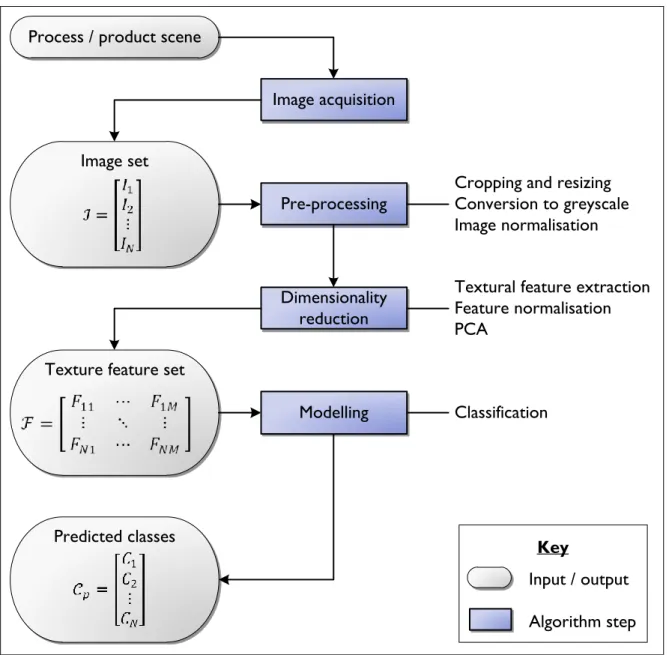
The framework for vision-based inferential sensing considered in this work is shown in figure 1-1, which at the most basic level consists of two steps: dimensionality reduction and modelling.
Figure 1-1: Basic vision-based inferential sensing workflow
The sensor takes image data as inputs, which are very high-dimensional as each pixel amounts to a dimension. The first step is therefore to reduce the dimensionality of the data, because modelling techniques do not perform well when the dimensionality of the input data is too high. To this end, two major types of features are typically extracted from images: spectral and textural features. Spectral features are usually extracted with multivariate image analysis (MIA), which has been very popular in recent image analysis applications in the process industries. The extraction of textural features capture the spatial organisation of images, and it is this type of feature extraction that is a main focus in this work.
The second step in vision-based inferential sensing is modelling, where the extracted features from a set of training images are used as input to train a regression or supervised classification model. Regression is used when a continuous dependent variable is to be predicted, while classification is used for the prediction of discrete dependent variable values or ranges. After the model has been trained, new, unseen images may be analysed by extracting their features and using these features as input to the trained model, allowing the model to predict the variables associated with each image.
1.2.2
Image analysis in the process industries
Research on image analysis in the process industries has been focused to a large extent on MIA, a technique that was originally proposed by Geladi and others (1989) for the extraction of spectral features from images. In MIA, the usual approach is to apply principal component analysis (PCA) to an unfolded multivariate image, after which spectral features can be extracted in a number of different ways.
MIA has been applied to a diverse range of problems, such as the online grading of wood (Bharati et al., 2003), prediction of zinc grade in a sphalerite froth flotation process (Duchesne et al., 2003), estimation of the coating content of snack foods (Yu & MacGregor, 2003) and monitoring of flames in an industrial boiler (Yu & MacGregor, 2004).
Image data
Dimensionality reduction
Modelling
Predicted variable
MIA
Texture feature extraction
Feature selection
Regression
Classification
Chapter 1 – Introduction 4
The extraction of spectral features is appropriate when there is a strong correlation between the predicted variable and the colour, saturation or luminosity of the image data, as in the applications mentioned here. However, in many cases the spatial organisation of pixels process images, as captured by textural features, are more descriptive of the process.
1.3
Texture analysis
Texture is present in many natural images and can intuitively be interpreted by humans, but there does not yet exist a complete mathematical model that can explain the complex nature of this image property. For this reason, several types of texture analysis approaches have been developed that attempt to approximate textural properties in different ways. These approaches can be grouped into three main categories: statistical, structural and transform-based approaches. Each of these has their advantages and disadvantages, which is why most of the more recent and advanced texture analysis methods tend towards the unification of these approaches, combining their elements in various ways.
Depending on the application, the end goals of texture analysis algorithms may vary considerably. The three main problem types are texture segmentation, texture synthesis and texture classification, of which the latter is the most applicable to vision-based inferential sensing.
1.3.1
Texture feature extraction
Texture classification follows the two-step procedure depicted in figure 1-1. For the texture feature extraction step, two methods have received much attention in process engineering literature: the use of grey-level co-occurrence matrices (GLCMs) and wavelet texture analysis. Even though many alternatives to these techniques exist, GLCMs and wavelets are considered as state-of-the-art texture analysis methods within the process industries (Duchesne et al., 2012).
Introduced by Haralick and others (1973), a GLCM of an image is a concise summary of the frequencies at which grey levels (pixel intensities) in an image occur at a specified displacement from each other, thus summarising the spatial relationships between pixels in an image. Statistical texture features are extracted based on one or more GLCMs of an image. There have been many process applications of GLCMs, among others in the monitoring of froth flotation processes (Bartolacci et al., 2006; Gui et al., 2013), defect detection on wooden surfaces (Conners et al., 1983; Mäenpää et al., 2003a) and quality grading of steel surfaces (Bharati et al., 2004a).
Wavelets are mathematical functions that can be convolved with images, transforming the images into representations that emphasise the frequency and spatial distribution of the image pixels, allowing for improved analysis of these properties (Mallat, 1989). Wavelet texture analysis typically involves the decomposition of images into horizontal, vertical and diagonal coefficient sets at multiple scales or levels. A feature set commonly extracted from this representation consists of the energies of all the coefficient sets. Wavelets have also seen many applications within the process industries, for example in the monitoring of flotation froth health (Liu et al., 2005; Liu & MacGregor,
Chapter 1 – Introduction 5
2008), defect detection in textile products (Latif-Amet et al., 2000) and tiles (Ghazvini et al., 2009), and surface quality inspection of steel surfaces (Bharati et al., 2004a; Liu et al., 2007).
While the GLCM and wavelet texture analysis methods both led to significant breakthroughs in the field of texture feature extraction when they were first popularised, newer texture analysis methods have since been developed. Specifically, three texture analysis methods have received much attention in recent texture classification literature, although they have not yet been applied extensively to process engineering applications: steerable pyramids, textons and local binary patterns (LBPs).
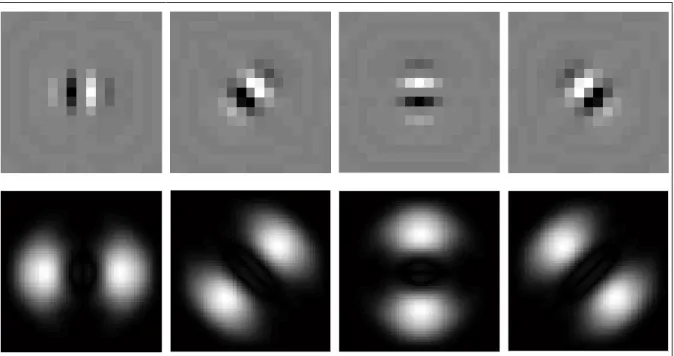
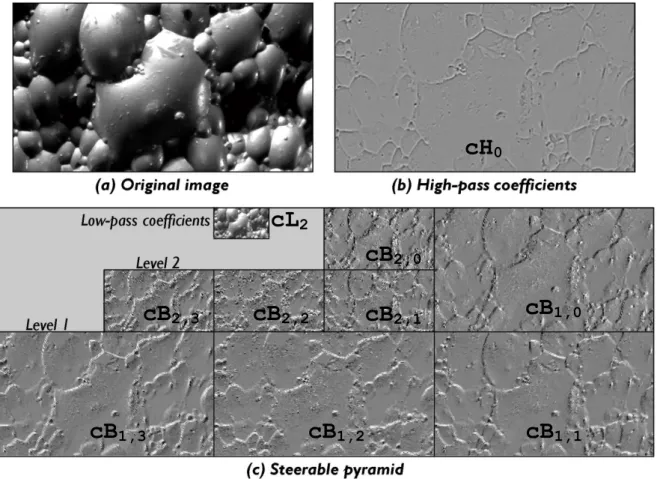
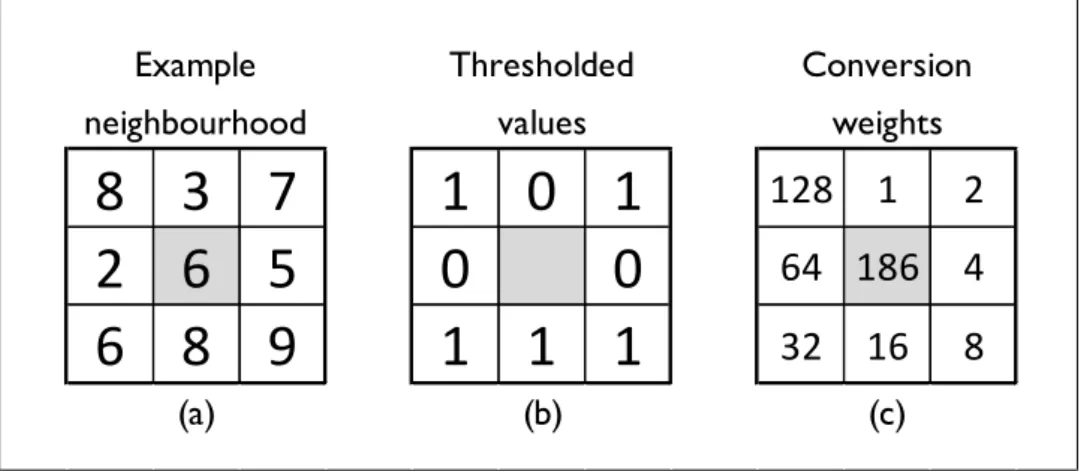
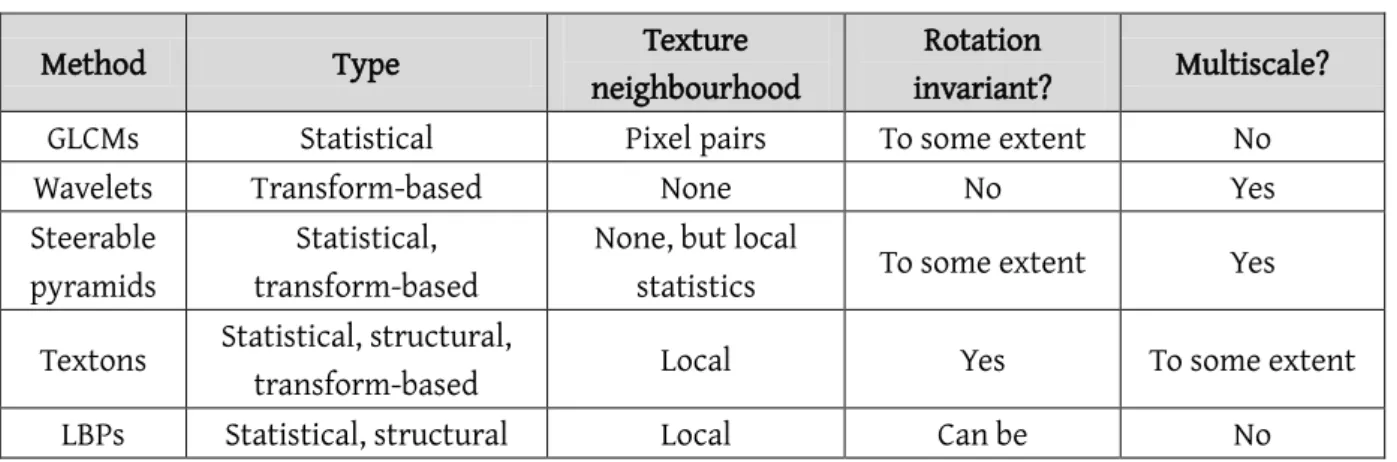
Steerable pyramid transformations (Simoncelli et al., 1992) are similar to wavelet transformations in that they also result in multi-resolution image representations. Steerable pyramids have the advantage of being rotation and translation invariant, a very desirable property in most image analysis applications. Furthermore, the extraction of an advanced set of statistical measurements from steerable pyramid representations has been proposed by Portilla and Simoncelli (2000). Textons are conceptually perceived as local texture descriptors or textural “primitives” that occur frequently in images, such as blobs, edges, line terminators and line crossings (Julesz, 1981). Modern texton approaches involve image filtering and pixel clustering, with textons being defined as cluster centres in the filter response space (Leung & Malik, 2001; Varma & Zisserman, 2005). This method combines ideas from the statistical, structural and transform-based approaches in a unique way. Finally, the LBP is a texture analysis operator for local texture characterisation, initially proposed by Olaja, Pietikäinen and Harwood (1994). The operator is applied to greyscale images in a pixel-wise fashion by comparing each pixel to its local pixel neighbourhood and employs a simple thresholding function. A major improvement to the original LBP was made when Ojala and others (2002b) proposed several mapping types that allowed for rotational invariance and proper representation of so-called “uniform” textures. The underlying principles of LBP texture analysis is the same as that of the texton algorithm, but with the advantage of reduced computational complexity.
The latter three methods described here will be referred to as advanced texture analysis methods in this work, as they combine texture analysis approaches in various ways and have some unique, desirable properties. The former two methods, GLCMs and wavelets, will be referred to as baseline
methods, since their application within the process industries is already well established. There is reason to believe that the advanced texture analysis methods may be able to extract improved features when compared to the baseline methods, and this possibility is investigated in the current work.
1.3.2
Classification
In the vision-based inferential sensing framework, dimensionality reduction is followed by a modelling step. In this work, two well-known and popular classification methods were considered for this step: a K-nearest neighbour (K-NN) classifier and discriminant analysis (DA). In K-nearest neighbour (K-NN) classification, given a set of training data points with known labels, a new (test)
Chapter 1 – Introduction 6
data point is assigned the most prevalent label among its 𝐾𝑁 closest neighbours in the feature
space, with the number of neighbours 𝐾𝑁 being pre-specified.
Discriminant analysis (DA) attempts to find a weighting matrix for the training feature set that the multiplication of each feature vector with the weighting matrix results in a feature projection where the classes are maximally separated. The data are then classified according to the maximum a-posteriori probability rule.
1.4
Case studies
Three vision-based inferential sensing case studies, in which textural features are expected to play a more important role than spectral features, were considered in this work:
I. the classification of platinum flotation froth images into platinum grade categories, II. the classification of coal particle images into fines fraction categories, and
III. the classification of hydrocyclone underflow images into particle size categories.
1.4.1
Case study I: Platinum flotation froths
Froth flotation is a popular method for the separation of valuable metal-containing minerals from gangue minerals. The metallurgical and economic performance of a froth flotation system is determined by the grade and recovery of the valuable mineral in the froth, and ideally these key process quality variables should be measured in real-time.
Currently, the best way of measuring froth grade is with on-stream analysers (OSAs), which can provide chemical analyses of a process streams downstream of the flotation cells. However, these instruments are expensive to purchase and maintain (Liu & MacGregor, 2008), which often means that only one OSA is used to analyse the collective process stream from many flotation circuits (Holtham & Nguyen, 2002). Therefore, there could be a significant measurement delay of up to 20 minutes, and any deviations within a particular flotation circuit would be difficult to detect. This is not desirable for control purposes.
The performance of flotation systems has been linked to the visual characteristics of the froth phase (Moolman et al., 1994), and in most flotation plants the control decisions are made based on visual judgement of the appearance of the froth. For this reason, much research has been done on vision-based inferential sensing for the monitoring of flotation systems (Bonifazi et al., 2000; Duchesne et al., 2003; Gui et al., 2013).
In platinum froth flotation the colour of the froth and its grade does not appear to be correlated (Marais & Aldrich, 2011). This motivates the use of textural features as input to a classifier for platinum froth grade.
Chapter 1 – Introduction 7
1.4.2
Case study II: Coal on a conveyor belt
The performances of many process reactors and metallurgical furnaces are influenced to a great extent by the physical properties of the feed to these processes, such as its particle size distribution. In this case study, the online prediction of the fraction of fine particles in coal on a conveyor belt is considered. The fines fraction is an important quality variable to be measured in coal feeds to gasification reactors, since excessive amounts of fine particles in the feed can impair the gas permeability of the coal bed in the reactor. This would result in non-ideal conditions for the reacting phase and, subsequently, an adverse effect on the performance of the gasifier (Aldrich et al., 2010).
Traditionally, particle size distributions or fines fractions of coal is analysed periodically via sieve analysis of belt cut samples. This method is not adequate for control purposes, due to the significant delay in the availability of information and the poor representativeness of samples, as the feed material properties can fluctuate rapidly.
The alternative of vision-based inferential sensing has been investigated using GLCM features (Aldrich et al., 2010) or texton features (Jemwa & Aldrich, 2012) as input to classifiers for fines fraction categories. The prediction of fines fraction is clearly more of a texture analysis problem than a spectral analysis problem, since groups of particles with different sizes have very distinctive textures, but their colour remains the same.
1.4.3
Case study III: Hydrocyclone underflows
Hydrocyclones are used as separation devices in many engineering processes. In grinding circuits, for example, hydrocyclones take as input ore from mills and separate the particles that conform to size specifications from oversize particles. Most of the smaller, conforming particles separate into the overflow and are passed along to downstream processes, while the most of the oversize particles pass into the underflow and are returned to the mill for regrinding.
When a hydrocyclone in a grinding circuit is properly controlled, the load that circulates through the process is minimised, leading to optimal energy usage and lower operating costs (Janse van Vuuren, 2011). The operating state of a hydrocyclone can be determined visually by assessing the spray angle of the underflow (Neesse et al., 2004), and is related to the particle size distribution of the particles in the underflow (Janse van Vuuren, 2011; Uahengo, 2013).
In this work the classification of hydrocyclone underflow images into mean particle size categories is investigated. Again, particle size analysis is more suited to textural feature extraction than spectral feature extraction. In fact, colour features can be very misleading in this application, as the colour of ores can fluctuate considerably, with no relation to the mean particle size.
Chapter 1 – Introduction 8
1.5
Objectives
The main goal of this study is to compare the use of advanced image texture analysis methods to baseline texture analysis methods for the prediction of key process quality variables in specific process engineering applications.
To achieve this goal, four secondary objectives are specified:
1. Conduct a critical survey of literature on vision-based inferential sensing and texture analysis techniques, as well as their applications within the process industries.
2. Identify and select texture analysis algorithms that, based on the literature review, have a reasonable chance of leading to the successful prediction of key process quality variables from process image data. Study and understand the theoretical concepts behind these algorithms.
3. Implement baseline and advanced texture feature extraction algorithms. Use these algorithms to extract features from process image data from three case studies where clas-ses of key process quality variables are to be predicted. Optimise the hyperparameters of all methods.
4. Assess the quality of the features extracted with each texture analysis algorithm in a structured manner by comparing their abilities to predict key process quality variable classes.
1.6
Scope
The algorithms considered for implementation are limited to texture classification algorithms. That is, texture analysis algorithms are used to extract textural features from images, which are subsequently used for supervised classification of the data into two or more classes. This specifically excludes spectral feature extraction and regression from the scope of the project. The evaluation of classification performance is considered to be sufficient for the assessment of the quality of features extracted with different texture analysis algorithms, as performance trends observed from the results of classifying into ordinal classes should reasonably hold true when using regression. Since the focus is on texture feature extraction, a thorough investigation and optimisation of the classification step also falls beyond the scope of this project.
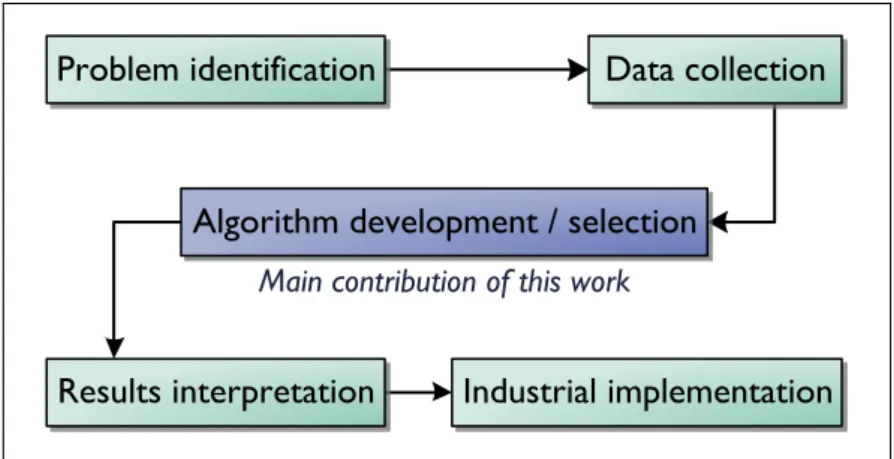
The methods explored in this study do not constitute an end product that is ready for implementa-tion in an industrial setup. Rather, this work contributes towards the long-term goal of developing effective vision-based inferential sensors for process engineering applications by assessing algorithms that may eventually be used by such sensors. An interpretation of the entire life cycle of a vision-based inferential sensing research program shows that it consists of many stages, as depicted in figure 1-2 (adapted from Wagstaff, 2012). Although all stages in such a vision-based inferential sensor research programme are discussed, the main contribution of this work is to the algorithm development or selection phase.
Chapter 1 – Introduction 9
1.7
Layout
This thesis is organised as follows. Chapter 2 presents a literature review on vision-based inferential sensing, which is followed by a theoretical overview of five texture analysis methods in chapter 3. In chapter 4 the methodology followed in implementing and assessing the texture analysis algorithms is detailed. The results for the three case studies are presented in chapters 5, 6 and 7. Chapter 8 concludes this work with a final discussion, including the most important conclusions and recommendations for future research.
The appendices include a nomenclature (appendix A), sample calculations (appendix B), all repetition results for two of the case studies (appendices C and D) and a list of publications based on this work (appendix E).
Figure 1-2: The entire life cycle of a vision-based inferential sensor research programme.
Problem identification
Algorithm development / selection
Data collection
Results interpretation Industrial implementation Main contribution of this work
Chapter 2
Vision-based
inferential sensing
Inferential sensing is the use of measured process variables to predict an unknown process variable through some form of a model. Vision-based inferential sensing refers to the use of image data as input to an inferential sensor. The development of a vision-based inferential sensor consists of two main steps: dimensionality reduction and modelling. In applications of this technology in the process industries, the focus has been on multivariate image analysis (MIA). Three application areas of vision-based inferential sensing are in the monitoring of froth flotation systems, the estimation of physical properties of particulate feed materials on conveyor belts and the monitoring of hydrocyclones.
Chapter 2 – Vision-based inferential sensing 11
2.1
Introduction
Inferential sensors can be used for the online, real-time measurement of key process quality variables, which can be very useful for monitoring and control purposes. In section 2.2, inferential sensing is discussed in detail.
In some process applications there are no causal relationships between the desired process information and the available process variables, but there is a strong relation between the desired information and the visual appearance of the process. In such cases, process images can be used as input variables to the inferential sensor and analysed to develop a model for the desired variable. The use of machine vision in this way is called vision-based inferential sensing. In applications of vision-based inferential sensing in the process industries, a strong focus has been placed on multivariate image analysis (MIA), a very well-known and efficient technique for the extraction of spectral information from images. Section 2.3 introduces image analysis and shows how this field has been applied to inferential sensing in the process industries.
Three case studies that have received considerable attention in machine vision literature will be discussed in section 2.4:
1. the monitoring of mineral froth flotation systems,
2. the characterisation of the physical properties of rock particles on conveyor belts and 3. the monitoring of hydrocyclones.
This chapter ends with conclusions in section 2.5.
2.2
Inferential sensing
Inferential sensors can measure key process response or product quality variables online and in real-time, without interfering with the process at hand. In the process industries, the demand for this technology has grown over the last two decades, and there have been a large number of theoretical studies and industrial implementations. Inferential sensors are also widely known as soft sensors (Kadlec et al., 2009), virtual online analysers (Han & Lee, 2002) or observer-based sensors (Goodwin, 2000).
In many applications the desired process information can be extracted by constructing a model using the many process measurements available from standard sensors (such as pressure, pH, temperature or flow rate) as inputs. Comprehensive reviews of inferential sensing in process applications may be found in Fortuna and others (2007) and Kadlec and others (2009).
2.2.1
Inferential sensor tasks
Online prediction
Inferential sensors may be used to perform a variety of tasks in process systems, the most dominant application area being the real-time estimation of key process variables that cannot be measured
Chapter 2 – Vision-based inferential sensing 12
within a sufficient timeframe with traditional sensors (Kadlec et al., 2009). This task will henceforth be referred to as online prediction.
Typically, the inferred variables are closely related to the efficiency of the process or quality of the product. The timeous availability of these variables can aid process operators in the accurate determination of the process state and the source of any deviations, leading to improved process control.
An example of an online prediction application of inferential sensors is the estimation of key process response variables in mineral flotation processes, such as grade or recovery. Traditionally, the froth grade is indirectly measured with on-stream analysers (OSAs), but these devices are expensive and can have significant measurement delays. In general, even if the measuring time is in the order of minutes, for instance as is the case with many on-stream gas chromatographs, the delay would still be too long if it is in a range comparable to the time constant of the process (Fortuna et al., 2007).
Automated process monitoring and control
The effectiveness of manual monitoring depends largely on the experience and engineering judgement of the operator, whose task is becoming increasingly difficult as modern process plants grow in size and complexity (Venkatasubramanian et al., 2003). When the variables predicted by inferential sensors meet accuracy requirements for process control, it is relatively easy to incorporate the predicted variables into existing process monitoring and control systems. The difference between this soft sensor task and online prediction is that the variables predicted for process monitoring and control are not necessarily significant in their own regard, but rather could be any derived features that are useful inputs to a model that can determine the process state. In some cases, new automatic control systems can be built by using variables predicted by the soft sensors as inputs. When these automatic control systems replace manual control systems, operator man-hours are reduced and the possibility of erroneous manual control actions is alleviated. This can lead to significant economical savings.
Sensor validation
Another soft sensor task is sensor validation (Fortuna et al., 2007). Sensor validation is a particular type of process monitoring where the process to be monitored is another sensor. Let the sensor to be monitored be denoted by 𝜆ℎ and the inferential sensor by 𝜆𝑖. In sensor validation, the reliability
of the variable measurement produced by 𝜆ℎ is determined by comparing it to the output predicted
by 𝜆𝑖 (again, this task contains an online prediction component). If 𝜆ℎ is found to be defective, 𝜆𝑖
may temporarily replace the defective sensor by providing an estimate of the measured variable. Sensor validation can be used to detect and diagnose any sensor faults before a model for online prediction or automated process monitoring is built, to prevent inaccuracies in the model (Kadlec et al., 2009).
Chapter 2 – Vision-based inferential sensing 13
What-if analysis
Inferential sensors may also be used for what-if analysis. In this type of analysis, the sensor model is used to simulate system dynamics corresponding to interesting trends in the input variables. This can lead to improved control policies and a deeper understanding of the process (Fortuna et al., 2007).
2.2.2
Inferential sensor models
Soft sensors use models to relate measured process variables to unknown process response variables or product properties. The models used can be categorised into two basic types: model-driven and data-model-driven (Kadlec et al., 2009).
Model-driven models rely on first principle models that are derived from fundamental chemical and physical principles, for instance by using energy balances or reaction kinetics. These analytical models often focus on steady process states, and it is sometimes necessary to make simplifying assumptions during their derivation. These factors can limit their success in predicting process variables under real-life conditions.
On the other hand, data-driven models are based solely on historical process data. These models are derived empirically using statistical techniques such as regression. This is especially useful in cases where the first principle relationship between the input and output variables is not well-established, or when the analytical model is too computationally expensive for real-time implementation. It is also possible to combine the model-driven and data-driven models to form a hybrid model.
The data-based approach does have its drawbacks, particularly where low-quality input data is involved. Pre-processing of the input variables remains a difficult and time consuming task, as process data is often highly correlated, measured at different sampling rates and riddled with missing values and outliers (Kadlec et al., 2009). However, data-based models are more versatile and adaptable than their model-based counterparts. For instance, a data-based model can continue to grow and be recalibrated as more process data becomes available, so that new, unseen process states are eventually included in the model.
2.2.3
Framework
The development or “training” of a data-based (empirical) inferential sensor involves a number of steps, each of which may be performed using a range of methods, as shown in figure 2-1 (adapted from Kadlec et al., 2009; Duchesne et al., 2012).
Chapter 2 – Vision-based inferential sensing 14
Figure 2-1: A general framework for the development of a data-based inferential sensor for online prediction. The blocks with solid frames represent required steps, while the blocks with dashed frames represent steps that may be
omitted.
Process variables
Process variable measurement
Pre-processing
Dimensionality reduction
Modelling
Desired information
Incorporation into monitoring
and control schemes
Normalisation
Outlier detection
Feature extraction
Feature selection
Regression
Key
Input / output
Algorithm step
Chapter 2 – Vision-based inferential sensing 15
The first step in an inferential sensing framework is to select variables from historical process data, which are usually abundantly available in modern process plants. The collection of data for the process response variable that is to be predicted can be a challenging and costly task.
The next step, pre-processing, typically includes normalisation of the variables to zero mean and unit variance, outlier detection and handling of missing data points.
Although dimensionality reduction is technically not a required step, it becomes important when a large number of input variables are used, since many of these variables are expected to be redundant or correlated. Feature extraction is one way to reduce the dimensionality of a data set, and involves transformation of the input variables to a reduced representation, for example by calculating statistical properties of the data and using these properties as features instead of the original data. With feature selection, a minimal subset of the original features is determined. One of the most well-known tools for dimensionality reduction is principal component analysis (PCA) (Pearson, 1901), which finds the orthogonal axes of maximal variation in the data and projects the data onto these axes. This allows for the variables to be represented with a smaller, transformed feature set (principal component scores), without significant loss of information.
After these data preparation steps, a regression or classification model can be trained. When the variable to be predicted is continuous, a regression model is appropriate, whereas discrete variables or categories are predicted with classification models. The various forms of regression, especially partial least squares (PLS) regression, are some of the most popular approaches for data-based inferential sensing (Wold et al., 2001).
Once the desired process response or product quality variables have been determined, these may be used to aid process operators in the determination of the process state, or optionally be incorporated into automated monitoring and control systems.
2.3
Image analysis
2.3.1
Machine vision
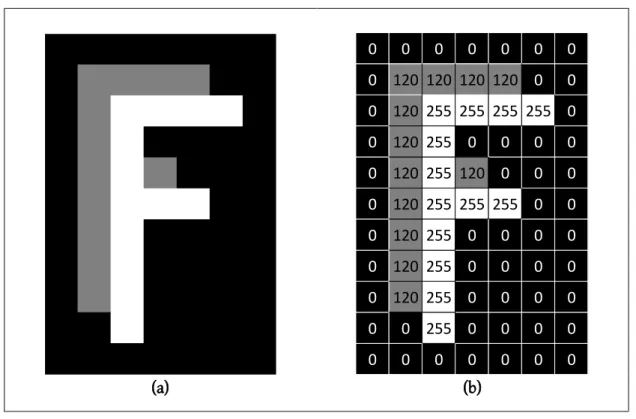
Digital image analysis is the extraction of useful information from images by using image processing algorithms. This falls within the field of computer vision, which includes all matters related to the development of an artificial system that can interpret visual information in a meaningful way. Thus, computer vision is the larger field that also includes subjects related to image acquisition, such as lighting and imaging devices (cameras). When computer vision is used in industrial applications, it is commonly referred to as machine vision, although no universally accepted terminology exists in these overlapping fields. Hereafter, the term machine vision and not computer vision will be used, since the applications of this work are in the process industries. Computers “see” images as data points, with each pixel in the image being a variable. In greyscale images each pixel is represented by one value called its lightness or intensity, which ranges from 0
Chapter 2 – Vision-based inferential sensing 16
to 255 in an 8-bit image. An example is shown in figure 2-2: the extreme intensities are black (0) and white (255), with all other intensities having values in between these two extremes.
Since each pixel is a variable, image analysis algorithms sometimes require the “unfolding” of an image: the image matrix is reshaped either row-wise or column-wise into a one-dimensional array. In the example in figure 2-2, the 7 × 11 matrix would be unfolded into a vector of length 77.
Unlike in greyscale images, pixels in multivariate images are represented by more than just one value. Colour images are often represented in the RGB colour space: each pixel is a three-dimensional variable represented by a red, green and blue value. An alternative and perhaps more intuitive colour space is the HSL system, in which a hue, saturation and lightness (intensity) value is associated with each pixel.
RGB images have three spectral bands (red, green and blue). Images represented by higher dimensional colour spaces are called multispectral images, and can include infrared spectra. These images contain additional information in the spectra that cannot be observed by the human eye, but which can be extracted with image analysis algorithms.
The goal of a machine vision implementation is usually to obtain some of the same information that would be obtained with the human visual cortex (a biological vision system). For this reason, many image analysis methods are based on models of biological vision. Although much progress has been made in the last few decades with the ever-increasing computer processing power, in most cases machines have not been able to replace human analysts. However, in some applications computers can even outperform humans, especially when a large amount of pre-processing is required.
(a) (b)
Figure 2-2: (a) An example greyscale image of an “F” with size 7 x 11 pixels, and (b) its computer representation. 0 0 0 0 0 0 0 0 120 120 120 120 0 0 0 120 255 255 255 255 0 0 120 255 0 0 0 0 0 120 255 120 0 0 0 0 120 255 255 255 0 0 0 120 255 0 0 0 0 0 120 255 0 0 0 0 0 120 255 0 0 0 0 0 0 255 0 0 0 0 0 0 0 0 0 0 0
Chapter 2 – Vision-based inferential sensing 17
Machine vision may be used for a diverse range of tasks. The most common tasks in the process industries are:
Object recognition – determining whether an image contains a specified object, which can be used by autonomous robots in the handling of products (Felisberto et al., 2003)
Defect detection – finding regions in an image that do not conform to the norm, for instance detecting fabric faults in textiles (Kumar & Pang, 2002)
Classification – assigning one of several pre-defined classes to an image based on its
content, for example classifying the quality of steel surfaces into excellent, good, medium and bad categories (Bharati et al., 2004a)
Regression – inferring a continuous variable from an image, for instance predicting the grade of the valuable material in a flotation froth (Bartolacci et al., 2006)
2.3.2
Image analysis for inferential sensing
In many inferential sensing applications in the process industries, the desired information can be predicted by using process measurements from sensors that are already installed in the plant as inputs to a model. However, this is not always the case, especially in the minerals processing industry where many of the process streams or products are solids or slurries (Duchesne, 2010). In these cases the process state can often be determined visually, and this means that image analysis can be used to assist in, or take over, the role of plant operators who interpret the appearance of the process.
The key point to observe here is that the use of image analysis to extract desired information from a process is the same as the use of an inferential sensor with image data as its input variables. In this work, these synonymous procedures are referred to as vision-based inferential sensing.
Framework used in this work
All purely vision-based inferential sensors use data-driven models, since a first principle relationship between the input variables (image pixels) and an output process response variable does not exist. Figure 2-3 shows a framework for the development of a vision-based inferential sensor (adapted from Duchesne et al., 2012), which is very similar to the general framework for data-based inferential sensor development (see figure 2-1).
The first step in this framework is to capture image data using some form of imaging device, such as a digital video camera. Many physical factors can influence the quality of images obtained, and the usual approach is to optimise the imaging conditions as far as possible. For instance many authors recognise the importance of keeping the lighting conditions as constant and uniform as possible (Swain & Ballard, 1991; Duchesne et al., 2012). Alternatively, all possible variable image conditions can be captured and then modelled for removal during pre-processing (Leung & Malik, 2001). The pre-processing step typically consists of normalisation of each image to zero mean and unit variance, and can also include the correction of uneven lighting. Pre-processing is not always critical in vision-based inferential sensing, as many of the problems associated with process data
Chapter 2 – Vision-based inferential sensing 18
from standard sensors (such as differing sampling rates and missing measurements) are not relevant here.
Figure 2-3: A framework for the development of a vision-based inferential sensor. The blocks with solid frames represent required steps, while the blocks with dashed frames represent steps that may be omitted.
Process / product scene
Image acquisition
Pre-processing
Dimensionality reduction
Modelling
Desired information
Incorporation into monitoring
and control schemes
Normalisation
Lighting correction
MIA
Textural feature extraction
Feature selection
Regression
Classification
Key
Input / output
Algorithm step
Chapter 2 – Vision-based inferential sensing 19
Image data is very high-dimensional; moreover, spectral bands are usually highly correlated. Since regression or classification models do not perform well when the dimensionality of the input data is too high, dimensionality reduction is extremely important in vision-based inferential sensing. Dimensionality reduction of image data usually involves the extraction of features from the images. The problem of deciding which features to extract is the most critical part of the framework, as the overall efficiency of the sensor depends on how informative and appropriate these features are for the prediction of the desired information (Duchesne et al., 2012).
Two types of features are typically extracted: spectral and textural features. Spectral features contain information regarding the number of pixels in an image having specific colours, and do not take the spatial distribution of the colours into account. These features are commonly extracted with multivariate image analysis (MIA), which applies PCA to an unfolded multivariate image. A more detailed discussion of MIA follows in section 2.3.3.
Textural features capture the spatial organisation or texture of the pixels, but only take one spectral dimension (usually intensity) into account. Since texture analysis is a major focus area of the current work, the larger part of chapter 3 (p. 27) is dedicated to this topic.
The final step is to build a regression or classification model. Partial least squares (PLS) is a popular regression option, while common classifiers include the K-nearest neighbour (K-NN) classifier, discriminant analysis (DA) and support vector machines (SVMs). In this work, only classification case studies were considered, and the investigation of the classification step was moreover not a main focus. Therefore, only two basic and popular classifiers were considered: K-NN (detailed in chapter 3, section 3.8.1, p. 58) and DA (section 3.8.2, p. 59).
Other image analysis frameworks
It should be noted that the dimensionality reduction and modelling procedure described here is not the only possible framework for the extraction of desired information from process images. Segmentation techniques have frequently been used in commercial image analysis software. For example, to determine the particle size distribution of particulate matter, segmentation techniques such as edge detection would attempt to find the edges of each particle in an image. From the segmentation of the image, mathematical correlations are used to calculate the particle size distribution. Segmentation techniques have been found to be very sensitive to irregular light reflections and shadows, which limits their robustness in industrial applications (Aldrich et al., 2012).
2.3.3
Multivariate image analysis
Image analysis in the process industries has been focused on multivariate image analysis (MIA), a technique that was originally proposed by Geladi and others (1989) for the extraction of spectral features from images. The use of MIA for prediction is often referred to as multivariate image regression (MIR), which is a form of vision-based inferential sensing.
The earliest work on the application of MIA in the process industries was a conceptual study by Bharati and MacGregor (1998), who illustrated the potential of MIA for real-time process
Chapter 2 – Vision-based inferential sensing 20
monitoring and control by using a sequence of multispectral satellite images, since multispectral process image data were not available at the time.
There are many variations of MIA, but most techniques involve PCA of unfolded images as a primary step: for each image a PCA representation is obtained by treating the pixels as variables and the spectral bands as dimensions. Thus, each image is associated with a set of component scores (also called score images) and a set of loading vectors (the weights by which the original pixels should be multiplied to obtain the component scores).
There are several ways in which PCA results may be used to extract desired information. In the traditional approach MIA is used directly for process monitoring in a segmentation approach. Areas of interest (“masks”) are identified in the principal component space (typically a plot of the first principal component score versus the second principal component score). The pixels falling within the masks are then overlaid on the original image to assess the segmentation quality, and the procedure is repeated iteratively until a sufficient segmentation is obtained (Geladi & Grahn, 1996). This masking approach was used to detect various defects in softwood lumber, which enabled the online grading of the wood – an online prediction inferential sensor task (Bharati et al., 2003). In an application to a zinc froth flotation process, masks were used to detect clear windows on bubbles (corresponding to a deficiency in reagents) and brown spots (correlated with sphalerite grade). These were used to monitor the sphalerite grade (Duchesne et al., 2003) and to detect when the reagent dosage should be adjusted (Liu et al., 2005).
MIA may be used for prediction by computing “overall” features (based on global representations of an image) or “distribution” features (based on local regions in images). One possible set of overall features is the first loading vector of each image (from its PCA representation). This was used by Yu and MacGregor (2003) to determine snack food coating content and by Bharati and others (2004b) to predict pulp properties. Additional loading vectors may also be used: in a flotation system the mineral grade in the froth was predicted by using the first two loading vectors as input spectral features (Yang et al., 2009).
Distribution features are more appropriate when the desired information is related to local variations of spectral features within an image, and can also be more robust to variations in lighting conditions. Some successful MIA applications using distribution features include the monitoring of flames in an industrial boiler (Yu & MacGregor, 2004) and the prediction of nitrogen oxides emissions in the off-gas of a rotary cement kiln (Lin & Jørgensen, 2011).
2.4
Applications in the process industries
This section gives an overview of three important application areas in the minerals processing industry, where the desired information is related to the visual appearance of the process: froth flotation systems, rock particles on conveyor belts and hydrocyclone underflows.
Chapter 2 – Vision-based inferential sensing 21
2.4.1
Froth flotation
Flotation is a popular method for the separation of valuable metal-containing minerals from gangue material. Slurry consisting of liberated ore particles and water is conditioned through the addition of a surfactant to render the valuable mineral particles hydrophobic. The slurry is then fed to a series of flotation cells, which are aerated to introduce air bubbles. The hydrophobic particles attach to the air bubbles, which rise to the surface, forming froth. This froth then passes to the next cell and is removed from the final cell, yielding a mineral-rich concentrate.
The metallurgical and economic performance of a froth flotation system is determined by the grade and recovery of the valuable material in the concentrate. Theoretically, grade and recovery are inversely related via the specific mineral’s grade-recovery curve.
The grade (𝐺) is the ratio of the mass of valuable material reporting to the concentrate (𝑚𝐶) to the
total mass of solids reporting to the concentrate (𝑀𝐶):
Recovery (𝑅) is the ratio of the mass of valuable material reporting to the concentrate (𝑚𝐶) to the mass of valuable material that was fed to the process (𝑚𝐹):
Recovery cannot be measured online, but rather has to be estimated from steady state mass balances after laboratory analysis of input ore and the final concentrate samples. Apart from the significant time delay incurred when calculating recovery in this way, some estimation error is inevitably introduced, as samples taken are not necessarily representative of entire process streams. Therefore, the usefulness of recovery as a controlled variable is limited, and most strategies focus on controlling the grade at the theoretical optimum point in the grade-recovery curve (Del Villar et al., 2010).
The mineral grade can be measured periodically via laboratory analysis, but this does not provide real-time information, as is required for process monitoring. Another possibility is the use of OSAs to measure the grade downstream from the flotation circuits, but these devices are expensive and have limited accuracy. The use of machine vision to aid in process monitoring has become an attractive alternative solution (Duchesne, 2010).
Commercial vision-based products for flotation monitoring
Several commercial products have been developed for vision-based inferential sensing in flotation systems. With FrothMasterTM (developed by Outotec) properties related to the physical appearance
and dynamic properties of a froth are calculated, among others the bubble size distribution, froth speed and direction, and froth stability. These measurements, together with statistical data related to these variables and grade predictions from an OSA, can be used for the automated control of the
𝐺 =𝑚𝐶
𝑀𝐶 (2-1)
𝑅 =𝑚𝐶