THE EFFECT OF ECHIACEA AGUSTIFOLIA O VARIOUS BIOCHEMICAL PARAMETERS I STRESS IDUCED RATS
Roshan. S1, Abdullah khan1, Tazneem.B2, Sadath Ali2*
1. Department of Pharmacy, Singhania University, Rajasthan 2. Luqman college of Pharmacy, Gulbarga, Karnataka.
*For correspondence: E-mail- [email protected]. [email protected].
Summary
The present study was carried out to evaluate the effect of ethanolic root extract of
Echinacea angustifolia on swimming endurance and anoxia tolerance test in mice,
cold induced stress and Immobilization in albino rats. The effect was assessed by swimming survival time and anoxia tolerance time, estimation of various biochemical parameters in cold and immobilization stress like glucose, cholesterol, triglycerides, plasma cortisol and blood urea nitrogen (BUN), and by determining the weight of organ such as, liver, spleen and adrenal gland. Blood cell count (WBC) and also the differential count at a dose of 200mg/kg and 400 mg/kg body weight per oral was carried out. It was found that extract significantly (p<0.001) increases swimming time and anoxia tolerance time. It also showed significant (p<0.001) decrease in blood glucose, cholesterol, triglyceride, plasma cortisol and BUN levels and also showed a significant (p<0.05) decrease in weight of organs. A significant (p<0.01) decrease in WBC count, polymorphs and monocytes and decrease in lymphocytes (p<0.05) and eosinophils was observed, compared to control group. Thus the obtained results revealed that the Echinacea angustifolia has got a significant anti stress activity.
Key words: Stress, Echinacea angustifolia, WBC, BUN
Introduction
Echinacea angustifolia known as Black Sampson of Compositae family known to have a great medicinal importance possessing many medicinal properties like, immunomodulator5, anti-inflammatory6, anti-microbial7,8, anti-cancer8, anti-oxidant9 and wound healing activity10. This study is designed to evaluate anti stress activityof
Echinacea angustifolia.
Materials and Method
The Ethanolic root extract of Echinacea angustifolia(EREA) (ECAG/JA 0071) and Ethanolic extract of Panax ginseng (EPG) (PAN-C00531) a gift sample obtained from Madhur Pharma, Bangalore.
The dried ethanolic extracts were suspended in distilled water using 1% Tween 80, used for pharmacological screening.
Experimental animals
Adult Swiss albino mice (20- 25g) and Wistar rats (150 -200g) of either sex were used for the study. The mice and rats were fed with standard pellet (Parnava Agro industries Ltd. Sangali, India) and water ad libitum. The animals were maintained under standard 12-hr light / dark cycle throughout the study. The study protocol was approved by IAEC. (No.CPCSEA/IAEC/PC-01/346).
Acute toxicity study 11
The study was performed according to the acute toxic classic method (as per CPCSEA/OECD guidelines). Swiss albino mice were used for acute toxicity study. The animals were kept Fasting for overnight providing only water, after which the test drug extract dissolved in water was administered orally at the dose of 1000 mg/kg and observed for 14 days. Animals were observed individually at least once during the first 30 min after dosing, periodically during the first 24h (with special attention during the first 4h) and daily thereafter for a period of 14 days. Once daily cage side observations included changes in skin and fur, eyes and mucous membrane (nasal) and also respiratory rate, circulatory (heart rate and blood pressure), autonomic (salivation, lacrimation, perspiration, piloerection urinary incontinence, defecation) and central nervous system (ptosis, drowsiness, gait, tremors, convulsion). The toxicity study carried out as per the guidelines of AOT- 421 using albino mice. The extracts were found to be safe till 1000mg/kg per oral. Hence the dose of 200 and 400mg/kg of EREA was selected for pharmacological screening.
Anoxia stress tolerance test 12
Swimming endurance test 13
Swiss albino mice (20 ± 2 g) of either sex were randomly divided into 4 groups of 6 animals each consisting Group I as control, Group II swimming test and subjected to the oral administration of EREA at the dose 200 mg/kg, Group III swimming test and subjected to the oral administration of EREA at the dose 400 mg/kg and Group IV subjected to anoxia test and the oral administration of EPG at the dose 100 mg/kg p.o respectively for 21 days. Swimming test was carried out on 7th, 14th and 21st day. One hour after the drug administration mice were allowed to swim in rectangular container (24×24×18 cm) filled with water maintained at 25 ± 2°C till they got exhausted and the moment they drowned head was considered as the endpoint. The time was noted and the data obtained were subjected to statistical analysis.
Cold stress
Albino rats (210-230gm) of either sex were divided in to 5 groups of 6 animals each. Group-I served as control, Group-II served as cold stress control, Group-III cold stress induced and treated with EREA 200mg/kg p.o, Group-IV cold stress induced and treated with EREA 400mg/kg p.o and Group-V cold stress induced and treated with EPG 100mg/kg p.o. Cold Stress was induced in 2nd, 3rd, 4th and 5th groups in albino rats, by exposing animals to 4 ±1°C daily for 2 hrs for10 days14. On 11th day all the animals were sacrificed and blood was collected for estimation of biochemical parameters like, glucose, cholesterol, triglycerides, plasma cortisol and BUN15, blood cell count16 and weight of organs such as liver, spleen and adrenal gland 17.
Immobilization stress
Albino rats (210-230gm) of either sex were divided into 5 groups of 6 animals each. Group-I served as control, Group-II served as immobilization stress control, Group-III immobilization stress and treated with EREA 200 mg/kg, Group-IV immobilization stress and treated with EREA 400mg/kg and Group-V immobilization stress treated with EPG 100mg/kg. Immobilization stress was induced in 2nd, 3rd, 4th and 5th group animals by immobilizing the animals with head down in supine position, by fixing the animals to a board inclined position at an angle of 60° daily for 2 hrs for the duration of 10 days18,19. On 10th day, the animals were sacrificed and blood was collected for estimation of biochemical parameter like glucose, cholesterol, triglyceride, Plasma cortisol and BUN levels15, blood cell count16 and weight of organs like liver, spleen and adrenal gland17.
Statistical analysis
All the values are expressed as mean ±SEM and data was analyzed by one-way ANOVA, using Graph pad INSTAT. The post-hock analysis was carried out by Dunnet's multiple comparison test to estimate the significance of difference between individual groups.
Results
The Anoxia tolerance test was determined by taking the appearance of convulsion as end point. EREA at the dose of 200 and 400mg/kg body weight has shown significant (p<0.001) increase tolerance stress time in 14th and 21st day compared to control (Table 1).
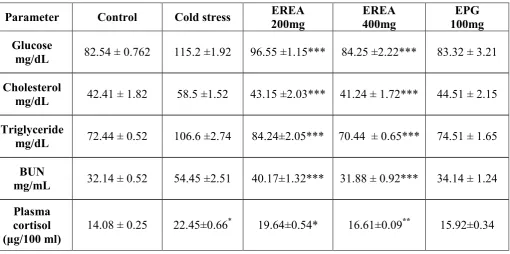
In cold stress induced, EREA has significantly (p<0.001) reduced the elevated levels of biochemical parameters like glucose, cholesterol, BUN, triglyceride and plasma cortisol levels compared to stress control group (Table 3). EREA has also reduced the blood cell count WBC’s significantly (p<0.01) and lymphocytes and eosinophils (p<0.05) compared to stress control group (Table 4). Determination of weight of organs showed that EREA has significantly (p<0.01) reduced the weight of liver, spleen and adrenal gland (Table 5).
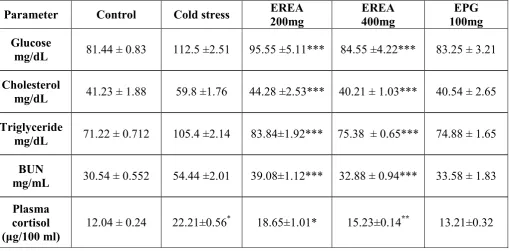
In immobilization stress induced, EREA has significantly (p<0.001) reduced glucose, cholesterol, BUN, triglyceride and plasma cortisol when compared with stress control group (Table 6). It has also reduced the blood cell count WBC’s significantly (p<0.01) compared to stress control group (Table 7). Determination of weight of organs showed that the extract has significantly (p<0.01) reduced the weight of liver, spleen and adrenal glands (Table 8).
Table 1: Effect of EREA on anoxia tolerance test
Mean duration of tolerance time (in min) Mean± SEM
Group
1st week 2nd week 3rd week
Control 3.8 ± 0.15 6.5 ± 0.65 11.8 ±0.15
EREA 200mg 3.2±0.71* 5.9 ±1.35*** 8.5 ± 0.22**
EREA 400mg 3.7±0.18* 6.2 ±1.07*** 10.2 ± 0.11**
EREA 100mg 3.3 ±0.11* 6.7 ± 0.25** 11.3 ± 0.83**
The values are expressed as mean ± S.E.M, n=6.
Significance at *(P<0.05), ** (P<0.01), *** (P<0.001), when compared to control.
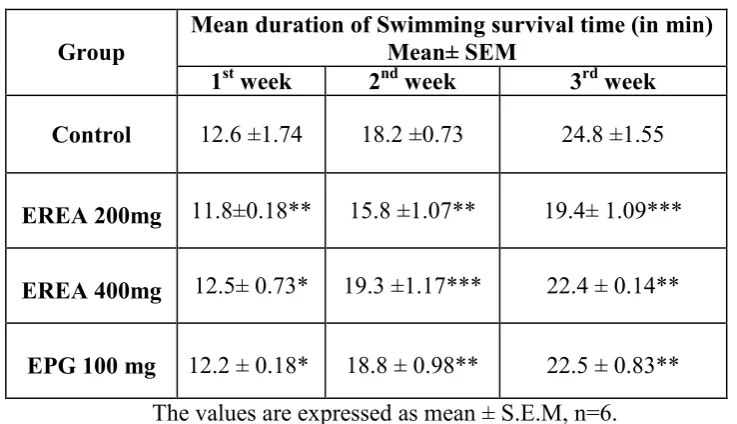
Table 2: Effect of EREA on swimming endurance test
Mean duration of Swimming survival time (in min) Mean± SEM
Group
1st week 2nd week 3rd week
Control 12.6 ±1.74 18.2 ±0.73 24.8 ±1.55
EREA 200mg 11.8±0.18** 15.8 ±1.07** 19.4± 1.09***
EREA 400mg 12.5± 0.73* 19.3 ±1.17*** 22.4 ± 0.14**
EPG 100 mg 12.2 ± 0.18* 18.8 ± 0.98** 22.5 ± 0.83**
The values are expressed as mean ± S.E.M, n=6.
Table 3: Effect of EREA on biochemical parameters in cold stress
Table 4: Effect of EREA on weight of organ in cold stress
Table 5: Effect of EREA on blood cell count in cold stress
Parameter ormal cold stress EREA
200mg
EREA 400mg
EPG 100mg
WBC 4844 ± 40.22 6670 ± 25.1 6014 ±33.1*** 5123±42.21*** 5204±46.01
Lymphocytes 47 ± 1.52 68 ± 1.22 60 ± 0.12** 55 ± 1.03** 54 ± 1.02
Monocytes 1.00 ± 0.0 3.15 ± 0.19 1.45 ± 0.50** 1.5 ± 0.46** 1.5 ± 0.71
eutrophills 23 ± 0.41 36 ± 0.85 27 ± 0.50* 29 ± 0.22* 28 ± 0.01
Eosinophils 1.24 ± 0.2 4.55 ± 0.22 2.25 ± 0.15* 1.0 ± 0.10* 1.0 ± 0.25
.
Parameter Control Cold stress EREA 200mg
EREA 400mg
EPG 100mg
Glucose
mg/dL 82.54 ± 0.762 115.2 ±1.92 96.55 ±1.15*** 84.25 ±2.22*** 83.32 ± 3.21
Cholesterol
mg/dL 42.41 ± 1.82 58.5 ±1.52 43.15 ±2.03*** 41.24 ± 1.72*** 44.51 ± 2.15
Triglyceride
mg/dL 72.44 ± 0.52 106.6 ±2.74 84.24±2.05*** 70.44 ± 0.65*** 74.51 ± 1.65
BU
mg/mL 32.14 ± 0.52 54.45 ±2.51 40.17±1.32*** 31.88 ± 0.92*** 34.14 ± 1.24
Plasma cortisol (µg/100 ml)
14.08 ± 0.25 22.45±0.66* 19.64±0.54* 16.61±0.09** 15.92±0.34
Parameter Control Cold stress EREA
200mg
EREA 400mg
EPG 100mg Spleen
mg/100g 3.15 ±0.11 2.31±0.12 3.08±0.21** 3.31±0.25** 3.32 ± 0.26**
Liver
g/100g 5.142±62.5 6.718±38.2 5.921±13.8*** 5.22±11.8*** 5.101 ± 10.8**
Adrenal
Table 6: Effect of EREA on Biochemical parameter in immobilization stress
Table 7: Effect of EREA on weight of organ in immobilization stress
Table 8: Effect of EREA on blood cell count in immobilization stress
Parameter ormal cold stress EREA
200mg
EREA 400mg
EPG 100mg
WBC 4844 ± 41.01 6940 ± 45.9 6014 ±
40.2*** 5521±42.21*** 5216±45.21
Lymphocytes 47 ± 1.74 69 ± 1.20 64 ± 0.52** 56 ± 1.03** 55 ± 1.04
Monocytes 1.00 ± 0.0 3.35 ± 0.15 1.55 ± 0.50** 1.5 ± 0.46** 1.5 ± 0.04
eutrophills 24 ± 0.42 35 ± 0.88 28 ± 0.50* 30 ± 0.22* 29 ± 0.91
Eosinophils 1.24± 0.5 4.51 ± 0.22 2.24 ± 0.25* 1.82 ± 0.05* 1.41 ± 0.25 The values are expressed as mean ± S.E.M, n=6.
Significance at *(P<0.05), ** (P<0.01), *** (P<0.001), when compared to stress control.
Parameter Control Cold stress EREA 200mg
EREA 400mg
EPG 100mg
Glucose
mg/dL 81.44 ± 0.83 112.5 ±2.51 95.55 ±5.11*** 84.55 ±4.22*** 83.25 ± 3.21
Cholesterol
mg/dL 41.23 ± 1.88 59.8 ±1.76 44.28 ±2.53*** 40.21 ± 1.03*** 40.54 ± 2.65
Triglyceride
mg/dL 71.22 ± 0.712 105.4 ±2.14 83.84±1.92*** 75.38 ± 0.65*** 74.88 ± 1.65
BU
mg/mL 30.54 ± 0.552 54.44 ±2.01 39.08±1.12*** 32.88 ± 0.94*** 33.58 ± 1.83
Plasma cortisol (µg/100 ml)
12.04 ± 0.24 22.21±0.56* 18.65±1.01* 15.23±0.14** 13.21±0.32
Parameter Control Cold stress EREA 200mg
EREA 400mg
EPG 100mg Spleen
mg/100g 3.59 ±0.12 2.59±0.15 3.06±0.22** 3.31±0.22** 3.33 ± 0.26**
Liver
g/100g 5.124±14.5 6.715±32.2 5.941±13.5*** 5.22±11.8*** 5.181 ± 10.8**
Adrenal gland g/100g
Discussion
Stress produce characteristic changes in several hormones and parameters associated with the central nervous system and the hypothalamic-pituitary-adrenal axis (HPA). HPA changes include an increase in cortisol, a reduced sensitivity of the HPA to feedback down-regulation, and a disruption in the circadian rhythm of cortisol secretion. Central nervous system changes include the stress-induced depletion of catecholamine neuro transmitters such as nor epinephrine and dopamine. An acute increase in beta-endorphin levels is also observed under stressful conditions 20.
Rodents when forced to swim in a restricted space become immobile after an initial period of vigorous activity indicating the stress. Pretreatment with adaptogen increase swimming endurance in mice21. Increase in total swimming time of EREA treated mice showed significant improvement in the swimming time. Cold stress typically increases total leukocyte count, eosinophils and basophils. Plant adaptogen are smooth prostressors which reduce the reactivity of host defense system. The mode of action of adaptogens is basically associated with stress system. Adaptogens increase the capacity of stress to respond to the external signals of activating and deactivating mediators of stress response subsequently21, 22. The stress induced increase in total WBC count, which is decreased by EREA indicating its antistress and adaptogenic activity are similar to the changes produced by reference drug EPG.
Release of ACTH in stress stimulates adrenals to increase production of hormones epinephrine, norepinephrine, and corticosteroids. These hormones have profound effect on metabolic functions. Adrenaline raises blood sugar, while corticosteroid stimulates glycogenolysis and gluconeogenesis. Thus, increased cortisol influences mobilization of stored fat and carbohydrate reserve, which in turn increases blood glucose, protein, cholesterol, BUN, plasma cortisol and triglyceride levels23,24.
All the body functions, including cellular respiration depends on the oxygen supply. Any lack of vital element will play havoc on all body mechanisms and increase in adaptation during stress by any drug could be considered as its major anti stress effect. During stress adaptogens are capable of increasing succinate dehydrogenase[SDH] in the brain, decrease in brain neurotransmitters like norepinephrine(NE), dopamine(DA), serotonin(5-HT) and acetylcholine(ACh). Hence the observed drug effective in this model may be effective by the modulation of above mentioned neurotransmitters25. The extract of EREA showed significant increase in anoxia tolerance time which is an indication of either resistance to it or reduction in cerebral oxygen consumption. Both these effect are useful to protect neuronal cell against oxidative stress, the enzyme is responsible for utilization and conservation of energy in the cellular system of the organism; which helps adaptive processes during stress. EREA as well as the standard drug EPG significantly reduced the elevated serum cholesterol, triglyceride, plasma cortisol and BUN levels which may be due to inhibition of stimulation of sympathetic nervous system.
Stress causes alteration in hematological parameters like increase in WBC and DLC counts, neutrophils16,26. EREA as well as the standard EPG significantly reduced the WBC, lymphocytes, eosinophils and monocyte counts in cold and immobilization stress.
A variety of biological activities including Anti-stress activity were reported with flavonoids, tannins and glycosides26. Echinecea angustifolia contains biologically active chemicals that include glycosides, alkaloids, phenols like echinacoside, Cichoric, caftaric acid, alkylamides, polysaccarides like inulin, flavanoids, tannins and volatile oil27,28. The anti stress activity may be due to the presence of these constituents where as standard drug Panax ginseng an established adaptogenic drug too contains glycosides, steroids and flavoniods29.
Conclusion
The results obtained from this study suggest that the Ethanolic extract of Echinacea
angustifolia has potential Anti-stress activity which is comparable to standard
Ethanolic extract of Panax Ginseng.
Acknowledgements
The authors are thankful to Madhur Pharma Pvt Ltd, Bangalore, India, for the gift sample of ethanolic root extract of Echinacea angustifolia and ethanolic extract of
Panax ginseng.
References
1. Selye H. Experimental evidence supporting the conception of adaptation Energy. Amer J Physiol 1938;123:758.
2. Selye H. The evolution of the stress concept. American Scientist 1973;61:693-699.
3. Panossian A, Wikman G, Wagner H. Plant adaptogens III.* Earlier and more recent aspects and concepts on their mode of action. Phytomedicine 1999;6(4):287-300.
4. Ahmed G, Yusuf Amin KM, Khan NA, Tajuddin. The anti-stress activity of a gem containing Unani formulation against diverse stressors. J Ethanopharmacol 1998;59:187.
5. Bauer VR, Jurcic K, Puhlmann J, Wagner H. Immunologic in vivo and in vitro studies on Echinacea extracts. Arzneimittelforschung 1988;38:276-281.
6. Tubaro A, Tragni E, al. e. Anti-Inflammatory Activity of a Polysaccharide Fraction of Echinaceaangustifolia. J Pharm Pharmacol 1987;39:567-569.
7. Tragni E, Galli C, Tubaro A, P DN, Della Loggia R. Anti-inflammatory activity of Echinacea angustifolia fractions separated on the basis of molecular weight. Pharmacol Res Commun 1988;20:87-103.
8. Voaden DJ, Jacobson M. Tumor Inhibitors 3 Identification and synthesis of an oncolytic hydrocarbon from American coneflower roots. J Medicinal Chemistry 1972;15:619-623.
9. Chun Hu and David D. Kitts. Studies on the Antioxidant Activity of Echinacea
10.Tunnerhoff FK, Schwabe HK. Studies in human beings and animals on the influence of echinacea extracts on the formation of connective tissue following the implantation of fibrin. Arzneim Forsch 1956;6:330-334.
11.Nimbekar, Patil and Patki. Pharmacological evaluation of antistress and androgenic activity of polyherbal formulatiom AP 30000 containing P Ginseng. Indian drugs 2001:27-31.
12.Tomar VS. Effect of 'Geriforte' a Herbal Compound Drug on Anoxic Stress Tolerance in Animals. Indian Drugs 1984 March; 233-235.
13.Nagaraja HS, Jeganathan PS. Forced Swimming stress induced alterations in ingestive behavior in rats. Indian J Physiol Pharmacol 2003;41(1):94-100.
14.Bhargava KP, Singh N. Anti stress activity of Ocimum santium. Ind J Exp biology 1981;73:443-451
15.Vinay Agarwal, Bhayesh Gupta, Ushan Singhal, Bajpal SK. Examination stress changes in serum cholesterol, triglycerides and total lipids. Ind J Physiol Pharmacol 1997;41(1):404-408.
16.Takano T. Additive effect of nitrogen oxides and cold stress on circulating leukocyte counts in rats. Toxicology lett 1983;17:289-291.
17.Sandip, Sardesai R, Marjorie AE, Jolly FM.1993. Effect of stress on organ weight in rats. Ind J Physiol Pharmacol 1993;37:2:104-108.
18.Upadhya L, Shukla SS, Agrawal A, Dubey GP. Changes in brain biogenic amines under influence of an indigenous drug, geriforte, following immobilization stress. Indian J Exp Biol1988;6(11):911-912.
19.Shivprasad, Kharya and Rana. Antioxidant and Adaptogenic effect of an herbal preparation, Triphala. J Nat Remedies 2008;82-88.
20.Charlie Esimone, Michael O, Adikwul U, et al. Adaptogenic potentials of
Camellia sinensis leaves, Garcinia kola and Kola nitida seeds. Scientific
Research and Essay 2007;2 (7):232-237.
21.Gregory S, Kelly ND. Rhodiola rosea A Possible Plant Adaptogen. Alter Med Review 2001;(6)3:291-96
22.Meera Sumanth, Mustafa SS. Antistress, Adaptogenic activity of Sida cordifolia
roots in mice. Indian j Pharm Sci 2009;71(3):323-324.
23.Sharma VN, Godhawani JL. Stress induced changes in catecholamine, glycogen and blood glucose levels and their modification by antiadrenergic drugs. Indian J. Med. Res 1970:58:1063-1072.
24.Tache Y, Du Ruisseau P, Tache J, Selye H, Collu R. Shift in adenohypophyseal activity during chronic intermittent immobilization of rats. Neuroendocrinol.
1976;22:325-336.
25.Deore SL, Khadabadi SS. Screening of antistress properties of Chlorophytum
borivilianum tuber. Pharmacologyonline 2009;1:320-328.
26.Lakshmi BVS, Sudhakar M. Adaptogenic Activity of Lagenaria: An Experimental study using acute stress models on rats. J Pharmacol Toxicol 2009;4(8):300-306.
27.Pietta P, Mauri P, bauer R. MEKC analysis of different Echinacea species. Planta Medica 1998;64:649-652.
28.Ivan AR. Medicinal plants of the world: chemical constituents, traditional and modern medicinal uses. Vol 2, Humana press, Totowa, 2001:121-122.
29.Bhattacharya SK, Muruganandam AV. Adaptogenic activity of Withania
somnifera: an experimental study using a rat model of chronic stress. Pharmacol