1725
Implementation Of Multi-Security Algorithms In
Cloud To Achieve Confidentiality And Apply
Authentication
Arpit Agrawal, Ankit Yadav
Abstract— Cloud computing originates with many features to serve users with resources, services and wide storage for data. If any kind of data is stored then it requires security, so security of data becomes significant issue in cloud. Over the time, this issue needs to be resolved for the security purpose. Due to the sharing of distributed resources through an insecure network in an open environment, cloud faces security issues therefore easy access of data is possible from anywhere. Existing work employed security using symmetric algorithm AES, which suffers with the issue of stolen of key while transmission. Performance of existing work is also not satisfying and is achieved in proposed work by decreasing delay time. Presented work achieved authentication, confidentiality and integrity to maintain security and privacy.
Index Terms— AES, BLOWFISH, Cloud Computing, ECC, Security, SLA, Resource Pooling
—————————— ——————————
1 I
NTRODUCTION Cloud security can be achieved using following terms:1. Data Security: Data security can be achieved by the identity access management, risks of multi tenancy, availability and backup, data privacy and security.
2. Physical Security: Data location, server, storage and network are calculated in physical security.
3. Organizational: Organization with resource planning,
change management and malicious insider, which is important to detect.
4. Technological: Application development, portability, lack of interoperability standards is essential in technological security.
5. Compliance & Audit: Compliance and audit consisting of legal challenges, business continuity and disaster recovery.
Cloud model are coordinated with different advancements like web administrations, virtualization, and for the board of utilizations administration level understanding are utilized (SLA). Numerous clients' specialist organizations are turned towards cloud condition as a result of quick development in advances. For the system network, the military, business framework and government to get the accessibility of high administrations to the client utilize distinctive cloud administrations. The fate of IT division is envisioned in distributed computing. Distributed computing is the incorporated type of virtualization and robotization. It points as separating working framework from the equipment. It gives pay as examine administration, which is adaptable. Administrations can be effectively open in cloud by anybody. It is not totally verifying a result of its open nature however should be secure for the security reason. Private cloud is claimed and utilized by an association with constrained administrations and restricted openness to framework and is constrained to a specific association. Because of its private nature, it is more secure than open cloud. Hybrid cloud is the mix of open and private cloud; open cloud performs non-basic exercises and in private cloud performs basic exercises. Associations for the arrangement model on private cloud take points of interest for secure applications. By for the money saving advantages applications and information are shared for the money saving advantages. Network cloud resembles a private cloud where gathering of associations are present with the administrations. Distributed computing is the mutual pool of assets, which is open and is defenseless. It is well known as a result of its wide utilize and monstrous stockpiling. In cloud
information can be put away and recovered. Client can utilize its administrations and access assets. Innovation servers their clients with various administrations with giving secure information. Distributed computing is likewise a server farm, a cloud server farm. Here, sharing and putting away of information can be conceivable by client from anywhere whenever yet with the accessibility of web. Huge information rises up out of numerous sites and this information is to be put away some place at specific spot, these sites conveying a mass information are web-based business sites, person to person communication destinations and furthermore game plan of these information are significant. Over a web, clients are presenting with the on-interest administrations. Administration like conveying, putting away, arranging and sharing can be accomplished. Huge information of systems administration destinations, messages and so forth are put away in cloud.
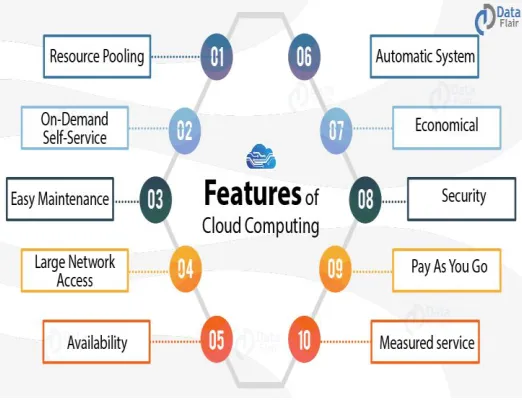
Features of Cloud Computing involves:
Resource pooling
On-Demand Self-service
Easy maintenance
Large network access
Availability
Automatic system
Economical
Security
Pay as you go
Measured service
2 R
ELATEDW
ORKAlgorithmic approach is described in this related work with the techniques and mitigation approaches for basic improvement. Bih-Hwang Lee [1] proposed a possible method to encrypt data is Advanced Encryption Standard (AES). Similar to cloud computing, Heroku was implemented by author in the proposed work. Some of the highlights of this work is as:
For implementation of data security in Heroku, author used AES algorithm.
AES is used for data security as a cryptographic algorithm
Calculation of delay time in encryption shows large data size with increased delay time.
Cloud computing [2] illustrates different attributes, which are elaborated below:
1. Self-requisite of resources: Requirement includes
processing capabilities, storage, software and other provision for network services.
2. Shared Resources: It includes corporate models for which shares resources, multiple users in same network shares resources at different levels like application, host and network level.
3. Scalability: Scalability is the ability to manage thousands of systems, storage and manage large bandwidth.
4. Resistance: Promptly escalation and reduction of resources as per user requirement.
5. Pay-per-use: It is cost effective in term where; use have to pay for the used resource.
Deyan Chen et al. [1] described about security in cloud and research about it with its drawbacks. Cloud security applications are designed and its significance are analyzed and discussed in multiple dimensions. This approach suggests that the technology is not completely adopted till now. The advantages and disadvantages of cloud security, its complete architecture is discussed. Vishwanath s Mahalle et al. [2] performs the security measures with the use of three keys. Logic of this says that if one key compromise then the other key will not permit user maintain the security by using three keys, the logic behind the work is that even if one key will be comprised the other two keys will not allow the user to get into the system. In this work, the security is applied at administrator end as well in order to have secure transaction. Chang et al. [3] proposed about the platform for financial software as a service (SaaS) and also about security framework in cloud. He demonstrated that the financial services on cloud can be achieved by the following features like scalability, flexibility, reliability, security, accuracy, speed and probability. The author mainly concluded about the financial service on cloud and how it can be achieved using SaaS or framework.
3
P
ROBLEMD
OMAINSSecurity of cloud involves network security and security among computer’s sub-domain. Data center model, which are owned by third party in cloud platform, also becomes the anxiety for user in terms of security. Many of the programming languages are provisioned by cloud platform for the deployment of web application. Cloud computing helps in managing and integrating services in ecosystem by deploying and running applications. Data security is the significant issue observed in cloud computing and needs to be handled within a time using cryptography methods. Existing system used Advanced Encryption Standard (AES) to encrypt data. AES is a symmetric key algorithm, which suffers with the issue of encrypting and decrypting using secret key, which should be known, to both the sender and receiver. That means both are using same key for encrypting and decrypting data. This involvement of similar key may lead to security issue of data in condition of stolen or hacking of key while transmission. Performance measure of AES is comparatively high in comparison of delay calculation while data encryption and decryption. Large size of data takes increased delay time for encrypting data. Problem faced in the proposed work is security issue. This type of issue arises due to the open nature of cloud where there is easy to access any data. In public cloud environment, anyone from anywhere can access resources and use service on demand. The data access in is the form of plain text, which can be easily accessed. The proposed approach used in our work is for protecting the private data. Data protection is essential for the purpose of authentication. If any user “A” stores his data in cloud and another user “B” want to access that data for any malicious activity then the data of user “A” should be secured, so that no one can access it. In most of the research homomorphic encryptions are used on the data mining approach to encrypt the data but for the better security, we have used hybrid approach in our paper.
The security issues in cloud computing includes: 1. Data security [Privacy of Data] 2. Authentication [User Identity]
3. Access control [Permission of Service Access]
4. Key management [Requirement of Strong Encryption
with minimum Key overhead]
5. Requirement of Separate security services for Internal User Access & External User Access
4
P
ROPOSEDM
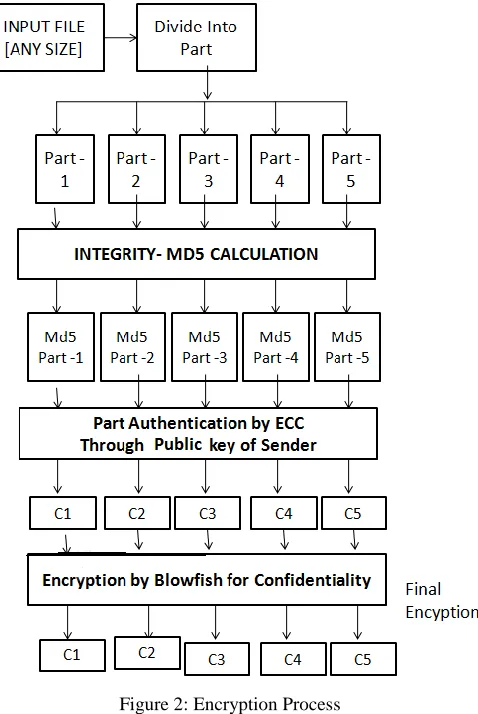
ETHODOLOGYProposed methodology involves the encryption process and decryption process, how the data is encrypted and decrypted using ECC and BLOWFISH algorithm. Complete system architecture for both the process is shown in figure 3 and figure 4.
Flow of complete architecture is as:
Input file of any size is taken.
It is divided into multiple parts
Every part of data is taken to calculate integrity using MD5.
After that, ECC is applied for part authentication
calculation through public key of sender.
The authenticated data is in chunk form and are encrypted using BLOWFISH algorithm to achieve confidentiality.
The complete encryption process has been shown in figure 2 Encryption process helps us to implement data privacy and keep data confidentiality safe. Flow to perform Decryption:
The encrypted chunks are firstly decrypted using
1727
Then the evaluated chunks are again decrypted using ECC
algorithm with the help of receiver’s private key.
After it every part of decrypted data, integrity is recalculated.
If the data match then final data file is obtained.
Figure 2: Encryption Process
The complete decryption process has been shown in figure 3 Methodology says that proposed model ensures security by encrypting data automatically with using vigorous algorithm that gives accurate and fast result. Methodology includes MD5 to achieve integrity, ECC to achieve authentication and Blowfish to achieve confidentiality.
Figure 3: Decryption Process
5 E
XPERIMENTALA
NALYSISExperimental analysis involves two sections to evaluate result and show performance of work. Section 1 shows snapshots of the working project and section 2 shows the performance of work involving existing work, proposed work and comparison between proposed and existing work.
Section 1 showing snapshots of login page and service page.
Figure 5: Service Page
Section 2 involves experimental analysis, which shows the study of existing work and proposed work, and also their comparison is shown which is examined through result table and its graph.
Table 1: Existing Table
File Size (KB) Delay (sec)
3000 0.6
5000 0.8
7000 1.3
10000 1.6
15000 2.1
0
0.5
1
1.5
2
2.5
D
el
ay
(s
)
File Size (KB)
Existing Work
Figure 6: Existing Work
Table 2: Proposed Table
File Size (KB) Delay (sec)
3000 0.1
5000 0.5
7000 1.8
10000 1.2
15000 1.5
0
0.5
1
1.5
2
3000 5000 7000 1000015000
De
la
y
(ms
)
File Size (KB)
Proposed Work
Figure 7: Proposed Work
1729
6 C
ONCLUSIONSMechanism for encryption and decryption using different algorithms are concluded in proposed work. BLOWFISH and ECC algorithm are used in both encryption and decryption. Where, authentication is achieved using ECC and then encryption is performed using BLOWFISH to achieve confidentiality. Presented work focuses on security of data in cloud. In addition, the security services like authentication, authorization, confidentiality and integrity is required to accomplish for proper accuracy and performance. No other user can access data of another user of cloud with detecting suspicious activity in cloud. Concluded work explores the performance evaluation comparison between existing and proposed work and result determines that proposed work is better than existing work. Delay time of existing work is more in comparison to proposed work.
7
R
EFERENCE[1] Bih-Hwang Lee, Ervin Kusuma Dewi, “Data Security in Cloud
Computing Using AES under HEROKU Cloud”. 27th Wireless and Optical Communications Conference, IEEE (WOCC2018), 2018.
[2] Information Security Briefing Cloud Computing, Vol.1, Center of The Protection of National Infrastructure CPNI by Deloitte, 2010, p. 71.
[3] L. Foster, Y. Zhao, I. Raicu, S.Y. Lu, Cloud computing and grid computing 360-degree compared, in: Grid Computing Environments Workshop, GCE’08, Austin, TX, Nov. 12-16, 2008, pp. 1-10.
[4] The NIST Definition of Cloud Computing, National Institute of Science and Technology, p.7. Retrieved July 24 2011.
[5] J.W. Rittinghouse, J.F. Ransome, Cloud Computing
Implementation, Management, and Security, CRC Press, Boca Raton, 2009.
[6] Deyan Chen; Hong Zhao, "Data Security and Privacy Protection Issues in Cloud Computing," in Computer Science and Electronics Engineering (ICCSEE), 2012 International Conference on, vol.1, no., pp.647-651, 23-25 March 2012.
[7] Vishwanath s Mahalle, Aniket K Shahade, “Enhancing the data
security in Cloud by implementing hybrid (Rsa & Aes)
encryption algorithm”, “Power, Automation and
communication (INAP)”, 2014.
[8] V. Chang, C.-S. Li, D. De Roure, G. Wills, R.J. Walters, and C. Chee, “The financial clouds review”, Cloud Computing Advancements in Design, Implementation, and Technologies, vol. 125, 2012.
[9] A. Lopez-Alt, E. Tromer, and V. Vaikuntanathan, “On-the-fly multiparty computation on the cloud via multikey fully homomorphic encryption”, in Proceedings of the forty-fourth annual ACM symposium on Theory of computing. ACM, 2012, pp. 1219-1234.
[10] M. Brenner, J. Wiebelitz, G. Von Voigt, and M. Smith, “Secret program execution in the cloud applying homomorphic encryption”, in 5th