358
Maximizing Profits Using Genetic Algorithm
Alaa Obeidat, Mohammed Al-Shalabi, Addy Al-quraan, Wafa’ Almaa’itah
Abstract—Maximizing profits from products that one sells in a given marketplace is the main goal of any manager, entrepreneur, or a marketer who
wants to make his business a success. This study aims at illustrating how this can be made possible by use of genetic algorithms. The proposed approach can be used by managers and marketers to maximize profits by increasing sales of products through optimization of the genetic algorithm (GA). The optimization results to greater accuracy in prediction and improves classification of the products in groups. Each group contains products with high sales and low sales. Then after applying the GA operations we will generate groups of three items and the manager then can make a promotion to sell these products together and improve the sales of products that are not selling well. This research seeks to provide manages with decision support model which will help them maximize sales and profits resultantly. Optimization using genetic algorithms is done in this research where versatile tools could be used in adjusting a business to reach a global scale in research. This will be achieved from the aspect of this research implementing a global optimization method that has capabilities of non-differentiating functions. The test conducted utilized minimum attention to generic algorithm. In this case, it is preferred that performance would be possible to implement rather than executing the algorithms in a way that they would run longer and on which that they would require varying selection method, rate of mutation, and the population size.
Index Terms: Crossover, Decision Support System, Genetic Algorithm, Offer, Optimization.
—————————— ——————————
1
INTRODUCTION
The marketplace has proven itself to be the greatest place of investment, where every investor wants to own a share. Besides, every investor wants to maximize their share so that they can maximize their profits. However, scaling to greater profits leads to an investment facing greater risks. This is the point at which investors and all stakeholders who run a profit-oriented investment need to capitalize of using various technologies that can optimize prediction as a way of evading or minimizing risks [1].
In most shops, especially those that sell food products, some of these products are not selling well, and they will expire, then the shop manager will get rid of them. So, the solution here is that the manager of the shop can get a list of the products regularly to find the products that will expire soon in order to sell them quickly by placing them with other materials that are high on demand.
But finding the low sales products is very difficult issue, and how the shop manager will find the products with a high demand[1], the products with low demand, or the products that will expire soon. And how the manager will decide what is the best offer of the products that will encourage the customers to buy them. All these issues make the manager is so confused regarding how to find the best solution for this problem. Genetic algorithm increases focus and improves accuracy performance, which results to improved market forecast. Thus, for a marketer to increase accuracy and precision in market forecast, they need to make use of GA. But GA optimization varies from one system to another. For instance, some forecast insights require processing of winning ratios, other implement payoff ratios, and others implement profit factor. Businesses could make use of an intelligent ensemble system which can be developed using GA optimization to process and generate inventory automatically.
The inventory generated via GA optimization has less wastage, therefore maximizing profits [2].
An approach for finding such products as well as the best offer to sell the products together in one package and avoid losing them is discussed in this research by using the genetic algorithm technique. Also, the approaches outlined in this paper could also be used in more efficient and outstanding inventory management [2]. Nonetheless, real estate is one business that involves high risks but at the same time it is one of the most efficient ways of maximizing profits. In this business, GA is applicable in matching rental price setting with geographical location of hose units. The aspect of urbanization is used in this case. This illustrates that with GA, it is hard to undercharge or overcharge tenants [3]. Legit business translates to a more efficient and more outstanding one that may guarantee great returns from loyal and returning customers.
In other studies, business promotion approaches that have been covered are typical but not of them have focused on use of genetic algorithms to maximize the output. The Generic algorithm helps in uniquely providing an optimal offer of pattern of products that lead to increase in profits. Considerably, genetic algorithms have different areas of application which include in sales and marketing. In this field, any number of string chromosomes is used in encoding the values of various groups of products on sale in an optimized manner. Other numerous studies focus on the domain of genetic algorithms and their application in sales and marketing but from the perspective that is a bit complex. The aspect of complexity motivates this research by having it based on application of genetic algorithms in sales and marketing with the aim of enhancing the operations and increasing profits in a way that is easy to understand.
1.1 Genetic Algorithm
GA is basically used as search algorithm in most cases and is mostly applied in solving complex issues. There are mechanics of natural selection as well as natural genetics that drive the workability of GAs. One of them is the use of fitness information instead of using Gradient information. This illustrates that GAs are not much demanding when it comes to requiring information to use in sales and marketing optimization. GAs can also be applied in classification, which is a very important operation as far as sales and marketing is concerned. This places GAs at a better advantage and favors _________________________
Alaa Obeidat is currently working as senior lecturer in Hashemite university, basic sciences dept, Jordan. E-mail: [email protected] Mohammed Al-Shalabi is Asst prof in world Islamic Sciences and
education university . E-mail: [email protected] Addy Al-quraan is currently working as senior lecturer in Hashemite
university, basic sciences dept, Jordan. E-mail: [email protected] Wafa’ Almaa’itah is currently working as senior lecturer in
359 managers of sales and marketing by ensuring that GAs
provide more than conventional parameters in optimization and classification, which makes them appropriate for problems that are ill-behaved and spaces that are highly non-linear for global optimal and adaptive algorithms [14].
The genetic algorithm (GA) is typically characterized by the following aspects:
They work based on the code of the artificial genetic strings which are put in variable groups and not with the variables themselves.
The GA also worth with sets of populations of potential solutions rather than taking the approach of attempting to improve one given solution.
The GA also refrains from using data that is collected directly from its derivatives that may be of similar object functions.
The GA implements the probabilistic transaction rules which are far from deterministic rules.
The GAs application involves a quite simple process. It only involves strings that are provided in a copy, and the string mutation in various random forms. From a basic perspective, GAs can produce acceptable results in solving a variety of particular problems, which are usually made of three major operators. They are:
Mutation, Crossover, and Reproduction
2 RELATED WORK
Some of the related works that are reviewed in this paper show various instances where GA is used in various commercial operations. According to [7], GA provides businesses with the ability to avoid complexities and time consumption that would be experienced with the use of traditional statistical and mathematical formulas which are hectic. Banks are usually faced with great challenges when it comes to making decisions regarding rending. They have to be careful whom they rent and at what cost as well as know the various ways they could use to recover the money. [7] Proposes a model that implements GA, which focuses on ensuring that lending decisions are highly organized and therefore are able to put a business at a competitive advantage in the competitive market environment. The GA powered framework is therefore able to carry out effective and efficient optimization of bank objective, which assist in construction of loan portfolios.
In another research presented by [8], users of renewable energy in business need to know when they can deplete the energy in use, how to get new energy sources, and the patterns that they use in consuming energy, which enables them to plan ahead. All these objectives are accomplished by the means of running the GA after having specified the basic inputs, the objectives, the process, and the desired output. Architects also need to save on labor and other elements that lead to them saving on the cost of construction. Underwater structures are generally known to be much expensive to construct and they consume heavily on capital. They also require high skill levels to achieve success especially in sea-waters. According to [9], GA is used in powering an UWCEAS system, which requires optimization and configurations for it to work efficiently. The GA therefore helps in ensuring that the data is efficiently and effectively stored. The optimization using
GA increases efficiency in the construction process underwater, therefore greatly assisting in saving on cost which translates to profit when the cost that would be incurred without GA is considered.
Another research presented by [10] illustrates that Bilevel Evolutionary algorithms could be improved by use of quadratic approximation. Bilevel optimization problems are usually difficult to implement, which requires application of GA in modifying them. They are then applied in commercial activities for effective and efficient running. Another research by [11] provides an overview of how loan portfolio can be optimized by banks to provide outstanding results. The GA helps banks easily synthesize the loan type, size, interest rates, credit ratings, and other aspects of loaning that employees may consider to implement. In this research, GA is found to provide reproduction, crossover, and mutation [12]. This research therefore helps banks make profit from the interest rates they gain from the works that they present. This presents evidence that the technology allows banks to maximize profit.
In another research presented by [13], GA is applicable motor vehicle engineering on solving the vehicle routing problem (VRP). GA provides solutions through assisting in design of Bi-directional Decoding (BDD) elements from a genetic chromosome. This is achieved through improvement of the descendant using the algorithm. This give car manufacturer an advantage with enables them to sell more as well as be in a position to solve various issues efficiently. Cars developed using this technology have high chances of selling more since they have a better security feature [13]. Another important element provided by genetic algorithm is creation of a large-scale flow shop scheduling as illustrated in research presented by [14].
Flow shops use scheduling to ensure that all operations in them run smoothly and effectively. Genetic algorithms provide great feasibility and effectiveness in ensuring that orders are fulfilled. Genetic algorithm could also be used in creating marketing strategy that involve bidding in a day-ahead market, which provides an effective strategy for running or mastering the market prior to the time it takes place. In other words, genetic algorithm provides individuals with information on how to manage various market entities [15]. Profit-making in an organization involves implementation of numerous strategies that seek to ensure that the market runs effectively. Therefore, genetic algorithm is needed to help the marketers conduct critical analysis and therefore be able to make smart moves as far as marketing is concerned. Besides, it is possible to establish a more profitable market while running a 24-hour business schedule, having been powered by GA optimization.
3
METHODOLOGY
3.1 Representation Mechanism
The database is created to store the products information such as:
Product name: alphabetical characters are used in this research to denote products being marketed. The letters are A, B, C, D, and others to Z.
Sales transactions: This describes the number of items sold for each product.
Offer package: these are items that sell at once for an offer.
360 the proposed application of GAs, each package is
represented by a string of 3 characters and each character represents one product, and this constitutes the configuration string.
In the process of deploying GA, the first step to take is known as initialization. This is where a group of data sets is randomly selected from the database in pairs. The pairs represent products and between each pair of products, there is a chromosome picked from the database that is used to make up a configuration string (CS). The database where all the CSs are collected from usually have its constraints maintained. The database size is usually maintained in a fixed position that is greater than the population size [16]. The new strings that are formed initially from the database are used in creating or generating others strings, which in turn replace the old ones.
Nonetheless, the fitness function is needed for the sake of interpreting the chromosome in terms of physical representation as well as evaluation of its fitness, which has to be associated with the traits that are desired as outcomes. However, the fitness function should measure accurately the chromosomes quality. This puts the fitness function definition in a critical position, therefore. So the database will be used to select the initial generation that will consist of strings of two genes; in the beginning, it is considered essential to come up with a good selection of the next generations. Also, a new way of making good solutions that is proposed in this research is to generate populations and the then comes up with selection and crossover operations soon afterwards.
3.2 Genetic Representation
A GA that is proposed is made of a chromosome with sequence of positive integers or characters that give a representation of the IDs of products available in the shop. The chromosomes usually have each of its locus representing an item of a group of products that it could be an offer in the near future. Chromosomes are found to vary in lengths but they are restricted to only 3 at maximum as illustrated in Figure 1.
Figure 1: Gene representation
Where A,C,F are products available in the shop, also the order of the products in the chromosome is not important when we perform the genetic algorithm operations on the chromosome.
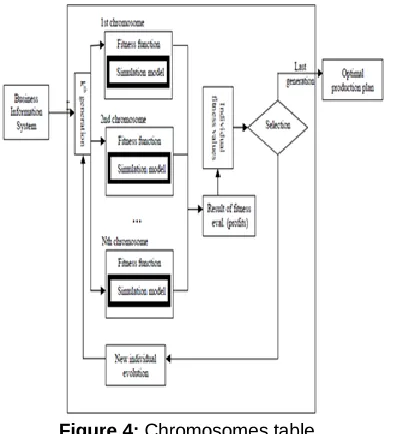
3.3 The Architecture of the Proposed System
Big shops require being dynamic to have a competitive edge in the market and cope up with the growing competition by increasing the products quality. This involves the mixture of products, productivity, etc. simulation enables the businesses improve their decision efficiency based on accurate prediction and actual data. The capability of simulation to indicate a real process with uncertainty is important in leading to correct decision.
The simulation model is later used in computation of fitness value using the chromosome as the data. By using the genetic operations on population members at the moment as G,
iteratively until produces a new result that will be used as G+1. The initial population G=0 is generated randomly and applied, iteratively.
When the optimization process is completed, the appropriate chromosome is simulated as the best offer that will increase the overall profit. The chromosome quality is indicated by the profit amount which occurs on the simulation model.
Figure 2: Architecture of the proposed system
3.4 Generate the Initial Generation (Select G0)
In earlier studies, this was not covered efficiently but in the proposed system the first generation covers all aspects of the solution.
A new different technique is used to select the initial generation. When we generate the initial generation, the first generation should have all the products in the shop.
Notes:
The matrix contains all products: (AB, AE, AC, BD, BF, CD…)
The first generation consists of pairs of products, and we have to ensure that each product existed with all the other products at least once regardless of the order of gene (product) in the chromosome (package of offer).
Any product must be taken once in every chromosome.
The system must account for all the products in the inventory or in the shop.
3.5 The Database OF Proposed System
Database of the proposed system consists of two tables as follows:
Table to store products information.
Figure 3: Products table
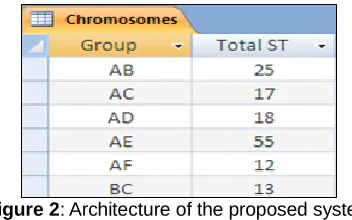
361 Figure 4: Chromosomes table
3.6 Tracing Example
Consider the following products in a shop:
CD, LCD, DVD, Printer, LED, and Mouse but in the example, we will use A,B,C,D,E and F to indicate each product in the shop. The sale transactions for each product are as follow: A=15, B= 10, C=2, D=3, E= 40, F= 12. As you can see from the numbers of sale transactions, there are some products are selling well and other products have low demand and are not selling well.
So we need to apply the algorithm on these products to maximize the overall profit by increasing the sales of products, and this can be done by making some offers on products of low demand together with the products of high demand.
3.7 Kinds OF Crossover That We Can Use:
1- One-point crossover: this involves taking one position randomly in first chromosome as a location to make other chromosome have the same. This can result in wrong results after the crossover operation. [4].
For example: If we take the following chromosomes and come up crossover between them at location 1: (BCD, AFE) after crossover, the following chromosomes are produced: (ACD, BFE).
2- Two-point crossover: this involves taking randomly one position on first chromosome to come up with the crossover; the location is taking the same for the gene. a different gene will be selected in the first chromosome and not necessarily in the same location.[5].
For example: If we have the following chromosomes, and make the crossover between them at location 3 then the location in the second chromosome is 2: AEBD, ABF, the following chromosomes are produced after crossover: (AEBF, ABD).
3.8 Mutation
It offers new information randomly to the genetic search process and evade being stuck at local optima. It increases population diversity when the population is standardized as a result of repeated use. The mutation can cause parent individuals to be different from other chromosomes. [5]. For example: If we take the following chromosomes, AEBD, ABF, ADF it can be noticed that all four chromosomes have
an (A gene) in the left-most position. So if we need another gene in the left other than A, here we can apply mutation on the first chromosome to produce chromosome with gene other than A like CEBD.
3.9 Fitness Function
F(i) is obtained from objective function and applied in the successive operations. Fitness is a quality value that measures the efficiency of productivity of chromosome. Fitness is applied to allocate reproductive characteristic of an individual. Those with great fitness have the likelihood of being designated for advanced examination.[6].
In this project, the following fitness function will be used to examine goodness of chromosomes:
( 1 ) F i) ∑li gi
j (j)
Where Fi stands for fitness value of the i-th chromosome, li is the length; gi (j) is the gene (product) of the n-th locus in the i-th chromosome, and (ST) is the sales transactions.
Example to demonstrate the methodology:
As mentioned before the following products will be used to demonstrate the methodology:
A=15, B= 10, C=2, D=3, E= 40, F= 12 The steps of the proposed algorithm are:
1. Generate the initial chromosomes, the initial chromosomes will be all the products in the shop, but any chromosome will be a pair of two products only:
2.
chromosome Total ST
AB 25
AC 17
AD 18
AE 55
AF 27
BC 12
BD 13
BE 50
BF 22
CD 5
CE 42
CF 15
DE 43
DF 14
EF 52
Table 1: Initial chromosomes
3. Then we will apply the GA operators as follows: After applying the GA operators randomly on the first generations, suppose the system will generate the following chromosomes:
BCD = 15, AFE= 67
Then applying the crossover operation on the above chromosomes will produce the following:
ACD = 20 BFE = 62
362 again on the chromosomes ACD, BFE will produce the
following: AFD= 30 BCE = 50
Here also, the gap is reduced; means the offers tend to be more attractive to the customers.
Also, we will apply the crossover on AFD, BCE the produced chromosomes will be
AFC = 29 BDE= 53
Figure 5: Main page of the shop
Here we will discard the produced chromosomes because the gap here is bigger than the gap in the previous stage. If we continue, we find the best offers that will be the best and will maximize the overall profit, and the best offer here will be ABF=37, CDE= 45.
Experimental example from the proposed system to demonstrate the new algorithm:
The customer page (Figure 6) shows the products without an offer. And after generating the offers, the offer page (Figure 7) will be as follows:
Figure 6: Customers page
The main page of a system for the shop (Figure 5) can be accessed by the shop manager only, and suppose here the manager selected all the products as we mentioned in the tracing example before, the customer page will be as follows:
Figure 7: Offers page
Genetic algorithm could be parallel and distributed as per the basics illustrated in the image below.
Figure 8: Parallel and Distributed GA
Illustratively, this image presents a model used in evaluating the effectiveness of genetic models in aiding decision-making processes. Decision-making is also applicable in maximizing profits in marketing [18]. A shop basically markets different products in parallel motion, which could be effectively and efficiently powered via use of GA as illustrated herein.
The GA is a methodology of solving optimization problem based on the natural selection driving the biological evolution. In every step the GA produces the parent individual and applies them as they come up with the next generation children. The GA also addresses mixed integer programming where particulars are restricted to a certain value.
4 DISCUSSION
From the introduction and related works, one can note that GA is applicable in a variety of businesses due to its benefits which include maximization of profits from different angles of businesses. One of them is by minimizing waste in the inventory, another one is by giving accurate results on price analysis and charges for real estate property rental, and in other cases, prediction results are achieved. But, one very essential and outstanding benefit that GA brings about is ensuring that outcomes are accurate. But, as outlined in this research, the algorithms to work efficiently, a locus need to be introduced. Every chromosome has one to three chromosomes. The locus represents products available in a shops inventory, implying that they are in store.
363 and maximize profits. Understanding the patterns of
customers means that business owner can be in a position to known what the customer needs most and therefore be able to provide them with what they want and how they need it. This could automatically lead to the customers being satisfied and happy. This would lead to the customers remaining loyal and referring more others. This leads to increased revenue and generation of more outstanding benefits lead by profit maximization. According to [17], satisfaction in customers implies that a business is growing and profits margins are increasing at the same time.
GA is characterized by working with codes in variable groups identified as the artificial genetic strings. This implies that GA optimization can be done in conjunction with other algorithms which are applicable in enhancing business such as Artificial Intelligence (AI), and others. The characteristic of implementing probabilistic transition rule implies that GA is applicable in the prediction of the future outcomes of a given trend in the market for a given commodity being priced. The research methodology presented in this research implements a sequential procedure that begins with initialization of variables and identification of characters. But, genetic labeling is very important in this process. It is considered a basic requirement since it helps in identifying the different products sets without struggling.
Again, for algorithms to work, they must be implemented via computer power. Now, there is no data that is too much to handle, particularly because Big Data analytics and other IT elements take case of data at any time and while at any place. The GA optimization is not expensive, which earns businesses a competitive advantage of having the ability to use GA in any field where prediction is needed. To make work easier, GA algorithms have the ability to sort out and arrange elements into groups that are easy to implement and understand at the same time. The grouping algorithm helps in identifying products that sell more from ones that do not.
5 CONCLUSIONS
GA is easily applied to wide range of problems like the travelling salesperson problem to inductive concept learning, layout problems and scheduling. The results are good and poor on others, the algorithm is very slow. The process of finding the best offer on the items in the shop is very difficult because we need to make an offer on the expiry or low demand items with another item that must have a high sale rate. Finding such items that have such relations with the expired item is difficult. The proposed system makes this process as easy as possible and increases the performance of the purchasing process (80%- 97%) by making the best offer on items. For example: if the sale rate of the expired item is 55%, and the system finds the best offer, the sale rate of such an item will increase and reach 85%, according to the result we got in our system.
6 FUTURE WORK
In the future, the GA algorithms will be enhanced further to ensure that they can comprehensively and efficiently achieve management of data in an effective manner that makes profits rise even higher. Also, a better arrangement and grouping process could give more effective and more efficient results and more importantly, more accurate prediction. GA could also be utilized in not only analyzing and identifying patterns in customer activities but it would also be used in enhancing
classification. More distinction in market segmentation would be achieved, which could result to efficient and effective business proves enhancement.
ACKNOWLEDGEMENTS
We acknowledge the anonymous reviewers who have issued various reviews and comments to help in improving the quality of this work. We also acknowledge the academic editors who have provided essential guidelines to ensure that this research is effectively and efficiently published.
REFERENCES
[1] Jaber A. Q, Hidehiko Y., F., Ramli R., Machine Learning in Production Systems Design Using GeneticAlgorithms, International Journal of Computational Intelligence, No. 4, 2008, pp. 72-79.
[2] Kim Y, Enke D. Instance Selection Using Genetic Algorithms for an Intelligent Ensemble Trading System. Procedia computer science. 2017 Jan 1;114:465-72. [3] Del Giudice V, De Paola P, Forte F. Using genetic
algorithms for real estate appraisals. Buildings. 2017 Jun;7(2):31.
[4] Goldberg, D.E., 1989. Genetic Algorithms in Search, Optimization and Machine Learning. Addison-Wesley, 1989.ISBN: 02-0115-7675.
[5] Radhakrishnan P., Prasad V. M., Gopalan M.R.,Optimizing Inventory Using Genetic Algorithm for Efficient Supply Chain Management, Journal of Computer Science 5 (3), 2009, pp. 233 - 241.
[6] Chen, S. H. Genetic Algorithms and Genetic Programming in Computational Finance. Boston, MA: Kluwer. 2002
[7] Metawa, N., Hassan, M. K., &Elhoseny, M. (2017). Genetic algorithm based model for optimizing bank lending decisions. Expert Systems with Applications, 80, 75-82.
[8] Iqbal M, Azam M, Naeem M, Khwaja AS, Anpalagan A. Optimization classification, algorithms and tools for renewable energy: A review. renewable and sustainable energy reviews. 2014 Nov 1;39:640-54.
[9] Cheung BC. Design of system architecture and thermal management components for an underwater energy storage facility.
[10]Sinha A, Malo P, Deb K. An improved bilevel evolutionary algorithm based on quadratic approximations. In2014 IEEE Congress on Evolutionary Computation (CEC) 2014 Jul 6 (pp. 1870-1877). IEEE.
[11]Metawa N, Elhoseny M, Hassan MK, Hassanien AE. Loan portfolio optimization using genetic algorithm: a case of credit constraints. In2016 12th international computer engineering conference (ICENCO) 2016 Dec 28 (pp. 59-64). IEEE.
[12]Metawa N, Elhoseny M, Hassan MK, Hassanien AE. Loan portfolio optimization using genetic algorithm: a case of credit constraints. In2016 12th international computer engineering conference (ICENCO) 2016 Dec 28 (pp. 59-64). IEEE.
[13]Jin F, Fu Y. Hybrid genetic algorithm for vehicle routing problem with time windows. In2010 International Conference on Management and Service Science 2010 Aug 24 (pp. 1-4). IEEE.
364 on Education Technology and Computer 2010 Jun 22
(Vol. 1, pp. V1-308). IEEE.
[15]Radhakrishnan P., Prasad V. M., Gopalan M.R., Optimizing Inventory Using Genetic Algorithm for Efficient Supply Chain Management, Journal of Computer Science 5 (3), 2009, pp. 233 - 241.
[16]Stoica F., Cacovean L., Using genetic algorithms and simulation as decision support in marketing strategies and long-term production planning, Proceedings of the 9th WSEAS International Conference onSIMULATION, MODELLING and OPTIMIZATION, Budapest, Hungary, September 3-5, 2009.
[17]Molina A, Martín-Consuegra D, Esteban A. Relational benefits and customer satisfaction in retail banking. International journal of bank marketing. 2007 Jun 12;25(4):253-71.
[18]Ivan. “Parallel and Distributed Genetic Algorithms.” Medium. Towards Data Science, October 7, 2018. https://towardsdatascience.com/parallel-and-distributed-genetic-algorithms-1ed2e76866e3.