This work is licensed under a Creative Commons Attribution-Noncommercial-No Derivative Works 3.0 United States License.
This site is published by the University Library System of the University of Pittsburgh as Vol. 31 (2012-2013) ISSN: 2164-7984 (online)
DOI 10.5195/jlc.2013.51 http://jlc.law.pitt.edu
ARTICLES
FORUM SHOPPING AND THE COST OF ACCESS TO JUSTICE COST AND CERTAINTY IN INTERNATIONAL COMMERCIAL
LITIGATION AND ARBITRATION
Vol. 31 (2012-2013) ISSN: 2164-7984 (online) ISSN 0733-2491 (print) DOI 10.5195/jlc.2013.51 http://jlc.law.pitt.edu
ARTICLES
FORUM SHOPPING AND THE COST OF ACCESS TO JUSTICE COST AND CERTAINTY IN INTERNATIONAL COMMERCIAL
LITIGATION AND ARBITRATION
Ali Assareh*
ABSTRACT
International commercial transactions sometimes give rise to disputes. Resolving these disputes requires access to justice (whether through litigation or arbitration), and access to justice costs money—in some cases, enough money to overshadow the substance of the underlying dispute. Knowing this, international commercial parties almost always include a “dispute resolution” clause in their contracts. Yet, despite their prevalence and importance in managing future arbitration and litigation costs, dispute resolution clauses are often poorly negotiated and hastily drafted, perhaps because some factors that affect the cost of resolving future disputes are not known by the parties ex ante. But, while some factors (like the nature of the dispute, enforcement costs, and attorney’s fees) may not be known by the parties ex ante, other factors (like the cost of access to justice) can be known by the parties ex ante. For example, parties know ex ante how much they have to spend in court or arbitration fees to gain access to a particular litigation or arbitration forum. Thus, rather than negotiating hastily for a
TABLE OF CONTENTS
I. Introduction ... 4
II. Cost of Access to Justice ... 8
A. Definition ... 8
B. Scope of Study ... 10
III. Forum Fees... 12
A. Flat Fee Fora... 12
B. Pure Variable Fee Fora ... 15
C. Hybrid Fee Fora ... 17
IV. Adjudicator Fees ... 18
A. No Adjudicator Fee Fora ... 19
B. Ad Valorem Fora ... 22
C. Ad Diem Fora ... 24
V. Apportionment of the Cost of Access ... 27
A. No Advance for Costs Fora ... 28
B. Equal Apportionment Fora ... 29
C. Proportional Apportionment Fora ... 29
D. Optional Apportionment Fora ... 31
VI. Refundability of Cost of Access and Settlement Prospects ... 33
A. Non-Refundable Fees ... 33
B. Partially-Refundable Fees ... 34
VII. Conclusion ... 36
I.INTRODUCTION
Access to justice costs money. This is a problem not only for policymakers,1 but also for commercial parties. Commercial transactions
sometimes give rise to disputes, and as the volume of international trade continues to grow,2 international commercial disputes are bound to become
more frequent.3 Resolving these disputes requires access to justice, and
access to justice costs money.
1 Much of the literature on the cost of access to justice examines the societal implications of the rising cost of access to justice, particularly for low- and moderate-income claimants. See,e.g., Earl Johnson, Jr., Equality Before the Law and the Social Contract: When Will the United States Guarantee Its People the Equality Before the Law the Social Contract Demands?, 37 FORDHAM URB.L.J. 157 (2010) (comparing relative expenditures on provision of counsel to low-income populations in civil cases in various countries and arguing that United States must spend more to promote equality before law); Shirley S. Abrahamson, The Old Order Changes, 8 J.APP.PRAC.&PROCESS 77, 81 (2006) (noting historical underfunding for legal services for indigent); Christopher J. Robin, Can There be a Unified Theory of Torts? A Pluralist Suggestion from History and Doctrine, 43 BRANDEIS L.J. 369, 407 (2005) (noting how cost of access to justice prevents initiation of medical malpractice claims and implications for corrective justice perspective); Lewis L. Maltby, Private Justice: Employment Arbitration and Civil Rights, 30 COLUM.HUM.RTS.L.REV. 29, 62 (1998) (“As the cost of access to justice rises, the number of employees who are denied justice will also rise.”); Craig A. McEwen & Laura Williams, Legal Policy and Access to Justice Through Courts and Mediation, 13 OHIO ST.J. DISP.RESOL. 865 (1998) (discussing “public” costs of access to justice). Numerous studies have also considered the relationship between access to justice, especially for the poor, and economic development. See,e.g., Maggi Carfield, Enhancing Poor People’s Capabilities Through the Rule of Law: Creating an Access to Justice Index, 83 WASH.U.L.Q. 339 (2005) (proposing inclusion of “access to justice index” measure of human development); HERNANDO DE SOTO,THE MYSTERY OF CAPITAL: WHY CAPITALISM TRIUMPHS IN THE WEST AND FAILS EVERYWHERE ELSE ch. 6 (2000) (describing problem of formal property systems in developing and former communist nations as lack of access problem).
2 According to data compiled by the World Trade Organization, the volume of world trade grew at an average rate of 6% between 1990 and 2008, and is set to increase by 6.5% in 2011. Press Release, World Trade Organization, Trade growth to ease in 2011 but despite 2010 record surge, crisis hangover persists (Apr. 7, 2011), available at http://www.wto.org/english/news_e/pres11_e/pr628_e.htm.
3 Dana Renée Bucy, How to Best Protect Party Rights: The Future of Interim Relief in International Commercial Arbitration Under the Amended UNCITRAL Model Law, 25 AM.U.INT’L L. REV. 579, 580 (2010) (noting increasing number of disputes due to globalization and increase in international commercial transactions); see also Louise Ellen Teitz, Both Sides of the Coin: A Decade of Parallel Proceedings and Enforcement of Foreign Judgments in Transnational Litigation, 10 ROGER
Although resolving a domestic commercial dispute is costly, expenses involved with the resolution of international commercial disputes are even higher. Aside from substantive issues that are unique to international commercial disputes—such as procedural complexities and difficulty of enforcing judgments4—parties to such disputes often need to hire counsel in
more than one country, spend additional travel time, pay for translator and interpreter services, and incur additional general expenses.5 These expenses
tend to add up quickly. Indeed, in some cases they become so substantial that they overshadow the substance of the dispute.6
International commercial players frequently take steps to minimize, or at least manage, the uncertainty associated with the substantial resolution of potential future disputes. Thus, they frequently include a dispute resolution clause in contracts, most commonly in the form of an arbitration clause. Although such clauses now are a staple of many kinds of commercial contracts,7 they tend to be used even more frequently in international
commercial contracts. According to one estimate, ninety percent of all international commercial contracts contain arbitration clauses.8
4See Steven C. Nelson, Alternatives to Litigation of International Disputes, 23 INT’L L. 187, 188–93 (1989) (discussing problems “unique” to international commercial transactions, including forum shopping and multiple proceedings, additional procedural complexities, difficulty of enforcing international judgments, sovereign immunity, and general extra costs).
5See Andrew Sagartz, Note & Comment, Resolution of International Commercial Disputes: Surmounting Barriers of Culture Without Going to Court, 13 OHIO ST.J. ON DISP.RESOL. 675, 679–80 (1998) (noting additional costs of resolving international commercial disputes).
6 Eric A. Schwartz, The ICC Arbitral Process, Part IV: The Costs of ICC Arbitration, 4 B ULL. ICCINT’L CT.ARB. 8, 8–23 (1993) (“When an international commercial dispute arises, the cost of resolving it may be as important to the parties as the merits of the claims themselves.”).
7See,e.g., Jean R. Sternlight, Creeping Mandatory Arbitration: Is It Just?, 57 STAN.L.REV. 1631, 1639 (2005) (“It is difficult to assess how common mandatory arbitration clauses have become, but they certainly seem ubiquitous. . . . I have seen arbitration mandated by my bank, my broker, my cell phone provider, various credit cards, and my mortgage lender.”); Linda J. Demaine & Deborah R. Hensler, “Volunteering” to Arbitrate Through Predispute Arbitration Clauses: The Average Consumer’s Experience, 67 L.&CONTEMP.PROBS. 55 (2004) (conducting study of “average Joe” in Los Angeles and finding that approximately one-third of consumer transactions in his life were covered by arbitration clauses).
But dispute resolution clauses can also be effective tools for mitigating or managing the uncertainty associated with the cost of resolution of potential future disputes.9 Dispute resolution clauses often mandate that
disputes be submitted to a particular forum, and resolved in accordance with a certain type of proceeding (litigation or arbitration, for example).10
Such choices do not just affect the resolution of the substance of future disputes; they also bear on the cost of their resolution, giving dispute resolution clauses their dual importance.
Yet, despite their prevalence and importance in managing future arbitration and litigation costs, dispute resolution clauses are often poorly negotiated and hastily drafted. They are sometimes infamously called “midnight clauses,” because negotiators leave them until the end, and then, late at night or early in the morning, simply use boilerplate arbitration language.11 This is surprising, given the importance of such clauses not only
in terms of the monetary cost of resolving future disputes, but also in light of the fact that the way contracting parties manage any dispute or disagreement that arises in the course of implementing the contractual agreement would invariably determine their future commercial relationship.12
9 See M. Christie Helmer, Understanding Legal Issues for Foreign Government Contracts Leading Lawyers on Navigating the Negotiation Process, Identifying Key Legal Terms, and Understanding U.S. Government Regulations, 2009 WL 1612527, at *5 (2009) (dispute resolution clauses can either “control” expenses or create exposure to “very costly litigation”); Steven H. Reisberg, Best Practices for International Alternative Dispute Resolution: Leading Lawyers on Understanding ADR Laws and Policies, Overcoming Challenges, and Succeeding in a Global Setting, 2007 WL 6082204, at *1 (2007) (“[T]he way the parties structure a dispute resolution clause calling for international arbitration will have a major effect on the length and costs of the proceeding.”); Andrew T. Guzman, The Cost of Credibility: Explaining Resistance to Interstate Dispute Resolution Mechanisms, 31 J.LEGAL STUD. 303, 306 (2002) (discussing how use of dispute resolution clause increases total costs of breach).
10 A “standard arbitration clause,” for example, may say: “All disputes arising out of or in connection with the present contract shall be finally settled under the Rules of Arbitration of the International Chamber of Commerce by one or more arbitrators appointed in accordance with the said Rules.” International Chamber of Commerce,Rules of Arbitration 3 (2012) [hereinafter ICC Rules], available at http://www.iccwbo.org/ICCDRSRules/.
11 Don Peters, Can We Talk? Overcoming Barriers to Mediating Private Transborder Commercial Disputes in the Americas, 41 VAND.J.TRANSNAT’L L. 1251, 1301 (2008) (discussing “midnight clauses”).
Some of this inattention is understandable. Unlike other, more tangible contract provisions—such as price—dispute resolution clauses are not perceived to be deal breakers, and parties are often willing to forgo their first choice of arbitral venue.13 More importantly, many of the factors that
affect the cost of a future dispute are not known by the parties at the time of contracting, at least not with any degree of certainty. For example, the parties do not know the nature of the dispute that may arise; the relationship between the parties when the dispute arises; whether one of the parties would commence litigation notwithstanding the arbitration clause and, if a lawsuit is commenced, where it would be brought; and whether any arbitration award would be susceptible to challenge.14
Nevertheless, some of the factors that affect the cost of a future dispute are known by the parties at the time of contracting. Most importantly, parties know ex ante the cost of access to any given forum. The parties, for example, know ex ante how much it would cost in court fees to commence litigation in various fora. They know, similarly, the cost of initiating arbitration at various arbitral institutions. Thus, while some factors (nature of dispute, enforcement costs, attorney’s fees) may not be known by the parties ex ante, other factors (most importantly, the cost of access to justice) can be known by the parties ex ante.
Because the cost of access to justice can be known by the parties ex ante, rather than negotiating hastily for a dispute resolution clause, or relying on boilerplate or status quo terms,15 parties can take that cost into
account as one important factor when negotiating dispute resolution clauses. While previous studies have considered the societal implications of the cost of access to justice,16 I am aware of no study on the interplay
between the cost of access to justice and forum shopping in the international commercial context. This paper seeks to fill that gap.
13 Chris Crowe, As Asia Begins to Dominate the Global Economy, Major Arbitral Venues Are Competing for the Increasing Disputes, 64 INT’L B.NEWS 37, 40 (2010) (citing Maxwell Chambers’ Chief Executive Wong Sheng Kwai for proposition that “foreign parties are more focused in achieving value for money and are willing to forgo their first choice of arbitral venue.”).
14 John Fellas, A Fair and Efficient International Arbitration Process, 59 DISP.RESOL.J. 78, 79 (2004) (noting that debate between whether arbitration or litigation is cheaper is beside the point because many of the relevant factors are unknown to parties at time of contracting).
Given that there exists significant disparities in the cost of access to justice in various fora, firms must seriously consider these disparities when contracting for or initiating legal action at a desired forum. In a commercial dispute, like any other dispute, some costs are fixed, and other costs are variables. This is true of the cost of access to justice as well. If the cost of access to justice is composed of two portions, a fixed portion and a variable portion, then the larger the fixed portion, the more certainty a party has about the overall cost of access to justice. While, in many situations, more certainty is more desirable,17 there are situations in which commercial
parties can use more uncertainty in costs to their advantage. This paper examines these carious situations and demonstrates how the cost of access to justice plays into forum shopping decisions.
This paper proceeds in four parts. Part II defines the cost of access to justice and sets the scope of this study. Part III examines how disparities in forum fees inform forum shopping decisions. Part IV examines the disparities among adjudicator fees and their relation to forum shopping. Part V extends the analysis to the apportionment of the costs of entry. Part VI examines the refundability of the costs of entry and the implication of that for settlement decisions. Part VII concludes, noting how a systematic examination of those cost aspects of potential future disputes that can be known ex ante yields useful and practical information that can aid the parties in their decision to choose a desirable forum.
II.COST OF ACCESS TO JUSTICE A. Definition
The process of access to justice can be seen as a path that is travelled by a party who is experiencing a problem in its relation with another party.18 Often, there is not one but multiple paths available to the claimant.
Each path presents its own measures of costs and uncertainty in connecting 17 Martin Gramatikov, A Framework for Measuring the Costs of Paths to Justice, 2 J.JURIS. 111, 125 (2009) (“[I]ndividuals will be less willing to act to protect their legal rights and interests when costs of justice processes are uncertain.”).
the claimant to the desired outcome. Each path to justice, therefore, has a particular cost of access associated with it.
The literature on the cost of access to justice defines the term “cost of access to justice” broadly. One study, for example, defines the term as “(all) the barriers that people experience when they seek access to justice,” including not only access to a court procedure, to legal aid, and to extra-legal mechanisms to resolve conflicts,19 but also time spent on the case,
costs of delay, and emotional costs.20 Another study similarly defines the
term as “all costs incurred on the quest to solve” a legal problem, including out-of-pocket costs, opportunity costs, and intangible costs.21
While this broad definition of the term is useful for societal impact analysis, it does not provide concrete guidance to commercial parties in their quest for selecting the most desirable forum for the resolution of their disputes. This is because the broad definition includes intangible factors, many of which are context-specific or very difficult for the firm to measure in a systematic way.22
Alternatively, a narrower definition of the term may prove more useful in examining the interplay between the cost of access to justice and forum shopping. I use one such narrow definition in this paper. Throughout this paper, I take the term “cost of access to justice” to mean only the cost of entry into or cost of access to a particular forum. This definition includes the out-of-pocket amount that must be paid to the relevant court or arbitral institution to initiate legal proceedings, and to compensate adjudicators, if applicable. It excludes all other costs (attorney’s fees, costs of delay, opportunity costs, emotional costs, or other intangible or extra-legal costs).
19 Maurits Barendrecht et al., How to Measure the Price and Quality of Access to Justice? 3 (Tilburg Law & Econ. Ctr., Working Paper Series, Nov. 2006), available at http://ssrn.com/ paper=949209.
20Id. at 14.
21See Gramatikov, supra note 17.
B. Scope of Study
I have chosen several litigation fora and arbitral institutions for this study. The litigation fora are the trial-level courts in New York, San Francisco, Delaware, London, Germany, and Hong Kong. The arbitral institutions are the London Court of International Arbitration (LCIA), the International Court of Arbitration (ICC), the Vienna International Arbitration Chamber (VIAC), the Arbitration Institute of the Stockholm Chamber of Commerce (SCC), the American Arbitration Association (AAA), the Singapore International Arbitration Center (SIAC), and the World Intellectual Property Organization Arbitration and Medication Center (WIPO). In selecting these fora, I took into account both their international reputation in handling commercial disputes and their geographic diversity.
It is often asserted that arbitration is cheaper than litigation.23 While
some vigorously defend this claim, at least for certain types of disputes,24
23 JOSEPH LOOKOFSKY &KETILBJORN HERTZ,TRANSNATIONAL LITIGATION AND COMMERCIAL ARBITRATION 756 (2d ed. 2003) (“International merchants often prefer arbitration to litigation, inter alia, because arbitration is perceived as a faster, less expensive, more flexible, and more confidential means of dispute resolution.”); Marcus Mungioli, The Manifest Disregard of the Law Standard: A Vehicle for Modernizing the Federal Arbitration Act, 31 ST. MARY’S L.J. 1079, 1106 (2000) (“[A]rbitration relieves court congestion by providing a more efficient, less costly alternative to litigation.”); Nancy K. Raber, Dispute Resolution in Olympic Sport: The Court of Arbitration for Sport, 8 SETON HALL J.SPORT L. 75, 88 (1998) (“[A]rbitration is typically less expensive than litigation.”); Anthony De Toro, Waiver of the Right to Compel Arbitration of Investor-Broker Disputes, 21 CUMB.L. REV. 615, 618–19 (1991) (“Courts favor arbitration because it provides a speedy alternative to litigation, lowers the cost to the parties, and relieves crowded court dockets.”); F. Chet Taylor, The Arbitrability of Federal Securities Claims: Wilko’s Swan Song, 42 U.MIAMI L.REV. 203, 224 (1987) (“The average arbitration hearing is faster and less costly than the average judicial proceeding.”).
others doubt whether it is universally true.25 I do not intend to take a stand
on which method of dispute resolution is cheaper per se. I only intend to shed light on some cost considerations to be taken into account ex ante, along with other relevant factors, in making the appropriate forum selection.
In evaluating cost issues, four factors are particularly important: what fees must be paid to the forum; what fees must be paid to the adjudicators; how are these fees apportioned between the parties; and which of these fees are not refundable. I will examine each factor in turn.
advantages for employees in the arbitration process” but that employers may nonetheless opt for arbitration because it offers more certainty).
III.FORUM FEES
Virtually every forum in the world charges a fee to adjudicate legal claims.26 “Forum fees,” as used in this section, refers to fees charged by a
particular institution—court or arbitral institution—to initiate legal proceedings. These are simply registration or initial filing fees. The various fora have three general approaches to calculating the cost of initiating legal action: (1) charging a flat fee, regardless of the amount in dispute; (2) charging a variable fee, depending on the amount in dispute; and (3) charging a hybrid fee, comprised of a flat fee portion and a variable fee portion.
A. Flat Fee Fora
In flat fee forums, the cost of access to the forum does not depend on the amount in dispute. Courts typically are flat fee forums. Most courts charge a flat filing fee to initiate legal proceedings. New York trial courts, for example, charge a $210 fee for the filing of a summons and complaint, whether the amount in dispute is $100 or $1 billion dollars.27 San Francisco
trial courts similarly charge a $410 fee for filing an initial complaint.28 The
Delaware Court of Chancery charges $350 for new cases with one or two 26 There are certain exceptions, but the exceptions almost never apply to disputes between commercial parties. The most frequent exception, for example, is the indigent exception. See,e.g., Brendan S. Maher, The Civil Justice Subsidy, 85 IND.L.J. 1527, 1548 (2010) (noting “frequent exception for indigents); Stephen M. Feldman, Indigents in the Federal Courts: The In Forma Pauperis Statute-Equality and Frivolity, 54 FORDHAM L. REV. 413 (1985) (discussing federal indigent exemption); John MacArthur Maguire, Poverty and Civil Litigation, 36 HARV.L.REV. 361 (1923) (discussing historical and contemporary treatment of indigent litigants in England and America). The indigent exception is not limited to the United States. German law permits state legal aid for litigants who can pass a combined means-based and merit-based test. See generally Gerhard Dannemann, Access to Justice: An Anglo-American Comparison, 2 EUR.PUB.L. 271, 287–92 (1996) (providing an overview of German legal aid scheme).
27 N.Y. C.P.L.R. § 8018 McKinney 2012. 28 C
defendants, and $650 for new cases involving three or more defendants.29
The Hong Kong trial court courts charge HKD 1,045 (about $135)30 for the
filing of an initial complaint.
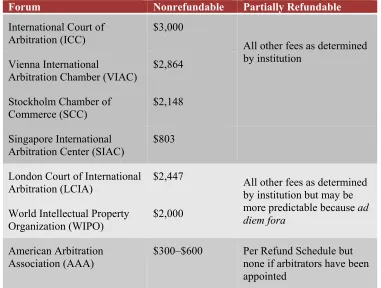
The most notable flat fee arbitral institution is the LCIA. The LCIA charges a flat £1,500 (about $2,352)31 registration fee to initiate an
arbitration proceeding.32 This, perhaps, is due to the LCIA’s non-profit
character.33 Another example of a flat fee arbitral forum that falls outside
the scope of this paper is the International Centre for Investment Disputes (ICSID).34
Flat fee fora are preferable to variable or hybrid fee forums in at least three situations. First, they are preferable in instances where the amount in dispute cannot be determined with any degree of reasonable certainty ex ante. Suppose, for example, that a particular contract contains a liquidated damages clause. Such a clause may or may not be enforceable depending on the final choice of law analysis.35 But even if it is ultimately determined
that the clause is per se enforceable under the final choice of law analysis, the governing law may impose certain requirements for the enforceability of the clause. Whether the clause meets those requirements is a separate question of application that must be further settled by the court or arbitral institution.36 In such a situation, the amount in dispute can vary from a
29 Del. Ch. Ct. R. 3(bb)(1), http://courts.delaware.gov/forms/download.aspx?id=39138. The above totals include the $100 nonrefundable deposit for costs pursuant to Rule 3(b).
30 Based on exchange rate of 1 Hong Kong dollar per 0.1289 U.S. dollars, as of March 13, 2012. 31 Based on exchange rate of 1 British pound sterling per 1.5684 U.S. dollars, as of March 13, 2012.
32 London Court of International Arbitration, Schedule of Arbitration Costs § 1(a) [hereinafter LCIA Schedule], http://www.lcia.org/Dispute_Resolution_Services/LCIA_Arbitration_Costs.aspx.
33 London Court of Int’l Arbitration website, section on “Organisation,” http://www.lcia.org/ LCIA/Organisation.aspx.
34 Int’l Cr. for the Settlement of Inv. Disputes, Schedule of Fees, http://icsid.worldbank.org/ ICSID/FrontServlet?requestType=CasesRH&actionVal=CaseScheduled.
35 For a quick summary of the enforceability of liquidated damages clauses in some jurisdictions, see Vivian Hanson & Laurie S. Hane, Practicing Law Institute, Licensing in Asia: Comparative Review of Selected Intellectual Property Law Issues, 1022 PLI/PAT 423, 452–53 (2010) (discussing enforceability of liquidated damages provisions in United States, Japan, China, Korea, India, and Philippines).
much lower amount (if the clause is held not be enforceable at all) to a much higher amount (if the clause is held to be valid and enforceable), and a flat fee forum is preferable to other forums.
Second, flat fee fora are preferable where the amount in dispute may vary wildly depending on the opposing party’s actions. This consideration is relevant, for example, if the contracting parties have no or little history of prior business transactions. As I will explain in the next section, in a variable fee forum, the opposing party may choose not to file a counterclaim, in which case the amount in dispute would not change (and forum fees would not either). But it may choose to file a counterclaim, suddenly doubling or tripling the amount in dispute (thus significantly increasing forum fees). In a flat fee forum, by contrast, the actions of the other party do not matter with respect to forum’s fees. The parties are charged a flat rate regardless of the amount in dispute.37
Third, flat fee fora are preferable where the amount in dispute is itself contested or unclear. This consideration is relevant, for example, when a party seeks specific performance, which is typically very difficult to measure.38 Generally, arbitral tribunals determine the amount in dispute by
aggregating the value of all claims, counterclaims, and set-offs.39 But if a
party is seeking specific performance, or the amount in dispute is difficult to measure for other reasons, the arbitral tribunals reserves a great deal of discretion in setting the amount.40 In a variable fee forum, this discretion
Contract: When Is Contract Interpretation a Legal Question and When Is It a Fact Question?, 5 VA.L. &BUS.REV. 81, 104 (2010) (describing liquidated damages clause as example of clause requiring determination of legal enforceability).
37 This advantage is more relevant to arbitration than to litigation, because in litigation a party may still incur significant additional filing fees due to the unpredictable behavior of the other party (fee to file motions, etc.), whereas in arbitration the initial filing fee usually covers the entirety of the dispute.
38See generally Charles Fried, The Convergence of Contract and Promise, 120 HARV.L.REV.F. 1 (2007) (linking specific performance provisions to “hard to value” remedies); David McGowan, The Trespass Trouble and the Metaphor Muddle, 1 J.L.ECON.&POL’Y 109, 122 (2005) (same); Richard Craswell, Against Fuller and Perdue, 67 U.CHI.L.REV. 99, 144 (2000) (same).
39See,e.g., Arbitration Institute of the Stockholm Chamber of Commerce, Schedule of Costs art. 2(3) [hereinafter SCC Schedule], available at http://www.sccinstitute.com/skiljedomsregler-4.aspx (“The amount in dispute shall be the aggregate value of all claims, counterclaims and set-offs.”).
could amount to a real and substantial increase in forum fees. In a flat fee forum, by contrast, amount-in-dispute calculations are irrelevant for the calculation of the forum’s fees.
B. Pure Variable Fee Fora
In pure variable fee fora, the cost of entry varies directly based on the amount in dispute. Some international arbitral institutions are pure variable fee fora. The ICC, for example, charges a registration fee that varies from $3,000 (for disputes up to $50,000) to $113,000 (for disputes up to $1 billion).41 The AAA has an interesting fee structure, charging a variable
initial filing fee and a variable final fee under its Standard Fee Schedule.42
It also provides a Flexible Fee Schedule, which is composed of three variable fees: a variable initial filing fee, a variable proceed fee, and a variable final fee.43
The most notable example of a variable fee litigation forum is Germany. The German system is based on a highly regulated framework of legal provisions on costs, which mainly provide for fixed costs in proportion to the amount in dispute.44 The amount is payable by the person
who filed the proceeding or motion at the time of the filing.45 Although the
basic rule of the German system is that the loser of the litigation pays all costs and fees incurred by the winner,46 the cost of initiation is born by
party bringing the claim, and is relevant to that party’s forum shopping decision.
=210&Itemid=130 (“Where the amount of the claim or the counterclaim is not quantifiable at the time payment is due, a provisional estimate of the costs of the arbitration shall be made by the Registrar. Such estimate may be based on the nature of the controversy and the circumstances of the case. This may be adjusted in light of such information as may subsequently become available.”).
41 ICC Rules, supra note 10.
42 American Arbitration Association, Commercial Arbitration Rules (fee schedule amended June 1, 2010) [hereinafter AAA Rules], available at http://www.adr.org/aaa/faces/rules/searchrules/ rulesdetail?doc=ADRSTG_002008&_afrLoop=905165792861930&_afrWindowMode=0&_afrWindow Id=tcwripui0_48#%40%3F_afrWindowId%3Dtcwripui0_48%26_afrLoop%3D905165792861930%26d oc%3DADRSTG_002008%26_afrWindowMode%3D0%26_adf.ctrl-state%3Dtcwripui0_100.
43Id.
44 Gerichtskostengesetz (GKG–Court Charges Act) §§ 22–23. 45Id. § 22.
Because variable fora tend to have higher costs of entry, they are preferable to flat or hybrid fee fora in at least three situations. First, they are preferable where a party anticipates being a defendant in a future dispute should such a dispute arise. This could happen, for example, when a party is contracting with an overly aggressive counterparty.47 In such a case, the
cost of access for the opposing party would be higher in variable fee fora relative to flat fee fora, therefore reducing the incentives for pursuing formal dispute resolution in the future. Furthermore, the opposing party will be careful not to inflate the amount in dispute in its claim, because the higher the claimed amount of dispute, the higher the cost of access.
Second, variable fee forums are preferable where a party wants to discourage the other party from submitting a counterclaim, or at least from submitting an inflated counterclaim. As I will explain later, some arbitral institutions require the counterclaiming party to share in the payment of the cost of entry in proportion to the value of its counterclaim.48 In a pure
variable fee forum, that proportion is determined by reference to the value of the counterclaim, thereby decreasing the counterclaiming party’s incentive to bring a frivolous or inflated counterclaim.
Third, variable fee fora are preferable where the parties want to increase the incentives for informal dispute resolution. Because, in variable fee fora, the cost of access is directly correlated with the amount in dispute, the incentive to pursue informal dispute resolution mechanisms increases as the amount in dispute increases. This may push the parties toward settling their differences through informal channels, saving them a great deal in the costs of resolution, as informal dispute resolution mechanisms are thought to be less costly49 and less damaging to business relations.50
47See,e.g., Ellen Frankel Paul, Hayek on Monopoly and Antitrust in the Crucible of United States v. Microsoft, 1 N.Y.U.J.L.&LIBERTY 167, 195 (2005) (noting Microsoft’s “aggressive contracting relationships with PC manufacturers”); Cristina DeFrancia, Ownership Controls in the New Entertainment Economy: A Search for Direction, 7 VA.J.L.&TECH. 1, 13 (2002) (noting “[a]ggressive acquisition and contracting” strategies of movie producers and distributors in the 1940s); Bruce M. Graham, Abuse of Dominance—Recent Case Law: Nutrasweet and Laidlaw, 38 MCGILL L.J. 800, 818 (1993) (noting Laidlaw’s “aggressive contracting practices” and impact on Canadian Competition Tribunal’s decision).
48Seeinfra Part V.C.
C. Hybrid Fee Fora
In the hybrid fee fora, the costs of initiation are calculated using a combination of variable fee and flat fee formulas. An example of a hybrid fee arbitral forum is VIAC. VIAC charges a flat €2,000 (about $2,616)51
registration fee, and variable administration fee,52 ranging from €3,000
(about $3,924) for claims under €100,000 (about $130,810) to €119,500 (about $156,317) for a claim amounting to €1 billion (about $1.3 billion).53
The SCC follows a similar arrangement, charging a flat €1,500 (about $1,962) registration fee and a variable administrative fee ranging from €1,500 up to a maximum of €60,000 (about $78,486). SIAC54 and WIPO55
have similar fee schedules.
Hybrid fee fora offer some of the advantages of the flat fee fora and some of the advantages of the variable fee fora. Hybrid fora calculate the raw cost of entry by a mixture of fixed fee and variable fee. On the one hand, since at least the fixed portion of the raw cost of entry is known ex ante in these fora, a smaller portion of the cost remains uncertain. As such, Economic Development, 32 FORDHAM INT’L L.J. 1, 20 (2008) (use of informal dispute resolution channels bypasses concerns over costs in formal dispute resolution systems); Jennie Kihnley, Unraveling the Ivory Fabric: Institutional Obstacles to the Handling of Sexual Harassment Complaints, 25 LAW &SOC.INQUIRY 69, 71 (2000) (“[I]nformal dispute resolution is more efficient and cost effective than formal avenues of recourse.”).
50See V.LEE HAMILTON &JOSEPH SANDERS,EVERYDAY JUSTICE:RESPONSIBILITY AND THE INDIVIDUAL IN JAPAN AND THE UNITED STATES 41–42 (1992) (“American business people rarely turned to law to remedy disputes with those with whom they had an ongoing business relationship.”); Stewart Macaulay, Non-Contractual Relations in Business: A Preliminary Study, 28 AM.SOC.REV. 55, 65 (1963) (“A breach of contract law suit may settle a particular dispute, but such an action often results in a ‘divorce’ ending the ‘marriage’ between two businesses”).
51 All euro exchange rates in this section are based on 1 euro per 1.3081 U.S. dollars exchange rate, as of March 13, 2012.
52 Vienna International Arbitral Centre, Rules of Arbitration and Conciliation art. 36, annex 1 [hereinafter VIAC Rules], available at http://www.internationales-schiedsgericht.at/images/stories/ documents/en/VIAC_Arbitration_Rules_2006_1.pdf (“The administrative cost of the Centre and the arbitrators’ fees shall be fixed on the basis of the amount in dispute[.]”).
53Id.
54SIAC Schedule of Fees, SINGAPORE INTERNATIONAL ARBITRATION CENTER, available at http://www.siac.org.sg/index.php?option=com_content&view=article&id=255&Itemid=91 (last visited Oct. 15, 2012).
they offer some of the certainty provided by flat fee fora. On the other hand, they peg the remaining portion of the cost of entry to the amount in dispute. As such, they offer some of the strategic incentives provided by pure variable fee fora.
Table 1 summarizes the above categorizations.
Table 1—Forum Fees, Categorization of International Fora
Flat Fee Fora Pure Variable Fee Fora Hybrid Fee Fora
London Court of International Arbitration (LCIA) New York
San Francisco Delaware Hong Kong
International Court of Arbitration (ICC) American Arbitration Association (AAA) Dubai International Arbitration Center (DIAC)
Germany
Vienna International Arbitration Chamber (VIAC)
World Intellectual Property Organization (WIPO)
Singapore International Arbitration Center (SIAC)
Stockholm Chamber of Commerce (SCC) IV.ADJUDICATOR FEES
Adjudicator fees refer to fees charged by individuals in charge of adjudicating the case. In this area, there are three general approaches: (1) not charging for adjudicator fees (common in litigation fora); (2) charging adjudicator fees per case (used in majority of arbitral institutions); and (3) charging hourly fees for adjudicators (used minority of arbitral institutions).
additional $1,000 initial filing fee for cases designated as “complex.”56
Thus, unless the law changes from the time of the drafting of the contract to the time of the dispute, parties can calculate forum fees and adjudicator fees for most litigation fora with ultimate certainty.
Arbitral institutions, on the other hand, invariably reserve the right to charge higher forum or adjudicator fees in exceptional or unusual circumstances. The ICC Rules of Arbitration, for example, state that the ICC may fix the fees of the arbitrators at a figure higher or lower than the amount prescribed by the ICC’s standard scale if “deemed necessary due to the exceptional circumstances of the case.”57 A similar ICC Rule governs
the institution’s administrative charges.58 Other arbitral institutions have
similar rules.59 This is a significant point to bear in mind: while forum and
adjudicator fees are capped by statute in litigation fora, the sky is the limit in arbitration.
We can now turn to an examination of the three different approaches in calculating adjudicator fees.
A. No Adjudicator Fee Fora
Courts have no adjudicator fees. Indeed, as some commentators have noted, litigation is subsidized by the government through its provision of
56San Francisco Superior Court of California Statewide Civil Fee Schedule, T
HE SUPERIOR
COURT OF CALIFORNIA COUNTY OF SAN FRANCISCO, available at http://sfsuperiorcourt.org/sites/ default/files/pdfs/Civil%20Fee%20Schedule%20eff%207-9-2012.pdf (last visited Oct. 15, 2012); see also CAL.GOV’T CODE § 70616 (West 2012).
57 ICC Rules, supra note 10, at art. 37 (“(2) The Court may fix the fees of the arbitrators at a figure higher or lower than that which would result from the application of the relevant scale should this be deemed necessary due to the exceptional circumstances of the case. (3) At any time during the arbitral proceedings, the arbitral tribunal may make decisions on costs, other than those to be fixed by the court, and order payment.”).
58Id. at art. 2 (“In exceptional circumstances, the Court may fix the ICC administrative expenses at a lower or higher figure than that which would result from the application of such scale, provided that such expenses shall normally not exceed the maximum amount of the scale.”).
the courts, while parties bear the full cost of the arbitration process.60 One
important policy implication of this is whether and to what extent foreign plaintiffs should be allowed to sue in foreign jurisdictions. In the United States, for instance, one recurrent justification for the doctrine of forum non conveniens is the need to ensure that U.S. judiciary is not “financially burdened by litigation arising elsewhere.”61
For forum shopping purposes, however, the fact that courts have no adjudicator fees, coupled with the fact that most courts also have low forum fees,62 means that courts have very low overall entry fees. This makes
courts very attractive fora generally and, at least in some instances, make litigation cheaper than arbitration.63 The Delaware Court of Chancery, for
example, may provide parties with a quick, efficient, and competent resolution of a dispute at much lower entry cost than arbitral institutions.64
60 Christopher R. Drahozal, Arbitration Costs and Forum Accessibility: Empirical Evidence, 41 U.MICH.J.L.REFORM 813, 816 (2008) (“Unlike in litigation, which is subsidized by the government through its provision of courts, the parties bear the full costs of the arbitration process.”); Christopher R. Drahozal, Arbitration Costs and Contingent Fee Contracts, 59 VAND.L.REV. 729, 831 (2006) (noting that “upfront forum costs are higher in arbitration than in court” because court litigation is subsidized by government but parties to arbitration proceedings must pay all forum costs); Haagen, supra note 25 (“[C]ourts and litigation are heavily subsidized by taxpayers.”). But see Jeffrey W. Stempel, Reflections on Judicial ADR and the Multi-Door Courthouse at Twenty: Fait Accompli, Failed Overture, or Fledgling Adulthood?, 11 OHIO ST.J. ON DISP.RESOL. 297, 358 (1996) (arguing that government subsidizes private dispute resolution to some degree).
61 Cassandra Burke Robertson, Transnational Litigation and Institutional Choice, 51 B.C.L.REV. 1081, 1122 (2010).
62Seesupra Part III.A.
63See,e.g., David S. Schwartz, Mandatory Arbitration and Fairness, 84 NOTRE DAME L.REV. 1247, 1312–16 (2009) (arguing that litigation may be cheaper than arbitration); Henry S. Noyes, If You (Re)Build It, They Will Come: Contracts to Remake the Rules of Litigation in Arbitration’s Image, 30 HARV. J.L. & PUB. POL’Y 579, 583–84 (2007) (arguing that modified litigation is cheaper than arbitration); Jean R. Sternlight, Forum Shopping for Arbitration Decisions: Federal Courts’ Use of Antisuit Injunctions Against State Courts, 147 U.PA.L.REV. 91, 149 (1998) (discussing situations where litigation may be cheaper than arbitration); see alsosupra note 25 and accompanying text.
The low costs of entry makes courts attractive in two additional situations. First, courts are preferable where a party seeks to initiate legal proceedings simply to gain leverage in some other area. This is because, simply speaking, a court action gives you the biggest “bang for the buck”: a great deal of leverage and publicity for a relatively low cost of access. If one party is interested in a quick settlement of a dispute, for example, it can use litigation as an effective tool to achieve its goal.65 Even if a settlement
is not reached, the party may still benefit from litigation if it is commenced in a forum that is known to be competent (Delaware, for example).66
Second, courts are preferable where a party seeks to initiate litigation as a defensive tactic against anticipated legal action by another party. One well-known phenomenon in this area is the “torpedo defense” in the European Union (EU).67 Anticipating a lawsuit, a defendant intent on
delaying the litigation process may rush to file a negative declaratory judgment action in a slow forum, such as Italy or Belgium, where the time from filing to a verdict can take several years. This delaying tactic can be implemented because of the Brussels Regulation, which precludes EU member state court from deciding cases involving the same parties and matters until the first court of jurisdiction has issued a decision regarding its jurisdictional authority.68 Courts allow for the successful implementation of
this defense at low entry costs.
65 The issue of litigation aimed at obtaining a settlement has long concerned legal policy makers and analysts. See,e.g., Lucian Arye Bebchuk & Howard F. Chang, An Analysis of Fee Shifting Based on the Margin of Victory: On Frivolous Suits, Meritorious Suits, and the Role of Rule 11, 25 J.LEGAL
STUD. 371 (1996); Lucian Arye Bebchuk, A New Theory Concerning the Credibility and Success of Threats to Sue, 25 J.LEGAL STUD. 1 (1996); Charles M. Yablon, The Good, the Bad, and the Frivolous Case: An Essay on Probability and Rule 11, 44 UCLAL.REV. 65 (1996); Janet Cooper Alexander, Do the Merits Matter? A Study of Settlements in Securities Class Actions, 43 STAN.L.REV. 497 (1991); Lucian Arye Bebchuk, Suing Solely to Extract a Settlement Offer, 17 J.LEGAL STUD. 437 (1988).
66Seesupra note 64.
67 For a general discussion of the “torpedo defense,” see Will Hueske, Rule, Britannia! A Proposed Revival of the British Antisuit Injunction in the E.U. Legal Framework, 41 GEO.WASH.INT’L
L.REV. 433 (2009); Isabella Betti, The Italian Torpedo is Dead: Long Live the Italian Torpedo, 3 J. INTELL.PROP.L.&PRAC.1, 6 (2008); Mario Franzosi, Worldwide Patent Litigation and the Italian Torpedo, 19(7) EUR.INTELL.PROP.L.REV. 382 (2005); Trevor C. Hartley, How to Abuse the Law And (Maybe) Come Out on Top: Bad-Faith Proceedings Under the Brussels Jurisdiction and Judgments Convention, in LAW AND JUSTICE IN A MULTISTATE WORLD:ESSAYS IN HONOR OF ARTHUR T. VON
B. Ad Valorem Fora
Arbitral institutions, by contrast, invariably charge for arbitrator’s fees. Most arbitral institutions are ad valorem institutions, fixing the arbitrators’ fees by reference to the amount in dispute. Although all ad valorem
institutions charge variable arbitrator fees based on the amount in dispute, there are important variations among the various ad valorem institutions that bear on forum shopping decisions.
Some ad valorem fora adhere to strict formulas for the calculation of arbitrators’ fees for different amounts in dispute. SIAC, for example, follows this approach. It charges, for a panel of three arbitrators, SGD 16,500 (about $13,115)69 for claims under SGD 50,000 (about $39,742),
and SGD 2.5 million (about $2 million) for a claim of SGD 1 billion (about $794 million). As noted earlier, SIAC follows the general practice of other arbitral institutions by reserving the right to alter the arbitrators’ fees in unusual circumstances.70 Absent such determination, however, the
arbitrators’ fees are set by the uniform fee schedule, and the parties know ex ante exactly how much they must pay in arbitrators’ fees for every amount in dispute.
In the strict formula category, some fora rely on formulas for the calculation of arbitrators’ fees, but only for a certain number of parties to the dispute. The VIAC, for example, already has a flexible fee schedule. It charges, for a panel of three arbitrators, fees ranging from €2,500 (about $3,270) for a €10,000 (about $13,081) claim to €661,250 (about $864,981) for a €1 billion (about $1.3 billion) claim.71 The VIAC charges an
Where proceedings involving the same cause of action and between the same parties are brought in the courts of different Member States, any court other than the court first seised shall of its own motion stay its proceedings until such time as the jurisdiction of the court first seised is established.
Council Regulation (EC) 44/2001, art. 27, 2001 Official J. (L 012). The Brussels Regulation superseded the Brussels Convention in March of 2002. The Brussels Regulation encompasses all European Union member states, except for Denmark, which chose not to opt into the Brussels Regulation.
69 All Singapore dollar exchange rates in this section are based on 1 Singapore dollar per 0.7948 U.S. dollars, as of March 13, 2012.
70 SIAC Rules, supra note 40, at art. 32.1 (“The fees of the Tribunal shall be fixed by the Registrar in accordance with the Schedule of Fees and the stage of the proceedings. In exceptional circumstances, the Registrar may allow an additional fee over that prescribed in the Schedule of Fees to be paid.”).
additional 10% for each additional party beyond two parties.72 This could
amount to a very significant increase in adjudicator costs. If, for example, the opposing party successfully attaches 5 other defendants, the adjudicator costs alone suddenly rise by 50 percent.
Other ad valorem institutions have a more flexible fee schedule, generally setting a range identified by a minimum and a maximum. The ICC, for example, provides a minimum and a maximum range. The range increases greatly as the amount of the dispute rises. For example, for a $1 billion claim, the minimum payment per arbitrator is $171,867, while the maximum is $783,300, a 455 percent increase.73 If we assume that a
complex international commercial case would be presided over by three arbitrators, not just one, the range increases from $515,601 to $2.35 million. Some of the flexible fee ad valorem fora take this flexibility even a step further, adding additional layers of uncertainty in the calculation of arbitrators’ fees. The SCC, for example, has a flexible minimum/maximum formula table for claims up to €100 million (about $130 million), but no prescribed schedule to calculate such fees for claims exceeding that amount, leaving the determination of the amount of such disputes to the institution. But, even at a €100 million level, the fees for a panel of three arbitrators could range anywhere from €105,600 (about $138,135) to €508,200 (about $664,776), a 481 percent difference!74
Whether or not ad valorem fora is preferable compared to ad diem fora depends largely on the certainty of the amount in dispute and the opposing party’s actions. The level of predictability depends on the level of predictability of the amount of dispute and the variation used by the arbitral institution. The most predictable fees are charged in cases where the arbitral fee charges a fixed amount and the amount of dispute is known. The least predictable fees are when the arbitral institution charges within a range and the amount of dispute is not known, perhaps because one party is not aware of the other party’s counterclaims or set-off claims.
72 Id. at art. 36.2 (“If there are more than two parties to proceedings, the rates for the administrative costs of the Centre and the arbitrators’ fees . . . shall be increased by 10% for each additional party.).
C. Ad DiemFora
A minority of arbitral institutions are ad diem institutions, fixing the arbitrators’ fees by reference to the amount of time spent in adjudicating the dispute. Like ad valorem fora, ad diem fora also exhibit important variations that bear on forum shopping decisions.
Some ad diem fora cap the hourly fees that may be charged by the arbitrators. The LCIA sets separate hourly rates for arbitrators up to £400 (about $627 per hour).75 The LCIA Schedule of Fees, however, is clear that
the hourly rates “shall” be set at numbers “not exceeding” that amount.76 In
exceptional circumstances, the LCIA may allow higher charges. But even in those circumstances, the institution, the arbitrators, and all parties must “expressly” agree to the higher hourly rates.77
Other ad diem fora do not set such caps, but rather “suggest” hourly fees for their arbitrators. The WIPO takes such an approach, suggesting a fee of $300 to $600 per hour per arbitrator.78 The AAA has the most
flexible and unpredictable approach, not setting a maximum cap nor suggesting any rates, leaving the matter entirely to the parties and the arbitrators.79
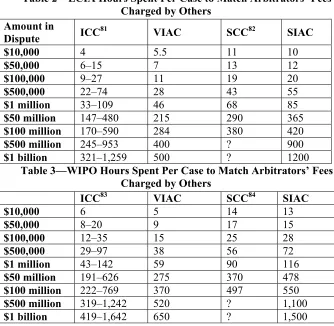
The following tables summarize how many hours per case LCIA and WIPO arbitrators can spend on a case to reach arbitrators’ fee schedules set by other arbitral institutions.80
75 LCIA Schedule, supra note 32, at art. 4(a).
76Id.
77Id. (“[I]n exceptional cases, the rate may be higher provided that, in such cases, (a) the fees of the Tribunal shall be fixed by the LCIA Court on the recommendation of the Registrar, following consultations with the arbitrator(s), and (b) the fees shall be agreed expressly by all parties.”).
78 WIPO Rules, supra note 55, at 122.
79 AAA Rules, supra note 42, at R-51(a) (“Arbitrators shall be compensated at a rate consistent with the arbitrator’s stated rate of compensation.”).
Table 2—LCIA Hours Spent Per Case to Match Arbitrators’ Fees Charged by Others
Amount in
Dispute ICC81 VIAC SCC82 SIAC $10,000 4 5.5 11 10
$50,000 6–15 7 13 12
$100,000 9–27 11 19 20
$500,000 22–74 28 43 55
$1 million 33–109 46 68 85
$50 million 147–480 215 290 365
$100 million 170–590 284 380 420
$500 million 245–953 400 ? 900
$1 billion 321–1,259 500 ? 1200
Table 3—WIPO Hours Spent Per Case to Match Arbitrators’ Fees Charged by Others
ICC83 VIAC SCC84 SIAC $10,000 6 5 14 13
$50,000 8–20 9 17 15
$100,000 12–35 15 25 28
$500,000 29–97 38 56 72
$1 million 43–142 59 90 116
$50 million 191–626 275 370 478
$100 million 222–769 370 497 550
$500 million 319–1,242 520 ? 1,100
$1 billion 419–1,642 650 ? 1,500 The above tables suggest several interesting things. First, as mentioned earlier, the ICC fee range (the range between minimum and maximum fees 81 ICC numbers are calculated based on the minimum/maximum range prescribed by the ICC. See ICC Rules, supra note 10, at app. III, art. 4. The number on the left in each cell refers to the hours corresponding to the minimum fee prescribed by the ICC. The number on the right refers to the hours corresponding to the maximum fee prescribed.
82 SCC has no fee schedule for claims over €100 million (about $1.4 million), so the corresponding LCIA hours cannot be calculated for those amounts.
83Seesupra note 81 and accompanying text.
charged) increases rapidly as the amount in dispute rises. As a result, it is very difficult to compare fees between ad diem fora and ICC for higher amounts in dispute. Thus, for example, depending on how much the ICC would charge for the resolution of a $1 billion dispute, the comparable number of hours that could be spent by a panel of LCIA arbitrators working on the same dispute could range from 419 hours to more than 1,600 hours—almost a 400% difference.
Second, LCIA/VIAC hours fall toward the lower range of the LCIA/ICC hours, while LCIA/SIAC fees fall toward the upper range, with LCIA/SCC falling somewhere in between. This means that if parties were initially planning to contract for SIAC as the arbitral forum, they should be more likely to consider hourly fora. On the other hand, if parties were initially planning to submit to VIAC as the arbitral fora, they should be less likely to consider hourly forums, unless they know more about the nature of the probable dispute.
Generally, ad diem fora are preferable to ad valorem fora in at least two situations. First, they are preferable to ad valorem fora where the amount in dispute is relatively high but the contested legal and factual issues are relatively non-complex. This could be true, for example, if the parties agree on the precise legal or factual question in the dispute, or if the adjudicator’s task is to pick from two conflicting lines of precedent, rather than having to navigate a difficult or novel issue. In such situations, parties can avoid paying higher arbitrators’ fees by choosing an ad diem forum rather than an ad valorem forum.
Second, ad diem fora are preferable to ad valorem fora where settlement prospects are high. This could be due to the nature of the parties in dispute, and whether they have had longstanding business relationships. In ad diem forums, it is much easier to calculate the pro-rata share of arbitrators’ fees depending on the stage of proceedings at the time of settlement. Thus, the costs associated with the settlement value are easier to calculate than they are in ad valorem fora, where arbitral institutions retain a great deal of discretion in refunding advanced costs due to settlement or early termination.85
Table 4 summarizes the categorization of the fora on the basis of their adjudicator fee rules.
Table 4—Adjudicator Fees, Categorization of International Fora
No Fee For a Ad Valorem Fora Ad Diem Fora
New York San Francisco Delaware Hong Kong Germany86
-- Fixed
Singapore International Arbitration Center (SIAC)
Stockholm Chamber of Commerce (SCC)
-- Fixed + Additional Parties Fee
Vienna International Arbitration Chamber (VIAC)
--Range
International Court of Arbitration (ICC)
London Court of International Arbitration (LCIA)
World Intellectual Property
Organization (WIPO) American Arbitration Association (AAA)
V.APPORTIONMENT OF THE COST OF ACCESS
As we already noted, the cost of access in litigation is generally confined to initial filing fees, while the cost of access in arbitration includes fees paid to the arbitral institution as well as the arbitrators themselves. In other words, costs of access are higher in arbitration than in litigation because arbitral institutions almost always require the parties to pay all or substantially all of the adjudication costs in advance.
There are four general approaches to the charging of advance for costs: (1) charging no advance for costs; (2) charging advance for costs in equal shares; (3) charging advance for costs in proportional shares; and (4) leaving the determination to the forum’s discretion.
A. No Advance for Costs Fora
Courts often do not require an advance for costs. This is certainly true in the United States where, under the so-called American rule, each party bears its own litigation costs.87 Germany is a major exception to the general
trend. In Germany, court costs and attorneys’ fees may have to be paid in advance. These costs may be quite substantial, since in Germany both court costs and attorneys’ fees are calculated in relation to the amount in controversy, according to statutory law.88
The fact that most litigation fora do not require an advance for costs is financially significant. Many arbitral institutions require advance for costs, which can amount to a substantial sum. For a $1 billion claim adjudicated by the ICC, for example, parties may be required to pay all or substantially all of the $2.5 million in standard fees,89assuming the ICC does not set
higher rates under the “exceptional circumstances” clause.90
Furthermore, arbitral institutions generally do not pay interest on the advance for costs. SIAC explicitly rejects payment of interest,91 while
others are silent on the issue. Most litigation fora, by contrast, do not require any advance for costs, enabling the parties—in theory, at least—to earn market interest on the money that they would otherwise have had to pay as an advance for costs. The $2.5 million ICC advance example from the previous paragraph can, for example, earn more than $81,000 in interest over twelve months at the current federal prime rate of 3.25 percent.92
87See generally Micha Buhler, Awarding Costs in International Commercial Arbitration: An Overview, 22 ASABULL. 249, 250 (2004).
88See generally Tobias Kraetzschmar & Philipp K. Wagner, Responding to Differing Procedural Concepts in U.S.-German Cross-Border Disputes, 23-SPGINT’L L.PRACTICUM 34 (2010).
89 ICC Rules, supra note 10, at app. III; see also ICC Rules, supra note 10, at art. 30(2) (“As soon as practicable, the Court shall fix the advance on costs in an amount likely to cover the fees and expenses of the arbitrators and the ICC administrative costs for the claims and counterclaims which have been referred to it by the parties.”).
90 ICC Rules, supra note 10, at art. 37(2) (“The Court may fix the fees of the arbitrators at a figure higher or lower than that which would result from the application of the relevant scale should this be deemed necessary due to the exceptional circumstances of the case. Decisions on costs other than those fixed by the Court may be taken by the Arbitral Tribunal at any time during the proceedings.”).
91 SIAC Rules, supra note 40, at art. 30.8 (“All advances shall be made to and held by the Centre. Any interest which may accrue on such deposits shall be retained by the Centre.”).
B. Equal Apportionment Fora
By contrast, almost all arbitral institutions require an advance for payment of costs, including forum fees, arbitrators’ fees, and other general administrative costs. The default rule for many institutions is to require the payment of the advance for costs in equal shares. For example, the ICC,93
the SCC,94 the VIAC,95 the WIPO,96 and the SIAC97 rules all contain
provisions requiring the parties to cover the costs of arbitration in advance in equal shares.
C. Proportional Apportionment Fora
There is a caveat, however. Where a case involves claims and counterclaims, some arbitral institutions may fix separate advances for the claims and counterclaims, requiring each of the parties to pay the advance for costs in proportion to the value of its claims or counterclaims. There are, however, important variations among these institutions. The ICC,98 the
SCC,99 and the SIAC100 all follow the general approach of allowing the
institution, in its discretion, to fix separate advances.
93 ICC Rules, supra note 10, at art. 30(3) (“The advance on costs fixed by the Court shall be payable in equal shares by the Claimant and the Respondent.”).
94 SCC Rules, supra note 39, at art. 45(3) (“Each party shall pay half of the Advance on Costs, unless separate advances are determined.”).
95 VIAC Rules, supra note 52, at art. 34(2) (“The Secretary General shall fix the amount of the deposit against the expected costs of arbitration. That deposit shall be paid in equal shares by the parties[.]”).
96 WIPO Rules, supra note 55, at art. 70(a) (“[T]he Claimant and the Respondent shall each deposit an equal amount as an advance for the costs of arbitration[.]”).
97 SIAC Rules, supra note 40, at art. 30.2 (“The Registrar shall fix the advances on costs of the arbitration. Unless the Registrar directs otherwise, 50% of such advances shall be payable by the Claimant and the remaining 50% of such advances shall be payable by the Respondent.”).
98 ICC Rules, supra note 10, at art. 36(3) (“Where, apart from the claims, counterclaims are submitted, the Court may fix separate advances on costs for the claims and the counterclaims.”); id. at art. 36(3) (“Where the Court has set separate advances on costs . . . each of the parties shall pay the advance on costs corresponding to its claims.”).
99 SCC Schedule, supra note 39, at art. 45(3) (“Each party shall pay half of the Advance on Costs, unless separate advances are determined.”).