Iran J Public Health, Vol. 47, No.9, Sep 2018, pp.1354-1363
Original Article
Social Reactions and Reasoned Pathways of High School Students
and School Dropouts’ Inclination toward Smoking Behavior:
Proto-type/willingness Modelling via Generalized Structural Equation
Mohammad ASGHARI JAFARABADI
1,2, Haidar NADRIAN
3, *Hamid
ALLAHVERDIPOUR
41. Road Traffic Injury Research Center, Tabriz University of Medical Sciences, Tabriz, Iran
2. Dept. of Statistics and Epidemiology, Faculty of Health, Tabriz University of Medical Sciences, Tabriz, Iran 3. Dept. of Health Education and Promotion, Faculty of Health, Tabriz University of Medical Sciences, Tabriz, Iran 4. Clinical Psychiatry Research Center, Dept. of Health Education and Promotion, Tabriz University of Medical Sciences, Tabriz, Iran
*Corresponding Author: Email: [email protected]
(Received 17 Oct 2017; accepted 10 Jan 2018)
Introduction
If the current worldwide patterns of smoking continue, one billion deaths are expected to happen in this century from tobacco use, the most of which is low- and middle-income coun-tries (1-3). Smoking is primarily initiated during adolescence (4). Studies have reported different prevalence rates for smoking among adolescents, ranging from 9.3% to 39% (4-7). The prevalence
rate of smoking behaviour among Iranian adoles-cents (9.5% to 26.0%) is alarming (8-12).
Theory-based approaches (13) like the theory of reasoned action (TRA) and the Theory of planned behavior (TPB) explain risky behavior from a decision-making perspective and assume that behavior is intentional (14). The applicability of these approaches is controversial (15, 16) and
Abstract
Background: To investigate the determinants of smoking behavior among Iranian adolescents applying the
Prototype/Willingness (P/W) Model.
Methods: In this cross-sectional study, a self-administered P/W model-based questionnaire was completed
be-tween 760 randomly selected adolescents (high school students and dropouts) in Hamadan, Iran, in 2015. Gen-eralized structural equation modeling (GSEM) was applied to analyze data.
Results: Significant associations were found between subjective norms and positive attitudes toward smoking
(P<0.001). The behavioral intention was also significantly related to the willingness and subjective norms (P<0.001). Prototype or risk image was not significantly related to the willingness among the dropout adoles-cents.
Conclusion: When social reaction and reasoned processes are modeled together, both may predict the smoking
behavior. The high-risk perception and the high-risk image toward smoking behavior among the adolescents may originate from socio-cultural factors underlying the behavior. Further research is recommended to investi-gate the socio-cultural biases of the issue.
Keywords: School dropouts, P/W model, Smoke, High school students, Generalized structural equation
evidence has demonstrated the application of theories emphasizing social interaction and rea-soned path perspectives in explaining the willing-ness and intention to smoke, respectively (13). The decision of an adolescent for smoking is in-fluenced by his/her smoking images (16, 17).
Prototype/Willingness Model
The Prototype/Willingness (P/W) model was developed to explain and predict risky behaviors among adolescents (Fig. 1) (18), assuming two
pathways: 1) the reasoned action path reflects a conscious decision-making process engaging a risky behaviours and 2) the social reaction path-way, which is much more reactive and uninten-tional (19) and is a response to the situations that are conducive toward risk (20).
One of the central constructs in the P/W model is behavioral willingness (BW) which explains the unintentional or reactive component of a risk behavior and is defined as openness to risk op-portunity (18).
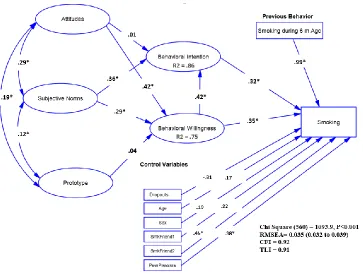
Fig. 1: The relationship among study variables reflected in P/W full model
*: P<0.05: the model parameters were also adjusted for control variables.
Employee Status (1: Employed (Dropouts), 2: Un-Employed (Dropouts), Reference Category: Students). Age: Age Category (Comparing: 17 and higher age with Reference Category of 16 and lower). Sex (Comparing Boys with Ref-erence Category of Girls).SmkFriend: Having Smoker Friend (1: Always, 2: Sometimes, RefRef-erence Category: Not
Have). PeerPressure: Peer Pressure (Comparing Yes with Reference Category of No)
Willingness to engage in a risky behavior usually develops before intentions (21). Both BW and behavioral intentions (BI) may predict risk behaviors (18, 22).
The second major key construct in the model is prototype image refers to one’s perception from typical individuals of his/her age who engage in a
behavior. The prototype is positively related to willingness for engaging behavior (22-24).
from those in developed countries due to the dif-ferences may exist in the cultural values, socioeconomic status, and racial/ethnic groups. In Iran, several studies have assessed the deter-minants of smoking among adolescents (10, 30). To the best of our knowledge, no study has fo-cused on the issue, therefore, understanding the cognitive determinants of adolescents' decisions to engage in tobacco smoking applying the PW model may be helpful aiming at smoking cessa-tion among adolescents.
The objective of this study was to investigate the determinants of smoking behavior among Iranian adolescents applying the P/W model considering the possible differences in social reaction path-way among adolescents by employment status and gender utilizing GSEM.
Materials and Methods
Participants
This cross-sectional study was conducted on 760 high school students (including the dropouts from the schools) with 14 to 18 yr of age in Hamadan, Iran, in 2015. Cluster random
sam-pling was employed to recruit the 9th to 12th-grade
high school male and female students. Eight high schools were randomly selected from the educa-tional districts of Hamadan. Twenty male and 15 female students were randomly selected from each of the four educational grades to complete the questionnaire. The employed dropouts were randomly chosen from their location of employ-ment and the unemployed students were recruit-ed from the streets and public parks.
This study was conducted after providing ap-proval from the Institutional Review Board of Hamadan University of Medical Sciences. In-formed assent and consent were obtained from all the participants. The students were assured of the complete anonymity of their data.
Instruments
Willingness to smoke cigarettes: The ques-tionnaire was started with presenting a hypothet-ical risk-conducive situation as follows: “Suppose
you were with a group of friends some of whom were smoking and there were some extra ciga-rettes for you to smoke if you wanted.” Then, three different questions regarding willingness to smoke were presented on how they would react in such a situation (31). The response to each item was recorded on a 5-point Likert-type scal-ing from 1 (not at all) to 5 (extremely willscal-ing” respectively (the total score range = 3-15). The higher score indicated the higher level of willing-ness to smoke.
The prototype of smokers: The participants were first asked to imagine a classmate or friend in their age who smokes cigarettes. Then partici-pants were asked to rate the favorability of the image by 7 adjectives (popular, smart, good-looking, cool, childish, careless, and dull/boring) (31). A reverse scale was employed for the latter 4 adjectives. Response format was based on a 5-point scale ranging from 1 (not favorable at all) to 5(extremely favorable). Higher values indicated a positive image of smoking.
Intention to smoke cigarettes: The behavioral intention to smoke was a self-administered scale including 5 items. An example of the items is as follows: “I intend to smoke in the next month.” The response format was based on a 5-point scale ranging from 1 (not at all) to 5 (absolutely). Subjective Norms about cigarette smoking: A 3-item scale was developed to evaluate subjective norms. An example of the items was “I think that I should leave my friends who smoke?” The re-sponse format was based on a 5-point scale rang-ing from 1 (completely disagree) to 5 (completely agree).
Smoking Behaviour: This measure included one item: “Have you ever smoked cigarettes?” A di-chotomous answer (yes/no) was considered as the response format.
Demographics and Tobacco Smoking Relat-ed Variables: The background variables includRelat-ed
age, gender, employment status
(stu-dents\employed\unemployed), the history of tobacco smoking in the prior month (yes/no), and prior 6 months (yes/no), age at time of smoking initiation (year), parents smoking (yes/no), friends smoking (yes/no), peer persua-sion and pressure to smoke (yes/no).
Validity and reliability of the Measures: The measure showed a good to excellent ranges of internal consistency for the scales: willingness (α = 0.92), prototype (α= 0.79), intention (α= 0.92), subjective norms (α= 0.78), and Attitude (α= 0.86). Construct validity of the measure was as-sessed and confirmed applying confirmatory fac-tor analysis (CFA).
Statistical Analyses
Statistical analyses were performed using MPlus (6.2) (32) and SPSS (17) (SPSS Inc., Chicago, IL,
USA). To test the construct validity and the fit-ness of the measurement model and to fit the conceptual P/W model to data, CFA and GSEM were used, respectively (32). To investigate the fitness, the goodness of fit indices was calculated. Values smaller than 0.08 for root mean square error of approximation (RMSEA) and values greater than 0.90 for Tucker-Lewis index (TLI) and comparative fit index (CFI) confirmed the fitness of model (33). Additionally, multi-group GSEMs were conducted by educational status and gender.
Results
Study participant characteristics: Among all
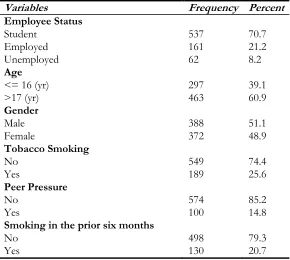
the 760 adolescents aged 14-18 yr, 71% were en-rolled in an academic institution and the remain-ing (29%) were dropouts ((employed (21%) and unemployed (8%)). More than 39% were 16 yr old or younger. Moreover, 51% were male and 49% were female. Almost 27% of the partici-pants were smokers and the mean age of smok-ing initiation was 13.9 ± 2.2 yr (Table 1).
Table 1: Demographic and background characteristics of the participants
Variables Frequency Percent
Employee Status
Student 537 70.7
Employed 161 21.2
Unemployed 62 8.2
Age
<= 16 (yr) 297 39.1
>17 (yr) 463 60.9
Gender
Male 388 51.1
Female 372 48.9
Tobacco Smoking
No 549 74.4
Yes 189 25.6
Peer Pressure
No 574 85.2
Yes 100 14.8
Smoking in the prior six months
No 498 79.3
Full Model: The full model fitted the data well
after some modifications; χ2
(326) =1093.9, P<.001,
χ2/df =1.9<5, TLI= .91>0.9, CFI= .92 >0.9,
RMSEA=0.035< .08 (90% CI =(0.032 to 0.039). In addition, all the relationships between the items and the scales were statistically significant (P<0.001). Findings showed no significant relationship between the adolescents’ prototype and their willingness (P=0.193). However, the subjective norms (P<0.001) and the positive atti-tudes (P<0.001) had significant and positive rela-tionships with the willingness. The intention was also significantly related to willingness (P<0.001) and subjective norms (P<0.001). Finally, in this model, the relationships between smoking with willingness (P=0.005) and behavioral intention (P=0.016) were positively significant (Fig. 1).
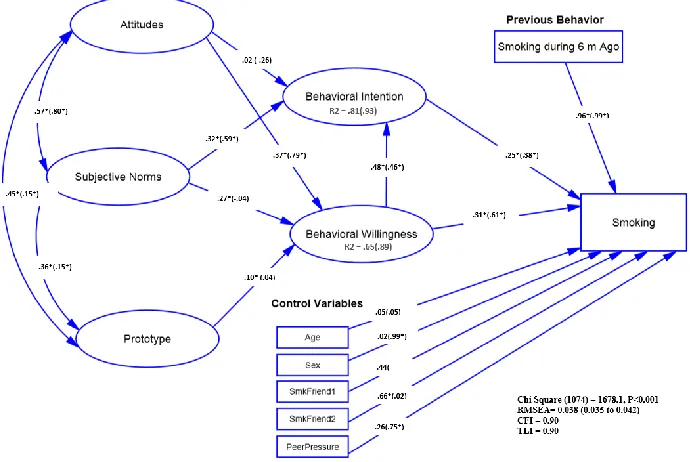
Multi-group model by educational status: The model fit well and showed a significant dif-ference between students and dropouts (P<0.001). Among students, there was a signifi-cant inverse relationship between the smoker prototype (P=0.017) and subjective norms (P<0.001) with willingness. In addition, the atti-tudes were significantly related to willingness among students and dropouts (P<0.001). Fur-thermore, a significant relationship was found between intention with willingness and subjective norms among students and dropouts (P<0.001). Finally, positive and significant relationships were found between smoking with willingness and in-tention among students and dropouts (P<0.05) (Fig. 2).
Fig. 2: The relationship among study variables reflected in P/W full model by employee status (Students v. s.
Drop-outs (Employed and Un-Employed). *: P<0.05
The model (adjusted for control variables) parameters were presented for students outside of parentheses and for employed and unemployed subjects inside of the parentheses.
Age: Age Category (Comparing 17 and higher age with Reference Category of 16 and lower). Sex (Comparing Boys with Reference Category of Girls).SmkFriend: Having Smoker Friend (1: Always, 2: Sometimes, Reference Category:
Not Have). PeerPressure: Peer Pressure (Comparing Yes with Reference Category of No)
Multi-group model by gender: The model fit
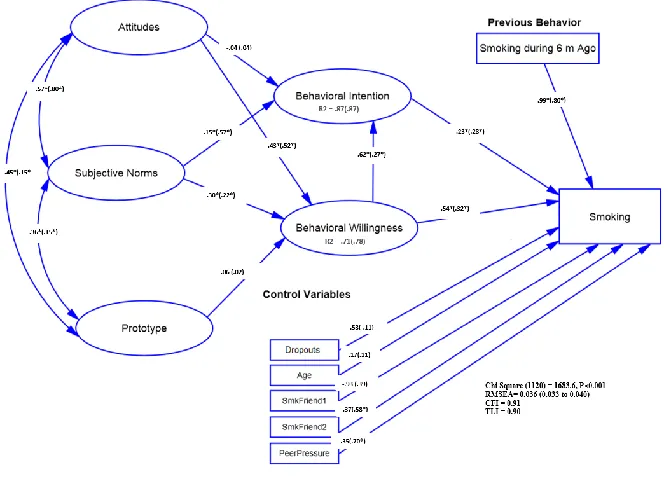
related among both genders (P>0.05). Significant positive relationships were found between sub-jective norms and willingness among boys and girls (P<0.05).
In both groups, the attitude and intention were significantly related to willingness (P<0.001).
Such associations were also found between inten-tion and subjective norms (P<0.001). The smok-ing and willsmok-ingness were also positively associated among boys and girls (P<0.05) (Fig. 3).
Fig. 3: The relationship among study variables reflected in P/W full model by Sex
*: P<0.05
The model (adjusted for control variables) parameters were presented for Girls out of parentheses and for Boys in the parentheses. Employee Status (1: Dropouts (Employed and Un-Employed), Reference Category: Students). Age: Age Category (Comparing: 17 and higher age with Reference Category of 16 and lower). SmkFriend: Having Smoker Friend (1: Always, 2: Sometimes, Reference Category: Not Have). Peer Pressure: Peer Pressure (Comparing Yes with
Reference Category of No)
Discussion
This is the first study that explored the applicabil-ity of the P/W model for predicting smoking behavior among adolescents. The social reaction path was mediated by attitudes towards cigarette smoking. Moreover, the social norms on tobacco smoking affected the behavioral willingness and consequently smoking behavior which was con-sistent with those found in a previous study (34). The relationship between social norms and smoking was mediated by intention. Both inten-tion and willingness demonstrated significant re-lationships with smoking. The P/W model could
be a useful theoretical framework to describe how the willingness and behavioral intention may predict and mediate smoking behavior among adolescents.
or negativity deters smoking remains unclear (37). Attitude was related to intention to smoke (30). In our study attitude did not predict intention directly. The indirect pathway between attitude and intention found mediated via subjective norms and willingness.
The direct association of subjective norms, as a predictor for willingness, indicated that subjective norms acted as one of the main factors to predict smoking mediated via willingness. Subjective norms are associated with both greater intention and willingness (23). Smoking complies with a social nature among Iranian adolescents which makes them more susceptible to social effects rather than individual's personal attitudes.
TRA predicted intention more than willingness (38). Dissimilarly, our findings showed that the TRA constructs predicted the willingness but not the intention. Based on TRA, attitude and subjec-tive norms are considered as the proximal deter-minants of behavioral intention. However, in our findings, attitude was not proximally related to intention, and instead, subjective norms and will-ingness were the main predictors of intention. This finding indicated the applicability of subjec-tive norms and willingness in promoting the in-tention of adolescents do not smoke cigarette. Surprisingly, the prototype was not significantly associated with the willingness, however, was in-directly associated with willingness through atti-tude and subjective norms. Favorable prototypes may be associated with high willingness to engage in different behaviors (35, 39). Our inconsistent findings may be due to less broadcasting of effec-tive risk message about smoking and also devel-oping unelaborated risk messages especially for teenagers in the Iranian society.
We found significant relationships between inten-tion and willingness. Social reacinten-tion path alone as a possible way of smoking behavior among ado-lescents (20, 39). However, our results suggest that when social reaction and reasoned processes are modeled together, both may predict the smoking behavior. It is not well known that to what extent the social reaction or reasoned pro-cesses may be attributed to initiation of smoking
among Iranian adolescents. Further studies to investigate such attributions are suggested.
Employee Status: Among dropouts, the social reaction processes was a stronger predictor of smoking, however, the risk images of the stu-dents were more favorable than dropouts. Addi-tionally, among students, the smokers’ prototype was associated more strongly with attitude and subjective norms. As we expected, attitude and subjective norms were associated with willingness among students. However, among dropouts atti-tude was the only factor associated with willing-ness.
Gender: Being female dominates the social reac-tion processes for smoking. However, among both girls and boys, both intention and willing-ness were significant predictors of intention to smoke. In the line with other studies (15, 20), when gender-specific images were assessed, no significant association was found between prototype and willingness. Due to the specific values and beliefs existing in the Islamic coun-tries, the communication of a gender with the opposite gender is socially stigmatized, which may thus affect smoking behavior. In the present study, the P/W model hypotheses were support-ed among girls, except for one: the prototype predicted better attitude toward smoking and subjective norms.
Limitations and Strengths
Firstly, the cross-sectional design of this study
limits the ability to conclude causal inferences among model relation. As a second limitation and similar to many studies (10, 40, 41), we assessed smoking by asking one question. Thirdly, we re-lied on the self-report evaluation; however assur-ing anonymity may have lessened the inaccurate reporting (20). Fourth, the study was performed in a city in Iran which may limit the generalizabil-ity of the results.
Conclusion
smok-ing. When social reaction and reasoned processes are modeled together, both may predict the smoking behavior. The high-risk perception and image toward smoking among adolescents may originate from socio-cultural factors underlying the behavior. Further research is recommended to investigate the socio-cultural biases of the is-sue. Healthcare providers and health policymak-ers should consider the dominance of social reac-tion processes among females while designing adolescent smoking cessation programs. The so-cial reaction processes should be also considered as a stronger determinant of smoking behavior among dropouts compared to students.
Ethical considerations
Ethical issues (Including plagiarism, informed consent, misconduct, data fabrication and/or fal-sification, double publication and/or submission, redundancy, etc.) have been completely observed by the authors.
Acknowledgements
We thank the Hamadan University of Medical Sciences and Tabriz University of Medical Sci-ences for their contribution.
Conflicting Interest
The authors declared no potential conflicts of interest.
References
1. Jha P, Peto R (2014). Global effects of smoking, of quitting, and of taxing tobacco. N Engl J Med;370(1): 60-8.
2. WHO (2013). WHO report on the global tobacco epidemic, 2013: enforcing bans on tobacco advertising, promotion and
sponsorship. Geneva: World Health
Organization.
3. Jha P, MacLennan M, Chaloupka FJ et al (2015). Global Hazards of Tobacco and the Benefits of Smoking Cessation and Tobacco Taxes.
In: Cancer: Disease Control Priorities. Third Edition. Gelband H, Jha P, Sankaranarayanan R, et al., editors. Washington (DC): The International Bank for Reconstruction and Development / The World Bank; 2015 Nov 1.
4. Centers for Disease Control and Prevention
(2015) Youth and Tobacco Use.
https://www.cdc.gov/tobacco/data_statistics /mmwrs/byyear/2015/index.htm
5. El Mhamdi S, Wolfcarius-Khiari G, Mhalla S et al (2011). Prevalence and predictors of smoking among adolescent schoolchildren in Monastir, Tunisia. East Mediterr Health J, 17(6):523-8.
6. Ogwell AE, Astrom AN, Haugejorden O (2003). Socio-demographic factors of pupils who use tobacco in randomly-selected primary schools in Nairobi province, Kenya. East Afr Med J, 80(5):235-41.
7. Pinilla J, Gonzalez B, Barber P, Santana Y (2002). Smoking in young adolescents: an approach with multilevel discrete choice models. J Epidemiol Community Health, 56(3):227-32.
8. Mohammadpoorasl A, Abbasi Ghahramanloo A, Allahverdipour H et al (2014). Prevalence of Hookah smoking in relation to religiosity and familial support in college students of Tabriz, northwest of Iran. J Res Health Sci,14(4):268-71.
9. Ayatollahi AS, Mohammadpoorasl A, Rajaeifard A (2005). Predicting the stages of smoking acquisition in the male students of Shiraz's high schools, 2003. Nicotine Tob Res, 7(6):845-51.
10. Jafarabadi MA, Allahverdipour H, Bashirian S et al (2012). Modeling the Underlying Predicting Factors of Tobacco Smoking among Adolescents. Iran J Public Health, 2012;41(5):46-57.
11. Allahverdipour H, MacIntyre R, Hidarnia A et al (2007). Assessing protective factors against drug abuse among high school students: self-control and the extended parallel process model. J Addict Nurse, 18(2): 65-73.
13. Gerrard M, Gibbons FX, Brody GH et al (2006).
A theory-based dual-focus alcohol
intervention for preadolescents: the Strong African American Families Program. Psychol Addict Behav, 20(2):185-95.
14. Ajzen I (1996). The social psychology of decision making In: Social Psychology: Handbook of Basic Principles. Eds, Higgins and Kruglanski, Guilford Publications. New York, pp.297 - 328.
15. Skalle S, Rise J (2006). The relationship between smoker and nonsmoker prototypes and
smoking status among 14-year-old
Norwegians. Addict Behav, 31(1):57-68. 16. Gerrard M, Gibbons FX, Stock ML et al (2005).
The power of positive images: The role of social comparison in self-regulation. In: New perspectives on health behavior: The role of self-regulation. Ed(s), de Ridder and de Wit. Wiley, Hoboken. pp.107-136.
17. Rivis A, Sheeran P, Armitage CJ (2006). Augmenting the theory of planned behaviour with the prototype/willingness model: predictive validity of actor versus abstainer prototypes for adolescents' health-protective and health-risk intentions. Br J Health Psychol, 11(Pt 3):483-500.
18. Gibbons FX, Gerrard M, Lane DJ (2003). A social reaction model of adolescenthealth risk. In: Social psychological foundationsof health and illness Eds, Suls and Wallston. Blackwell series
in health psychology and
behaviouralmedicine. Blackwell Publishers. Malden, pp.107-136.
19. Gibbons FX, Gerrard M, Ouellette JA et al (1998). Cognitive antecedents to adolescent health risk: Discriminating between behavioral intention and behavioral willingness. Psychology and Health, 13(2):319-39. 20. Gerrard M, Gibbons FX, Stock ML et al (2005).
Images of smokers and willingness to smoke among African American pre-adolescents: an application of the prototype/willingness model of adolescent health risk behavior to smoking initiation. J Pediatr Psychol, 30(4):305-18.
21. Pomery EA, Gibbons FX, Reis-Bergan M et al (2009). From willingness to intention: experience moderates the shift from reactive to reasoned behavior. Pers Soc Psychol Bull, 35(7):894-908.
22. Gibbons FX, Gerrard M, Reimer RA et al (2006). Unintentional behavior: A subrational approach to health risk. In: Self-regulation in Health Behavior. Ed(s), de Ridder and de Wit. John Wiley & Sons. Chichester, pp. 45-70. 23. Gerrard M, Gibbons FX, Houlihan AE et al
(2008). A dual-process approach to health risk decision making: The prototype willingness model. Developmental Review, 28(1):29-61. 24. Zimmermann F, Sieverding M (2010). Young
adults' social drinking as explained by an augmented theory of planned behaviour: the roles of prototypes, willingness, and gender. Br J Health Psychol, 15(Pt 3):561-81.
25. Gagné T, Frohlich KL, Abel T (2015). Cultural capital and smoking in young adults: applying new indicators to explore social inequalities in health behaviour. Eur J Public Health, 25(5):818-23.
26. Glanz K, Rimer BK, Viswanath K (2008). Health behavior and health education: theory, research, and practice. 1st ed. John Wiley and Sons, Chichester.
27. Hanson MD, Chen E (2007). Socioeconomic status and health behaviors in adolescence: a review of the literature. J Behav Med, 30(3):263-285.
28. Kann L, McManus T, Harris WA et al (2016). Youth Risk Behavior Surveillance—United States, 2015. MMWR Surveill Summ, 65(6):1-174.
29. Pampel FC, Krueger PM, Denney JT (2010). Socioeconomic disparities in health behaviors. Annu Rev Sociol, 36:349-70.
30. Mohammadpoorasl A, Nedjat S, Yazdani K et al (2012). Intention to start smoking and its related factors in never smoked adolescents in tabriz, 2010. Int J Prev Med, 3(12):880-6. 31. Gibbons FX, Gerrard M (1997). Health, Coping,
and Well-Being: Perspectives from Social Comparison Theory. In: Health, coping and wellbeing: Perspectives from social comparison theory. Ed(s), Buunk and Gibbons. Lawrence Erlbaum Associates. Mahwah, pp. 63-94. 32. Muthén LK, Muthén BO (2007). Mplus: Statstical
Analysis With Latent Variables - User’s Guide. 6th ed. Muthén & Muthén, Los Angeles.
34. Gibbons FX, Gerrard M, Blanton H et al (1998).
Reasoned action and social
reaction:Willingness and intention as independent predictors of health risk. J Pers Soc Psychol, 74(5):1164-1180.
35. Hammer JH, Vogel DL (2013). Assessing the utility of the willingness/prototype model in predicting help-seeking decisions. J Couns Psychol, 60(1):83-97.
36. Schomerus G, Matschinger H, Angermeyer MC (2009). Attitudes that determine willingness to seek psychiatric help for depression: a representative population survey applying the Theory of Planned Behaviour. Psychol Med, 39(11):1855-65.
37. Larsen JT, Cohen LM (2009). Smoking attitudes, intentions, and behavior among college student smokers: Positivity outweighs negativity. Addiction Research & Theory, 17(6):637-649.
38. Todd J, Mullan B (2011). Using the theory of planned behaviour and prototype willingness model to target binge drinking in female undergraduate university students. Addict Behav, 36(10):980-6.
39. Hukkelberg SS, Dykstra JL (2009). Using the Prototype/Willingness model to predict smoking behaviour among Norwegian adolescents. Addict Behav, 34(3):270-6.
40. Abedini S, MorowatiSharifabad M, Kordasiabi MC et al (2014). Predictors of non-hookah smoking among high-school students based on prototype/willingness model. Health Promot Perspect, 4(1):46-53.