UNIVERSITY OF LONDON INSTITUTE OF CHILD HEALTH
Communication Patterns in Non-Verbal Physically Disabled Children -
Description and Intervention
SANDRA CATHERINE WINYARD
Thesis submitted for the degree of MPhil
ProQuest Number: U056098
All rights reserved
INFORMATION TO ALL USERS
The quality of this reproduction is dependent upon the quality of the copy submitted.
In the unlikely event that the author did not send a complete manuscript and there are missing pages, these will be noted. Also, if material had to be removed,
a note will indicate the deletion.
uest.
ProQuest U056098
Published by ProQuest LLC(2016). Copyright of the Dissertation is held by the Author.
All rights reserved.
This work is protected against unauthorized copying under Title 17, United States Code. Microform Edition © ProQuest LLC.
ProQuest LLC
789 East Eisenhower Parkway P.O. Box 1346
ABSTRACT
There has been little detailed follow up of children who use augmentative communication systems, although frequent reports from schools and parents indicate that the introduction of augmentative communication is not always successful.
This project describes the communication of physically handicapped children who were referred to The Wolfson Centre Communication Aids Centre, London, for assessment and recommendation of a communication aid. It aims to examine whether the provision of aids to this client group actually does improve communication patterns.
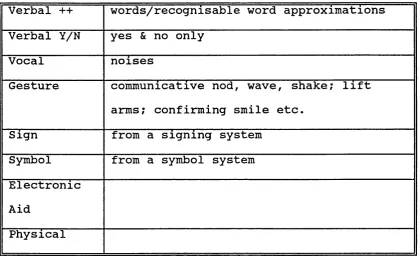
A method of describing communication patterns in these children was developed, using videotaped observation of adult/child dyads. Approximately five minutes of filmed interaction was transcribed for each contact. Coding focused on the structure (initiations and responses) and speed of interaction, the communicative functions and the modes the child used to communicate with (eg gesture, verbal, vocal, symbol etc).
A questionnaire about functional communication was also administered at contact 2.
Study 2 aims to evaluate the effect of a training workshop for parents and uses the method to profile 14 children in two groups of matched pairs. The parents of the children in the experimental group attended a one day workshop training communication skills. Both groups were profiled at assessment (contact 1), three months later (contact 2) and approximately one year later (contact 3).
ACKNOWLEDGEMENTS
There are many people who have made this thesis possible, and my grateful thanks go to them all.
First and foremost the children, their families and teachers all of whom were cooperative and tolerant of my data collection needs.
My supervisor, Helen McConachie for her patience, guidance and encouragement.
The staff of The Wolfson Centre Communication Aids Centre; particularly Nicola Jolleff, Alison Wisbeach and Colin Clayton who were very supportive and great fun to work with.
The staff of the Rehabilitation Research Unit, University of Southampton; particularly Ann Ashburn who has given me time and space; Malcolm Burnett for help with diagrams and computer problems and Agnes Shiel for her general good humour and help with statistics.
The Nuffield Foundation and the Association for Child Psychology and Psychiatry for some financial support.
TABLE OF CONTENTS
PAGE
CHAPTER ONE INTRODUCTION 16
1.1 Setting 16
1.2 Aided Communication 17
1.2.1 Signing Systems 19
1.2.2 Symbol System 20
1.2.3 Electronic Devices 21
1.3 Accessing Communication Aids 23
1.4 Communication Aids in Practice 25
1.5 Assessment 26
1.5.1 The Wolfson CAC Assessment Model 28
1.6 Conclusion 31
CHAPTER TWO LITERATURE REVIEW 33
2.1 Introduction 33
2.2 The Development of Communication Skills in the
Normal Child 34
2.2.1 Social Interaction and the Beginnings
of Communication 35
2.2.2 Communicative Function 36
2.2.3 Motherese 39
2.2.4 Synchrony between Mother and Child 40
2.2.5 Turntaking 41
2.3 The Development of Communication Skills in the
2.3.6 Psycholinguistic Processing in the
2.3.1 Mothers and their Physically Disabled Children - an Early Study and
Developing Methodology 44
2.3.2 Mothers and Disabled Child Interaction 46
2.3.3 Maternal Responsivity 48
2.3.4 Interaction and Mothers as Therapists 48 2.3.5 Intervention Programmes based on
Mother/Child Interaction Analysis 49 2.4 Communication Patterns in Children who use
Communication Aids 50
2.4.1 Barriers to Effective Communication 53 2.4.2 Communication Patterns of
Communication Aid Users 55
2.5 Training Issues 59
2.5.1 Training Partner Interaction Skills 62
2.5.2 Multimodal Approaches 63
2.5.3 Environmental Support 63
2.5.4 Parents as Teachers 64
2.5.5 Summary 65
2.6 Conclusions 65
CHAPTER THREE THE DEVELOPMENT OF PROCEDURES 68
3.1 Standard Assessments used for Baseline
Assessments 68
3.2 Establishing Reliability of Nonconventional Responses to Standard Test Material
3.3 Development of a Descriptive Profile of Communication Patterns
3.3.1 Phase 1
3.3.2 Reliability Study 1 3.3.3 Phase 2
3.3.4 Reliability Study 2 (main stage)
72 75 77 80 84 85
CHAPTER FOUR STUDY 1 - HOW NON-VERBAL PHYSICALLY
DISABLED CHILDREN COMMUNICATE 90
4.1 Design 4.2 Method 4.2.1 4.2.2 4.2.3 4.2.4 4.2.5 4.3 Results
4.3.1 4.3.1.1 Subjects Inclusion Criteria Assessment Procedures Measures Analysis
Contact 1
Ability and Language Comprehension
91 92 92 93 93 95 98 99 99 Levels 99
4.3.1.2 Structure 101
4.3.1.3 Adult Response to Child Initiation 103
4.3.1.4 Rate of Communication 103
4.3.1.5 Functions 104
4.3.1.7 Summary 108
4.3.2 Contact 2 109
4.3.2.1 Provision of Communication Aids 109
4.3.2.2 Structure 110
4.3.2.3 Adult Response to Child Initiation 113
4.3.2.4 Rate of Communication 113
4.3.2.5 Functions 114
4.3.2.6 Mode 116
4.3.2.7 Summary 118
4.3.3 Change Over Time - Parent/Child,
Teacher/Child Dyads 118
4.3.3.1 Parent/Child Dyads 118
4.3.3.2 Teacher/Child Dyads 120
4.3.3.3 Summary 122
4.3.4 The Structured Interview 122
4.3.4.1 Frequency of Use of Function 124
4.3.4.2 Preferred Modes 124
4.3.4.3 People the Child will Communicate with 125 4.3.4.4 Validation of Observed Functions and
Modes 125
4.3.4.5 Summary 130
CHAPTER FIVE STUDY 2 - TRAINING COMMUNICATION
SKILLS 134
5.1 Design 5.2 Method
5.2.1 Subjects
5.2.2 Inclusion Criteria 137
5.2.3 Procedures 140
5.2.3.1 Procedures for Parents' Workshop
Training Day 141
5.2.4 Measures 142
5.2.5 Analysis 142
5.3 Results 143
5.3.1 Contact 1 143
5.3.1.1 Structure 143
5.3.1.2 Adult Response to Child Initiation 143
5.3.1.3 Rate of Communication 144
5.3.1.4 Function 145
5.3.1.5 Mode 145
5.3.1.6 Summary 147
5.3.2 Contact 2 147
5.3.2.1 Structure 147
5.3.2.2 Adult Response to Child Initiation 148
5.3.2.3 Rate of Communication 148
5.3.2.4 Function 149
5.3.2.5 Mode 149
5.3.2.6 Summary 152
5.3.3 Comparison of Contact 1 and Contact 2
Within Groups 152
5.3.3.1 Structure 152
5.3.3.2 Adult Response to Child Initiation 154
5.3.3.3 Rate of Communication 154
5.3.3.4 Function 156
5.3.4 Comparison of Contact 1 and Contact 3
Within Groups 158
5.3.4.1 Structure 158
5.3.4.2 Adult Response to Child Initiation 159
5.3.4.3 Rate of Communication 160
5.3.4.4 Function 160
5.3.5 Comparison of Contact 1, Contact 2
and Contact 3 Within Groups 160
CHAPTER 6 DISCUSSION 165
6.1 Limitations of the Study 165
6.1.1 Methodological Issues 165
6.1.2 Adequacy of Assessment Procedures 166 6.1.3 Provision of Recommended Aids 169
6.2 Results - Study 1 170
6.2.1 Observed Communication Patterns 170 6.2.1.1 Subject 4 and His communication
Aid - Problems and benefits 172
6.2.1.2 Parents and Teachers 177
6.2.2 Reported Communication Patterns 177 6.2.3 Intervention: The training Workshop
-Study 2 180
6.2.3.1 Short Term Effects 180
6.2.3.2 Long Term Effects 182
CHAPTER 7 IMPLICATIONS FOR FURTHER RESEARCH
AND SERVICE DELIVERY 185
REFERENCES 192
APPENDICES 210
Appendix 1 Appendix 1.1
Appendix 2 Appendix 2.1 Appendix 3
3.1 3.2 3.3 3.4 3.5 3.6 3.7 Appendix 4 4.1 4.2 4.3 4.4 4.5 4.6 210 Videotaped Observation of
Communication 211
216 Structured Interview Form 217 Subject Data - Study 1 221
Contact 1 - Structure 222
Contact 1 - Observed Use of Function 223
Contact 2 - Structure 224
Contact 2 - Observed Use of Function 225 Structured Interview - Use of
Function 226
Structured Interview - Mode 227 Structured Interview - People 228 Subject Data - Study 2 229
Contact 1 - Structure 230
Contact 2 - Structure 231
Contact 3 - Structure 232
Published Paper - Communication Aids for Children:
LIST OF FIGURES
1.1 Makaton/Rebus Symbols 20
1.2 Bliss Symbol Chart 21
1.3 Text to Speech Electronic Aid with Optional
Scanning Access 23
2.1 Intention to Expression for Non-Aid Users 51 2.2 Intention to Expression for Aid Users 52
4.1 Structure - Contact 1 102
4.2 Functions - Contact 1 106
4.3 Structure - Contact 2 112
4.4 Functions - Contact 2 115
4.5 Functions - Parent/Child Dyads 119 4.6 Structure - Teacher/Child Dyads 121
4.7 Use of Gestures - Parents 126
4.8 Use of Gestures - Teachers 127
4.9 Use of Verbal - Parents 128
4.10 Use of Verbal - Teachers 129
4.11 Use of Aids - Parents 130
4.12 Use of Aids - Teachers 131
5.1 Child Initiation and Child Response 153 5.2 Adult Response to Child Initiation 155
5.3 Functions 7a and 3,4,7b,8 157
5.4 Child Initiation and Child Response
-Contacts 1,2,3 162
5.5 Functions 3,4,7b,8 - Contacts 1,2,3 163 5.6 Adult Response to Child Initiation
-Contacts 1,2,3 164
6.2 Subject 4 at Contact 2 in his New Chair 173
6.3 The Light-Talker 174
LIST OF TABLES
3.1 Agreements between Scorers 1 and 2 - TROG 74 3.2 Reliability of Coding of Adult Communication
Acts for Structure 81
3.3 Reliability of Coding of Child Communication
Acts for Structure 82
3.4 Reliability of Coding of Function - Researcher
1 with Researchers 2,3,4 82
3.5 Final List of Communicative Functions used
for Coding 86
3.6 Final List of Modes used for Coding 87 3.7 Interrater reliability in Coding Structure and
Function in Communication 88
4.1 Design of Study 1 92
4.2 Response Categories to Interview Schedule 97 4.3 Subject's Characteristics at Contact 1 100
4.4 Contact 1 - Structure 101
4.5 Contact 1 - Rate of Communication 104 4.6 Contact 1 - Observed Use of Function 105
4.7 Contact 1 - Modes 108
4.8 Status of provision of Aids at Follow-Up 110
4.9 Contact 2 - Structure 111
4.10 Contact 2 - Rate of Communication 114 4.11 Contact 2 - Observed Use of Function 116
4.12 Contact 2 - Mode 117
4.13 Communicative Function - Comparison of Contact
1 and Contact 2 120
Contact 2: Adult/Child Dyads 122 4.15 Structured Interview: Mean Number of Reported
Instances - Functions, Modes, People 123 4.16 Total Reported Modes Related to Observed Modes
for the Same Communicative Functions 132 4.17 Total Reported Modes Related to the Same
Observed Modes for the Same Communicative
Functions 133
5.1 Design of Study 2 137
5.2 Subjects 139
5.3 Contact 1 - Structure 143
5.4 Contact 1 - Rate of Communication 144 5.5 Contact 1 - Observed Use of Function 145
5.6 Contact 1 - Modes 146
5.7 Contact 2 - Structure 147
5.8 Contact 2 - Rate of Communication 148 5.9 Contact 2 - Observed Use of Interaction 149
5.10 Contact 2 - Modes 151
5.11 Structure - Comparison of Contact 1 and
Contact 2 154
5.12 Observed Use of Function - Comparison of
Contact 1 and Contact 2 156
5.13 Structure - Comparison of Contact 1 and
Contact 3 159
5.14 Adult Response to Child Initiation - Comparison
of Contact 1 and Contact 3 159
5.15 Observed Use of Function - Comparison of
CHAPTER 1 INTRODUCTION
COMMUNICATION AIDS FOR PHYSICALLY DISABLED CHILDREN
Children who are physically disabled are universally recognised as having difficulties with mobility and fine motor movements. In addition to these motor difficulties they often experience major problems in developing and using communication skills. One possible method of helping these children develop optimal communication skills is by introducing the use of a communication aid. The aim of the present research was to describe the communication patterns these children use and evaluate intervention with a communication aid.
1.1 Setting
The Wolfson Centre Communication Aids Centre provides:
1. a multidisciplinary assessment team to assess severely physically disabled non-verbal children for augmentative communication systems. These range from simple communication boards to sophisticated electronic systems.
2. an initial assessment culminating in recommendations for an augmentative communication system.
3. a regular review service to monitor the progress of the children using their communication system.
4. a loan library of equipment.
5. a resource and information centre.
6. a continuing commitment to inform and educate professionals involved in the field of childhood disability about new advances in technology and approaches to remediation.
1.2 Aided Communication
described as being characterised by major disturbances in phonation, articulation and respiration. This suggests that even the less severely affected physically disabled children are at risk for developing impaired communication, while the more severely affected, who may have normal
intelligence, cannot write or speak and are reduced to communicating with illdefined vocalisations and gross gestures.
There are many different augmentative/alternative communication systems available to help these children and
improve their communication potential.
Communication aids fall into a number of categories:
1. signing systems which are only useful if the child has the physical control to sign fairly accurately.
2. symbol systems which are particularly useful for more physically handicapped children.
3. electronic aids which are useful for any child who has difficulties with verbal expression. These range from very simple devices to complex text to speech aids which potentially offer infinite expressive ability.
t
1.2.1 Signing Systems
Alternative/augmentative communication in the form of signing systems eg BSL - British Sign Language (Brien, 1992) and the Paget-Gorman Sign System (Paget, Gorman & Paget, 1976) have been available for many years, particularly as systems for the deaf. They are systems that offer a potentially sophisticated communication
A
method^ BSL is often criticised for its lack of syntax, but with hand signs and finger spelling, it can provide a rapid form of communication. The Paget Gorman Sign System is able to communicate both the syntax and semantics of language in a non-vocal, visual form. However, because in both these systems the hand movements are quick and complex, they do not generally offer a viable alternative for the physically disabled child.
1.2.2 Symbol Systems
Symbol systems are now familiar alternative/augmentative communication systems. They include Blissymbols which were developed in 1949 by Charles K. Bliss (2nd edition 1965) as an international language, Rebuses which were developed from the Peabody Reading Scheme, originally to help children learn to read and Makaton symbols which were developed in 1976 to accompany the signs from the Makaton Vocabulary project. They have now been combined with the British Rebus system. Makaton/Rebus symbols are simple pictographic line drawings and for this reason are often used for children with learning difficulties.
Figure 1.1 Makaton/Rebus Svmbols
stage 4
Stage 4
jP
A
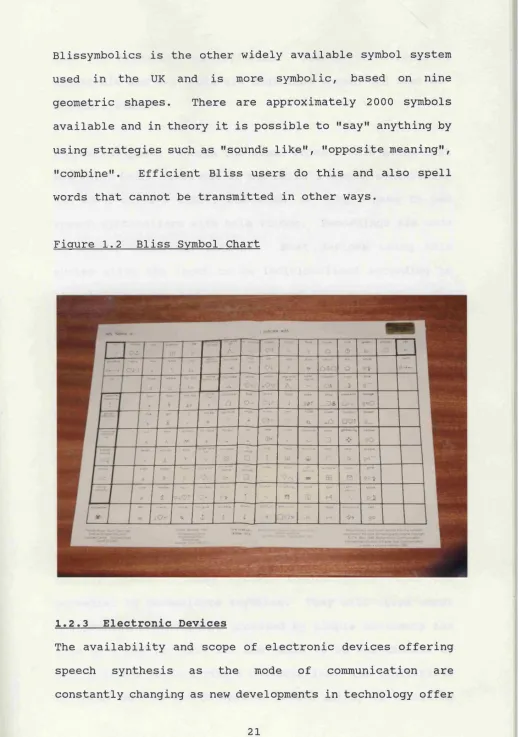
“Blissymbolics is the other widely available symbol system used in the UK and is more symbolic, based on nine geometric shapes. There are approximately 2000 symbols available and in theory it is possible to "say" anything by using strategies such as "sounds like", "opposite meaning", "combine". Efficient Bliss users do this and also spell words that cannot be transmitted in other ways.
Figure 1.2 Bliss Svmbol Chart
1.2.3 Electronic Devices
more and different possibilities. The two main types of electronic aid available are digitised speech and text-to- speech systems.
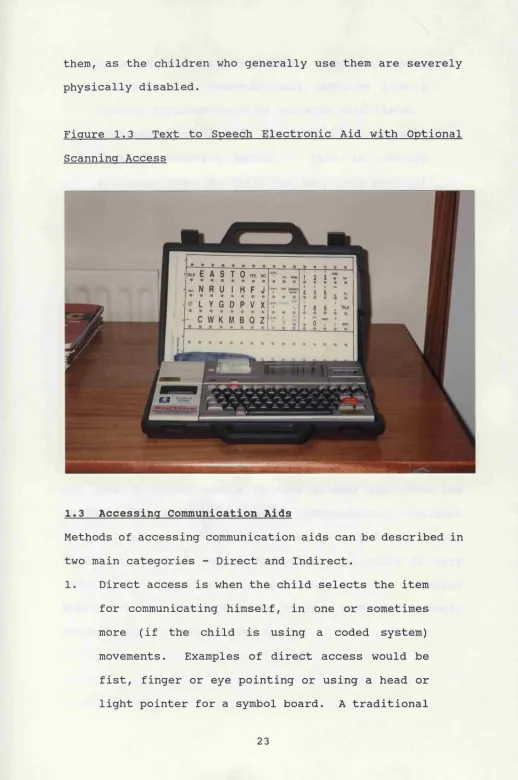
Digitised speech records the human voice. This means that the voice which comes out of the child's speech synthesizer can be a child's voice, and women no longer have to use speech synthesizers with male voices. Recordings are made of useful words and phrases. Most devices using this system allow the input to be individualised according to the child's needs and easily changed when necessary. The limitations of aids using digitised speech are a restricted number of recordings, although the number does vary according to the device, and no flexibility in spontaneous input, although some devices do allow phrases to be combined when required.
them, as the children who generally use them are severely physically disabled.
Figure 1.3 Text to Speech Electronic Aid with Optional Scanning Access
• • • • • • • • ■tau( E A S T O y e s n o
• • • • • • • •
- * Î ^— 5 _
i i Î i t
~ N R U 1 H F J 4 t S t t fi «C k • • • • • • • • • • • • •
^ L Y G D P V X 1 !
7 0 9 TALK
• • •
* C W K M B Q Z urn • c 3 ^, I Ô T J
»
1.3 Accessing Communication Aids
Methods of accessing communication aids can be described in two main categories - Direct and Indirect.
1. Direct access is when the child selects the item for communicating himself, in one or sometimes more (if the child is using a coded system) movements. Examples of direct access would be
keyboard could be operated with fingers or a head pointer, or a nontraditional keyboard like a Concept Keyboard could be operated with fists. 2. Indirect access is when the child has to use some
sort of scanning method. This is usually necessary when the child has very poor physical control and coordination. Examples of scanning methods would be using another person to scan down a symbol chart, stopping him on the correct horizontal line and scanning across, stopping the person when they reach the appropriate picture, symbol, word or letter. Scanning can be done using a switch to stop the scanning process vertically and horizontally. There are a number of computer programmes that will do this from simple games and puzzles to sophisticated word processing programmes.
1.4 Communication Aids in Practice
There have been few follow-up studies on the outcome of the recommendation of communication aids but those that have been reported offer a gloomy picture of underuse of the aid and very restricted communication. This tends to support clinical observations from therapists involved in the recommendation process and reports from schools and parents, that aids frequently do not meet client expectation and needs, that is, effective communication.
However, Udwin & Yule (1990, 1991a, 1991b) studied two groups of children learning to communicate using either Bliss symbols or Makaton signing, and followed them for 18 months. They report a disappointing picture of limited communication skills with very little progress over time.
1.5 Assessment
A number of different models for assessing this client group for an appropriate communication aid have been developed. As early as 1976, Vanderheiden & Harris- Vanderheiden were suggesting that choosing the right aid
for the child was a complex task and that the following issues should be taken into account: type and degree of physical handicap, cognitive ability, social and physical environment, other functional communication channels available to the child and the communication function to be fulfilled by the aid.
In response to the complexity of assessing the child for an augmentative communication system, attempts were made to develop decision making flow charts.
Shane & Bashir (1980) developed an election decision matrix with ten categories including motor, language, cognitive and environmental factors. The matrix gives an 'elect',
selection model takes account of environmental, user and technique factors.
The matrix suggested by Owens & House (1984) has three levels. The first looks at the appropriateness of augmentative communication for the client, the second provides information on modes of communication and the third on the kind of code (signs, symbols, words, pictures etc.) the client requires.
Although these flow charts were not completely successful in overcoming the difficulties clinicians were experiencing in assessment, they did highlight the importance of factors other than the aid user. As Culp (1987) states "the characteristics of the communication system, the behaviour of the communication partner and the nature of the communication situation, have a dramatic effect on the behaviour of the augmentative technique user", and suggests documenting these factors for evaluation.
client to reach his potential and move on.
1.5.1 The Wolfson CAC Assessment Model
The assessment model used by this author was developed by the Wolfson Centre Communication Aids Centre team and is described in detail by Jones et al (1990). A brief summary is presented here.
Professionals making a referral to the CAC are requested to complete a pre-assessment form before being offered an assessment appointment. This is to determine which children have the prerequisite skills thought to be necessary to use a communication aid.
Pre-requisites are considered to be: 1. Visual function:
most augmentative communication systems rely on visual stimuli such as pictures, symbols, signs.
2. Visual attention:
it is necessary to be able to attend to visual stimuli, as most systems rely on decoding visual stimuli like pictures, symbols and signs.
3. Verbal comprehension:
children usually need a basic understanding of labels of familiar names and actions before they use them to express themselves.
4. Cause and Effect:
development (Bates, Benigni, Bretherton, Camaioni and Volterra 1977) and the child needs to demonstrate that he can consistently perform an action for a reward or operate a toy with a switch.
5. Communicative intent:
the ability to communicate specific messages through pointing, vocalising, body movements or physically manipulating an adult to achieve the comprehension of the message.
If the child is seen to have the pre-requisites, an assessment appointment is offered. A first assessment typically takes a day. In the morning the child and his carers are seen by the multidisciplinary team. The team may consist of a speech therapist, an occupational therapist, rehabilitation engineer, paediatrician and psychologist. In the afternoon, the child's local therapists and teachers are invited to join the family. Before seeing the child, the family and the team meet to discuss the child and how the family perceive the problems and how they feel the child can best be helped.
Assessment by the multidisciplinary team addresses a number of areas:
1. Mobility:
2. Posture:
Sitting position is very important for accessing the communication aid.
3. Accessing:
If the child has good hand function, it will be possible to access a keyboard directly to work the communication aid. If the child has limited hand function, the aid could be accessed indirectly by switches. If the child does not have reliable hand function, the team need to identify another reliable, consistent response to train for accessing.
4. Vision:
It is important to know about the child's visual field because of positioning the aid's visual display. Many of the children referred have restricted visual fields.
5. Oculo-motor:
The child's scanning ability needs assessment because of the size and type of visual display.
6. Hearing:
If the child has a hearing impairment it may be important to reinforce the auditory input with a visual means of communication like signing or symbol use.
7. Symbolic and Verbal Comprehension:
Reception of Grammar (Bishop, 1983) and the BPVS - British Picture Vocabulary Test (Dunn, Dunn, Whetton, Pintilie, 1982) .
8. Communicative Functions;
Range and type of communicative functions used. This is now assessed by the use of a scripted elicitation procedure. (Price, McConachie, Jolleff, 1992)
9. Communicative Modes:
The modes and combination of modes which the child uses for communicating. For example, verbal, vocal, gestures, signs, symbols etc.
At the end of the assessment day, the Team make recommendations for a communication system that will meet the needs of the child and his environment.
1.6 Conclusion
Although this kind of assessment model offers a multidisciplinary view of the child and includes many different factors, it primarily addresses the child and the aid. To identify and anticipate factors which might facilitate or prevent effective aid use, it is necessary as Culp (1987) suggests to assess other aspects like communication partners and different communication situations.
CHAPTER 2 LITERATURE REVIEW
2.1 Introduction
The development of communication is vital to a child's personal, social, cognitive and emotional growth. It is the means by which the child controls the environment and makes relationships. However as Wells (1981) states "it is a collaborative enterprise" and each partner in the communication takes turns in being the speaker or message transmitter and being the hearer or receiver of the message. Successful communication requires agreement on the subject matter in the shared situation, follows an orderly sequence of turns, appropriately relates the meaning of the messages to the level of the communicators and to the communication turns that have preceded and will succeed the current turn. McLean and Snyder McLean (1978) propose that "early social interactions provide the vehicle through which the child acquires linguistic structures, much of the semantic content and the social use of
language" and as early as 1962, Vygotsky stated that, " What the child can do today in co-operation, tomorrow he will be able to do on his own"
therefore denying them the experience of collaboration and co-operative learning. They are consequently at risk of becoming isolated from normal social interaction and as this is seen as the medium through which the development of communication is facilitated (Bruner, 1975a; Bates, Camaioni & Volterra, 1975; McLean and Snyder McLean, 1978) they are therefore at risk for the development of abnormal communication patterns.
In view of this, this review will first briefly examine the development of communication skills in the context of social interaction in the normal child as a background to considering the development of communication patterns in the physically disabled child. It will then move on to examine the communication patterns of non-verbal children who use communication aids and finally will address issues
of training aid users and their caregivers.
2.2 The Development of Communication Skills in the Normal Child
of gestures and vocalisations within this interactive dialogue is discussed by Bruner (1975a) and Bates, Camaioni & Volterra (1975).
2.2.1_____ Social Interaction and the Beginnings of Communication
Bruner suggests that linguistic concepts are first realised in joint action. Joint action consists of three components; the child, the object and the mother or caretaker. Joint action occurs when both the caretaker and the child can focus on the object - when the child is about four months of age. Once joint focus has been achieved, a behaviour or a vocalisation will occur which will serve as a comment upon the object being focused on. The child's understanding of syntactical rules develops because they have been abstracted from the joint action routines of the mother and child.
topic, it was almost always accompanied by non-verbal communication to aid the child's understanding. Harris et al and Schaffer, Hepburn & Collls (1983) made the same observations about how mothers monitor their child's actions and attention so that they can make appropriate comments about what the child is doing.
These findings are given further refinement by a study in 1986 (Harris, Jones, Brookes & Grant) which suggests that while the relationship between the non-verbal context and the language input is important, it is the timing of the language input that is crucial. Language levels were assessed for ten children of twenty four months of age. Seven were found to be normal and three were exhibiting delay. Retrospective data analysis of conversations from these ten mother/child dyads at sixteen months found differences in the timing of the mother's commentary. All mothers talked about the activities their child was engaged in. However, mothers of the children with normal language talked about the objects or actions the child was attending to at that time, whereas the mothers of the children with delayed language often talked about an object or activity before or after the child had attended to it.
2.2.2 Communicative Function
* Bishop & Mogford (1988) describe pragmatics as "The study of how utterances are used to convey meaning in different social and environmental contexts".
social/communicative function of language is referred to as "pragmatics” . Bruner (1975a) defines pragmatics as the "direct function" of speech through which communicators affect the behaviour of others. The term pragmatics is essentially linguistic, and strictly does not include the non-verbal behaviours and they will therefore be referred to as communicative functions hereafter.*
Bates et al (1975) divide prelinguistic development into three distinct stages based on Austin (1962) and attempt to link them to Piaget's six stages of sensorimotor development. Caregivers respond and interpret the earliest vocalisations by the baby, although it is doubtful that the baby is intending to send a message. The adult, however behaves as though the baby is trying to send a message and even if the interpretation is wrong, the baby will learn something about the effects of certain kinds of behaviour. Bates et al classify this as the first stage perlocutionary. The child has "a systematic effect on his listener without having an aware control over that effect." Crying or cooing in the very young baby would be an example of this.
The final stage - locutionary is when the child "constructs propositions and utters speech sounds within the same performative sequences that he previously expressed non verbally". An illustration of this in the very young child would be asking for an object or action by name instead of pointing at it as in the illocutionary stage. Bates et al (1977) suggest that this stage does not occur until the child has reached Stage 5 in the Piagetian sensorimotor framework (Piaget, 1954). This requires that the child should have achieved an understanding of the means-end relationship and operational causality. Applied to intentional communication, this means that the child must recognise events as ordered in causal sequences, with one event occurring before and capable of influencing or causing later events. The child must also recognise that other people can operate independently and need to be contacted if the child wants them to be part of the interaction and act in accordance to the child's intentions.
core categories that are common to all systems: eg attention seeking; requesting objects, actions and information; protesting or rejecting; responding and acknowledging.
Therefore prelinguistically, it would seem that the child is constructing a communicative framework which is already facilitating communication and from which can develop verbal communication. It is estimated that only 35% of human communication is conveyed through speech, the remaining 65% is transmitted through non-verbal behaviour (Birdwhistell cited in Blackstone, 1986) . However, as Bruner (1975a) comments the process is only made possible by the "presence of an interpreting adult who operates not so much as a corrector or reinforcer but rather as a provider, an expander and idealizer of utterances while interacting with the child".
2.2.3 Motherese
"motherese" and is considered by some researchers (Snow, 1972; Cross, 1977; Pinker, 1979) to have an effect in language acquisition.
2.2.4 Synchrony between Mother and Child
There is growing evidence that language learning strategies of the child and language teaching strategies of the caregiver change with the development of the child in both verbal and non-verbal ways (Bates, 1976; Garnica, 1977; Snow, 1977; McLean & Snyder McLean, 1978). These changes in strategies appear to be related. The child's communicative behaviour is modified by the mother or caregiver's input and the mother's communicative behaviour is modified by the child's communicative behaviour.
of communication the child was using and to be attempting a "match". eg when the child was one month, although the mother used verbalisations, vocalisations, eye contact and facial expressions, her predominant communicative mode was body action and when the child was two to three years old and was developing verbal communication as his main mode, the mother adjusted and also predominantly used the verbal channel.
2.2.5 Turntakina
This mutual responsiveness between the adult and the child facilitates a successful pattern of interaction, which is characterised by each partner taking turns and expressing communication through a variety of different modes. Each partner must be sensitive and responsive to the other's communication, be expecting signals from different modes and be aware of the relevant linguistic level of the partner (McLean & Snyder-McLean, 1978) . Turntaking involves the roles of each partner shifting from communicator (active) to listener (passive) and back again. Schaffer (1977) comments that "it is the manner whereby this change is accomplished that constitutes the severest test of the ongoing relationship". Signals must be produced that indicate to each partner intentions of initiating or terminating his turn.
been observed to use different strategies to establish and prolong the turntaking. For example, the child may be playing and the mother may comment on the play. In response to the comment the child looks up at the mother. Although the child did not intend to initiate an interaction, the mother, by responding to the child's action, gave him the experience of affecting another person's behaviour with his actions and in this way offered the child the experience of playing the role of initiator within the interaction. The mother has enclosed the child's behaviour in a communicative sequence without any apparent intention on the child's part (Jones, 1980) . The use of "turnabouts", turns which respond to and require a response from the opposite partner, (Kaye & Charney, 1980), were often employed by mothers of young children to maintain an interaction.
reply. The third group consisted of mothers who used both the expanded reply and the request for information. Three months later, the children in group 3 had made more linguistic progress suggesting that children need the experience of being an active communicator - providing information that they know - but that they also require the extra linguistic information that the expanded reply supplies. The importance of expanding on something the child has just said is also highlighted by Cross (1978).
2.3 The Development of Communication Skills in the Physically Disabled Child
From the very brief examination of the literature concerned with the normal development of interaction and communication, it seems that the child's developing motor activity plays a crucial role and that a number of subtle features of the social interaction and collaboration between mother and child could be very important. The non verbal framework has assumed an important place in the development of normal communication and the physical disability of the child increases the risk of its disruption. This section will review work specifically related to the development of communication skills in the physically disabled child.
communication development.
2.3.1 Mothers and their Physically Disabled Children - an Early Study and Developing Methodology
Shere & Kastenbaum, (1966) examined thirteen pairs of mothers and their physically disabled children, particularly focusing on the relationship of mother-child interaction and cognitive development. The children were between the ages of two and four years. Each child was studied by interviewing the mother and observing their interaction at home. The study yielded much descriptive information and serves to paint a picture of the feelings and perceptions of mothers of physically disabled children and the context in which they find themselves.
physical disability was limiting their learning potential and consequently did not realise that there was an active role for them to play in facilitating learning situations for their children. Mothers expressed anger and negative feelings towards professionals because they did not say encouraging things, and it was also clear that professionals did not offer helpful advice like how to change children's environments to help them learn.
From the observational study they present two cases in detail. One mother limits herself to providing basic needs for the child, who was generally discontented, passive and uninterested in things around her. The second mother was more interactive and was observed to comfort, teach and stimulate her child, who was active, alert, happy and interested in things around him. Shere & Kastenbaum comment that despite the differences between the mothers, "both lacked insight into the relationship between a severe physical handicap and cognitive development in a young child".
passivity while overestimating their cognitive ability, lacking insight into the children's cognitive and social development needs and focusing on their physical development may lead to the children experiencing non stimulating environments. It is interesting to note how little useful information the mothers seemed to have and how professionals were seen as unhelpful.
The Shere & Kastenbaum study did indicate that the framework they used was capable of identifying differences in interactional patterns. Other researchers began to develop ways of documenting interaction and in 1969 Kogan, Wimberger & Bobbitt developed an approach to observe
interaction between mothers and their disabled children which Kogan and different colleagues then utilised and refined in a number of studies ( Kogan & Tyler, 1973; Kogan & Gordon, 1975; Kogan, Tyler & Turner, 1974; Tyler, Kogan & Turner, 1974; Kogan, 1980) The approach was based on the view that social interaction is a "multivariate dynamic process" and behaviours were analyzed according to their "relative status, affection and involvement components". They studied interactions between the disabled children, their mothers and therapists.
2.3.2 Mother and Disabled Child Interaction
group were highly motivated and the children were not matched on variables like developmental levels or the parents on educational status their results did indicate interesting differences between the groups. They found that the mothers of the disabled children displayed more controlling behaviours than the mothers of the non-disabled children and that both groups of disabled children were more passive than the normal control group, although the physically disabled group displayed more assertive, controlling behaviour than the group with learning difficulties.
1974) that mothers of disabled children were more controlling in their interactions with their children than were the mothers of non-disabled children. They suggest that this is evidence of reciprocal influences within the dyad and that the mother's behaviour pattern within the disabled dyad may interfere with communication development.
2.3.3 Maternal Responsivitv
Brookes-Gunn & Lewis (1984) studied maternal responsivity in mother/handicapped infant dyads. They found that cerebral palsied children exhibited less behaviour than groups of Downs syndrome or developmentally delayed children, and also that mothers of developmentally delayed children were more responsive to their children than mothers of children in other groups. They linked this difference to the higher mental age of the developmentally delayed group and suggest that maternal responsiveness may be most related to the mental age of the child and not to the disabling condition.
2.3.4 Interaction and Mothers as Therapists
2.3.6 Psycholinquistic Processing in the Physically Disabled Child
Bishop (1988) states that "The available evidence shows that, provided hearing and intelligence are not impaired, inability to speak does not prevent development of language understanding and inner speech". There are a number of case studies which support this. As early as 1962, Lennenberg described a child who had a complete inability to make speech sounds and yet had good comprehension of spoken language and in 1975 Fourcin described the famous case of Richard Boydell who had severe cerebral palsy and who was unable to express himself until the age of 30 when he was given a Possum typewriter which he operated with his foot. Recently there have been a number of popularised cases, eg the
film "My Left Foot".
Within the physically disabled population there are many whose neurological damage also affects their cognitive ability. This will also affect their ability to learn and use language in the same way as it does in a child without physical disability but with low general intelligence.
affection and warmth towards the child demonstrated by both parents and therapists. Mothers were more controlling and negative when offering therapy than they were when playing with the child. The study indicated that there may be a longitudinal relationship between the child's physical progress and the adult's responsiveness, possibly exacerbated by professional's emphasis on the child's physical disability. This supports some of the findings in the Shere & Kastenbaum (1966) study.
2.3.5 Intervention Proaraumes based on Mother/Child Interaction Analysis
Shere & Kastenbaum (1966) and Kogan (1980) carried their observations into intervention programmes. The findings from both these programmes suggest that family dynamics and mother/child interaction are often negatively toned and tend to inhibit rather than facilitate development. Shere & Kastenbaum suggest early intervention to help families have a realistic view of the child. Kogan suggests identifying behaviours that can be changed. The study indicates that poor parental interaction and behaviours may be avoided and can be helped by behaviour instruction to groups of parents. However, the change in parents' behaviour was not accompanied by any measurable change in the child's skill or independent function.
disabled children and normal children and that this could be of significance to the development of communication in the disabled child.
2.4 Communication Patterns in Children who use Communication Aids
It has already been mentioned in Chapter 1, that speech for severely physically disabled children is either not possible or severely limited, while the previous section of this chapter has reviewed work that indicates that the children's non-verbal framework is distorted. It seems reasonable now, to consider what happens to physically disabled children's communication when they use a communication aid to augment their expressive speech.
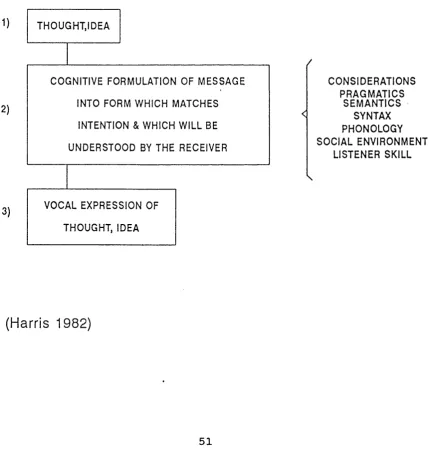
Figure 2.1 Intention to expression for non - aid users
1)
2)
3)
THOUGHT,IDEA
VOCAL EXPRESSION OF
THOUGHT, IDEA
COGNITIVE FORMULATION OF MESSAGE
UNDERSTOOD BY THE RECEIVER INTO FORM W HIC H MATCHES
INTENTION & WHIC H WILL BE
C ONSID ERATIO NS PRAGMATICS
SE M A N T IC S SYNTAX PHONOLOGY SOCIAL ENVIR ONMENT
LISTENER SKILL
Figure 2.2 Intention to expression for aid users
Considera ti ons : p r ag mat ic s s e m a nti cs sy nt ax p h o n o l o g y
listener skill social environment
(Reformulate)
No di rect
match
M e s s a g e e x p r e s s i o n Thought, idea
Me ss a g e ex pr ess io n
Aler t re ce i v e r to m o d e c h o s e n Se lect e x p r e s s i v e
m o d e C o g n i t i v e f o r m u l a t i o n into a p p r o p r i a t e fo rm
R e - f o r m u l a t e m e s s a g e if i ncorrect or not
c o m p r e h e n d e d V i s u a l / m o t o r search
of v o c a b u l a r y avaiI a b le in order
to se le ct "best m a tc h" to in tended _ _ _ _ _ m e s s a g e
Exam ine ac cu r a c y of output an d en sure corr ect ne ss of me ss a g e_ _ _ _ _
Visual moto r s e le cti on and sequencing of me ss a g e elements
2.4.1 Barriers to Effective Communication
"Augmentative communication devices are a poor substitute for natural speech" (Kraat,1985) and communication between aid users and normal speakers does not replicate or parallel speech to speech interaction. She suggests that communication > using these systems will have many constraints and peculiarities.
Both Harris (1982) and Kraat (1985a) identified the speed of communication as a barrier - aid users are much slower than normal speakers. Foulds (1980) comments that a typical adult speaks at a rate of 126 - 172 words per minute, while a typical aid user has an output of 2 - 25 words per minute. If we consider the stages the child using a communication aid has to go through to express one idea (Harris, 1982) it is easy to see why there is such a difference in communicative rate. This slow rate of delivery from the aided speaker can make the interaction boring and tedious and tempt the normal speaking partner to
speak for the aid user.
dominate the interaction using a high frequency of requests and instructions (Harris, 1982; Light, Collier & Parnes, 1985a; Buzolich & Wiemann, 1988). The aid user tends to play the respondent role in the interaction by using "yes/no" or providing specific answers to requests (Beukelman & Yotkston, 1980; Harris, 1982; Calculator & Luchko, 1983) and the normal speaker tends to initiate more frequently within the interaction (Calculator & Dollaghan, 1982; Harris 1982; Calculator & Luchko, 1983).
Vocabulary available to the aid user is restricted (Harris, 1982; Kraat, 1985a; Udwin & Yule, 1990) as most aids have limited vocabularies. Some aids have facilities for spelling vocabulary or combining parts of words but this method is obviously slow and communication is then affected by the constraint of speed.
The range of communicative functions used by the aid user is noted by Harris (1982) to be restricted. This is further supported by the detailed work of Light, Collier & Parnes (1985b) and Udwin & Yule (1991a) which will be discussed later in this section.
Kraat (1985a) suggests that both the aid user and his communication partners need to make adjustments to the communication situation and aim for the "optimal levels of interaction that can be achieved" within this framework. This may mean employing a variety of different techniques that normal speakers would not use, like for example, utilising a sort of shorthand. We have already discussed in Chapter 1 how efficient Bliss users overcome lack of vocabulary by using strategies like "sounds like" etc. Word processing packages with predictive lexicons reduce the number of keystrokes users have to make and therefore reduce time. PAL - Predictive Adaptive Lexicon (Swiffin, Pickering, Arnott & Newell, 1985) would be an example of this.
2.4.2 Communication Patterns of Communication Aid Users There has been very little detailed work in this area but there are two major studies that have examined this client group's communication patterns. The work of Light, Collier & Parnes (1985a, 1985b, 1985c) was concerned with cerebral palsied Bliss board users, and the work of Udwin & Yule (1990, 1991a, 1991b) looked at two groups of physically disabled children - Makaton signers and Bliss board users.
communication modes. The interaction in two settings - a free play session with their caregiver and a structured context with a clinician - was recorded by videotape and analyzed according to the three frameworks. All the children in the study had Bliss communication boards with a vocabulary of a minimum of one hundred symbols that they had been using for at least six months prior to the study.
Discourse was analyzed on three levels:
Level 1: Is a communicative act present or absent where it would be reasonable to expect one to occur? Level 2 : Does the communicative turn have backward links ie is it related contextually, or does it establish a new context?
Level 3 : Does the communicative turn have forward links, demand a response or just invite a comment? This is important for keeping the interaction going
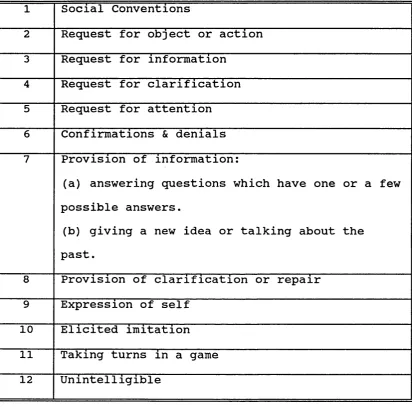
Functions were analyzed according to a list of twelve functions: social conventions; requests for objects or actions; requests for information; requests for clarification; requests for attention; confirmations & denials; provision of information; provision of clarification; expressions of self; elicited imitations; conversational fillers; unintelligible.
gesture and vocalisation; eye gaze and vocalisation.
Results showed that the discourse pattern was unequal; while the children and adults influenced each other, the caregivers produced more than twice the communicative turns of the child, and controlled the interaction. They did this by initiating new topics and demanding specific responses from the child. The children only used about half their turn opportunities and then usually when they were obliged to respond. The child's range of communicative functions was limited - Yes/no responses yielded a 39% mean score, and answering questions with specific information ie information demanded by the caregiver and known to both child and adult, yielded a mean score of 18.4%. The children rarely asked for information or clarification, although there were a wider range of functions used with the clinician in the structured context than in the free play session. Communication modes produced some interesting results. Only 18.2% of the child's turns were taken using their communication board. The authors also noted that the mode used was influenced by the communication partner's demands on the child and by the function. Confirmations and denials were transmitted primarily by gestures or vocalisations, while more symbolic communication was transmitted by the communication board.
users, aged between 3;6 and 9;8 years to evaluate the "impact of augmentative communication training on the communicative abilities of language impaired cerebral palsied children". They were followed up every six months for eighteen months. Measures of physical handicap, IQ, and language comprehension were taken. Results indicated that there were very few differences between the groups at assessment, and over time, in acquisition and use of the system and in the use of communicative functions. The differences that there were disappeared when measures of IQ and language comprehension were taken into account.
The overall picture these papers present is very similar to the Light et al (1985) study of limited use of systems for a small number of communicative functions. For example, Udwin & Yule report over 80% of all utterances recorded were for just four functions. The children did demonstrate some progress over the eighteen month period, but it was very slow and restricted. The sign/symbol vocabulary they used was small and the length and complexity of their utterances was limited. An interesting finding was that neither system appeared to facilitate greater communication, although it is widely believed that brighter children should be introduced to Blissymbolics as it provides more communicative potential.
study and the limited use of the system made by children in the Udwin & Yule (1990, 1991) study it would be reasonable to question the use of the system for communication. Light, Remington & Porter (1982) when discussing substitutes for speech suggest that the system cannot be considered to be a substitute for speech until it is used "referentially to pursue the child's own ends in a variety of settings". They suggest that the systems should be taught and practised in structured settings, used in structured settings and then used spontaneously in unstructured settings. Udwin & Yule suggest that possible contributory factors to the underuse of the systems they report on is the very limited exposure to the system the child received both at home and at school, eg one to one and threequarter hours formal training time per week at school and few structured strategies to encourage the use of the system in everyday communication.
This suggests the importance of considering the training issues associated with augmentative communication.
2.5 Training Issues
particularly noted the paucity of studies on Makaton signing and Blissymbolics which Kiernan, Reid & Jones (1982) report as being the most widely used systems in the UK for the communicatively disabled. The data available are largely descriptive and often from a small sample or a single case study.
However, there are some studies available that have increased knowledge of training issues. It has already been mentioned that the interaction patterns of physically disabled children can be distorted (Kogan & Tyler, 1973; Kogan, Tyler & Turner, 1984; Barrera & Vella, 1987) and the studies discussed in the previous section show that the patterns of child passivity and adult control continue into aid use (Harris, 1982, Light, Collier & Parnes, 1985a; Kraat, 1985). This interaction pattern does not facilitate the development of a wide range of communicative functions and communication for the aid user remains limited. The importance of the communicating partner has been emphasised in the discussion of normal interaction and aided interaction (Harris, 1982; Kraat, 1985a) and evidence from Kogan (1980) suggests that it is possible to change interaction patterns by intervention with the child's partner.
Schultz emphasised early introduction of individualised language boards for cerebral-palsied children and stated that "the language board facilitates social interactions, language development and organisation of thought and ideas". They suggested that the child would become "self- actualising and responsive". There was no suggestion that the child or his carers might need help in communicating with a language board or that different environments like the child's school might not accept it. Until very recently, the assumption was that now the child had a mode of expressive communication available he would be able to communicate effectively.
Later research (Kraat, 1985a; Blackstone, 1986; Mathy- Laikko & Yoder, 1986) strongly suggests that the interaction pattern between the aid user and his communication partner and the supporting context contribute significantly to the quality and effectiveness of the aid user's communication.
responded to intervention strategies and produced a cumulative increase in communicative effectiveness. This provides support for the suggestion that effective communication with an aid depends on a number of different factors interacting together.
2.5.1 Training Partner Interaction Skills
teachers insisted that she communicate via her aid, even when it was much faster and easier to indicate replies by using eye-pointing and gesture.
2.5.2 Multimodal Approaches
Calculator (1988) suggests that aid users would often benefit from a multimodal approach and make use of aids like electronic devices and symbol boards while still using eye pointing and gestures when appropriate. It was observed by Kraat (1985b) that the expectations of electronic devices are high and there is a tendency to remove items like symbol boards and ignore gestures and eye-pointing when the child finally has access to a sophisticated electronic device. She suggests that knowledge and skill in using the new aid are required by both the communicator and their partner before successful communication even at the child's current level can be achieved. Culp & Carlisle (1988) have published a programme that is able to identify communication behaviours between the aid user and the communication partner and has a facility for defining long and short term goals, plan intervention and evaluate change.
2.5.3 Environmental Support
teaching process. There is a tendency for augmentative communication to be seen as something the child does with his teacher or therapist in structured situations: a teaching strategy and not a communication strategy. Udwin & Yule (199bl) in their study of Makaton signers and Bliss board users found that there was a very low priority ascribed to using the system at school (see previous section) and even less by parents at home. Parents were asked what they disliked about augmentative communication systems. The two commonest objections were that the use of the system would discourage efforts to speak and that other people did not understand the systems. This suggests that parents lack information and understanding of augmentative communication (Berry 1987).
2.5.4 Parents as Teachers
It is suggested by Berry (1987) that well-informed and trained parents are very effective teachers for their children. One of the reasons for their effectiveness is suggested by the literature on the normal development of interaction skills; the importance of language learning in context.
additional parental training sessions at home. Before the parents began the home training programme, group parent training sessions were held to familiarise parents with language development, signing and intervention issues. The results were very encouraging. All children learned to use single sign utterances spontaneously; all parents learned to use the signs taught and to handle the sign manual. In addition a very positive and encouraging report was that all parents felt confident and competent to train their children to use the signs.
2.5.5 Summary
Calculator (1988) suggests there are a number of training issues that should be seen as priorities. These are: increasing the number of different environments and opportunities the child has available for communication; augmentative communication should be valued by the user and the people he communicates with; the communication aid should be available all the time to enable spontaneous communication; and finally the communication aid and the training programme should be integrated into daily activities.
2.6 Conclusions
communication aids and the CAC staff were seeking accurate methods of describing the children's communication in order to evaluate communication aid intervention.
The broad aim of the study was therefore to measure the effectiveness of intervention with a communication aid for the children who were referred to the Communication Aids Centre. The majority of these children have cerebral palsy and over half of these have a severe physical disability
(Jolleff et al 1992).
To carry out this study it was first necessary to develop a method of measuring the communication skills of this client group. This descriptive profile was then used to test a number of hypotheses:
1. Non-verbal, physically handicapped children's communication skills will improve after the introduction of a communication aid.
2 Children will use more mature communication patterns and make more use of communication aids when interacting with their teachers than when interacting with their parents.
3. Parents will become more responsive to the child's communication and the child will use more sophisticated communication shortly (3 months) after a workshop training day.
CHAPTER 3
THE DEVELOPMENT OF PROCEDURES
The studies to be reported here sought to measure communication in nonverbal physically disabled children using both standardised assessments and observational procedures.
This client group is very difficult to assess and they respond to assessment questions in nonconventional ways. It was therefore necessary to establish reliability of the assessor's recognition and recording of responses within standard baseline measures, eg Test for Reception of Grammar (TROG), British Picture Vocabulary Scale (BPVS) and the Columbia Mental Maturity Scale (CMMS).
The studies involved using repeated measures. The major dependent measure was a descriptive profile of the child's communication patterns, transcribed from videotape and analyzed. It was therefore important to assess firstly, the validity and secondly, the reliability of the system of categorisation.
should provide potential for the child to develop and enhance his expression. The child's potential for language use is difficult to estimate from observation of current communication as it is often very restricted due to physical disabilities and limited alternative methods of communication. A reliable measure of verbal understanding should offer a guide to the child's potential for developing expression given a suitable mode of communication. It was also considered necessary to obtain a measure of cognitive ability as this would be an
important factor for describing the subjects in the follow up study and for recommending a communication aid that would maximise the child's potential.
The physical disabilities of the client group made selection of suitable assessments for language comprehension and cognitive ability difficult. As the children were non-verbal, tests that did not require verbal responses were needed. Stimulus material also needed to be quite large and in a format in which it would be easy to indicate the answer using a gross movement like fist pointing.