1
Tailoring Macromolecular Structure of Cationic Polymers towards Efficient
Contact Active Antimicrobial Surfaces
Rubén Tejero,1 Beatriz Gutiérrez,1 Daniel López,1 Fátima López-Fabal,2 José L. Gómez-Garcés,2
Alexandra Muñoz-Bonilla,1 Marta Fernández-García1*
1Instituto de Ciencia y Tecnología de Polímeros (ICTP-CSIC), C/ Juan de la Cierva 3, 28006 Madrid,
Spain
2Hospital Universitario de Móstoles, C/ Río Júcar, s/n, 28935 Móstoles, Madrid, Spain
Corresponding author: [email protected]
Abstract
The aim of this work is the preparation of contact active antimicrobial films by blending
copolymers with quaternary ammonium salts and polyacrylonitrile as matrix material. A series of
copolymers based on acrylonitrile and methacrylic monomers with quaternizable groups were
designed with the purpose of investigating the influence of their chemical and structural characteristics
on the antimicrobial activity of these surfaces. The biocide activity of these systems was studied
against different microorganisms, such as the Gram-positive bacteria Staphylococcus aureus and the
Gram-negative bacteria Pseudomona aeruginosa and the yeast Candida parapsilosis. The results
confirmed that parameters such as flexibility and polarity of the antimicrobial polymers immobilized on
the surfaces strongly affect the efficiency against microorganisms. In contrast to the behavior of
copolymers in water solutions, when they are tethered to the surface, the active cationic groups are
less accessible and then the mobility of the side chain is critical for a good contact with the
microorganism. Blend films composed of copolymers with high positive charge density and chain
mobility present up to a more than 99.999% killing efficiency against the studied microorganisms.
2
Keywords: Cationic polymers; blends; surfaces; antimicrobial.
1. Introduction
Microbial adhesion and proliferation onto surfaces of medical devices or common items often leads to
the spread of bacterial infections by contact, which is especially critical in hospitalized patients.
According to the Centers for Disease Control and Prevention (CDC) approximately 1 of every 25
hospitalized patients in the U.S. develops a ‘healthcare-acquired’ infection,1 whereas 1 in 18 patients
become infected in Europe, as stated by the European Centre for Disease Prevention and Control
(ECDC).2 The most serious infections are surgical site infections and those associated with indwelling
devices such as catheter-associated urinary tract infections. Therefore, the development of strategies
to prevent or eliminate bacterial contamination on material surfaces is urgently required and has
attained much interest over last years. Impregnating the surfaces with antimicrobial agents provides
the potential to reduce bacterial contamination and limit the transmission of diseases. Self-disinfecting
surfaces have been obtained by incorporating of a variety of antimicrobial agent including antibiotics,
silver and copper compounds, light active species, alongside antimicrobial polymers.3-4 Antimicrobial
polymers offer some advantages over the rest of the existing biocides and have become increasingly
important as a potential alternative. Antimicrobial polymers are in general highly active, with low
potential of building up resistance and reduced toxicity.5 Additionally, they have gained importance for
the fabrication of contact active antimicrobial surfaces, which exert kill actions without releasing
biocides and reducing the toxicity.6 The antimicrobial polymers can be physically incorporated onto the
surfaces and due to their high molecular weight and low diffusion coefficient, their leaching out of the
surfaces is limited.7-8 Alternatively, the polymers can be covalently anchored to the surfaces, which in
most of the cases do not entail losing their biological activity.9-10 In recent years, a variety of
antimicrobial polymeric systems have been investigated including quaternary ammonium compounds,
polymeric quaternary phosphonium salts, guanidine containing polymers and halogen polymers (i.e.
3
quaternary nitrogen atoms.13-14 Although their mechanism of action is not fully understood, these
polycationic structures interact electrostatically with the negative charged bacterial membrane,
causing disruption of the wall and the posterior death of the microorganism. Many investigations have
been focused on discussing the optimal chemical structure and the factors affecting the antimicrobial
activity of these cationic polymers such as the hydrophobic/hydrophilic balance, the charge density,
the length of the alkyl chain as well as molecular weight of the polymers.15-16 However, most of these
researches imply studies in solution rather than on surfaces. When the polymer is attached onto a
surfaces its mobility can be reduced and the accessibility of the active groups limited.
Herein, we systematically study the influence of polymer chemical structure on the antimicrobial
activity of polymeric films. For this purpose, we prepared films of blends, consisting of a series of
cationic copolymers physically blended with polyacrylonitrile (PAN). Polyacrylonitrile was selected as
model material with excellent properties such as thermal and UV stability, chemical resistance, high
strength and modulus of elasticity, that make it a desired material for a variety of biomedical uses,
such as protein filtration and hemodialysis membranes.17 As antimicrobial copolymer incorporated to
PAN, we employ a series of methacrylic copolymers bearing two quaternary ammonium groups per
monomeric units previously designed and synthesized by our group.18 These structures are based on
monomeric units with 1,3-thiazolium and 1,2,3-triazolium side-chain groups (MTA#), which
demonstrated broad spectrum of antimicrobial activity in solution against negative and
Gram-positive bacteria and fungi. In this series of copolymers it was varied several structural and chemical
parameters with the aim of investigating their influence on the antimicrobial activity when there are on
a surface. In particular, these copolymers were obtained by copolymerization of MTA# units and
acrylonitrile monomer, varying the final chemical composition, that is, the hydrophobic/hydrophilic
balance. In addition, several MTA# monomers were employed in the copolymerization in which
positive charge density, the length of the side chain, its flexibility and polarity were also varied.
4 2. Experimental part
2.1. Materials
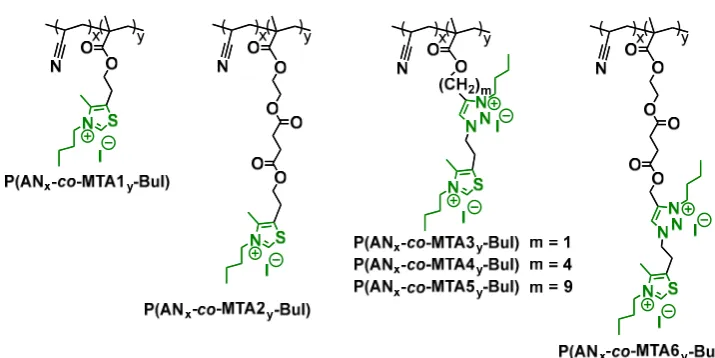
Several P(ANx-co-MTA#y-Bu) statistical copolymers quaternized with butyl iodide were synthesized as
previously reported by our group (see Figure 1).18-19 Polyacrylonitrile (PAN, Mn = 150 kDa) was
supplied by Sigma Aldrich and was used without previous purification. N,N-dimethylformamide (DMF,
99.8%) provided by Alfa-Aesar and ethanol (EtOH, 99.9%) from Scharlau Chemie, were used as
received. Sodium chloride (NaCl, 0.9%, BioXtra, suitable for cell cultures), saline phosphate buffered
saline (PBS, pH 7.4) and formalin (10%, neutral buffer) were purchased from Aldrich and used
directly.
For the microbiological assays: Sheep blood (5%) Columbia Agar plates were purchased from
bioMérieux and BBLTM Mueller Hinton broth was purchased from Becton, Dickinson and Company
and was used as a microbial growth media. American Type Culture Collection (ATCC): Gram-negative
Pseudomonas aeruginosa (P. aeruginosa, ATCC 27853) and Gram-positive Staphylococcus aureus
(S. aureus, ATCC 29213) bacteria and Candida parapsilosis (C. parapsilosis, ATCC 22019) yeast
were obtained from OxoidTM. Microorganisms were incubated for 24 h for bacteria and 48 h for yeast
at 37 ºC in a Jouan IQ050 incubator. The optical density of the microorganism suspensions was
measured in McFarland units proportional to microorganism concentration by a DensiCHEK™ Plus
(VITEK, bioMérieux).
2.2. Antimicrobial Films preparation
The films were prepared by casting process from polymer blend solutions in DMF at a final polymer
concentration of 10 wt%. These solutions were prepared by dissolving PAN and the corresponding
quaternized copolymer P(ANx-co-MTA#y-Bu) in a PAN/copolymer ratio of 70/30 by weight. Each
solution was filtered through a fiberglass filter (Symta) with a pore diameter of 3.1 μm and then,
spread in a flat Petri dish. The solvent was first eliminated at room temperature, followed by a heating
5
2.3. Evaluation of antimicrobial activity of the films
Antimicrobial activity of blend films was determined following the E2149-01 standard method of the
American Society for Testing and Materials (ASTM)20 against P. aeruginosa, S. aureus and C.
parapsilosis. Initially, the microbial strains were grown on 5% sheep blood Columbia agar plates,
dispersed, and adjusted to a turbidity equivalent to 0.5 McFarland standards (108 colony-forming units
per mL, CFU/mL) with sterile saline solution. Subsequently, the working bacterial suspension (∼5×10⁵
CFU/mL) was obtained by 200-fold dilution with phosphate buffered saline. Films were previously
sterilized by washing with ethanol and exposure to UV radiation during 30 min. Then, each sample
was introduced in a sterile falcon tube and 10 mL of inoculum with 5×10⁵ CFU/mL were added. Falcon
tubes with only the inoculum and PAN film without the copolymers were also prepared as control
experiments. All samples were shaken at 150 rpm for 24 h at ambient temperature. Bacterial
concentrations at time 0 and after 24 h were calculated by the plate count method performing 1:10
serial dilutions, followed by the drop plate technique. Three films of each sample were evaluated and
plated them by duplicate. The percentage reduction was estimated from the average of the results.
2.4. Characterization of microorganisms after exposure to the antimicrobial surface by SEM
Microbial strains (P. aeruginosa, S. aureus and C. parapsilosis) were cultured in a similar protocol as
antimicrobial measurements. The microorganism suspensions, ∼5 × 10⁵ CFU mL−1, were treated with
the films blend and incubated for 24 h (48 h for C. parapsilosis). After incubation, the microbes were
fixed on amorphous carbon-coated copper grids with 10% formalin solution for 60 minutes at room
temperature. Subsequently, the grids were washed twice with PBS and water, and finally dried for 10
min with ethanol/water mixtures increasing sequentially the ethanol content from 30 to 50, 70 and
100%. The dehydrated samples were dried at room temperature, and imaged with field emission
scanning electron microscopy (FE-SEM) Hitachi SU 8000 at 30 kV.
The adherent microorganisms (S. aureus bacteria) were also visualized by FE-SEM. Films were
6
rinsed several times with PBS, and the bacteria were fixed using the previous protocol described. The
micrographs of the films were recorded by FE-SEM with a Hitachi SU 8000 at 30 kV.
3. Results and discussion
3.1. Antimicrobial copolymer design and film preparation
Several statistical copolymer systems were investigated as antimicrobial agents to modify polymeric
surfaces (Figure 1). The copolymers consist of acrylonitrile (AN) units statistically copolymerized by
radical copolymerization with different methacrylic monomers containing 1,3-thiazole pendant groups,
MTA#, in which the final copolymer composition was varied, with mole fractions of AN in the
copolymer, fAN: 0.2, 0.4, 0.6 and 0.8.
Figure 1. Quaternized copolymers of acrylonitrile and MTA# monomers.
Several antimicrobial monomer structures (MTA#) were designed and selected in order to study the
influence of different structural parameters on the antimicrobial activity, on one hand the length and
flexibility of the side chain, secondly its polarity and, on the three hand, the incorporation of additional
antimicrobial functionality in further quaternization reaction, 1,3-thiazole and 1,2,3-triazole moieties.
7
antimicrobial activity of polymers in solution. In the particular case of antimicrobial films, the behavior
of the antimicrobial polymer might vary significantly as the chains are attached onto the surface and
the mobility might be partially impeded. Then, in addition to the positive charge, the structure of the
side chain, in terms of polarity and mobility, is expected to be crucial. Regarding the positive charge,
the MTA1 and MTA2 units only bear thiazole functionality whereas MTA3, MTA4, MTA5 and MTA6
contain also a triazole group, thus two groups per monomer susceptible of quaternization.Also,it was
studied the influence of the MTA# comonomer composition on the antimicrobial activity, that is the
hydrophilic/hydrophobic balances. Thereby, several compositions were prepared for each system,
varying the fAN. As above mentioned, in addition to the charge density and the hydrophobic/hydrophilic
balance, the flexibility of the side chain, the length of the side chain was varied; MTA2 with a long side
chain of ethyl succinate, showed higher flexibility than MTA1 leading polymers with lower glass
transition temperature (Tg).21 The flexibility of the side chain was also varied in polymers bearing both
functional groups, MTA3, MTA4, MTA5 and MTA6 in which the length of the lateral chain was also
systematically changed. In the copolymers MTA3, MTA4 and MTA5 the side chain incorporates alkyl
group, methyl, butyl and nonyl, respectively; whereas the MTA6 contains a methyl succinate group,
which is a more polar group. Finally, all the copolymers were quaternized with butyl iodide to obtain
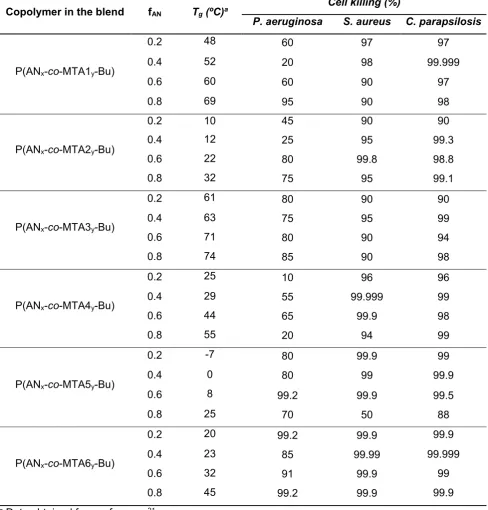
the polycationic and antimicrobial systems. Table 1 summarizes the Tg of all the copolymers studied in
this work.
From all these statistical copolymers, blend films were prepared by a casting process by dissolving
PAN and the corresponding quaternized copolymer P(ANx-co-MTA#y-Bu) in DMF at a final
concentration of 10% wt. The ratio between PAN and copolymers was fixed to 70/30 by weight. Once
the solvent was evaporated at room temperature the films were further dried at 50 ºC and the
complete solvent removal was checked on each film by ATR-FTIR spectroscopy.
3.2. Evaluation of the antimicrobial activity of the blend films
Next, the antimicrobial activity of the prepared films containing the different series of antimicrobial
8
C. parapsilosis yeast after 24 and 48 h of incubation, respectively. It has to be mentioned that the
copolymers were not directly water soluble, and then any possible leaching out of the film is avoided.
Table 1 summarizes the cell killing percentage for each microorganisms expressed with respect to
control experiments in which the bacterial reduction was null (experiments done on films prepared
from exclusively PAN, and without any films).
It is worthy to remark that the films containing the P(ANx-co-MTA#y-Bu) copolymers practically did not
present activity against Gram-negative bacteria. Previous investigations of these copolymers in
aqueous-DMSO media reveal, in general, high activity against both Gram-positive and Gram-negative
bacteria and against C. parapsilosis, showing broad spectrum activity.18 In contrast, when the
copolymers are immobilized on the films the activity against Gram-negative bacteria is significantly
reduced, meaning that a stronger and closer interaction between the polymer chain and the bacterial
membrane is necessary to kill Gram-negative bacteria with a double membrane. Therefore, it seems
that the mobility of the copolymers is crucial for the bactericidal behavior of these series of
copolymers. On the other hand, the films show acceptable activity against Gram-positive S. aureus
bacterium and C. parapsilosis yeast, with the exception of samples containing P(ANx-co-MTA1y-Bu),
P(ANx-co-MTA2y-Bu) and P(ANx-co-MTA3y-Bu) copolymers that exhibit low activity against S. aureus.
The P(ANx-co-MTA1y-Bu) and P(ANx-co-MTA2y-Bu) copolymers contain monomeric units with only
thiazolium moieties, thereby with lower cationic charge density in comparison with the rest of the
structures that contains an addition triazolium group. Therefore, in principle, an apparently high charge
density is required to achieve good antibacterial activity in such polymer films with relatively low
content of antimicrobial copolymer related to the PAN homopolymer, 30/70. However, the copolymer
P(ANx-co-MTA3y-Bu) bears thiazolium and triazolium groups in its structures, thus high charge density
9
Table 1. Chemical composition of the antimicrobial copolymers used in the blends with PAN, their
glass transition temperatures (Tg) and their microorganism elimination effectiveness.
Copolymer in the blend fAN Tg (ºC)a
Cell killing (%)
P. aeruginosa S. aureus C. parapsilosis
P(ANx-co-MTA1y-Bu)
0.2 48 60 97 97
0.4 52 20 98 99.999
0.6 60 60 90 97
0.8 69 95 90 98
P(ANx-co-MTA2y-Bu)
0.2 10 45 90 90
0.4 12 25 95 99.3
0.6 22 80 99.8 98.8
0.8 32 75 95 99.1
P(ANx-co-MTA3y-Bu)
0.2 61 80 90 90
0.4 63 75 95 99
0.6 71 80 90 94
0.8 74 85 90 98
P(ANx-co-MTA4y-Bu)
0.2 25 10 96 96
0.4 29 55 99.999 99
0.6 44 65 99.9 98
0.8 55 20 94 99
P(ANx-co-MTA5y-Bu)
0.2 -7 80 99.9 99
0.4 0 80 99 99.9
0.6 8 99.2 99.9 99.5
0.8 25 70 50 88
P(ANx-co-MTA6y-Bu)
0.2 20 99.2 99.9 99.9
0.4 23 85 99.99 99.999
0.6 32 91 99.9 99
0.8 45 99.2 99.9 99.9
10
Contrary, in solution all these copolymers demonstrated considerable efficacy against all the
microorganisms, suggesting that when the copolymer is embed in the films the active thiazolium
and/or triazolium groups might be less accessible. Then, although the charge density should be
important, the cationic groups have to be available to contact with the microorganisms. Therefore, the
flexibility and the polarity of the side chain are expected to be decisive parameters in the antimicrobial
activity. In effect, as the length of the alkyl chain augments, with butyl and nonly as alkyl group spacer,
for the P(ANx-co-MTA4y-Bu) and P(ANx-co-MTA5y-Bu) copolymers, respectively, the cell killing
percentage remarkably increases, up to more than 99.999% killing efficiency in some cases. However,
no significant differences can be observed when comparing both systems, with butyl and nonyl. This
can be explained by the fact that as the alkyl group is longer and more flexible, the hydrophobicity of
the chains is also higher, which can provoke the constriction of the chain and disfavor its accessibility.
Indeed, the copolymer P(ANx-co-MTA6y-Bu) with a long side chain of methyl succinate, a more polar
group, exhibits excellent antimicrobial activity against S. aureus bacteria and C. parapsilosis yeast for
all the copolymer compositions, and relatively acceptable against Gram-negative P. aeruginosa
bacteria. This copolymer may present a good balance between flexibility and polarity, thus their active
cationic groups are available for killing contact.
The composition of the copolymer is another parameter that might influence the antimicrobial activity
of the copolymer. In principle, copolymer with large content of antimicrobial copolymer, low fAN, would
exhibit better antimicrobial activity as the content of cationic group is higher and their Tg lower.
However, it can be observed from the data that intermediate compositions showed better
performances, which demonstrates that the hydrophobic/hydrophilic balance of the copolymer is also
important in the interaction with the bacterial membrane as previously reported in many studies.15, 22-23
In summary, for antimicrobial polymers immobilized on surfaces the flexibility and polarity of the side
chain are crucial parameters for enhancing the accessibility of the active cationic groups. In addition,
an intermediate copolymer composition with adequate hydrophobic/hydrophilic balance is desired for a
11
3.3. Evaluation of the morphological changes of microbes
The morphological changes of microorganisms, S. aureus, P. aeruginosa and C. parapsilosis, after
incubation with the antimicrobial films during 24 h (48 h for C. parapsilosis) were observed by Field
Emission Scanning Electron Microscopy (FE-SEM) as shown in Figure 2. In particular, the
micrographs show the results with the films containing the copolymer P(AN0.6-co-MTA40.4-Bu). Control
experiments were also carried out, in which the microbes were incubated onto films obtained from
exclusively PAN solutions. It is clearly observed that the morphology of the cells incubated with the
antimicrobial films significantly changed with respect to the cells incubated onto control PAN films. The
shape of all studied microorganisms becomes more expanded and irregular. The microbes tend to be
stuck together and in some cases, especially in Gram-positive S. aureus (Figure 2d),
membrane-fusion events took place. The cell membranes of the C. parapsilosis (Figure 2f) also present damaged
structure in which the intracellular material leaked out from the cells. In the case of the Gram-negative
P. aeruginosa, although the damage seems less accused, the bacterial cell membrane was also
distorted (Figure 2e).
Figure 2. FE-SEM images of: (a) and (d) S. aureus; (b) and (e) P. aeruginosa; and (c) and (f) C.
parapsilosis after incubation during 24 h (48 h for C. parapsilosis) on control films of PAN (a, b, c) and
12
Therefore, these results demonstrated that the mechanism of action of these antimicrobial surfaces is
by cell-membrane disrupting due to hydrophobic interactions and electrostatic interactions between
the negatively charged cell walls and the positively charged copolymers24-27.
Biofilm inhibition was also confirmed by FE-SEM. Figure 3 shows the micrographs of the film surfaces
obtained from PAN and from the blend of PAN and P(AN0.6-co-MTA40.4-Bu) after incubation with S.
aureus bacteria during 2 h. It is clearly observed a significant reduction in the bacterial population in
comparison with the control film, made from PAN without antimicrobial copolymer.
Figure 3. FE-SEM images of S. aureus on PAN films a) in the absence and b) in the presence of the
antimicrobial copolymer P(AN0.6-co-MTA40.4-Bu) after 2 h of contact.
4. Conclusions
In this work, contact active antimicrobial films were prepared by simple blending process incorporating
cationic copolymers into polyacrylonitrile matrix, a polymeric material extensively used in biomedical
applications. A series of cationic copolymers with high charge density was selected to investigate
systematically the influence of the macromolecular structure on the biocidal efficiency, when the
cationic polymers are tethered on a surface rather than in solution. The results showed that the films
13
in solution in which the cationic polymers were highly efficient. Besides, it was demonstrated that the
macromolecular structure of the cationic polymers strongly affects the biocidal activity of the blend
films, in addition to the influence of chemical composition and positive charge density. Remarkably,
films composed of copolymers with high chain mobility exhibit better cell killing efficiency, more than
99.999%. Thus, we can conclude that when cationic polymers are enclosed on surface, parameters
such as the length, flexibility and polarity of the side chain are crucial to enhance the accessibility of
the active groups for killing the microorganisms by surface contact.
Acknowledgements
This work was supported financially by the MINECO (Project MAT2016-78437-R), the Agencia Estatal
de Investigación (AEI, Spain) and Fondo Europeo de Desarrollo Regional (FEDER, EU). Authors
would like to thank Ms. Charline Merad for her help in the experimental part.
References
1. AHRQ July 2016: https://psnet.ahrq.gov/primers/primer/7/health-care-associated-infections.
2. ECDC, 2013: https://ecdc.europa.eu/en/healthcare-associated-infections-acute-care-hospitals.
3. Page, K.; Wilson, M.; Parkin, I. P., Antimicrobial surfaces and their potential in reducing the
role of the inanimate environment in the incidence of hospital-acquired infections. Journal of Materials
Chemistry 2009,19 (23), 3819.
4. Hickok, N. J.; Shapiro, I. M., Immobilized antibiotics to prevent orthopaedic implant infections.
Adv Drug Deliv Rev 2012,64 (12), 1165-76.
5. Milovic, N. M.; Wang, J.; Lewis, K.; Klibanov, A. M., Immobilized N-alkylated polyethylenimine
avidly kills bacteria by rupturing cell membranes with no resistance developed. Biotechnol Bioeng
14
6. Siedenbiedel, F.; Tiller, J. C., Antimicrobial Polymers in Solution and on Surfaces: Overview
and Functional Principles. Polymers 2012,4 (4), 46-71.
7. Alvarez-Paino, M.; Bonilla, P.; Cuervo-Rodríguez, R.; López-Fabal, F.; Gómez-Garcés, J. L.;
Muñoz-Bonilla, A.; Fernández-García, M., Antimicrobial surfaces obtained from blends of block
copolymers synthesized by simultaneous ATRP and click chemistry reactions. European Polymer
Journal 2017,93, 53-62.
8. Álvarez-Paino, M.; Muñoz-Bonilla, A.; López-Fabal, F.; Gómez-Garcés, J. L.; Heuts, J. P. A.;
Fernández-García, M., Functional surfaces obtained from emulsion polymerization using antimicrobial
glycosylated block copolymers as surfactants. Polymer Chemistry 2015,6 (34), 6171-6181.
9. Gao, J.; Huddleston, N. E.; White, E. M.; Pant, J.; Handa, H.; Locklin, J., Surface Grafted
Antimicrobial Polymer Networks with High Abrasion Resistance. ACS Biomaterials Science &
Engineering 2016,2 (7), 1169-1179.
10. Correia, V. G.; Ferraria, A. M.; Pinho, M. G.; Aguiar-Ricardo, A., Antimicrobial Contact-Active
Oligo(2-oxazoline)s-Grafted Surfaces for Fast Water Disinfection at the Point-of-Use.
Biomacromolecules 2015,16 (12), 3904-15.
11. Muñoz-Bonilla, A.; Fernández-García, M., Polymeric materials with antimicrobial activity.
Progress in Polymer Science 2012,37 (2), 281-339.
12. Kenawy, E.-R.; Worley, S. D.; Broughtonand, R., The Chemistry and Applications of
Antimicrobial Polymers: A State-of-the-Art Review. Biomacromolecules 2007,8 (5), 1359-1384.
13. Xue, Y.; Xiao, H.; Zhang, Y., Antimicrobial polymeric materials with quaternary ammonium and
phosphonium salts. Int J Mol Sci 2015,16 (2), 3626-55.
14. Jiao, Y.; Niu, L.-n.; Ma, S.; Li, J.; Tay, F. R.; Chen, J.-h., Quaternary ammonium-based
biomedical materials: State-of-the-art, toxicological aspects and antimicrobial resistance. Progress in
Polymer Science 2017,71, 53-90.
15. Ganewatta, M. S.; Tang, C., Controlling macromolecular structures towards effective
15
16. Palermo, E. F.; Sovadinova, I.; Kuroda, K., Structural Determinants of Antimicrobial Activity
and Biocompatibility in Membrane-Disrupting Methacrylamide Random Copolymers.
Biomacromolecules 2009,10 (11), 3098–3107.
17. Wang, Z.-G.; Wan, L.-S.; Xu, Z.-K., Surface engineerings of polyacrylonitrile-based asymmetric
membranes towards biomedical applications: An overview. Journal of Membrane Science 2007, 304
(1-2), 8-23.
18. Tejero, R.; Gutierrez, B.; Lopez, D.; Lopez-Fabal, F.; Gomez-Garces, J. L.; Fernandez-Garcia,
M., Copolymers of acrylonitrile with quaternizable thiazole and triazole side-chain methacrylates as
potent antimicrobial and hemocompatible systems. Acta Biomater 2015,25, 86-96.
19. Tejero, R.; López, D.; López-Fabal, F.; Gómez-Garcés, J. L.; Fernández-García, M.,
Antimicrobial polymethacrylates based on quaternized 1,3-thiazole and 1,2,3-triazole side-chain
groups. Polymer Chemistry 2015,6 (18), 3449-3459.
20. ASTM E2149-01, Standard Test Method for Determining the Antimicrobial Activity of
Immobilized Antimicrobial Agents Under Dynamic Contact Conditions (Withdrawn 2010); ASTM
International, West Conshohocken, PA, 2001, www.astm.org.
21. Tejero, R.; López, D.; Fernández-García, M., Influence of spacer group on the structure and
thermal properties of copolymers based on acrylonitrile and methacrylic 1,3-thiazole and 1,2,3-triazole
derivatives. European Polymer Journal 2015,71, 401-411.
22. Zou, P.; Laird, D.; Riga, E. K.; Deng, Z.; Dorner, F.; Perez-Hernandez, H.-R.; Guevara-Solarte,
D. L.; Steinberg, T.; Al-Ahmad, A.; Lienkamp, K., Antimicrobial and cell-compatible surface-attached
polymer networks – how the correlation of chemical structure to physical and biological data leads to a
modified mechanism of action. Journal of Materials Chemistry B 2015,3 (30), 6224-6238.
23. Engler, A. C.; Tan, J. P.; Ong, Z. Y.; Coady, D. J.; Ng, V. W.; Yang, Y. Y.; Hedrick, J. L.,
Antimicrobial polycarbonates: investigating the impact of balancing charge and hydrophobicity using a
16
24. Bieser, A. M.; Tiller, J. C., Mechanistic considerations on contact-active antimicrobial surfaces
with controlled functional group densities. Macromol Biosci 2011,11 (4), 526-34.
25. Hoque, J.; Akkapeddi, P.; Yadav, V.; Manjunath, G. B.; Uppu, D. S.; Konai, M. M.; Yarlagadda,
V.; Sanyal, K.; Haldar, J., Broad spectrum antibacterial and antifungal polymeric paint materials:
synthesis, structure-activity relationship, and membrane-active mode of action. ACS Appl Mater
Interfaces 2015,7 (3), 1804-15.
26. He, W.; Zhang, Y.; Li, J.; Gao, Y.; Luo, F.; Tan, H.; Wang, K.; Fu, Q., A Novel Surface
Structure Consisting of Contact-active Antibacterial Upper-layer and Antifouling Sub-layer Derived
from Gemini Quaternary Ammonium Salt Polyurethanes. Sci Rep 2016,6, 32140.
27. Alvarez-Paino, M.; Juan-Rodriguez, R.; Cuervo-Rodriguez, R.; Tejero, R.; Lopez, D.;
Lopez-Fabal, F.; Gomez-Garces, J. L.; Munoz-Bonilla, A.; Fernandez-Garcia, M., Antimicrobial films obtained
from latex particles functionalized with quaternized block copolymers. Colloids Surf B Biointerfaces