Original Research Article
Knowledge and attitude regarding HIV/AIDS among patients attending
medicine outpatient department in C. C. M. Medical College and
Hospital, Durg
Suresh C. Gupta
1, Karan J. Jain
1*, Anjana Tiwari
1, Indu Padmey
1,
Nandkishor J. Bankar
2, Md. Naushad Alam
1INTRODUCTION
One of the deadliest diseases that modern medicine has ever had to tackle is acquired immunodeficiency syndrome (AIDS). Human immunodeficiency virus (HIV) affects immune system of body and also reduces defense functioning of body against protection from various infectious diseases. There is no cure to the disease but treatment can help delaying death of person suffering
from disease. Due to this fact it becomes necessary to educate people so they can protect themselves from getting infected. Various non-governmental organization (NGO’s) and government organizations have undertaken awareness programs for HIV/AIDS.
Since the beginning of epidemic, over 70 million people have been infected with HIV and about 35 million have died of the disease. At the end of year 2017, 36.9 million
ABSTRACT
Background: Acquired immunodeficiency syndrome (AIDS) is one of the deadliest diseases that modern medicine has ever had to tackle. Understanding the knowledge about HIV/AIDS in general populations will help in formulating strategy for prevention and treatment. With this background, this study was conducted to assess the knowledge and awareness about HIV/AIDS among general population.
Methods: A cross sectional study was conducted at C.C.M. Medical College and Hospital, Durg during December 2018 to January 2019. The data was collected from 450 patients attending the medicine outpatient department. Study subjects were selected using convenient sampling technique. Patients giving consent and willing to participate were included in the study. The data was collected in predesigned and pretested questionnaire.
Results: 77.11% study participants were aware that unprotected sex can lead to transmission of HIV, 73.78% knew that shaking hands will not transmit the disease. 79.8% knew that use of condom can prevent transmission of HIV/AIDS. Overall males had better knowledge than females. 76.85% said they would behave friendly with people having HIV/AIDS and 69.78% were willing to take care of relatives with HIV.
Conclusions: This study indicates that majority participants have good knowledge about difference between HIV and AIDS, modes of transmission and prevention though they were not completely aware of it. The proportion of those with lack of correct knowledge though comparatively less, needs to be taken as a challenge and addressed through well planned health educational activities at various platforms including teaching hospital premises.
Keywords: HIV, AIDS, Knowledge, Attitude
1Department of Community Medicine, 2Department of Microbiology, C.C.M. Medical College, Durg, Chhattisgarh, India
Received: 29 August 2019
Revised: 15 November 2019
Accepted: 16 November 2019
*Correspondence:
Mr. Karan J. Jain,
E-mail: [email protected]
Copyright: © the author(s), publisher and licensee Medip Academy. This is an open-access article distributed under the terms of the Creative Commons Attribution Non-Commercial License, which permits unrestricted non-commercial use, distribution, and reproduction in any medium, provided the original work is properly cited.
people were living with HIV, globally. It is estimated that 0.8% of adults aged 15-49 years worldwide are living with HIV.1
A major barrier in fighting the epidemic of HIV and AIDS is HIV-related stigma and discrimination. Stigma increases when disease concerned is thought to be acquired by patient's fault entirely, for example, immoral behavior.2 People living with HIV/AIDS (PLWHA) are being shunned by family and the community as a result of stigma and discrimination. Besides this, it also results in poor treatment in healthcare and educational settings, an erosion of rights and psychological damage.
There are several reasons for the stigma towards PLWHA among the general population, one of them could be inaccurate and inadequate information about the cause, source and transmission of HIV; creating irrational behavior and misperceptions of personal risks. People are hesitant to get the test done due to stigmatization, which results in unawareness of more PLWHA that they suffer from the disease and thus putting sexual partners and needle sharers at risk of getting infected.
As per the recently released, India HIV estimation 2017 report, HIV prevalence among adults (15-49 years) in India is estimated at 0.22% (0.16-0.30%) in 2017. Among males, the adult HIV prevalence is estimated at 0.25% and among females it is estimated at 0.19%. HIV prevalence at national level has been observed to decline steadily from an estimated peak of 0.38% in 2001-03 through 0.34% in 2007, 0.28% in 2012 and 0.26% in 2015 to 0.22% in 2017. The prevalence among adults as per 2017 HIV estimation report of India in Chhattisgarh is estimated at 0.20%.3
Understanding the knowledge about HIV/AIDS in general populations will help in formulating strategy for prevention and treatment. With this background, this study was conducted to assess the knowledge and awareness about HIV/AIDS among the people attending medicine outpatient department (OPD) in a tertiary care hospital of Durg.
METHODS
The present cross sectional study was conducted at C.C.M. Medical College and Hospital, Durg during December 2018 to January 2019. The data was collected from the patients attending the Medicine OPD for various health problems. Study subjects were selected using convenient sampling and a total of 450 patients participated in the study. The data was analyzed and presented in absolute numbers and percentage. Test for proportionality has been applied to check whether there is significant difference in knowledge and attitude among males and females.
Inclusion criteria
Patients giving consent and willing to participate. The data was collected in predesigned and pretested questionnaire.
RESULTS
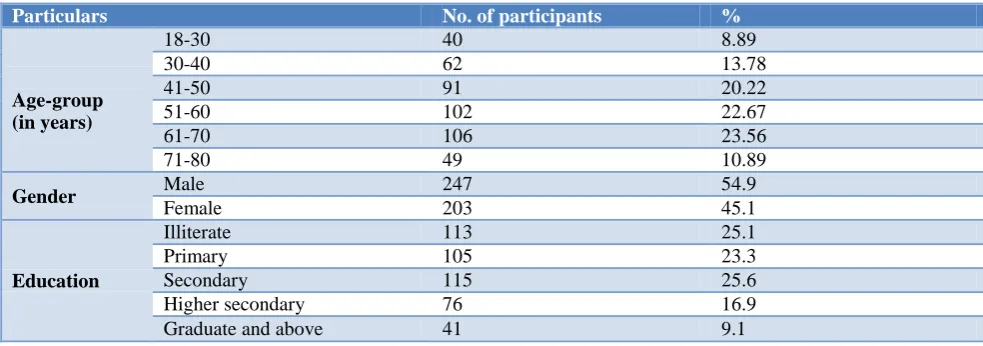
The demographic characteristics of participants of the study show that in present study male participants were 54.9% and participation of females was 45.1%. Majority of the participants belonged to age-group 41 to 70. It is observed that less number of people was graduate and above, proportion of them being 9.1%. About a quarter of all participants were illiterate and nearly same proportion was observed with those who had secondary education. Those who had primary education were 23.3% and proportion of those with higher secondary education was 16.9% (Table 1).
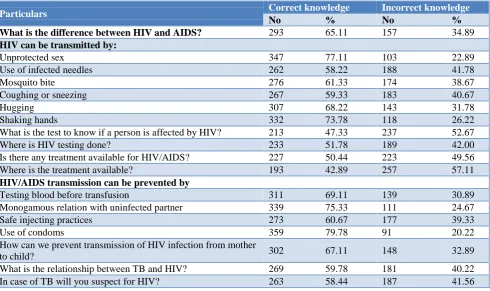
In present study 65.11% of the participants knew about difference between HIV and AIDS. About 77.11% study participants had fair knowledge that unprotected sex can lead to transmission of HIV. 61.33% were aware that mosquito bite is harmless. Among all study participants 73.78% knew that shaking hands will not transmit the disease and 68.22% were of the same opinion about hugging a diseased person.
Table 1: Distribution of participants according to demographic profile (n=450).
Particulars No. of participants %
Age-group (in years)
18-30 40 8.89
30-40 62 13.78
41-50 91 20.22
51-60 102 22.67
61-70 106 23.56
71-80 49 10.89
Gender Male 247 54.9
Female 203 45.1
Education
Illiterate 113 25.1
Primary 105 23.3
Table 2: Distribution of participants according to knowledge about HIV/AIDS.
Particulars Correct knowledge Incorrect knowledge
No % No %
What is the difference between HIV and AIDS? 293 65.11 157 34.89
HIV can be transmitted by:
Unprotected sex 347 77.11 103 22.89
Use of infected needles 262 58.22 188 41.78
Mosquito bite 276 61.33 174 38.67
Coughing or sneezing 267 59.33 183 40.67
Hugging 307 68.22 143 31.78
Shaking hands 332 73.78 118 26.22
What is the test to know if a person is affected by HIV? 213 47.33 237 52.67
Where is HIV testing done? 233 51.78 189 42.00
Is there any treatment available for HIV/AIDS? 227 50.44 223 49.56 Where is the treatment available? 193 42.89 257 57.11
HIV/AIDS transmission can be prevented by
Testing blood before transfusion 311 69.11 139 30.89 Monogamous relation with uninfected partner 339 75.33 111 24.67
Safe injecting practices 273 60.67 177 39.33
Use of condoms 359 79.78 91 20.22
How can we prevent transmission of HIV infection from mother
to child? 302 67.11 148 32.89
What is the relationship between TB and HIV? 269 59.78 181 40.22 In case of TB will you suspect for HIV? 263 58.44 187 41.56
Table 3: Comparison of knowledge of male and female participants.
Particulars
Correct knowledge
P value
Male Female
(n=247) (n=203)
N % N %
What is the difference between HIV and AIDS? 173 70.04 120 59.11 0.0156
HIV can be transmitted by
Unprotected sex 196 79.35 151 74.38 0.2123 Use of infected needle 157 63.56 105 51.72 0.0114
Mosquito bite 152 61.54 124 61.08 0.9207
Coughing or sneezing 156 63.16 111 54.68 0.0687
Hugging 173 70.04 134 66.01 0.3614
Shaking hands 187 75.71 145 71.43 0.3049
What is the test to know if a person is affected by
HIV? 132 53.44 81 39.90 0.0357
Where is HIV testing done? 139 56.28 94 46.31 0.2262 Is there any treatment available for HIV/AIDS? 138 55.87 89 43.84 0.9044 Where is the treatment available? 122 49.39 71 34.98 0.0042
HIV/AIDS transmission can be prevented by
Testing blood before transfusion 176 71.26 135 66.50 0.2774 Monogamous relation with uninfected partner 183 74.09 156 76.85 0.4996 Safe injecting practices 156 63.16 117 57.64 0.2335
Use of condoms 203 82.19 156 76.85 0.1609
How can we prevent transmission of HIV infection
Table 4: Attitude towards PLWHA.
Attitude towards HIV patients Male Female P value
Yes % Yes %
Allow PLWHAs to continue their routine in society 189 76.52 152 74.88 0.4715
Take care of relatives with HIV 168 68.02 146 71.92 0.3705
Behave friendly with PLWHA 186 75.30 156 76.85 0.7020
Buy grocery from shopkeeper having HIV 178 72.06 141 69.46 0.5462
It is observed that use of infected needle is considered as mode of transmission by 58.2% participants while 59.3% believe that coughing or sneezing will not spread the disease. Among all participants in this study, more than 60% participants were aware that testing blood before transfusion (69.1%), monogamy (75.3%), safe use of needles (60.7%) and use of condoms (79.8%) can prevent transmission of HIV/AIDS. 67.1% participants had knowledge about prevention of disease infection from mother to child. The knowledge was better about difference between HIV and AIDS, modes of transmission and modes of prevention and relation between tuberculosis (TB) and HIV. It is observed that knowledge was not so satisfactory regarding testing of HIV and treatment availability for the disease (Table 2).
It is observed that males had better knowledge than females except for monogamous relation as a mode of prevention and prevention of HIV from mother to child, where females had a slightly better knowledge compared to males. The difference between genders was found to be statistically significant for questions on difference between HIV and AIDS, use of infected needle as mode of transmission, test to know HIV and treatment availability for the disease (Table 3).
In present study, 24.2% of all participants were of the opinion that PLWHA should be socially banned while rest 75.78% were of opinion to allow PLWHA continue their routine in society. Among all study participants, 69.78% were willing to take care of relatives with HIV. Also, 76.85% said they would behave friendly with people having the disease whereas 70.89% had no problem in buying grocery from a shopkeeper who suffered from HIV. No statistically significant difference of attitude has been observed between males and females. Also majority of participants from both groups have shown right attitude (Table 4).
DISCUSSION
In present study male and female participation were 54.9% and 45.1% respectively. Maximum number of participants belonged to age group 40-70. In a similar study by Kawale et al 48.5% were male and 51.5% were female where majority were between 21 to 40 years of age.4
conducted by Vijayakrishnan et al shows comparatively better knowledge among engineering students at 71.3%.5 This is quite likely as we expect better knowledge about HIV/AIDS from college students.
In our study it is found that 79.78% knew about prevention of disease by use of condoms whereas a comparatively higher proportion was noted in a study by Kawale et al at 82.1%.4 Also, it has been observed in our study that 76.85% females had knowledge that condom prevents transmission of disease, which is higher compared to a study conducted by Lucksom et al on antenatal mothers which reported 48% of women knew condom prevents the infection.6 It was recorded that 77% people were aware condom prevents HIV transmission in a study conducted on social worker by Pitts et al.7 In our study it has been observed that 61.54%, 63.16%, 70.04% and 75.71% people were aware that mosquito bite, coughing/sneezing, hugging and shaking hands respectively does not spread HIV. Kawale et al reported in a study that 53.3% were aware about mosquito bite does not transmit disease.4 In a study by Vijayakrishnan et al it is noted that 76.8% of participants knew hugging does not spread the disease.5
In present study 69.78% respondents were willing to take care of relatives suffering from disease while 75.78% were of the opinion that PLWHA should be allowed socially with their routine whereas in other study by Kawale et al among rural people 81.6% responded that they will take care of relatives or family members and in a study by Pitts M et al. 91% respondents said that people with HIV/AIDS should be treated same as sick people.4,7
CONCLUSION
Recommendations
We want to emphasize an important finding i.e., usually obtained in almost all the studies and that is the proportion of those participants who do not answer several questions correctly. With the implementation of National AIDS Control Organisation for almost last 3 decades, it is expected that everybody is aware of basic facts about HIV/AIDS. But the lack of knowledge noted in the present study ranging from 20 to 57% to different questions is regarded as a great concern and necessitates further attempts at reaching every adult in the population with correct knowledge on all basic facts on HIV/AIDS through well planned health educational activities. During the present study, all the participants were made aware of the correct knowledge on various facts about the disease through power point presentations organized in the hospital premises.
ACKNOWLEDGEMENTS
Authors are thankful to study subjects for their valuable cooperation during research process and to the staff of Department of Community Medicine, C.C.M. Medical College, Durg for their help during research. Authors are also thankful to the scholars whose articles are cited in references of this manuscript.
Funding: No funding sources Conflict of interest: None declared
Ethical approval: The study was approved by the Institutional Ethics Committee
REFERENCES
1. WHO. Global health observatory (GHO) data: HIV/AIDS. Available at http://www.who.int/gho /hiv/en/. Accessed on 10 July 2019.
2. Herek GM. AIDS and Stigma. Am Behav Scientist. 1999;42(7):1106-16.
3. HIV Facts and Figures. Available at: http://naco.gov.in/hiv-facts-figures. Accessed on 15 June 2019
4. Kawale S, Sharma V, Thaware P, Mohankar A. A study to assess awareness about HIV/AIDS among rural population of central India. Int J Community Med Public Health. 2017;5(1):373-6.
5. Vijayakrishnan G, Veluru C, Pandurangi R, Rajan R. A study on awareness of HIV/AIDS and attitude toward PLHA among engineering college students of Nellore district, Andhra Pradesh, India. Int J Community Med Public Health. 2016;3:1219-23. 6. Lucksom PG, Upadhya R, Kharka L, Dubey S,
Choudhary N, Yadav R. KAP Study on HIV/AIDS Among Antenatal Women Attending Central Referral Hospital of North East India. J Obstet Gynaecol India. 2016;66(1):55-9.
7. Pitts M, Jackson H, Wilson P. Attitudes, knowledge, experience and behaviour related to HIV and AIDS among Zimbabwean Social Workers. AIDS Care. 1990;2(1):53-61.
Cite this article as: Gupta SC, Jain KJ, Tiwari A, Padmey I, Bankar NJ, Alam MN.Knowledge and attitude regarding HIV/AIDS among patients attending medicine outpatient department in C. C. M. Medical College and Hospital, Durg. Int J