The core enabling technologies
of big data analytics and context‑aware
computing for smart sustainable cities: a review
and synthesis
Simon Elias Bibri
1*and John Krogstie
2Abstract
Data sensing, information processing, and networking technologies are being fast embedded into the very fabric of the contemporary city to enable the use of inno-vative solutions to overcome the challenges of sustainability and urbanization. This has been boosted by the new digital transition in ICT. Driving such transition pre-dominantly are big data analytics and context-aware computing and their increasing amalgamation within a number of urban domains, especially as their functionality involve more or less the same core enabling technologies, namely sensing devices, cloud computing infrastructures, data processing platforms, middleware architectures, and wireless networks. Topical studies tend to only pass reference to such technologies or to largely focus on one particular technology as part of big data and context-aware ecosystems in the realm of smart cities. Moreover, empirical research on the topic, with some exceptions, is generally limited to case studies without the use of any common conceptual frameworks. In addition, relatively little attention has been given to the integration of big data analytics and context-aware computing as advanced forms of ICT in the context of smart sustainable cities. This endeavor is a first attempt to address these two major strands of ICT of the new wave of computing in relation to the infor-mational landscape of smart sustainable cities. Therefore, the purpose of this study is to review and synthesize the relevant literature with the objective of identifying and dis-tilling the core enabling technologies of big data analytics and context-aware comput-ing as ecosystems in relevance to smart sustainable cities, as well as to illustrate the key computational and analytical techniques and processes associated with the function-ing of such ecosystems. In dofunction-ing so, we develop, elucidate, and evaluate the most rel-evant frameworks pertaining to big data analytics and context-aware computing in the context of smart sustainable cities, bringing together research directed at a more con-ceptual, analytical, and overarching level to stimulate new ways of investigating their role in advancing urban sustainability. In terms of originality, a review and synthesis of the technical literature has not been undertaken to date in the urban literature, and in doing so, we provide a basis for urban researchers to draw on a set of conceptual frameworks in future research. The proposed frameworks, which can be replicated and tested in empirical research, will add additional depth and rigor to studies in the field. In addition to reviewing the important works, we highlight important applications as well as challenges and open issues. We argue that big data analytics and context-aware
Open Access
© The Author(s) 2017. This article is distributed under the terms of the Creative Commons Attribution 4.0 International License (http://creativecommons.org/licenses/by/4.0/), which permits unrestricted use, distribution, and reproduction in any medium, provided you give appropriate credit to the original author(s) and the source, provide a link to the Creative Commons license, and indicate if changes were made.
SURVEY PAPER
*Correspondence: [email protected]
1 Department of Computer
computing are prerequisite technologies for the functioning of smart sustainable cit-ies of the future, as their effects reinforce one another as to their efforts for bringing a whole new dimension to the operating and organizing processes of urban life in terms of employing a wide variety of big data and context-aware applications for advancing sustainability.
Keywords: Smart sustainable cities, Urban sustainability, Big data analytics, Context-aware computing, Sensors, Models, Data processing, Cloud computing, Middleware, Big data and context-aware applications
Introduction
The contemporary city is evolving into becoming computerized on a hard-to-imagine scale due to the rapid development of ICT. This is increasingly fueled by new discover-ies in computer science and data science, coupled with the quick-paced ubiquity and massive use of computational and data analytics within a variety of urban domains to address the complex challenges of sustainability and urbanization facing the city. This is manifested in the ongoing large-scale design, development, deployment, and imple-mentation of sensor technologies, data processing platforms, cloud computing infra-structures, middleware architectures, and wireless communication networks across urban environments. In parallel, the increasing convergence, prevalence, and advance of urban ICT is giving rise to new faces of cities that are quite different from what has been experienced hitherto on many scales. This is increasingly boosted by data acquisition and storage, information processing, data networking, and intelligence decision support increasingly infiltrating urban systems as operating and organizing processes of urban life. Accordingly, it has been suggested that the potential of monitoring, understanding, and analyzing the city through advanced ICT can well be leveraged in advancing its con-tribution to the goals of sustainable development. Indeed, the cities that are engaging on the new transition in ICT are getting smarter in how to become more sustainable (e.g. [1–8]). Besides, cities as complex systems, with their domains becoming more intercon-nected and their processes being highly dynamic, rely more and more on sophisticated technologies to realize their potential for responding to the challenge of sustainability and urbanization. Among these technologies are big data analytics and context-aware computing, which are rapidly gaining momentum and generating worldwide attention in the realm of smart sustainable urban development (e.g. [1, 2, 5, 6, 9–11]). Big data and context information constitute the fundamental ingredients for the next wave of urban functioning and planning, especially in relation to sustainability. There indeed is a vari-ety of potential uses of big data analytics and context-aware computing to address urban sustainability issues from the source thanks to the deep insights, intelligent decision-making processes, and efficient services delivery enabled by data mining, machine learn-ing, and statistics and related modellearn-ing, simulation, and prediction methods. This points to new opportunities and alternative ways to develop, operate, and plan future cities.
distributed computing environments to provide information and services to urbanites and diverse urban entities. The most prevalent forms of pervasive computing in rela-tion to the urban domain are UbiComp, AmI, the IoT, and SenComp [6]. Context-aware behavior and big data capability are considered as prerequisites for realizing the novel applications pertaining to such technologies (e.g. [2, 5, 6, 9–14]). In all, the expansion of these computing trends as to the underlying technologies and applications are increas-ingly stimulating smart sustainable city initiatives and projects in ecologically and tech-nologically advanced nations [3].
The past 5 years have seen extensive investments in ICT infrastructure in cities, which have improved the ability to collect and process large amounts of data throughout urban systems. Virtually every urban aspect, process, activity, and domain is now open to data collection and processing and often even instrumented for data collection and process-ing: operations, functions, and services in terms of management, control, optimiza-tion, enhancement, planning, and so on. At the same time, information is now widely available on external states and events such as urban trends, environmental dynamics, socio-economic patterns, and so on. This broad availability of data has led to increasing interest in methods and techniques for inferring context knowledge as well as extracting useful knowledge from various forms and sources of data—the realm of context-aware computing and data science—for knowledgeable and strategic decision-making pur-poses. In all, data are being produced and warehoused, the computing power is available and affordable, the environmental pressures and socio-economic concerns are alarming, and urbanization challenges are enormous.
The need to understand what constitutes the informational landscape of smart sus-tainable cities in terms of big data analytics and context-aware computing technologies presents an important topic and new direction of research in the field of smart sustain-able cities of the future. The prominence lies in identifying the core enabling technolo-gies and related key techniques and processes required to design, develop, deploy, and implement big data and context-aware applications for advancing urban sustainability. Topical studies tend to only pass reference to such technologies or to largely focus on one particular technology as part of big data and context-aware ecosystems in the realm of smart cities. Moreover, empirical research on the topic, with some exceptions, is gen-erally limited to case studies without the use of any common conceptual frameworks. In addition, relatively little attention has been given to the integration of big data ana-lytics and context-aware computing as advanced forms of ICT in the context of smart sustainable cities. This topic is a significant research area that merits attention, and this endeavor is a first attempt to address these two major strands of ICT of the new wave of computing in relation to the informational landscape of smart sustainable cities. This is to highlight that computers have become far more powerful, networks have become ubiquitous, and techniques and algorithms have been developed that can combine a large number and variety of sensors and connect various datasets to enable broader and deeper computational and analytical solutions than previously possible. The conver-gence of these phenomena is increasingly enabling many applications of smart comput-ing and data science principles and big data analytics techniques.
technologies of big data analytics and context-aware computing as ecosystems in rele-vance to smart sustainable cities, as well as to illustrate the key computational and ana-lytical techniques and processes associated with the functioning of such ecosystems. In doing so, we develop, elucidate, and evaluate the most relevant frameworks pertaining to big data analytics and context-aware computing in the context of smart sustainable cities, bringing together research directed at a more conceptual, analytical, and over-arching level to stimulate new ways of investigating their role in advancing urban sus-tainability. In terms of originality, a review and synthesis of the technical literature has not been undertaken to date in the urban literature, and in doing so, we provide a basis for urban researchers to draw on a set of conceptual frameworks in future research. The proposed frameworks, which can be replicated and tested in empirical research, will add additional depth and rigor to studies in the field. In addition to reviewing the important works, we highlight important applications as well as challenges and open issues.
The main motivation for this endeavor is to provide the necessary material to inform relevant research communities of the state-of-the-art research and the latest develop-ment in the field of smart sustainable cities in terms of the major technological compo-nents of their informational landscape, as well as a valuable reference for researchers and practitioners who are seeking to contribute to, or working towards, the design, develop-ment, and implementation of smart sustainable city applications. Especially, with vast amounts of urban data being now available, diverse entities in connection with every urban domain are focused on exploiting data for sustainable advantage.
Conceptual and theoretical background
Smart sustainable cities
The concept of smart sustainable cities has emerged as a result of three important global trends at play across the world, namely the diffusion of sustainability, the spread of urbanization, and the rise of ICT [5]. As echoed by Höjer and Wangel [17], the inter-linked development of sustainability, urbanization, and ICT has recently converged under what is labelled ‘smart sustainable cities.’ Accordingly, smart sustainable cities is a new techno–urban phenomenon that materialized around the mid–2010s (e.g. [5, 6,
15–17, 72]). The idea revolves around leveraging the advance and prevalence of ICT in the transition towards the needed sustainable development in an increasingly urbanized world. Therefore, the development of smart sustainable cities is gaining increasing atten-tion worldwide from research institutes, universities, governments, policymakers, and ICT companies as a promising response to the imminentchallenges of sustainability and urbanization.
The term ‘smart sustainable city’, although not always explicitly discussed, is used to denote a city that is supported by a pervasive presence and massive use of advanced ICT, which, in connection with various urban systems and domains and how these intricately interrelate and are coordinated, enables the city to control available resources safely, sustainably, and efficiently to improve economic and societal out-comes. Here ICT can be directed towards, and effectively used for, collecting, pro-cessing, analyzing, and synthesizing data on every urban domain and system in terms of forms, structures, infrastructures, networks, facilities, services, and citizens. The resulting knowledge can then be employed to develop urban intelligence functions and build urban simulation models for strategic decision-making associated with sustain-ability. Further, the combination of smart cities and sustainable cities, of which many definitions are available, has been less explored as well as conceptually difficult to delineate due to the multiplicity and diversity of the existing definitions (see [5] for an overview). ITU [18] provides a comprehensive definition based on analyzing around 120 definitions, ‘a smart sustainable city is an innovative city that uses…ICTs and other means to improve quality of life, efficiency of urban operation and services, and competitiveness, while ensuring that it meets the needs of present and future genera-tions with respect to economic, social and environmental aspects’. Another definition put forth by Höjer and Wangel ([17], p. 10), which is deductively crafted and based on the concept of sustainable development, states that ‘a smart sustainable city is a city that meets the needs of its present inhabitants without compromising the ability for other people or future generations to meet their needs, and thus, does not exceed local or planetary environmental limitations, and where this is supported by ICT’. This entails unlocking and exploiting the potential of ICT of the new wave of computing as an enabling, integrative, and constitutive technology for achieving the environmental, social, and economic goals of sustainability due to the underlying transformational, substantive, and disruptive effects [5, 6].
Context‑aware computing
(e.g. traffic system, energy system, healthcare system, education system, information sys-tem, human user, etc.) that can be integrated in the design and development of a given computational artifact. Originated in pervasive computing the term ‘context awareness’ is used to describe technology that ‘is able to sense, recognize, and react to contextual variables, that is, to determine the actual context of its use and adapt its functionality (and behavior) accordingly or respond appropriately to features of that context.’ ([19], p. 76). Another definition of context proposed by Dey [20] states: ‘context is any infor-mation that can be used to characterize the situation of an entity. An entity is a per-son, place, or object that is considered relevant to the interaction between a user and an application, including the user and applications themselves.’ Context-aware applications and systems in the urban domain entail the acquisition of contextual urban data using sensors of many types to perceive situations of urban life, the abstraction of contextual urban data by matching sensory readings to specific urban context concepts, and appli-cation behavior through firing actions based on the outcome of reasoning against con-textual urban information, i.e. the inferred context, to draw on Schmidt [21].
In recent years, the concept of context awareness has been expanded beyond the ambit of HCI applications to include urban applications, such as energy systems, transport sys-tems, communication syssys-tems, traffic syssys-tems, power grid syssys-tems, healthcare syssys-tems, education systems, security systems, and so on (e.g. [1, 6, 9–11, 21–24]). Here context denotes, drawing on Chen and Kotz [25], the environmental conditions within the urban landscape that either determine applications’ behavior or in which application events occur and are interesting to different classes of users, including citizens, urban adminis-trators, urban operators, urban authorities, and urban departments.
Big data analytics: characteristics and techniques
to note is that such data are invariably tagged with spatial and temporal labels, largely streamed from various forms of sensors, and mostly generated automatically and rou-tinely. Regardless of the lack of agreement about the definition of big data, there seems to be consensus that big data will lead to, in light of the projected advancements and innovations, immense possibilities and fascinating opportunities in the coming years. Moreover, big data solutions requires novel technologies to proficiently process large volumes of data emanating from multiple sources, in unprecedented quantities, and in quick time.
Big data are often characterized by a number of Vs. The main of which—identified as the most agreed upon Vs—are volume, variety, and velocity (e.g. [28, 29]). Additional Vs include veracity, validity, value, and volatility (e.g. [27]). The emphasis here is on the main characteristics of big data, namely the huge amount of data, the velocity at which the data can be analyzed, and the wide variety of data types.
The term ‘big data analytics’ refers commonly to any vast amount of data that has the potential to be collected, stored, retrieved, integrated, selected, preprocessed, trans-formed, analyzed, and interpreted for discovering new or extracting useful knowledge, which can subsequently be evaluated and visualized in an understandable format prior to its deployment for decision-making purposes (e.g. a change to or enhancement of opera-tions, strategies, practices, and services). Other computational mechanisms involved in big data analytics include search, sharing, transfer, querying, updating, modeling, and simulation. In the context of smart sustainable cities, big data analytics denotes a col-lection of sophisticated and dedicated software applications and database systems run by machines with very high processing power, which can turn a large amount of urban data into useful knowledge for well-informed decision-making and enhanced insights pertaining to various urban domains, such as transport, mobility, traffic, environment, energy, land use, planning, and design.
The common types of big data analytics include predictive, diagnostic, descriptive, and prescriptive analytics. These are applied to extract different types of knowledge or insights from large datasets, which can be used for different purposes depending on the application domain. Urban analytics involves the application of various techniques based on data science fundamental concepts—i.e. data-analytic thinking and the principles of extracting useful knowledge (hidden patterns and meaningful correlations) from data, including machine learning, data mining, statistical analysis, regression analysis (explan-atory modeling versus predictive modeling), database querying, data warehousing, or a combination of these. The use of these techniques depends on the urban domain as well as the nature of the urban problem to be tackled or solved.
Related work
Research on big data analytics and context-aware computing has been active for more than 2 decades, resulting in the development of many concepts, approaches, and systems spanning a large number and variety of application domains. Context-aware comput-ing has been researched extensively by the HCI community from various perspectives, including conceptual (e.g. [19, 20, 30, 31]), theoretical (e.g. [25, 32, 33]), critical (e.g. [12,
growing level of criticism over the past decade, questioning its feasibility in terms of the inherent complexity surrounding the modeling of all kinds of situations of life (based on the cognitive, affective, emotional, social, behavioral, conversational, and physical sub-sets of context), as well as challenging its added value as to transforming the way people live (e.g. [19, 35–39]). The whole premise is that it is too difficult to identify and model the specifics of context in real life given their extreme subtlety, subjectivity, and fluidity. In addition, the failure of the original promise of intelligence points to a two-sided prob-lem: the persistent elusiveness of ordinary human reasoning and knowing what people really want and the permissiveness of the definitional looseness of intelligence in terms of what can be expected of the role and scope of artificial reasoning in context-aware interaction paradigms ([38], p. 12). Context awareness research and development con-tinues to grapple with the problem of what the intelligence in context-aware computing can stand for. Nonetheless, the notion of intelligence as enabled by context awareness capabilities has inspired a whole generation of scholars and researchers into a quest for the immense, fascinating opportunities enabled by the incorporation of computer/ machine intelligence into our everyday lives, as well as a large body of research into new techniques and methods for enhancing the sensing, analysis, reasoning, inference, and modeling processes. These have been of extreme value to several other applications (industrial, urban, and organizational) than those directed for human users, in which these processes are inapt to handle the complexity of the nature and scope of inferences (context knowledge) generated by computationally constrained reasoning mechanisms and oversimplified models and on the basis of limited, uncertain, incomplete, or imper-fect data collected through sensors. However, the issues stemming from these challenges are under scrutiny and investigation by the research community towards alternative directions (e.g. [39]), most notably situated intelligence which entails that the cognitive processes and behavior of a situated system should be the outcome of a close coupling between the system (agent) and the environment (user) (see [40]). This form of intel-ligence entails ‘assisting people in better assessing their choices and decisions and thus enhancing their actions and activities’, and the ‘quest for situated forms of intelligence is seen by several eminent scholars as an invigorating alternative for artificial intelligence research within context-aware computing’ ([19], p. 9).
However, the emphasis in this paper is on the notion of intelligence as enabled by context awareness capabilities but in relation to urban applications rather than human-inspired HCI applications. Urban intelligence in this sense involves enhancing the efficiency of energy systems, communication systems, traffic systems, transporta-tion systems, and so on, as well as the delivery of several classes of city services (utility, healthcare, safety, learning, etc.), based mainly on the physical, situational, spatiotempo-ral, and socio-economic subsets of context. Especially, building and maintaining com-plex models of smart sustainable cities functioning in real time from routinely sensed data has become a clear prospect [2, 5, 6].
revolves around the most common approaches into context representation and reason-ing and their integration. Integrated approaches have been mainly proposed to overcome the shortcomings (information incompleteness and uncertainty, lack of expressiveness, inflexibility, lack of scalability, etc.) associated with the application of a single approach. For instance, context recognition methods based on probabilistic reasoning inher-ently suffer from ad-hoc static models, scalability, and data scarcity, and the ontology approach allows easy incorporation of machine understandability and domain knowl-edge, which provide rich expressiveness and facilitates reusability and intelligent pro-cessing at a higher level of automation [42]. However, the ontology approach falls short in handling information uncertainty and vagueness (e.g. [41]). Important to underscore is that most reviews focus on context awareness in relation to the HCI domain, while the literature on context awareness in relation to the urban domain remains scant, in par-ticular as to large-scale applications in the context of smart sustainable cities.
Furthermore, several studies (e.g. [42–48]) have addressed middleware technologies associated with pervasive computing environments and distributed applications. Mid-dleware plays a key role in the functionality of distributed context-aware applications, as it represents the logic glue in a distributed computing system by connecting and coordinating many components constituting distributed applications. Among the key topics addressed in the literature include architectures for pervasive context-aware ser-vices in smart spaces in terms of middleware components and prototype applications, middleware for context representation and management in pervasive computing, mid-dleware-based development of context-aware applications with reusable components, middleware for real-time systems, and so forth. There is a need for further research in the area of middleware with regard to the use of large-scale context-aware applications as part of the informational landscape of smart sustainable cities, as well as to the mod-eling and management of context information in distributed pervasive applications and in open and dynamic pervasive environments.
on new trends and emerging shifts. In all, the analytical outcomes of data mining/knowl-edge discovery (see [55] for an overview with relevant use cases) serve to improve urban operational functioning, optimize resources utilization, reduce environmental risks, and enhance the quality of life and well-being of citizens.
Furthermore, many reviews or surveys have been conducted in recent years on big data analytics. While they offer different perspectives on, and highlight various dimen-sions of, the topic, they overlap in many computational, analytical, and technologi-cal aspects. Also, they are more often than not oriented towards business intelligence (e.g. [56, 57]), and tend to put emphasis on different components of big data analytics, such as techniques, algorithms, software tools, platforms, and applications. Chen et al. [58] provide a systematic review of data mining in technique view, knowledge view, and application view, supported with the latest application cases related mostly to business intelligence. In their survey, Zhang et al. [59] explore new research opportunities and provide insights into selecting suitable processing systems for specific applications, pro-viding a high-level overview of the existing parallel data processing systems categorized by the data input as stream processing, machine learning processing, graph processing, and batch processing. Singh and Singla [60] provide an overview of the leading tools and technologies for big data storage and processing, throw some light on other big data emerging technologies, as well as cover the business areas from which big data are being generated. In their review, Tsai et al. [61] discuss big data analytics and related open issues, focusing on how to develop a high performance data processing platforms to effi-ciently analyze big data and to design an appropriate mining algorithm to extract useful knowledge from big data, in addition to presenting some research directions. One of the aspects emphasized in their work is the steps (selection, preprocessing, transformation, mining, and interpretation/evaluation) of the whole process of knowledge discovery in databases (KDD), as summarized by Fayyad et al. [49]. Most of research articles focus typically more on data mining than other steps of KDD process. Tsai et al. [61] simplify the whole process into three parts (input, data analytics, and output) and seven steps (collection, selection, preprocessing, transformation, mining, evaluation, and interpreta-tion). Katal et al. [26] provide a varied discussion covering several big data issues, chal-lenges, tools, characteristics, sources, and best practices in relation to such applications as social media, sensor data, log storage, and risk analysis. Karun and Chitharanjan [62] deliver a whole review on Hadoop in terms of HDFS infrastructure extensions, mak-ing a comparison of Hadoop Infrastructure Extensions (HadoopDB, Hadoop++, Co-Hadoop, Hail, Dare, Cheetah, etc.) on the basis of scalability, fault tolerance, load time, data locality, and data compression. Chen et al. [63] reviews the big data background and the associated technologies, including applications and challenges (in relation to data generation, acquisition, storage, and analysis). However, the literature on the core ena-bling technologies of big data analytics is scant in relation to smart sustainable cities and related sustainability applications.
terms of the quality of life. There have been no research endeavors undertaken thus far to develop comprehensive or integrated infrastructures for smart sustainable cities as a holistic urban development approach. But there have been some attempts to address some aspects of environmental sustainability in the context of smart cities. For example, Lu et al. [71] propose a framework for multi-scale climate data analytics based on cloud computing. Speaking of the climate in this context, there is still a risk of a mismatch between urban climate targets and the opportunities offered by ICT solutions (e.g. [7]).
In all, despite the recent increase of research on big data analytics and context-aware computing, the bulk of work tends to deal largely with the domain of business intelli-gence and the field of HCI respectively in terms of techniques, algorithms, processes, architectures, platforms, and services, thereby barely exploring their relevance and role in the urban domain in terms of advancing sustainability and integrating its dimen-sions. Especially, a new research wave has started to focus on how to enhance smart city approaches as well as sustainable city models by combining the two urban develop-ment strategies in an attempt to achieve the required level of urban operations, func-tions, designs, and services in line with the goals of sustainable development (e.g. [5, 6,
72]). In particular, this holistic urban development approach emphasizes the combina-tion of big data analytics and context-aware computing as a set of advanced technolo-gies, techniques, processes, and applications and related platforms, architectures, and infrastructures [5, 6]. In other words, these two advanced forms of ICT are being given a prominent role in smart sustainable cities, and the evolving data-centric and context-aware approach is seen to hold great potential to address the challenge of sustainability under what is labelled ‘smart sustainable cities’ of the future [5, 6]. The way forward for future cities to advance sustainability and provide the quality of life to their citizens is through advanced ICT that ensures the utilization of big data and the access to con-textual information (see, e.g. [1, 2, 5, 6, 11]). Local city governments are investing in advanced ICT to provide technological infrastructures supporting AmI and UbiComp, as well as to foster respect for the environmental and social responsibility [11].
The core enabling technologies of big data analytics and context‑aware computing for smart sustainable cities of the future
There are many permutations of the core enabling technologies underlying big data analytics and context-aware computing. However, they all pertain to ICT of the new wave of computing, an integration of UbiComp, AmI, the IoT, and SenComp, which will in the near future be the dominant mode of monitoring, understanding, analyzing, and planning smart sustainable cities to improve sustainability [5, 6]. It is worth iterating that both big data analytics and context-aware computing share the same core enabling technologies because they are an integral part of ICT of the new wave of computing, as we will elucidate below. As such, they involve unobtrusive and ubiquitous sensing tech-nologies and networks, sophisticated data management and analysis approaches, data processing platforms, cloud computing and middleware infrastructures, and advanced wireless communication technologies. These are to provide solutions in the form of use-ful and context knowledge for the purpose of achieving the required level of sustainabil-ity in the context of smart sustainable cities. Moreover, to have effective and successful solutions on the basis of core enabling technologies, it is required to select a number of design and development priorities in a planned manner prior to any deployment and implementation. For example, it is essential to consider flexible design, quick deploy-ment, extensible implementation, more comprehensive interconnections, and more intelligence (e.g. [73]). However, while most of the core enabling technologies are gen-eral and apply to many application domains, others remain specific to the urban applica-tion domain, specifically to the special requirements and objectives of smart sustainable cities.
Pervasive sensing for urban sustainability
Collecting and measuring urban big data
as well as for exploiting and extending a variety of data mining and machine learning techniques through which the generation of models will be essential in a wide range of engineering solutions for advancing urban sustainability, i.e. improving the contribu-tion of smart sustainable cities to the goals of sustainable development. Such cities are to be monitored, understood, analyzed, and planned across several spatial levels mostly on the basis of data routinely and automatically collected by sensors. With the flourish-ing smart sustainable urban plannflourish-ing approach (e.g. [2, 5]), pervasive sensing is gain-ing increased momentum and prevalence as to measurgain-ing and collectgain-ing data on urban functioning and change in a new way, from the ground up, by means of powerful sens-ing technologies (motion, behavior, orientation, location, etc.). At present, for instance, sensing urban change from the ground up occurs ‘through new sensing technologies that depend on hand-held and remote devices through to assembling transactional data from online transactions processing which measure how individuals and groups expend energy, use information, and interact’ ([2], p. 492) with respect to resources. Linking and meshing data from various types of sophisticated measuring devices (RFID, NFC, GPS, laser scanners, etc.) with the automation of standard secondary sources of data and unconventional data no doubt provides a rich nexus of possibilities as to providing new and open sources of data necessary for monitoring and understanding how smart sus-tainable cities will function in a more effective and efficient way.
At present, the urban environment is pervaded by huge quantities of active devices of diverse kinds and forms to particularly automate routine decisions. The fabric of smart sustainable cities is expected to be, arguably, enveloped with an electronic skin, which can be sewed together and entrenched with even more advanced embedded measuring devices, information processing systems, and communication networks. These include countless intelligent sensing and computing devices and related sophisticated and dedi-cated techniques and algorithms, as well as widespread diffusion of wirelessly ad-hoc, mobile network infrastructures and related protocols. The primary aim is to build an entirely new holistic system which supports the following:
• The acquisition and coordination of data from multiple distributed sources.
• The management and organization of data streams.
• The integration of heterogeneous data into coherent databases and their warehous-ing.
• The preprocessing and transformation of data.
• The management and seamless composition of extracted models and patterns respectively.
• The evaluation of the quality of the extracted models and patterns.
• The visualization and exploration of behavioral patterns and models.
• The simulation of the mined patterns and models.
• The deployment of the obtained results for decision support and efficient service provision.
wireless (internet) connectivity as well as middleware architectures connecting several kinds of distributed, heterogeneous hardware systems and software applications [19]. All of the above is to be directed for advancing the contribution of smart sustainable cities to the goals of sustainable development. Explicitly, future urban ICT driven by the new wave of computing will result in a blend of advanced applications, services, and compu-tational (data) analytics enabled by constellations of instruments across several spatial scales linked via multiple networks, which can provide a fertile environment conducive to monitoring, understanding, analyzing, evaluating, and planning the sustainability of future cities.
Recent advances in sensor technology have given rise to a new class of miniaturized devices characterized by advanced signal processing methods, high performance, multi-fusion techniques, and high-speed electronic circuits. The trends toward ICT of the new wave of computing, coupled with the evolving concept of smart sustainable cities, are driving research into ever-smaller sizes of sensors capable of powerfully sensing com-plex and varied aspects of urban life and environment at very low cost. The production of sensing devices with a low cost-to-performance ratio is further driven by the rapid development of sensor manufacturing technologies (e.g. [19]). The increasing miniaturi-zation of computer technology is making it possible to develop miniature on-body and remote sensors that allow registering various human and urban parameters without dis-turbing citizens or interfering with urban activities, thereby the commonsensical infiltra-tion of sensors into daily urban life and environment. This is instrumental in enhancing the computational understanding and data processing of human mobility, urban dynamic processes, and urban operational functioning, a process that entails analysis, interpretation, modeling, and evaluation of big data for enhanced decision-making and deep insights. The new wave of urban computing is about the omnipresence of invis-ible technology in urban environments and thus citizens’ everyday life. Countless tiny, distributed, networked sensor devices will be invisibly embedded in cities for data col-lection. The research in the area of micro- and nano-engineering [74] is expected to yield major shifts in ICT performance and the way mechatronic components and devices are manufactured, designed, modeled, and implemented, thereby radically changing the nature and structure of sensing devices and thus the way cities will be monitored, under-stood, analyzed, probed, and planned in the near future.
Sensor‑based urban sustainability mining
regard. Therefore, sensor-based big data have enormous potential to gain new insights into and drive decisions about how sustainability can be better translated into the built, infrastructural, operational, and functional forms of smart sustainable cities across sev-eral spatial scales. Further studies in this direction are most likely to enhance mobility, transport engineering, energy engineering, planning, spatial and physical structures, and data-driven characterization of urban functioning in the context of sustainability.
Sensor technologies in context‑aware computing
Sensor types and sensing areas in context‑aware applications As with big data analytics, context-aware computing involves a wide variety of sensors. A sensor can be described as a device that detects or measures a physical property or some type of input from the physical environment, and then indicates or reacts to it in a particular way (e.g. [19]). The output is a signal in the form of human-readable display at the sensor location or a recorded data that can be transmitted over a network for further processing. Com-monly, sensors can be classified according to the type of energy they detect as signals, and include, but are not limited to, the following types:
Location sensors (e.g. GPS, active badges).
Optical/vision sensors (e.g. photo-diode, color sensor, IR and UV sensor). Light sensors (e.g. photocells, photodiodes).
Image sensor (e.g. stereo-type camera, infrared). Sound sensors (e.g. microphones).
Temperature sensors (e.g. thermometers). Heat sensors (e.g. bolometer).
Electrical sensors (e.g. galvanometer).
Pressure sensors (e.g. barometer, pressure gauges).
Motion sensors (e.g. radar gun, speedometer, mercury switches, tachometer). Orientation sensors (e.g. gyroscope).
Physical movement sensors (e.g. accelerometers). Biosensors (e.g. pulse, galvanic skin response measure). Vital sign processing devices (heart rate, temperature).
Wearable sensors (e.g. accelerometers, gyroscopes, magnetometers). Identification and traceability sensors (e.g. RFID, NFC).
context). Too often, in relation to both citizens and urban systems, various kinds of sen-sors are used to detect context.
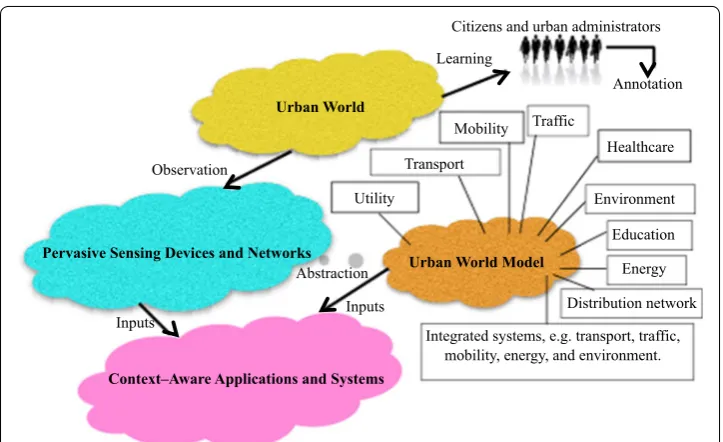
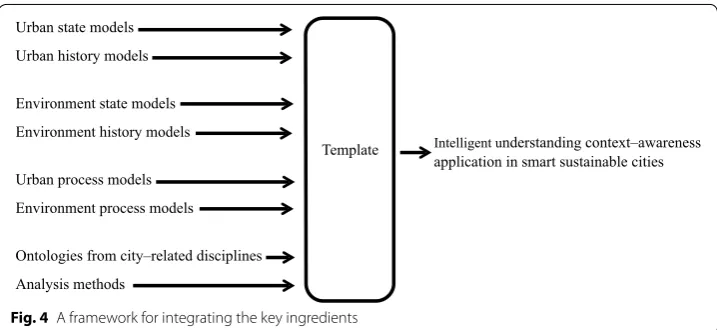
Acquisition of sensor data about citizens and urban systems (energy, traffic, transport, mobility, etc.) and their behavior and functioning is an important factor in addition to the knowledge domain for analysis of such data by data processing units. In relation to context-aware applications pertaining to citizens, data can be generated from multiple sources, including software equivalents in relation to citizens’ devices, such as smart-phones, computers, laptops, and other everyday objects. In other words, data are collected and captured from a variety of digital sensors as well as online interactive applications. Observed information about the citizen and urban system’ states or situations in conjunc-tion with the dynamic models for the citizen and system’ relevant processes serve as input for the process of computational understanding. This entails the analysis and estimation of what is going on in the surrounding environment in the context of smart sustainable cities. Accordingly, for a context-aware application or system to be able to infer high-level context abstraction based on the interpretation of and reasoning on context information, it is first necessary to acquire low-level data from physical sensors (and other sources). Researchers from different application domains within the field of context-aware com-puting have investigated context recognition for the past 2 decade or so by developing a diversity of sensing devices (in addition to methods and techniques for signal and data processing, pattern recognition, modeling, and reasoning tasks). Thus, numerous types of sensors are currently being used to detect various attributes of context.
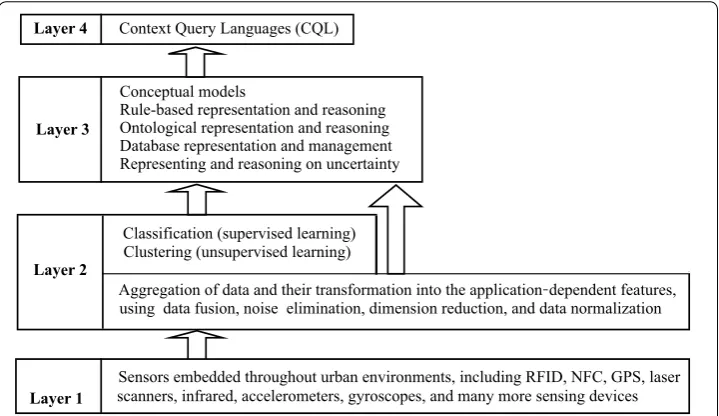
Multi‑sensor data fusion and its application in context‑aware applications and sys‑ tems In context-aware computing, underlying the multi-sensor fusion methodology is the idea that an abstraction of context as an amalgam of different, interrelated contextual elements can be generated or inferred on the basis of information detected from multi-ple, heterogeneous data sources, which provide different, yet related, sensor information. Thus, sensors should be integrated to yield optimal context recognition results, i.e. pro-vide robust estimation of context. A given dimension of the context, a higher level of the context, can be deduced by using a number of external or internal contexts as an atomic level of the context. Figure 1 illustrates multisensor fusion for context awareness.
The use of multi-sensor fusion approach in context-aware applications and systems allows gaining access simultaneously to varied information necessary for accurate estimation or inference of context. Multi-sensor fusion systems have the potential to enhance the information gain while keeping the overall bandwidth low [19]. Figure 1
illustrates a multi-sensor fusion approach.
Wireless communication network technologies and smart network infrastructures In the context of smart sustainable cities, wireless solutions are set to proliferate in ways that are hard to imagine, as ICT continues to be fast embedded and interwoven into the very fabric of current smart and sustainable cities in terms of their systems and processes in an increasingly computerized urban society. This is a future world of pervasive com-puting infrastructures and communication networks. Countless sensors will use various wirelessly ad-hoc and mobile networks to provide cities with all kinds of data necessary for a wide variety of applications and services. In particular, the widespread diffusion of wireless network technologies will, as a by-product of their normal operations, enable to sense, collect, and coordinate massive repositories of spatiotemporal data pertaining to urban systems, which represent city-wide proxies for all kinds of activities and operating and organizing processes.
Also, smart networks are necessary for big data applications in terms of connecting the components and entities of smart sustainable cities, including diverse citizens’ eve-ryday objects (computers, smart phones, cars, house devices, etc.) and city infrastruc-tures and facilities as well as urban departments, authorities, and enterprises. Such networks are intended to provide efficient means for transferring the collected data from heterogeneous and distributed sources to data warehouses where big data are to be stored, coalesced, organized, and integrated for processing and analysis in connection with intelligent decision support systems. This involves transferring responses back to the different citizens’ devices and urban entities’ systems for the purpose of improving different aspects of sustainability.
monitoring, understanding, and analyzing urban life in terms of infrastructure, built form, administration, and ecosystem and human services, pervasive networking infra-structures allow for collecting and coordinating extensive data in terms of how these data are stored, made accessible, and utilized.
In the context of smart sustainable cities, advanced digital networks are crucial to urban operational functioning and planning due to the interrelationships between urban components and domains that are too many to catalogue (transport, mobility, communi-cation, building, energy, environment, water, waste, land use, healthcare, etc.). These are planned to be further heavily networked while the activities relating to these domains to be linked up. The key domains ‘which currently are being heavily networked involve: transport systems of all modes in terms of operation, coordination, timetabling, utili-ties networks which are being enabled using smart metering, local weather, pollution levels and waste disposal, land and planning applications, building technologies in terms of energy and materials, health information systems in terms of access to facilities by patients the list is endless. The point is that we urgently need a map of this terrain so that we can connect up these diverse activities’ ([2], p. 493). Especially, the evolving techno-urban contexts are opening spaces for smart sustainable initiatives in domain network-ing at current times of tension as alternative trajectories are actively benetwork-ing sought due to the challenge of sustainability, which entails creating innovative solutions that further facilitate collaboration among urban domains and hence integrate urban systems.
In parallel, the aim of emerging technological platforms such as UbiComp, AmI, the IoT, and SenComp is to orchestrate and coordinate the various computational entities in the informational landscape of smart sustainable cities and merging it with their physical landscape into an open system that helps diverse urban entities cope with and plan their activities in relation to improving sustainability. Besides, the growing depth, scale, and complexity of urban networks in terms of both domains and technological infrastruc-tures call for developing and coordinating such networks and enhancing their digital capabilities in ways that increase and sustain the contribution of smart sustainable cities to the goals of sustainable development. Advanced wireless technologies are extremely placed to initiate this development and coordination. Moreover, with their ever-grow-ing volume, variety, velocity, and timeliness, data on the state of urban networks as built artifacts as well as on that of their use as part of urban activities and processes provide enormous potential to improve urban operational functioning and planning (see, e.g. [1,
Data processing platforms for big data analytics
There is a variety of available data processing platforms for big data analytics, which provide the stream processing required by real-time big data applications in relation to various urban domains. Therefore, data processing platforms are a key component of the ICT infrastructure of smart sustainable cities of the future with respect to big data appli-cations. Among the leading platforms for big data storage, processing, and management include Hadoop MapReduce, IBM Infosphere Streams, Stratosphere, Spark, and NoSQL-database system management (e.g. [1, 28, 53, 60, 62, 63]). These platforms work well on cluster systems to meet the requirements of big data applications for smart sustainable cities; entail scalable, evolvable, optimizable, and reliable software and hardware compo-nents; and provide high performance computational and analytical capabilities (namely selection, preprocessing, transformation, mining, evaluation, interpretation, and visu-alization), in addition to storage, coordination, and management of large datasets across distributed environments. As ecosystems, they perform big data data analytics related to a wide variety of large-scale applications intended for different uses associated with the process of sustainable urban development, such as management, control, optimization, assessment, and improvement, thereby spanning a variety of urban domains and sub-domains. In all, they are prerequisite for data-centric applications for smart sustainable cities of the future. The focus on Hadoop MapReduce is justified by the suitability of its functionalities as to handling urban data as well as to its advantages associated with load balancing, cost effectiveness, flexibility, and processing power compared to other data processing platforms. Hadoop MapReduce has become the primary big data storage and processing system given its simplicity, scalability, and fine-grain fault tolerance [59]. For example, it is capable of handling all data types collected from multiple sources to derive actionable insights. However, it does pose issues regarding processing efficiency, rigid data flow, and low-level abstraction. NoSQL (e.g. Mongo DB and Cassandra) is also fast becoming a choice for storing and sorting structured and unstructured data and clutter-ing them with greater efficiency and scalability.
Cloud computing for big data analytics: characteristic features and benefits
Big data analytics can also be performed in the cloud. This involves both big data plat-form as a service (PaaS) and infrastructure as a service (IaaS) (e.g. [77]). Having attracted attention and gained popularity worldwide, cloud computing is becoming increasingly a key part of the ICT infrastructure of both smart cities and sustainable cities (e.g. [1, 5, 7,
53, 66, 67, 71]) as an extension of distributed and grid computing due to the prevalence of sensor technologies, storage facilities, pervasive computing infrastructures, and wire-less communication networks. Especially, most of these technologies have become tech-nically mature and financially affordable by cloud providers. By commoditizing services, low cost open source software, and geographic distribution, cloud computing is becom-ing increasbecom-ingly an attractive option [78].
and elegant solution in terms of facilitating the huge demand for computing resources associated with big data analytics for decision-making processes in relation to the opera-tional functioning and planning of cities in terms of sustainability. Through the use of cloud computing, smart sustainable cities can accordingly have higher possibilities to perform more effectively and efficiently thanks to the advanced technological features underlying the functioning of cloud computing model.
In addition, cloud computing performs service-oriented computing. In this regard, it can rapidly process large and complex data produced from urban activities and simul-taneously serve citizens in relation to healthcare, education, housing, utility, and so on, providing a kind of integrated and specialized center for information services to both the general public and urban departments across various urban domains. In light of this, with reference to smart sustainable cities, cloud computing has the ability to run smart applications on many connected computers and smartphones at the same time for dif-ferent purposes associated with increasing sustainability performance.
In sum, among the key advantages provided by cloud computing technology include cost reduction, location and device independence, virtualization (sharing of servers and storage devices), multi-tenancy (sharing of costs across a large pool of cloud provider’s clients), scalability, performance, reliability, and maintenance. Therefore, opting for cloud computing to perform big data analytics in the realm of smart sustainable cities remains thus far the most suitable option for the operation of infrastructures, applica-tions, and services whose functioning is contingent upon how urban domains interrelate and collaborate, how efficient they are, and to what extent they are scalable as to achiev-ing and maintainachiev-ing the required level of sustainability.
Middleware infrastructure for context‑aware computing: characteristics and functions Middleware infrastructure is associated with pervasive computing environments and distributed applications. These encompass UbiComp, AmI, and SenComp environ-ments and applications. Middleware infrastructure (e.g. [44, 47, 48]) plays a key role in the functionalities of complex distributed applications, including context-aware appli-cations. Thus, context-aware computing, which is associated with UbiComp, AmI, and SenComp, requires middleware infrastructure to operate. This infrastructure can also run on cloud computing [platform as a service (PaaS) and infrastructure as a service (IaaS)]—i.e. cloud middleware.
communicate seamlessly across disparate networks that create smart environments rather than just their ubiquitous presence and massive use. In the context of smart sus-tainable cities, such systems in their various forms (e.g. sensors, smartphones, comput-ers, databases, data warehouses, application integration methods, application servcomput-ers, web servers, context management systems, and messaging systems) are highly distrib-uted, interoperable, and dynamic, involving a myriad of embedded devices and informa-tion processing units ‘whose numbers are set to increase by orders of magnitude and which are to be exploited in their full range to transparently provide services on a hard-to-imagine scale, regardless of time and place’ [19]. This in turn allows for the function-ing of context-aware applications across the diverse domains of smart sustainable cities.
There are different approaches to conceptualizing middleware. According to Schmidt [46], middleware consists of the following four distinct layers based on their intended functionality:
(1) Host-infrastructure middleware (2) Distribution middleware (3) Common middleware services (4) Domain-specific middleware services.
Another conceptualization of middleware entails a common multilayer architecture that provides particular functionalities and constitute the basis for upper layers of more abstraction. It includes the following components:
• Infrastructure and communications (messaging services) pertaining to entities of the upper layer
• Services and agents related to semantic descriptions
• Middleware services concerned with the software environment
• Intelligence associated with the coordination of application actions and involving a number of devices in the environment.
infrastructure in a dynamic fashion), and interoperability of the different components of distributed applications (e.g. [19, 45, 85]). These functionalities are in fact necessary for supporting scalable systems as well as highly heterogeneous and distributed compo-nents, such as agents and services. In relation to this, middleware support and deploy data-centric distributed systems (e.g. network-monitoring systems, sensor networks, and dynamic web) whose ubiquity creates large application networks spreading over large geographical areas [19]. Especially, AmI and UbiComp infrastructures are highly dynamic and involve high degree of heterogeneity (e.g. [86]. As to interoperability, for instance, context-aware applications run on different operating systems, thereby the role of middleware in enabling interoperability between applications by supplying services for exchanging data in a standard way. Indeed, in the realm of context-aware comput-ing, which entails distributed processing in the sense of multiple applications being connected to create larger applications over a network, middleware provides services beyond or more than those available from the operating system of these applications to enable the various elements of the underlying distributed system to communicate and manage data, thereby serving as a kind of a software glue. Therefore, distributed process-ing is empowered by middleware for transferrprocess-ing signals from various sources and for realizing information fusion from multiple perceptive components [44].
Middleware and cloud computing infrastructures differ in their technical details as to how they provide application services and which kind of services they are concerned with, as well as in the characteristic features of their operation and complexity. Yet, they denote computing models where machines in large data centers across distributed envi-ronments can be used to deliver a variety of services and meet the needs of different urban constituents in terms of the use of big data and context-aware applications for improving sustainability. Hence, both are prerequisite for in the operation of smart sus-tainable cities. This is anchored in the underlying assumption that big data and context-aware applications are an integral part of ICT of the new wave of computing, and smart sustainable cities typically rely on the fulfillment of its underlying visions.
Big data management
best practices, and dedicated computational processes for properly managing data life-cycle throughout various phases of data use, particularly in terms of addressing the issue of variety and velocity, i.e. recognizing their different formats and sources as well as organizing, cataloguing, classifying, and controlling all classes and structures of data. In addition, for smart sustainable city applications, big data management should pro-vide tools for scalable handling of massive data to serve real-time applications and sup-port offline applications (see [1]). For the interested reader, there are several studies that have addressed the topic of big data management (e.g. [84–89]) in terms of concepts, approaches, techniques, and challenges.
Advanced big data analytics techniques and algorithms
directed to Barbi [55]. Also, Chen et al. [58] provide a thorough survey on data mining techniques and algorithms.
Privacy mechanisms and security measures
It is highly important to ensure that all technological components associated with big data and context-aware applications for smart sustainable cities are supported by secu-rity measures and privacy mechanisms. It is essential to control big data [91] and context data [92]. Massive repositories of urban data are at stake, and failure to protect these data will pose risks and threats to the functioning of smart sustainable cities as well as to the safety and well-being of their citizens on several scales. Therefore, security measures and privacy mechanisms should be at the core of urban policy and governance practice associated with the design, development, deployment, and implementation of big data and context-aware applications within smart sustainable cities. Any attempt of an unau-thorized access, malicious attack, or abuse of information on citizens, infrastructures, networks, and facilities can compromise the integrity of such applications and related services. Smart sustainable cities generate colossal amounts of data on virtually every urban process, which are to be stored, processed, and shared. Urban environments ‘are now being continually forged and re-forged in (sensorial), informational, and communi-cative processes. It is a world where…cities think of us, where the environment reflex-ively monitors our behavior’ ([93], p. 1), including whether and the extent to which we behave in a sustainable way through the activities we perform in cities.
computer assets such as hardware, software, data, and services’ ([94], p. 442), integrity and confidentiality—i.e. protection of information from modification and unauthorized use—should be more of focus as categories of security threats in the ICT of the new wave of computing networks than in the traditional networks [92]. This is due to the fact that there are ‘possible conflict of interests between communicating entities; net-work convergence; large number of ad-hoc communications; small size and autonomous mode of operation of devices; and resource constraints of mobile devices’ ([95], p. 50). Of critical importance, nevertheless, is to develop a new security paradigm which supports advanced features of context-aware technology, as conventional password entry schemes using traditional input devices have proven to be vulnerable to attacks. To address these issues, new research endeavors are focusing on such new techniques as authenticat-ing with minds; pointauthenticat-ing and selection usauthenticat-ing gaze and keyboard; and gaze-based user authentication [92]. In relation to this, Wright et al. [95] suggest some research direc-tions, including ‘improving access control methods by multimodal fusion, context-aware authentication and unobtrusive biometric modalities’, and ‘increasing security by detec-tion of unusual patterns.’
Standards and open standards
It is important to follow standards when it comes to data integration to make sense of data proliferation as well as to ensure data quality. Standard rules are also needed for evaluat-ing the accuracy and correctness of data and for dealevaluat-ing with such issues as uncertainty and incompleteness of data, especially in relation to real-time big data (and context-aware) applications which require the data to be described using advanced models of the very urban systems that that data are associated with in case of missing and inconsistent data. It is of equal importance to set and comply with standard rules with respect to new applications for advancing urban sustainability to achieve seamless integration between the available urban systems (in terms of infrastructural, physical, operational, and func-tional forms) and the introduced big data (and context-aware) applications across diverse urban domains. In this regard, the way forward is to carry out a thorough investigation of the different urban entities and actors as well as the infrastructure, built form, adminition, and ecosystem and human services as to their operation as urban systems to stra-tegically assess the benefits of new solutions and the readiness of urban stakeholders to join any smart movement associated with improving urban sustainability. In light of such investigation, new practices, regulations, and standard models of design and rules can be developed for big data and context-aware applications for smart sustainable cities.
The state‑of‑the‑art analytical and computational processes
The process of data mining
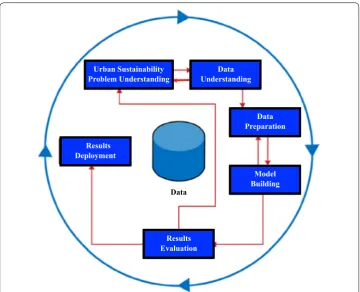
One of the fundamental concepts of data science is the automated extraction of useful knowledge from large masses of urban data to solve urban sustainability problems (phys-ical, environmental, social, and economic) related to diverse urban domains, which can be treated systematically by following a set of reasonably well-defined stages, i.e. several codifications of the process of data mining, most notably the cross industry standard process for data mining (CRISP-DM). This process provides a framework to structure urban thinking about data analytics problems related to different dimensions of sustain-ability, as in smart sustainable urban planning practice, it is important to devise ana-lytical solutions based on careful analysis and evaluation of the relevant problems using high-powered analytical and evaluative tools, as well as creativity, common sense, and specialized knowledge. Therefore, structured thinking about urban data analytics is of significance to supporting decision-making processes concerning different dimensions of sustainability within almost all urban domains. A codification of the data mining pro-cess, drawing on Shearer [50, 51], involves the following steps:
1. Urban sustainability problem understanding 2. Data understanding
3. Data preparation 4. Model building 5. Results evaluation 6. Results deployments.
For a detailed description and discussion of these steps, including an account of data mining techniques, algorithms, and tasks based on supervised and unsuper-vised methods, the interested reader can be directed to [55]. Also, Chen et al. [58] provide a systematic review of data mining in technique view, knowledge view, and application view, supported with the latest application cases related mostly to business intelligence. A well-understood process of urban analytics places a structure on the problems pertaining to urban sustainability, allowing reasonable consistency, repeat-ability, and objectiveness. The codification of the data mining process espoused here is adapted from CRISP-DM [50, 51], as illustrated in Fig. 2. The deep technical details of the sub-processes of the data mining process and how they relate to urban domains and subdomains in the context of sustainability dimensions is beyond the scope of this paper.
Applicable to the domains of smart sustainable cities, the process of data mining emphasizes the idea of iteration. This implies that solving a particular urban sustainabil-ity problem may require going through the process more than once.
sustainability. For an optimal outcome in the case of spatial data mining, for example, it is invaluable to integrate different methods (spatial analysis, spatial statistics, fuzzy logic, probability theory, cluster analysis, etc.), especially these methods are not mutu-ally exclusive [65]. As to the spatial data, they include such features as spatial, massive temporal, massive multidimensional, and complex [96].
The process of context recognition
Smart sustainable cities as intelligent urban environments provide important contextual information that should be exploited in such way that the intelligent actions taken by diverse context-aware applications related to both citizens and systems within such envi-ronments must be relevant to the current context. Context recognition is the process whereby various contextual features of the urban environment (physical, environmental, spatiotemporal, socio-economic, situational, and behavioral) are detected, monitored, analyzed, and interpreted to generate relevant inferences though reasoning processes. It encompasses many different tasks, namely context modeling in terms of knowledge representation and reasoning, contextual features monitoring, data processing and pat-tern recognition, and intelligent decision-making and action-tacking. The whole process involves the following steps:
Urban Sustainability
Problem Understanding Understanding Data
Data Preparation
Model Building
Results Evaluation Results
Deployment
Data
1. Create computational models of contexts pertaining to the citizen and urban system (energy, traffic, transport, building, mobility, healthcare, utility, etc.) in a way that allows software agents/systems to perform reasoning and manipulation
2. Monitor and capture relevant contextual features depending on the application domain
3. Process observed information (low-level contextual data) through aggregation and fusion to generate a high-level abstraction of context
4. Decide which algorithm or a set of algorithms to use. This is based on the way in which contexts as related to some aspects of sustainability are modeled, represented, and reasoned about (often based on a hybrid modeling approach)
5. Carry out pattern recognition and generate inferences
6. Make a timely decision and take the most appropriate action accordingly.
These steps can be applicable to the recognition of different dimensions of context, e.g. situational, spatiotemporal, behavioral, and environmental. Researchers from different application domains in the field of context-aware computing have investigated context recognition for the past 2 decades by developing and enhancing a variety of approaches, techniques, and algorithms in relation to a wide variety of context-aware applications [19].
Basic issues of context‑aware applications
Placing reliance on context knowledge through recognizing, interpreting, and reason-ing about contextual data from sensors to infer a high-level abstraction of a context and react to it by performing application actions to support citizens or operate urban sys-tems is a process that is non-trivial and often extremely difficult to realize, regardless of the application domain in the context of smart sustainable cities. A central concern, in particular, is the issue of linking the perceived context (observed contextual data) to application behaviors—firing context-dependent actions. Drawing on Bibri [19], there are four basic issues related to generic contextual model that are central and necessary to be addressed to create context-aware applications pertaining to smart sustainable cities:
1. Perception as precondition. To create context-aware applications it is inevitable to provide them with perception capabilities as to various types of urban context, including the domains of sensing, abstraction, and modeling (conceptualization and representation)
2. Finding and analyzing situations pertaining to citizens and urban systems that are of relevance to context-aware applications. When such applications are based on some kind of implicit interaction, it becomes a central problem to find the situations that should have an effect on their behavior
4. Linking context to behavior. To describe application classes of situations and in a more abstracted way, contexts must be linked to actions carried out by context-aware applications.
Context‑aware computing and its computational, technical, and urban dimensions
Context awareness technology for urban sustainability
The focus in this paper is on the physical, situational, spatiotemporal, and socio-eco-nomic features of the citizen context as to the interactive applications pertaining to healthcare, education, learning, security, accessibility, utility, and so forth, as well as on the physical, operational, environmental, and spatiotemporal aspects of the urban sys-tem context as to the operating and managing processing relating to energy, transport, traffic, mobility, power grid, and so on. Thus, the capabilities of context awareness tech-nology directed for enhanced decision-making and service delivery processes are of high relevance to smart sustainable cities in terms of urban analytics associated with sustain-ability. The adaptive and responsive features of context-aware applications and systems constitute forms of urban intelligence in its wider sense. One of the cornerstones of ICT of the new wave of computing (UbiComp, AmI, and SenComp) is the intelligent behav-ior of applications and systems in response to the different contexts of citizens and urban systems (situations, events, locations, settings, behaviors, activities, etc.).
Context-aware computing is becoming increasingly a key component of the infra-structure of smart sustainable cities (e.g. [5, 6, 11, 97] and future smart cities (e.g. [98]). Having access to context information in smart sustainable city applications plays a key role in supporting decision-making processes pertaining to sustainability (e.g. [1, 5, 6,