Open Access
Research article
Association of the TLR4 Asp299Gly polymorphism with lung
function in relation to body mass index
Punam Pahwa*
1,2, Chandima P Karunanayake
1, Donna C Rennie
1,3,
Yue Chen
4, David A Schwartz
5and James A Dosman
1Address: 1Canadian Centre for Health and Safety in Agriculture; 103, Hospital Drive, P.O. Box 120, R.U.H., Saskatoon, Saskatchewan, S7N 0W8,
Canada, 2Department of Community Health and Epidemiology; Health Science Building, 107, Wiggins Road, University of Saskatchewan,
Saskatoon, Saskatchewan, S7N 5E5, Canada, 3College of Nursing, 107, Wiggins Road, University of Saskatchewan, Saskatoon, Saskatchewan, S7N
5E5, Canada, 4Department of Epidemiology and Community Medicine, University of Ottawa, 451, Smyth Road, Ottawa, Ontario, K1H 8M5,
Canada and 5Division of Pulmonary and Critical Care Medicine, National Jewish Medical and Research Center, 1400, Jackson Street, Denver,
Colorado, 80206, USA
Email: Punam Pahwa* - [email protected]; Chandima P Karunanayake - [email protected];
Donna C Rennie - [email protected]; Yue Chen - [email protected]; David A Schwartz - [email protected]; James A Dosman - [email protected]
* Corresponding author
Abstract
Background: Previous studies have shown conflicting results for the association between TLR4 polymorphism (Asp299Gly) and lung function. We investigated the influence of TLR4 Asp299Gly, a polymorphism, on lung function in a community population.
Methods: In 2003, a cross-sectional survey was conducted to assess the respiratory health of residents living in and around the town of Humboldt, Saskatchewan, Canada. There were 2090 adults age 18-79 years who completed a questionnaire that included a medical and smoking history, as well as socio-economic and lifestyle variables. Genetic information and lung function test measurements were available on 1725 subjects (754 males and 971 females) of the 2090 respondents. These subjects were selected for further analysis to investigate the association between TLR4 Asp299Gly genotype and forced expiratory volume in the first second in liters (FEV1), forced vital capacity in liters (FVC), FEV1/FVC ratio, and forced expiratory flow rate in liters/second (FEF25-75). Multivariable linear regression analysis was used to investigate associations.
Results: Adjusted mean values of FEV1 and FVC were significantly different between TLR4 wild type and TLR4 variant groups [Mean ± S.E.: (TLR4 wild type - FEV1: 3.18 ± 0.02, FVC: 3.95 ± 0.03; TLR4 variant - FEV1: 3.31 ± 0.06, FVC: 4.14 ± 0.07)]. Based on multivariable regression analysis, we observed that body mass index (BMI) was associated with decreased FEV1/FVC ratio and FEF25-75 in TLR4 variant group but not in wild type group.
Conclusion: BMI may modify the associations of TLR4 Asp299Gly polymorphism with FEV1/FVC ratio and FEF25-75.
Published: 21 September 2009
BMC Pulmonary Medicine 2009, 9:46 doi:10.1186/1471-2466-9-46
Received: 25 November 2008 Accepted: 21 September 2009
This article is available from: http://www.biomedcentral.com/1471-2466/9/46 © 2009 Pahwa et al; licensee BioMed Central Ltd.
Background
Toll-like receptor (TLR) proteins have been shown to play an important role in both innate and adaptive immune response in higher vertebrates and have been involved in a number of lung-associated immune responses and pathologies [1-7]. The role of TLR proteins in lung-associ-ated conditions such as airway hyperactivity, allergic asthma, tuberculosis and exposure to endotoxin has been studied [6,7]. TLR4 has been shown to play a role in aller-gic asthma, perhaps by modulating the Th1 vs. Th2 responses [8]. TLR4 polymorphisms Asp299Gly and Thr399Ile have been associated with the development of respiratory diseases [5]. However, LeVan et al. [9] reported no association between TLR4 Asp299Gly and lung func-tion or wheeze. The prevalence of TLR4 Asp299Gly poly-morphism has been demonstrated to be approximately 10-12% in populations dominated by Caucasians [(Ren-nie DC, Chen Y, Pahwa P, Burch LH, Bharadwaj L, Grover VK, Schwartz DA, Dosman JA: Gender-related associa-tions between toll-like 4 receptor 299 polymorphism and respiratory outcomes, submitted), [3]].
It has been shown that the TLR4 gene may have a major influence on adiposity [10], and metabolic syndrome [11] in addition to its well known role in the immune response. An association between body mass index and reduced lung function has been demonstrated [12,13]. A few studies have shown an association between waist cir-cumference, a component of the metabolic syndrome, adiposity and impaired lung function [14-17]. It has been suggested that waist circumference is a better indicator of metabolic syndrome compared to percentage fat [17]. The association between TLR4 Asp299Gly polymorphism and lung function in relation to obesity (in terms of BMI or waist circumference or other metabolic syndrome compo-nents) is an uncharted area. The aim of this paper was to investigate a possible association between the Asp299Gly polymorphism of the TLR4 and the lung function meas-urements (FEV1, FVC, FEF25_75, and FEV1/FVC ratio) in the presence of potential effect modifiers and/or confound-ers.
Methods
Recruitment
The cross-sectional community study of adults was con-ducted in 2003 in Humboldt, Saskatchewan, Canada through a household canvass of town residents and through a mail out to rural residents in the surrounding municipality. All participants brought completed ques-tionnaires to a health screening centre located in the town. The study protocol has been previously described [18]. Briefly, 2090 adults in the age group 19-79 years completed a questionnaire that included medical history, smoking history, socio-economic and life style variables. Subjects signed a witnessed informed consent. Prior to the
study, approval by the Biomedical Research Ethics Board of the University of Saskatchewan was obtained. Genetic information and lung function test measurements were available on 1725 subjects (754 males and 971 females).
Questionnaire
The respiratory questionnaire collected information on demographics, medical history, personal smoking history and household smoking. Information on exposure to grain dust was identified by history of grain farming or handling grains.
Pulmonary function testing
Pulmonary function test variables forced vital capacity
(FVC [L]), forced expired volume in one second (FEV1
[L]), forced expiratory flow at 25%-75% vital capacity (FEF25-75 [L/sec]), and ratio of FEV1 to FVC (FEV1/FVC
[%]) were conducted using MedGraphics CPF-S system,
(Medical Graphics Corp. St. Paul, MN 55127, 1992),
according to American Thoracic Society criteria[19]. Per-cent expected values for pulmonary function test variables were derived from the equations of Crapo et al.[20]
DNA isolation and genotyping
Blood samples were collected in Qiagen PAXgene tubes.
Blood cards were spotted for each sample (S&S, catalog #10538414) [21]. DNA was isolated on a Gentra Autopure
robot (Qiagen Corporation, Hilden, Germany), quantified
by UV spectrophotometry, and stored at -80°C. Working dilutions of DNA at a concentration of 10 ng/ul were pre-pared for genotyping. TaqMan allelic discrimination assays for human TLR4 Asp299Gly polymorphism was
designed using Primer Express software (Applied
Biosys-tems, Foster City CA). Fluorescent probes were ordered with minor groove binding (MGB) protein and non-fluo-rescent quencher (NFQ). Plasmids carrying mutant (299) and wild type sequences were diluted to a concentration of 20 fg/ul as controls. Primer and probe concentrations were optimized using control plasmids as templates. Taq-Man genotype was determined by post-amplification plate reading on an ABI Prism 7900 Sequence Detection System (Applied Biosystems). Assays were not available on demand at that time, therefore they were custom designed. The assay was titrated for optimal performance, so the concentration information is important. Sequence and concentration information for HTLR4 299 TqaMan Assays is as follows:
Oligonucleotide Sequence Conc. (nM)
D299G wildtype TET-CCTCGATGATATTATT-MGBNFQ 900
299 forward primer GAAGAATTCCGATTAGCATACTTAGACTACT 2 00
299 reverse primer TAATTCTAAATGTTGCCATCCGAA 200
DNA samples that failed to genotype in two assays were submitted for sequencing by fluorescent dye termination sequencing.
Data Analysis
Descriptive statistics were expressed as mean ± S.E. Com-parisons of demographic characteristics between any two groups were conducted by using two-tailed Student's t-test or Pearson's Chi-square test. Multiple linear regression analysis was conducted to determine associations between TLR4 Asp299Gly polymorphism and lung func-tion measurements after adjusting for age, height, sex and smoking. Statistical analyses were performed using SPSS (SPSS Inc, Chicago, IL). In order to investigate the associ-ation between TLR4 Asp299Gly polymorphism and lung function, adjusting for other potentially important covari-ates, the univariate analysis was conducted to determine the candidate variables for the multivariable model [22]. Variables with p-value < 0.20 were selected for the multi-variable linear analysis.
Results
For TLR4 299, 86.4%, were Asp299Asp, 13.4% were Asp299Gly, and 0.2% were Gly299Gly [Rennie DC, Chen Y, Pahwa P, Burch LH, Bharadwaj L, Grover VK, Schwartz DA, Dosman JA: Gender-related associations between toll-like 4 receptor 299 polymorphism and respiratory outcomes, submitted]. The allelic frequencies for the TLR4 Asp299Gly polymorphism were Asp = 93.0% and Gly = 7.0%. The Hardy-Weinberg test for equilibrium was met (p > 0.05).
Demographic characteristics of the study population strat-ified by sex are shown in Table 1. As demonstrated, there were no differences in mean values for age between males and females. Compared to males there were more females in the BMI category <25 kg/m2. The proportion of ever smokers was significantly higher in males (52.4%) com-pared to females (40.5%). TLR4 Asp299Gly frequency was 15.8% for males and 11.9% for females. Significantly more males (59.5%) were exposed to grain dust com-pared to females (23.1%).
Mean values for the pulmonary function test variables FVC (L), FEV1(L), FEF25-75 (L/sec), and FEV1/FVC ratio are shown in Table 2. These results are stratified by (i) sex (male vs. female); (ii) smoking status (never smoker vs. ever smoker) and (iii) TLR4299 genotype (wild type vs.
polymorphic). There was no difference in the observed
FEV1 and FVC values between never and ever smokers.
However, ever smokers had significantly lower predicted
FEV1 and FVC values compared to never smokers. Ever
smokers had significantly lower values for FEV1/FVC ratio
and FEF25-75 (both observed and predicted). Compared to
the wild type group, those with the polymorphic group had significantly higher observed FEV1 and FVC. For other observed or predicted lung function values, no differences were observed between the wild type and polymorphic groups.
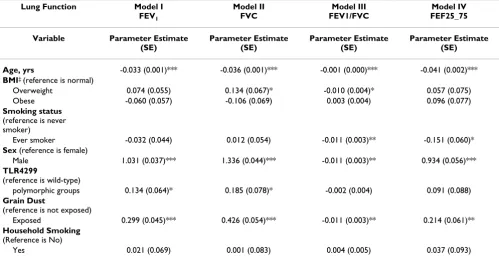
Results of the univariate analysis are shown in Table 3. Variables with p-value < 0.20 were included in the multi-variable model. However, TLR4 Asp299Gly was a risk fac-tor of primary interest, so it was kept in all the four final models selected to draw conclusions (one model for each of lung function outcome variable: FEV1, FVC, FEV1/FVC ratio, FEF25-75). The significant predictors for FEV1 and
Table 1: Demographic characteristics and TLR4 Asp299Gly stratified by Sex
Sex
Male (n = 754) Female (n = 971)
Mean ± SE Mean ± SE
Age, yrs 51.7 ± 0.55 51.1 ± 0.51 Height, cm 175.5 ± 0.57 162.4 ± 0.51 Weight, Kg 89.8 ± 0.24 74.3 ± 0.20
n(%) n(%) Age groups
< 40 years 180 (23.9%) 246 (25.3%) 40-59 years 320 (42.4%) 393 (40.5%)
≥ 60 years 254 (33.7%) 332 (34.2%) Body Mass Index (Kg/m2)
< 25 132 (17.5%) 289 (32.7%)* 25-30 343 (45.5%) 301 (34.1%) >30 279 (37.0%) 293 (33.2%) Smoking Status
Never Smoker 359(47.6%) 578 (59.5%)* Ever Smoker 395 (52.4%) 393 (40.5%) TLR4299
Wild-type 635 (84.2%) 855 (88.1%)†
Polymorphic 119 (15.8%) 116 (11.9%) Grain Dust
Not Exposed 305 (40.5%) 747 (76.9%)* Exposed 449 (59.5%) 224 (23.1%) Household Smoking
Table 2: Observed mean value ± standard error and mean values of the % predicted ± standard error for the pulmonary function test variables for sex, smoking status and TLR4 Asp299Gly
Sex Smoking Status# TLR4 299#
Male (n = 754) Female (n = 971) Never Smoker (n = 937)
Ever Smoker (n = 788)
Wild type (n = 1490) Polymorphic (n = 235)
Observed FEV1(L) 3.78 ± 0.03 2.65 ± 0.02 3.21 ± 0.03 3.18 ± 0.03 3.18 ± 0.02 3.31 ± 0.06+
% predicted 98.44 ± 0.59 102.86 ± 0.54 102.47 ± 0.53 99.09 ± 0.60& 100.91 ± 0.43 101.01 ± 1.05
Observed FVC (L) 4.73 ± 0.04 3.39 ± 0.02 3.97 ± 0.04 3.98 ± 0.04 3.95 ± 0.03 4.14 ± 0.07+
% predicted 98.55 ± 0.55 103.24 ± 0.51 102.38 ± 0.50 99.77 ± 0.57& 101.10 ± 0.41 101.76 ± 0.97
Observed FEV1/FVC 0.80 ± 0.002 0.81 ± 0.002 0.81 ± 0.0.002 0.80 ± 0.0.002& 0.80 ± 0.002 0.80 ± 0.004
% predicted 99.96 ± 0.29 100.06 ± 0.25 100.39 ± 0.26 99.57 ± 0.27& 100.11 ± 0.20 99.44 ± 0.49
Observed FEF25-75(L/s) 3.82 ± 0.05 2.89 ± 0.03 3.36 ± 0.04 3.21 ± 0.04& 3.28 ± 0.03 3.37 ± 0.08
% predicted 101.28 ± 1.10 103.89 ± 1.06 105.64 ± 1.04 99.30 ± 1.13& 102.89 ± 0.82 101.80 ± 2.17
Note: Predicted values are adjusted for age and height. * Comparison made between Male and Female p value < 0.05 ** Comparison made between Male and Female p value < 0.10
+ Comparison made between wild type and polymorphic group p value < 0.05 &Comparison made between never smoker and ever smoker group p value < 0.05 # Separate prediction equations used for males and females.
Table 3: Univariate regression analysis (one variable at a time) for relationship between lung function and TLR4 wild-type and polymorphic groups
Lung Function Model I
FEV1
Model II FVC
Model III FEV1/FVC
Model IV FEF25_75
Variable Parameter Estimate
(SE)
Parameter Estimate (SE)
Parameter Estimate (SE)
Parameter Estimate (SE)
Age, yrs -0.033 (0.001)*** -0.036 (0.001)*** -0.001 (0.000)*** -0.041 (0.002)***
BMI‡ (reference is normal)
Overweight 0.074 (0.055) 0.134 (0.067)* -0.010 (0.004)* 0.057 (0.075) Obese -0.060 (0.057) -0.106 (0.069) 0.003 (0.004) 0.096 (0.077)
Smoking status
(reference is never smoker)
Ever smoker -0.032 (0.044) 0.012 (0.054) -0.011 (0.003)** -0.151 (0.060)*
Sex (reference is female)
Male 1.031 (0.037)*** 1.336 (0.044)*** -0.011 (0.003)** 0.934 (0.056)***
TLR4299
(reference is wild-type)
polymorphic groups 0.134 (0.064)* 0.185 (0.078)* -0.002 (0.004) 0.091 (0.088)
Grain Dust
(reference is not exposed)
Exposed 0.299 (0.045)*** 0.426 (0.054)*** -0.011 (0.003)** 0.214 (0.061)**
Household Smoking
(Reference is No)
Yes 0.021 (0.069) 0.001 (0.083) 0.004 (0.005) 0.037 (0.093) *** p < 0.001; ** p < 0.01; * p < 0.05
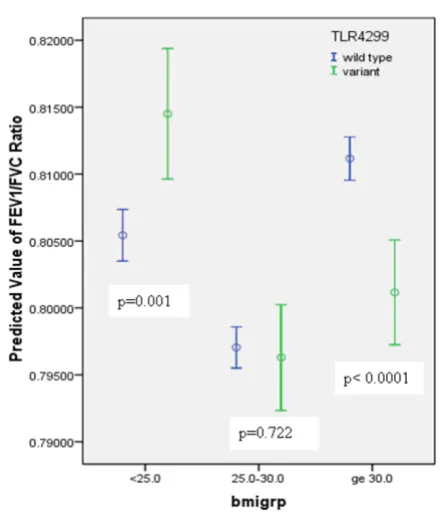
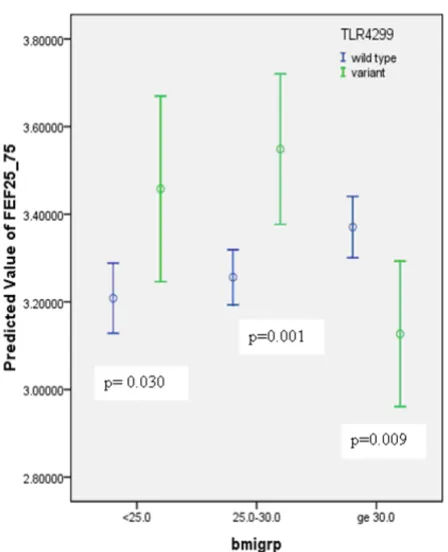
FVC were: age, smoking status, and TLR4 299 genotype (see Table 4). For FEV1, BMI achieved borderline signifi-cance. For FEV1/FVC ratio and FEF25-75significant predic-tors were: age smoking status, and sex. BMI was an effect modifier for the relationship between TLR4 Asp299Gly and FEV1/FVC ratio and FEF25-75. For different categories of BMI, the relationship between (i) TLR4 Asp299Gly and FEV1/FVC ratio, and (iii) TLR4 Asp299Gly and FEF25-75 are shown in Figures 1, and 2 respectively. Due to multiple comparisons, adjustment in p-values (0.05/3 = 0.01667 was used for statistical significance) was made based on the Bonferroni correction.
Discussion
In this study we investigated the association between TLR4 Asp299Gly polymorphism and the lung function in a community population. Based on the multivariable sta-tistical analysis, this cross-sectional study showed that TLR4 Asp299Gly was a potential risk factor for reduced FEV1/FVC and FEF25-75 in obese subjects (BMI ≥ 30 kg/
m2). Earlier studies have shown: (i) an association
between obesity and reduced lung function [12-15,23,24]; (ii) metabolic syndrome and impaired lung function [16,17]; (iii) no association between TLR4 poly-morphism and metabolic syndrome and diabetes [10,11]; and (iv) controversial relationship between TLR4 poly-morphism and lung function [2-7,9,25]. The most impor-tant finding of this report is that BMI appears to be an effect modifier in the relationship of TLR4 polymorphism and lung function. Based on the multivariable analysis: (i)
Table 4: Multiple regression analysis for relationship between lung function and TLR4 wild-type and polymorphic groups, adjusting for age, BMI, sex and smoking
Lung Function FEV1 FVC FEV1/FVC FEF25_75
Variable Parameter Estimate (SE) Parameter Estimate (SE) Parameter Estimate (SE) Parameter Estimate (SE)
Age, yrs -0.033 (0.001)*** -0.036 (0.001)*** -0.001 (0.000)*** -0.041 (0.002)***
BMI (reference is normal: <25)
Overweight (BMI: 25-30) 0.019 (0.035) 0.026 (0.042) -0.00002 (0.004) 0.065 (0.064) Obese (BMI: >30) -0.057 (0.035) -0.145 (0.043)** 0.015 (0.004)*** 0.232(0.065)***
Smoking status
(reference is never smoker)
Ever smoker -0.074 (0.027)** -0.056 (0.033) -0.007 (0.003)* -0.176 (0.047)***
Sex (reference is female)
Male 1.059 (0.028)*** 1.367 (0.034)*** -0.010 (0.003)** 0.959(0.048)***
TLR4299 (reference is wild-type)
polymorphic groups -0.020 (0.039) 0.003 (0.048) 0.007 (0.009) 0.062 (0.135)
Interactions BMI and TLR4299
(reference is < 25 BMI and Wild type) 25-30 BMI group and polymorphic group
-0.008 (0.011) 0.040 (0.172) >30 BMI group and polymorphic
group
-0.021 (0.011)# -0.432 (0.175)*
*** p < 0.001; ** p < 0.01; * p < 0.05 # p < 0.10
Association between TLR4 genotype and FEV1/FVC ratio by BMI categories (error bars represent 95% confidence inter-vals around the mean)
Figure 1
the variant group had a significantly higher mean pre-dicted FEV1/FVC ratio in the BMI category < 25 compared to the wild type group; (ii) no difference between wild type and variant groups in the BMI category 25 - <30; and (iii) the polymorphic group had lower mean predicted
FEV1/FVC ratio compared to the wild type group in the
BMI category ≥ 30. Conversely, the wild type group had
significantly lower mean value of predicted FEF25-75 in
BMI category 25 - <30 and significantly higher mean value of FEF25-75 in the BMI category ≥ 30 compared to the pol-ymorphic group.
In a recent study by Pistelli et al. [23] it was reported that the "becoming obese" and "always obese" categories had a significantly greater decline in lung function than "never obese" group. In the "always obese" group, this was true for vital capacity but not for FEV1. In our report, we did not observe any significant interaction between BMI and
TLR4 gene for FVC and FEV1. However the relationship
between obesity (in terms of BMI) and lung function
indi-ces FEV1/FVC ratio and FEF25-75 was different between
wild type and polymorphic groups. In another recent study, Rohde et al. [25] reported that the frequency of TLR4 Asp299Gly polymorphism is decreased in COPD
patients. Cross-sectional analysis of our database did not show any association between TLR4 polymorphism and COPD. Reasons for the lack of association between TLR4 polymorphism and COPD may be either a small sample size or a low frequency of TLR4 Asp299Gly polymor-phism in the study population. To examine completely the role of TLR4 Asp299Gly polymorphism, large popula-tions or longitudinal studies are required to give adequate statistical power to test the hypothesis of association between this TLR4 polymorphism and COPD.
Santos et al suggest that it is unlikely that TLR4 Asp299Gly polymorphisms have a major influence on adiposity, bone mineral density or osteoporosis status in Chilean elderly women [10]. A similar finding of no association between TLR4 Asp299Gly and metabolic syndrome or diabetes was observed by Illig et al. [11] Research has shown that obesity affects the mechanics and physiology of the respiratory system and people with higher BMI [18,23] and waist circumference [17] are more likely to
have lower values for FEV1, FVC and higher values for
FEV1/FVC ratio. A study conducted in Taiwan reported
that obesity and metabolic syndrome were associated with impaired lung function in an adult population [16]. It was suggested by the authors that obesity and insulin resistance may be the common pathways underlying lung function impairment and metabolic syndrome [16]. Shen et al. reported that waist circumference correlates with metabolic syndrome and other health risk indicators, fol-lowed by BMI [17]. The authors also reported that while percent fat is a useful indicator of overall adiposity, health risks are best represented by the simply measured waist circumference [17]. In a recent study, Ochs-Balcom et al. [24] reported that abdominal adiposity is a better predic-tor of pulmonary function than weight or BMI. The etiol-ogy of metabolic syndrome is complex, which is determined by the interplay of genetic and environmental factors [26]. Yamada et al identified a genetic polymor-phism that conferred susceptibility to metabolic syn-drome [26]. Illig et al. reported that there is no impact of TLR4 polymorphism on major features of metabolic syn-drome [11]. According to the National Cholesterol Educa-tion Program's Adult Treatment Panel III report (ATP III) metabolic syndrome can be identified clinically based on the five components: abdominal obesity, given as waist circumference (for men > 102 cm and for women > 88 cm); triglycerides (≥ 150 mg/dL); high-density lipoprotein choelstrol (< 40 mg/dL); blood pressure (≥ 130/≥ 85 mm
Hg) and fasting glucose (≥ 110 mg/dL). Abdominal
obes-ity is most strongly associated with the metabolic syn-drome [27]. In our study, information on all the five components of metabolic syndrome was not available to us, hence, when we conducted the statistical analysis by replacing BMI with waist circumference in multivariable models, and similar results were obtained.
Association between TLR4 genotype and FEF25-75 by BMI cat-egories (error bars represent 95% confidence intervals around the mean)
Figure 2
In our study TLR4 Asp299Gly frequency was 15.8% for males and 11.9% for females, so it was of interest to explore the three-way interaction between sex, TLR4 and BMI. A 3-way crosstab analysis showed that there may be a potential three-way interaction between sex, TLR4 Asp299Gly polymorphism and BMI. There was no
signif-icant difference in the mean values of FEV1 and FVC for
wild and variant groups when stratified by sex. Mean
val-ues for predicted FEV1/FVC ratio were (i) significantly
higher in variant group (males: 80.9 ± 0.02, females: 81.8 ± 0.02) compared to the wild type (males: 79.9 ± 0.02, females: 80.8 ± 0.02) in BMI category <25 kg/m2 and (ii) significantly lower for the variant group (males: 79.5 ± 0.02, females: 80.6 ± 0.02)) compared to the wild type group (males: 80.6 ± 0.02, females: 81.6 ± 0.02) in BMI category ≥ 30 kg/m2. Mean values for predicted FEF
25-75 were (i) significantly higher for the variant group (males: 3.93 ± 0.69, females: 3.71 ± 0.63) compared to the wild type group for BMI category 25 - < 30 kg/m2 ; and (ii) sig-nificantly lower in the variant group (3.62 ± 0.68) com-pared to the wild type group (3.89 ± 0.63) in BMI category
≥ 30 kg/m2. The association between TLR4 Asp299Gly
polymorphism and FEF25-75 was not modified by BMI for
females. However, this three-way interaction was not sig-nificant in the multivariable regression model, possibly due to a relatively low prevalence of TLR4 Asp299Gly in the study population.
This study had some methodological strengths and as well as weaknesses. The pulmonary function tests were admin-istered by trained nurses using techniques which con-formed to ATS standards. The pulmonary function tests were reviewed by a respiratory physician. A weakness of this study was that the number of the subjects was too small to conduct comparisons among three groups (Asp299Asp, Asp299Gly and Gly299Gly). For TLR4 299, 86.4%, were Asp299Asp, 13.4% were Asp299Gly, and 0.2% were Gly299Gly [Rennie DC, Chen Y, Pahwa P, Burch LH, Bharadwaj L, Grover VK, Schwartz DA, Dosman JA: Gender-related associations between toll-like 4 recep-tor 299 polymorphism and respirarecep-tory outcomes, submit-ted]. We therefore combined the last two groups. The allele frequencies of single nucleotide polymorphisms, such as Asp299Gly, vary between different ethnic popula-tions. The TLR-4 Asp299Gly polymorphism has different minor allele frequencies in, for example, 0% in Chinese, 6.5% in American and 9.8% in West African populations [28]. 93% of our study subjects were Caucasians; 0.4% were aboriginal; 1.4% had reported other ethnicity, and for 5.3% subjects ethnicity was missing. We were unable to define the presence/absence of metabolic syndrome due to lack of information on all the five components of metabolic syndrome and hence conducted our analysis using BMI (and repeated statistical analysis using waist circumference [results not shown]).
Overall, our study was adequately powered to detect clin-ically meaningful differences. To our knowledge this is the first study which showed that BMI is an effect modifier in the relation of TLR4 Asp299Gly polymorphism and lung function (FEV1/FVC ratio and FEF25-75). More studies are needed to accumulate the evidence of this effect modifica-tion and to assess the credibility [29] of this associamodifica-tion. It is essential to understand and investigate the interplay between lung function, TLR4 Asp299Gly polymorphism and metabolic syndrome in humans. TLR4 itself is not associated with lung function but has opposing effects at extremes of BMI. The mechanism is unknown to explain these opposing effects. Further studies should investigate the role of TLR4 Asp299Gly and additional polymor-phisms of TLR4 to understand the potential effects of innate immunity on lung function in relation to meta-bolic syndrome. It will be important to investigate
whether or not TLR4 Asp299Gly linked to another genetic
modifier of the metabolic syndrome. The association of TLR4 Asp299Gly variant status and lung function should be replicated in more than one population in order to establish the importance of this finding.
Conclusion
BMI may modify the associations of TLR4 Asp299Gly pol-ymorphism with FEV1/FVC ratio and FEF25-75. The associ-ation of TLR4 Asp299Gly variant status and lung function should be analyzed in more than one population in order to establish the importance of this finding.
Abbreviations
TLR: Toll-like receptor; FEV1: Forced expiratory volume in the first second; FVC: Forced vital capacity; FEF: forced expiratory flow rate; BMI: Body mass index, DNA: Deox-yribonucleic acid; COPD: Chronic Obstructive Pulmo-nary Disease; MGB: Minor groove binding; NFQ: Non-fluorescent quencher; (SE): Standard Error.
Competing interests
The authors declare that they have no competing interests.
Authors' contributions
PP designed and coordinated the study as well as data col-lected and prepared the manuscript. CPK analyzed data and prepared the manuscript. DCR participated in the design of the study and data collection and prepared the manuscript. YC participated in study design, coordina-tion, and data collection. DAS involved with genetic anal-ysis. JAD participated in study design, coordination, data collection and manuscript preparation. All authors read and approved the final manuscript.
Acknowledgements
Publish with BioMed Central and every scientist can read your work free of charge "BioMed Central will be the most significant development for disseminating the results of biomedical researc h in our lifetime."
Sir Paul Nurse, Cancer Research UK
Your research papers will be:
available free of charge to the entire biomedical community
peer reviewed and published immediately upon acceptance
cited in PubMed and archived on PubMed Central
yours — you keep the copyright
Submit your manuscript here:
http://www.biomedcentral.com/info/publishing_adv.asp
BioMedcentral
CIHR strategic initiative Public Health and the Agricultural Rural Ecosystem (PHARE) program and Canadian Centre for Health and Safety in Agricul-ture.
References
1. Aderem A, Ulevitch RJ: Toll-like receptors in the induction of the innate immune response. Nature 2000, 406:782-787. 2. Raby BA, Klimecki WT, Laprise C, Renaud Y, Faith J, Lemire M,
Greenwood C, Weiland KM, Lange C, Palmer LJ, Lazarus R, Vercelli D, Kwiatkowski DJ, Silverman EK, Martinez FD, Hudson TJ, Weiss ST:
Polymorphisms in toll-like receptor 4 are not associated with asthma or atopy-related phenotypes. Am J Respir Crit Care Med 2002, 166:1449-1456.
3. Michel O, LeVan T, Stern D, Dentener M, Thorn J, Gnat D, Beijer ML, Cochaux P, Holt PG, Martinez FD, Rylander R: Systemic respon-siveness to lipopolysaccharide and polymorphisms in the toll-like receptor 4 gene in human beings. J Allergy Clin Immunol 2003, 112:923-929.
4. Sandford AJ, Joos L, Pare PD: Genetic risk factors for chronic obstructive pulmonary disease. Curr Opin Pulm Med 2002,
8:87-94.
5. Hang J, Zhou W, Zhang H, Sun B, Dai H, Su L, Christiani DC: TLR4 Asp299Gly andThr399Ile polymorphisms are very rare in the Chinese population. J Endotoxin Res 2004, 10(4):238-240. 6. Basu S, Fenton MJ: Toll-like receptors: functions and roles in
lung disease. Am J Physiol Lung Cell Mol Physiol 2004, 286:L887-L892. 7. Arbour NC, Lorenz E, Schutte BC, Zabner J, Kline JN, Jones M, Frees K, Watt JL, Schwartz DA: TLR4 mutation is associated with endotoxin hyporesponsiveness in humans. Nature Genetics 2000, 25:187-191.
8. Eisenbarth SC, Piggott DA, Huleatt JW, Visintin I, Herrick CA, Bot-tomly K: Lipopolysaccharide-enhanced, toll-like receptor 4-dependent T helper cell type 2 responses to inhaled antigen.
J Exp Med 2002, 196:1645-1651.
9. LeVan TD, Von Essen S, Romberger DJ, Lambert GP, Martinez FD, Vasquez MM, Merchant JA: Polymorphisms in the CD14 Gene Associated with Pulmonary Function in Farmers. Am J Resp Crit Care Med 2005, 171:773-779.
10. Santos JL, Lera L, Pérez-Bravo F, Albala C: Adiposity and bone mineral density of Chilean elderly women in relation to toll-like receptor 4 gene polymorphisms. Ann Hum Biol 2006, 33(5-6):585-592.
11. Illig T, Bongardt F, Schöfer A, Holle R, Muller A, Rathmann W, Koenig W, Meisinger C, Wichmann H-E, Kolb H: The endotoxin receptor TLR4 polymorphism is not associated with diabetes or com-ponents of the metabolic syndrome. Diabetes 2003,
52:2861-2964.
12. Medarov BI, Strachan P, Cohen R: Effect of body mass index on pulmonary function tests. Chest 2005, 128(4):171S-172S. 13. Jones RL, Nzekwu MMU: The Effects of Body Mass Index on
Lung Volumes. Chest 2006, 130:827-833.
14. Chen Y, Rennie D, Cormier YF, Dosman J: Waist circumference is associated with pulmonary function in normal-weight, overweight, and obese subjects. Am J Clin Nutr 2007, 85:35-39. 15. Carey IM, Cook DG, Strachan DP: The effects of adiposity and
weight change on forced expiratory volume decline in a lon-gitudinal study of adults. Int J Obesity 1999, 23:979-985. 16. Lin WY, Yao CA, Wang HC, Huang KC: Impaired lung function is
associated with obesity and metabolic syndrome in adults.
Obesity 2006, 14(9):1654-1661.
17. Shen W, Punyanitya M, Chen J, Gallagher D, Albu J, Pi-Sunyer X, Lewis CE, Grunfeld C, Heshka Stanley, Heymsfield SB: Waist circumfer-ence correlates with metabolic syndrome indicators better than percentage fat. Obesity 2006, 14(4):727-736.
18. Chen Y, Rennie DC, Cormier Y, Dosman J: Sex specificity of asthma associated with objectively measured body mass index and waist circumference: The Humboldt Study. Chest 2005, 128:3048-3054.
19. Standardization of Spirometry-1994 update. American Tho-racic Society. Am J Respir Crit Care Med 1995, 152:1107-1646. 20. Crapo RO, Morris AH, Clayton PD, Nixon CR: Lung volumes in
healthy nonsmoking Adults. Bull Europ Physiopathol Respir 1982,
18:419-425.
21. Schwartz DA: TLR4 and LPS hyporesponsiveness in humans.
Int J Hyg Environ Health 2002, 205:221-227.
22. Hosmer DW, Lemshow S: Applied Logistic Regression. A Wiley-Interscience Publication, John Wiley and Sons Inc., Canada; 1989:82-134.
23. Pistelli F, Bottai M, Carrozzi L, Di Pede F, Baldacci S, Maio S, Brusasco V, Pellegrino R, Viegi G: Changes in obesity status and lung func-tion decline in a general populafunc-tion sample. Respir Med 2008,
102(5):674-680.
24. Ochs-Balcom HM, Grant BJB, Muti P, Sempos CT, Freudenheim JL, Trevisan M, Cassano PA, Iacoviello L, Schünemann HJ: Pulmonary function and abdominal adiposity in the general population.
Chest 2006, 129:853-862.
25. Rohde G, Klein W, Umut A, Hagedorn M, Duerig N, Bauer T, Gillis-sen A, Schultze-Werninghaus G, Epplen JT: Association of the ASP299GLY TLR4 polymorphism with COPD. Respir Med 2006, 100(5):892-896.
26. Yamada Y, Ichihara S, Kato K, Yoshida T, Yokoi K, Matsuo H, Watan-abe S, Metoki N, Yoshida H, Satoh K, Aoyagi Y, Yasunaga A, Park H, Tanaka M, Lee W, Nozawa Y: Genetic risk for metabolic syn-drome: examination of candidate gene polymorphisms related to lipid metabolism in Japanese people. J Med Genetics 2008, 45:22-26.
27. Grundy SM, Brewer HB, Cleeman JI, Smith SC, Lenfant C, for the Conference Participants: Definition of Metabolic Syndrome. Cir-culation 2004, 109:433-438.
28. Veltkamp M, Grutters JC, van Moorsel CHM, Bosch van den: Toll-like receptor (TLR) 4 polymorphism Asp299Gly is not asso-ciated with disease course in Dutch sarcoidosis patients. J Clin Microbiol 2005, 145:215-218.
29. Ioannidis JPA, Boffetta P, Little J, O'Brien TR, Uitterlinden AG, Vineis P, Balding DJ, Chokkalingam A, Dolan SM, Flanders WD, Higgins JPT, McCarthy MI, McDermott DH, Page GP, Rebbeck TR, Seminara , Khoury MJ: Assessment of cumulative evidence on genetic associations: interim guidelines. Int J Epidemiol 2008,
37:120-132.
Pre-publication history
The pre-publication history for this paper can be accessed here: