Open Access
Research article
Development and initial testing of a computer-based patient
decision aid to promote colorectal cancer screening for primary
care practice
Jane Kim*
†1,2, Annie Whitney
2, Sarah Hayter
2, Carmen Lewis
2,
Marci Campbell
3, Lisa Sutherland
3, Beth Fowler
3, Sue Googe
4,
Regina McCoy
3and Michael Pignone
†2Address: 1Preventive Medicine Residency Program, University of North Carolina, Chapel Hill, NC, USA, 2Division of General Internal Medicine,
Department of Medicine, University of North Carolina, Chapel Hill, NC, USA, 3Department of Nutrition, University of North Carolina School of
Public Health, Chapel Hill, NC, USA and 4Lineberger Comprehensive Cancer Center, University of North Carolina, Chapel Hill, NC, USA
Email: Jane Kim* - [email protected]; Annie Whitney - [email protected]; Sarah Hayter - [email protected]; Carmen Lewis - [email protected]; Marci Campbell - [email protected]; Lisa Sutherland - [email protected]; Beth Fowler - [email protected]; Sue Googe - [email protected]; Regina McCoy - [email protected];
Michael Pignone - [email protected] * Corresponding author †Equal contributors
Abstract
Background: Although colorectal cancer screening is recommended by major policy-making organizations, rates of screening remain low. Our aim was to develop a patient-directed, computer-based decision aid about colorectal cancer screening and investigate whether it could increase patient interest in screening.
Methods: We used content from evidence-based literature reviews and our previous decision aid research to develop a prototype. We performed two rounds of usability testing with representative patients to revise the content and format. The final decision aid consisted of an introductory segment, four test-specific segments, and information to allow comparison of the tests across several key parameters. We then conducted a before-after uncontrolled trial of 80 patients 50–75 years old recruited from an academic internal medicine practice.
Results: Mean viewing time was 19 minutes. The decision aid improved patients' intent to ask providers for screening from a mean score of 2.8 (1 = not at all likely to ask, 4 = very likely to ask) before viewing the decision aid to 3.2 afterwards (difference, 0.4; p < 0.0001, paired t-test). Most found the aid useful and reported that it improved their knowledge about screening. Sixty percent said they were ready to be tested, 18% needed more information, and 22% were not ready to be screened. Within 6 months of viewing, 43% of patients had completed screening tests.
Conclusion: We conclude that a computer-based decision aid can increase patient intent to be screened and increase interest in screening. Practice Implications: This decision aid can be viewed by patients prior to provider appointments to increase motivation to be screened and to help them decide about which modality to use for screening. Further work is required to integrate the decision aid with other practice change strategies to raise screening rates to target levels.
Published: 28 November 2005
BMC Medical Informatics and Decision Making 2005, 5:36 doi:10.1186/1472-6947-5-36
Received: 20 May 2005 Accepted: 28 November 2005 This article is available from: http://www.biomedcentral.com/1472-6947/5/36
© 2005 Kim et al; licensee BioMed Central Ltd.
Background
Colorectal cancer (CRC) is the second leading cause of cancer death and third most diagnosed cancer in the United States [1,2]. Multiple policy-making organizations have published evidence-based CRC screening guidelines that recommend annual fecal occult blood testing (FOBT), sigmoidoscopy or barium enema every 5 years, or colonoscopy every 10 years for adults 50 and older [3-5]. Despite these guidelines, rates of colorectal cancer screen-ing in the U.S. are low with only approximately 50% of adults 50 and older reporting a CRC screening test within recommended time intervals [6,7].
Given the many testing options, colorectal cancer screen-ing can be a complex issue, and time limitations may pre-vent providers from adequately discussing all options with patients. Patient decision aids offer a means of cir-cumventing these limitations. Decision aids are educa-tional materials that help individuals understand their choices for screening or treatment [8,9]. They have been shown to improve patients' knowledge, reduce decisional conflict, and increase active patient participation in med-ical decision making [8].
We previously conducted a randomized controlled trial of an 11-minute videotape-based decision aid on CRC screening paired with a color-coded chart marker and bro-chure [10]. The decision aid was based on the transtheo-retical stages of change model [11]. Patients indicated their stage of readiness to be screened by selecting a color-coded brochure, and a chart marker of the same color was attached to their charts. The decision aid increased patients' intent to ask their providers for screening, and 47% of intervention group participants had CRC screen-ing tests ordered compared to 26% of controls. A chart review 3 months afterwards found increased screening test completion in the intervention group compared to con-trols (37% vs. 23%, respectively, p < 0.05).
Despite the videotape-based decision aid's success in rais-ing screenrais-ing rates, there were some limitations in its for-mat and content. First, it only offered FOBT and sigmoidoscopy; colonoscopy was not an available option at the time of the original study. Because it was produced in videotape form, the decision aid could not be easily updated to include newly endorsed screening modalities or other new information. In addition, the videotape could not be tailored to meet different levels of patient interest in CRC screening. Recent advances in web-based technology made it possible to produce a computer-based decision aid that can be updated and customized to meet patients' individual knowledge needs.
We sought to develop, refine, and pilot test whether a computer-based, patient-directed decision aid can
increase patient interest in screening, meet informational needs, and lead to the ordering and completion of color-ectal cancer screening tests.
Methods
Computer-based decision aid development
We based the content of the computer-based decision aid, called CHOICE™ version 1.0, on systematic reviews of the literature and our videotape decision aid [10]. New seg-ments on colonoscopy, barium enema, and comparative information about the tests were developed. We also developed patient vignettes by filming interviews with patients who had undergone screening and agreed to dis-cuss their experiences. The decision aid, two self-adminis-tered questionnaires, and a data collection mechanism using Microsoft Access as a back-end database were pro-grammed into a web-based format using Active Server Pages. The decision aid was developed for use on a local computer version, although an Internet-based version has subsequently been developed.
Decision aid format and content
The final version of the decision aid consists of a modular design with a 5-minute introduction and five additional 3–5 minute segments that describe individual screening tests or comparative information about the tests. An audio track accompanies the entire decision aid and explains all figures that are presented, making the content accessible to users with varying levels of literacy. Readability was not formally assessed given that the decision aid was not based on prose text. However, we designed the interface, including the audio track and figures, with the intent to make the information easy to understand. The patient uses a mouse to activate an introductory segment that explains what colorectal cancer is, describes its prevalence and lifetime risk, outlines the importance of colorectal cancer screening and the benefits of early detection, and gives a brief overview of each recommended screening modality. A physician provided narration and multiple interviews were included of patients describing their expe-riences and views of colorectal cancer screening. This por-tion of the decision aid was to be viewed by all users.
required, discomfort anticipated during the test, the risk of adverse effects, as well as the ability of each test to detect colorectal cancer or precancerous polyps. After the overview about the test, the decision aid presents multiple 5–15 second patient vignettes. These vignettes consist of interviews with white and African American men and women describing their reasons for choosing a particular screening modality, their experiences with the test, and the benefits and downsides of the test. Additional video footage shows patients preparing for the tests. Follow-up of abnormal results and comparisons of different screen-ing modalities to one another are explained via text, nar-ration, and graphs (Figure 3). At the end of each segment, patients are directed to the navigation screen that allows them to choose another test information segment, exam-ine comparative information, or to go to the post-inter-vention questionnaire. After initial testing, the decision aid was modified to require that patients watch the intro-duction and at least one other video segment.
Usability testing
We recruited twelve patients 50–75 years old to partici-pate in each round of usability testing. These patients were
a convenience sample recruited from the University of North Carolina-Chapel Hill (UNC) general internal med-icine practice. We attempted to identify users with a wide range of previous computer experience and education lev-els. The computer used for the usability testing and the pilot study was an IBM PC with a Pentium processor and Windows operating system. Research team members experienced in usability testing observed and videotaped patients as they worked with the decision aid using the Think Aloud technique [12]. The study investigators mod-ified the decision aid via an iterative process based on feedback from the usability testing that identified users' difficulties with the decision aid. In the first session, users, particularly those less familiar with computers, had sev-eral problems with navigation. These problems included confusion about how to use the mouse, difficulty in read-ing the type font, and inability to move between screens. Based on these results, we increased font sizes, changed the placement and color contrast of navigation elements and content, and simplified navigation options and oper-ation of the video segments. After these changes, patients in the second round of testing with varying levels of com-puter experience were able to navigate through the
deci-Menu of choices
Figure 1
sion aid with greater ease and less confusion than first-round users.
Study design
To pilot test the efficacy of the decision aid, we then con-ducted a before-after uncontrolled trial at the UNC gen-eral internal medicine practice. The practice consists of 75 medical residents, 20 attending physicians, and approxi-mately 12,000 patients, of whom approxiapproxi-mately 5,000 are between 50 and 75 years of age.
Population
We enrolled a convenience sample of patients from June 2003-April 2004. The participants were adults 50 to 75 years old who were cared for in the general internal med-icine practice and presented to their provider for a sched-uled appointment. Eligibility criteria were: 1) the absence of a personal or family history of colon cancer in a first degree relative; 2) sufficient general health to undergo screening as determined by the research assistant (RA) or primary care provider; and 3) the ability to communicate in English. The RA sought permission from providers and
then approached eligible patients and asked them to enroll. Clinic providers also referred patients for participa-tion. If the patient agreed to participate, the RA obtained written informed consent. Both patients who were up-to-date with screening and those who were due for screening were allowed to enroll with the rationale that individuals in both groups could learn more about screening options for their next decision about screening. We defined up-to-date status as having an FOBT in the past year, sigmoidos-copy or barium enema in the past 5 years, or colonossigmoidos-copy in the past 10 years. If we found in patients' medical records or baseline surveys that they were up-to-date with screening, they were asked to respond as if they were deciding about their next screening opportunity.
Intervention
Participants viewed the decision aid on a computer in a private area in the clinic either before or after their sched-uled appointment. The RA was present during their view-ing session. The patients were encouraged to navigate independently through the decision aid and question-naires, but were offered assistance from the RA if needed.
Illustration of endoscopy technique
Figure 2
Data collection
Patients completed web-based, self-administered ques-tionnaires before and after viewing the decision aid (see Additional file 1). We based the questionnaires' content and format on the questions used in our videotape deci-sion aid trial. After viewing the decideci-sion aid, participants indicated their stage of readiness to be screened by choos-ing one of three color-coded stages: green indicated that they were ready to be screened, yellow that they needed more information, and red that they did not want screen-ing. They completed an additional paper-based question-naire based on their stage of readiness (Appendix A). We asked patients who were ready to be screened what criteria were most important in deciding on screening and which test they would prefer to have. The RA conducted an elec-tronic chart review 6 months afterwards to determine if CRC screening tests were ordered and completed.
Outcome measures
The primary outcome measures were: 1) intent to ask pro-viders about screening; and 2) interest in CRC screening.
Intent to ask providers for screening was measured on a 4-point Likert scale (1 = not at all likely to ask, 4 = very likely to ask). Patients' interest in being screened for CRC in the next 6 months was also measured on a 4-point Likert scale (1 = not at all interested, 4 = definitely interested). Secondary outcome measures included: subjective change in knowledge about screening, helpfulness of the infor-mation in making a decision about screening, and prefer-ences for shared decision making with their provider. Other outcome measures were the proportions of CRC screening tests ordered and completed after 6 months. Test ordering was defined as an FOBT order recorded in the clinic's database or a colonoscopy, sigmoidoscopy, or barium enema order in the electronic medical record. Test completion was defined as a completed FOBT recorded in the clinic database or a completed colonoscopy, sig-moidoscopy, or barium enema report in the electronic medical record. Patients choosing a test were then asked to give their main reason for their particular choice.
Comparison of screening tests
Figure 3
Statistical analysis
We examined the characteristics of the sample by using univariate analyses to determine the distribution of each variable. The mean, range, and standard deviation were calculated for continuous variables and frequencies and percentages were tabulated for categorical variables. To assess change in interest and intent to be screened, we
used paired t-tests to compare the difference in Likert scores before and after viewing the decision aid. Frequen-cies and percentages were tabulated for categorical varia-bles in the questionnaires and for test ordering and completion.
Table 1: Characteristics of the sample (n = 80).
Characteristic Mean (range) or percent
Mean age 60 (49–75)
% Male 59
% White 69
% African American 29
% Insured 81
% More than high school education 65
% Self-rated excellent-good health 67
% Screened for colorectal cancer in the past 48
% Up to date with screening 18
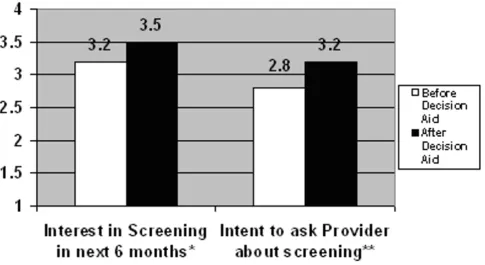
Change in intent to be screened after viewing the decision aid
Figure 4
Pearson's chi-square test was used to compare the percent-age ordering and completing tests by stpercent-age of readiness to be screened. We conducted another analysis after exclud-ing patients who were already up-to-date with screenexclud-ing because these patients might be less likely to have tests ordered or completed after viewing the decision aid. We used Pearson's chi-square test to compare the proportion completing tests among patients who had previously been screened, were up-to-date with screening, or had previous conversations about screening with their provider vs. those who had not.
Two-sided p-values < 0.05 were considered statistically significant. Stata version 8.2 (College Station, TX) was used for all analyses. Prior approval for the study was obtained from the University of North Carolina-Chapel Hill Institutional Review Board, and the research was car-ried out in compliance with the Helsinki Declaration [13].
Results
Patient characteristics
Approximately 260 patients were approached and 80 agreed to participate (31% response rate). The main rea-son for non-participation was lack of time to complete the study during the index visit. The demographic characteris-tics of participants are shown in Table 1; demographic characteristics were similar for those who were up-to-date with screening and those who were not. The mean age was 60 years. Fifty-nine percent were male and 69% were white. Of the 81% with health insurance, 18% had Medi-care and 46% had private insurance. Approximately half of the participants had ever been screened for colon can-cer and 18% were up-to-date with screening. Almost two-thirds of patients said that a provider had discussed CRC screening with them in the past.
Change in interest in screening and intent to be screened
Interest in screening and intent to ask providers about screening rose significantly after viewing the decision aid. Patients' interest in being screened in the 6 months after viewing the decision aid increased from a mean score of 3.2 before viewing the decision aid to 3.5 afterwards (dif-ference, 0.3; p = 0.01, paired t-test, Figure 4). Patients' intent to ask for screening increased from 2.8 to 3.2 (dif-ference, 0.4; p < 0.0001, paired t-test).
Process outcomes
Eighty-nine percent said that the information increased their knowledge about colon cancer, 78% said that the information helped them decide whether to be screened, and 90% felt that the amount of information presented was just right. Even among those who were not ready to be screened, most found the aid helpful and reported that it increased their knowledge about colorectal cancer. Ninety percent preferred to make decisions about their health together with their physician. The mean amount of time spent viewing the decision aid was 19 minutes.
Test ordering and completion
Forty-eight percent had either an FOBT or endoscopy (colonoscopy or sigmoidoscopy) ordered within 6 months of viewing the decision aid (Table 2). Thirty-three percent had an FOBT ordered and 26% had an order for endoscopy. In terms of test completion, 43% of partici-pants completed either FOBT or endoscopy. Twenty-three percent completed FOBT and 26% completed endoscop-ies, and 2.5% completed both tests. No barium enemas were ordered or performed.
Table 2: Six-month follow-up: screening test ordering and completion
Total FOBT Colonoscopy/sigmoidoscopy
% Ordered 48 33 26
% Completed 43 23 26
All percentages based on n = 80
Table 3: Test ordering and completion by stage of readiness to be screened
Stage of Readiness n % with test ordered* % completing test**
Green: ready to be tested 47 51 43
Yellow: need more Information 18 47 33
Red: not ready for screening 15 39 33
Self-reported stage of change and relationship with test completion
When asked about stage of readiness to be screened, 60% chose green (ready to be tested), 18% chose yellow (needed more information) and 22% chose red (not ready to be screened). There was a greater percentage of test ordering and completion among patients choosing green (51% and 43%, respectively) compared to those choosing yellow or red, but these differences did not reach statistical significance (Table 3).
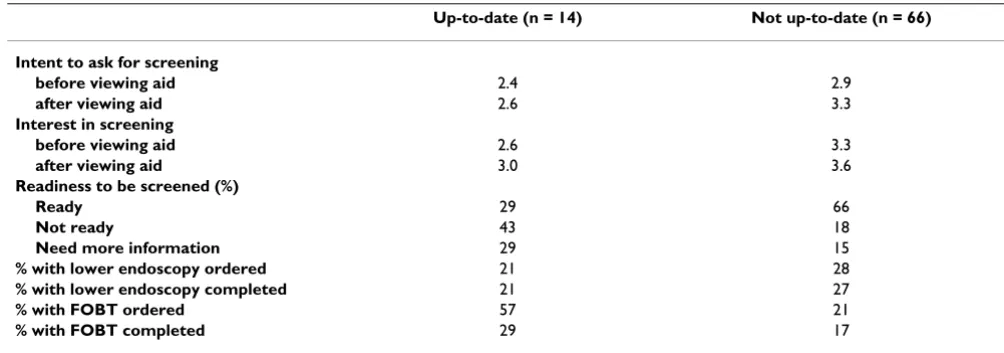
After excluding patients who were up-to-date with screen-ing, there was no significant change in the percentage of patients having tests ordered and completed by stage of readiness to be screened. Screening test completion rates did not differ significantly between those who were already up-to-date with screening and those who were not in compliance. Individuals who were up-to-date had lower baseline intent and interest scores and fewer were ready to be screened compared to those who were not up-to-date (Table 4). More FOBTs were ordered in those who were up-to-date, but the percentage that had a lower endoscopy was similar to the percentage that had endo-scopies among those due for screening. Having a previous history of screening or having previous conversations about screening with a provider did not result in higher test completion rates.
Test preferences
We asked patients who were ready to be screened which screening modality they preferred to have. Forty-two per-cent chose colonoscopy, 20% chose FOBT alone, and 18% chose FOBT in combination with sigmoidoscopy.
How-ever, only 28% actually had the test they preferred ordered by their provider. We also asked these patients to choose the most important factor in deciding on a screening test (Appendix A). More than half (54.5%) said that the ability of tests to find cancers or polyps, or test accuracy, was the most important criteria in selecting a screening method.
Discussion
We developed a computer-based colon cancer screening decision aid and found that it could increase patient inter-est in screening and intent to be screened. Most partici-pants were ready to be screened after viewing the decision aid, 48% had tests ordered and 43% completed screening tests. These results are similar in magnitude to those from our videotape decision aid trial in which patients' intent to ask providers for screening increased significantly after viewing the aid and 37% completed tests.
In our current study, the computer-based decision aid subjectively improved patients' knowledge about screen-ing and was useful to most in makscreen-ing decisions about screening. Other studies have found that similar tools increased patients' level of knowledge about screening, but effects on screening rates have varied. Zapka et al. con-ducted a randomized controlled trial of a video on sig-moidoscopy that was mailed to patients in advance of a scheduled visit [14]. A decision aid developed by Meade et al. improved patient knowledge about CRC screening as determined by a change in score from expert-validated pre- and post-tests [15]. Dolan et al. found that patients subjectively reported improved knowledge about CRC screening after using a decision aid [16]. In these studies, there was no difference in screening test ordering and
Table 4: Intent* and interest** in screening, test ordering and completion, and readiness to be screened by up-to-date§ status
Up-to-date (n = 14) Not up-to-date (n = 66)
Intent to ask for screening
before viewing aid 2.4 2.9
after viewing aid 2.6 3.3
Interest in screening
before viewing aid 2.6 3.3
after viewing aid 3.0 3.6
Readiness to be screened (%)
Ready 29 66
Not ready 43 18
Need more information 29 15
% with lower endoscopy ordered 21 28
% with lower endoscopy completed 21 27
% with FOBT ordered 57 21
% with FOBT completed 29 17
*Intent to ask for screening was based on the question: "How likely are you, at this visit, to ask your doctor about being tested for colon cancer?" and used a 4-point Likert scale, 1 = not at all likely to ask, 4 = very likely to ask
**Interest in screening was based on the question:"How interested are you in having a test for colon cancer in the next 6 months?" and used a 4-point Likert scale, 1 = not at all interested, 4 = definitely interested
completion between those who viewed the decision aid compared to those who did not [16]. In contrast to these studies that looked at the effect of a decision aid alone, our previous study using a combined intervention of a videotape decision aid and chart marker was able to increase screening test ordering and completion com-pared to controls [10].
Our computer-based aid differs from other decision aids for CRC screening in that patients were able to interact with the aid via its modular format and choose to view information based on their knowledge needs. Patients in previous trials of decision aids on CRC screening all received the same educational content regardless of their knowledge about screening [10,14-16]. Our computer-based aid was not truly tailored in that the decision aid was not customized to fit individual patients' characteris-tics. Each patient, however, was able to select the amount and content of information they received. In this way, the information on CRC screening may have achieved greater relevance to patients.
Only 28% of those who were ready to be screened had the test they preferred ordered by their provider. There are a number of possible reasons for the lack of congruence between patient preferences and test ordering. First, some patients may have viewed the decision aid after seeing their provider and thus did not have an opportunity to discuss screening at that visit or another visit within the 6-month follow-up window. Another possibility is that pro-viders may not have been aware of patients' preferences and had not been trained to provide stage-appropriate responses. Third, patients who were already up-to-date with screening may not have had tests ordered. Excluding patients who were up-to-date from the analysis, however, did not increase the proportion of tests ordered, so this explanation is unlikely to account for the low test ordering rates.
Given these results, a patient-oriented decision aid alone may be insufficient to ensure test ordering based on patient preferences or increase test ordering and comple-tion to desired levels; multifaceted intervencomple-tions that tar-get a combination of providers, patients, or office systems may be more likely to increase screening rates [17]. Inter-ventions such as physician prompts and standing orders can increase performance of preventive care, including cancer screening [18,19]. Standing orders are another potential component of a multifaceted intervention. In a standing orders protocol, a nurse initiates test ordering based on patient preferences and a practice-approved pro-tocol. Implementing the decision aid with office-system interventions may help improve rates of screening test ordering.
The proportion of tests ordered and completed for patients who answered green was higher than for patients who answered yellow or red, but the differences were not statistically significant. The study with its small sample size may have lacked power to detect a significant differ-ence between the groups. In addition, approximately 40% of patients choosing red had tests ordered and one-third completed screening tests. In our previous videotape deci-sion aid study, only 7% of patients choosing red had tests ordered and 4% completed tests. The seeming disconnect between patient interest and provider ordering in the cur-rent study is concerning and may be due to poor patient-provider communication about preferences or patients who changed their mind about screening after completing the questionnaire. More research needs to be done to determine why patients who were uncertain or not ready for screening had tests ordered and completed.
Of the patients who were ready for screening, most rated the ability to find cancer, or accuracy, as the most impor-tant factor in deciding on a test. Ling et al. previously found that most patients rate accuracy as the most impor-tant feature of a CRC screening test, but that providers thought that discomfort in undergoing a test was most important to patients [20]. Providers should be aware that many individuals value the accuracy of screening methods and counsel their patients accordingly.
response rate, the responses of those who chose to partic-ipate may be different from those who did not particpartic-ipate. Our results also could have been affected by the fact that almost half of the participants were previously screened and 18% were up-to-date with screening. We performed additional analyses excluding those who were up-to-date and did not find a change in the percentage of tests ordered and completed. There were also some differences in outcomes between those who were up-to-date and those who were not. Individuals who were up-to-date had lower mean intent and interest scores at baseline and after watching the aid, and less were ready to be screened after watching the aid compared to those who were not up-to-date (Table 4). These results are based on small numbers, however, and should be interpreted with caution. Although patients were able to choose different videos in the decision aid, we did not track which segments were viewed by patients. Tracking may have provided addi-tional information on how individual use of the decision aid was related to change in interest, test preferences, or test completion. However, mean viewing time was 19 minutes, indirectly suggesting that patients were accessing a significant portion of the content.
This study did not objectively measure screening knowl-edge before and after the aid, its effect on decisional con-flict, or changes in anxiety or satisfaction with decisions, other important measures of a decision aid's effectiveness [8]. In this pilot study conducted in a busy primary care practice, we chose to focus on whether the aid could increase interest in screening and was useful in deciding on a screening modality. Future studies should assess whether this decision aid can decrease decisional conflict and improve objective knowledge about screening. Because our study was conducted at a single site, our study findings may not be generalizable to other populations. Those in our convenience sample had high levels of edu-cation, most had insurance, and many had prior experi-ence with screening. Other patient populations, including individuals not currently receiving regular medical care, might respond differently to the decision aid.
Although Medicare, Medicaid, and most private insurers cover CRC screening [21], cost may be an important issue for patients. We did not collect information on which tests were covered by patients' insurance carriers, co-pays and deductibles, or the importance of cost in patients' decisions about screening. Evaluating the effect of differ-ent levels of co-paymdiffer-ent on patidiffer-ent preferences is an important area for future research.
A final limitation is that the decision aid may be some-what challenging for those with limited computer skills.
Although we did not objectively measure how many patients needed assistance, we observed that most patients completed the aid independently and required limited, if any, computer assistance. Whether the addi-tional benefits of the web-based format outweigh the greater requirements for computer skill requires further research. We have developed a DVD version of the deci-sion aid that preserves the ability to self-navigate but may be easier for computer-inexperienced users or those with-out access to a computer.
Conclusion
This computer-based decision aid on colorectal cancer screening increased patient interest in screening and intent to be screened. Most patients could independently navigate through the menu of choices to select segments that met their knowledge needs. It is interactive and takes approximately 20 minutes of patient time.
There are many ways in which the decision aid can be incorporated into primary care practice. Because the deci-sion aid explains the importance of CRC screening and describes each test with its risks and benefits, it can poten-tially save providers time in counseling patients about screening. Internet- and DVD versions of the decision aid are currently in production, and we plan to produce a Spanish language version that will allow for dissemina-tion of the aid to Spanish-speaking patients. The decision aid could be watched by patients at home in preparation for a provider appointment, a process we are currently testing in another study. In the office, nurses can identify patients at triage who are due for screening and direct them to watch the decision aid prior to an upcoming visit or while waiting to see their provider.
In this pilot study, a computer-based, patient-directed decision aid increased patient interest in colorectal cancer screening and subjectively improved knowledge about screening options. Most patients were ready to be screened after viewing the decision aid but only half the patients who wanted to be screened had tests ordered. Future research needs to be done to determine whether implementation of the decision aid with other interven-tions can effectively raise screening rates in a primary care setting.
Competing interests
The author(s) declare that they have no competing inter-ests.
Authors' contributions
Publish with BioMed Central and every scientist can read your work free of charge
"BioMed Central will be the most significant development for disseminating the results of biomedical researc h in our lifetime."
Sir Paul Nurse, Cancer Research UK
Your research papers will be:
available free of charge to the entire biomedical community
peer reviewed and published immediately upon acceptance
cited in PubMed and archived on PubMed Central
yours — you keep the copyright
Submit your manuscript here:
http://www.biomedcentral.com/info/publishing_adv.asp
BioMedcentral
the drafting and editing of the decision aid. MC, LS, and BF participated in the drafting and editing of the decision aid. SG programmed the decision aid interface. RM partic-ipated in the design of the decision aid. MP conceived of the study, participated in the drafting and editing of the decision aid, designed and coordinated the study, and helped to draft the manuscript. All authors read and approved the final manuscript.
Additional material
Acknowledgements
Dr. Kim's fellowship support was from the Physician Training Award in Pre-ventive Medicine #PTAPM-01-085-01 from the American Cancer Society. Support for this project was provided through a Career Development Award for Primary Care Physicians # 01-195-01 from the American Cancer Society to Dr. Pignone and from the National Institutes of Health grant # DK 56350 for the UNC Clinical Nutrition Research Center
References
1. Jemal A, Tiwari R, Murray T, Ghafoor A, Samuels A, Ward E, Feuer E, Thun MJ: Cancer Statistics, 2004. CA: A Cancer Journal for Clinicians
2004, 41:8-29.
2. Cancer Facts and Figures. Atlanta, American Cancer Society; 2003.
3. Smith RA, Cokkinides V, Eyre HJ: American Cancer Society guidelines for the early detection of cancer, 2003. CA Cancer J Clin 2003, 53:27-43.
4. Screening for colorectal cancer: recommendation and rationale. Ann Intern Med 2002, 137:129-131.
5. Winawer S, Fletcher R, Rex D, Bond J, Burt R, Ferrucci J, Ganiats T, Levin T, Woolf S, Johnson D, Kirk L, Litin S, Simmang C: Colorectal cancer screening and surveillance: clinical guidelines and rationale-Update based on new evidence. Gastroenterology
2003, 124:544-560.
6. Centers for Disease Control and Prevention. Behavioral Risk Factor Surveillance System Prevalence Data [http:// www.cdc.gov/mmwr/preview/mmwrhtml/mm5210a2.htm]
7. Seeff LC, Nadel MR, Klabunde CN, Thompson T, Shapiro JA, Vernon SW, Coates RJ: Patterns and predictors of colorectal cancer test use in the adult U.S. population. Cancer 2004,
100:2093-2103.
8. O'Connor AM, Rostom A, Fiset V, Tetroe J, Entwistle V, Llewellyn-Thomas H, Holmes-Rovner M, Barry M, Jones J: Decision aids for patients facing health treatment or screening decisions: sys-tematic review. Bmj 1999, 319:731-734.
9. Barry MJ: Health decision aids to facilitate shared decision making in office practice. Ann Intern Med 2002, 136:127-135. 10. Pignone M, Harris R, Kinsinger L: Videotape-based decision aid
for colon cancer screening. A randomized, controlled trial. Ann Intern Med 2000, 133:761-769.
11. Prochaska JO, Redding CA, Evers KE: The transtheoretical model and stages of change. In Health behavior and health education: The-ory, research, and practice Edited by: Glanz K, Lewis KM and Rimer B. San Francisco, Jossey-Bass; 2002:99-120.
12. Dumas J, Redish J: A practical guide to usability testing. Volume xiv. Norwood, NJ, Ablex Publishing Corporation; 1993:412. 13. Helsinki Declaration [http://www.wma.net/e/policy/b3.htm]
14. Zapka JG, Lemon SC, Puleo E, Estabrook B, Luckmann R, Erban S:
Patient education for colon cancer screening: a randomized trial of a video mailed before a physical examination. Ann Intern Med 2004, 141:683-692.
15. Meade CD, McKinney WP, Barnas GP: Educating patients with limited literacy skills: the effectiveness of printed and video-taped materials about colon cancer. Am J Public Health 1994,
84:119-121.
16. Dolan JG, Frisina S: Randomized controlled trial of a patient decision aid for colorectal cancer screening. Med Decis Making
2002, 22:125-139.
17. Hulscher ME, Wensing M, Grol RP, van der Weijden T, van Weel C:
Interventions to improve the delivery of preventive services in primary care. Am J Public Health 1999, 89:737-746.
18. Balas EA, Weingarten S, Garb CT, Blumenthal D, Boren SA, Brown GD: Improving preventive care by prompting physicians. Arch Intern Med 2000, 160:301-308.
19. Snell JL, Buck EL: Increasing cancer screening: a meta-analysis. Prev Med 1996, 25:702-707.
20. Ling BS, Moskowitz MA, Wachs D, Pearson B, Schroy PC: Attitudes toward colorectal cancer screening tests. J Gen Intern Med
2001, 16:822-830.
21. Medicare preventive services...to help keep you healthy.
[http://www.medicare.gov/Publications/pubs/pdf/11039.pdf]
Pre-publication history
The pre-publication history for this paper can be accessed here:
http://www.biomedcentral.com/1472-6947/5/36/prepub
Additional File 1
Decision aid questionnaires
Click here for file