R E S E A R C H A R T I C L E
Open Access
Utilization and responsiveness of the asthma
control test (ACT) at the initiation of therapy for
patients with asthma: a randomized controlled
trial
Mohamed S Al Moamary
1*, Ahmed G Al-Kordi
1, Mohammed O Al Ghobain
1and Hani M Tamim
2Abstract
Background:The aim of this study was to assess the responsiveness of the asthma control test (ACT) to detect changes at the initiation of therapy and its utilization in the initiation of asthma treatment.
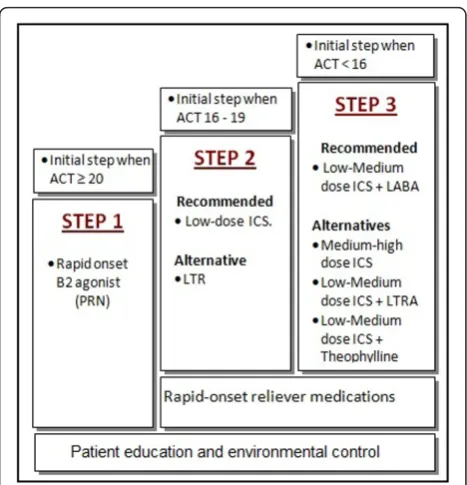
Methods:This study was designed as a randomized clinical trial conducted in a primary care setting. The subjects were asthma patients who had not received controller therapy for at least two months. The patients were randomized into two groups: The Saudi Initiative for Asthma (SINA) group and the Global Initiative for Asthma (GINA) group. Treatment in the SINA group was initiated at step1 when the ACT scores≥20, step 2 when the score between16-19, and step 3 when the score < 16 began at step 3. The GINA group patients were started on step 2 when they had persistent asthma symptoms or step 3 when they had severely uncontrolled disease. Results:Forty-five patients were analyzed in each group. The improvement in ACT score after treatment initiation was significantly higher when the SINA approach was used (2.9 in the SINA group compared to 1.7 in the GINA group (p= 0.04)). The improvement in FEV1 was 5.8% in the SINA group compared to 3.4% in the GINA group (p
= 0.46). The number of patients who achieved asthma control at the follow-up visit and required no treatment adjustment was 33 (73.3%) in the SINA group and 27 (60%) in the GINA group (p= 0.0125).
Conclusion:The ACT was responsive to change at the initiation of asthma treatment and was useful for the initiation of asthma treatment.
Trial Registration number:ISRCTN31998214
Keywords:Asthma, Asthma control test, Guidelines, Global initiative for asthma, Saudi initiative for asthma, Control
Background
The Global Initiative for Asthma (GINA) has evolved management from being based on a severity index to the concept of achieving asthma control [1-4]. It has adopted a five-step approach to control asthma, where each step represents a different treatment option with increasing efficacy. The five-step approach is designed to maintain control with the least amount of medication [1,5]. For the initiation of treatment, the GINA recom-mended step 2 for most treatment naïve patients with
persistent symptoms, while step 3 was recommended for severely uncontrolled disease [1]. The National Asthma Education and Prevention Program (NAEPP) is another major guideline that utilized asthma severity categoriza-tion when initiating treatment in treatment-naïve patients or in those with newly diagnosed asthma [6]. These different approaches were based on a consensus of experts’opinions, as there was insufficient available evidence.
The Saudi Initiative for Asthma management (SINA) was created by the Saudi Thoracic Society which was adopted and customized from the GINA, the NAEPP, and the available local literature [7,8]. The SINA panel has reached a consensus of using the Asthma Control
* Correspondence: [email protected]
1
College of Medicine, King Saud bin Abdulaziz University for Health Sciences, P.O. Box 84252, Riyadh 11671, Saudi Arabia
Full list of author information is available at the end of the article
Test (ACT) score to simplify the initiation and adjust-ment of asthma therapy, as there are variations in the qualifications of health professionals dealing with asthma [6]. The ACT is a validated, short, easy to use, and self-administered instrument used to assess asthma control [8]. It consists of five items that cover a patient’s activity limitations, shortness of breath, frequency of night symptoms, use of rescue medication and a rating of overall control of the disease over the past 4 weeks [9,10]. The score of the ACT is the sum of five ques-tions, where each is scored from 1 (worst) to 5 (best), leading to a maximum best score of 25. A score ≥ 20 indicates controlled asthma, scores from 16 to 19 indi-cate partly controlled asthma, and scores < 16 indiindi-cate uncontrolled asthma [11]. In addition to its availability in Arabic, it is a valuable tool that is responsive to changes in patient clinical status over time when used for treatment maintenance and adjustment [6,8,12-14]. Therefore, the objective of this study was to assess the utilization and responsiveness of the ACT at the initia-tion of asthma therapy in a primary care setting.
Methods
This study was a randomized clinical trial conducted in asthma patients who presented at primary care centers belongs King Abdulaziz Medical City, Riyadh, Saudi Arabia between 21 September and 12 November 2011. These primary care centers were operated independent of the main hospital and open to patients who has med-ical records at the center. The inclusion criteria included the following: an age above 12 years, a diagnosis of asthma, and literacy, as patients had to answer the ACT without assistance. Patients were excluded if they had used controller therapy for the two months prior to the initial presentation in order to ensure that our findings are contaminated by a prior controller treatment. Con-troller therapy was defined as the use of inhaled corti-costeroids, leukotriene modifiers, and/or long-acting bronchodilators agents. This study was approved by the Institutional Review Board of the King Abdullah Inter-national Center for Medical Research (RC10-091). It was also registered in the International Standard Rando-mized Controlled Trial Number Register with the num-ber ISRCTN31998214.
Intervention
Patients were randomized to receive their initial treat-ment based on either the SINA approach (Group A, Fig-ure 1) or the GINA approach (Group B). More specifically, block randomization was carried out with a block size of 4. To avoid selection bias, the random numbers generated were kept in closed opaque envel-opes to assure allocation concealment. Following obtain-ing the written consent from each patient for
steroids and SINA recommended a low-medium dose of inhaled steroids. Therefore, to avoid any variation, step 3 was unified to be the combination of LABA with low dose inhaled steroids for both groups. Patients received an educational session for their asthma that included an explanation of the nature of the disease, the importance of compliance, the features of an asthma attack, and inhaler technique. A follow-up visit was offered to the patients four weeks later to assess their level of asthma control using the aforementioned ACT score, and treat-ments were adjusted accordingly [1,6]. Patients were advised to return to their physicians between visits if they felt that their asthma was not under control.
Outcome
The primary outcome was measured by changes in the mean FEV1, PEF, and ACT scores. More specifically, the proportion of controlled patients in each of the two arms was compared. Any treatment adjustments were also noted at the follow-up visit.
Sample size and statistical analyses
Sample size calculation, we estimated the controlled patients to be 30% and thus, a sample size of 45 is needed in each arm to have an 80% power to detect a difference of 30%, at an alpha level of 0.05. The data were entered into a Microsoft Excel spreadsheet, which was then transferred into the Statistical Package for Social Sciences (SPSS) program, which was used for data cleaning, management, and analyses. The difference in outcome between the first visit and the follow-up visit was calculated, and then patients with a significant response were flagged. Descriptive analyses were carried out by calculating the number and percent for categori-cal variables and mean and standard deviation for con-tinuous data. The inferential statistics for the comparison between the two groups was carried out using the Chi-square test for categorical variables, and the t-test for continuous variables. The association between the changes in the different measures consid-ered (FEV1, PEF, and ACT) between baseline visit and follow-up visit was done by calculating the Pearson cor-relation coefficient. A p-value less than or equal to 0.05 was accepted as statistically significant. All randomized patients were included in the analysis, as per the inten-tion-to-treat principle.
Results
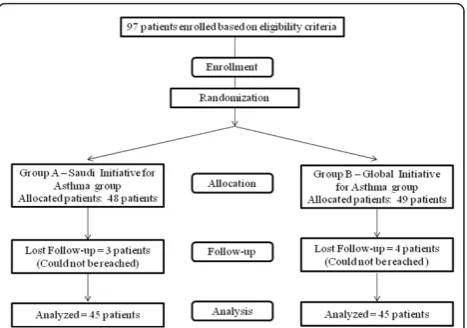
Ninety-eight patients were recruited for this study (Fig-ure 2). Forty-five patients in each of the two groups (SINA and GINA) completed the study and were ana-lyzed. The baseline characteristics of the two groups were comparable (Table 1). Although the initial PFM and FEV1 values were lower in the SINA group than the
GINA group, this difference did not reach statistical sig-nificance. Table 2 shows the treatment responses of patients assigned to each group. Although there was more improvement in the mean FEV1score of the SINA group (5.8%) than the GINA group (3.4%), this differ-ence did not reach statistical significance (p= 0.46). In contrast, the improvement in PEF was higher in the GINA group compared to the SINA group, but this dif-ference also did not reach statistical significance (p= 0.803). The improvement in the ACT score after treat-ment initiation was significantly higher in the SINA group compared to the GINA group (2.9 compared to 1.7 (p= 0.04)).
Although both groups showed similarities in categori-zation based on the initial ACT scores (table 1), the fol-low-up visit revealed that the SINA group contained 32 controlled asthmatics (71.1%), 9 partially controlled asthmatics (20.0%), and 4 uncontrolled asthmatics (31.1%), while the GINA group contained 26 controlled asthmatics (57.8%), 14 partially controlled asthmatics (31.1%), and 5 uncontrolled asthmatics (11.1%) (p= 0.185). The correlation between the difference in FEV1 and that of the ACT scores between the initial and fol-low-up visits was found to be statistically significant, with a correlation coefficient of 0.21 (p = 0.05). Although there was a positive correlation between the changes in FEV1 and PFM (correlation coefficient = 0.19), the change was not significant (p= 0.07). Finally, there was a very weak positive correlation between the changes in the PFM and ACT (correlation coefficient = 0.06,p= 0.6).
Figure 3 showed steps adjustments for patients assigned to either approach. There were 33 (73.3%) patients in the SINA group who achieved control at the follow-up visit and required no treatment adjustment, compared to 27 (60%) in the GINA group (p= 0.0125). Eight (17.8%) patients in the SINA group required a
step down in therapy, and 4 required a step up in treat-ment at the follow-up visit. In comparison, 18 patients in the GINA group required a step down, while no patients required a step up.
Discussion
This study showed that the ACT was responsive to changes at the initiation of asthma treatment [6]. It has also showed the usefulness of the ACT score for the initiation of asthma treatment compared to the GINA approach. Despite ample amount of evidence that sup-ports the use of the ACT for treatment adjustment, a unique feature of this study is the presentation of new evidence supporting the utilization of the ACT in mak-ing an initial asthma treatment decision. The initiation of asthma treatment has evolved from being based on severity index to achieving asthma control by
recommending step 2 for most treatment naïve patients with persistent symptoms and step 3 for severely uncon-trolled disease. Both the GINA and the NAEPP approaches require the cumulative experience of health-care practitioners to make the appropriate clinical judg-ment. While the severity index and the ACT both use common items related to asthma symptoms, such as nocturnal symptoms, the use of reliever inhalers and the effect of asthma on daily activities, in their classification strategies, the ACT lacks any pulmonary function mea-surement. On the other hand, a unique characteristic of the ACT is the adoption of a simple 5-item Likert scale that is different from the complex scale adopted in the severity index. Therefore, there are similarities in the items covered in the two instruments, but a lack of pul-monary function measurement in the ACT. The ACT was utilized in this study because it is a standardized Table 1 Baseline characteristics for the Saudi Initiative for Asthma group and the Global Initiative for Asthma group
Characteristics SINAagroup GINAbgroup pvalue
Number of patients 45 45
Age, years (± SD) 42.9 (± 13.4) 42.3 (± 12.6) 0.840
Gender
- Male, No. (%) 14 (31.1%) 19 (42.2%) 0.274
- Female, No. (%) 31 (68.9%) 26 (57.8%)
Body mass index, No. (± SD) 32.6 (± 7.4) 34.0 (± 7.3) 0.370 Disease duration, years (± SD) 10.9 (± 9.3) 10.1 (± 8.6) 0.630 Respiratory Symptoms
- Cough, No. (%) 27 (60.0%) 22 (48.9%) 0.290
- Shortness of breath, No. (%) 10 (22.2%) 15 (33.3%) 0.239
- Wheezing, No. (%) 7 (15.6%) 9 (20.0%) 0.581
Asthma attacks in the past 4 weeks, No. (%) 1.5 (± 1.1) 1.8 (± 1.5) 0.378 Initial visit Peak Flow meter, value (± SD) (L/min) 343.1 (± 129.5) 362.9 (± 148.8) 0.143 Initial visit Forced Expiratory volume in 1 second, Percentage of normal (± SD) 81.4% (± 17.1) 84.3% (± 16.2) 0.269 Initial visit asthma control test score, score (± SD) 17.6 (± 4.5) 17.8 (± 3.6) 0.776
a
SINA: Saudi Initiative for Asthma;b
GINA: Global Initiative for Asthma
Table 2 Performance of patients assigned to either the Saudi initiative for asthma or Global initiative for asthma approaches after treatment initiation
Characteristics SINAagroup GINAbgroup p-value
Forced expiratory volume in 1 second
- First visit–No. (± SD) 81.4% (± 17.1%) 84.3% (± 16.2%) 0.269 - Follow-up visit–No. (± SD) 87.2 (± 14.7%) 87.7 (± 17.6) 0.697 - Difference between two visits–No. (± SD) 5.8% (± 12.8) 3.4% (± 13.9) 0.46
Peak flow meter
- First visit–No. (± SD) 343.1 (± 129.3) 362.9 (± 148.8) 0.503 - Follow-up visit–No. (± SD) 389 (± 120.5) 423.1 (± 116.6) 0.182 - Difference between two visits–No. (± SD) 46.84 (63.3%) 60.7 (± 77.8) 0.803
Asthma control test score
- First visit–No. (± SD) 17.6 (± 4.5) 17.8 (± 3.6) 0.776 - Follow-up visit–No. (± SD) 20.5 (± 3.5) 19.5 (± 3.3) 0.43 - Difference between two visits–No. (± SD) 2.9 (± 3.1) 1.7 (± 2.9) 0.04
a
SINA: Saudi Initiative for Asthma;b
objective tool that avoids the variability in the practi-tioner’s experience and qualifications. It has also been utilized by both the SINA and the GINA and validated in the Arabic language [10,13]. Due to the lack of any other validated gold-standard tool for asthma treatment initiation, the GINA approach was included in the study protocol as a benchmark. Moreover, the GINA has received increasing global acceptance as a guideline for asthma management.
Utilizing the initial ACT score to determine the appropriate treatment in this study has led to an improvement of 2.9 units, better than the 1.7 unit improvement observed when treatment was determined by physician judgment based on the GINA approach (p = 0.04). Though the improvement in FEV1was better in the patients who followed the SINA approach, this dif-ference did not reach statistical significance. This lack of statistical significance could be related to an inadequate sample size to assess a positive response of this out-come. The conflicting results obtained regarding the improvement in PEF in the GINA group may be related to the poor correlation of PEF with the ACT and pul-monary function when used to assess asthma control [19,20]. An interesting study from Greece utilized the ACT to assess disease control after treatment initiation in naïve patients, showed an average response of 1.73 units, which is similar to the response we observed in the group that used the GINA standards [21]. The uncontrolled asthma status present in the previous study based on initial ACT was found to be statistically correlated with a higher fractional exhaled nitric oxide (FeNO) and positively correlated with pre-bronchodila-tor FEV1. Moreover, the change in the ACT between the two visits was significantly correlated with the change in the FEV1 and FeNO in that study [22]. The scanty data regarding the correlation of the ACT with different parameters at the initiation of treatment are
supported by studies regarding the utilization of the ACT to assess asthma control. Recent studies have also shown that a score of less than 19 on the ACT has a 66% sensitivity in detecting uncontrolled asthma and serves as an objective measure of control that correlates well with the GINA [22-24]. Another study from Hong Kong showed that an ACT score≤20 correlated better with treatment decision than PEF and FeNO. Their find-ing revealed a sensitivity of 70.5% and specificity of 76.0% [20]. Although FEV1is the main objective physio-logical measurement of asthma control, the ACT was also found to correlate well with lung function and inflammation [20,25]. Moreover, the ACT was found to be a useful tool for detecting poorly controlled asthma to optimize asthma control [26]. These studies have shown that the ACT was at least equivalent to pulmon-ary function or FeNO in assessing asthma control or making a treatment adjustment. This has a practical implication for treatment adjustment due to the unavail-ability of spirometry or FeNO in primary care settings, especially in developing countries.
We observed a non-significant trend toward achieving control upon follow-up when the ACT was utilized to determine a treatment plan. Nevertheless, the SINA group patients showed significant stability in treatment plan upon follow-up when compared to the GINA group patients (73.3% vs. 60%). This was supported by the fact that 40% of those treated with the GINA approach required a step down in treatment upon fol-low-up, compared to 17.8% of those who treated with the SINA approach. Commencing treatment with the appropriate dose would enhance compliance and mini-mize the side effects of medications. On the other hand, 8.9% of the patients who followed the SINA required a step-up in treatment compared to none in the GINA group, a finding that may indicate an inadequate initial treatment.
Finally, it is worth mentioning a few limitations and concerns related to this study. The utilization of the ACT as an objective measure for initiating asthma ther-apy is independent of the practitioners’clinical judg-ment. In contrast, the knowledge of those practitioners who utilized the GINA approach in this study may have been augmented by the pre-study workshop, possibly contaminating the results in that group. This issue was discussed during the preparation of the study protocol, and the authors felt that it was inappropriate to deny the practitioners’placement in the GINA arm due to ethical considerations. In day-to-day practice, most prac-titioners have variability in their knowledge and experi-ence and may not have the opportunity for dedicated education sessions. Therefore, it is an area for future research to challenge our findings in general practice. Another limitation was the use of set ACT score limits Figure 3Follow-up visit step adjustments for patients assigned
of 16 and 19 for decisions regarding the appropriate initial treatment step. Due to the lack of evidence identi-fying ACT reference scores for treatment initiation, these numbers were extrapolated from studies that assessed asthma control to make decisions about treat-ment adjusttreat-ment and maintenance. Defining the ACT categories that determine initial treatment is another area that needs to be challenged to support its suitability [25,27].
Conclusions
We believe that despite the aforementioned limitations and concerns, this study can be considered a pilot pro-ject that showed the ACT to be responsive to change at treatment initiation and showed usefulness for the initiation of asthma treatment compared to the GINA approach.
Support
This study was supported by a grant from the King Abdullah International Center for Medical Research.
Abbreviations
ACT: Asthma control test; SINA: Saudi Initiative for Asthma; GINA: Global Initiative for Asthma; NAEPP: National Asthma Education and Prevention Program; PEF: Peak expiratory flow; FEV1: Forced expiratory volumes in one
second; FeNO: Fractional exhaled nitric oxide.
Acknowledgements
The authors would like to thank the King Abdullah International Center for Medical Research for their assistance in the final editing of the manuscript. We would like also to thank GSK-Saudi Arabia for having ACT available in Arabic.
Author details
1
College of Medicine, King Saud bin Abdulaziz University for Health Sciences, P.O. Box 84252, Riyadh 11671, Saudi Arabia.2Faculty of Medicine, American
University of Beirut, Beirut, Lebanon.
Authors’contributions
MSAM: primary author, study design, analysis, and writing of the manuscript. MOAG: study design, data collection, and writing of the manuscript. AGAK: data collection, approvals, and writing of the manuscript. HMT: study design, randomization, data analysis and manuscript writing. All authors read and approved the final manuscript.
Competing interests
The authors declare that they have no competing interests.
Received: 6 January 2012 Accepted: 26 March 2012 Published: 26 March 2012
References
1. Bateman ED, Hurd SS, Barnes PJ, Bousquet J, Drazen JM, FitzGerald M, Gibson P, Ohta K, O’Byrne P, Pedersen SE, Pizzichini E, Sullivan SD, Wenzel SE, Zar HJ:Global strategy for asthma management and prevention: GINA executive summary.Eur Respir J2008,31:143-178. 2. Koshak E:Classification of asthma according to revised 2006 GINA: evaluation from severity to control.Ann Thorac Med2007,2:45-46. 3. Humbert M, Holgate S, Boulet LP, Bousquet J:Asthma control or severity:
that is the question.Allergy2007,62:95-101.
4. Wechsler ME:Managing asthma in primary care: putting new guideline recommendations into context.Mayo Clin Proc2009,84:707-717.
5. Moore W:Update in Asthma 2008.Am J Respir Crit Care Med2009, 179:869-874.
6. National Heart Lung and Blood Institute:National Asthma Education and Prevention Program Expert Panel Report 3: Guidelines for the Diagnosis and Management of Asthma.Bethesda, MD: National Institutes of Health;, NIH Publication 08-4051.[http://www.nhlbi.nih.gov/guidelines/asthma/ asthgdln.htm]. Accessed June 19, 2011.
7. Nathan RA, Sorkness CA, Kosinski M, Schatz M, Li J, Marcus P, Murray J, Pendergraft T:Development of the asthma control test: a survey for assessing asthma control.J Allergy Clin Immunol2004,113:59-65. 8. Halbert RJ, Tinkelman DG, Globe DR, Lin SL:Measuring asthma control is
the first step to patient management: a literature review.J Asthma2009, 46:659-664.
9. Alanezi M, Al-Jahdali HH, Al-Hajjaj MS, Zeitoni MO, Al-Tasan TH:Levels of acceptance of asthma control test questionnaire among Saudi patients attending 5 tertiary care hospitals in Saudi Arabia.Saudi Med J2009, 30:546-549.
10. Al-Jahdali HH, Al-Hajjaj MS, Alanezi MO, Zeitoni MO, Al-Tasan TH:Asthma control assessment using Asthma control test among patients attending 5 tertiary care hospitals in Saudi Arabia.Saudi Med J2008,29:714-717. 11. Schatz M, Sorkness CA, Li JT, Marcus P, Murray J, Nathan RA, Kosinski M, Pendergraft T, Jhingran P:Asthma control test: reliability, validity, and responsiveness in patients not previously followed by asthma specialists.
J Allergy Clin Immunol2006,117:549-556.
12. Bateman ED, Boushey HA, Bousquet J, Busse W, Clark T, Pauwels R, Pedersen S:Can guideline-defined asthma control be achieved? the gaining optimal asthma control study.Am J Respir Crit Care Med2004, 170:836-844.
13. Lababidi H, Hijaoui A, Zarzour M:Validation of the Arabic version of the asthma control test.Ann Thorac Med2008,3:44-47.
14. Schwats M, Kosinski M, Yarlas AS, Hanlon J, Watson ME, Jhingran P:The minimally important difference of the asthma control test.J Allergy Clin Immunol2009,124:719-723.
15. Quanjer PH, Lebowitz MD, Gregg I, Miller MR, Pedersen OF:Peak expiratory flow: conclusions and recommendations of a working party of the european respiratory society.Eur Respir J Suppl1997,24:2S-8S. 16. American Thoracic Society:Standardization of Spirometry, 1994 Update.
Am J Respir Crit Care Med1995,152:1107-1136.
17. Alanezi M, Al-Jahdali HH, Al-Hajjaj MS, Zeitoni MO, Al-Tasan TH:Levels of acceptance of asthma control test questionnaire among Saudi patients attending 5 tertiary care hospitals in Saudi Arabia.Saudi Med J2009, 30:546-549.
18. Asthma control test website:Arabic ACT.[http://www.asthmacontroltest. com/countries/saudiarabia/frames.htm], Accessed on 3 July 2011. 19. Ko FW, Leung TF, Hui DS, Chu HY, Wong GW, Wong E, Tung AH, Lai CK:
Asthma control test correlates well with the treatment decisions made by asthma specialists.Respirology2009,14:559-566.
20. Shirai T, Furuhashi K, Suda T, Chida K:Relationship of the asthma control test with pulmonary function and exhaled nitric oxide.Ann Allergy Asthma Immunol2008,101:608-613.
21. Papakosta D, Latsios D, Manika K, Porpodis K, Kontakioti E, Gioulekas D: Asthma control test is correlated to fev(1) and nitric oxide in Greek asthmatic patients: influence of treatment.J Asthma2011,48:901-906. 22. Miedinger D, Neukomm E, Chhajed PN, Schnyder A, Naef M, Ackermann M,
Leuppi JD:The use of the asthma control test in general practice and its correlation with asthma control according to the GINA guidelines.Curr Med Res Opin2011,27:2301-2308.
23. Koolen BB, Pijnenburg MW, Brackel HJ, Landstra AM, van den Berg NJ, Merkus PJ, Hop WC, Vaessen-Verberne AA:Comparing global initiative for asthma (GINA) criteria with the childhood asthma control test (C-ACT) and asthma control test (ACT).Eur Respir J2011,38:561-566.
24. Thomas M, Kay S, Pike J, Williams A, Rosenzweig JR, Hillyer EV, Price D:The asthma control test (ACT) as a predictor of GINA guideline-defined asthma control: analysis of a multinational cross-sectional survey.Prim Care Respir J2009,18:41-49.
25. Lai CK, Ko FW, Bhome A, DE Guia TS, Wong GW, Zainudin BM, Nang AN, Boonsawat W, Cho SH, Gunasekera KD, Hong JG, Hsu JY, Viet NN, Yunus F, Mukhopadhyay A:Relationship between asthma control status, the asthma control test™and urgent health-care utilization in Asia.
26. Prabhakaran L, Arul E, Abisheganaden J, Chee J:Difference in asthma control test™(ACT) scores in three different clinical practice settings.
Ann Acad Med Singapore2010,39:783-789.
27. Holt S, Perrin K:Using the asthma control test to improve asthma outcomes.N Z Med J2010,123:43-47.
Pre-publication history
The pre-publication history for this paper can be accessed here: http://www.biomedcentral.com/1471-2466/12/14/prepub
doi:10.1186/1471-2466-12-14
Cite this article as:Al Moamaryet al.:Utilization and responsiveness of the asthma control test (ACT) at the initiation of therapy for patients
with asthma: a randomized controlled trial.BMC Pulmonary Medicine
201212:14.
Submit your next manuscript to BioMed Central and take full advantage of:
• Convenient online submission
• Thorough peer review
• No space constraints or color figure charges
• Immediate publication on acceptance
• Inclusion in PubMed, CAS, Scopus and Google Scholar
• Research which is freely available for redistribution