Open Access
Research article
Using data envelopment analysis to measure the extent of technical
efficiency of public health centres in Ghana
James Akazili*
1, Martin Adjuik
1, Caroline Jehu-Appiah
2and Eyob Zere
3Address: 1Navrongo Health Research Centre, P.O. Box 114, Navrongo, Upper East Region, Ghana, 2Policy, Planning, Monitoring and Evaluation
division of Ghana Health Service, Accra, Ghana and 3World Health Organization, P. O. Box 30390, Lilongwe, Malawi
Email: James Akazili* - [email protected]; Martin Adjuik - [email protected]; Caroline Jehu-Appiah - [email protected]; Eyob Zere - [email protected]
* Corresponding author
Abstract
Background: Data Envelopment Analysis (DEA) has been used to analyze the efficiency of the health sector in the developed world for sometime now. However, in developing economies and particularly in Africa only a few studies have applied DEA in measuring the efficiency of their health care systems.
Methods: This study uses the DEA method, to calculate the technical efficiency of 89 randomly sampled health centers in Ghana. The aim was to determine the degree of efficiency of health centers and recommend performance targets for the inefficient facilities.
Results: The findings showed that 65% of health centers were technically inefficient and so were using resources that they did not actually need.
Conclusion: The results broadly point to grave inefficiency in the health care delivery system of public health centers and that significant amounts of resources could be saved if measures were put in place to curb the waste.
Background
A recent critical review of the Health Sector Reforms in Sub-Saharan Africa points to the fact that besides the issue of ever diminishing financial inflows to the health sector, poor quality of health care, mainly occasioned by a variety of inefficiencies at all levels of health care delivery is one of the most important concerns which has precipitated a number of reform initiatives and strategies in nearly all the developing countries [1]
There is also a growing concern among policy makers and planners that health services are not being delivered with utmost efficiency. In 2002, government in about 65% of the 46 countries in the WHO Africa Region spent less than
US$ 10 per capita per year [2]. Evidence from the Africa Region indicates that the problem of scarcity of resources is also compounded with technical inefficiency that leads to wastage of the available meager resources [2]. In 2006, cognizant of the technical inefficiency plaguing the Afri-can health systems, Ministers of Health of the AfriAfri-can Union Member States undertook to institutionalize effi-ciency monitoring within the national health information systems [3].
Coupled with this recognition, there is a realization among policy makers that increased funding alone will not and cannot solve the problem. From a strict sustaina-bility perspective, it can be argued that most African
coun-Published: 20 November 2008
BMC International Health and Human Rights 2008, 8:11 doi:10.1186/1472-698X-8-11
Received: 10 June 2008 Accepted: 20 November 2008
This article is available from: http://www.biomedcentral.com/1472-698X/8/11
© 2008 Akazili et al; licensee BioMed Central Ltd.
tries are approaching or have already reached their upper limit in terms of increasing real financial resources allo-cated to the health sector. Given the escalating disease burden and the limited ability of governments, private and donor funds to meet this burden, the issue of health system sustainability has gained prominence in policy debates about finding a solution. These concerns are legit-imate due to the magnitude of expenditure on health serv-ices, which account for as much as 5% of GDP and between 5% to 10% of government expenditures in devel-oping countries, though this falls below the Abuja target of 15% of government expenditure allocated to the health sector [4,5]
Having provided rather generously for the creation and running of health centres, the Ghana government, inter-national organizations and donors are beginning to ques-tion the performance of health centres [6]. Do health centres produce their outputs using the minimum amount of inputs feasible? Are there any inefficiencies related to the size of a health centre (too large or too small)? If all health centres operate efficiently, what are the possible efficiency savings? What are the lessons that can be drawn from the efficient health centre that are worth emulating by those that are inefficient so as to improve the efficiency of health centres and maximize efficiency savings? It is evident from these concerns that there is a knowledge gap as to the level of efficiency of health centres in the overall delivery of health services. Additionally the concern is also whether the volume or quality of services could be maintained by improving on the efficiency of health care delivery in health centres, in the face of current dwindling resources in developing countries.
To enhance the efficiency of health centers, planners need to develop methods to tackle the problems of accessibil-ity, acceptabilaccessibil-ity, intensity of use and compliance with medical instructions, quality of care, recurrent costs and community ownership [7]. To develop these methods, planners need prior knowledge of the efficiency levels in the health centers. Unfortunately there is limited literature on efficiency measures of health centers especially in developing countries and particularly in Africa and that must have informed the World Health Organization (WHO) Africa office to call for vigorous research on the efficiency of the health sector.
Brief country profile
Ghana is located on West Africa's Gulf of Guinea only a few degrees north of the Equator. It lies between longi-tudes 3°15' W and 1°.12' E, and latitude 4°.44'and 11°.15' N. The country is bordered to the west by La Cote d'Ivoire, east by the Republic of Togo, Burkina Faso to the North and to the South by the Gulf of Guinea [8]
For administrative purposes, Ghana is divided into ten regions. The country is further divided into one hundred and thirty-eight administrative districts. Each of the dis-trict assemblies is headed by a nominated and approved District Chief Executive (DCE). The districts are further divided into sub-districts and units. The division of the country into regions, districts, sub-districts and units cor-relates with the health sector division in the provision of health services such that health centres are the highest health care facilities operating at the sub-district level.
Ghana's population was estimated to be about 21 million for 2007 with an annual growth rate of 1.3% [9]. The pop-ulation density per square mile is estimated at 227. The Ghana Demographic and Health Surveys report that TFR declined from an average of 5.5 live children born per woman in 1993 to 4.2 children in 2003. In 2003, Infant and under-five mortality rates are estimated to have wors-ened to 64 and 111 deaths respectively per 1,000 live births compared to 57 deaths and 108 deaths in 1998 [9].
Ghana's economy is dominated by agriculture, which contributes over 42% of the Gross Domestic Product (GDP), followed by the service sector (38%). About 50 percent of the population relies on agriculture for their income. Ghana has a GDP per capita income of US$538, and is heavily aid-dependent and highly indebted to external creditors [10]. The country spends a total of US$252 million (4.2% of the GDP of US$ 6 billion) annually on health. About 53.5% of this expenditure is incurred by government and 46.5% by the household through out-pocket expenses. The total per capita expend-iture on health at an average exchange rate is US$11 [11].
concentrating on sector-wide policy development, financ-ing, regulation, monitoring and evaluation using its agen-cies including Ghana Health Service (GHS) which is an executing agency responsible for health service delivery. However despite the strategically dispersed location of health centres in the country, the teaching, regional and district hospitals still have to contend with high outpa-tient and other primary health related cases which could be managed at that level. This phenomenon raises doubts on the efficiency of health centres.
Measurement of efficiency in Africa
Data Envelopment Analysis (DEA) has been extensively used in Asia [13], the Americas [14,15] and Western Europe [16-19] to shed light on the efficiency of various aspects of national health systems. In Africa, the applica-tion of DEA in the health sector has been quite limited. So far, the approach has been applied to health facilities in only few countries, i.e. a study of 155 primary health care clinics in Kwazulu-Natal province in South Africa found 70% of them to be technically inefficient [20]. A similar study of 32 public health centres in Kenya revealed that 56% of them were technically inefficient [21]. Kirigia (2002) also assessed the technical efficiency of 54 public hospitals (which are higher level of health care) using the DEA application in Kenya and found that 26% (14) of the hospitals were technically inefficient [22]. The study sin-gled out the inefficient hospitals and provided the magni-tudes of specific input reductions or output needed to attain technical efficiency. An assessment of technical effi-ciency of 30 district hospitals in Namibia was carried out in 2006 using DEA and the findings were similar to that of public hospitals in Kenya [22]. The average technical effi-ciency was less than 75% [23]. Another study in Sierra Leone revealed that 59% of the 37 peripheral health units in Pujehun district were technically inefficient [24]. A recent technical efficiency study using DEA in Zambia of 20 hospitals revealed average efficiency of 64% implying that the 17 inefficient hospitals could lower their cost by 36% and still achieve their current levels of output [25]. A pilot study of 21 public health centres and 21 hospitals was carried out five years ago in Ghana [26] and the results shows that 18% of the health centres were techni-cally inefficient, According to the paper, the sample of the health centres was too small (3.7%) that the results could not be generalised for the whole country and so suggested further studies on the technical and allocative efficiency of health centres. It is important to note that the assessment of the efficiency ought to be more prevalent in low-income countries like Ghana in order to optimise health benefits from the available meagre health sector resources.
Methods
DataThe total number of public health centres in Ghana was 622 in 2004 [12] and using an expected inefficiency rate
of the health centres to be 20% (based on the previous pilot study by Osei et al (2005) in Ghana), a precision of 8% (based upon a power calculation) at the 95% confi-dence level we calculated the required sample size as 84. Since this was a nation-wide survey, we expected about 10% missing/non-response in the collection of the data and the expected sample size came to 92 health centres. After cleaning and eliminating health centres with missing data, the sample size came to 89. The two researchers who were trained on how to collect the data visited each of the health centres in the sample in 2005 and reviewed their 2004 inputs and outputs records and a structured form was used to collect the inputs and output data. Inputs in the health centre production are classified as human resources (clinical and non-clinical staff), expenditure on drugs and other consumables and number of beds and cots. Outputs were categorized into outpatient visits, number of antenatal care visits, number of deliveries, number of children immunized, number of family plan-ning visits. These inputs and outputs were use to estimate the technical efficiencies of the health centres. The instru-ments were pre-tested for consistency and accuracy before actual data collection. Data collection was preceded by a certification from the Ethical Review Committee of the Ghana Health Service. Consent was sought at each health facility before data collection. Supervision was conducted by the Principal Investigator to ensure that data were properly or scientifically collected. Data collected were entered using Epi Info™ 3.3, and the technical efficiency scores were computed using Data Envelopment Analysis programme, version 2.1 (DEAP 2.1).
Selection of inputs and outputs data
part by the previous DEA health care studies in the African Region and availability of data [23,25,26]. The inputs and output selected include the following.
Inputs
Input 1: Number of non clinical staff including labourers
Input 2: Number of clinical staff
Input 3: Number of beds and cots
Input 4: Expenditure (in local currency call cedi) on drugs and supplies. The inter-bank exchange rate of the cedi to the dollar was ¢8,500 to 1 US$ at the time of the study.
Output
Output 1: General outpatient visits
Output 2: Number of antenatal care visits
Output 3: Number of deliveries
Output 4: Number of children immunised
Output 5: Number of family planning visits
Efficiency and DEA Analytical framework
The basic premise underlying the concept of efficiency is that no output can be produced without resources (inputs) and that these resources are limited in supply. From this, it also follows that there is a limit to the volume of output (commodities) that can be produced.
There are two basic measures of efficiency: allocative and technical efficiency. Allocative efficiency refers to how dif-ferent resource inputs are combined to produce a mix of different outputs [27]. Technical efficiency on the other hand is concerned with achieving maximum outputs with the least cost. Overall efficiency measures the combined effect of allocative and technical efficiency [27].
In order to measure efficiency a norm must be specified. The norm set for measuring technical efficiency is that the minimum amount of resources should be used for a given level of output or, alternatively, the maximum amount of output that should be produced for a given level of resource use. If more resources than necessary are used to produce a given amount of output, this implies a waste of resources and therefore inefficiency. Equally, the differ-ence in the amount of output that could have been pro-duced from a given amount of resources and the amount of output that was actually produced can be used as a measure of technical inefficiency [28]. Technical ineffi-ciency is thus a matter of degree depending upon how
much unnecessary resources have been used. The size of a health centre may sometimes be a cause for inefficiency. A health centre may be too large for the volume of activities that it is conducting; and therefore may experience ineffi-ciencies of scale. In the presence of inefficiencies of scale, a health centre is inefficiently large, unit costs increase as the scale of production increases. On the other hand, a health centre may be too small for its level of operation, and thus experience efficiencies of scale.
Until recently, the traditional methodology for measuring efficiency in economics (including health economics) has been the production frontier approach based on the prin-ciples of statistics and econometrics [28]. These functions, which are estimated to determine efficiency, are also known as stochastic frontier models (SFM). During the recent few decades, however, an alternative methodology to the stochastic frontier approach (SFA) has been devel-oped and its application has grown rapidly over the years. This methodology has come to be known as the Data Envelopment Analysis (DEA) [28]. It has been found that there are several compelling methodological and practical advantages for using DEA over the stochastic frontier models. DEA accommodates multiple inputs and multi-ple outputs in a single measure of efficiency than the SFA and has become the dominant approach to efficiency measurement in health care and in many other sectors of the economy [16]. DEA does not impose a specified func-tional form to model and calculate the efficiency of a deci-sion making unit (DMU). Unlike the parametric frontier models therefore, DEA does not suffer from the problem of model mis-specification, which has the potential of providing misleading results [28]. In addition, Unlike SFA, DEA does not suffer from the problems of multicol-linearity and heteroscedasticity. DEA gives a measure of efficiency that is empirically obtainable in a given sce-nario (given available resources, institutional set-up, etc). Hence we can compare the efficiency of individual health centres realistic benchmarks.
For assessing differences in the productive efficiency of health centres, we use DEA, a mathematical programming based method that converts multiple input and output measures into a single summary measure of productive efficiency. DEA is based on relative efficiency concepts proposed by Farrell but Charnes et al (1994) extended and developed Farrell's approach. DEA can be said to uti-lize an extended concept of Pareto efficiency [28].
Following Charnes et al (1978) the technical efficiency of health centres as the maximum of a ratio of weighted out-puts to weighted inout-puts subject to the condition that the similar ratios for every health centre be less than or equal to unity. This is done by solving the following fractional programming problem
The terms yrjo and xrjo represent the amount of output r and the amount of input i for the unit j0. Optimization is per-formed separately for each unit to compute an optimal set of weights (ur, vi) and efficiency measure h0. The method chooses values of ur and vr which are most favorable to the unit that is being studied. As a consequence, a unit that is superior to all others on any single output-input ratio will be rated efficient.
The standard DEA model, the relative efficiency of pro-duction unit is defined as the ratio of the sum of its weighted outputs to the sum of its weighted inputs. The weights have been determined so as to show the produc-tion unit at the maximum relative efficiency.
In the study we will adopt the input oriented-based approach because decision making units (Health centres) have better control over inputs than outputs hence our interest in the input based approach. This approach is also more popular in terms of usage than the output oriented approach [29,30,20,21,23,25]. The model in (1) is a frac-tional programming model, which can be converted into the following linear forms (models 2 and 3) so that the methods of linear programming can be applied.
Constant Returns to Scale (CRS) model
The constant returns to scale model assumes a production process in which the optimal mix of inputs and outputs is independent of the scale of operation. The following CRS model measures overall technical efficiency for each of the sample health centre. The objective function is to maxi-mize the efficiency score h0 for health centre j0, subject to
the constraints that no health centre will be more than 100% efficient and the coefficient values are positive and non-zero, when the same set of u and v coefficients (weights) are applied to all other health centres being compared.
Variable Returns to Scale (VRS) model
The VRS model, though similar to the CRS model, meas-ures pure technical efficiency and returns to scale for each of the sample health centres. Scale efficiency can be meas-ured by dividing the CRS efficiency score by the VRS effi-ciency score. From the VRS model, it is possible to analyze whether a health centre's production indicates increasing return to scale, constant return to scale, or decreasing return to scale by the sign of the variable zjo. Increasing
returns to scale exists if the value of zjo is greater than zero (zjo > 0), constant returns to scale if the value of zjo is equal to zero (zjo = 0), and decreasing returns to scale if the value of zjo is less than zero (zjo < 0). Thus, we can analogize the existence of efficiencies of scale similar, confirm the most productive scale size (minimum efficient scale) of a health centre and estimate the number of health centres operat-ing at the efficient scale.
Max h uryrjo r s viyijo i m uryrj r s vixij i m Subject to 0 1 1 1 1 = = ∑ = ∑ = ∑ = ∑ ∑ ≤ = ≥ = ≥ = 1 1
0 1 0 1
0
, ,... ,...
, ,..., , ,...,
j j n
ur r s and vi i m
(1)
Max h u y
v x
u y v x
r rj r s i ij i m r rj r s i ij Subject to 0 1 1 1 0 0 1 = = − ≤ = = =
∑
∑
∑
00 10 1 i m r i j n u v =
∑
= ≥ ,..., , (2)Max h u y z
v x z
u y
r rj j
r s
i ij j
i m r rj r s Subject to 0 0 1 0 1 1 0 0 1 = + + = = = =
∑
∑
∑
∑
−∑
+ ≤ = ≥ =v x z j n
u v
The paper concentrated on the VRS model. This is so because the VRS model isolates the pure technical effi-ciency component and scale effieffi-ciency which related to the size or structure of the decision making unit (DMU). Health centres that are overall efficient exhibit constant returns to scale. The size of a Health centre may some-times be a cause for inefficiency. A health centre may be too large for the volume of activities that it is conducting; and therefore may experience inefficiencies of scale. On the other hand, a health centre may be too small for its level of operation, and thus experience efficiencies of scale. Inefficiency due to congestion refers to too many inputs (staff, funds, drugs, etc) leading to decreased output or what is commonly known as inefficiencies of scale which to some extend are realistic assumption for a developing country like Ghana where political and other irrational reasons affect the establishment of facilities such health centres, schools etc. It is important to point out that this study does not attempt to address allocative efficiency in the paper, as it was difficult to get accurate input prices. The study also does not address issues of productivity, due to lack of appropriate panel data.
Results
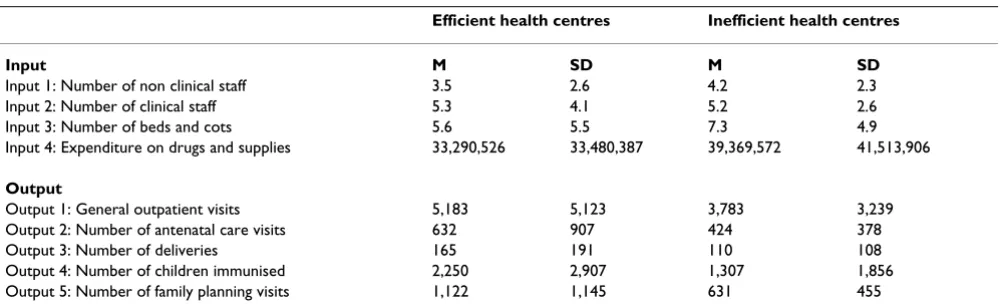
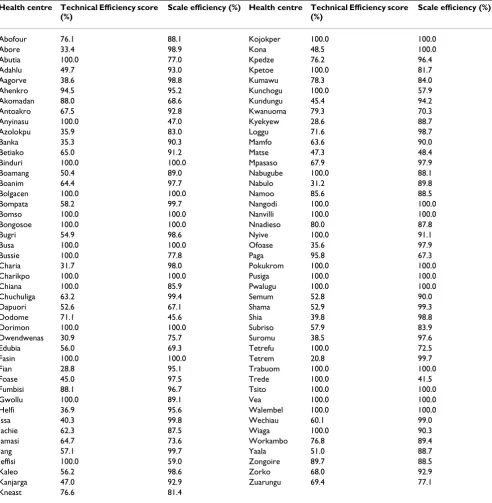
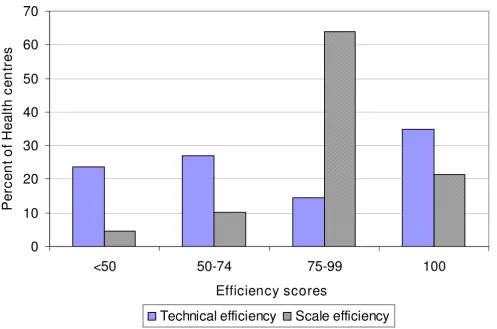
Table 1 presents the mean and standard deviations of the inputs and output variables of the 89 public health cen-tres. Table 2 also presents the technical efficiency scores and the scale efficiency levels of the 89 health centres (HC). It is important to note that efficiency scores range from 0 (totally inefficient) to 100% (efficient). Out of the 89 health centres in the analysis 31 (35%) were techni-cally efficient whereas the remaining 58 (65%) where technically inefficient. Among the inefficient health cen-tres 21 (24%) had a technical efficiency score of less than 50%, 24 health centres (27%) between 50 and 74% (see Figure 1). The inefficient health centres had an average TE score of 57% and a standard deviation of 19%. This implies that on average they could reduce their utilization of all inputs by about 43% without reducing output.
On the other hand out of the 89 health centres analysed 19 (21%) were scale efficient whereas the remaining 70 (79%) where scale inefficient. Among the inefficient health centres 4 (4.5%) had a scale efficiency score of less than 50%, 9 health centres (10%) between 50 and 74%, 57 (64%) between 75 and 99 (see Figure 1). The ineffi-cient health centres had an average scale score of 86% (with a standard deviation of 14%); implying there is potential for increasing total outputs by about 14% using the existing capacity/size.
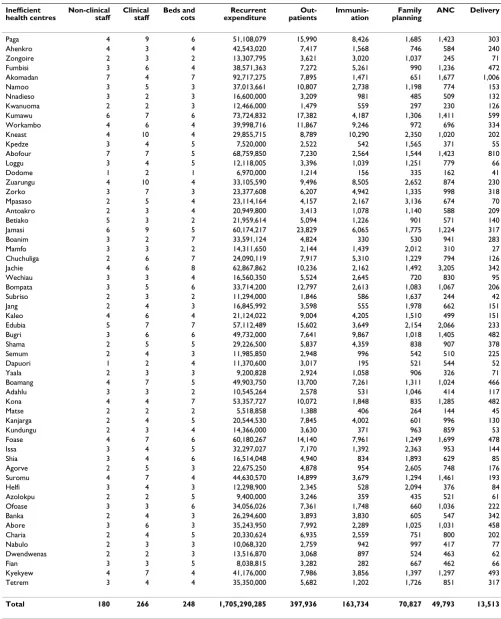
Table 3 also displays the inputs reductions and/or output increases needed to make individual inefficient health centres efficient. Table 4 also provides a summary of total input savings that would have resulted if the inefficient health centres were operating efficiently.
The average technical efficiency scores levels were also cal-culated according to the three broad division of the coun-try, the northern, middle and coastal belts. In the sample the northern belt was calculated based on sample health centres from Upper East and Upper West regions; the mid-dle composed of Ashanti and Volta regions and the coastal is made up of Greater Accra and Western regions. The estimates showed that average technical efficiency scores were highest amongst health centres in the coastal belt, followed by the northern belt. Health centres in the middle belt recorded the lowest average efficiency scores.
Discussion
Public health centres support the Community-based Health Planning and Services (CHPS) and provide pre-ventive, affordable, promotive, and basic curative care in localities inhabited mainly by the poor. Their location makes them critically important in the ongoing efforts to scale up pro-poor cost-effective public health interven-tions geared at achieving the health related Millennium Development Goals (MDGs) [11] and New Partnership for Africa's Development (NEPAD) health targets [31].
Table 1: Means (M) and standard deviations (SD) of efficient and inefficient health centres
Efficient health centres Inefficient health centres
Input M SD M SD
Input 1: Number of non clinical staff 3.5 2.6 4.2 2.3
Input 2: Number of clinical staff 5.3 4.1 5.2 2.6
Input 3: Number of beds and cots 5.6 5.5 7.3 4.9
Input 4: Expenditure on drugs and supplies 33,290,526 33,480,387 39,369,572 41,513,906
Output
Output 1: General outpatient visits 5,183 5,123 3,783 3,239 Output 2: Number of antenatal care visits 632 907 424 378
Output 3: Number of deliveries 165 191 110 108
Thus, the importance of these close-to-client health facili-ties in all efforts to reduce the burden of disease and improve health conditions, especially in rural areas, can-not be overemphasized.
The results point to grave technical inefficiency in the Ghana health system especially at the lower level of care. The results of the 89 public health centres sampled shows that 65% of them are technically inefficient. The findings
of this study are in line with other studies in sub-Saharan Africa, which indicate the wide prevalence of technical inefficiency [20,21,24,25]. According to Osei et al (2005) study in Ghana a sample of the health centres was too small (3.7%) that the results could not be generalised for the whole country and so suggested an expanded study in this direction. The current study samples over 14% of the public health centres in Ghana.
Table 2: Technical and scale efficiency scores for health centres
Health centre Technical Efficiency score (%)
Scale efficiency (%) Health centre Technical Efficiency score (%)
Scale efficiency (%)
Abofour 76.1 88.1 Kojokper 100.0 100.0
Abore 33.4 98.9 Kona 48.5 100.0
Abutia 100.0 77.0 Kpedze 76.2 96.4
Adahlu 49.7 93.0 Kpetoe 100.0 81.7
Aagorve 38.6 98.8 Kumawu 78.3 84.0
Ahenkro 94.5 95.2 Kunchogu 100.0 57.9
Akomadan 88.0 68.6 Kundungu 45.4 94.2
Antoakro 67.5 92.8 Kwanuoma 79.3 70.3
Anyinasu 100.0 47.0 Kyekyew 28.6 88.7
Azolokpu 35.9 83.0 Loggu 71.6 98.7
Banka 35.3 90.3 Mamfo 63.6 90.0
Betiako 65.0 91.2 Matse 47.3 48.4
Binduri 100.0 100.0 Mpasaso 67.9 97.9
Boamang 50.4 89.0 Nabugube 100.0 88.1
Boanim 64.4 97.7 Nabulo 31.2 89.8
Bolgacen 100.0 100.0 Namoo 85.6 88.5
Bompata 58.2 99.7 Nangodi 100.0 100.0
Bomso 100.0 100.0 Nanvilli 100.0 100.0
Bongosoe 100.0 100.0 Nnadieso 80.0 87.8
Bugri 54.9 98.6 Nyive 100.0 91.1
Busa 100.0 100.0 Ofoase 35.6 97.9
Bussie 100.0 77.8 Paga 95.8 67.3
Charia 31.7 98.0 Pokukrom 100.0 100.0
Charikpo 100.0 100.0 Pusiga 100.0 100.0
Chiana 100.0 85.9 Pwalugu 100.0 100.0
Chuchuliga 63.2 99.4 Semum 52.8 90.0
Dapuori 52.6 67.1 Shama 52.9 99.3
Dodome 71.1 45.6 Shia 39.8 98.8
Dorimon 100.0 100.0 Subriso 57.9 83.9
Dwendwenas 30.9 75.7 Suromu 38.5 97.6
Edubia 56.0 69.3 Tetrefu 100.0 72.5
Fasin 100.0 100.0 Tetrem 20.8 99.7
Fian 28.8 95.1 Trabuom 100.0 100.0
Foase 45.0 97.5 Trede 100.0 41.5
Fumbisi 88.1 96.7 Tsito 100.0 100.0
Gwollu 100.0 89.1 Vea 100.0 100.0
Helfi 36.9 95.6 Walembel 100.0 100.0
Issa 40.3 99.8 Wechiau 60.1 99.0
Jachie 62.3 87.5 Wiaga 100.0 90.3
Jamasi 64.7 73.6 Workambo 76.8 89.4
Jang 57.1 99.7 Yaala 51.0 88.7
Jeffisi 100.0 59.0 Zongoire 89.7 88.5
Kaleo 56.2 98.6 Zorko 68.0 92.9
Kanjarga 47.0 92.9 Zuarungu 69.4 77.1
On average, health centres are using more inputs than they need to produce what they are currently producing. Put differently, health centres could increase on the number of outpatients, ANC registrants, deliveries and family planning services with the resources they have cur-rently. However, since we do not expect health centres to go out and look for more patients or clients, in the name of increasing output, cost minimisation might be the noble objective to aspire to. In essence the operations and performance of health centres could be strengthened if resources are better utilised. The study clearly reveals a substantial amount of input savings, which could go a long way in injecting additional resources to the health system to address the backlog of inequities and/or further improve the quality of the available health care. For exam-ple, the efficiency saving (see Table 4) that could have been realized is US$73, 357, 53.
Table 3 provides the magnitudes by which specific inputs per inefficient health centre ought to be reduce. Equipped with this information, policy makers and health centres managers could proactively improve the efficiency of
pri-mary delivery by transferring clinic staff to more efficient health centres that will enhance the capacity of primary health sector to response to the needs of the people. They could also send non clinical staff to early retirement and the savings used to improve on the quality of the facilities. With regards to the beds and cots, transfer them to more efficient facilities; they can also sell them or enter into partnership with private providers to use them at the price which should not be less than the marginal cost
The study further reveals that the prevalent scale ineffi-ciency is increasing returns to scale. In the presence of increasing returns to scale, expansion of outputs reduces unit costs. Because increasing the level of outputs requires an increase in the demand for health care which is beyond the control of the health centre's management, a merger of two centres in close geographic proximity is an option worth considering. However, this option may potentially pose some problems given the low density of population in some of the areas. Residents may even incur additional costs in travel expenditure and in delayed treatment of emergency cases. These potential problems may to some
Distribution of technical and scale efficiency scores Figure 1
Distribution of technical and scale efficiency scores.
0
10
20
30
40
50
60
70
<50
50-74
75-99
100
Efficiency scores
P
er
c
en
t o
f H
eal
th
c
en
tr
e
s
Table 3: Inputs reductions and/or output increases needed to make individual inefficient health centres efficient Inefficient
health centres
Non-clinical staff
Clinical staff
Beds and cots
Recurrent expenditure
Out-patients
Immunis-ation
Family planning
ANC Delivery
Paga 4 9 6 51,108,079 15,990 8,426 1,685 1,423 303
Ahenkro 4 3 4 42,543,020 7,417 1,568 746 584 240
Zongoire 2 3 2 13,307,795 3,621 3,020 1,037 245 71
Fumbisi 3 6 4 38,571,363 7,272 5,261 990 1,236 472
Akomadan 7 4 7 92,717,275 7,895 1,471 651 1,677 1,006
Namoo 3 5 3 37,013,661 10,807 2,738 1,198 774 153
Nnadieso 3 2 3 16,600,000 3,209 981 485 509 132
Kwanuoma 2 2 3 12,466,000 1,479 559 297 230 126
Kumawu 6 7 6 73,724,832 17,382 4,187 1,306 1,411 599
Workambo 4 6 4 39,998,716 11,867 9,246 972 696 334
Kneast 4 10 4 29,855,715 8,789 10,290 2,350 1,020 202
Kpedze 3 4 5 7,520,000 2,522 542 1,565 371 55
Abofour 7 7 5 68,759,850 7,230 2,564 1,544 1,423 810
Loggu 3 4 5 12,118,005 3,396 1,039 1,251 779 66
Dodome 1 2 1 6,970,000 1,214 156 335 162 41
Zuarungu 4 10 4 33,105,590 9,496 8,505 2,652 874 230
Zorko 3 7 3 23,377,608 6,207 4,942 1,335 998 318
Mpasaso 2 5 4 23,114,164 4,157 2,167 3,136 674 70
Antoakro 2 3 4 20,949,800 3,413 1,078 1,140 588 209
Betiako 5 3 2 21,959,614 5,094 1,226 901 571 140
Jamasi 6 9 5 60,174,217 23,829 6,065 1,775 1,224 317
Boanim 3 2 7 33,591,124 4,824 330 530 941 283
Mamfo 3 3 2 14,311,650 2,144 1,439 2,012 310 27
Chuchuliga 2 6 7 24,090,119 7,917 5,310 1,229 794 126
Jachie 4 6 8 62,867,862 10,236 2,162 1,492 3,205 342
Wechiau 3 3 4 16,560,350 5,524 2,645 720 830 95
Bompata 3 5 6 33,714,200 12,797 2,613 1,083 1,067 206
Subriso 2 3 2 11,294,000 1,846 586 1,637 244 42
Jang 2 4 3 16,845,992 3,598 555 1,978 662 151
Kaleo 4 6 4 21,124,022 9,004 4,205 1,510 499 151
Edubia 5 7 7 57,112,489 15,602 3,649 2,154 2,066 233
Bugri 3 6 6 49,732,000 7,641 9,867 1,018 1,405 482
Shama 2 5 5 29,226,500 5,837 4,359 838 907 378
Semum 2 4 3 11,985,850 2,948 996 542 510 225
Dapuori 1 2 4 11,370,600 3,017 195 521 544 52
Yaala 2 3 3 9,200,828 2,924 1,058 906 326 71
Boamang 4 7 5 49,903,750 13,700 7,261 1,311 1,024 466
Adahlu 3 3 2 10,545,264 2,578 531 1,046 414 117
Kona 4 4 7 53,357,727 10,072 1,848 835 1,285 482
Matse 2 2 2 5,518,858 1,388 406 264 144 45
Kanjarga 2 4 5 20,544,530 7,845 4,002 601 996 130
Kundungu 2 3 4 14,366,000 3,630 371 963 859 53
Foase 4 7 6 60,180,267 14,140 7,961 1,249 1,699 478
Issa 3 4 5 32,297,027 7,170 1,392 2,363 953 144
Shia 3 4 6 16,514,048 4,940 834 1,893 629 85
Agorve 2 5 3 22,675,250 4,878 954 2,605 748 176
Suromu 4 7 4 44,630,570 14,899 3,679 1,294 1,461 193
Helfi 3 4 3 12,298,900 2,345 528 2,094 376 84
Azolokpu 2 2 5 9,400,000 3,246 359 435 521 61
Ofoase 3 3 6 34,056,026 7,361 1,748 660 1,036 222
Banka 2 4 3 26,294,600 3,893 3,830 605 547 342
Abore 3 6 3 35,243,950 7,992 2,289 1,025 1,031 458
Charia 2 4 5 20,330,624 6,935 2,559 751 800 202
Nabulo 2 3 3 10,068,320 2,759 942 997 417 77
Dwendwenas 2 2 3 13,516,870 3,068 897 524 463 62
Fian 3 3 5 8,038,815 3,282 282 667 462 66
Kyekyew 4 7 4 41,176,000 7,986 3,856 1,397 1,297 493
Tetrem 3 4 4 35,350,000 5,682 1,202 1,726 851 317
Total 180 266 248 1,705,290,285 397,936 163,734 70,827 49,793 13,513
extent be minimized by pursuing vigorously the govern-ment current policy of Community-base Health Planning and Service (CHPS). In all these the equity implications must be taken in consideration
The current under five and maternal rates in Ghana is quite high given the targets of the MDGs by 2015. Cur-rently Ghana and many African countries are strengthen-ing and promotstrengthen-ing CHPS to help improve their health indicators (especially on child and maternal mortality). Health centres which are referral points to community based health care efforts (community clinics and mater-nity homes) could help play a significant role in the desire to improve on health indicators towards meeting the MDG targets. However, health centres can play this role well if their efficiency levels are known and dealt with. The findings provide the bases upon which Government, pol-icy makers and all other relevant stakeholders will target efforts to reduce the identified inefficiency of the health centres (see Table 3). In the case of Ghana and in this study, efforts will need to be directed to reducing ineffi-ciency of health centres especially those at the middle belt of the country as indicated in figure 2.
The DEA analysis of the health centres could be factored into the monitoring of the health system in which case, it could be assessed every year. During the data collection at the health centres we also identified the problem of infor-mation capturing, storage and management and so it will be important that training in management information systems for all health centres to enable them produce timely and reliable information be instituted.
Conclusion
The study has shown that only 35% of the health centres in Ghana are efficient and even though this findings is perfectly inline with other findings from other developing countries particularly from Africa [20-25], its implications with regards to health care provision (given the limited resources in the health sector) is of serious concern. Given that primary health care is an important driver in the health care system of most developing countries including Ghana, efforts are needed to making the health centres that are not operating on the frontier efficient.
The study has demonstrated that DEA is an essential tool for identifying the most and least efficient health centres, and strategies for saving resources/inputs and/or increas-ing output. We concur with Kirigia et al [22] and Boussifi-ane et al [32] that DEA can be used in identifying efficient operating practices and efficient strategies, setting targets/ bench marks for relatively inefficient health centres, mon-itoring effects of health sector reforms on efficient over time, and resource allocation
It would have been interesting and relevant to unearth the causes of inefficient in the health centres unfortunately it was not possible to get complete and reliable data that could be used to unpack the causes of technical ineffi-ciency using a second stage Tobit regression analysis. For further studies in this area we recommend an examination of the causes of inefficiencies in health centres. It will also be interesting to look at allocative efficiency which is closely related to technical efficiency and which warrants the collection of price data in addition. With good panel data for a sufficiently longer period of time it will be important and interesting to also do further research to estimate DEA-based Malmquist productivity index (MPI) to observe the changes in efficiency and those changes in productivity that are accounted for by technological change. This study is on public health centres, it will important to examine technical and allocative efficiency by ownership of higher level facilities in Ghana like the district and regional hospitals.
Competing interests
The authors declare they have no competing interests. The study was supported with grants from the Ghanaian-Dutch for research and development and the sponsors had no involvement in the study design; in the collation, analysis and interpretation of the data; in the writing of the paper, and in the decision to submit the paper for pub-lication.
Authors' contributions
JA, MA and CJA contributed to the study design, analyzed the data and wrote the manuscript. ZE contributed to the study design and implementation and also critically read through the manuscript and restructured the paper. All authors read through and agreed for the paper to be sub-mitted for publication.
Table 4: Total input savings from inefficient health centres
Type of input Actual inputs use Inputs that owe to be used Input savings
Non clinical staff 246 180 66
Clinical staff 299 266 33
Beds and cots 427 248 179
Acknowledgements
We acknowledge the cooperation of the study participants and financial support from the Ghanaian-Dutch for research and development. We thank Samuel Chatio for the support in data collection. To the director (Dr. Abraham Hodgson) and staff of Navrongo Health Research Centre, we acknowledge their technical support. To Helen Ayiredine, Eugenia Awin-boya Akazili, Thomas Anyorigiya, Gifty Akum, Rita Akazili and Nana Kwadwo Biritwum, we appreciate your moral support. We acknowledge with appreciation the reviewers for the valuable comments and suggestions to shaping the paper. Finally and more importantly, we thank the Almighty God for His many blessings.
References
1. Leighton C, Makinen M: Health sector reforms in Sub- Saharan Africa. In Paper presented in a Workshop Addis Ababa, Ethiopia; 1999. 2. Kirigia JM, Preker A, Carrin G, Mwikisa C, Diarra-Nama AJ: An over-view of health financing patterns and the way forward in the WHO Africa Region. East Afr Med J 2006, 83(9 Suppl):S1-S28. 3. Kirigia JM, Asbu EZ, Greene W, Emrouznejad A: Technical
effi-ciency, efficiency change, technical progress and productiv-ity growth in the national health systems of continental African Countries. Eastern Africa Social Science Research Review
2007, XXIII(2):19-40.
4. World Bank: The millennium development goals for health: rising to the Challenges. Washington DC, World Bank; 2004. 5. Ghana Macroeconomics and Health: Scaling-Up Health
Invest-ments for Better Health, Economic Growth and Accelerated Poverty Reduction. Report of the Ghana Macroeconomics and Health Initiative; 2005.
6. World Health Organisation: The role of health centres in the development of urban health systems. Geneva (Technical Report Series 827); 1992.
7. World Health Organization: The World Health Report. Improving performance of health systems. Geneva 2000.
8. Government of Ghana: Ghana Poverty Reduction Strategy. An agenda for growth and prosperity. Accra 2002.
9. Ghana Statistical Service: Ghana Demographic and Health Sur-vey. Ghana Statistical Service and Macro International. Carlverton 2003. 10. World Health Organization: The World Health Report. Geneva
2002.
11. United Nations Development Programme: Human Development Report. In Millennium Development Goals: A compact among nations to end human poverty New York: Oxford University Press; 2003. 12. Ghana Health Services: Facts and Figures. Policy, Planning,
Monitor-ing and Evaluation 2005.
13. Chang H: Determinants of hospital efficiency: the case of cen-tral government- owned hospitals in Taiwan. Omega Interna-tional Journal of Management Science 1998, 26(2):307-317.
14. Chattopadhy S, Ray CS: Technical, scale, and size efficiency in nursing home care: a nonparametric analysis of Connecticut homes. Health Economics 1996, 5:363-373.
15. Shroff HFE, Gulledge TR, Haynes KE, O'neill MK: Efficiency of long-term health care facilities. Socio-Economic Planning Science 1998,
32(1):25-43.
16. Giuffrida A, Gravelle H: Measuring performance in primary care: econometric analysis and DEA. Applied Economics 2001,
33:163-175.
17. Ersoy K, Kavuncubasi S, Ozcan YA, Harris JM: Technical efficien-cies of Urkish hospitals: DEA approach. Journal of Medical Sys-tems 1997, 21(2):67-74.
18. Jacobs R: Alternative methods to examine hospital efficiency: data Envelopment analysis and stochastic frontier analysis.
Health Care Management Science 2001, 4:103-115.
19. Linna M, Nordblad A, Koivu M: Technical and cost-efficiency of oral health care provision in Finnish health centres. Soc Sci Med 2003, 56(2):343-353.
Distribution of efficiency scores by location (belts) Figure 2
Distribution of efficiency scores by location (belts).
86
75
87
0
10
20
30
40
50
60
70
80
90
100
Northern
Middle
Coastal
Country belts
E
ff
ici
e
n
cy
l
e
ve
ls
(
%
Publish with BioMed Central and every scientist can read your work free of charge
"BioMed Central will be the most significant development for disseminating the results of biomedical researc h in our lifetime."
Sir Paul Nurse, Cancer Research UK
Your research papers will be:
available free of charge to the entire biomedical community
peer reviewed and published immediately upon acceptance
cited in PubMed and archived on PubMed Central
yours — you keep the copyright
Submit your manuscript here:
http://www.biomedcentral.com/info/publishing_adv.asp
BioMedcentral 20. Kirigia JM, Sambo LG, Scheel H: Technical efficiency of public
clinics in Kwazulu-Natal province of South Africa. East Afr Med J 2001, 78(3 Suppl):S1-S13.
21. Kirigia JM, Emrouznejad A, Sambo LG, Munguti N, Liambila W: Using Data Envelopment Analysis to measure the technical effi-ciency of public health centres in Kenya. Journal of Medical Sys-tems 2004, 28(2):155-166.
22. Kirigia JM, Emrouznejad A, Sambo LG: Measurement of technical efficiency of public hospitals in Kenya: using data envelop-ment analysis. Journal of Medical Systems 2002, 26(1):39-45. 23. Zere E, Mbeeli T, Shangula K, Mandlhate C, Mutirua K, Tjivambi B,
Kapenambili W: Technical efficiency of district hospitals: Evi-dence from Namibia using Data Envelopment Analysis. Cost Effectiveness and Resource Allocation 2006, 4:5.
24. Renner A, Kirigia J: Technical efficiency of health centers in Sierra Leone. African Health Economics Monitor 2005, 6(number 1):.
25. Masiye F: Investigating health system performance: an appli-cation of data envelopment analysis to Zambia hospitals.
BMC Health services research 2007, 7:58.
26. Osei D, D'Almeida S, Melvill OG, Kirigia JM, Ayayi OM, Kainyu LH:
Technical efficiency of public district hospitals and health centres in Ghana: a pilot study. Cost Effectiveness and Resource Allocation 2005, 3:9.
27. Coelli TJ: A guide to DEAP version 2.1: A Data Envelopment Analysis Programme. In CEPA working paper 96/8, department of econometrics University of New England; 1996.
28. Charnes A, Cooper W, Lewin AY, Seiford LW: Data Envelopment Analysis: Theory. Methodology and Applications Kluwer Academic Publishers; 1994.
29. Zere EA, Addison T, McIntyre D: Hospital efficiency in sub-Saha-ran Africa: evidence from South Africa. South African Journal of Economics 2000, 69(2):336-358.
30. Kirigia JM, Lambo E, Sambo LG: Are public hospitals in Kwazulu-Natal Province of South Africa technically efficient. African Journal of Health Sciences 2000, 7(3–4):25-32.
31. New Partnership for Africa's Development (NEPAD): Human Development Programme. NEPAD Health Strategy Pretoria 2001. 32. Boussofiane A, Dyson RG, Thanassoulis E: Applied data
envelop-ment analysis. Eur J Oper Res 1991, 53:1-15.
Pre-publication history
The pre-publication history for this paper can be accessed here: