Dynamic VAR Compensation using Static VAR
Compensator
Ajith. N T. R. Narasimhegowda
Department of Electrical and Electronics Engineering Department of Electrical and Electronics Engineering Adichunchanagiri Institute of Technology
Chikkamagaluru-577102
Adichunchanagiri Institute of Technology Chikkamagaluru-577102
T. M. Vasantha Kumar Aditya Patil
Department of Electrical and Electronics Engineering Department of Electrical and Electronics Engineering Adichunchanagiri Institute of Technology
Chikkamagaluru-577102
Adichunchanagiri Institute of Technology Chikkamagaluru-577102
D. Kavitha
Department of Electrical and Electronics Engineering Adichunchanagiri Institute of Technology Chikkamagaluru-577102
Abstract
The role of the transmission network in the Power System is to transmit the power generated in the power plants to the load centers and the interconnected power systems. The transmission of electric power has to take place in the most efficient way in addition to providing flexibility in the process. Hence Flexible A.C. Transmission System (FACTS) devices are used. A Static VAR Compensator (SVC) is a shunt-connected FACTS controller that is able to exchange reactive power with the power system in a controlled way of static controllers to enhance the controllability and increase the power transfer capability. In this paper the operation of shunt SVC in the 10 bus system with different loading conditions are studied. Dynamic VAR compensation and voltage control at all the buses are analyzed with and without SVC. Losses of transmission lines with and without SVC are compared. Simulation is carried by using Mi-Power software Simulation package.
Keywords: Flexible AC Transmission System, Static VAR Compensator, Mi-Power
________________________________________________________________________________________________________
I.
INTRODUCTION
Today’s power system is highly complex and requires careful design of new devices taking into consideration of already existing equipments. Now-a day, number of private generating units is getting commissioned due to power generation policy and open access to transfer power. But, due to variety of environmental and regulatory concern, the expansion of electric power transmission facilities is restricted. Power Transmission and Generation utility would be benefited if they could increase line power capability. It is well known that the power flow through transmission line is a function of line impedance, magnitude and phase angle of bus voltage. If these parameters can be controlled, the power flow through the transmission line can be controlled in a predetermined manner. Controlling power flow in modern power systems can be made more flexible by the use of recent developments in power electronics and computing control technology. The Static VAR Compensator (SVC) is a Flexible AC transmission system (FACTS) device that can regulate voltage, power factor, harmonics and stabilizing the system. The objective of the project is to achieve significant improvements in operating parameters of power systems such as voltage profile, control of real and reactive power, and reduction in transmission line losses by connecting SVC in 10 bus system considered for study. Finally the simulation results have been presented to indicate the improvement in the performance of the SVC to control voltage, active and reactive power in transmission system.
II.
STATIC VAR COMPENSATOR
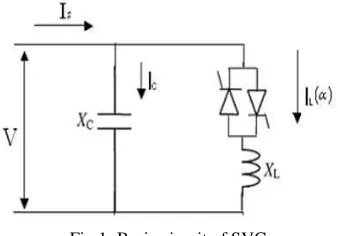
Fig 1: Basic circuit of SVC
V-I Characteristics of SVC A.
SVC is basically a shunt connected static VAR generator/load whose output is adjusted to exchange capacitive or inductive current so as to maintain or control specific power system variables: typically, the controlled variable is the SVC bus voltage. One of the major reasons for installing a SVC is to improve dynamic voltage control and thus increase system load ability.The SVC can be operated in two different modes: • In voltage regulation mode
In VAR control mode (the SVC susceptance is kept constant).
Fig 2: V-I Characteristics of SVC
III.
MODEL OF THE 10 BUS SYSTEM
Fig 3: A Standard 10-Bus Network
IV.
SIMULATION MODEL OF THE SYSTEM
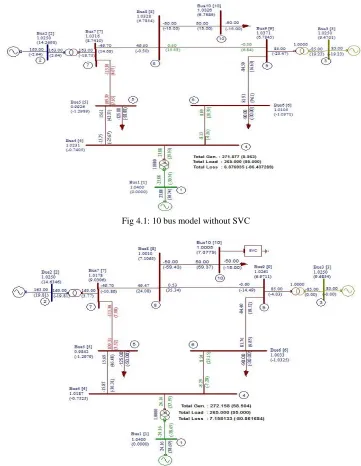
Case1: Normal case A.
Fig 4.1: 10 bus model without SVC
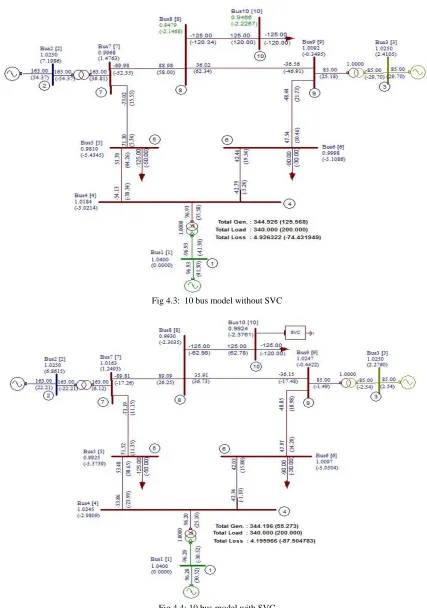
Case 2: Overloading Case B.
Fig 4.3: 10 bus model without SVC
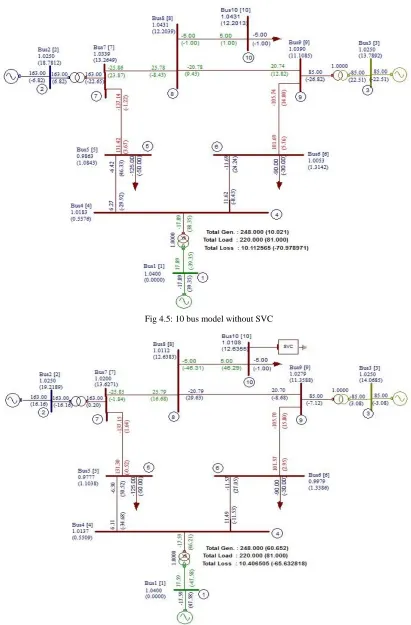
Case 3: Under Loading Case C.
Fig 4.5: 10 bus model without SVC
Fig 4.6: 10 bus model with SVC
Display Notification D.
Injection into the bus : +ve Drawl away from the bus: -ve
Voltage Magnitude/(Angle) in p.u/degree Flows in MW and (Mvar)
V.
SIMULATION RESULTS
Case 1: Normal Case A.
Table 5.1: VOLTAGE PROFILE
Table 5.2: TOTAL LINE LOSSES
Table 5.3: TRANSFORMER LOSSES
Case 2: Overloading Case B.
Table 5.5: Voltage Profile
Table 5.6: Total Line Losses
Table 5.7: Transformer Losses
Case 3: Under Loading Case C.
Table 5.9: Voltage Profile
Table 6.0: Total Line Losses
Table 6.1: Transformer Losses
Table 6.2: Summary of Results
VI.
CONCLUSION
Capacitive reactive power injected by SVC during overloading conditions is 57.162 MVAR and consumes Inductive reactive power of 45.281 MVAR during underloading condition to maintain voltage across the buses near to 1 p.u. Line losses has been reduced in overloading case with the presence of SVC, but losses has been increased during underloaded condition. This is due to the injection of Inductive reactive power by the SVC. Reactive power generation by conventional generation has been reduced with the presence of SVC. This increases the stability of the generators.
REFERENCES
[1] Jizhong Zhu,Kwok Cheun, Davis Hwang, and Ali Sadjadpour “Operation Strategy for Improving Voltage Profile and Reducing System Loss” IEEE TRANSACTIONS ON POWER DELIVERY, VOL. 25, NO. 1, JANUARY 2010
[2] Venkata Padmavathi.S. “Modeling and Simulation of Static Var Compensator to Enhance the Power System Security” conference paper 2013 [3] Glenn W Stagg, and I. Stagg, “Computer Methods in Power System Analysis”.
[4] T.J.E. Miller, “Reactive Power Control in Electric Systems,” Wiley Interscience,1982. [5] D.P.Nagrath, I. J. Kothari, “Modern Power Flow Analysis”, Chap 6, Chap7