Analysis of AC Solar Water Pump and PV array with
Battery
A Shojaei, M Abolhasani far*
Department of Engineering, Neyshabur Branch, Islamic Azad University, Khorasan Razavi, Iran
*Corresponding Author email: [email protected]
Abstract- Fossil fuel resources are permanently decreasing in quantity and their pollution to the environment is always increasing. Due to this problems, the new era led to use the renewable energies. These resources are not finished at all and have no dangers to the environment, animals and human lives. Due to these reasons, in this study we analyze a Photovoltaic (PV) powered centrifugal water pump scheme for water pumping in agricultural applications. The general system is connected to a battery to save the extra energy for the lackluster times. In this study, the utilized motor for driving the centrifugal pump is a three phase induction motor. Here, motor torque and speed depend on the frequency and source voltage, whereas the water-flow rate depends on the motor speed, static head and density according to the flow. The overall asynchrony pumping system fed by solar cell is simulated and the results are achieved.
Keywords: PV array, MPPT, Induction motor, water pumping, Centrifugal Pumps
INTRODUCTION
By developing the modern industrial society and population growth, the world energy demand is increased. This subject causes to make a great deal of investments in different energy solutions to enhance the energy performance and power quality problems.
One of these energy resources which has the considered cases is Photovoltaic (PV) energy resources. PVs are alternative and friendly to the environment energy resources. Photovoltaic energy resources provide a good solution to supply remote area with sustainable and clean energy during the daytime in lighting, heating, refrigeration and water pumps systems during the whole day and the night time (Q. Meng and W. Hu, 2005; Agrawal, 1989; Chikh et al., 2008).
Usually to set the output voltage of the photovoltaic with the inverter, a dc-dc converter is required. These converters can be boost or buck choppers in order to boost or unbrace the voltage to the predetermined levels.
The DC/DC choppers are mainly employed in regulated switch mode power supplies, where the input voltage of these converters changes in wide range especially in the Photovoltaic (PV) supply source due to sudden and unpredictable changes in the solar irradiation level like the cell operating temperature.
There are different connection topologies to concern the switching systems for the purpose of realizing the required voltage level during different periods of day for specific applications like motors, pumps in general and power supplies (Worrell et al., 2004; Kjaer et al., 2005; Odeh et al., 2006).
Generally, solar technology has two inherent problems: the presence of highly non-linear I-V characteristics and low conversion efficiency (10%to 16% efficiency for commercially available amorphous silicon solar cells).
The dependency of the solar system characteristics to the temperature and insolation level variations gets the issue worse. Hence, the maximum power point (MPP) and operating point of the solar cells get mismatch. To achieve the maximum power from the PV panel source, it should be capable to track the solar panel unique maximum power point which varies with temperature and irradiance. To do this, MPPT can be employed by using any one of the algorithms perturb &observe (P&O).
Water pumping system is one of the most popular applications of the photovoltaic energy utilization which is driven by electrical motors. One of the most and frequently encountered machines in industry is the three-phase induction motors. Their popularity is because of their high power, simple design and easy maintaining.
V/f control for induction motors has a big deal of applications in industry. The control purpose is to keep the voltage-frequency ratio of the motor supply source constant.
Dazhi et al. (2004) proposed a PID controller based on neural network for speed sensor less field-oriented control of induction motor. The neural networks based rotor flux components and speed identification method for IM are utilized by measuring the voltages and currents of the phase in Induction Motor (IM) drive.
Power electronics converters can be used to reduce the initial investments of the photovoltaic water pumping system and to adapt the electrical impedance to the PVG for different operating conditions dynamically (Matsui et al., 1999).
Various studies have been done on the choice of the drive system, which suits PVG, type of pumps to use and
In the past, only the DC motors were utilized to drive pumps. Some studies about direct coupling of shunt, series and separately excited DC motors in water pumping systems were studied (Appelbum, 1986; Saied, 1988, Fam and Balachander, 1988).
In this paper, we propose an efficient and simple photovoltaic water pumping system. We consider the theoretical studies of photovoltaics (PV) and their modeling methods. The maximum power point tracker (MPPT) is also investigated and a power electronic device is utilized to improve the system efficiency. Finally, simulation results of the system are given and analyzed.
Photovoltaic system (PV)
`PV is a nonlinear system which can be modeled as a current source paralleled by a diode. The practical model of the photovoltaic cell is a serial and shunt connection of resistors (Rs and Rp) which can be
mathematically modeled as below:
(1) S
PV
P
V IR
I I Id
R
where,
(2) 0 exp 1
j
V q Id I
KT
I is the voltaic output current, V is the voltaic output voltage, k is the bultsman constant (1.3806503 e−23J K-1
), K is the diode ideal constant,I0is the diode inverse saturation current, q is the electron charge and T is the p-n junction temperature (Razmjooy et al., 2011). After that, the nonlinear I-V characteristics of the PV can be given as below:
(3)
0
0
(1 ) I
ln 1
S p
P P
t s
R V
I
R R
V V R I
I
here, Vtis the array heating voltage by Ns number of series cells andIpis the generated current derived from the radiation in the nominal condition and:
(4) KT
V q
Buck regulator
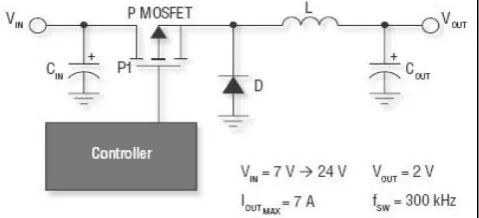
In a buck regulator, the average output voltage value is less than the input voltage value. The circuit diagram of a buck converter with a power electronic MOSFET is shown in the fig.1. From the figure, it is obvious that the system is as similar as the step reduced chopper.
(5) 1 2 1 2 T V D LI V V i o i o
where, L is the inductance, T describes the time, I0is the output current, D is the duty cycle and Vi and Vo are
the input and the output voltages. The output of the buck converter in here is connected to an MPPT to provide the maximum power for the system.
Inverter
By the radiation of sun rise, photovoltaic module generates DC energy. But for most of applications, especially in this paper which an induction motor is set in the output, we need to perform a conversion on the output DC energy into the AC energy. This operation can be performed easily by the inverter. By using the transformers, switches and control circuits, DC current get converted into the AC current and can have any value of frequency and voltage.
PWM switching technique is employed to drive the inverter with a modulation index M and the ratio between the frequencies of the carrier and modulating waveforms P. Murphy and Turnbull (1985) proved that when a full bridge control and P > 9, the root mean square value of the fundamental motor voltage Vm can be
considered as below:
(6) 2
m MV V
Three phase induction motor
Three phase induction motor is the most popular motor in the industry. This motor is usually utilizing in the adjustable speed drives. The simple but tenacious design, cheap cost, low cost in maintaining and its easy connection to the three phase source are some of the good characteristics of these motors. In this paper, this type of machine is utilized because of the considerations above.
When the armature is supplied by a balanced 3-phase voltage, a rotating magnetic field is generated. The speed of rotation is the synchronous speed can be given by the following formula:
(7)
s 4f1
p rad / s
(8) ns120f1
p rpm,
here f1 describes the line frequency and p is the number of poles of the armature winding.
The angular speed of the rotor in rad/s can be defined by and the speed in rev/min (rpm) can be defined by n. The speed of the rotor relative to the field (slip speed) is equal to:
(9) s – ns – n (rpm)= s
here, s defines the slip and can be achieved by the equation below:
(10) s
s
s nsn ns
The rotor frequency is, thus,
(11) f2 = sf1
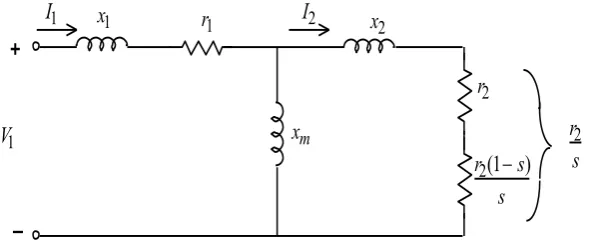
The equivalent circuit of an induction motor is shown in the figure below:
Figure 2. Equivalent Circuit of an Induction Motor
+
–
I
1I
2x
2
x
1x
mr
1r
2r
2
1
s
s
Centrifugal Water Pump model
Due to the immense extent of agricultural lands in the country and the water supplying importance from the deep holes, using the photovoltaic pumps in the direction of a free energy source, can extend the agriculture in the Deprived areas and reduces the agricultural costs in these areas.
In the photovoltaic water pumps, the number of moving parts is low. Hence, they need to less maintaining and repairing. The mechanical model of the pump can be considered as below:
(12)
e m m m m L
T J p B T
where, P describes the poles number, mis the drive angular velocity, Bm is the stick friction coefficient, Jmis the motor shaft total energy and TLis the load torque and can be achieve by the equation below:
(13) 2
L P P m
T T A
here, APis the pump toque constant and is equal to:
(14) 3
n P
m
P A
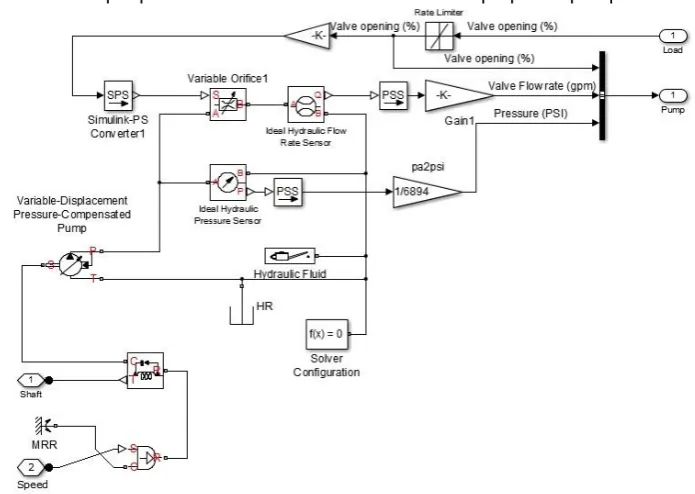
where, Pnis the motor output power rate. The Simulink model of the proposed pump is shown in the fig.3.
Figure 3. The utilized pump model in this study
Battery
One of the other important parts of the photovoltaic system is the energy storing resources (batteries). Batteries usually employed for increasing the Sentiment in the electrical energy generation required for a customer and also for power stabilizing in the cases with no energy generation in some specific cases. These sources are taken in between of the energy producers and customers. They take the energy and if there is no need to the consumption, they store the energy for the future. In this mechanism, in during the day, the produced energy from PV get utilized for operating the pump and then the stored energy in the battery can be used for utilizing during the night. The employed model of battery in this study is employed from the MATLAB Simulink tools and is shown in the figure below:
Simulation results
Out purpose in this paper is to use a PV system for free pumping the water in the agriculture lands especially for land that are Deprived. The novelty of our system is using battery and also utilizing renewable energy for pumping the water. The operation steps are operated as follows:
Instead of the fossil fuels, our system uses renewable energy. after receiving the illumination and generating the energy by the PV cells, a buck converter is used to reduce the voltage value into the range of inverter. The output voltage gets into an inverter to convert it into the AC current. The existence of the inverter in this paper is because of the existence of the induction motor in the output. After taking the output voltage from the inverter and performing it into the induction motor, for proper control of the induction motor, a PID technique is used. This type of the controller is a hybrid of proportional, integrator and derivative controllers which is widely utilized in the industry.
MATLAB-Simulink model of the PV system used in this study is shown in fig.5. The dc to dc buck converter is used to step down the dc voltage to the considered level and also to reduce the usage of PV modules.
Figure 5. MATLAB-Simulink model of the PV system
The converter is designed for continuous inductor current mode with following specifications: L=6000μH, C=1000 μF. The system characteristics of the module are shown in Table 1.
Table 1. Parameters of the proposed PV module
Parameter Variable Value
Maximum power Pmpp 40 W
Voltage at Pmax Vmpp 17.3 V
Current at Pmax Impp 2.31 A
Short-circuit current ISC 2.54 A
Open-circuit voltage VOC 21.8 V
Temperature coefficient of open-circuit voltage Kv -(80±10) mV/°C Temperature coefficient of short-circuit current Ki (0.065±0.015)%/°C
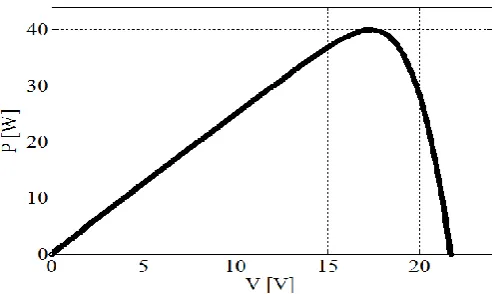
The power-voltage (PV) and current-voltage (IV) diagram of the photovoltaic array at the nominal condition is shown below in figures 6 and 7.
Figure 7. P-I diagram of the PV array in the nominal condition
The pump switching is shown in the fig.8. from the figure, the switching times are characterized based on time.
Figure 8. pump switching
The flow rate of the system is shown in figure below. As it can be seen, at first we have no flow rate till the battery get charged fully. After charging, the energy get performed to the induction motor and pump and make the flow rate get increased.
Figure 9. debi flow rate
By using the PID technique to control the induction motor torque, the output system is achieved as fig.10. note that, in this system, a PI controller achieved the considered purpose and there is no need to the derivative controller. The value for proportional and integrator controllers are: KP=1, KI=3 respectively.
0 2 4 6 8 10 12
x 104 0
20 40 60 80 100
0 2 4 6 8 10 12
x 104 -0.1
Figure 10. Step response of the induction motor torque
CONCLUSION
One of the advantages of the renewable energies toward the oil fuels is that they have no pollution to the environment. Furthermore, they can provide a free energy for using in any applications like agriculture. In this study, a photovoltaic powered centrifugal pump is presented. The achieved power required by the pump is delivered from the induction motor depending on the head and flow rate. For supplying the induction motor energy, an inverter is used in between the PV array and the induction motor. For enhancing the induction motor efficiency, a PID controller is performed on its torque. the simulation results are applied by MATLAB Simulink and the results show a good performance for the proposed system.
REFERENCES
Q. Meng and W. Hu, “Roof Cooling Effect with Humid Porous Medium,” Energy and Buildings, Vol. 37, No. 1, 2005, pp. 1-9. doi:10.1016/j.enbuild.
P. C. Agrawal, “A Review of Passive Systems for Natural Heating and Cooling of Buildings,” Solar and Wind Technology, Vol. 6, No. 5, 1989, pp. 557-567. doi:10.1016/0741-983X(89)90091-X
M. Chikh, A. Mahrane and A. Chikouche, “A Proposal for Simulation and Performance Evaluation of Stand- Alone PV Systems,” Proceedings of the 23rd EPVSEC, Valence, Spain, 2008, pp. 3579-3584.
E. Worrell, S. Ramesohl and G. Boyd, “Advances in En-Ergy Forecasting Models Based on Engineering Economics,” Annual Review of Environmental Resources, Vol. 29, 2004, pp. 345-381. doi:10.1146/annurev.energy.29.062403.102042
S. B. Kjaer, J. K. Pedersen and F. Blaabjerg, “A Review of Single-Phase Grid-Connected Inverters for Photovoltaic Modules,” IEEE Transactions on Industry Applications, Vol. 41, No. 5, 2005, pp. 1292-1306. doi:10.1109/TIA.2005.853371
I. Odeh, Y. G. Yohanis and B. Norton, “Economic Viabil- Ity of Photovoltaic Water Pumping Systems,” Journal of Solar Energy, Vol. 80, No. 7, 2006, pp. 850-860.
Subhankar, D., S. Abhrajit, K.S. Pradip and K.P. Goutam, 2012. PID controller based closed loop control of L- matrix based induction motor using V/f constant method. J. Sci. Theory Meth., 2012: 1-21.
Dazhi, W.R., J. Hui and Y. Jie, 2004. Sensorless-speed control strategy of induction motor based on artificial neural networks. Proceeding of 5th World Congress on Intelligent Control and Automation (WCICA), 5: 4467-4471.
Matsui, M., Kitano, T., Xu, D., Yang, Z., 1999. A new maximum photovoltaic power tracking control scheme based on power equilibrium at DC link. In: Proceeding of IEEE Industry Applications Conference.
Appelbum, J., 1986. Starting and steady state characteristic of DC motor powered by solar cell generator. IEEE Trans. Energ. Convers. 1 (1), 17–27.
Saied, M.M., 1988. Matching of DC motor to photovoltaic generator for maximum daily gross energy. IEEE Trans. Energ. Convers. 3 (3), 465–471.
Fam, W.Z., Balachander, M.K., 1988. Dynamic performances of a DC shunt motor connected to a photovoltaic array. IEEE Trans. Energ. Convers. 3 (3), 613–617.
Hosseini, Hossein, Morteza Farsadi, Mohsen Khalilpour, and Navid Razmjooy. "Hybrid Energy Production System with PV Array and Wind Turbine and Pitch Angle Optimal Control by Genetic Algorithm (GA)." (2011).
Murphy JMD, Turnbull FG. Power electronics control of AC motors. Pergamon Press; 1985.
0 2 4 6 8 10 12
x 104 -200