https://doi.org/10.5194/se-10-1921-2019
© Author(s) 2019. This work is distributed under the Creative Commons Attribution 4.0 License.
A Python framework for efficient use of pre-computed Green’s
functions in seismological and other physical forward
and inverse source problems
Sebastian Heimann1, Hannes Vasyura-Bathke2,4, Henriette Sudhaus3, Marius Paul Isken3,1, Marius Kriegerowski3,4, Andreas Steinberg3, and Torsten Dahm1,4
1GFZ German Research Centre for Geosciences, Potsdam, Germany
2Division of Physical Sciences and Engineering, King Abdullah University of Science and Technology, Thuwal, Saudi Arabia 3Institute for Geoscience, University of Kiel, Kiel, Germany
4Institute for Earth and Environmental Sciences, University of Potsdam, Potsdam, Germany Correspondence:Sebastian Heimann ([email protected])
Received: 30 April 2019 – Discussion started: 22 May 2019
Revised: 28 August 2019 – Accepted: 10 September 2019 – Published: 11 November 2019
Abstract.The finite physical source problem is usually stud-ied with the concept of volume and time integrals over Green’s functions (GFs), representing delta-impulse solu-tions to the governing partial differential field equasolu-tions. In seismology, the use of realistic Earth models requires the cal-culation of numerical or synthetic GFs, as analytical solu-tions are rarely available.
The computation of such synthetic GFs is computatially and operationcomputatially demanding. As a consequence, the on-the-fly recalculation of synthetic GFs in each iteration of an optimisation is time-consuming and impractical. Therefore, the pre-calculation and efficient storage of synthetic GFs on a dense grid of source to receiver combinations enables the efficient lookup and utilisation of GFs in time-critical sce-narios. We present a Python-based framework and toolkit – Pyrocko-GF – that enables the pre-calculation of synthetic GF stores, which are independent of their numerical calcu-lation method and GF transfer function. The framework aids in the creation of such GF stores by interfacing a suite of es-tablished numerical forward modelling codes in seismology (computational back ends). So far, interfaces to back ends for layered Earth model cases have been provided; however, the architecture of Pyrocko-GF is designed to cover back ends for other geometries (e.g. full 3-D heterogeneous media) and other physical quantities (e.g. gravity, pressure, tilt). There-fore, Pyrocko-GF defines an extensible GF storage format suitable for a wide range of GF types, especially handling elasticity and wave propagation problems. The framework
assists with visualisations, quality control, and the exchange of GF stores, which is supported through an online platform that provides many pcalculated GF stores for local, re-gional, and global studies. The Pyrocko-GF toolkit comes with a well-documented application programming interface (API) for the Python programming language to efficiently facilitate forward modelling of geophysical processes, e.g. synthetic waveforms or static displacements for a wide range of source models.
1 Introduction
an excitation source can be represented in space and time. The concept of GF source representation was introduced by George Green in 1828 (see e.g. Cannell and Lord, 1993), and since then it has been used to describe electromagnetic, me-chanical, and thermal problems, including elasto-static de-formation, wave propagation, wave scattering, and fluid and pressure diffusion.
With a combination of point forces we can approximate the wave fields and deformation for a variety of different pro-cesses. For instance, the wave field and the deformation of the well-known double-couple moment tensor representation closely resembles a distribution of dislocations on a rupture plane (e.g. Dahm and Krüger, 2014). Such representations of finite-volume sources often include higher-order moments and not only single forces, formally leading to elementary solutions which are spatial and temporal derivatives of the original GFs. In practice, the nomenclature is often not dis-tinguished between the elementary solutions and the point-force GF, and all are denoted as Green’s functions.
Solving the non-linear inverse problem of determining the parameters of sources with a finite duration and finite ex-tent is a computational costly effort. It involves the repeated numerical calculation of a large number of GFs for combi-nations of force excitations in the context of an optimisa-tion algorithm. During the iteraoptimisa-tions of an optimisaoptimisa-tion the parameters of the force excitations change, e.g. times, loca-tions, orientaloca-tions, and strength. If done on the fly, the GF calculation may strongly dominate the overall computational costs of the optimisation and even render it impractical.
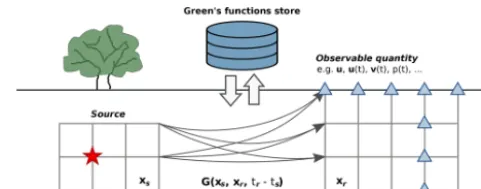
The structured storage of GFs in GF databases (GF stores in the following) allows for the query of pre-calculated GFs for individual source–receiver configurations rather than time-consuming recalculation. The conceptional architecture of this approach is sketched in Fig. 1. Pre-calculated GFs have long been used for operational routine seismological source inversion (Dahm and Krüger, 2014, Table 3). Of-ten, these are in-house-developed database solutions or other structured storage linked to specific forward modelling and inversion codes. Some recent developments provide open GF databases for seismological applications, like Instaseis (Van Driel et al., 2015) or Syngine (IRIS DMC, 2015; Krischer et al., 2017). The benefit for users is significant because the expensive calculation of standard GF databases, particularly for global seismic velocity models, can be avoided. Also, making errors in the GF calculation can be avoided by us-ing such approved GF databases. However, rigid database schemes can be restricted to the modelling method which has been used to create them.
The aim of our work is to provide a stand-alone open-source toolbox for the calculation and storage of GFs, suited for an easy integration into individual routines. To achieve this, we made our framework independent of the GF type and the GF calculation method that synthesises the physi-cal quantities. The architecture of the GF stores is flexible to allow for the storage of extra attributes, e.g. travel time
Figure 1.Concept of the Green’s function stores, the positions of the sourcexs, and the positions of receiversxrfrom source–receiver
pairs of Green’s functionsG(xs,xr, tr−ts)that are computed on a
predefined grid for a specified time window. These GFs are saved in a store and can be utilised through the Pyrocko-GF Python API.
tables. We put special effort into finding a good balance between stability, numerical performance, and user-friendly implementation. While being part of the Pyrocko software library, our framework is easily linked to other seismolog-ical Python toolboxes, e.g. Pyrocko (Heimann et al., 2017) orObsPy (Krischer et al., 2015). Similarly to the seismo-logical projects Instaseis and Syngine, we also openly share various existing GF stores at https://greens-mill.pyrocko.org (last access: 23 October 2019).
The paper is organised as follows: Sect. 2 describes the theoretical framework and GF definitions used in the pro-posed Pyrocko-GF infrastructure. Section 3 refers to the im-plementation design, and Sect. 4 gives examples of seismo-logical applications.
2 Theoretical framework 2.1 Basic approach
representation is then given by
u(xr, tr)= Z Z Z
V d3xs
tr
Z
−∞
dtsG(xr,xs, tr−ts)f(xs, ts)
=
Z Z Z
V
{G(xr,xs)∗f(xs)}d3xs. (1)
The observed quantity is a superposition of all forces acting in the source volume, convolved with the individual timing of force excitation. In the second GF representation (Eq. 1) the convolution integral is replaced by the symbol∗, omitting the time variablet. The convolution in Eq. (1) can be rewrit-ten as a matrix equation in any coordinate system convenient for numerical implementation, with three-dimensional data vector uand source vectorf, and a 3×3 matrixCof GF components as
G(xr,xs)∗f(xs)=
C11 C12 C13 C21 C22 C23 C31 C32 C33
∗ f1 f2 f3
. (2)
While Eq. (1) is valid in general, a buried seismic source can also be represented by generalised force couples m, lo-calised on a planar surface with an areaA(rupture plane). The generalised force couples m form a symmetric, 2nd-order moment tensor density. In such a moment tensor rep-resentation, the GF tensor has 27 instead of 9 components. It relates to the 1st- and 2nd-order spatial derivatives of the single-force GF (denoted by a comma-separated last index) as (e.g. Aki and Richards, 2002)
ui(xr, tr)=
Z Z
A n
Gij,k(xr,xs)∗mj k(xs)
o
dA xs∈A, (3)
withi, j, andk∈ {x, y, z}in Cartesian coordinates. InGij,k, the superscript index i is the displacement direction, while the subscriptsj andkindicate the force direction and force arm, respectively.
A matrix formulation of the index-notated Eq. (3) is ob-tained by mapping the symmetric moment tensor m into a source vector of length 6. Accordingly, the Green’s tensor becomes a 3×6 matrix:
n
Gij,k(xr,xs)∗mj k(xs) o
=
C11 C12 C13 C14 C15 C16
C21 C22 C23 C24 C25 C26 C31 C32 C33 C34 C35 C36
! ∗ m11 m22 m33 m12 m13 m23 . (4)
Due to the symmetry of the moment tensor, the GF matrix in general has only 18 independent components:Ci4=Gi1,2+ Gi2,1,Ci5=Gi1,3+Gi3,1, andCi6=Gi2,3+Gi3,2.
The given matrix formulation is convenient for an efficient numerical implementation in the GF store and it allows for
a generalisation of mixed problems. For example, let uin Eq. (3) be a mixed-data vector bobserved at the receiver, consisting of ground displacementsuand rotational motions ω. Also, let the source vectorsbe represented by a mixed-type force system, wherein force couples and single forces act together within the source volumeV. Then, the matrix representation of the mixed problem can be written as
b(tr)=
Z Z Z
V
{C∗s}d3xs,
with
b=(un, ue, ud, ωe, ωn, ωz)T,
s=(mnn, mee, mdd, mne, mnd, med, fn, fe, fd)T, and
C= CMT CSF. (5)
Note that in Eq. (5)Ccontains GF components of different units. If the GF componentsCare known over the range of potential source and receiver positions as well as over the relevant time lags, the observables due to arbitrary source models can be synthesised using Eq. (5) by approximating the temporal and spatial integrals with sums (e.g. Dahm and Krüger, 2014).
2.2 Green’s tensor and source models in layered elastic media
The number of independent GF components can be further reduced for media of cylindrical symmetry in a flat-Earth model or of spherical symmetry in a spherical-Earth model. For a GF tensor that is calculated for a station at zero azimuth we use the variable0G. Considering geometric symmetries at zero azimuth (north direction), P-wave motion and vertically polarised S-wave (SV) motion can only be excited by the mo-ment tensor componentsmxx,myy,mzz,mxz, andmzx.
Sim-ilarly, horizontally polarised S-wave (SH) motion can only be excited by the moment tensor componentsmxyandmyx.
This reduces0Gto the form (Dahm, 1996; Heimann, 2011; Dahm and Krüger, 2014)
0Gx=
0Gx
x,x 0 0Gxx,z
0 0Gxy,y 0 0Gx
z,x 0 0Gxz,z
,
0Gy=
0 0Gyx,y 0
0Gy
y,x 0 0Gyy,z
0 0Gyz,y 0
,
0Gz=
0Gz
x,x 0 0Gzx,z
0 0Gzy,y 0 0Gz
z,x 0 0Gzz,z
. (6)
A layered medium is invariant to rotation aroundzat the source element. We exploit this cylindrical symmetry to de-rive GFs in ther–ϕ–zdirection at a station with a given az-imuth through a tensor rotation with the azaz-imuth angleϕ:
Gip,q0 =Rpj(ϕ) Rqk(ϕ)0Gij,k or G i0
=R(ϕ)0GiRT(ϕ)
with R(ϕ)=
cosϕ −sinϕ 0 sinϕ cosϕ 0
0 0 1
!
. (7)
Note that indexi0is in ther–ϕ–zcoordinate system, whilei is in the localx–y–zcoordinate system at the source (equiva-lent to north-east-down). Thus, with Eq. (7), the convolution ofmwithG(Eq. 3) is derived component-wise as
ur=
h
Grj,k∗mj k
i
r
=g1r∗mxxcos2ϕ+myysin2ϕ +mxysin 2ϕ+gr2∗ mxzcosϕ+myzsinϕ +g3r∗mzz+gr4∗
mxxsin2ϕ+myycos2ϕ−mxysin 2ϕ
, uz=
h
Gzj,k∗mj k
i
z
=g1z∗mxxcos2ϕ+myysin2ϕ +mxysin 2ϕ
+gz2∗ mxzcosϕ+myzsinϕ
+g3z∗mzz+gz4∗
mxxsin2ϕ+myycos2ϕ−mxysin 2ϕ
, uϕ=
h
Gϕj,k∗mj ki
ϕ =gϕ1∗
1
2(myy−mxx)sin 2ϕ +mxycos 2ϕ
+gϕ2∗ myzcosϕ−mxzsinϕ
, (8)
with
gr1=0Grx,x, g2r=0Grx,z+0Grz,x, gr3=0Grz,z, g4r=0Gry,y, g1z=0Gzx,x, g2z=0Gzx,z+0Gzz,x, g3z=0Gzz,z, g4z=0Gzy,y, g1ϕ=0Gϕx,y+0Gϕy,x, g2ϕ=0Gϕy,z+0Gϕz,y.
The calculation of synthetic displacements is a linear com-bination of 10 GF componentsgji, here elementary seismo-grams, with the moment tensor components as weighting fac-tors. These GF componentsgji are placed into a GF store. The GF components g4r andgz4are near-field terms and do not add to regional or teleseismic observations of dynamic displacements (Aki and Richards, 2002).
The GF representation from Eq. (8) can be re-ordered in the form of the matrix notation (Eq. 5)
b= ur uϕ uzT,
s= mxx myy mzz mxy mxz myz T , C=
g1rcos2ϕ+gr 4sin2ϕ
−gϕ1sin 2ϕ2 g1zcos2ϕ+gz 4sin2ϕ
gr
1sin2ϕ+g4rcos2ϕ
g1ϕsin 2ϕ2
g1zsin2ϕ+gz 4cos2ϕ
gr3 0 gz3
gr1−g4r
sin 2ϕ gϕ1cos 2ϕ
gz1−g4z sin 2ϕ
gr2cosϕ −g2ϕsinϕ gz2cosϕ
gr2sinϕ gϕ2cosϕ gz2sinϕ
T ,
wherebis the observed data vector (here components of dis-placements),sis the source vector (here components of mo-ment tensors), andCis the matrix form of the GF compo-nents. This form is suited for a mixed-type implementation (Eq. 5) and it also allows for a simple projection of{C∗s} a priori to components of the data vector. These projections can be useful, for example, to project to the ray system (L– Q–T), to inclined borehole sensors, or to transform ther–ϕ–z coordinate system to an N-E-D coordinate system of the sen-sor.
3 Implementation and design
3.1 Green’s function store architecture, schemes, and storage format
Green’s function stores consist of a discrete, sparse, and trun-cated representation of thegij in Eq. (8). Time-dependent 1-D arrays (GF traces) are stored for a finite grid of source and receiver positions or of relative coordinates, resembling a fi-nite spatial extent (Fig. 1). The GF traces are stored in a sin-gle binary filetraces, which allows for efficient reading of the stored data. Lookup indices for accessing the GF traces are stored in the binary file index (for technical details, see Heimann et al., 2017, https://pyrocko.org/docs/current/ formats/gf_store.html, last access: 5 November 2019). Start and end times of the GF traces may be different for every node to allow for the compact storage of application-relevant portions of the waveforms (e.g. P or S phases, surface waves, etc.). A repeating end-point condition is assumed when ex-tracting waveforms from the store. This way, a step function can be represented by just two samples at every node (e.g. for the modelling of static displacement changes). The strat-egy we follow to build synthetic data vectors for arbitrary source–receiver locations by using the discretised GF is de-scribed below in Sect. 3.2.
the generation of synthetic quantities, e.g. seismograms, is efficient.
The range and spacing of source locations, depths, and lat-eral source–receiver distances, along with the time span and the sampling rate of the GF traces and other metadata, are de-fined in a configuration file,config. Theconfigfile also contains the medium model definitions, i.e. seismic veloci-ties, densiveloci-ties, and attenuation coefficients. The selection of a component scheme and configuration type defines the map-ping used to transform physical source–receiver coordinates into the file lookup indices used in theindexfile.
The config is defined in the human-readable YAML Ain’t Markup Language (YAML) structured YAML format. This eases the inspection of the metadata and the file can easily be edited with any text editor. The configuration file can be created and edited either manually or automatically by using the API. For details on the binary encoding and the YAML data structure, please see Heimann et al. (2017, Py-rocko GF store file format).
In addition to the mentioned filestraces,index, and config, the store comprises two directories, extraand phases. They contain the individual GF-method-related configuration file(s) and, in the case of waveform problems, the travel time tables for user-specified arrivals. Providing travel time tables consistent with the GFs is useful in prac-tical applications, e.g. to extract specific seismic phase ar-rivals.
Once created, the grid of traces in a GF store may be decimated in space and time. Such a downsampled version may be placed in an individual store or in the sub-directory decimatedof the parent GF store. A downsampled store can be read faster and synthetic quantities are calculated faster. This can be useful, e.g. to simultaneously simulate high-frequency body waves and long-period surface waves by using the full resolution store and the downsampled store, respectively.
3.2 Green’s function computational back end modules The Green’s functions depend on the Earth model and the problem geometry. As scientific applications differ, several specialised numerical methods have been developed to cal-culate GFs. For instance, reflectivity-type wavenumber inte-gration methods (e.g. QSEIS; Wang, 1999) are commonly used to calculate high-frequency body waves and surface waves from teleseismic to local distances. Direct integration (e.g. GEMINI; Friederich and Dalkolmo, 1995) or hybrid methods (e.g. QSSP; Wang et al., 2017) are established for long-period global seismology on a spherical Earth. QSSP can also be used to simulate the coupling between the solid Earth, ocean, and atmosphere, including gravity waves and infrasound, or to calculate the elasto-gravitational effect from elastic wave propagation. The program AxiSEM (Nissen-Meyer et al., 2014), as employed by Instaseis (Van Driel
et al., 2015), provides seismic wave fields for a 3-D ax-isymmetric Earth structure. Layered elasto-static and grav-ity problems in seismology and volcanology are often ap-proached with methods adopted from Haskell-type integra-tion (e.g. PSGRN/PSCMP; Wang et al., 2006). Poro-elastic quasistatic problems of fully coupled deformation and flow in layered media can be handled using orthonormal Haskell-type integration (e.g. POEL; Wang and Kümpel, 2003). These GF calculation methods assume horizontally layered medium models, apart from AxiSEM, which requires ax-isymmetric heterogeneity only.
Different GF computation methods are implemented with different model parameter conventions (e.g. for the different coordinate systems, source model descriptions, etc.). They are also written in different programming languages (e.g. Fortran or C). Therefore, we designed the structure of the GF store to be independent from the calculation method of the GFs. A standardised set-up and configuration is ensured by so-called back ends, written as Python modules. These back ends transfer the output of the respective GF computa-tion method to the data format of the GF store. Such a con-cept enables the implementation of various existing or future GF calculation methods. The structured filling process of the store allows for the parallel computation of GFs to efficiently exploit the computer systems at hand.
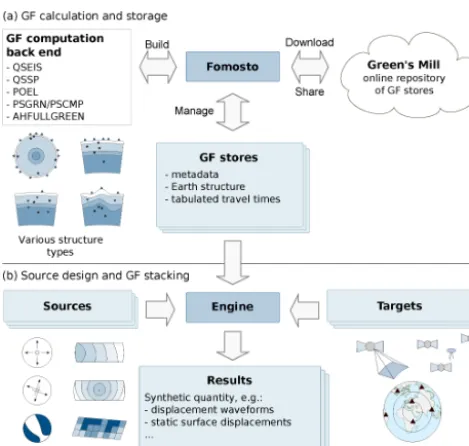
At the time of publication we have implemented back ends for QSEIS, QSSP, PSGRN/PSCMP, and POEL to be in-stalled individually and to be used with the Python tool-box Pyrocko (Fig. 2a and Heimann et al., 2017). In addition to these external code back ends, Pyrocko includes its own method AHFULLGREEN. This back end calculates GFs for an analytical, homogeneous full space (Aki and Richards, 2002) including near-, intermediate-, and far-field wave com-ponents. It can be applied to simulate acoustic emissions in mines or laboratory probes, or it can be useful for lectur-ing purposes. The chosen structure is not limited to GFs of force excitation. Also, GFs simulating other processes could be handled through GF stores, e.g. flow rate and pressure pulses. Only the implementation of a method-related back end is needed here.
3.3 Source design
To simulate the physical quantity related to points of force excitations (sources), several GF traces from the pre-calculated store are combined. In the following, we illustrate the concept of source design based on a rectangular disloca-tion source that is finite in space and time, with uniform slip, a rupture nucleation point, and a rupture velocity.
Table 1.Green’s tensor component schemes and configuration types for GF stores. Configuration types A and B stand for rotation-symmetric media with (A) common-depth receivers or (B) variable-depth receivers. Configuration type (C) is used for three-dimensionally heteroge-neous media with sources in a defined source volume and receivers at fixed positions.
Component scheme Configuration type Source type Receiver distances
elastic10 A, B moment tensor all
elastic8 A, B moment tensor far field only elastic5 A, B single force all
elastic2 A, B isotropic source all
poroelastic10 A, B flow rate, pressure near field (quasi-static) elastic18 C moment tensor all
Figure 2.The architecture of Pyrocko-GF and the object-oriented implementation scheme.(a)The fomosto program is a command-line interface (CLI) to create GFs using the back ends to inspect and manage GF stores.(b) The engine is the central object that accesses the computed Green’s function stores and calculates the synthetic waveforms based on the specified source (e.g. moment tensor, double-couple source, or finite rectangular) and targets (e.g. virtual seismometers, GNSS stations, or InSAR line-of-sight dis-placements).
generating far-field waveforms or surface displacements; see Table 1).
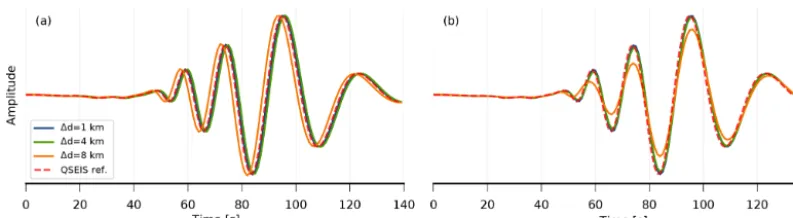
The observed quantity at the receiver is a linearly weighted combination of the spatially closest GF components. Often, this requires interpolation to match the requested source– receiver configuration. The interpolation of GF components requires an appropriate density of grid nodes to result in seis-mograms that are accurate in amplitude and phase (Fig. 3). Furthermore, simulated seismograms vary for different inter-polation methods such as nearest-neighbour or multi-linear interpolation. For standard applications with multi-linear in-terpolation, we could require that the grid spacing dgrid
should be less than a quarter of the minimum wavelength. It can be estimated using the minimum wave velocityvmin and the maximum signal frequency of the GF traces fmax withdgrid=vmin/(4fmax). For applications requiring higher accuracy, a smaller grid spacing must be used. For static dis-placements in the near field of finite sources discussed be-low, an appropriate grid spacing is smaller than half the min-imum source–receiver distance. In general, smaller grid spac-ing leads to higher accuracy at the cost of forward modellspac-ing performance and larger GF stores. The interpolation of GF components in the spectral domain is superior but computa-tionally more demanding (Gülünay, 2003).
To constrain the finite duration of moment release at a source point, we extend the delta-force excitation to force ex-citations in time, which is known as the source–time function (STF). Common STF types are triangular, half-sinusoidal, boxcar, or smooth ramp (Brüstle and Müller, 1983; Udias et al., 2014). All of these are defined through a source du-ration parameter and STF-specific parameters, e.g. the peak moment for a triangular STF. The temporal discretisation of finite-duration source models corresponds to the temporal sampling of the stored GF traces,1tGF.
The linear combination of several of these point sources allows us to construct spatially finite sources. For example, a rectangular source can be expressed with point sources that are aligned on a rectangular grid outlining the area of the finite source. The source area is defined by the length and width of the rectangular plane and its strike and dip. In com-bination with the rake angle and the amount of slip on the rupture plane, the mechanisms of the dislocation and the mo-ment are defined. The nucleation point of the rupture across the fault is defined relative to the centre of the rectangular plane.
The spatial distance of point sources on the plane is con-trolled by the spatial discretisation of the stored GFs (1zGF and1xGF). The point-source spacing is also constrained by the temporal sampling intervals1tGFand the minimum pos-sible rupture velocityvrupt,min. The distance between point
Figure 3.Comparison of interpolation artefacts on synthetic waveforms with different GF grid spacings (a: nearest neighbour,b: multi-linear). Shown are vertical component displacements based on GF stores with 1, 4, and 8 km spatial grid spacing (blue, green, and orange, respectively) against a reference for the exact source–receiver distance (QSEIS; red). The sampling rate is 2 Hz and the signal contains information up to close to the Nyquist frequency (1 Hz). The waveforms are filtered with a pass band from 0.05 to 0.1 Hz after interpolation. The medium is layered with important discontinuities of upper crust, lower crust, and mantle at 20 and 35 km of depth. The slowest seismic velocity in the medium is 3.5 km s−1. The waveform is simulated for a 10 km deep moment tensor source at a distance of 553.3 km.
1src< 1
2min 1zGF, 1xGF, 1tGF·vrupt,min
. (9)
Accordingly, the integer number of equally spaced point sources NL,src along the length of a rectangular, planar sourceLsrcis
NL,src=1+2·
L
src
min(1zGF, 1xGF, 1tGF·vrupt,min)
. (10) The same relations apply for the number of sources across the rectangular planeNW,src of width Wsrc. Thus, the total number of point sources Nsrc that build the finite source is Nsrc=NL,src·NW,src. In the case that the point sources con-tribute equally to the moment of the finite source, the point-source moment is the total moment divided by the number of point sourcesNsrc. In general, the sum of all point-source moments is the total moment of the discretised source.
Finally, we define the rupture propagation across the rup-ture plane by the ruprup-ture velocity vrupt. The rupture starts at the nucleation point and from there propagates radially across the fault. The other point sources start rupturing with a time shift of tshift,i at theith point source. This time shift
depends on the distancedi between the point source and the
nucleation point as well as the mean rupture velocityvrupt, i
between these two points: tshift, i=
di
vrupt, i
. (11)
With a similar strategy many more finite-source types can be realised using Pyrocko-GF (for details, see Sect. 3.5 and the online documentation at https://pyrocko.org/docs, last ac-cess: 23 October 2019).
Once the source model has been discretised into an ensem-ble of point sources in space and time, a discrete approxima-tion of Eq. (1) can be used to calculate a synthetic seismo-gram or any other observable quantity at a receiver site. The
sampleu[i]at discrete timeican be computed from a sum of weighted and time-shifted GF contributions as
u[i] =X
j
G[j, i−k[j]]w[j], (12)
wherew[j]represents weighting coefficients andk[j] repre-sents delay times. The indexjselects the stored GF trace and is a mapping of source position, receiver position, and the GF component index. If it is required to interpolate between the nodes of stored GFs, multiple such contributions from a neighbourhood in GF space are added. Similarly, time inter-polation can be implemented by adding weighted and time-shifted GF contributions. The weights w[j] are computed considering (1) a rotation at the source (from the source co-ordinate system to the GF coco-ordinate system), (2) a rotation at the receiver (from the GF coordinate system to the receiver component orientations), and (3) the involved interpolations. Our implementations of source design and the GF stacking approach in Pyrocko-GF take into account additional practi-cal considerations to provide an efficient, flexible, and easy-to-use modelling engine.
3.4 Computation and quality checks of Green’s function stores
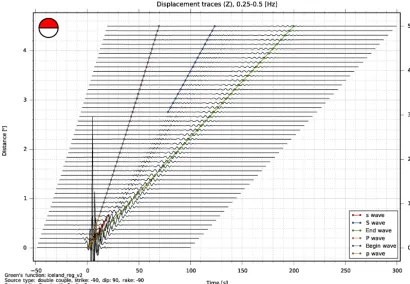
Figure 4.Synthetic seismogram distance section generated by thereportsub-command of fomosto (generated by commandfomosto report single min_configwhereinmin_configis a configuration file). Vertical component seismograms are calculated for a given moment tensor source for a given frequency range and distance range provided in the GF store (0.25–0.5 Hz at 0–500 km of distance). Theoretical first arrivals (P body waves) and other travel time curves are plotted together with synthetic seismograms. Such a display is useful to identify numerical artefacts. Here, an acausal numerical phase running with a negative velocity into negative times at distances below 50 km can be found.
The quality control of the ensemble of GF traces is not triv-ial. GF stores can contain GFs for a large number of source and receiver positions such that a complete visual control by the scientist is impossible. In order to facilitate quality control, fomosto offers several options for visual inspection. In a report generated with its report sub-command, the GF traces are assembled in specified time windows in predefined frequency ranges together with predicted travel time arrivals (Fig. 4). The standard report produces plots of displacement and velocity traces, plots of maximum amplitudes, and plots of displacement spectra from the GF traces in the analysed store(s). These plots help identify spurious signals or numer-ical artefacts in synthetic seismograms. The reports can be customised through a dedicated configuration file. Fomosto can also be used to visualise the metadata of the GF store, e.g. the Earth model of seismic velocities or the associated travel time tables.
The computational effort to create a GF store depends on the complexity of the medium model, the temporal and spa-tial sampling, and the duration of the desired waveforms. For example, a global database based on the Preliminary Refer-ence Earth Model (PREM), calculated with QSSP with 2 s sampling and 4 km spatial spacing in distance and source
depth, requires an effort of about 19 h on a 100-core Intel Xeon E7-8890 high-performance computer and uses 52 GB of disc space. For comparison, regional GF stores at 2 Hz maximum frequency are built within hours on modern desk-top computers.
To avoid redundant calculations, pre-calculated GF stores are provided for download on the Green’s Mill web service under https://greens-mill.pyrocko.org (last access: 23 Octo-ber 2019). As of today, GF stores for global and regional applications are provided for a set of different global Earth models and individual layered regional models adapting se-lected CRUST 2.0 velocity profiles1. GF stores developed during new applications and external projects can be up-loaded to the GF store web page Green’s Mill.
3.5 Forward modelling programming interface
The Pyrocko-GF framework implements the described meth-ods to utilise the GF stores for the forward modelling of seismic waveforms and near-field displacements. The frame-work is focused on various forward modelling applications 1http://igppweb.ucsd.edu/~gabi/rem.html (last access: 25
in seismology and geophysics. The object-oriented program-ming model providesSourceobjects defining the disloca-tion source(s),Targetobjects defining the modelling tar-get (e.g. seismometer or global navigation satellite system (GNSS) station components), and the Engine object re-sponsible for forward modelling (Fig. 2b). TheSource ob-jects define the source properties, which may include the lo-cation, mechanism, and origin time. TheSourceobject is responsible for the discretisation of point- and finite-extent sources into their moment tensor representations for weight-ing the store’s GF traces (see Eq. 8). TheTargetobject de-fines the parameters of the synthesised quantities such as the location of receivers and the requested quantity type. In addi-tion, seismic targets can provide derivatives of the synthetic displacements (i.e. velocity and acceleration).Sourceand Target locations are specified as geographic coordinates with an optional Cartesian offset. This design allows the user to handle global, local, and mixed set-ups. These different set-ups are achieved, respectively, by either setting the Carte-sian offset to zero, by setting the geographic coordinates to a common reference location, or by using a combination of both.
TheEngineconnects theSourceandTargetobjects to the GF store. Based on the configuration ofSourceand Target, theEngineextracts the required GF traces from the store and realises the stacking of delayed and weighted traces and their subsequent convolution with theSource’s STF. Finally, the Enginereturns the synthetics for the re-quest defined by theSourceandTargetobjects. An ex-ample illustrating the use of the Pyrocko-GF API is given in Listing 1.
In practice, the described stacking of GF traces is compu-tationally demanding. Stored GF traces are time dependent and differ in length. Consequently, a stacking of these GF traces requires time shifting the GF traces and dynamic re-sizing of the output response. GF stores can become large, depending on resolution in time and space. To overcome lim-itations, we make use of the virtual memory mapping of files. Parallelised C extensions manage queries to the database and efficiently stack the GF traces according to the different com-ponent schemes (Sect. 3.1). An adaptive stacking scheme is available for waveforms and static models, which often have a very large number of source–receiver pairs. To ensure the correct complex interplay of functions software unit tests are carried out routinely.
The presented architecture in Pyrocko-GF enables the sim-ple imsim-plementation of custom point and extended dislocation sources, as well as STFs. The framework’s flexibility allows for the modelling of finite earthquake ruptures with vari-able STFs across the rupture plane (Vasyura-Bathke et al., 2019). The complete documentation of Pyrocko-GF’s API is available online at https://pyrocko.org/docs/current/, fea-turing tutorials and examples of Python scripts and Jupyter notebooks.
4 Applications
4.1 Seismic and acoustic source inversion
Challenges in seismic source inversions include computa-tional aspects, for instance the estimation of parameter un-certainties, and the aspect of a flexible definition of force representations for the specific rupture process under study. Several groups of researchers use GF stores and the Py-rocko framework for source parameter estimation and cen-troid moment tensor inversion. Examples include nuclear ex-plosion source studies (Cesca et al., 2017; Gaebler et al., 2019), anthropogenically triggered events (Sen et al., 2013; Ma et al., 2018; Grigoli et al., 2018), sinkhole processes (Dahm et al., 2011), local and regional tectonic earthquakes (e.g. Dahm et al., 2018), magmatic-induced low-frequency earthquakes (Hensch et al., 2019), earthquakes related to caldera collapses (Gudmundsson et al., 2016; Cesca et al., 2019), landslides (Kulikova et al., 2016), and meteor explo-sions (Heimann et al., 2013). These examples show that Py-rocko GF stores (in some cases its predecessors) have been applied to synthesise data from global, regional, and local seismic networks, with different frequency ranges and dif-ferent wave modes (body waves, surface waves, W phases, etc.). Also, the range of studied source types is wide, in-cluding full moment tensors and double-couple, single-force, finite-extent earthquake, and point- or finite-extent volcanic sources.
A standard application is to estimate the parameters of a double-couple source from teleseismic data by us-ing a GF store based on a global velocity model. We provide a commented step-by-step code example for the real-data optimisation of the 2009 L’Aquila earth-quake (Italy) in the form of a Python Jupyter note-book at https://git.pyrocko.org/pyrocko/pyrocko-notenote-books/ src/master/Waveform_Inversion-Double-Couple.ipynb (last access: 23 October 2019).
min-Listing 1.Python script example for forward modelling a synthetic seismogram with the Pyrocko-GF framework. More complete examples are available at https://pyrocko.org/docs/current/library/examples/gf_forward.html (last access: 23 October 2019).
imal modifications applied to the two distinct code bases. The GF store used for the Chelyabinsk meteor explosion source inversion is available at https://greens-mill.pyrocko. org/42487ae804b0cfb219d7486ee1c10ee412fe12a3 (last ac-cess: 23 October 2019).
The separation of GF handling, source modelling, and inversion–optimisation encourages designing modular soft-ware architectures with well-defined interfaces. At the time of writing, two feature-rich, open-source earthquake analy-sis software packages rely on Pyrocko-GF for modelling and GF handling: the Bayesian Earthquake Analysis Tool (BEAT; Vasyura-Bathke et al., 2019), which implements Bayesian inference for source characterisation, and the probabilis-tic earthquake source inversion framework Grond (Heimann et al., 2018), which implements a Bayesian bootstrap tech-nique.
4.2 Inverting near-field surface displacements during magma chamber evacuation
In geophysics, static displacement in the near field is often modelled assuming a homogeneous half-space, using ana-lytical solutions (e.g. Mogi, 1958 or Okada, 1985). Many methods for modelling more realistic dislocation sources and media are available but at higher computational cost. A GF store approach can compensate for this obstacle and provide convenient access to a more complex modelling environ-ment. Our fomosto tool facilitates the computation of static GF stores for layered media with its PSGRN/PSCMP (Wang et al., 2006) back end. To illustrate the use of Pyrocko-GF
for static deformation modelling, let us examine a case study on the volcano–tectonic crisis in the Comoro Islands, which started in 2018 offshore of the island of Mayotte (Cesca et al., 2019).
On Mayotte four GNSS stations showed large horizon-tal displacements and subsidence of up to 20 cm over a pe-riod of more than 8 months; the distinct horizontal displace-ments point towards a deflation source situated offshore. We used the few near-field GNSS data to complement the seis-mic analysis in constraining the location and character of the deflation source. From the seismic analysis an upward mi-gration of the seismicity from∼20 km to shallower crustal levels was inferred (Cesca et al., 2019).
We tested different point dislocation sources and velocity– elasticity models against the observed GNSS data and eval-uated the different models in a Bayesian inversion, provided by the Grond framework (Heimann et al., 2018). We found that an isotropic source model in a homogeneous half-space cannot adequately represent the observations. However, the observations are compatible with a constrained moment-tensor-based point-source model, representative for a verti-cally elongated, deflating ellipsoid, similar to the point com-pound dislocation model (Nikkhoo et al., 2016) or an ellip-soidal cavity (Davis, 1986; Segall, 2010, chap. 7). Such a tai-lored dislocation source and more realistic elasticity model derived from the AK135 model2(Kennett et al., 1995) pro-vide a more physical representation of the phenomenon and 2GF store: https://greens-mill.pyrocko.org/ak135_static-b18151
thus a better interpretation of the underlying geological pro-cesses.
In this case study, Pyrocko-GF provided a fast and ef-ficient modelling framework, into which a newly designed source model could be plugged without requiring additional implementation work on the forward modelling itself. Seis-mic waveforms and static displacement are analysed in a ho-mogeneous environment in terms of the Earth models and software toolset used.
4.3 Ground motion and shake map simulation
GF stores can be used to explore attenuation functions of ground motions and their uncertainties that are related to the variability of the source and the structural parameters of the medium. Such explorations can be applied in scenario simu-lations to support risk assessment procedures. Furthermore, it is possible to generate near-real-time ground motion fore-casts after an earthquake. The Pyrocko-GF framework is suf-ficiently fast to allow for such near-real-time waveform sim-ulations. The advantages of synthetic GF-based approaches to empirical relations of peak ground motion (Dahm et al., 2018) and magnitudes (Dahm et al., 2019) are (1) that re-gional Earth structure models can be taken into account and (2) that earthquake sources can be simulated in regions where natural earthquakes have not been recorded. The latter situa-tion also arises in most cases of induced seismicity, for which hazard and risk assessment is of particular importance. A challenge in induced and micro-earthquake ground motion simulations is, however, to realistically simulate synthetic seismograms at sufficiently high frequencies.
Dahm et al. (2018) used a synthetic GF approach to vali-date peak velocity attenuation relations in central Germany, where damaging earthquakes struck in historical times but not during the instrumental period. Two similar GF stores were created to calculate peak ground velocity for two deep crustal earthquakes. One store contained GFs for a medium with a hard rock surface layer, while the other store had a soft sedimentary surface layer (find the corresponding GF stores
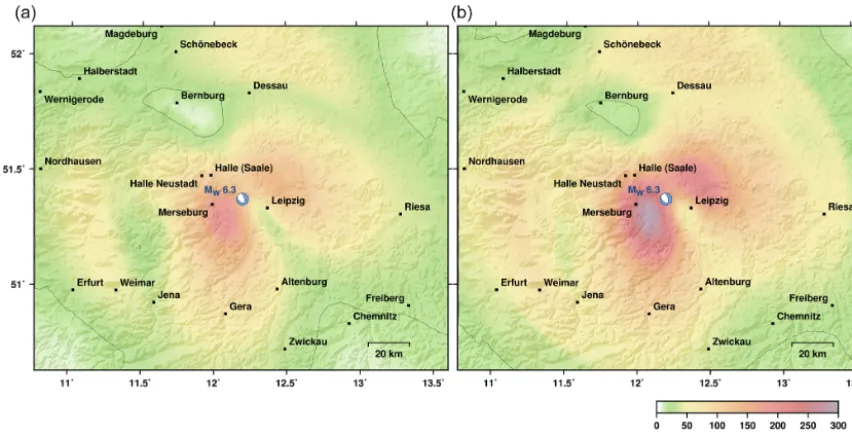
crust2_m5_hard_top_16Hz andcrust2_m5_16Hzat https:// greens-mill.pyrocko.org (last access: 23 October 2019). GFs are pre-calculated for distances between 0 and 300 km and for source depths ranging between 0 and 35 km at inter-vals of 1 km with a sampling rate of 16 Hz. Peak ground velocities were extracted for 6 Hz low-pass-filtered seismo-grams (PGV6 Hz). The PGV6 Hz attenuation reproduced the observed averages and their variability well for the two deep crustal earthquakes, while empirical attenuation relations de-rived for other regions over- or under-predicted the obser-vations. In Fig. 5 we show, as an example, PGV6 Hz shake map simulations for a magnitude MW 6.3 earthquake sce-nario near the cities of Leipzig and Halle, Germany3.
3See shake map code example at https://pyrocko.org/docs/
current/library/examples/gf_forward.html (last access: 23 Octo-ber 2019).
Peak ground motions of displacements or velocities are used to estimate earthquake magnitudes. Usually, empiri-cal attenuation relations are used to normalise measured peak values and to estimate station magnitudes. The empir-ical relations are often poorly calibrated for the region un-der study and only valid for a narrow range of instruments, source depths, and strengths. GF stores can overcome some of the limitations of empirical attenuation curves in magni-tude scales and can be used to estimate moment magnimagni-tudes from peak ground motions. Examples are provided in Dahm et al. (2019) for local magnitude estimations. Figure 6 gives an example of how the effect of different crustal models on full waveforms can be simulated on the fly4. This can be used, for instance, to explore the station variability of global surface wave magnitude scales.
4.4 Array and network design optimisation by full waveform simulation
The simulation of full waveforms for the directed Monte Carlo optimisation of seismic networks is computationally demanding and not standard in seismology. López-Comino et al. (2017) used synthetic GF stores for the simulation of full waveforms to predict the network performance and spa-tial and temporal variation of the magnitude of completeness before the deployment of stations. Synthetic velocity seismo-grams were generated and modified by real recorded noise based on a randomised catalogue of synthetic earthquake sources for a given source volume in the area under inves-tigation. The seismograms were then used in a full waveform event detector to evaluate the expected magnitude of com-pleteness.
For the design of a small-aperture array for the study of local micro-earthquakes, a synthetic GF store has been used by Karam Zadeh Toularoud et al. (2019). For a given distri-bution of synthetic hypocentres and source mechanisms that simulate an earthquake swarm, the authors randomly gener-ated array locations and station configurations for which syn-thetic seismic waveforms were computed. For these synsyn-thetic set-ups the expected beam power and the slowness calcula-tion error was optimised, which allowed the authors to judge a preferred array installation configuration. The array set-up was fixed to use seven stations with three components; 4000 different station configurations have been tested with 100 dif-ferent sources each. Hence, a total number of 8.4 million traces had to be generated for the analysis. A desktop com-puter was sufficient for the computational task. Karam Zadeh Toularoud et al. (2019) used the GF store https://greens-mill. pyrocko.org/vogtland_malek2004_sed_HR-95ef03 (last ac-cess: 25 October 2019).
4See Rayleigh wave waveform variability code example at https:
Figure 5.Shake map scenario of aMW6.3 characteristic lower-crust earthquake at 25 km of depth between Halle and Leipzig, Germany.
(a)Predicted PGV6 Hzassuming a hard rock upper-layer model.(b)Predicted PGV6 Hzassuming a 500 m thick soft layer beneath the surface
with P- and S-wave velocities of 2.5 and 1.2 km s−1, respectively. The contour line shows the 20 mm s−1threshold (see Dahm et al., 2018, for further explanation).
Figure 6.Illustration of waveform sensitivities caused by crustal velocity variations.(a)Colour-coded crustal P-wave velocity profiles as a function of depth. Darker colours correspond to lower crustal thickness.(b)Synthetic, low-pass-filtered seismograms of a double-couple point source corresponding to the P-wave velocity structure in(a)at 278 km of distance.
5 Conclusions
Pyrocko-GF is a Python module that provides functionality to calculate Green’s functions (GFs) and to organise these in a store. In Pyrocko-GF, back ends utilise different numerical calculation methods for GFs, making the stores independent of the actual type of GFs. The command-line interface tool fomosto within the Pyrocko-GF framework manages the gen-eration of GFs through the computational back ends, which so far exist for layered media. Fomosto also facilitates the
comparison, visualisation, and quality check of stored GFs. The software is open source and encourages the contribu-tion of use-specific extensions and adding interfaces to other computational back ends.
In-SAR. Furthermore, Pyrocko-GF stores are prepared to store infrasound, oceanic infragravity, poro-elastic, and elasto-gravitational GFs. On the GF online platform Green’s Mill (https://greens-mill.pyrocko.org, last access: 25 Octo-ber 2019) we provide GF stores for download that are use-ful for many standard earthquake-related applications using global velocity models.
The Pyrocko-GF framework allows users to efficiently ac-cess GF stores to synthesise source-specific responses in-side the medium for comparison with different observations. Sources and source–time functions can easily be customised without limitations on the source complexity. We discussed seismological applications using Pyrocko-GF stores to sim-ulate seismic waveforms, static surface displacements and peak ground motion caused by earthquakes, volcanic activ-ity, and exploding meteoroids. The range of applications is not limited to generalised force couples or single forces. With new back ends, flow rate, pressure pulse, or any other type of excitation and observable, which are representable using the GF approach, could also be included in a Pyrocko-GF store.
Code and data availability. The presented software is available as
open source under the GNU General Public License v3 and can be downloaded from https://git.pyrocko.org/pyrocko/pyrocko/ (last access: 25 October 2019). The documentation and examples are available at https://pyrocko.org (last access: 25 October 2019). Pre-computed Green’s function stores can be browsed and downloaded at https://greens-mill.pyrocko.org/ (last access: 25 October 2019).
Author contributions. SH and TD are the scientific Pyrocko project
leaders, supported by HS and HVB as scientific project partners. SH leads the software implementation to which HVB, MI, and MK have contributed significantly and in many ways, e.g. by writing parts of the codes. All authors contributed to the software design, the code testing, and the paper writing.
Competing interests. The authors declare that they have no conflict
of interest.
Acknowledgements. Henriette Sudhaus, Andreas Steinberg, and
Marius Paul Isken acknowledge funding by the German Research Foundation (DFG) through an Emmy-Noether Young Researcher Grant (276464525). Hannes Vasyura-Bathke was financially sup-ported by the King Abdullah University of Science and Technology (KAUST) BAS/1/1353-01-01 as well as by Geo.X, the Research Network for Geosciences in Berlin and Potsdam (project number: SO_087_GeoX). Torsten Dahm and Sebastian Heimann acknowl-edge co-funding by SERA (EU grant 730900). Timothy Willey helped to implement fomosto report plots. We thank the University of Nevada, Reno, for processing and providing GNSS deformation data for Mayotte (Blewitt et al., 2018).
Financial support. This research has been supported by the
German Research Foundation (grant no. 276464525), the King Abdullah University of Science and Technology (grant no. BAS/1/1353-01-01), the EU SERA (grant no. 730900), and the Geo.X Research Network for Geosciences in Berlin and Potsdam (grant no. SO_087_GeoX).
The article processing charges for this open-access publication were covered by a Research
Centre of the Helmholtz Association.
Review statement. This paper was edited by Caroline Beghein and
reviewed by Tim Greenfield and one anonymous referee.
References
Aki, K. and Richards, P. G.: Quantitative Seismology, University Science Books, 2nd Edn., available at: http://www.worldcat.org/ isbn/0935702962 (last access: 25 October 2019), 2002. Blewitt, G., Hammond, W., and Kreemer, C.: Harnessing the
GPS data explosion for interdisciplinary science, EOS, 99, https://doi.org/10.1029/2018EO104623, 2018.
Brüstle, W. and Müller, G.: Moment and duration of shallow earth-quakes from Love-wave modelling for regional distances, Phys. Earth Planet. In., 32, 312–324, https://doi.org/10.1016/0031-9201(83)90031-6, 1983.
Cannell, D. M. and Lord, N. J.: George Green, Mathematician and Physicist 1793–1841, Math. Gaz., 77, 26–51, 1993.
Cesca, S., Heimann, S., Kriegerowski, M., Saul, J., and Dahm, T.: Moment Tensor Inversion for Nuclear Explosions: What Can We Learn from the 6 January and 9 September 2016 Nu-clear Tests, North Korea?, Seismol. Res. Lett., 88, 300–310, https://doi.org/10.1785/0220160139, 2017.
Cesca, S., Letort, J., Razafindrakoto, H. N. T., Heimann, S., Rivalta, E., Isken, M. P., Nikkhoo, M., Passarelli L., Petersen, G. M., Cotton, F., and Dahm, T.: Drainage of a deep magma reservoir near Mayotte inferred from seismicity and deformation, submit-ted, 2019.
Dahm, T.: Relative moment tensor inversion based on ray-theory: Theory and synthetic tests, Geophys, J. Int., 124, 245–257, 1996. Dahm, T. and Krüger: Moment tensor inversion and moment tensor interpretation, in: New Manual of Seismological Ob-servatory Practice (NMSOP-2), edited by: Bormann, P. E., https://doi.org/10.2312/GFZ.NMSOP-2_IS_3.9, IASPEI, GFZ German Research Centre for Geosciences, Potsdam, 2014. Dahm, T., Heimann, S., and Bialowons, W.: A seismological study
of shallow weak earthquakes in the urban area of Hamburg city, Germany, and its possible relation to salt dissolution, Nat. Haz-ards, 58, 1111–1134, https://doi.org/10.1007/s11069-011-9716-9, 2011.
Dahm, T., Cesca, S., Heimann, S., Maghsoudi, S., and Kühn, D.: A Greenfunction magnitude approach to overcome limitations of traditional magnitude scales, AGU 2017: 11–15 December 2017, New Orleans, Louisiana, 2019.
Davis, P. M.: Surface deformation due to inflation of an arbitrar-ily oriented triaxial ellipsoidal cavity in an elastic half-space, with reference to Kilauea volcano, Hawaii, J. Geophys. Res.-Sol. Ea., 91, 7429–7438, https://doi.org/10.1029/JB091iB07p07429, 1986.
Friederich, W. and Dalkolmo, J.: Complete synthetic seismograms for a spherically symmetric earth by a numerical computation of the Green’s function in the frequency domain, Geophys. J. Int., 122, 537–550, 1995.
Gaebler, P., Ceranna, L., Nooshiri, N., Barth, A., Cesca, S., Frei, M., Grünberg, I., Hartmann, G., Koch, K., Pilger, C., Ross, J. O., and Dahm, T.: A multi-technology analysis of the 2017 North Korean nuclear test, Solid Earth, 10, 59–78, https://doi.org/10.5194/se-10-59-2019, 2019.
Grigoli, F., Cesca, S., Rinaldi, A. P., Manconi, A., Clinton, J. F., Westaway, R., Cauzzi, C., Dahm, T., and Wiemer, S.: The November 2017Mw5.5 Pohang earthquake: A possible case of
induced seismicity in South Korea, Science, 5, 1003–1006, 2018. Gudmundsson, M. T., Jónsdóttir, K., Hooper, A., Holohan, E. P., Halldórsson, S. A., Ófeigsson, B. G., Cesca, S., Vogfjörd, K. S., Sigmundsson, F., Högnadóttir, T., Einarsson, P., Sigmarsson, O., Jarosch, A. H., Jónasson, K., Magnússon, E., Hreinsdót-tir, S., Bagnardi, M., Parks, M. M., HjörleifsdótHreinsdót-tir, V., Pálsson, F., Walter, T. R., Schöpfer, M. P. J., Heimann, S., Reynolds, H. I., Dumont, S., Bali, E., Gudfinnsson, G. H., Dahm, T., Roberts, M. J., Hensch, M., Belart, J. M. C., Spaans, K., Jakob-sson, S., GudmundJakob-sson, G. B., Fridriksdóttir, H. M., Drouin, V., Dürig, T., Aðalgeirsdóttir, G., Riishuus, M. S., Pedersen, G. B. M., van Boeckel, T., Oddsson, B., Pfeffer, M. A., Bar-sotti, S., Bergsson, B., Donovan, A., Burton, M. R., and Aiuppa, A.: Gradual caldera collapse at Bárdarbunga volcano, Ice-land, regulated by lateral magma outflow, Science, 353, 1–24, https://doi.org/10.1126/science.aaf8988, 2016.
Gülünay, N.: Seismic trace interpolation in the Fourier transform domain, Geophysics, 68, 355–369, https://doi.org/10.1190/1.1543221, 2003.
Heimann, S.: A Robust Method To Estimate Kinematic Earthquake Source Parameters, PhD thesis, University of Hamburg, Ham-burg, 2011.
Heimann, S., Gonzalez, A., Wang, R., Cesca, S., and Dahm, T.: Seismic characterization of the Chelyabinsk meteor’s terminal explosion, Seismol. Res. Lett., 84, 1021–1025, 10.1785/0220130 042., 2013.
Heimann, S., Kriegerowski, M., Isken, M., Cesca, S., Daout, S., Grigoli, F., Juretzek, C., Megies, T., Nooshiri, N., Steinberg, A., Sudhaus, H., Vasyura-Bathke, H., Willey, T., and Dahm, T.: Py-rocko – An open-source seismology toolbox and library, GFZ Data Services, V. 0.3, https://doi.org/10.5880/GFZ.2.1.2017.001, 2017.
Heimann, S., Isken, M., Kühn, D., Sudhaus, H., Steinberg, A., Vasyura-Bathke, H., Daout, S., Cesca, S., and Dahm, T.: Grond – A probabilistic earthquake source inversion framework, GFZ Data Services, https://doi.org/10.5880/GFZ.2.1.2018.003, 2018. Hensch, M., Dahm, T., Ritter, J., Heimann, S., Schmidt, B., Stange, S., and Lehmann, K.: Deep low-frequency earthquakes
reveal ongoing magmatic recharge beneath Laacher See Vol-cano (Eifel, Germany), Geophys. J. Int., 216, 2025–2036, https://doi.org/10.1093/gji/ggy532, 2019.
IRIS DMC: Data Services Products: Syngine, IRIS DMC, https://doi.org/10.17611/dp/syngine.1, 2015.
Karam Zadeh Toularoud, N., Heimann, S., Dahm, T., and Krüger, F.: Application based seismological array design by seismic-ity scenario modelling, Geophys. J. Int., 216, 1711–1727, https://doi.org/10.1093/gji/ggy523, 2019.
Kennett, B. L., Engdahl, E., and Buland, R.: Constraints on seismic velocities in the Earth from traveltimes, Geophys. J. Int., 122, 108–124, 1995.
Krischer, L., Megies, T., Barsch, R., Beyreuther, M., Lecocq, T., Caudron, C., and Wassermann, J.: ObsPy: a bridge for seismology into the scientific Python ecosystem, Computa-tional Science & Discovery, 8, 17, https://doi.org/10.1088/1749-4699/8/1/014003, 2015.
Krischer, L., Hutko, A. R., van Driel, M., Stähler, S., Bahavar, M., Trabant, C., and Nissen-Meyer, T.: On-Demand Custom Broad-band Synthetic Seismograms, Seismol. Res. Lett., 88, 1127– 1140, https://doi.org/10.1785/0220160210, 2017.
Kulikova, G., Schurr, B., Krüger, F., Brzoska, E., and Heimann, S.: Source parameters of the Sarez-Pamir earthquake of 1911 Febru-ary 18, Geophys. J. Int., 205, 1086–1098, 2016.
López-Comino, J., Cesca, S., Kriegerowski, M., Heimann, S., Dahm, T., Mirek, J., and Lasocki, S.: Monitoring performance using synthetic data for induced microseismicity by hydrofrack-ing at the Wysin site (Poland), Geophys. J. Int., 210, 42–55, https://doi.org/10.1093/gji/ggx148, 2017.
Ma, J., Dineva, S., Cesca, S., and Heimann, S.: Moment tensor in-version with three-dimensional sensor configuration of mining induced seismicity (Kiruna mine, Sweden), Geophys. J. Int., 213, 2147–2160, https://doi.org/10.1093/gji/ggy115, 2018.
Mogi, K.: Relations between the eruptions of various volcanoes and the deformations of the ground surfaces around them, B. Earthq. Res. I. Tokyo, 36, 99–134, 1958.
Mueller, C. S.: Source pulse enhancement by deconvolution of an empirical Green’s function, Geophys. Res. Lett., 12, 33–36, https://doi.org/10.1029/GL012i001p00033, 1985.
Nikkhoo, M., Walter, T. R., Lundgren, P. R., and Prats-Iraola, P.: Compound dislocation models (CDMs) for vol-cano deformation analyses, Geophys. J. Int., 208, 877–894, https://doi.org/10.1093/gji/ggw427, 2016.
Nissen-Meyer, T., van Driel, M., Stähler, S. C., Hosseini, K., Hempel, S., Auer, L., Colombi, A., and Fournier, A.: AxiSEM: broadband 3-D seismic wavefields in axisymmetric media, Solid Earth, 5, 425–445, https://doi.org/10.5194/se-5-425-2014, 2014. Okada, Y.: Surface deformation due to shear and tensile faults in a
half-space, B. Seismol. Soc. Am., 75, 1135–1154, 1985. Segall, P.: Earthquake and volcano deformation, Princeton
Univer-sity Press, 2010.
Sen, A., Cesca, S., Bishoff, M., Meier, T., and Dahm, T.: Automated full moment tensor inversion of coal min-ing induced seismicity, Geophys. J. Int., 195, 1267–1281, https://doi.org/10.1093/gji/ggt300, 2013.
Tolstoy, I.: Wave propagation, McGraw-Hill, New York, 1973. Udias, A., Madariaga, R., and Buforn, E.: Source mechanisms of
van Driel, M., Krischer, L., Stähler, S. C., Hosseini, K., and Nissen-Meyer, T.: Instaseis: instant global seismograms based on a broadband waveform database, Solid Earth, 6, 701–717, https://doi.org/10.5194/se-6-701-2015, 2015.
Vasyura-Bathke, H., Dettmer, J., Steinberg, A., Heimann, S., Isken, M., Zielke, O., Mai, P. M., Sudhaus, H., and Jónsson, S.: BEAT – Bayesian Earthquake Analysis Tool. V. 1.0, GFZ Data Services, https://doi.org/10.5880/fidgeo.2019.024, 2019.
Wang, R.: A simple orthonormalization method for stable and ef-ficient computation of Green’s functions, B. Seismol. Soc. Am., 89, 733–741, 1999.
Wang, R. and Kümpel, H.-J.: Poroelasticity: Efficient modeling of strongly coupled, slow deformation processes in a multilayered half-space, Geophysics, 68, 705–717, 2003.
Wang, R., Lorenzo-Martín, F., and Roth, F.: PSGRN/PSCMP – a new code for calculating co- and post-seismic deforma-tion, geoid and gravity changes based on the viscoelastic-gravitational dislocation theory, Comput. Geosci., 32, 527–541, https://doi.org/10.1016/j.cageo.2005.08.006, 2006.