SHIELDING AND CRITICALITY ANALYSIS FOR SPECIAL NUCLEAR MATERIAL (SNM) VAULT IN FUEL REPROCESSING PLANT (FRP) OF FAST REACTOR FUEL
CYCLE FACILITY (FRFCF)
Subhrojit Bagchi and M.M. Shanthi
Radiation Shielding & Data Division
Reactor Design Group, Indira Gandhi Centre for Atomic Research Kalpakkam, Tamil Nadu, India
Correspondence author: [email protected].
ABSTRACT
Fuel Reprocessing Plant (FRP) which is a part of Fast Reactor Fuel Cycle Facility (FRFCF), under construction, will be dedicated to recover the unburnt and bred fissile material from fast reactor (Prototype Fast Breeder Reactor) spent fuels. The purified finished oxide product of FRP will be stored in its Strategic Nuclear Material (SNM) vault. The radiations emitted due to the inherent nature of the product and the residual fission products are to be shielded. These shielding requirements have been estimated using the 3D transport code MCNP4B (Monte Carlo N Particle Transport Code-version 4B). The SNM vault contains 18 cylindrical containers with each having 6 kg of PuO2.Each such container is kept in a concrete pit. Total dose rates (neutron & gamma) have
been estimated at various locations inside and outside the SNM vault and to reduce it below 1 µSv/hr at all locations, 7 cm mild steel plus 3 cm polyethylene extra is required as lid for the pit. Near the single pit, additional 5 cm thick concrete is required near the surface facing inside. Criticality analysis carried out for SNM vault confirms that the present arrangement of 18 containers with shield is critically safe.
Keywords: Criticality, FRP, PFBR, shielding, SNM
INTRODUCTION
The Prototype Fast Breeder Reactor (PFBR) is a 500 MWe fast breeder nuclear reactor presently being constructed in Kalpakkam, India. For India, with its 2nd largest thorium reserve in the world, fast reactor technology would be economically more viable to potentially deploy its thorium resource for power production. PFBR would use uranium-238 not thorium, to breed new fissile material, in a sodium-cooled fast reactor design. The surplus plutonium (or uranium-233 for thorium reactors) from each fast reactor can be used to set up more such reactors and grow the nuclear capacity in tune with India's power requirement.
17
vault is just a buffer space for storing the finished Pu product of FRP before sending it to FFP for fabrication which ensures smooth and safe transfer of the product from FRP to FFP without affecting the normal functioning of the two plants. Hence the vault is designed to accommodate PuO2 generated during a specific period of time which is fixed as per the site’s safety requirement. To ensure minimum manrem exposure while handling the finished product, the vault has to be designed with sufficient shielding to reduce the dose rates to safe limits. At the same time the arrangement must be critically safe. The PuO2 containers are also to be arranged in a specific array to ensure criticality safety of the vault with maximum storage capacity (Dunn and Shultis, 2012).
MATERIALS AND METHODS
Geometric Description
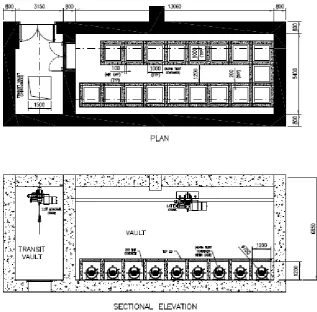
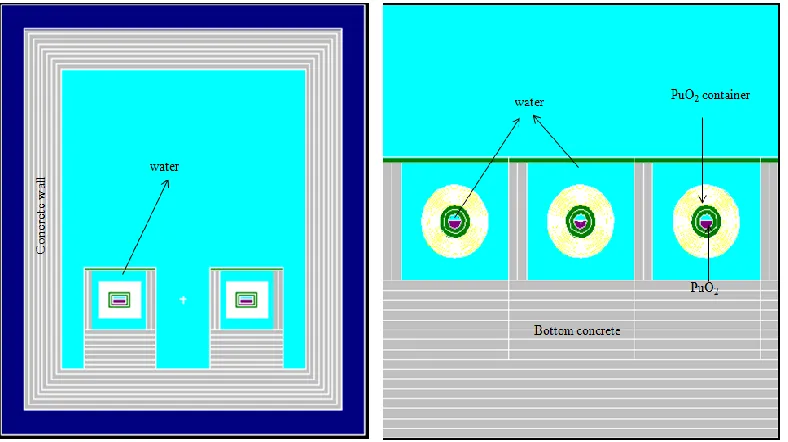
SNM vault contains 18 cylindrical containers each holding 6 kg of PuO2 (Fig. 1). The diameter and length of PuO2 container are 14 cm, 30 cm. Each container is surrounded by 10 cm mild steel and 20 cm polyethylene respectively on all sides. Each shielded containers are kept inside 80 cm x 80 cm concrete pit with wall thickness 20 cm. Top of the pit is covered with 5 cm thick mild steel and at the bottom 80 cm thick concrete is provided (Fig. 2). The shield requirements are estimated to meet the design limit of 1 µsv/h outside the SNM vault (Shanthi et al., 2006).
18
Radiation Sources: Neutron and Gamma
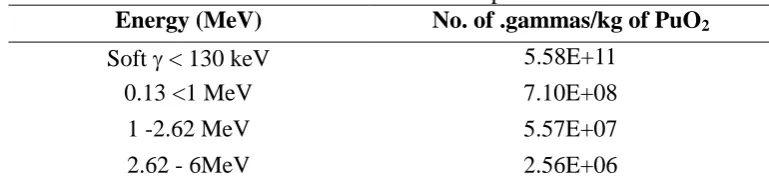
The neutron sources in PuO2 powder are from (α, n) reaction and spontaneous fission (Pandikumar and Gopalakrishnan, 2010). With the known isotopic composition of Plutonium in PFBR spent fuel, 6 kg PuO2 powder is estimated to have neutron source strength of the order of 2.45 x 10⁶ n/s. For total 18 containers it is about 4.42 x 10⁷.
The sources of gamma radiation are fission product activity, actinides, spontaneous fission (Baskar et al., 2009). Among these, gamma radiations from fission products and actinides are the major source of radiation. Considering all sources, the gamma source spectrum has been calculated (Table 1).
Table 1: Gamma source spectrum
Energy (MeV) No. of .gammas/kg of PuO2
Soft < 130 keV 5.58E+11
0.13 <1 MeV 7.10E+08
1 -2.62 MeV 5.57E+07
2.62 - 6MeV 2.56E+06
Calculation Details
19
Figure 2: Sectional view of single concrete pit
Steel plate
Concrete pit
Bottom concrete
Air
polyethylene
PuO2 Powder
20
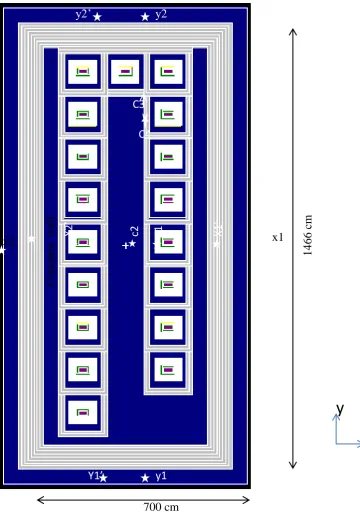
Figure 3: Plan view of SNM vault simulated by MCNP
RESULTS AND DISCUSSION
Criticality
To ensure safe storage of fissile materials in the storage room, criticality analysis has been carried. Effective multiplication factor (keff) has been estimated even in water flooded condition, assuming the entire vault with the concrete pits and SNM container to be immersed in water completely as shown in Fig. 4. The estimated keff values are given in Table 2. It is observed that even in water flooded condition the estimated keff value is below 0.9 which validates the criticality safety of the SNM vault with its present layout.
x
y
y2
x1 x2
y1
700 cm
1466 c
m
C
onc
re
te w
all
X2
’
X1
’
c2 c1
y2’
Y1’
C3
21
Figure 4: Sectional view if SNM vault in water flooded conditions
Table 2: Estimated values of Keff
Serial No. Description Keff SNM Vault
1 With air 0.2166
2 Water flooded 0.32787
Shielding
22
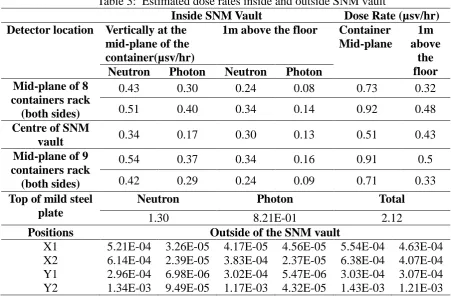
Table 3: Estimated dose rates inside and outside SNM vault
Inside SNM Vault Dose Rate (µsv/hr) Detector location Vertically at the
mid-plane of the container(µsv/hr)
1m above the floor Container Mid-plane
1m above
the floor
Neutron Photon Neutron Photon
Mid-plane of 8 containers rack
(both sides)
0.43 0.30 0.24 0.08 0.73 0.32
0.51 0.40 0.34 0.14 0.92 0.48
Centre of SNM
vault 0.34 0.17 0.30 0.13 0.51 0.43
Mid-plane of 9 containers rack
(both sides)
0.54 0.37 0.34 0.16 0.91 0.5
0.42 0.29 0.24 0.09 0.71 0.33
Top of mild steel plate
Neutron Photon Total
1.30 8.21E-01 2.12
Positions Outside of the SNM vault
X1 5.21E-04 3.26E-05 4.17E-05 4.56E-05 5.54E-04 4.63E-04 X2 6.14E-04 2.39E-05 3.83E-04 2.37E-05 6.38E-04 4.07E-04 Y1 2.96E-04 6.98E-06 3.02E-04 5.47E-06 3.03E-04 3.07E-04 Y2 1.34E-03 9.49E-05 1.17E-03 4.32E-05 1.43E-03 1.21E-03
ACKNOWLEDGEMENTS
We would like to thank, Dr. R.S. Keshavamurthy, Head, Reactor Physics Division, FBTR, P. Puthiyavinayagam, Director, Core Design Group (CDG), Dr. P. Chellapandi, Director, Reactor Design Group (RDG) & all members of RSDD for their fruitful discussion and support in carrying out this work.
REFERENCES
Baskar, S. et al. (2009). Estimation of Gamma Dose Rate from the Product of FRP (FRFCF),
IGC/SG/RSD/RSS/92622/DN/3004/REV-A.
Dunn, W.L. and Shultis, K.J. (2012). Exploring Monte Carlo Methods, Elsevier.
Pandikumar, G. and Gopalakrishnan, V. (2010). NSOURCE: A code for calculating (α, n) and Spontaneous Fission Neutron Sources and Spectra”, RPD/NDS/139, July 2010.