The Potential of EDTA – Modified Rice Husk Ash as Solid Phase
Extraction Resin in Seawater
Nhicole Francisco ,Bernadette Hugo and, Jazzelle San Jose
Dr. Abigail Cid-Andres
Department of Physical Sciences, College of Science,
Polytechnic University of the Philippines, Sta. Mesa, Manila, Philippines
2018
Abstract
Solid Phase Extraction (SPE) is one of the methods used in extraction of elements and metals with the aid of preconcentration process. The development of sorbents and their application in preconcentration is a subject of great importance in the environment. This review summarizes the use of solid phase extraction in developing resin for the extraction of trace elements in seawater. On the right hand, Rice Husk Ash (RHA) is a cost-effective agricultural material that has the great properties and capability to be a sorbent for tracing elements. The important properties and components of the RHA will be further specify. This journal review will provide general information regarding solid phase extraction, rice husk ash (RHA), tracing elements and resin.
Keywords: solid phase extraction, trace elements, rice husk ash, resin
Table of Contents
1. Objective ... 3
2. Introduction ... 3
2.1 Solid-Phase Extraction ... 4
2.1.1 Advantages ... 4
2.1.1.1 Separation ... 4
2.1.1.2 Preconcentration ... 4
21.2 Basic Principles ... 5
2.1.3 Adsorption ... 6
2.2 Sorbent ... 7
2.2.1 Rice Husk... 7
22.1.1 Composition of Rice Husk ... 7
2.2.1.2 Composition of Rice Husk Ash ... 8
2.2.1.3 Preparation of Activated Carbon ... 8
2.2.1.4 Water Purification ... 9
2.2.2 Rice Husk Ash ... 9
2.3 Trace Elements ... 10
2.3.1 Seawater ... 10
2.3.1.1 Preconcentration of Seawater ... 11
2.5 EDTA ... 12
2.5.1 EDTA-Modified ... 13
3. Methodology ... 13
3.1 Seawater Samples ... 13
3.2 Procedure for Preconcentration of Seawater ... 14
3.3 Rice Husk Samples ... 14
3.4 EDTA Modification of Rice Husk Ash ... 14
3.5 Characterization of RHA ... 14
3.5.1 X-Ray Diffraction (XRD) ... 14
3.5.2 Scanning Electron Microscopy (SEM) ... 14
3.6 Preconcentration System ... 15
3.7 Instrument for Tracing Elements ... 16
4. Results ... 16
5. Discussion ... 22
6. Conclusion ... 23
Introduction
Trace metals play an important role in daily life. Thus, determination of trace elements or metals in water, soil, plant and other things is becoming increasingly important. Instrumental methods including spectrophotometry, inductively coupled plasma-atomic emission spectrometry (ICP-AES), atomic absorption spectrometry (AAS), have been used for the determination of traces of heavy metal ions. Separation and preconcentation of analyte are important aspects in the determination of trace metal ions. [1] Despite the selectivity and sensitivity of analytical techniques, there is a crucial need for the preconcentration of trace elements before their analysis due to their frequent low concentrations in numerous samples. Determination of trace metals in seawater is a hard task, not only because of the concentration of the water or detection limits of instruments that will be used but also the seawater matrix that may interfere with the determination of trace metals.
Preconcentration can overcome these problems. Preconcentration methods include ion exchange, precipitation, solvent extraction, and solid phase extraction. Above
all, solid phase extraction is the most commonly used. [2]
Objective
The overall purpose of the journal is to provide information regarding the utilization of the rice husk (RH) into rice husk ash (RHA) and its usage in extracting trace elements. The rice husk ash is chemically modified with EDTA to improve the property of the sorbent.
1. Solid Phase Extraction
In most instances, environmental samples tend to be too complex with chromatographic systems. This fact is often overlooked in analytical development, thus causing sample preparation techniques to be a limiting factor in many analyses. In comparison with other developments, it has been suggested that sample preparation advances have come about due more to need rather than desire. Regardless of original sample concentration and matrix, the ultimate goal is a final solution with an enriched sub-fraction of analytes of interest at easily separated and detected concentrations that are compatible with the chromatographic system of choice. [4]
1.1Advantages 1.1.1 Separation
The solid-phase extraction (SPE) approach as rapid acceptance separation procedure has advantage over classical liquid extraction technique in term of rapidity, simplicity, amenability to automation, low disposal costs and lower extraction time, and high preconcentration factor.SPE procedure characteristic performance significantly can be improved by efficient selection of a suitable sorbent. Silica gel immobilized with various organic compounds was widely used in this technique due its good mechanical and thermal stability, lower swelling susceptibility, shrinking, and microbial and radiation decay. [5]
Solid phase extraction (SPE) has several advantages over other method, such as simple and fast extractor system. Solid phase extraction procedures combine the advantages of high selectivity of solvent extraction and high efficiencies of chromatographic separation [6, 7] and they separate elements with high purity. [8]
1.1.2 Preconcentration
and silica gel are used. [10]Diaion HP-20, fullorenes, naphthalene, activated carbon and other sorbents have also been used for separation and preconcentration of trace amounts of heavy metal ions from various matrices. [11] It is easily adaptable to the preconcentration and to the determination of trace metal ions by flow injection analysis technique. In solid phase extraction, analyte ions are adsorbed on an adsorbent, and then desorbed with a suitable eluent. Metal determinations were performed in this solution.
Solid phase extraction offers a major advantage over solvent extraction methods.[12] There are two broad types of solid phase extraction. In one, seawater is passed slowly over a resin containing immobilized chelating ligands (i.e., chelating ion exchange) while in the other hand, chelating ligands are added to the sample and the resultant metal–organic complexes sorbed to a resin. [13]
1.2Basic Principles
Solid Phase Extraction has 4 steps:
First, the solid sorbent should be conditioned using an appropriate solvent, followed by the same solvent as the sample
solvent. This step is difficult, as it enables the wetting of the packing material and the combination of the functional groups. In addition, it removes possible impurities initially contained in the sorbent or the packaging. This step removes the air in the column and fills the void volume with solvent. The nature of the conditioning solvent depends on the nature of the solid sorbent. Typically, for reversed phase sorbent (such as octadecy{l-bonded silica), methanol is frequently used, followed with water or aqueous buffer whose pH and ionic strength are similar to that of the sample. Care must be taken not to allow the solid sorbent to dry between the conditioning and the sample treatment steps, otherwise the analytes will not be retained and poor recoveries will be obtained. If the sorbent dries for more than several minutes, it must be reconditioned.
concentrated. Even though matrix components may also be retained by the solid sorbent, some of them pass through, thus enabling somepurification of the sample.
The third step is the washing of the solid sorbent with an appropriate solvent, to have low elution strength and to eliminate matrix components that have been retained by the solid sorbent,without removing the analytes. A drying step may also be advisable, especially for aqueous matrices, to remove traces of water from the solid sorbent. This will remove the water in the final extract, which may hinder the succeeding concentration of the extract and the analysis.
The final step consists in the elution of the analytes by an appropriate solvent, without removing retained matrix components. The solvent volume should be adjusted so that required recovery of the analytes is achieved with subsequent low dilution. In addition, the flow rate should be correctly adjusted to ensure efficient elution. It is often recommended that the solvent volume be fractionated into two aliquots, and before the elution to let the solvent soak the solid sorbent. [14]
Fig.1. Solid Phase Extractionstandard operation
1.3Adsorption/Extraction
Industrial activities are major source of water pollution due to industrial chemicals which contain heavy metals, hazardous waste which can affect not only our environment but also our health. Common methods for the removal of heavy metals comprise membrane separation, electrochemical precipitation, ion exchange, pre-concentration, fertilization and adsorption. [15] These methods differ depends on the cost, complexity and efficiency.
and activated carbon has been frequently used as an adsorbent. [16]
Active carbon adsorption was considered to be common and effective, but the cost is high [17]. For this reason, many studies have been conducted in order to find out effective and low-cost adsorbents.
2. Sorbents
The development of sorbents is a topic of great importance for the determination of trace elements. Sorbent is used to effectively collect residues in various kinds of surfaces with the use of different methods. Sorbents such as coconut coir [18], coconut shell [19], sawdust, [20] corn cob [21] are effective sorbents for trace and heavy metals.
2.1Rice Husk
Rice Husk (RH) is widely available throughout the world. Every year, approximately 500 million tons of rice is produced by world and 2-3 million tons are produced in the Philippines. Rice husk ash (RHA) is a by-product of RH. This is a versatile material with good adsorption properties.
Rice husk was chosen as the local low-cost adsorbent since million tons of rice husks are produced annually as a result of paddy cultivation. Various modifications on rice husk have been publishedin order to enhance their sorption capacities for metal ions, dye and other pollutants. Most of the studies indicated that the modified adsorbents are efficient in binding either the cationic or anionic species but not both. In continued effort to use low-cost materials for the removal of organic pollutants, the performance of ethylenediaminetetraacetic acid (EDTA) modified rice husk as a sorbent have been investigated throughout the years. [22]
2.1.1 Composition of rice husk
0.04-0.08%, Hydrogen 4-5%). The composition of RH depends on many factors such as rice variety, type of fertilizer used, soil chemistry, and even the geographic localization of the production. [24]
2.1.2 Composition of rice husk ash
RH is high in ash content as compared to other biomass fuels ranging 14-25%. [25] Silica content in RHA ranges from 83-98%.[26] Presence of high amount of silica makes it a valuable material for use in industrial applications. Chemical composition of RHA determined by x-ray fluorescence (XRF) as SiO2 89%, Al2O3
1.20%, C 18.24%, CaO 1%, K2O 1.22%,
Fe2O3 1.28%. The various factors which
affects the ash properties are incinerating conditions (temperature and time), rate of heating, burning technique. [27]
2.1.3 Preparation of activated carbon
Various properties such as high surface area, large adsorption capacity and fast adsorption kinetics makes activated carbons as valuable material for different environmental applications. Production of
activated carbon from rice husk is achieved through activation with chemical or physical means. The nanoporous activated carbon with large specific area of 2523.4 m2 g−1 was
obtained from RH. [28] The effect of alkali carbonate in the activation process can be related to formation of porosity due to SiO2
interaction with the carbonates, CO2 reacts
with the carbon phase with formation of CO, according following reaction:
M2CO3 + SiO2 = M2SiO3 + CO2
CO2 + C = 2CO
Safranin-T using activated rice husks and activated carbon is carried out. [29]
2.1.4 Water Purification
The high silica content of RH makes it insoluble in water, having good chemical stability and structural strength. Thus, it serves an important role in water purification as well as sorbent in tracing metals. Sorbent made by RH effectively used to removal of the six heavy metals such as Fe, Mn, Zn, Cu, Cd and Pb.[30] RH is also used as adsorbent to remove various pollutants, phenols, dyes, pesticides, inorganic anions, organic compounds and heavy metals. [31]
2.2Rice Husk Ash
In particular, fly ash is generated by the air pollution control systems are hazardous waste materials for which landfilling is still considered the most appropriate management strategy. Indeed, this ash contains leachable toxic metals, as for example Pb and Zn. So, the use of silica extracted from rice husk ash (RHA) for heavy metals stabilization of fly ash. It is attributed to two different reactions, due to the amorphous silica and carbonation. Since the organic part of rice husk (RH) can easily be
removed by thermal decomposition, thermal treatment of RH is an approach to obtain, not only energy, but also silica from rice husk. [32]Different optimization approaches have been used to improve the adsorption capacity of the mesoporous silica.
Rice husk removal during rice refining, creates disposal problem due to less commercial interest. Also, handling and transportation of RH is problematic due to its low density. RHA is a great environment threat causing damage to land and surrounding area where it is dumped. Therefore, commercial use of rice husk and its ash is an alternative solution to the disposal problem. RHA has been found to be effective as an oil spill absorbent, and for use in waterproofing chemicals, flame retardants, and as a carrier for pesticides and insecticides. Presently, RH usually ends up being burnt in open space, thus causing environmental pollution. To conserve energy and resources, efforts have been made to burn the husk under controlled conditions and to utilize the resultant ash in building, semiconductor, composite, and abrasive materials. Also, ash is an active catalyst and a good material for catalyst support because of its high surface area. [33]
Generally, toxic heavy metals have been reported to cause potential human health risk and ecological disturbances. Lots of studies have been performed for the determination of trace metal ions in various media including some body tissues and fluids, natural waters etc. The determination of heavy trace metals is important for human health.[34] Most heavy metal ions such as Ni2+, Zn2+, Pb2+, Cu2+ and Co2+ are toxic and
can exist for a long time in the environment. These metals cause serious environmental and public health problems even at very low concentrations.
Currently, research efforts have shifted towards the development of new, low cost adsorbents preferably from biogenic sources. An adsorbent may be regarded as low cost if it is abundant in nature, is a by-product, a waste material from industry or requires little processing. [35]
To curtail heavy metal pollution problems, some various techniques for wastewater treatment have been developed through decades. This includes coagulation, chemical precipitation, membrane separation, reverse osmosis, solvent extraction, ion exchange, filtration, and adsorption by activated carbon. Among these methods, adsorption by activated carbon is
widely used as an effective adsorbent in many applications but metal ions removal by activated carbon is relatively expensive. Hence there is a need to search for the lowcost adsorbent. Rice husk an abundant agricultural waste material generated in rice producing countries is found to be capable of removing heavy metals.[36]It can be considered as an efficient and low-cost adsorbent for heavy metals and the potential of adsorbents to treat the wastewater in heavy metal ions. [37]
3.1Seawater
Trace metals in seawater are widely used studied to understand their geochemical and biological cycles in marine environment and for environmental monitoring.
are inductively coupled plasma mass spectrometry (ICP-MS) and inductively coupled plasma optical emission spectrometry (ICP OES). [41]
Trace metal effects on marine primary production has driven a greater demand for accurate, precise metal determinations at the very low concentrations found in seawater. Bioactive metal cations like, Fe, Co, Ni, Cu, Zn and Cd, given the growing use of inductively coupled plasma mass spectrometry (ICP-MS) as a rapid multi-element instrumental detection system. The new extraction method must be applied easily to a range of sample volumes yet also be clean and precise enough to permit accurate trace metal determinations at picomolar levels in seawater. [42]
With the development of more sensitive analytical techniques, marine chemists are capable of detection and estimation of trace metals in seawater even at µg/I to ng/I level. Several methods are adopted to preconcentrate the trace metals and to separate the salt matrix from seawater prior to trace metal determination. With the growing use of ICP-MS as a rapid multi-element instrumentation detection system, a wide range of trace metals were determined in seawater by ICP-MS technique for preconcentration and matrix removal. [43]
3.1.1 Preconcentration of Seawater
Figure 2: Sohrin’s Diagram of Manual Preconcentration system
The preconcentration and separation methods based on the sorption are considered to be superior to the liquid-liquid extraction as regards simplicity, rapidity and ability to attain a high preconcentration factor. Preconcentration methods based on adsorption of complexed metals on columns filled with activated carbon have found widespread application for this purpose. [44] Activated carbon was used for the purification of drinking water for the adsorbing of aromatic and other organic materials which cause bed smelling and taste in water for many years.
applied for ultratrace amounts determination in waters. Methods based on solid phase extraction (SPE) are widely used for this purpose. The efficiency of SPE procedure and such SPE characteristics as analysis time), preconcentration factor, selectivity, regeneration ability, chemical and mechanical stability depend mainly on the nature and properties of the sorbent material. Sorbents used for this purpose are chemically modified silica gel, activated carbon, inorganic–organic hybrid materials as C 18– silica (8, 9) and synthetic chelating polymers resins. [45]Preconcentration procedures, especially solid phase extraction (SPE), have been indispensable tools to analyte enrichment to bring the elemental concentrations in solution to the detection range of the ICP-OES instrument. [46]
4. Resin
The most common packing used today in Solid Phase Extraction (SPE) and HighPerformance Liquid Chromatography (HPLC) is silica gel. The gel is a network of silica atoms bound to one another by siloxane bonds. This gel is then modified with any number of chemical entities such as C8 or C18 reacted at terminal hydroxyl groups to facilitate reverse-phase separations. [47]
5. EDTA
EDTA is a remarkable reagent not only because it forms chelates with all cations but also because most of these chelates are sufficiently stable for titrations. EDTA can form a highly soluble complex with a wide variety of metal ions in an aqueous solution and can greatly reduce the efficiency of metal removal by conventional chemical precipitation, such as hydroxide and sulfide precipitations. [48]
One of the common structures for EDTA complexes is shown in Fig 2.
EDTA forms very stable complexes with metal ions and prevents them from catalyzing air oxidation reactions that can lead to decomposition of proteins and other compounds. [49]
5.1EDTA – Modified
Various materials from biomass to inorganic oxides have been functionalized with EDTA. The usage of EDTA arises from its strong metal chelating ability, local availability, and economically-friendly price. Silica gel is an amorphous form of silicon dioxide where silicon atoms are linked together via oxygen atoms with siloxanebonds. Silica gel surface contains hydroxyl groups that can be further functionalized using a familiar silanization procedure. [50]
Different modifications on rice husk have been reported in order to enhance their sorption capacities for metal ions, dye and other pollutants. [51] Most of the studies indicated that the modified adsorbents are efficient in binding either the cationic or anionic species but not both. Therefore, there is a need to have adsorbents capable of removing different types of dyes either singly or simultaneously. Many studies have investigated the performance of
ethylenediaminetetraacetic acid (EDTA) modified rice husk as a sorbent for basic and reactive dyes and other metals.
Some trace metals have been determined by ICP-MS just after dilution of seawater. Although this technique is simple, the sensitivity is not adequate to determine the concentrations in the open ocean and the signals usually suffer from drift and suppression due to the seawater matrix. Thus, preconcentration from major constituents is crucial to accurate and precise determination of trace metals.
EDTA can form a maximum of five coordinate bonds to a metal ion. This resin has excellent affinity to trace metal ions. This resin is usually used in a closed column to preconcentrate trace metals, which reduces the risk of contamination. The trace metals in the eluate were determined by ICP-MS. This method was successfully applied to determine trace metals in seawater. [52]
Methodology
1. Seawater Samples
detergent, followed by deionized (Milli Q) water, dilute nitric acid, and lastly, with double distill deionized water.
2. Procedure for the Preconcentration of Seawater
Seawater samples will be acidified first with nitric acids at <2.0 pH in order to prevent metal adsorption onto the inner bottles' walls. These seawater samples will then transferred into a pre-cleaned polyethylene bottles by first filtering it through 0.45 um polycarbonate membrane Nucleopore filter (Millipore) [53]. The samples will be analyzed within 2 weeks after the collection, following the preconcentration procedure that is given above. For the analysis, the sample containing 600ml of the acidified sea water will be neutralized first and then buffer to the desired pH. [54]
3. Rice Husk Samples
The rice husks from C4 Navotas will be modified. These rice husk samples will authenticated at Bureau of Plant Industry, Pandacan, Manila.
4. EDTA Modification of Rice Husk Ash
The rice husk ash will wash thoroughly with water then dry it in an oven at 105 °C for 12 hours. [55] 8g of grinded rice
husk with 0.5g of
(Ethylenediaminetetraacetic acid) EDTA and soaking it in 300 mL of 1.0 M Sodium hydroxide (NaOH) for 3 hours at 70 °C, the optimum conditions for the modification of rice husk according to the study. The effect of functional groups on the surface of rice husk will be studied and investigated. In order to do that, the rice husk will treat first with NaOH, as stated on the reported method. [56] This sample of treated rice husk will filter, wash with excess water, dry in an oven at 60 °C, and label as ERH.
5. Characterization of RHA a. X-Ray Diffraction (XRD)
X – Ray Diffraction analysis is use to determine the particle size and shape of the rice husk ash.
b. Scanning Electron Microscopy
and determine by the use of scanning electron microscopy.
6. Preconcentration System
The EDTA-modified rice husk ash will be contained and stored in a propylene syringe. It will initially clean using methyl alcohol, acetone, 3 M HNO3, and 1 M
HCl-1x10⁻² M ascorbic acid by allowing the
reagents to drip with gravity through the syringe. After that, the resin will take out of syringe and suspend in 1 M HCl in a Teflon perfluoroalkoxy (PFA) beaker for 24 hours in order to remove small resin particles. After decantating, the resin will packed in the column of the PFA tube.
The inside diameter of the preconcentration system's columns are 6 mm and has a bed height 30 mm, containing 500 mg of the resin sandwich between ethylene-tetrafluoroethylene meshes. Another set up of this will prepared again and use in order to purify the buffer solution.
The column will mount on either manual or automated preconcentration system. The system will compose of chelating resin columns, low-density polyethylene (LDPE) bottles, PFA tubes, poly(tetrafluoroethylene) (PTFE) joints, PTFE three-way valves, peristaltic pump, and
a nitrogen gas line. The system will place in a clean box, which will construct with plastic props and polyethylene sheets. All the plastic materials are clean in the same way as the bottles prior to construction. The PTFE three-way valves switch the flow line. The peristaltic pump sends sample and buffer solutions to the column. The eluent will send by nitrogen gas pressure to avoid contamination from the tubings. The nitrogen gas will introduce into the eluent bottle after passing through deionized water (MQW) trap and a cartridge filter. The system use three parallel lines and which can process three samples simultaneously. After construction, the chelating resin column will clean by passing 1 M HNO3 as an eluent. The whole
solution line will fill with 1M HNO3 and
leave to stand for 24 hours. Lastly, it will clean with ultrapure MQW water.
proceeding to the elution step of every sample.
A stock solution of concentrated HAcO-NH4AcO buffer with 3.6 M and pH 6.0 will prepare by mixing 100g of HAcO and 44.3 g of NH3. A working solution 0.05 M HAcO-NH4AcO will prepare by diluting the concentrated buffer. It will purify by passing it twice through a EDTA-modified solid phase extraction resin column for purification. As stated, the preconcentration column will clean using 15 mL of the eluent. After that, the column will condition by passing 30 mL MQW and 40 mL of working solution of GAcO-NH4AcO through it, prior to sample being loaded. After loading the seawater samples in the column for ~40 minutes, 40 mL of 0.05 M HAcO-NH4AcO
are use to wash away the remaining sea salts that accumulate in the column.
The analytes are then elute with 15 mL of 1M HNO3. LPDE bottle is use to store
the target metals until determination by ICP-MS. The flow rate is 3 mL/min for both sample and buffer solution, while eluent's is 1 mL/min in the opposite direction to the sample loading. The exact volume of the loaded sample and eluate is determined by weighing for the flow rates vary with regards to the condition of the column. It find out that
one cycle of preconcentration usually took 2 hours to be accomplished.
7. Instrument for Tracing Elements
Inductively coupled plasma-mass spectrometry (ICP-MS) offers exceptional sensitivity and multi-element capability for trace metal analysis. [42] An ICP MS instrument is use for analysis of the eluate.
Results
I. Parameters in Solid Phase Extraction 1. pH [12,52]
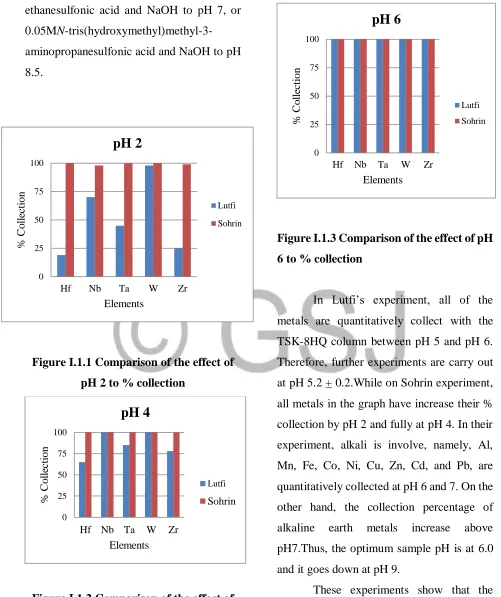
For Lutfi’s experiment, they will adjust the sample solution and column with HNO3 or CH3COOH-NH3 buffer solution. A
25 ml of seawater sample is spike with the analyte and pass through the TSK-8HQ column. Adsorption of metals onto the TSK-8HQ resin is dependent on both in metals and in 8-hydroxyquinoline group which changes depending on the pH.
Sohrin’s experiment on the other hand, the pH of each sample solution will adjust with HNO3 to pH 1-3, 0.05 M
HAcO-NH4AcO to pH4-5,
0 25 50 75 100
Hf Nb Ta W Zr
% C o ll ec ti on Elements
pH 2
Lutfi Sohrin 0 25 50 75 100Hf Nb Ta W Zr
% C o ll ec ti on Elements
pH 6
Lutfi Sohrin ethanesulfonic acid and NaOH to pH 7, or0.05MN-tris(hydroxymethyl)methyl-3-aminopropanesulfonic acid and NaOH to pH 8.5.
Figure I.1.1 Comparison of the effect of
pH 2 to % collection
Figure I.1.2 Comparison of the effect of
pH 4 to % collection
Figure I.1.3 Comparison of the effect of pH
6 to % collection
In Lutfi’s experiment, all of the metals are quantitatively collect with the TSK-8HQ column between pH 5 and pH 6. Therefore, further experiments are carry out at pH 5.2 + 0.2.While on Sohrin experiment, all metals in the graph have increase their % collection by pH 2 and fully at pH 4. In their experiment, alkali is involve, namely, Al, Mn, Fe, Co, Ni, Cu, Zn, Cd, and Pb, are quantitatively collected at pH 6 and 7. On the other hand, the collection percentage of alkaline earth metals increase above pH7.Thus, the optimum sample pH is at 6.0 and it goes down at pH 9.
These experiments show that the higher the pH that will be used, the higher the 0
25 50 75 100
Hf Nb Ta W Zr
70 75 80 85 90 95 100
1.5 4.5 7.5
%
C
o
ll
ec
ti
on
Flow rate
Copper
Hossein Huseyin recovery or percent collection of the trace metals, using the same method.
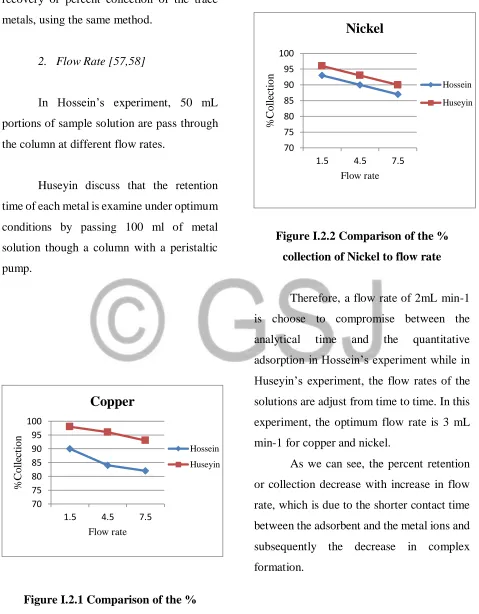
2. Flow Rate [57,58]
In Hossein’s experiment, 50 mL portions of sample solution are pass through the column at different flow rates.
Huseyin discuss that the retention time of each metal is examine under optimum conditions by passing 100 ml of metal solution though a column with a peristaltic pump.
Figure I.2.1 Comparison of the %
collection of Copper to flow rate
Figure I.2.2 Comparison of the %
collection of Nickel to flow rate
Therefore, a flow rate of 2mL min-1 is choose to compromise between the analytical time and the quantitative adsorption in Hossein’s experiment while in Huseyin’s experiment, the flow rates of the solutions are adjust from time to time. In this experiment, the optimum flow rate is 3 mL min-1 for copper and nickel.
As we can see, the percent retention or collection decrease with increase in flow rate, which is due to the shorter contact time between the adsorbent and the metal ions and subsequently the decrease in complex formation.
70 75 80 85 90 95 100
1.5 4.5 7.5
%
C
o
ll
ec
ti
on
Flow rate
Nickel
Hossein
3. Eluent
Figure I.3.1 Effect of pH
The choice of a suitable eluent is another important task in the recovery of analytes. As can be seen from Figure
I.3, the extraction of these metal ions are negligible at pH <3, in the presence of dilute HCl and HNO3. The elution of the adsorbe
metal-chelates on the solid phases are important step for solid phase extraction studies.
Due to this point, various eluent solutions, given in Table 1, are use for desorption of ions complex within dane-1,2,3-trione 1,2-dioxime chelates from SDS coated alumina. Quantitative recoveries for copper, nickel, and cobalt ions are obtain only with 1 mol L−1 HNO3. Recoveries are
not quantitative for other eluents use in the present study. For this reason, HNO3 is the
best eluent and choose as eluent and various concentrations and volumes of HNO3 are attempt to elute the analytes retained in the modified column.
TableI.3.1
Effect of type and concentration of eluting
agent on recovery of analytes
4. Recovery and Detection Limit [59, 12]
TableI.4.1 Comparison between previous
works
(A) The detection limit of Zr, based on three standard deviations of the blank, is 0.21 pmol/kg and Hf is 0.03 pmol/kg while for (B) the ICP-MS instruments detection limit (IDL) for each analyte will calculate from three times the standard deviation for ten determinations of 0.5 M HNO3 with the
resulting detection limit of 0.009-0.15 pmol kg -1.
Recovery
(A) The results indicate a precision (recovery) of 7.7% and 2.5% for Zr and 22% and 8.9% for Hf at surface leves and deep levels, while (B) five metals (Zr, Hf, Nb, Ta and W) are quantitatively recover from seawater with good precision (2-4%).
II. Characterization of Rice Husk Ash as sorbent [60,61]
1. Efficiency
Table II.1 Comparison of adsorption
capacity of URH, RH, RHA-300 and
RHA-600
2. Particle Size
Figure II.2 Comparison of particle size to
% retention
Adsorption studies for different particle sizes of RHA-300 and RHA-600 (diameters of 38–53, 53–106, 106–150, 150– 300, 300–600 and 600–850mm) and Bi and Cr concentration of 5.0mg/L reveal that adsorption decrease from 99–98% to 91–84% with increasing particle size. Higher adsorption obtain for smaller particle size can be attribute to larger surface area of smaller particles per unit masses of the both RHAs.
The effect of particle size on the retention of Bi and Cr on RHA-300 and RHA-600 (RHA-300 and RHA-600: 0.5g;
pH=6; shaking time: 30min; sample volume: 25mL).
3. Temperature
Figure II.2 Comparison of pH to %
retention
The effect of pH on the retention of bismuth (Untreated Rice Husk: 5.0g; Rice Husk: 1.0g; RHA heated at 300 deg C 300) and RHA heated at 600 deg C (RHA-600): 0.5g; sample volume: 25mL; shaking time: 48hours for URH and RH, 30min for RHA-300 and RHA-600).
Discussion
(Lutfi, 2007)
The researchers compared their methods from the existing methods that are widely use determination of trace elements namely Zr, Hf, Nb, Ta, and W with the latter having highly accessible studies. Data shows that the perform method is more precise and gives lower procedural blank. And finally, it covers lower detection limit, giving it an advantage to outperform existing or other widely use methods for determination of the said trace metals.
The method is use for determining Zr, Hf, Nb, Ta, and W's concentration (in molality) on NASS-5, a seawater reference material that is collect in the North Atlantic at a known depth and accurate location. The method provided information value that can be use for future studies that several laboratories and
analysts can use to develop and refine method to determine the mentioned trace metals in seawater.
(Sohrin, 2008)
The researchers found that the methodology used has many advantages compared to other methods that were used in determining the specified trace elements. High selectivity, 100 4% recovery rate of trace metals, lower detection limit of the method, and its ability to remove almost 100% of alkali and alkaline earth metals are just part of those that justifies its efficiency.
The method proposed and used was then tested to NASS-5 and CASS-4, seawater reference materials, in order to validate its precision and accuracy. Data gathered has shown that the method and technique provided excellent agreement and possess similarities with the certified values of the seawater reference materials. The results given by the analysis seems to give oceanographically consistent data, thus making it viable for an actual trace metal determination method for seawater samples from other sources.
The chelating resin with ethylenediaminetriacetic acid functional groups, like in Sohrin’s experiment has excellent selectivity fortrace metals. They applied this resin to preconcentration ofAl, Mn, Fe, Co, Ni, Cu, Zn, Cd, and Pb in seawater fordetermination by using ICP-MS. Through the construction of closedpreconcentration systems and optimization of the procedure, such advantages were realized: the recovery of tracemetals was 100 ± 4% and >99.9% of alkali and alkaline earth metalswere removed. However, the concentrations for Fe, Zn, and Cd in surfacewater in the open ocean would be lower than the overall detectionlimits. Moreover, the preconcentration was said to be performed ina nonclean room laboratory and took only 2hours for one cycle. Thismethod will be very useful to elucidate the stoichiometry andsystematic behavior of trace metals in the oceans. Also, certain resins gave satisfactory performance in tracing elements for other studies.
The researcher’s sorbent, rice husk, gave an overwhelming info in extracting trace metals. Its components that were discussed are truly a help in our environmental problems. Certain parameters
such as pH, temperature, particle size, etc. are important in conducting experiments. That’s why many studies are conducted to prove such parameters.
References
[1] Rao, G., Veni, S., Pratap, K., Rao, Y., &Seshaiah, K. (2006).Solid Phase
Extraction of Trace Metals in Seawater
Using MorpholineDithiocarbamate-Loaded
Amberlite XAD-4 and Determination by
ICP-AES.
[2] Zhang, S., Lu, A., Han, F.,
&Shan,X.(2005).Preconcentration and Determination of Trace Metals in Seawater Using a Thiol Cotton Fiber Minicolumn Coupled with Inductively Coupled Plasma Mass Spectrometry. Retrieved from
https://www.researchgate.net/publication/24 4601409
[3] Biziuk, M. (2001). Pesticides,
occurrence, determination, and disposal.
[4] Schmidt, L. (1993). Solid-PhaseExtraction of Phenolsusing Membrane-Loaded with Modified
[5] Ghaedi, M., Rezakhani, M., Khodadoust, S., Niknam, K.,&Soylak, M. (2012).The Solid Phase Extraction of Some Metal Ions Using Palladium Nanoparticles Attached to Silica Gel Chemically Bonded by Silica-Bonded N-Propylmorpholine as New Sorbent prior to Their Determination by Flame Atomic Absorption Spectroscopy. The Scientific World Journal,1-9.
[6] Cortina, J., Miralles, L., Sastre, A. M.&Aguilar, M. (1997).Solid-Liquid Extraction Studies of Divalent Metals with Impregnated Resins containing mixtures of Organophosphorus Extractants.Reactive and Functional Polymer, 32(3): 221-229.
[7] Ohto,K.,Tanaka,Y.,Yano, M., Shinohara, T., Mura-kami, E., & Inoue, K. (2001). Selective Adsorption of Lead Ion on
Calix[4]Arene Carboxylate Resin Supported by Polyal-lylamine.Solvent Extraction and Ion Exchange, 19(4): 725-741.
[8] Jia, Q., Wang,Z. H., Li, D. Q., &Niu, C. J. (2004). Adsorption of Heavy Rare
Earth(III) with Extraction Resin Containing Bis(2,4,4-trimethylpentyl)
Monothiophosphinic Acid.Journal of Alloys and Compounds, 374(1-2): 434-437.
[9] Ferreira, S.L.C., De Brito, C.F., Dantas, A.F., De Araujo, N.M.L., & Costa, A.C.S. (1999). Nickel determination in saline matrices by ICP-AES after sorption on Amberlite XAD-2 loaded with PAN. Talanta, 48: 1173.
[10] Azeredo, L.C., Sturgeon, R.E., &Curtius, A.J. (1993). Determination of trace metals in seawater by graphite furnace atomic absorption following on-line
separation andpreconcentration. Spectrochim. Acta. B(48): 91.
[11] Elci, L.,Soylak, L.M.,Uzun, A.,Buyukpatir, E., & M. Dogan. (2000) Determination of trace impurities in some nickel compounds by flame atomic absorption spectrometryafter solid phase extraction using Amberlite XAD-16 resin. Fresenius J. Analytical Chemistry. 358-368.
[12] Lutfi, M., Umetani, S., &Norisuye, K. (2007) Preconcentration of Zr, Hf, Nb, Ta and W in seawater using solid phase
extraction on TSK-8-hydroxyquinoline resin and determination by inductively coupled plasma-mass spectrometry. Retrieved from
[13] Wells, M., Bruland, K. (1998). An improved method for rapid preconcentration and determination of bioactive trace metals in seawater using solid phase extraction and high resolution inductively coupled plasma mass spectrometry.Marine Chemistry, 63: 145–153.
[14] Mester,Z.,&Sturgeon, R. (2003). Sample Preparation for Trace Element Analysis.
[15] Bhattacharya, A.K., Mandal, S.N. & Das,S.K.(2006). Removal of Cr(VI) from Aqueous Solution by Adsorption.Tanz. J. Sci.,41, 2015,102. onto Low cost Non-conventional Adsorbents. Indian. J. Chem. Technol.,13: 576-583.
[16] Nhapi, I., Banadda, N.,Murenzi, R.,Sekomo,C.B., &Wali,U.G.(2011). Removal of Heavy Metals from Industrial Wastewater Using Rice Husks. The Open Environmental Enginnering Journal, 4: 170-180.
[17] Babel, S. &Kurniawan, T. A. (2003). Low-cost adsorbents for heavy metals uptake from contaminated water: A
Review.Journal ofHazardous Materials, 97(1–3): 219–243.
[18] * Barrameda, R., Lubao, B.,
&Pagulayan, K. (2017) Kinetic Modeling of Coconut Coir as biosorbent of Cadmium and Cobalt in aqueous solution.
[19] * Carmona, P. Jr., Furton, J., &Serreon, C. (2016). Development of an Acetylated coconut shell powder-based fixed-bed column for the removal of chromium (VI) from inorganic and acid waste.
[20] * Gregorio, M., Montejo, J., & Porras, B. (2015). Assessment of alkali-treated coconut (cocosnuciferalinn) sawdust form the removal of Cu2+ ions in aqueous solution.
[21] Shim, J., Shea, P., & Oh, B. (2014).Stabilization of heavy metals in mining site soil with Silica extracted from Corn Cob. Water Air Soil Pollution, 225: 2152.
modified rice husk. International Journal of Physical Sciences, 5(5): 582-595.
[23] Patel, M., A. Karera& P.
Prasanna(1987). Effect of thermal and chemical treatment on carbon and silica contents in rice husk. Journal of Material Science, 22(7): 2457-2464.
[24] Bining, A. S., & Jenkins, B. M. (1992). Thermochemical reaction kinetics for rice straw from an approximate integral
technique. American Society of Agricultural Engineers Meeting (USA), 92-92: 6001-6040.
[25] Chandrasekhar, S., K. G. Satyanarayana, P. N. Pramada, P. Raghavan& Gupta, T. N. (2003).
Processing, properties and applications of reactive silica from rice husk-an overview. Journal of Materials Science, 38(15): 3159-3168.
[26] Adam, F., Balakrishnan, S. & Wong, P. (2006). Rice husk ash silica as a support material for ruthenium based heterogeneous catalyst. Journal of Physical Science, 17(2): 1-13.
[27] Mansaray, K. G., &Ghaly, A. E.
(1999). Thermal degradation of rice husks in
an oxygen atmosphere. Energy Sources,21(5): 453-466.
[28] Xu, H., B. Gao, H. Cao, X. Chen, L. Yu, K. Wu, L. Sun, X. Peng and Fu, J. (2014). Nanoporous activated carbon
derived from rice husk for high performance super capacitor. Journal of Nanomaterials 2014: 1-7
[29] Vinod, K., Gupta, M., Rajeev, J. (2006). Adsorption of Safranin-T from wastewater using waste materials activated carbon and activated rice husks. Journal of Colloid and Interface Science, 303(1): 80-86
[30] Munaf, E., &Zein, R. (2010). The use of rice husk for removal of toxic metals from waste water. Environmental Technology, 18(3):359-362.
[31] Lata, S., &Samadder, R. (2014). Removal of heavy metals using rice husk: a review. International Journal of
Environmental Research and Development,4: 165-170.
[33] Ajward, N., Rajendra, J., &Perera, V., Elemental Analysis of Rice Husk Ash obtained from different varieties of rice grown in Polonnaruwa District.
[34] Dakova, I. G., Karadjova, I. B.,
Georgieva, V. T., &Georgiev, G. S. (2009). Polycarboxylic microsphere polymer gel for solid phase extraction of trace elements. MicrochimActa, 164:55–61.
[35] Ligate, F., &Mdoe, J. (2016). Removal of heavy metal ions from aqueous solution using rice husks-based adsorbents.
[36] Luo, X., Deng, Z., Lin, X., & Zhang, C. (2011). Fixed-bed column study for Cu2+ removal from solution using expanding rice husk. Journal of hazardous materials, 187(1-3): 182-9.
[37] Sovattei, C., Bacani, F., Promentilla, M., Hinode, H., &Seingheng, H.(2013). Utilization of Untreated and Treated Rice Husk as adsorbents for Lead removal from wastewater.
[38] * Gubat, I., Cariño, R., Raymundo, J., &Aniago, R. (2017).Radiocesium Activity
of the Seawater and Fishes in the San Jose Coast of the Lagonoy Gulf.
[39] Soylak, M, S. Saracoglu, Tuzen, M., and Mendil, D.(2005). Determination of trace metals in mushroom samples from Kayseri, Turkey. Food Chemistry. 92: 649-652.
[40] Khosravan, M. & A.S. Saljooghi, 2009. Synthesis, characterization of silica gel phases chemically immobilized with – 2- aminothiophenol and the use of it for separation and preconcentration of trace amounts of manganese ions. Eur. J. Scient., 39: 58-66.
[41] Zari, N., Hassan, J., Heydar, K. T.,&Ahmadi, S. H. (2016). On-line Green Solid Phase Extraction of Trace Rare Earth Elements and Uranium in Environmental Samples and ICP OES Detection. J. Braz. Chem. Society, 27(10): 1881-1888.
[42] Bloxham, M. (1994). The determination of Trace Metals in sea water using ICP-MS.
Preconcentration and Matrix separation by Dithiocarbamate Complexes. IJMS, 36(1).
[44]Doğan, M. (2008). Solid Phase Extraction Technique inAnalytical Chemistry(ANew Preconcentration and Separation Method for the Determination of Trace Heavy Metal Ions in Natural
Samples). Hacettepe Journal of Biology& Chemistry, 36 (3): 235-246.
[45] Saracoglu, S., Divrikli, U., Soylak, M., &Elci, L. (2002). Determination of Copper, Iron, Lead, Cadmium, Cobalt and Nickel by Atomic Absorption Spectrometry in Baking Powder and Baking Soda Samples after Preconcentration and Separation. Journal of Food and Drug Analysis, 10(3): 188-194.
[46] Baytak, S., &Arslan, Z. (2015). Solid Phase Extraction of Trace Elements in Water and Tissue Samples on a Mini Column with Diphenylcarbazone Impregnated Nano-TiO2 and Their Determination by Inductively Coupled Plasma Optical Emission Spectrometry.
[47] Schmidt, L. (1993). Chemically modified polymeric resins for solid-phase extraction and group separation prior to analysis by liquid or gas chromatography.
Retrospective Theses and Dissertations, 10268.
[48]Juang, R. S. & Wang, S. W. (2000). Electrolytic recovery of binary metals and EDTA from strong complexed solutions. Water Res., 34(12): 3179–3185.
[49] Crouch, S., &Holler, F. (2013). Fundamentals of Analytical Chemistry, 9th
Ed: 416-418.
[50] Jal, P.K., Patel, S.,& Mishra, B.K. (2004). Chemical modification of silica surface by immobilization of functional groups for extractive concentration of metal ions.Talanta62: 1005-1028.
[51] Wong, K.K., Lee, C.K., Low, K.S., &Haron, M.J. (2003). Removal of Cu and Pb by tartaric acid modified rice husk from aqueous solutions. Chemosphere, 50: 23-28.
[52]Sohrin, Y., Urushihara, S., Nakatsuka, S., Kono, T., Higo, E., Minami,T.,Norisuye, K., &Umetani, S.(2008). Multielemental Determination of GEOTRACES Key Trace Metals in Seawater by ICPMS after
Preconcentration Using an
[53]Romani, J. O., Pineiro, A. M., Barrera, A. B., &Barrera, P. B. (2005). Evaluation of commercial C18 cartridges for trace
elements solid phase extraction from seawater followed by inductively coupled plasma-optical emission spectrometry determination. AnalyticaChimicaActa, 536: 213–218.
[54]Saraçoglu, &S., Elçib, L. (2002). Column solid-phase extraction with
Chromosorb-102 resin and determination of trace elements in water and sediment samples by flame atomic absorption spectrometry. AnalyticaChimicaActa, 452: 77–83.
[55] * Glanan, H., Lapasanda, M. (2016). Kinetic Studies of Treated Rice Husk (Oryza Sativa Linn) Ash (RHA) as an adsorbent for Co2+ and Fe2+ adsorption.
[56] Selatnia,A.,Bakhti, M. Z.,Madani, A., Kertous, L.,&Mansouri,Y. (2004).
Biosorption of Cd2+ from aqueous solution
by a NaOH-treated bacterial dead Streptomyces rimosus biomass. Hydrometallurgy, 75(1–4): 11–24.
[57] Hossein, M., Dalali, N., Karimi, A., &Dastanra., K. (2010) Solid phase
extraction of copper, nickel, and cobalt inwater samples using surfactant coated alumina modifiedwith indane-1,2,3-trione 1,2-dioxime and determinationby flame atomic absorption spectrometry. Turk J Chemistry,
34 (2010): 805 – 814.
[58] Huseyin, B., Turker, A., & Mustafa, L. (1999). Determination of Trace Metals in Geological Samples by Atomic Absorption Spectrophotometry after Preconcentration by Aspergillusniger Immobilized on Sepiolite. Analytical Sciences, 15 (1999): 1251-1256.
[59] McKelvey,B.A., &Orians,K.J.(1998). The determination of dissolved zirconium and hafnium from seawater using isotope dilution inductively coupled plasma mass spectrometry. Chemistry, 60(1998): 245.
[60] Yasemin B.,Dilek, B. &Suleyman, A. (2003). Solid Phase Extraction of Bismuth and Chromium by Rice Husk, Journal of Trace and Microprobe Techniques, 21(3): 467-478.
[61] Etim, U.J.(2012).Coconut coir dust as a lowcost adsorbent for the removal of