OF PSYCHOLOGICAL STUDIES
HYPERION UNIVERSITY www.hyperion.ro
9
MEDIATING VARIABLES IN THE RELATION BETWEEN
PERSONALITY TRAITS AND TYPES OF COMMITMENT TO
AN ORGANIZATION. A META-ANALYTIC STUDY
1LAVINIA ȚÂNCULESCU a
a Hyperion University, Faculty of Psychology and Educational Sciences
Department of Psychology
Abstract
The present paper describes the manner in which employees with various personality traits might facilitate the appearance of one or more types of commitment towards an organization. We will support our theory with the arguments presented in the introductory section of our paper for which we have chosen to measure the personality of organization members according to the Big-Five model. To that effect, we will identify a series of factors that might act as mediating variables in the relation between personality traits and types of commitment an employee might evince towards their organization, as defined by Allen and Meyer Organizational Commitment Model (1990). Results and discussions presented rely on a revision of the literature.
Keywords: Big-Five Theory of Personality, Affective Commitment, Normative Commitment, Continuance Commitment,
1. INTRODUCTION
At present there are a series of meta-analytic studies that have been conducted in the field of identifying antecedents, correlations and consequences of organizational commitment. In order to offer a size range of the research conducted in this field, 100 studies have been generated for the past two decades, ever since 1980. These studies focused on the identification of antecedents and consequences in organizational commitment, but the research was restricted to union members only (Bamberger, Kluger & Suchard, 1999). Most of these antecedents were in the field of pro-union attitudes, job satisfaction as well as operational perceptions of employees and unions.
1 The current paper is based on the research included in Țânculescu, L. (2015), Chapter 1.
10
A different kind of paper (Mathieu & Zajac, 1990) draws attention to a series of 26 variables classified as antecedents, 8 as consequences and 14 as variables, correlated with organizational commitment. The results are discussed with respect to the type of organizational commitment (whether attitudinal or calculated) which is also a mediating variable for the present research study.
In a meta-analysis which studies the antecedents, correlations and consequences of the three types of commitment in an organization, Meyer et al. (2002) investigates variables such as job satisfaction and job involvement as main antecedents, while work disengagement and employee fluctuation appear as main consequences of organizational commitment. The investigation is done by including as many as 155 research reports which evince at least one of the three types of commitment discussed (affective, normative, continuance). The authors demonstrate that affective organizational commitment evinces the strongest and most preferable correlations with the results obtained at an individual level (for instance, with stress or clash between personal and professional life) and at an organization level (for instance, performance, involvement, organizational citizenship behavior), while normative organizational commitment evinces the second strongest such correlations. Conversely, continuance organizational commitment does not correlate or negatively correlates the results obtained at an individual or organizational level. Consequently, employees with a high degree of affective commitment want to be involved in their work because they identify themselves or share values with their organization.
This relation based on antecedents regarding individual traits in employees, especially profoundly psychological traits, such as, for instance, those related to personality, set of individual and organizational perceived values, satisfaction of psychological needs in the workplace has been studied only sporadically.
Considering what these types of antecedents can offer, we are surprised at the small number of research studies being conducted in this direction: that of establishing a comprehensive model combining personality with a set of individual values and with a perception of meeting work-related needs with a view to explaining a part of the variance in types of organizational commitment. In a paper that focuses on studying the role of personality in studying behaviors within organizations, Judge, Klinger, Simon and Yang (2008: 1983) note that “personality has proven to be relevant to individual and work-related attitudes in the same way in which one cannot deny the relation between effective team-work and effectiveness in an organization”. In the selfsame paper, the authors discuss the top 10 most important organizational and personality results, demonstrating how important studying personality turns out to be in the prediction of these results.
11
with a series of organizational results such as: job performance (Barrick & Mount, 1991), employee satisfaction (Judge et al., 2002), civic organizational behavior (Organ,1990).
Considering the increased interest in the diversification of more and more competitive markets and industries, organizations have understood that focusing on the employee might offer an answer to achieving success.
2. STUDY OBJECTIVES AND HYPOTESIS
2.1.OBJECTIVES
The present meta-analysis aims at establishing the impact that various personality factors have over the various types of organizational commitment.
The objectives of the present study are: 1) to calculate the size of medium effect regarding the association between the three main types of organizational commitment (affective, normative and continuance) and the five fundamental personality dimensions, according to the Big-Five model; 2) to identify, wherever necessary, a series of mediating factors responsible for variations in the range of the effects noticed.
We have decided to include only those studies that investigated the impact of personality traits on organizational commitment and have excluded those studies regarding other types of organizational behaviors: job satisfaction, intention of quitting the organization, employee fluctuation. We have also chosen those studies – exclusively written in English – that provide data about the impact of personality traits (exclusively defined according to the Big-Five model) on organizational commitment and that also provide sufficient data for a calculation of the size of the effect.
To our knowledge, up to the moment of concluding this study (2011) upon which we report in the present article, no other meta-analysis has been published that investigated the impact of personality factors on types of commitment shown by members to that organization to which they belong.
2.2.HYPOTESIS
To meet the objectives of the current study, the formulated hypothesis were: H1: There is a statistically significant correlation between personality traits as they are described by the Big-Five model and the organizational commitment.
H2: The type of organization mediates the relationship between personality traits and organizational commitment.
H3: The location of organization mediates the relationship between personality traits and organizational commitment.
12
3. THE METHOD
3.1.REVISING THE LITERATURE
We identified potential studies published in the interval 1990 – 2011 with respect to our subject of investigation by an analysis of the data bases PsychInfo, EconLit and EBSCO, which implied using the following key words: “Five-factor model of personality”, “personality”, “big-five”, “personality traits” associated with “organizational commitment”, “work engagement”, “affective commitment”, “normative commitment”, “continuance commitment”.
Personality evaluated by the Big-Five model
The capacity that the Big-Five model has in investigating personality traits, in integrating personality traits and concepts expressed in other theories and models has been extensively discussed in the literature for the past two decades (Ozer and Reise, 1994). By factorial analysis of more personality tests, Costa and McCrae (1995) have noticed that five factors stand out: extraversion (or surgency), agreeableness, conscientiousness, neuroticism (the opposite of emotional stability) and openness to experience (similar to Goldberg’s intellect, 1990) (Sava, 2008).
Since organizational commitment is an attitude, the Big-Five model may also include aspects not covered by the dyad positive – negative work attitude (Watson, Clark, & Tellegen, 1988; Judge & et al., 2002), which can lead to a better understanding of development in organizational commitment (Erdheim & et al., 2006).
Last but not least, for an option of working with the Big-Five model, we find extremely relevant Goldberg’s statement (apud Ozer and Reise, 1994) according to which the Big-Five model has become the main system of reference in the field of research on personality, as it manages to identify links with other personality models and many research studies in the field which support a taxonomy of personality that relies on five fundamental factors.
With regard to personality in the study of work-related behaviours, or, to be more precise, of organizational results, there are very few studies discussing the problem of relating personality with organizational commitment.
Organizational commitment
13
organization and a moral obligation of staying with the organization (Meyer & Allen, 1997).
Other authors have described “organizational commitment” as being the psychological link connecting the employee with the organization, a link which may have three forms, known under the name of compliance, identification and internalization, (O’Reilly & Chatman, 1986). Compliance is that form of organizational commitment which appears when those attitudes and behaviours valued by the organization are adopted by the employee, not because he shares them, but because this type of commitment is rewarded. Due to this, the attitudes of a certain person can vary in the organizational environment, being different on a personal level. Identification, as a form of organizational commitment, appears when a person accepts, though does not appropriate, the influences of the organization (whether these are expressed under the shape of goals and/or values within the organization). Internalization is that form of organizational commitment that presupposes an acceptance of values and goals of the organization because these are translated into adopting certain attitudes proposed by the organization, which, at the same time, are congruent with the personal values of the individual (Meyer & Allen, 1997; O’Reilly & Chatman, 1986; O’Reilly, Chatman & Caldwell, 1991).
According to Allen & Meyer (1990, 1991, 1997), each of the three dimensions of organizational commitment (affective, normative, continuance) describe the way in which it is formed.
Affective commitment refers to the way in which a person gets to identify themselves with, commit themselves to and emotionally involve themselves with the organization. Continuance commitment, or that type of commitment which regards the continuance of the person within the organization, is seen as a person’s choice to stay in the organization as a form of recognition of pecuniary implications that might arise as a result of their quitting it. Normative commitment reflects a feeling of loyalty towards the organization, based on the employee’s perception regarding the obligation they have towards the institution.
3.2.SELECTING THE RELEVANT STUDIES
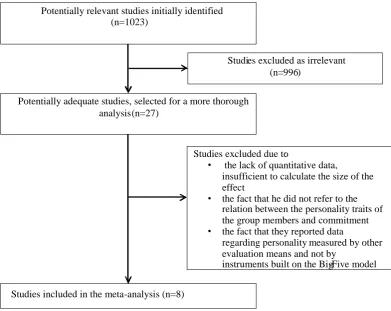
A number of 1023 potentially relevant studies were initially identified as a result of analysing the aforementioned data bases. Of these, a number of 996 studies were excluded for reasons of irrelevance, and the remaining 27 studies were subjected to a closer investigation.
meta-14
analysis effected within the present paper came to include as many as 8 relevant studies (see the data included in the table of Annex 1).
Figure 1. The QUORUM Diagram
3.3.PROCEDURE
For each of the selected studies we kept the following variables: the identification data of the respective study (author, year of publication), average age of subjects, the percentage of men included in the group of subjects, the type of personality trait studies with respect to organizational commitment, the type of organizational commitment evinced, the type of evaluation method for personality and the type of evaluation method for organizational commitment.
However, due to the great number of missing data (over 50% of these studies did not mention the average age of subjects, only the scope) and to the cases of low variability (for instance, almost all studies employed the same instrument of investigation for organizational commitment), we analysed variation in the size of the effect, calculated function of three potential mediating variables: type of
Potentially relevant studies initially identified (n=1023)
Potentially adequate studies, selected for a more thorough analysis (n=27)
Studi es excluded as irrelevant (n= 996 )
Studies excluded due to :
• the lack of quantitative data,
insufficient to calculate the size of the effect
• the fact that he did not refer to the relation between the personality traits of the group members and commitment • the fact that they reported data
regarding personality measured by other evaluation means and not by
instruments built on the Big - Five model
15
organization, location (culture) of the organization and length of service with the organization.
As for the statistical strategy employed here, we resorted to a meta-analysis of fixed effects with the aid of a specialized software programme, Comprehensive Meta-Analysis (CMA 2.0), due to similar reasons pertaining to a reduced number of available studies.
4. RESULTS
4.1.THE RELATION BETWEEN PERSONALITY DIMENSIONS AND AFFECTIVE COMMITMENT
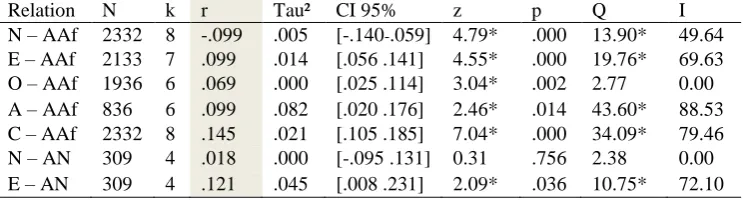
The data we obtained after operating the statistic procedures presented in Borenstein (2009), by the aid of the software programme Comprehensive Meta-Analysis 2.0, the Lite version, are gathered in Table 1. The data in the table support H1, namely, demonstrate the existence of a statistically significant correlation between personality traits as they are in the Big-Five model and organizational commitment, especially affective commitment.
The values of the size of the effect r (presented in the grey-shadowed column) indicate values with low magnitude, but significant from a statistic point of view. With the exception of the reverse neuroticism and affective commitment, all the other four dimensions of personality stated here are in positive correlation with affective commitment. Also, with the exception of the variable openness to experience, all the other personality traits evince a heterogeneous effect, which requires identifying some potential mediating factors responsible for the variations observed at the level of effect size.
The present paper has analysed three potential mediators: the type of organization (non-profit or governmental vs. profit-oriented); the location of the organization (of the subjects ) (Western culture vs. Eastern culture) and length of service with the organization (under 10 years of service vs. over 10 years/ at least 10 years of service with the respective organization).
Table 1
The results of the meta-analysis regarding the correlation between personality (OCEAN) and organizational commitment (the meta-analysis of fixed effects)
Relation N k r Tau² CI 95% z p Q I
16
O – AN 309 4 .073 .000 [-.041 .185] 1.26 .207 1.70 0.00 A – AN 309 4 .179 .041 [.067 .286] 3.11* .002 10.00* 70.09 C – AN 309 4 .006 .000 [-.108 .119] 0.10 .921 1.33 0.00 N – AC 309 4 .201 .000 [.090 .307] 3.51* .000 1.83 0.00 E – AC 309 4 -.173 .000 [-.281-.062] 3.02* .002 3.02 75.10 O – AC 309 4 -.112 .029 [-.223 .001] 1.94 .052 7.92* 62.13 A – AC 309 4 -.012 .042 [-.125 .101] .20 .836 10.22* 70.66 C – AC 309 4 .129 .016 [.016 .239] 2.23* .025 8.37* 64.15 Note: N – Total number of participants; k – number of indicators of the size of the effect included in the analysis (number of independent studies analysed; r – the weighted mean noted for the size of the effect; Tau² – the dispersion associated with the weighted mean; CI 95% - the interval of trust of the mean with a probability of 95%; z – the statistical significance test; p – materiality threshold associated with the average size of the effect - z (* for p < .05); Q – the indicator of the heterogeneity of the studies (* for p < .05); I² - indicator of the extent to which the mediating factors can explain the heterogeneity of the results; N, E, O, A, C – acronyms for the five fundamental dimensions of personality – neuroticism, extraversion, openness, agreeableness and conscientiousness; AAf – affective commitment; AN – normative commitment; AC – continuance commitment.
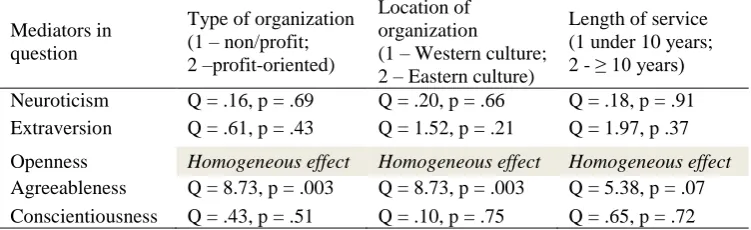
The data are presented in Table 2. This table shows that the relation between personality traits and affective commitment is one of low intensity.
Table 2
List of mediating variables analysed and their effect on the relation between personality and affective commitment
Mediators in question
Type of organization (1 – non/profit; 2 –profit-oriented)
Location of organization
(1 – Western culture; 2 – Eastern culture)
Length of service (1 under 10 years; 2 - ≥ 10 years)
Neuroticism Q = .16, p = .69 Q = .20, p = .66 Q = .18, p = .91 Extraversion Q = .61, p = .43 Q = 1.52, p = .21 Q = 1.97, p .37
Openness Homogeneous effect Homogeneous effect Homogeneous effect Agreeableness Q = 8.73, p = .003 Q = 8.73, p = .003 Q = 5.38, p = .07 Conscientiousness Q = .43, p = .51 Q = .10, p = .75 Q = .65, p = .72
The analysis of the heterogeneity of data indicates that the type of organization and its location play a mediating part in this relationship, as persons with a higher level of agreeableness are more affectively committed in the process, especially in the case of profit-oriented organizations. Moreover, unlike Western cultures, in Eastern cultures there can be perceived a statistically significant connection, albeit a negative one, between agreeableness and affective commitment.
4.2.THE RELATION BETWEEN PERSONALITY TRAITS AND NORMATIVE COMMITMENT
17
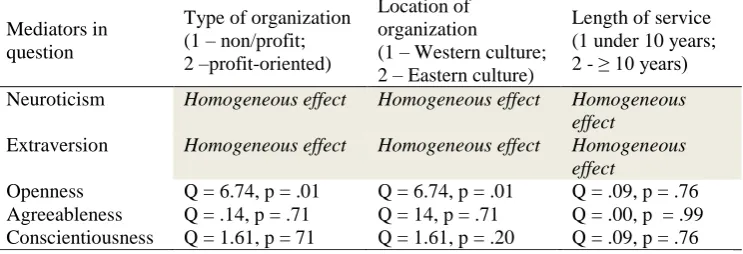
commitment (Table 2), as there are other variables which can be held responsible for the variations seen in the scope of the effect.
Table 3
List of mediating variables analysed and their effect on the relation between personality and normative commitment
Mediators in question
Type of organization
(1 – non/profit; 2 –profit-oriented)
Location of organization
(1 – Western culture; 2 – Eastern culture)
Length of service (1 under 10 years; 2 - ≥ 10 years)
Neuroticism Homogeneous effect Homogeneous effect Homogeneous effect Extraversion Q = .35, p = .56 Q = .35, p = .55 Q = .05, p = .82 Openness Homogeneous effect Homogeneous effect Homogeneous effect Agreeableness Q = .02, p = .89 Q = .02, p = .89 Q = .02, p = .88 Conscientiousness Homogeneous effect Homogeneous effect Homogeneous effect
At the level of main effects (Table 1) one can notice that the profile of those who tend to adopt an attitude of the normative commitment kind especially target those who show high levels of agreeableness and extraversion.
4.3.
THE RELATION BETWEEN PERSONALITY TRAITS AND CONTINUANCE COMMITMENTFrom the perspective of the personality profile of the employee who resorts to continuance commitment (see Table 1) one can notice that they have high levels of conscientiousness and neuroticism, but a low level of extraversion, as this profile is one typical of diffident persons, rather disinclined to explore other professional opportunities.
Table 4
List of mediating variables analysed and their effect on the relation between personality and continuance commitment
Mediators in question
Type of organization (1 – non/profit; 2 –profit-oriented)
Location of organization
(1 – Western culture; 2 – Eastern culture)
Length of service (1 under 10 years; 2 - ≥ 10 years)
Neuroticism Homogeneous effect Homogeneous effect Homogeneous effect
Extraversion Homogeneous effect Homogeneous effect Homogeneous effect
18
The data presented in Table 4 suggest that the type of organization and the location in which it operates are mediating factors of the relation between openness to experience and continuance commitment (Table 4). Thus, the negative relation between openness and continuance commitment is statistically significant against the background of profit-oriented organizations and Eastern cultures.
5. DISCUSSIONS AND CONCLUSIONS
The results presented in this meta-analytic study indicate a logical correspondence between a certain type of commitment and personality traits. Continuance commitment underlines the profile of the anxious, defined in the Big-Five terminology as persons with a high level of conscientiousness and neuroticism and a low level of extraversion, a triad supplemented under certain circumstances by persons with a low level of openness (to experience other alternatives). Also, normative commitment is higher in persons with a positive interpersonal style (high extraversion and agreeableness), with a high level of selflessness. Finally, of these three forms of commitment under scrutiny, affective commitment is the one which is most tightly linked with the personality profile, as it is the most frequently met in the personality profile of the optimist (the resilient), who shows high scores of conscientiousness, agreeableness and extraversion, but low scores of neuroticism.
In the study of the three types of commitment there have been identified a series of aspects contributing to the development of each of these three forms of commitment to organizations. For instance, we have argued that the main bases of development for affective commitment are built on personal involvement, identifying oneself with the goals of the organization and congruence with the set of values, both personal and promoted within the organization (Becker & Kernan, 2002), a fact which fits with our results, which show that persons with a high level of conscientiousness and agreeableness are more prone to develop this kind of attitude.
By contrast with this kind of attitude, normative commitment develops as a response to the cultural and organizational model of socializing and as a sign that a series of benefits have been received which activates the need to answer in kind, that is in a beneficial manner for the organization (Scholl, 1981; Wiener, 1982). The results of our study support the fact that persons with high scores for such traits as extraversion and agreeableness are the most likely to evince this kind of commitment, that is to adapt by a response to those aspects external to them, to the organization’s “agenda”, thus showing agreeableness.
19
agreeableness, is also apparent in the results of this meta-analytic study, which argues for the type of investment in external aspects (the contract with the organization) and actions that support fostering an agreeable attitude, one that is politically correct to the organization, rather than an attitude centred on one’s own success, which would otherwise allow for flexibility in subsequently choosing another position. The high degree of uncertainty that a person with a high level of neuroticism may evince is strongly associated with those results regarding this type of commitment and neuroticism presented in Table 1.
The results of the present meta-analysis can be added to the fact that affective commitment is the strongest and most consistent predictor of some organizational variables seen as resultants, such as preserving employees within the organization (Meyer and Smith, 2000; Rhoades et al., 2001), a fact that may lead to drawing up some ideal profiles of future employees, function of the specificity and goals of the respective companies and of the job descriptions for those positions that need to be filled.
We are however bound to admit that the main limit of this meta-analytic endeavour is its reliance on a reduced number of studies, which makes the results obtained here sensitive to modifications in light of further studies worthy of being included in the meta-analysis (the Fail-safe N values are low in this respect).
REFERENCES
Allen, N.J. & Meyer, J. P. (1990). The measurement and antecedents of affective, continuance and normative commitment to the organization. Journal of Occupational Psychology, 63, 1-18.
Allen, N.J. & Meyer, J.P. (1996). Affective, continuance, and normative commitment to the organization: An examination of the construct validity. Journal of Vocational Behavior, 49, 252–276.
Bamberger, P.A., Kluger, A., Suchard, R. (1999). The antecedents and consequences of union commitment: a meta-analysis. Academy of Management Journal, 42 (3), 304-318. Barrick, M.R. & Mount, M.K. (1991). The Big Five personality dimensions and job performance. A meta-analysis. Personnel Psychology, 44, 1-26.
Becker, H.S. (1960) Notes on the Concept of Commitment. The American Journal of Sociology, 66, 1, 32-40.
Becker, T. E. & Kernan, M. (2003). Matching commitment to supervisors and organizations to in-role and extra-role performance. Human Performance,16, 327–348.
Borenstein, M., Hedges, L., Higgins, J. & Rothstein, H. Englewood. (2005). Comprehensive meta-analysis, version 2.: NJ: Biostat, Inc.
Costa, P.T. Jr., McCrae, R.R. (1992). Revised NEO Personality Inventory (NEO PI-R) and NEO Five-Factor Inventory (NEO PI-FFI). Odessa, Fl, USA: Psychological Assessment Resources.
Erdheim, J., Wang, M. & Zickar, M. J. (2006)*. Linking the Big Five personality constructs to organizational commitment. Personality and Individual Differences, 41, 959–970.
20
Judge, T. A., Heller, D. & Mount, M. K. (2002). Five-Factor model of personality and job satisfaction: A metaanalysis. Journal of Applied Psychology, 87, 530–541.
Judge, T. A., Klinger, R., Simon, L. S., Yang, I. W. F. (2008). The contributions of personality to organizational behavior and psychology: Findings, criticisms, and future research directions. Social and Personality Psychology Compass, 2, 1982–2000
Mathieu, J. E., Zajac, D.M. (1990). A Review and Meta-analysis of the Antecedents, Correlates and Consequences of Organizational Commitment. Psychological Bulletin, 108, 171-194.
Matzler, K., Renzl, B. (2007)*. Personality Traits, Employee Satisfaction and Affective Commitment, Total Quality Management & Business Excellence, 18,(5), 589-598.
Meyer, J.P. & Smith C.A. (2000). HRM practices and organizational commitment: Test of a mediation model. Canadian Journal of Administrative Sciences, 17, 4, 319–331.
O’Reilly, C. A. & Chatman, J. (1986). Organizational commitment and psychological attachment: The effects of compliance, identification, and internalization on prosocial behavior. Journal of Applied Psychology, 71, 492–499.
O'Reilly, C. A. Caldwell. D. F. & Bamett, W. P. (1989). Work group demography, social integration and turnover. Administrative Science Quarterly, 34, 21-37.
Organ, D.W. (1990). The motivational basis of organizational citizenship behaviour. Research in Organizational Behavior, 12, 43-72.
Ozer, D.J., Reise, S.P. (1994). Personality assessment. Annual Review of Psychology, 45, 357-388.
Powell, D. and Meyer, J. (2004). Side-bet Theory and the Three-component Model of Organizational Commitment. Journal of Vocational Behavior, 65, 157-177.
Raja, U., Johns, G., Ntalianis, F. (2004)*. The impact of personality on psychological contracts. Academy of Management Journal, 47, (3), 350–367.
Sava, F.A. (coord.) (2008). Inventarul de personalitate DECAS. Timişoara: Editura ArtPress.
Scholl, R. (1981). Differentiating organizational commitment from expectancy as a motivating force. Academy of Management Review, 6, 589-599.
Smith, M.A., Canger, J.M. (2004)*. Effects of supervisor “Big Five” Personality on subordinates attitudes. Journal of Business and Psychology, 18, (4).
Țânculescu, L. (2015) Impactul factorilor de personalitate înțeleși în cheia teoriei celor cinci mari factori de personalitate asupra angajamentului organizațional. PhD Thesis (unpublished). Cluj-Napoca.
Watson, D., Clark, L. A. & Tellegen, A. (1988). Development and validation of brief measures of positive and negative affect: The PANAS scales. Journal of Personality and Social Psychology, 54, 1063–1070.
Wiener, Y. (1982). Commitment in organizations: A normative view. Academy of Management Review, 7, 418-428.
Witt, L. A., Kacmar, K.M., Carlson, D.W., Zivnuska, S. (2002)*. Interactive effects of personality and organizational politics on contextual performance. Journalof Organizational Behavior 23, 911–926.
Note: